Ellie turned ten on a Tuesday, which felt like a real milestone in a way I hadn’t expected. Double digits sounded grown. It sounded like the kind of birthday you remember, the kind you tell people about years later. I’d been up since six, moving quietly through our small rental like I was setting a stage for a play where I was also the entire cast.
The night before, I’d blown up thirty balloons until my cheeks hurt, then taped them to the ceiling with a roll of discount store tape that promised “extra strength” but clearly had never met gravity. By morning, half of them had sagged, drifting down like tired thoughts.
Ellie didn’t care.
She barreled out of her room with her hair wild and her pajama shirt on backwards, screaming, “I’M TEN!” like she’d just won an award. She threw herself into my arms and I almost dropped the pancakes I’d been flipping with one hand, the other hand already reaching for her because there’s a certain kind of hug that makes everything else disappear.
The kitchen looked like a birthday exploded in it. Confetti. Streamers. A crooked banner I’d cut out of construction paper because I refused to let her tenth feel like an ordinary day, even if it was just the two of us. We didn’t have a party. Not the kind with kids everywhere and rented bounce houses. It was always “maybe next year” when money was better, when schedules were easier, when life calmed down.
Life never calmed down. So I got creative.
I made her a scavenger hunt. I’d written clues on little cards, each one taped in a spot I knew she’d find—under her cereal bowl, behind the couch pillow that always slid to the floor, inside her favorite book with the dog-eared pages. She ran from room to room with her socks sliding on the hardwood, giggling like the whole house was a treasure map.
The last clue led her outside, to the driveway where I’d hidden a pink cruiser bike behind a sheet I’d “borrowed” from the linen closet. White basket. Streamers on the handlebars. A bell that made an obnoxiously cheerful ring.
Ellie lifted the sheet and froze. She stared like she couldn’t quite trust what she was seeing, then gasped so hard she squeaked. Tears sprang up instantly.
“You got me a real bike,” she whispered, like the word real mattered more than the bike itself.
“I got you a you bike,” I said, and she threw her arms around my waist so tight I felt her face pressed into my shirt.
For an hour after that, she rode in circles up and down the block, ringing the bell like it was her job, yelling greetings at confused neighbors who waved anyway. She didn’t need a crowd. Ellie had never needed a crowd. She needed attention, yes—she was a big personality, a bright spark—but she needed it from people who saw her, not just people who tolerated her.
That’s what I kept hoping my family would become.
Inside, on the kitchen table, Ellie had arranged party hats.
Not normal party hats. Ellie party hats. She’d cut glitter paper into triangles, glued stickers across them in uneven rows, and wrote names in her crooked handwriting. Grandma. Grandpa. Auntie Bri. Aunt Mara.
And on the last one, she wrote Mom, even though that hat was for me and I was already there.
She’d taped toothpicks to each hat so they’d stand up, like little signs waiting to be claimed.
“They’re going to love these,” she said, smoothing the glitter with her palm. “Do you think they’ll get here before cake?”
I kept my smile steady because that’s what you do when you’re a parent and you know you’re about to disappoint your kid even though you didn’t cause the disappointment. “We’ll see,” I said lightly.
I checked my phone every ten minutes, pretending I wasn’t. I’d posted pictures that morning: Ellie with her balloons, Ellie hugging her bike, Ellie making a face so dramatic it made her look like a cartoon character. Normally, Bri reacted to everything I posted, even if it was just a picture of my coffee with a sarcastic caption. She treated social media like breathing.
This time, nothing.
No text. No “happy birthday to my favorite niece.” No “tell Ellie I love her.” Not even a lazy thumbs-up.
By noon, I started making excuses in my head like they were coupons I could cash in later. Maybe Mom was at a doctor’s appointment. Maybe Dad’s phone was acting up again. Maybe Bri’s kids had soccer. Maybe Aunt Mara was working.
Ellie drew a giant “HAPPY DAY TO ME” on the sidewalk with chalk. She wore her new birthday sweatshirt and kept telling strangers she was ten now, like it made her a different person.
When it was time for cake, she asked, “Should we wait a little? Just in case?”
I felt something twist in my chest, but I kept my voice soft. “Let’s do it now,” I said. “We can celebrate as long as we want.”
So we lit the candles. Ten candles. Her cheeks puffed as she made a wish so serious it looked like she was negotiating with the universe.
She blew them out and clapped for herself, and I clapped too, louder than necessary, because sometimes a parent has to become a whole audience.
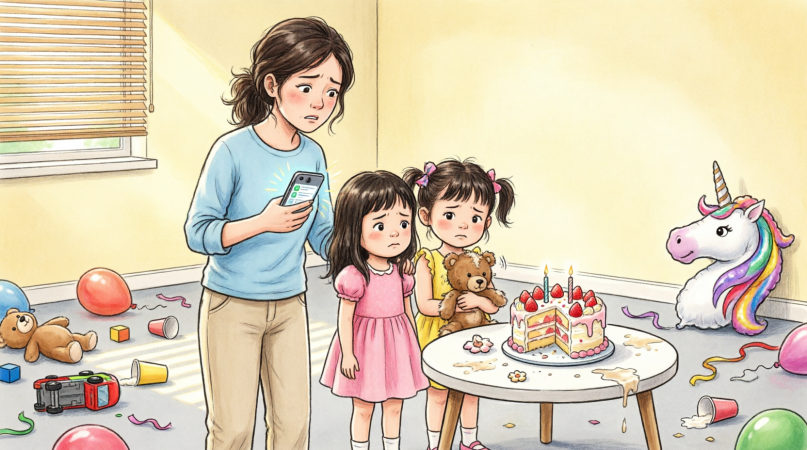
After lunch, Ellie watched cartoons while I scrolled on my phone out of habit more than suspicion. It wasn’t even a conscious decision. Just muscle memory. I opened Instagram, tapped through stories, and that’s when it hit like a slap.
Bri, at an airport, holding a drink with a tiny umbrella.
Next story: a group photo in front of a mural that said Welcome to Miami. My mom and dad were there. Bri’s kids. Aunt Mara. All of them smiling, sunlit, holding up peace signs like this was some wholesome family movie.
Palm trees. Beach chairs. Lobster tails. Margaritas.
Caption: Family trip. First time altogether in years.
My screen dimmed before I moved. I stared so long my eyes started to sting. My family was in Miami. On Ellie’s tenth birthday. And nobody said a word.
I didn’t even feel shocked at first. I felt… hollow, like a sound had been sucked out of the room.
Then Ellie bounced in and asked if we could ride the bike again after cake. She was so happy she didn’t notice my face.
I typed a comment under Bri’s story with fingers that felt disconnected from my body.
You all left town today?
Minutes passed. I went back to being “normal mom” because Ellie was right there. I cleaned frosting off the counter, helped her pick out a movie, pretended this didn’t matter even though it felt like everything.
An hour later, my phone buzzed with the family group chat coming back to life like it had been waiting.
My dad replied.
Didn’t feel like babysitting a problem child.
My brain read it twice, then three times, like it might turn into different words if I stared hard enough. But it didn’t.
Problem child.
That was their nickname for Ellie in private. I’d heard it before, disguised as jokes, wrapped in sighs when she talked too much or bounced too much or asked too many questions. They compared her to Bri’s kids, who could sit still for hours with tablets, quiet and neat like decoration.
Ellie wasn’t like that. Ellie had a motor in her. She was curious and loud and filled with life. She didn’t shrink.
My dad’s message wasn’t just cruel. It was casual. Like he was talking about a faulty appliance.
Something in me snapped cleanly, like a rope finally cutting after years of strain.
Perfect, I typed back. Because your retirement fund just lost its sponsor.
And I meant it.
For five years, I’d been sending them money every month. Not because they begged. Because they hinted. Because my mother cried about groceries. Because my father talked about medical bills and how retirement wasn’t what he’d thought it would be. Because I’d been trained since childhood to be the fixer, the responsible one, the daughter who made things easier.
Rent. Utilities. Prescriptions. “Just this once” that turned into every month.
They never called it what it was: dependence.
They laughed it off in the chat.
Bri sent a laughing emoji like I’d told a joke.
My dad wrote that I was being dramatic.
My mom said, Don’t be like this, Amanda. We just needed a break.
No one said happy birthday to Ellie. No one apologized. No one even asked how she was.
I muted the group chat and put my phone face down on the counter. Ellie walked in wearing one of the glitter hats she’d made, the one labeled Grandpa, balanced on her head like she was playing pretend.
“Do you think Grandpa will like it when he gets here?” she asked.
I swallowed hard. “He would’ve,” I said, because lying felt wrong and truth felt cruel, so I chose something in between.
She nodded like that made sense and went back to her movie. She didn’t cry. Ellie rarely cried about people who didn’t show up. She cried about animals in commercials and planets being lonely and books ending. She didn’t understand, yet, why grown-ups could be so careless.
I didn’t know how to explain it without staining her joy.
That night, after she fell asleep, I stared at my bank app. The payment I’d scheduled for my parents—automatic, like a habit—was still pending for the next morning.
I canceled it. Then I canceled the next one. Then I removed my saved payee info like I was erasing a number from my life.
I expected guilt to crash over me, loud and immediate. That’s what always happened when I disappointed them.
Instead, I felt quiet. Tired. Like I’d been carrying a heavy backpack for years and only just set it down.
Nine days passed.
I didn’t count them at first. They just happened, one after another, filled with Ellie’s normal routines and my own new habit of not checking my phone every hour. She rode her bike. She talked nonstop about Saturn after I bought her a cheap used telescope from a neighbor. She left space facts on sticky notes around the apartment like little gifts.
I didn’t hear from my family.
Until the tenth morning, when I woke up to my phone vibrating like it was trying to escape the table.
Twenty-two messages.
Missed calls.
Voicemails.
A new group chat title: family emergency.
And the first message, from my dad, was simple.
Amanda, please. Can we talk?
Part 2
I stood in the kitchen holding my coffee, watching the messages stack up like they were falling from the ceiling. It was strange how quickly desperation could fill a space where silence had lived for years.
My dad sent another text.
Please call me. Just five minutes.
Then my mom.
We didn’t mean it like that.
Then another.
Your father is stressed. We’re behind on rent.
Then Bri, rapid-fire, like she was firing a machine gun of judgment.
You can’t just cut them off without warning.
Are you proud of yourself?
This is cruel.
The irony was so sharp it almost made me laugh.
They were acting like I’d committed some shocking betrayal, when all I’d done was stop fixing the mess they refused to clean themselves. The only reason it looked like an emergency was because they’d grown used to my money being the safety net under every bad decision, every “oops,” every “we didn’t plan for that.”
I didn’t answer right away, not because I was plotting revenge, but because I genuinely didn’t have words. The part of me that used to scramble—used to type paragraphs explaining myself, smoothing everything over, begging them to understand—was simply… gone.
Ellie wandered into the kitchen rubbing her eyes, asked for cereal, then stopped to look at my face.
“You okay?” she asked.
It was such a simple question, and it almost broke me, because my own mother never asked it unless she needed something.
“I’m okay,” I said, and kissed the top of Ellie’s head. “Just thinking.”
Ellie shrugged and started telling me about a dream she had where Saturn had a mailbox and she had to deliver letters to the rings. She was so earnest it made the world softer.
I took her to school, and on the drive back my phone buzzed again. I kept it in my purse. I listened to the vibration like it was rain hitting a roof, something that didn’t require me to run outside and stand in it.
By the time I got home, there were more messages.
My mom’s texts had shifted into long paragraphs, full of vague phrases like we did our best and family is complicated and you know how your father is. There was a lot about how expensive groceries had gotten, how retirement didn’t go as planned, how they never expected to rely on me this long.
Not one sentence said: I’m sorry.
Not one sentence mentioned Ellie.
And that, more than anything, cemented my decision.
They didn’t see her pain as real.
They didn’t see my exhaustion as real.
They saw money missing from their lives, and that was the only emergency that mattered.
That afternoon, Ellie’s school called.
The front office secretary sounded polite at first, the way people do when they’re about to deliver information they know you won’t like.
“Hi, is this Amanda Carter?” she asked.
“Yes.”
“Someone called claiming to be Ellie’s grandmother. She said she was coming to pick Ellie up early for a surprise lunch.”
My grip tightened on the phone. “What?”
“She had Ellie’s full name, her teacher, even mentioned Ellie likes pizza,” the secretary said carefully. “But Ellie isn’t listed for pickup by anyone but you and your two emergency contacts, so we didn’t release her. We just wanted to make you aware.”
For a second, I couldn’t speak.
It wasn’t just that they tried. It was that they tried after leaving town without a word, after mocking my child, after acting like I was dramatic for being hurt. They’d crossed a line that wasn’t emotional anymore. It was physical. It was real-world.
“I’m coming in,” I said, voice tight.
At the school, I updated everything. Changed pickup permissions. Added a password system. Took my parents off every list, even the “grandparent” form they’d never used anyway. The principal was kind but firm, the kind of authority that made me feel both protected and furious that it was necessary.
When I sat in my car afterward, my hands shook. Anger rose up hot and clean.
This wasn’t about a birthday anymore.
This was about control.
That night, my mom left a voicemail. Her voice had that wounded tone she used when she wanted to flip blame like a pancake.
“Amanda, I heard you blocked us from picking up Ellie,” she said. “It wasn’t an abduction. Don’t be dramatic. I just wanted to surprise my granddaughter. She’s our granddaughter, Amanda. This isn’t fair.”
No apology. No acknowledgement of how terrifying that call from the school had been. Just her usual tactic: make me the unreasonable one so she didn’t have to feel wrong.
I blocked her number.
Then, a week later, a thick envelope arrived in the mail. Legal letterhead. A law office I didn’t recognize.
My first thought was debt, some medical bill that had finally crawled its way into my life. I opened it at the kitchen counter, standing over it like it might bite.
I read the words twice, then I actually laughed—sharp, humorless.
The letter talked about a “documented history of ongoing financial contribution” and “pattern of mutual understanding.” It said I had been named a “financial proxy” in an older estate plan, and they wanted to “reaffirm the terms.”
They were trying to use my generosity as legal leverage.
They were trying to turn my love into a contract.
My laugh turned into something colder.
I called the law office. The receptionist transferred me to the lawyer whose name was on the letter. His voice was polite, professional, slightly cautious—like he was already sensing he’d stepped into something messy.
“Ms. Carter,” he said. “Thank you for calling.”
“I need to be very clear,” I replied. “I am not reaffirming anything. I am not signing anything. And I want a note in your file that my parents’ depiction of this situation is misleading.”
There was a pause. “I see.”
“Did they tell you why I stopped sending money?” I asked.
Another pause. “They… did not provide details. They said you were their primary support system.”
“I’m not,” I said. “I was helping voluntarily. I am no longer helping. This is manipulation.”
His voice shifted, more careful now. “Understood. I’ll update the file. Thank you for letting us know.”
When I hung up, something in me felt like it had finally clicked into place.
All those years, I’d acted like helping them was an obligation I couldn’t escape, like I owed them forever for raising me. But the moment they tried to wrap my guilt in legal language, the guilt evaporated.
In its place was clarity.
They didn’t want connection. They wanted ownership.
While they spiraled, Ellie flourished.
She joined a summer enrichment program her school offered—robotics, creative writing, swim lessons. Things I’d always wanted for her but could never afford because my “extra” money wasn’t mine. It was theirs.
Ellie built a tiny robot that bumped into walls and she laughed like it was the funniest thing on earth. She wrote a short story about Saturn being lonely and making friends with a comet. She practiced swimming until she could do a confident dog paddle, yelling, “I’m basically a mermaid now!”
Every time she beamed with pride, I felt both joy and grief—joy for what she was getting now, grief for how long I’d postponed her happiness to keep my parents comfortable.
That summer, Ellie asked if we could see mountains. Real ones, not the flat horizon we had at home.
So I booked a trip. A modest cabin in a mountain town, trail maps and fresh air and a sky that looked wider than anything we’d ever had. We mailed ourselves a postcard from the top of a lookout point because Ellie decided we should collect “proof of adventures,” like we were explorers.
Back home, that postcard went on the fridge.
Meanwhile, the family group chat kept burning in the background, even muted. I’d occasionally peek, like looking at a fire from a distance to check if it was spreading.
It was always the same cycle.
My dad asking to talk.
My mom guilting.
Bri lecturing.
Then, in August, Bri showed up at my door.
No warning, no text. Just her standing there with a box of old books and DVDs like she was delivering a peace offering.
Ellie was inside. I stepped onto the porch and closed the door behind me without thinking, like my body already knew to protect her.
Bri talked fast. “I found these cleaning out my garage,” she said. “Thought Ellie might like them. Mom hasn’t been sleeping. Dad’s been really quiet.”
She said it like she was updating me on the weather.
Then she shifted, eyes narrowing slightly, voice sharpening. “This has gone too far, Amanda. You made your point. Now it’s time to stop holding grudges.”
“I’m not holding a grudge,” I said. “I’m just not participating anymore.”
Bri’s mouth tightened. “You’re being stubborn.”
“I’m being done.”
She scoffed like that was ridiculous. “Ellie’s getting spoiled. All these trips and programs—do you realize how it looks? You’re wasting money on one kid while the rest of the family suffers.”
There it was. The truth.
Not concern. Not regret. Resentment.
I looked at her and saw, with a sudden clarity that felt almost peaceful, that she wasn’t my sister in this moment. She was an envoy. A negotiator.
She wasn’t here to heal anything.
She was here to get the payments restarted.
Before she left, she delivered the line she clearly thought would crack me.
“It’s really sad, Amanda. Destroying a family over one birthday.”
I didn’t correct her. I didn’t argue. I didn’t explain.
I just said, “Take the box with you.”
Her eyes widened. “Seriously?”
“Seriously,” I said.
And when she walked away, clutching her box like it was suddenly heavy, I realized something else.
This wasn’t about one birthday.
That birthday was just the moment the mask slipped.
Part 3
Autumn arrived with cool mornings and Ellie’s backpack suddenly looking too small, stuffed with notebooks and pencils and little bits of paper she insisted were “important mission plans.” She’d started writing weekly “missions” for us to complete: try a new food, learn a fact about a new country, stargaze for ten minutes even if it was cloudy.
“Mission: Find Saturn,” she’d write, then draw a tiny planet with crooked rings.
Those missions became our rhythm. Our way of building a life that belonged to us.
The silence from my family stretched, but it wasn’t empty anymore. It was peaceful. Like stepping out of a room where someone had been shouting for years and realizing you can finally hear yourself think.
Then, in late October, my dad called from a new number.
I almost didn’t answer. I stared at the screen while it rang, watched the digits like they were a test.
Ellie was at a friend’s house for a playdate. The apartment was quiet.
I answered.
“Hello?”
For a moment, there was only breathing. Then my dad spoke, and he sounded older than I remembered.
“Amanda,” he said. “Please don’t hang up.”
I didn’t say anything.
“I messed up,” he continued, and the words came out slow, like he had to force them past his pride. “I messed up with what I said. About Ellie.”
Still, I stayed silent, because silence was the only space where truth could finally fit.
He cleared his throat. “I thought… I thought you’d cool off. I thought you’d come back like you always do.”
There it was again.
Not love. Expectation.
“You called my child a problem,” I said finally, voice steady. “On her birthday. After you left town without telling us.”
“I know,” he said, and his voice cracked slightly. “I know.”
I waited.
“I didn’t want to go to Miami,” he admitted. “Bri pushed. Your mother pushed. I went along with it because it was easier than fighting. And then… then I said what I said because I was angry.”
“Angry at who?” I asked.
He didn’t answer immediately, which was answer enough.
“Angry at me for not being convenient,” I said. “For having a kid who isn’t quiet.”
“No,” he said quickly, then softer, “Maybe. I don’t know. I just… I’ve been scared, Amanda.”
I almost laughed, but it wouldn’t have been kind. “Scared of what?”
“Of being old,” he said. “Of not having enough. Of depending on you. And I hated that I depended on you. I hated how it made me feel.”
I let the words settle.
“So you took it out on Ellie,” I said.
He didn’t deny it.
I heard him swallow. “Your mother’s been… she’s been spiraling,” he said. “She keeps saying you’re punishing us. She won’t admit we did anything wrong. Bri’s angry. Everyone’s angry. But I—” He stopped, like the rest of the sentence was hard.
“But you’re begging me to talk,” I finished for him.
“Yes,” he whispered.
There was a part of me, the old part, that wanted to rush in and fix it. To soothe him. To take responsibility for his fear. That part had been trained into me like muscle memory.
But another part—the part that had watched Ellie blow out candles alone, the part that had heard the school secretary say “grandmother” like it was a threat—held firm.
“I can talk,” I said. “But talking doesn’t mean you get what you want.”
“I don’t want money,” he said quickly.
I didn’t respond, and he exhaled, defeated.
“Okay,” he said quietly. “Maybe I do. But I also… I miss you.”
The words were small and imperfect and maybe even true, but they didn’t erase the damage.
“I’m not coming back the way you want,” I said. “Ellie and I have boundaries now.”
“Tell me what to do,” he said. “Just tell me.”
And that was the first time in my life my father had ever said those words to me without anger.
So I told him the truth.
“You apologize to Ellie,” I said. “Directly. Not through me. You write it down if you have to. You own what you did. And you stop trying to manipulate me—no more lawyers, no more guilt, no more sending Bri as a messenger.”
He was quiet for a long time.
Then, “Your mother won’t like that,” he said.
“I’m not doing this for your mother,” I replied. “I’m doing this for my child.”
Another long silence.
Finally, he said, “Okay.”
I didn’t trust it yet, but the word mattered anyway.
A week later, a letter arrived. Handwritten, shaky in places like his hand had cramped. It wasn’t perfect. My dad wasn’t suddenly a different person. But it was the closest thing to accountability I’d ever seen from him.
He wrote that he was sorry for what he said. That Ellie wasn’t a problem. That he’d been wrong. That he missed her laugh. That he’d been selfish.
Ellie sat at the table reading it slowly, her lips moving as she sounded out words she didn’t know.
When she finished, she looked up at me. “Is Grandpa sad?” she asked.
“Yes,” I said.
“Does he know he was mean?” she asked, blunt as always.
“Yes,” I said again.
She considered for a moment, then said, “Okay.”
Just like that. Not forgiveness exactly, but openness. The kind kids have when they aren’t carrying generations of resentment.
Ellie wrote him back.
Her note was short and honest.
She told him it hurt her feelings. She told him she liked being “high energy.” She told him Saturn had rings and Jupiter had storms and she hoped he would come see her telescope someday “if you can be nice.”
I mailed it before I could overthink it.
That winter, my dad came to Ellie’s school science fair.
Not my mom. Not Bri. Just him.
He stood awkwardly by the gym wall until Ellie spotted him. For a second, she froze like she couldn’t believe it, then she ran over, hair bouncing, and shoved a paper plate hat—one she’d made that morning—into his hands.
“You have to wear it,” she announced.
My dad looked like he might protest, then he glanced at me. I didn’t rescue him. I just watched.
He put it on.
Ellie dragged him to her project: a model of the solar system made out of painted foam balls hanging from a wire frame. She explained each planet like she was giving a TED talk. My dad listened. Actually listened. He asked questions, clumsy at first, then more genuine as Ellie warmed up.
When she finished, she said, “I’m going to be a scientist. Or an astronaut. Or both.”
“I believe you,” my dad said, and the way he said it made my throat tighten.
Afterward, he tried to hand me an envelope.
I didn’t take it.
“It’s not money from me,” he said quickly. “It’s… it’s paperwork. I went to the office. I withdrew the estate proxy thing. I told the lawyer it was wrong.”
I stared at him.
He looked embarrassed, but he held my gaze.
“I didn’t realize how far your mother and Bri had gone,” he said. “Or maybe I did, and I just… I let it happen. But I fixed that part. I wanted you to know.”
That mattered more than any apology text ever could.
“What about the rest?” I asked quietly. “Mom? Bri?”
He sighed. “Your mother’s still convinced you’re cruel. Bri’s… Bri’s Bri. But I’m tired, Amanda. I’m tired of being angry at you because you won’t carry us anymore.”
I didn’t soften. I didn’t rush to comfort him. I let him sit in his own sentence.
“Good,” I said. “Because I’m tired too.”
He nodded slowly, like he understood, or at least like he was finally willing to try.
In the months that followed, things didn’t magically become happy.
My mom stayed distant, posting vague quotes online about ungrateful children and broken families. Bri continued to treat me like a villain in her personal story. But my dad stopped participating in it the way he used to. He didn’t defend their guilt campaigns. He didn’t send flying monkeys to my door. He didn’t pretend Ellie was too much.
He showed up sometimes.
Not always. Not perfectly. But enough that Ellie started associating him with moments, not absences.
And that was the difference.
By the time Ellie’s eleventh birthday arrived, she didn’t make glitter hats for people who wouldn’t come.
She made one hat for herself, one for me, and one for my dad—just in case.
He did come.
He brought a small gift: a notebook with a leather cover and a little metal Saturn charm on the ribbon bookmark. Ellie gasped like it was treasure. She immediately declared it her “space log” and started writing in it that night.
My dad stayed for cake. Just cake. No big speeches. No dramatic apologies. But he lit a candle for Ellie, and when she made her wish, he watched her like she mattered.
After he left, Ellie leaned against my shoulder on the couch, frosting on her nose.
“Mom,” she said, “I like our birthdays.”
“Our birthdays?” I repeated.
“Yeah,” she said, like it was obvious. “Because we always do something. Even if it’s small. We always do it.”
I kissed her forehead. “That’s the rule,” I said.
“What rule?” she asked, already half-asleep.
“We show up,” I said. “We don’t disappear. We show up.”
She smiled drowsily. “Good,” she murmured. “Because Saturn would be lonely if we didn’t.”
In the years after that, Ellie grew into herself the way she always would’ve, with or without my family’s approval. She stayed bright. Loud. Curious. She joined coding camps, built robots that finally stopped crashing into walls, and kept her Saturn notebook filled with facts and sketches and dreams.
My dad, slowly, learned how to be a grandfather without expecting to be paid for it.
My mom never fully changed. Bri never admitted she was wrong. They didn’t get the sponsor back. They didn’t regain the control. And maybe, in their minds, they never stopped believing I was the one who broke something.
But the truth was simpler.
They broke it first.
All I did was stop pretending it wasn’t broken.
One evening, years later, Ellie stood in our backyard—taller now, voice deeper, still carrying that same spark—and pointed her telescope at the sky.
“Saturn’s out,” she said, grinning. “Want to see?”
I stepped beside her. The air was cool, the stars sharp. Inside, my phone sat on the counter, quiet. No group chat fire. No begging. No guilt.
Just peace.
Ellie adjusted the telescope and leaned back so I could look.
In the lens, Saturn floated—rings crisp, impossibly beautiful, steady in the dark.
Ellie’s voice was soft beside me. “It’s funny,” she said. “How something can be so far away and still feel like… ours.”
I kept my eye on the planet and felt the truth of it settle in my chest.
“Yeah,” I said. “Because we earned it.”
And we had. Not with money, not with sacrifice to people who only took, but with the simplest, hardest thing.
We showed up………………………………………..
Click the button below to read the next part of the story.⏬⏬
PART2: On My Daughter’s 10th Birthday, I Found Out The Whole Family Flew To Miami — Without Saying A Word. I Commented, “You All Left Town Today?”