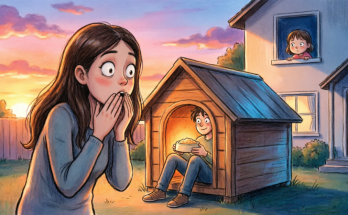
So she agreed.
When he arrived that evening, Emily ran upstairs immediately to finish hiding presents “where adults couldn’t snoop.”
Ethan stood awkwardly in the kitchen holding two coffees like a peace offering nobody requested.
“You still buy the terrible vanilla creamer?” he asked quietly.
Laura snorted despite herself.
“You still judge perfectly acceptable coffee choices?”
Tiny familiarity flickered between them painfully.
Not romantic.
Human
He handed her one cup carefully.
“You cut your hair.”
“So did you.”
Another small silence.
Then Ethan looked around the kitchen slowly.
The room felt different now.
Not physically.
Emotionally.
Less tense.
Less performative.
Laura noticed him noticing.
Finally he said quietly:
“You seem lighter.”
That startled her.
Because it was true.
Not happy all the time.
Not magically repaired.
But lighter.
“I stopped trying to earn love from people determined to misunderstand me,” she admitted.
Ethan absorbed that silently because he knew he belonged in that sentence too.
“I’m sorry,” he said eventually.
Not rushed.
Not dramatic.
Just plain.
Laura looked at him carefully.
“For what part?”
His eyes dropped immediately.
“All of it.”
Interesting answer.
No selective accountability.
No technicalities.
Just all of it.
That mattered.
He sat across from her at the kitchen table where they once paid bills and argued quietly and planned vacations and slowly became strangers without noticing quickly enough.
“I keep replaying things,” he admitted softly.
“Not the affair itself.
The smaller moments.”
Laura stayed silent.
“The way you stopped finishing stories halfway through because I wasn’t listening.”
“The way Emily watched our moods constantly.”
“The way I made you responsible for keeping the emotional temperature comfortable all the time.”
His voice grew rougher.
“You were lonely long before I left.”
That one landed hard.
Because yes.
She had been.
Terribly lonely.
Even married.
Especially married.
Laura stared into her coffee quietly.
“You know the worst part?” she admitted eventually.
“I blamed myself for becoming emotionally exhausted.”
Ethan closed his eyes briefly.
“I know.”
“No,” she said softly.
“You knew I was unhappy.
But you didn’t know I thought it was my fault.”
That visibly hurt him.
Good.
Not because she wanted revenge.
Because truth should cost something sometimes.
“I spent years trying to become easier to love,” she whispered.
“Smaller.
Less emotional.
Less demanding.
More understanding.
More flexible.”
She laughed once sadly.
“I nearly disappeared trying to keep everybody comfortable.”
Ethan looked shattered now.
And strangely…
Laura did not enjoy it.
That surprised her.
Months ago his pain would have felt satisfying.
Now it mostly felt tragic.
Because once love exists deeply enough, watching someone confront the worst parts of themselves stops feeling victorious.
It just feels sad.
“I don’t expect another chance,” Ethan said quietly.
“I need you to know that.”
Laura believed him.
“I’m not here trying to rebuild our marriage.
Honestly…
I don’t think we should.”
There it was.
The truth both of them had finally reached separately.
Not every relationship destroyed by betrayal should be rebuilt.
Some should simply end honestly instead of continuing dishonestly.
Ethan looked around the kitchen again slowly.
“But I do want Emily to grow up seeing two people who learned how to stop hurting each other.”
Laura felt tears sting unexpectedly then.
Because that…
that was finally the right goal.
Not reunion.
Not punishment.
Not winning.
Peace.
Real peace.
For everyone.
Including themselves.
Upstairs, something crashed loudly followed by Emily shouting:
“NOBODY COME UP HERE.”
Both Laura and Ethan laughed simultaneously.
And for one strange moment, the sound felt almost like old times.
Not because the marriage still existed.
But because beneath all the damage, they had once genuinely loved each other.
That mattered too.
Eventually Ethan stood to leave.
At the front door he hesitated.
“There’s something else,” he admitted.
Laura raised an eyebrow carefully.
“I sold the lake cabin.”
That surprised her completely.
The cabin had belonged to Ethan’s grandfather.
Emotionally sacred territory.
“Why?”
He exhaled slowly.
“Because I kept treating nostalgia like redemption.”
Wow.
Therapy was definitely working.
“What are you going to do now?” she asked quietly.
Ethan smiled faintly.
“Learn how to become someone my daughter can trust completely.”
Simple.
Difficult.
But simple.
Before leaving, he looked at her one final time.
“I did love you, Laura.
Even at my worst.
That part was real.”
Tears burned her eyes again unexpectedly.
“I know,” she whispered.
And somehow…
that was enough.
Not enough to fix it.
Not enough to undo it.
But enough to let the final bitterness go.
After he left, Laura stood quietly in the doorway watching snow fall across the streetlights.
Emily eventually came downstairs carrying crookedly wrapped presents and too much tape residue on her sweater.
“Did Dad leave?”
“Yeah.”
Emily studied her mother’s face carefully.
“You okay?”
Laura looked at her daughter.
At the little girl who survived confusion and tension and adult mistakes without losing her softness completely.
And she smiled gently.
“Yeah,” she said truthfully.
“I think I finally am.”
That Christmas morning felt different from every holiday before it.
Not perfect.
But peaceful.
Diane remained distant and carefully supervised.
Vanessa eventually moved to another city entirely.
Ethan rented a small townhouse nearby and slowly rebuilt trust with Emily one consistent action at a time.
And Laura…
Laura rebuilt herself.
She started painting again.
Joined a book club.
Traveled alone once and discovered solitude felt completely different from abandonment.
She stopped apologizing for taking up emotional space.
Most importantly:
she stopped confusing self-sacrifice with love.
Years later, Emily would remember that winter not as the year her family broke apart…
but as the year honesty finally entered the house.
And strangely enough,
that honesty saved all of them.
Not the marriage.
But the people inside it.
Final Lesson Learned — Educational Meaning of the Story
This ending teaches that healing does not always mean restoring what was broken.
Sometimes healing means ending cycles of harm honestly and building healthier lives afterward.
One major lesson is that forgiveness and reconciliation are different processes.
Laura learns she can release hatred without reopening access to unhealthy dynamics.
This distinction is emotionally crucial in real life.
The story also explores how emotional neglect slowly damages identity.
Laura spent years shrinking herself emotionally to maintain peace inside her marriage.
The ending demonstrates that long-term self-erasure is not love.
It is survival behavior.
Another educational theme is accountability without performance.
Ethan’s growth only truly begins when he stops defending himself and starts confronting the emotional consequences of his actions honestly.
The story also highlights the importance of emotional truth for children.
Emily heals not because adults pretend everything is fine, but because the adults around her finally stop lying emotionally.
Another key lesson:
peace is not the same thing as perfection.
Laura’s life remains complicated.
Family dynamics remain imperfect.
But honesty creates stability where denial once created emotional chaos.
Finally, the ending teaches one of the deepest truths in adult relationships:
sometimes love is real even when the relationship fails.
Acknowledging that complexity allows healing without rewriting history into pure bitterness or fantasy.
Character Analysis — Final Deep Exploration
Laura:
Laura completes a profound emotional transformation.
At the beginning of the story, she defined herself through emotional usefulness and self-sacrifice.
By the end, she understands her worth independently from being chosen, needed, or validated by others.
Her greatest evolution is internal:
she stops abandoning herself emotionally in order to preserve relationships.
Ethan:
Ethan’s final development is rooted in genuine accountability.
He stops seeking forgiveness as a shortcut to comfort and instead focuses on becoming trustworthy through consistent behavior.
Importantly, his growth does not erase his harm.
The story avoids romanticizing redemption while still allowing meaningful personal change.
Emily:
Emily symbolizes emotional resilience shaped through truth rather than denial.
Because her parents eventually choose honesty over performance, she develops healthy emotional instincts instead of internalizing confusion and manipulation.
Her emotional intelligence throughout the story reflects how deeply children observe relational dynamics even when adults believe they are hiding them.
Vanessa:
Vanessa ultimately becomes an example of how people trapped in unhealthy emotional validation systems can still evolve morally once they stop protecting their ego.
Her remorse becomes meaningful because it includes self-awareness instead of self-victimization.
Diane:
Diane represents generational control disguised as love.
Her inability to separate protection from possession illustrates how unresolved emotional fears can become invasive and destructive inside family systems.
Her reduced role in the ending reflects an important truth:
not every relationship receives full restoration simply because someone shares DNA.
End of Story.