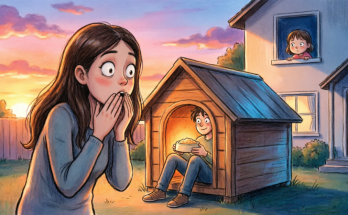
My father didn’t lower his voice when he said it.
He pushed the envelope across the dinner table with two fingers, the way he might slide a contract toward someone he expected to sign without reading, and said, “We gave your wedding fund to your sister. She deserves a real wedding.”
The chandelier above us hummed softly. Silverware gleamed under the light. The roast chicken my mother had spent all afternoon preparing filled the room with rosemary and butter, and still everything went cold.
My mother didn’t gasp. She didn’t even look embarrassed. She just gave one of her neat little nods, the kind she used whenever my father said something she had already agreed with in private.
Across from me, my sister Emily smiled.
It wasn’t a huge smile. That would have required honesty. It was smaller than that, tighter, the kind of smile people wear when they want to look surprised by good fortune they have quietly arranged for themselves. She touched the envelope with the tips of her manicured fingers but didn’t open it right away. She wanted us to sit with it first. She wanted me to sit with it.
I didn’t cry.
That’s the part people always expect when I tell the story. They expect tears, outrage, some dramatic scene with chairs scraping back and voices rising high enough to rattle the china cabinet.
But that’s not how it happened.
I looked at the envelope. Then I looked at my father. Then I looked at Liam.
My fiancé had been sitting beside me so quietly that evening you could have mistaken his silence for passivity if you didn’t know him. But I knew him. I knew the stillness that came over him when he was angry. I knew the way his shoulders settled, not because he was backing down, but because he was deciding how much force to use.
He set his fork down carefully on the plate.
Then he looked at my parents and asked, in a calm voice that somehow carried farther than my father’s had, “Anna, would you like me to tell them what I do for a living?”
The room changed.
It wasn’t loud. No one gasped. No one moved. But Emily’s smile vanished so quickly it felt like somebody had cut power to the house.
My father blinked once.
My mother’s hand stopped halfway to her water glass.
Emily looked at Liam the way people look at a locked door they had been certain would open.
I touched his wrist under the table.
“Not yet,” I said softly.
And because Liam was Liam, because he had never once tried to save me by making me smaller than I was, he nodded and leaned back in his chair.
My father mistook that for surrender. He always mistook silence for weakness.
He cleared his throat, lifted his wineglass, and said, “I think this is for the best. You and Liam are simple people. Emily has different needs.”
Simple people.
As if love had tax brackets.
As if dignity required centerpieces.
As if the life I was building counted less because I hadn’t spent years learning how to turn every room into an audience.
I should tell you that the truth didn’t begin at that table. It began years earlier, in a house where love was treated like a spotlight and somehow never stayed on me for long.
I grew up in a home that worshipped achievement with the intensity some families reserve for religion. Not quiet achievement, not private pride. My parents believed in measurable, displayable, enviable success. Certificates could be framed. Trophies could be polished. Degrees could be mentioned at dinner when guests came over. Promotions could be repeated so often they became family legends.
The dining room walls were proof.
By the time I was ten, they had turned one entire side of the room into a shrine to Emily’s life. Debate trophies on floating shelves. A framed newspaper clipping from her high school academic decathlon. Her college acceptance letter, mounted like sacred text. Photos of her in blazers and graduation robes and stiff smiles, each one positioned with the care of a museum exhibit.
If you looked hard enough, you could find traces of me in that house.
There was a second-place ribbon from a middle school art contest tucked into a drawer with expired coupons. There was a photograph of me at age eight holding a handmade birdhouse, but it sat on the side table behind a lamp where nobody ever really saw it. There were school reports my mother saved, probably out of obligation, in a plastic storage bin in the attic with old tax records and half-melted Christmas candles.
My memories lived in the shadows between Emily’s frames.
I learned early how to take up less room.
I learned that when Emily got an A, the house glowed. When I got an A, it was met with, “That’s good, sweetheart,” before the conversation drifted back to whatever internship Emily was applying for or which teacher had praised her in class.
When Emily won, it was evidence of destiny.
When I did well, it was called “nice.”
The difference between those two words can shape a child.
I need to be fair about one thing: my parents were not monsters in the theatrical sense. They didn’t scream at me every day. They didn’t forget my birthdays. There were no slammed doors, no broken plates, no obvious villainy anyone outside the house could point to and say, There, that’s the harm.
What they did was quieter.
They arranged affection around utility.
They celebrated the child who reflected best on them.
And because Emily was beautiful, bright, ambitious, polished, and deeply aware of how to turn approval into a lifestyle, she received more of their warmth than I ever did.
People love to say siblings are compared by accident. In my family, comparison was architecture.
Emily was three years older than me and good at everything in a way that made adults lean forward when she spoke. She could walk into a room and locate admiration the way some people locate exits. She knew when to laugh. She knew how long to hold eye contact. She knew how to list her accomplishments without sounding like she was bragging. It wasn’t magic. It was training and instinct braided together so tightly nobody noticed the effort.
I was different.
I was quieter, slower to speak, happier with sketchbooks than competition. I liked typography, color palettes, old buildings, and the strange comfort of noticing small things other people missed. I became the kind of child teachers called “thoughtful,” which is sometimes a compliment and sometimes a polite way of saying you are not impressive enough to build a future speech around.
There was one person in that house who saw me clearly.

My grandmother lived with us for most of my childhood after my grandfather died. Her room was across the hall from mine, and her door was almost never fully closed. Light slipped from under it late at night because she read before bed, and the smell of lavender lotion and peppermint tea seemed permanently woven into the walls around her.
She had soft hands, a patient laugh, and a way of speaking to me as though my thoughts were worth waiting for.
When Emily’s victories swallowed the house whole, Grandma would appear in the hallway with a plate of warm cookies and press one into my hand.
“For balance,” she’d whisper.
I was eight the first time she said it, and I asked, “Balance for what?”
“For the world,” she replied. “It isn’t always fair with sweetness. Sometimes you have to add your own.”
She never said cruel things about my parents. She didn’t need to. She just built me small shelters inside the life they made.
When I was thirteen and my mother forgot to come to the art fair because Emily had a debate tournament, Grandma sat on a folding chair beside my display for two hours and told every passing parent that I understood color better than adults twice my age.
When I was sixteen and my father dismissed my interest in design as “a nice hobby,” she saved up from her monthly spending money and bought me my first proper set of illustration pens.
When I left for college—state school, local, practical, not the kind of acceptance letter you frame in a dining room—she slipped a note into my overnight bag. It said, Don’t become invisible just because they’ve gotten used to looking past you.
I wish I could say I took that advice immediately.
I didn’t.
Invisibility, once practiced long enough, can start to feel like survival.
I kept my head down. I got my degree. I built a freelance design career one client at a time—branding packages, website layouts, invitation suites, social media campaigns for small businesses who paid late and thanked me warmly. It wasn’t glamorous, but it was mine. I liked the work. I liked making messy things legible. I liked finding the hidden structure inside chaos and giving it form.
My parents did not understand any of that.
When I said I was freelancing, my father called it “keeping your options open,” as though adulthood had not properly begun. When I landed my first major retainer client, my mother said, “That’s wonderful, honey,” with the tone she used for homemade pottery from neighborhood craft fairs.
Meanwhile, Emily marched through milestones like a parade route built just for her. Graduate school. Corporate strategy role. Promotion. A glossy apartment downtown. A social circle full of people who wore expensive neutrals and used the phrase “curated experience” without irony.
Every holiday came with new material for my parents to admire.
Every holiday reminded me how half-visible I still was.
It wasn’t jealousy, not exactly. Jealousy is too clean a word for something so old and tired. What I felt was an ache—the kind that forms when a person spends years trying not to need what should have been given freely.
The first time Liam met my grandmother was before he met anyone else in my family.
That had been my choice.
I met Liam through a literacy nonprofit that hired me to redesign their donor materials. He was on the board, though I didn’t know that at first. The first day we met, he was carrying three folding tables across a church basement in worn jeans and a gray sweater with a tiny fray at the wrist. Someone had spilled coffee on the sign-in sheet, and while two people complained and one person blamed the volunteer coordinator, Liam found paper towels, cleaned it up, and started helping set out chairs.
Later, during a break, he sat beside me with a cup of terrible coffee and asked if I always frowned at font pairings with that much personal offense.
I laughed before I meant to.
There was nothing flashy about him. No carefully engineered charm. No résumé-speaking, no social peacocking. He listened when people answered questions. He remembered details. He noticed who was carrying too much and took some of the weight before they had to ask.
It turned out he worked in tech. That was all he said the first few weeks we knew each other, and I didn’t push. He didn’t seem like a man hiding something shameful. He seemed like a man tired of being introduced through the wrong details.
We started slowly. Coffee after planning meetings. Walks after dinner. One rainy Sunday afternoon spent in a bookstore where he bought three novels and then admitted he never finished anything on time because he kept reading the acknowledgments pages and wondering about the lives behind the names.
He made me feel seen in a way that was almost disorienting at first.
Not admired. Not evaluated. Seen.
He asked what kind of work I loved most, and when I answered, he listened as if the answer mattered. He remembered the names of my clients. He sent me articles about typography and neighborhood architecture. He noticed when I got quiet around my family and never forced me to explain before I was ready.
By the time I brought him to Grandma’s room with a loaf of lemon bread from the bakery down the street, I was already half in love with him and scared enough to resent the feeling.
Grandma took one look at him, then at the bread, then at the way he waited for her to decide whether he should sit, and I knew she approved before she said a word.
They talked for an hour that first day.
About roses, first. Then books. Then a radio program Grandma used to listen to when she was young. Liam knew it. Not because he was pretending, but because his mother had loved it too. By the time he left, Grandma squeezed my arm and whispered, “He’s steadier than he looks.”
She was right.
He was not dramatic. He was not loud. He did not storm into my life declaring himself a rescue.
He simply showed up.
He helped Grandma reset the timer on the old sprinkler system in the backyard. He remembered how I took my tea. He came over when deadlines stacked up and silently washed dishes while I finished work. When a client stiffed me on payment and I tried to laugh it off, he sat on the kitchen floor with me while I cried and said, “You don’t have to pretend things don’t hurt just because you can survive them.”
My parents didn’t see any of that.
To them, simplicity translated instantly into insufficiency.
The first time Liam came to my parents’ house for dinner, my father asked him two questions about work in the tone of a man checking a box he expected to leave blank.
“So, tech,” Dad said. “Doing what exactly?”
“Software,” Liam answered.
“What kind?”
“The kind that solves problems.”
It should have been funny. It almost was. But my father didn’t smile.
My mother tried next. “And where do you see yourself in five years?”
Liam looked at her, perfectly polite. “Hopefully still kind.”
Emily snorted into her wineglass.
My father’s mouth flattened.
They had already decided. He dressed too simply. He didn’t advertise himself. He wasn’t eager to impress. Therefore, in their minds, he must not have much to offer.
That was the story they wrote. They never once considered they might be bad readers.
I don’t know whether it would have changed anything if they had known the truth about Liam sooner. Part of me believes it would have. My parents were highly susceptible to wealth. They treated money like evidence of character, which is one of the oldest and ugliest mistakes in the world. If they had known then that Liam founded one of the most successful cybersecurity companies in the state, that his firm’s software quietly protected hospitals, banks, and half the businesses my father admired from a distance, they would have rearranged themselves around him immediately.
But Liam didn’t tell them.
He wasn’t being coy. He wasn’t ashamed. He just understood something I had only recently begun to learn: people reveal themselves fastest when they think you have nothing to offer them.
He wanted to know who my family was when they believed he was ordinary.
He found out.
Not long after Liam proposed, Emily got engaged too.
That sentence makes it sound as if the two events were natural neighbors in time, but the truth is uglier than that. Liam proposed on a cool evening in early spring, in Grandma’s backyard, while the first rosebuds were still tightly furled and the grass was damp enough to soak the hem of my dress. He knelt beside the old stone bench Grandpa had built decades earlier and asked me if I wanted to spend the rest of my life with the person who already knew how to find me in a crowded room.
I said yes before he finished asking.
Grandma cried.
I laughed and cried too, and Liam, who had rehearsed something longer, forgot all of it halfway through and ended up kissing my wet face while Grandma clapped from the patio.
It was perfect in the way real things often are: a little messy, deeply sincere, and beautiful because nobody was performing.
We told my parents the next Sunday.
My mother smiled and hugged me. My father shook Liam’s hand with grave formality and said, “Congratulations. Have you set a date?”
I hadn’t even put the ring down long enough to think about a date.
Emily, who was between relationships at the time, smiled too brightly and said, “Wow. That’s fast.”
Three months later she was engaged to a man named Daniel, a corporate attorney with excellent posture, a family from the right neighborhood, and the kind of polished certainty my parents adored. Daniel himself was not unkind, but he had that blandly expensive air of a person who had always assumed life would move aside for him.
The moment Emily announced her engagement, the center of gravity in our family shifted so hard I felt it in my bones.
My mother was ecstatic.
My father became energized in a way I hadn’t seen since Emily’s college applications. Suddenly there were spreadsheets, calls, venue lists, menu tastings, and phrases like “once-in-a-lifetime event” floating through the house with an urgency that made my own engagement feel like an afterthought.
If I mentioned a florist Liam and I liked, my mother would nod and say, “Lovely,” before pivoting to Emily’s ballroom options.
If I talked about possibly keeping our ceremony small, my father would say, “Yes, that seems sensible,” with obvious relief, as though my restraint were a budgetary blessing.
Emily fed on it.
She started every conversation with wedding details. The imported silk. The venue overlooking the water. The custom monogrammed invitations. The string quartet she “simply had to have” for cocktail hour. The phrase “my planner” entered her vocabulary with a speed and seriousness usually reserved for life-threatening diagnoses.
At first I told myself it was fine.
Liam and I really did want something smaller. We talked about getting married in a garden or old conservatory, maybe with forty people at most. I was not yearning for chandeliers or ice sculptures. I had never once imagined arriving at my own wedding in a carriage or beneath a cathedral-length veil.
But smaller does not mean lesser.
And what began happening in my family was not a matter of scale. It was a matter of value.
My parents had always said there was money set aside for each daughter’s wedding. Not a fortune. Just enough to help. It had been one of those standing promises repeated throughout adulthood with such confidence that I stopped questioning it years earlier. “When the time comes, we’ve got something for both of you,” my mother had said more than once. “Nothing extravagant, but fair.”
Fair.
That word should have warned me.
The Sunday dinner where my father handed my wedding fund to Emily took place six weeks after her engagement.
He had invited us over with unusual insistence.
“Family dinner,” my mother said over the phone. “We need to talk through timelines.”
I almost hoped they were ready to treat both weddings like they existed.
I should have known better.
The table was set with the good china. My mother had made roast chicken, creamed spinach, and the lemon pie Emily liked. Dad poured wine before anyone sat down. Emily was already glowing with the certainty of someone expecting good news.
I knew something was wrong when my father kept touching the envelope beside his plate.
We ate most of dinner in a strange false normal. Emily talked about venues. My mother complimented a florist. Dad asked Daniel about a tax issue. Liam spoke politely when spoken to, his hand warm on my knee under the table.
Then my father cleared his throat and picked up the envelope.
“There’s something we’ve decided,” he said.
He slid it across the table toward Emily.
Inside was a cashier’s check and a printed account summary.
I didn’t need to see my name on the account designation to understand what it was. I had known about that fund since I was twenty-three. I knew the amount because my mother had once mentioned it while tipsy on Christmas wine.
Emily’s breath caught in delighted surprise she was not talented enough to fake convincingly.
Dad said the words then.
“We gave your wedding fund to your sister. She deserves a real wedding.”
I remember every detail of the seconds that followed.
The sound of the grandfather clock in the hallway ticking on as if time had no decency at all.
The smell of rosemary turning sharp in my nose.
My mother reaching for her glass and not drinking.
Emily looking down, then up, then down again, as if modesty were something she could perform into existence.
I said, “You gave her my fund?”
Dad frowned, already irritated by my tone. “You said you wanted simple.”
“That doesn’t mean disposable.”
Mom leaned in, fingers smoothing the edge of her napkin. “Honey, don’t make this ugly. Liam and you aren’t interested in all the pomp. Emily has a larger event to host. There are expectations.”
“Whose expectations?” I asked.
Emily finally spoke. “Anna, come on. You know our weddings aren’t the same.”
The sentence hit harder than the money.
I looked at her. “Explain that.”
She shrugged, looking almost embarrassed for me. “Mine is more traditional. More formal. Daniel’s family is inviting people from work and extended circles. There’s a standard we have to meet.”
My father nodded. “Exactly.”
I laughed then. I couldn’t help it. It came out wrong—thin, unbelieving, too sharp.
“So because I’m not throwing a performance for people I barely know, my wedding isn’t real enough to deserve what was promised to me?”
Dad’s eyes hardened. “That’s not what I said.”
“It’s exactly what you said.”
Liam set down his fork.
There was no anger in his face, which somehow made him more formidable.
He looked at me first. Then at my parents.
“Anna,” he asked quietly, “would you like me to tell them what I do for a living?”
Emily’s smile dropped.
My father’s gaze narrowed.
Mom went still.
I knew what Liam was offering. Not money. Never that. He was offering leverage—the one language my parents always understood.
If he told them the truth then, the whole balance of the room would flip. My father would backtrack. My mother would flutter. Emily would start recalculating.
And I wanted, fiercely and suddenly, not to win that way.
If they treated me fairly only because the man beside me turned out to be wealthy, then they still would not be seeing me. They would only be seeing a stronger bargaining position.
I put my hand over Liam’s wrist.
“Not yet,” I said.
His eyes met mine. He understood immediately. He gave the smallest nod and leaned back again.
My father mistook that for defeat. He drew himself up, relieved.
“This is not a crisis,” he said. “You’re both adults. Liam works, you work, and as I said, you’re planning something modest. Emily has one chance to do this properly.”
Something hot and old moved through me then, something that had been gathering its weight for years.
“Do you hear yourselves?” I asked.
Mom sighed. “Anna—”
“No. Do you hear yourselves?”
Emily crossed her arms. “You’re being dramatic.”
“Am I?”
“Yes,” she said. “You’ve always chosen the low-key route. Nobody is stopping you from getting married.”
I looked at the envelope in front of her.
“Of course not,” I said. “You’re just making sure I do it knowing exactly where I rank.”
The room went silent.
My father’s voice came out clipped. “If you’re going to be ungrateful—”
“I’m not ungrateful,” I said. “I’m finally paying attention.”
No one had a response to that.
Dinner ended badly, but not explosively. My family did not do explosive unless there were witnesses to impress. We did damage in more refined ways.
Mom insisted I was misunderstanding.
Dad told Liam he hoped I would “calm down and be sensible.”
Emily put the envelope in her purse and said, “I didn’t ask for this,” which was both untrue and so perfectly her I almost admired the efficiency of it.
Liam and I left in silence.
The moment we got in the car, I stared straight ahead and said, “Don’t say it.”
He kept both hands on the wheel. “I wasn’t going to.”
“Good.”
After a moment he said, “Are you angry about the money?”
I thought about it honestly.
“Yes,” I said. “But not because I need it.”
“Then why?”
I looked out the window at the dark neighborhoods sliding by.
“Because they wanted me to know I was worth less.”
Liam drove another block before answering.
“They were wrong.”
I closed my eyes.
“I know,” I whispered. “I’m just tired of always being the one who has to know it alone.”
He reached across the console and took my hand.
“You’re not alone anymore.”
That was the night I understood something uncomfortable: favoritism doesn’t stop hurting just because you become old enough to name it.
The weeks after that dinner tightened around me like a slow, deliberate squeeze.
Every conversation at my parents’ house circled back to Emily’s wedding. My mother repeated the phrase “a real wedding” so often it became unbearable. Sometimes she said it directly. Sometimes she implied it.
“This kind of event requires coordination.”
“There are standards for these venues.”
“Daniel’s family expects a certain level.”
“Emily only gets one real chance.”
Each sentence landed like a small stone.
Dad grew more openly dismissive of Liam. Not rude enough to be called rude by outsiders—he was always too careful for that—but patronizing in a way that made my skin prickle.
“Stability matters,” he said one afternoon while stirring coffee at the kitchen island. “Marriage is not built on chemistry alone.”
Liam, who had dropped me off and was helping Grandma carry in soil bags for her potted herbs, said, “I agree.”
Dad kept stirring. “Then you understand why I worry about long-term sustainability.”
I looked at him. “You mean money.”
Dad lifted one shoulder. “Practicality.”
Liam smiled very slightly. “We’re doing fine.”
Dad gave him the kind of thin smile men use when they believe they are being kind to someone beneath them. “Fine is relative.”
Liam said nothing more. Later, in the car, I asked if that bothered him.
“A little,” he admitted. “Mostly because he thinks money is the same thing as judgment.”
That was one of the many reasons I loved him. He could separate insult from truth without excusing the insult.
Grandma, of course, noticed everything.
One afternoon I found her in the backyard trimming roses with more force than usual. The late summer light had turned her silver hair almost gold. Petals clung to the grass around her feet like scraps of silk.
“You’re quiet,” she said without looking up.
“So are you.”
She snipped a stem cleanly. “That’s because I’m thinking.”
“About what?”
“The difference,” she said, “between being overlooked and being dismissed. One can happen by carelessness. The other is a decision.”
I knelt beside her, gathering clipped branches into a basket.
“And which do you think this is?”
She glanced at me then, her eyes sharper than their age ever suggested. “You know the answer.”
I did………….