“Parents Planned Free Duplex for Brother. I Said ‘Unless”
My Brother’s Wife Smirked Across the Dinner Table and Said, “Zelda, When We Move into YOUR DUPLEX, I WANT THE MASTER BEDROOM RENOVATED. It’s Only Fair Since We’ll Be Living There Long-Term.” Everyone Laughed Like It Was Already Decided. My Parents Nodded, As If My Hard Work, My Mortgage, My Blood and Sweat Meant Nothing. Their Face Froze in Shock…
Part 1
The first time my sister-in-law called my duplex “ours,” she did it with a smile so casual it could’ve passed for a joke—if everyone at the table hadn’t laughed like she’d just said something obvious.
It was Sunday dinner at my parents’ house, the kind they still hosted like they were the center of the universe. Roast chicken, buttery mashed potatoes, green beans cooked too long, and a bottle of wine my dad opened the moment we sat down because he liked the sound it made. He liked sounds that made him feel like a man in charge.
Across from me, Mason—my older brother, golden child, crowned prince of the family—carved his chicken like he was performing. He had that confident energy of someone who’d never had to imagine what it feels like to be the backup plan. Beside him, Brianna sat with her hand draped over his forearm like she owned him.
And apparently me.
Brianna tapped her fork against her plate, made a show of looking around the table, and said, “Zelda, when we move into your duplex, I want the master bedroom renovated. It’s only fair since we’ll be living there long term.”
She said it like she was ordering a side of fries.
Everyone laughed.
My dad leaned back, pleased with himself, and my mom nodded like Brianna had simply confirmed a plan that had already been approved by the city council.
I stared at my plate and felt my grip tighten around my fork. My hands didn’t shake. They didn’t have the luxury. If I shook, they’d smell blood.
My dad swirled his wine and said, “Your brother has a family, Zelda. You don’t. He needs stability.”
My mom added, “Be grateful you can help. It’s not like you’re doing much with the place anyway.”
I let the words settle in the air.
The place. My duplex. Two units, one mortgage, one dream I’d built from scraps of sleep and stubbornness. I’d bought it four years ago when no one believed I could, when my credit score was still climbing out of the pit created by a student loan and a starter job that paid in polite insults. I’d lived in the smaller unit and rented the other one out, then refinanced when interest rates dipped and poured every extra dollar into principal like I was trying to outrun a storm.
My parents never asked how I did it. They’d just said things like, “Must be nice,” and, “Don’t get ahead of yourself.”
Meanwhile, Mason had gotten everything handed to him like birthday presents: help with a down payment he promptly blew on a truck, a “temporary” move back home that lasted eighteen months, a job through my dad’s connections, and endless forgiveness dressed up as family love.
I looked at Mason’s kids—Leah and Carter—sitting at the kid table with chicken nuggets and iPads. They were good kids. Loud, messy, normal. They weren’t the problem.
The problem was the way my parents spoke about my life like it was spare parts.
I set my fork down carefully. “When did you decide this?” I asked.
Brianna tilted her head. “Decide what?”
“That you’re moving into my duplex,” I said.
My mom gave me a look like I’d asked a stupid question on purpose. “Zelda. Don’t make this difficult.”
My dad waved his hand. “It’s settled. Your brother’s lease is up in two months. Rent is ridiculous out there. Why should he struggle when you have extra space?”
I didn’t correct him. I didn’t have “extra space.” I had a rented unit with tenants who paid on time. And the other unit was my home.
Brianna smiled wider. “Besides, it’ll be better for you. You’ll have family around. You’re always alone.”
I nearly laughed. It wasn’t funny, but my body wanted to turn it into something that wouldn’t hurt.
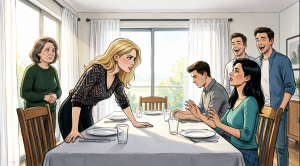
“I’m not alone,” I said quietly.
Mason finally looked at me like he was noticing I existed. “Zee,” he said, using the nickname he’d used when we were kids and I still thought he’d grow up and see me. “It’s not a big deal. You’ll still have a room. It’s family.”
“Family doesn’t take without asking,” I said.
Brianna’s smile flattened. “We’re not taking. Your parents are just helping decide what’s best.”
That sentence told the truth of everything.
I could feel my father’s expectation pressing down, the weight of years of being the “easy one.” The unmarried daughter. The one who didn’t bring drama. The one who kept her life small enough to fit around everyone else’s needs.
My dad leaned forward, voice sharpening. “Zelda, don’t embarrass us. This is how families work.”
I looked at him, then my mother, then Mason. I saw their certainty. Their comfort. Their assumption that my work belonged to them the moment they found a use for it.
What they didn’t know—what they couldn’t know, because they’d never looked close enough to see—was that I’d stopped being the easy one a long time ago.
I didn’t say anything else at the table. Not yet. I let the conversation drift to school schedules and Mason’s job complaints and Brianna’s remodeling ideas for a house she didn’t own.
I nodded at the right places. I smiled when expected. I played the role.
But inside, a quiet part of me clicked into place.
They thought they’d already moved in.
They thought my life was still available for rearrangement.
They were about to learn what happens when you build something in silence and stop asking for permission to keep it.
Part 2
That night, I sat at my kitchen table in my own unit of the duplex, listening to the steady hum of the refrigerator and the soft footfalls from the upstairs unit where my tenants lived. The building felt solid around me. The kind of solid you earn.
I opened my laptop and pulled up a folder labeled HOLDINGS.
Inside were documents I’d worked on for months—quietly, methodically, the way you stack bricks. Articles of incorporation. Property management agreements. A trust structure designed to separate my personal name from the assets, because once you own something worth taking, people start testing what they can grab.
I wasn’t doing anything shady. I was doing what people with money did every day—protecting what they built. The only difference was I’d built mine without applause.
My phone buzzed with a text from my mother.
We told Mason you’ll be ready to hand over keys by next month. Don’t start drama.
I stared at the screen until the words blurred, then set the phone face down.
My business had started as an “online job” my dad mocked at every holiday. Freelance work, odd projects, late-night clients in different time zones. I’d done social media management, then copywriting, then consulting. I got good at making other people’s businesses sound smarter than they were. Eventually, I started hiring subcontractors. I built systems. I built a brand. I built a client list that didn’t care if my parents thought my work was “real,” because they paid real invoices.
Zelda Holdings was supposed to be the shell that held my properties, the umbrella that made my assets harder to bully out of me. It wasn’t about revenge. It was about reality.
But then, six months ago, I’d stumbled onto something bigger.
My father’s company.
Wade Mechanical wasn’t glamorous, but it was old. The kind of family business my dad spoke about like a legacy. He ran it like a kingdom, and Mason worked there in a role that sounded important but never had clear responsibilities.
I found out the company was struggling the way you find out a house has termites: not because the owner tells you, but because you notice the quiet signs. A lien filing. A vendor complaint. A banker I’d met at a networking event who mentioned, a little too casually, that “the Wades were restructuring again.”
I didn’t dig out of curiosity.
I dug out of caution.
Because if my father was in trouble financially, he’d start reaching.
And he was already reaching for my duplex like it was a spare room in his house.
So I called a lawyer. Then an accountant. Then a commercial broker I trusted because she didn’t care about my family dynamics—only contracts.
I learned my dad had taken out loans using the business as collateral. The biggest one had been tied to a “growth initiative” Mason pitched last year—a half-baked plan to expand services without any real projections. It failed quietly. Mason moved on like it was a weather event. My dad covered the hole.
But the hole didn’t disappear.
The bank started calling in notes. Payments slipped. The company’s debt got packaged and sold like a hot potato.
And I bought a piece of it.
Not because I wanted to hurt my dad, but because I wanted control of my own future. Because if the wrong person bought that debt, they could crush the company, lay off innocent workers, and my father would come knocking on my door with his hand out and his pride disguised as entitlement.
So I did what no one expected me to do.
I bought it first.
Piece by piece. Quietly. Through legal channels. Through Zelda Holdings.
Then I negotiated. I wasn’t a predator—I wasn’t interested in gutting the business. I wanted leverage and protection. I wanted to keep people employed. I wanted the truth sitting on paper instead of floating around as family rumor.
By the time Sunday dinner happened, I wasn’t just the duplex owner.
I was also the person holding the company’s future in my hands.
I didn’t plan to drop that truth like a grenade.
But if my family wanted to play chess with my life, they were about to realize I’d already been studying the board.
I printed out three envelopes that night.
The first held the property transfer documents—showing the duplex was now held under a trust controlled by Zelda Holdings, and any tenancy required a formal lease through my management arm. No handshake. No family exception.
The second held a formal notice: if anyone attempted to occupy the unit without a lease, they’d be treated like any other unauthorized occupant. That wasn’t cruelty. That was policy.
The third envelope—the black one—held what would end the conversation permanently.
A proof of acquisition. Share transfers. Debt purchase confirmations. The legal reality that Wade Mechanical was no longer my father’s kingdom.
I didn’t want to do it at the dinner table.
But my family didn’t believe in private conversations. They believed in crowds. Pressure. The performance of control.
So I decided if they wanted a stage, I’d bring the paperwork.
The next day, Mason called like nothing had happened.
“Zee, just make it easy,” he said. “Brianna’s already planning paint colors.”
“I need you to stop making plans with my property,” I replied.
He sighed like I was being dramatic. “You always do this.”
“I always do what?” I asked. “Protect what I built?”
He laughed. “Relax. Mom and Dad already said it’s fine.”
I looked out my window at the duplex’s front steps, the chipped paint I’d repaired myself, the flowerpots I’d planted because I wanted the place to feel alive.
“No,” I said. “They said it’s fine for you. Not for me.”
There was a pause. “So what, you’re going to make your brother homeless?”
The word homeless was a weapon. A guilt-loaded exaggeration meant to make me fold.
I stayed calm. “You have two months. Find a place you can afford. Or fill out an application like everyone else.”
Mason’s voice sharpened. “Are you seriously talking to me like I’m a tenant?”
“I’m talking to you like an adult,” I said. “Try it.”
He hung up on me.
That evening, my mother called, furious. My father got on the line, voice booming, telling me I was ungrateful, telling me I was disrespectful, telling me I was “forgetting my place.”
I listened. Then I said, “We’ll talk at dinner next Sunday.”
I could hear their satisfaction. They thought that meant surrender.
It meant the opposite.
It meant I had a date on the calendar to end the story they’d been telling about me my whole life.
Part 3
The next Sunday, my parents set the table like they were preparing for a celebration.
Candles. Wine. My father’s “special occasion” plates. Brianna wore a new dress, the kind that was too tight to be comfortable but perfect for looking victorious. Mason brought a bottle of something expensive, like he was already paying rent in gestures.
I walked in with my bag heavy against my shoulder.
My mother’s eyes narrowed immediately. “What’s that?”
“Paperwork,” I said.
My father scoffed. “Here we go.”
Dinner started with forced politeness. Brianna talked about the school district near my duplex. Mason bragged about how much money they’d save. My mother acted like she was helping me by explaining how “nice it would be” to have family close.
Then Brianna smiled across the table and repeated her line like a finishing move.
“Zelda, when we move into your duplex, I want the master bedroom renovated.”
Everyone laughed again, but it was thinner this time. Maybe they sensed something.
I set my fork down and reached into my bag.
The first envelope slid across the table smoothly, right toward Mason.
He reached for it, smirking, like he was accepting a prize.
When he opened it, the color drained from his face.
He blinked, then looked up at me like the words weren’t cooperating with his brain. “W-what do you mean?”
My mother’s fork clattered against her plate. “What do you mean what do you mean?”
I leaned back, heart racing, voice calm. “That duplex doesn’t belong to me anymore.”
My dad’s eyes narrowed. “What are you talking about?”
“It belongs to my company,” I said. “And my company doesn’t do free rentals.”
Brianna snatched the document from Mason’s trembling hands and scanned it, lips moving as she read. Her smug smile vanished.
“Signed over under property trust, controlled by…” She stopped, eyes widening. “Controlled by Zelda Holdings.”
My father laughed, sharp and dismissive. “Zelda Holdings? Don’t make me laugh. You don’t have the brains or money to run anything with holdings in the name.”
I let the silence stretch until it got uncomfortable.
“Dad,” I said, “remember when you told me to stop wasting time with those online jobs?”
He waved his hand. “That nonsense?”
“Those clients,” I continued, “built my business.”
My mother shook her head like she was trying to wake up. “This has to be a joke.”
I smiled, not warm, not cruel—just clear. “It’s not. Zelda Holdings owns the duplex. And three more properties across town.”
Mason slammed his hand on the table. “You can’t just throw us out! We already told the kids.”
I leaned forward, locking eyes with him. “Then maybe you should’ve asked me before planning your future with my walls and my roof.”
My mother’s voice shot up. “How dare you speak to your brother like that!”
I didn’t flinch. “How dare you plan to take my home without even asking.”
My father’s face reddened. “We raised you. We fed you. We gave you everything.”
Something in me went still, like a door closing. “You gave me reminders that I wasn’t good enough,” I said. “While Mason got cars and college and help, I got lectures about being grateful for scraps.”
Brianna’s voice trembled, trying to regain control. “This isn’t real. You’ve always been the weak one.”
I held her gaze. “The weak one just told you no.”
Mason shoved his chair back. “This isn’t over.”
I reached into my bag and pulled out the second envelope, thicker, sealed.
I placed it on the table and watched their anger stall into nervous silence.
“Go ahead,” I said softly. “Open it.”
Mason tore it open. His hands shook as he read the first page.
His lips moved soundlessly, then his voice cracked. “This… this is an eviction notice.”
Brianna grabbed the papers, panic rising. “Effective immediately… tenants must vacate within seven days—Zelda, what kind of sick joke is this?”
“Not a joke,” I said. “A policy. If someone tries to occupy without a lease, they’re treated like any other unauthorized occupant.”
My mother slammed her palm down. “We are your family!”
“And that’s why you thought you didn’t need permission,” I replied.
My father leaned back, eyes hard. “So what? You think you’re better than us now?”
“I think I’m done being treated like property,” I said.
Mason’s face went red, veins bulging. He threw the papers back at me. “You’re humiliating us.”
I caught them calmly. “I’m not humiliating you. You humiliated yourselves when you assumed you could take.”
Then I pulled out the third envelope.
Black. Sleek. Sealed with gold.
My father’s confidence faltered just slightly. “Enough of this show.”
I slid it to the center of the table. “Open it if you dare.”
My mother snatched it up, tore it open in desperation.
Her eyes darted across the paper.
All color drained from her face.
She dropped it like it burned.
Brianna grabbed the pages, voice shaking. “No… this says Zelda Holdings acquired Dad’s company.”
The room froze.
My father jumped up, furious. “Impossible! That company’s been in our family for generations!”
I locked eyes with him. “Correction. It was. Until you defaulted on that loan.”
His mouth opened, then shut.
“The shares were sold,” I said. “I bought them piece by piece. Quietly. Legally.”
Mason slammed the table. “You ruined us!”
I leaned in, calm and sharp. “No, Mason. You ruined yourselves. I just stopped letting you ruin me.”
My father’s face twisted between rage and disbelief. “You’re doing this to punish us.”
“I’m doing this,” I said, “to protect what I built. And to protect the employees you were about to drag down with you.”
The candles flickered. The room felt too small for their entitlement now.
I gathered my papers, stood, and looked at the table like it was a scene from a life I was leaving behind.
“Enjoy your dinner,” I said. “It’s the last meal you’ll eat assuming my life belongs to you.”
And then I walked out, my bag lighter than it had been when I came in.
Not because I’d dropped documents.
Because I’d dropped a role……