Part 4
Three weeks after I walked out of my parents’ house, the family rumor mill wasn’t humming anymore.
It was screaming.
It started with a Facebook post from my mother that a distant aunt forwarded to me like a warning. My mother didn’t use my name, but she didn’t have to. She wrote about “a daughter lost to greed,” “a child who abandoned her roots,” “a family torn apart by selfishness.” The comments were full of people who didn’t know anything offering comfort to the woman who always knew how to play the victim.
Jennifer, my brother’s fiancée, commented a heart emoji and wrote, Praying for healing.
Healing, in their language, meant me handing over access.
Then my father went to my old neighbors. He stood on the sidewalk near his mailbox and told anyone who’d listen that I’d “fallen in with shady people” and “probably laundered money” because how else could a dropout afford a mansion?
By the end of the week, a local reporter from my hometown called my office.
I didn’t answer.
Silence is power, but only when it’s paired with preparation.
I met with my attorney, a sharp woman named Renata who had the calm eyes of someone who never panicked.
“They’re escalating because they think you’ll crack,” she said, flipping through the file of screenshots, voicemails, and timestamps I’d collected. “You won’t.”
“No,” I agreed. “I won’t.”
Renata tapped a page. “We can send a cease-and-desist for defamation. But there’s another issue.”
She slid a document across the desk.
I read the header and felt my stomach drop.
A loan application.
Under my name.
Not my signature, but close enough that someone who didn’t look carefully might accept it.
My parents had tried to take out a business loan and listed me as a guarantor, as if I’d quietly agreed to back them.
A cold calm washed through me. “That’s… fraud.”
Renata nodded. “Yes.”
I stared at the paper, feeling something inside me harden into something unbreakable.
This was the moment.
The unexpected thing.
Not rage. Not revenge. Not yelling.
Paperwork.
Accountability.
Consequences.
I called my bank first and locked down every account. I froze my credit with all three bureaus. I filed an identity theft report. Renata walked me through the next steps: documentation, police report, and notifying the lender that the guarantor information was fraudulent.
While I did that, my phone lit up with missed calls.
My mother. My father. Adam.
Like they could sense the tide shifting beneath them.
I didn’t answer until I had the police report number in my hand.
Then I picked up on the fourth call from my father.
His voice exploded the second I said hello. “What did you do?”
I didn’t raise my voice. “I protected myself.”
“You filed something,” he snarled. “Someone called. They said there’s an investigation.”
I leaned back in my chair and looked out at the ocean beyond my office windows. “You used my name to get a loan.”
“We were going to pay it back,” he shot back, as if that erased the crime. “It was just paperwork.”
“Paperwork that could ruin my credit and make me liable for your debt,” I said evenly.
My mother’s voice cut in from the background, sharp and frantic. “You did this to punish us!”
I let a beat of silence pass. Then I said, “No. You did this because you thought you owned me.”
My father started shouting. My mother started cursing. I heard Adam’s voice in the background, loud and panicked, asking what was happening.
They were screaming now, exactly like my transcript memory promised.
And the strange thing was, I felt nothing but clarity.
“Here’s what’s going to happen,” I said calmly, speaking over their noise. “You will not use my name again. You will not contact my workplace. You will not tell people I committed crimes to cover up the ones you’re committing. If you keep pushing, I will keep responding. Legally.”
My father’s voice cracked, furious and afraid. “You’re destroying this family.”
I smiled slightly, though they couldn’t see it. “You destroyed it the moment you decided love was something you could demand, not something you had to earn.”
I hung up.
The next two weeks were chaos on their end. I heard it through Mia, who sounded both horrified and impressed.
“They’re saying you called the cops on them,” she whispered like it was scandal.
“I filed a report because someone committed identity theft,” I said. “Facts aren’t scandal.”
Mia exhaled. “Dad is losing it. Mom is crying to everyone. Adam keeps saying you’re going too far.”
“Adam can mind his own business,” I said.
For the first time, Mia didn’t argue. “Honestly… I get it.”
The lender rejected the application. The investigation didn’t end in handcuffs, but it ended in consequences: warnings, documentation on record, and a clear message that my name was not a family resource.
My parents went quiet after that, not because they’d learned empathy, but because they finally understood I could push back in ways they couldn’t steamroll.
I thought that would be the end.
Then my mother tried one last play.
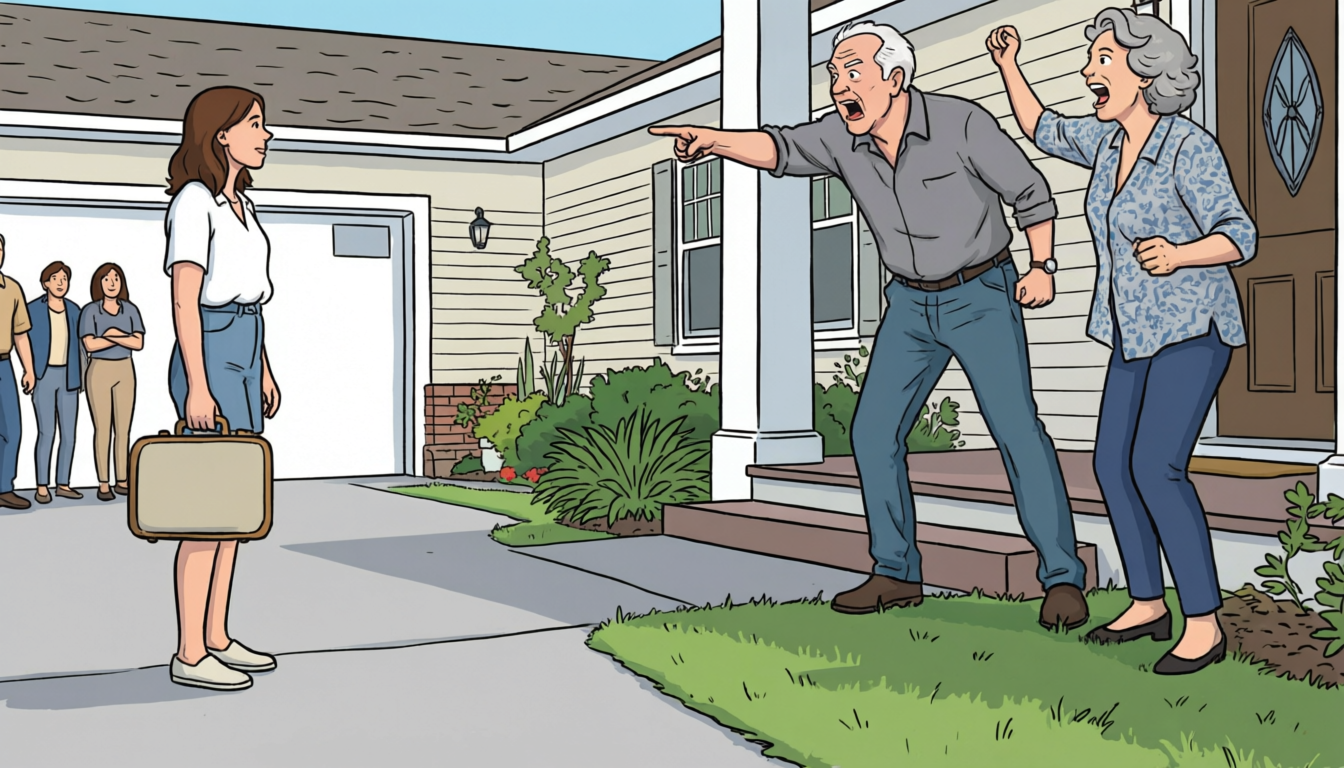
She showed up at my Florida property with a suitcase.
Security called me while I was in the gym.
“Ma’am,” the guard said, “a woman says she’s your mother. She’s asking to stay here.”
I dried my hands and stared at the wall for a moment, feeling the absurdity of it.
“Tell her no,” I said.
“She’s crying,” he added, unsure.
“Tell her no,” I repeated.
Ten minutes later, my mother called me from the gate, voice trembling with theatrical heartbreak.
“Lena,” she sobbed, “I have nowhere to go.”
I let the silence stretch.
Then I said, “You have the life you chose.”
Her sobs turned sharp. “How can you be so cold?”
I thought of her voice in that living room. Get lost. You’re a nobody.
“I learned from the best,” I said quietly.
And then I blocked her number.
Part 5
The funny thing about cutting off a family like mine is that you don’t just lose people.
You lose the constant noise in your head that tells you you’re only lovable if you’re useful.
The first few days after the identity theft mess, I kept waiting for the guilt to hit me like a wave. That old instinct to fix it, smooth it, make it right for everyone, even if I was the only one bleeding.
Instead, I felt something else.
Peace.
Not the kind you post about. The kind that comes when you finally stop negotiating with people who refuse to treat you like a human being.
One evening, I hosted a small dinner on the terrace. Not to show off. Just because I wanted laughter in my house that wasn’t laced with judgment. Mia came, cautious at first, like she expected the floor to collapse if she admitted she enjoyed being here. Two friends from my investment circle came. Renata came with her wife, and they brought a pie that was slightly burnt on one edge and perfect everywhere else.
We ate under string lights while the ocean rolled dark and steady beyond the glass railing. We talked about books and movies and ridiculous childhood stories. Nobody asked me what I “really” did for money. Nobody hinted that I owed them a cut.
At some point, Mia leaned close and said, “I used to think you were just… stubborn. Like you were doing the opposite of what your parents wanted out of spite.”
I chewed a bite of salad slowly. “And now?”
Mia looked out at the waves. “Now I think you were building a life that didn’t require their permission.”
I lifted my glass slightly. “That’s exactly it.”
A week later, a thick envelope arrived in my mail.
No return address.
Inside was a handwritten letter from Adam.
Lena, it read. I don’t know how to say this without sounding like them. I’m sorry. I didn’t stop it. I didn’t defend you. I benefited from being the “good kid” and I let them make you the bad one.
I stared at the paper for a long time, because apologies from my family were rare and awkward and usually followed by a request.
This one didn’t.
Adam wrote about how Dad had pressured him to “get information” from me. How Mom had been spiraling since the loan application failed. How they’d been telling everyone I’d turned “evil,” because in their world, boundaries look like cruelty.
At the end he wrote: I don’t want to lose my sister. But I don’t know how to be in the middle anymore.
I set the letter down, palms flat on the desk.
For a second, I felt that old pull: fix it. Rescue him. Make it okay.
Then I remembered the truth Renata had said early on: you can’t heal in the same place you were harmed.
So I called Adam.
He answered on the first ring, like he’d been holding his phone in his hand waiting.
“Lena,” he said, voice rough.
“Don’t ask me for money,” I said immediately.
He let out a breath that sounded like relief. “I wasn’t going to.”
“Don’t ask me to forgive Mom and Dad,” I added.
He swallowed. “I wasn’t going to.”
I paused. “Then why did you write?”
Adam’s voice softened. “Because I’m tired. And because… you were never trash. You were just inconvenient to their ego.”
My throat tightened unexpectedly. “Yeah.”
He hesitated. “Do you want to meet? Just us. Somewhere neutral.”
I could’ve said no. It would’ve been safer.
But Adam was the only piece of my old family that felt even remotely salvageable, and only if he learned how to stand on his own feet, not on my shoulders.
“Okay,” I said. “One meeting. No parents. No guilt. No games.”
“Deal,” he whispered.
We met at a small café near the beach. Adam looked older than I remembered, like carrying my parents’ expectations had finally started to crush him too.
He didn’t talk about the mansion. He didn’t ask about my money.
He just said, “I didn’t know you were building all that.”
“I didn’t tell you,” I replied. “You didn’t ask.”
He winced. “Fair.”
We talked for an hour. About childhood. About how Mom trained us to compete for her approval like it was oxygen. About how Dad’s love always felt conditional, granted only when we reflected well on him.
Adam stared at his coffee and finally said, “They used you.”
I nodded. “Yes.”
“And they’re going to keep trying,” he added, quiet.
“I know.”
Adam looked up. “What are you going to do?”
I thought about it, really thought. About the mansion. About the peace. About my mother’s Facebook tears and my father’s entitlement and the loan application with my name on it.
“I’m going to build something they can’t touch,” I said.
“I thought you already did.”
I smiled slightly. “I built money. Now I’m building legacy.”
Two months later, I launched a scholarship and small business grant program for people in my hometown who didn’t follow the “right” path. Trade school students. Entrepreneurs without degrees. Single parents starting over. People with talent and grit and no shiny credentials.
I named it The Nobody Fund.
Not as a petty jab—though the irony was satisfying—but as a reminder: the world is full of “nobodies” who are quietly building everything.
The local paper wrote a piece about it. They didn’t mention my parents, but they mentioned my story: a dropout turned investor, a self-made woman funding futures.
My mother called Mia screaming when she read it. Mia told me later, voice half-laughing, half-shocked.
“She said you’re humiliating her.”
I stared out at the ocean from my terrace, the waves steady as truth. “Good.”
A year after the night my parents kicked me out, I drove past their old house on a trip back to handle some paperwork. The front yard looked smaller than I remembered. The porch light flickered. The paint was peeling worse now.
I didn’t stop.
I didn’t need to.
Because the ending wasn’t me standing on their doorstep, begging to be loved.
The ending was me realizing I’d already built a home where love wasn’t measured by diplomas, approval, or obedience.
Back in Florida, I stood on my balcony again at sunrise, coffee warm in my hands, the ocean stretching endless and calm.
Somewhere far away, my parents were still telling each other stories where I was the villain.
They could have those stories.
I had the truth.
And the truth was simple:
They told me to get lost.
So I did.
And for the first time in my life, being gone felt like freedom.
Part 6
Two weeks after the Nobody Fund article ran, my mother stopped playing victim and started playing strategist.
I knew because the first letter didn’t come from her.
It came from a law office in my hometown, printed on thick paper with gold lettering that tried too hard. The letter claimed I was “financially coercing” my parents, that I had made “verbal commitments” to support them, and that my sudden withdrawal had caused “undue hardship.” It requested a meeting to “avoid litigation.”
Renata read it once, then again, then slid it back across my desk like it was something sticky.
“This isn’t about hardship,” she said. “It’s about control.”
I stared at the page. The language was dramatic but vague. No dates. No documents. No proof. Just pressure dressed up as professionalism.
“What do we do?” I asked.
Renata’s eyes were calm. “We respond with facts and a warning. And we prepare for them to escalate anyway.”
We did both.
Renata sent a reply outlining the identity theft report, the attempted loan fraud, and the cease-and-desist my parents had already ignored. She requested that all future communication go through counsel. She made it clear that any continued public defamation, harassment, or fraudulent financial activity would lead to formal action.
Then she added one line that made me exhale through my nose, half laugh, half relief.
Any further attempts to misrepresent Ms. Hale’s obligations will be met with aggressive legal defense.
My last name looked strange on paper. Too official. Too clean for the messy life I’d come from.
Three days later, my mother went live on social media.
Mia sent me a link with a single message: She’s spiraling. Do not watch if you want to keep your blood pressure normal.
I watched anyway.
My mother sat at her kitchen table under yellow lighting that made her look softer than she was. She wore a pale sweater and held a mug like a prop. She spoke in a trembling voice about motherhood, sacrifice, betrayal. She claimed she’d “given up everything” for me, that I’d “abandoned them in their time of need,” that I’d become “cold.”
Then she said something that made my spine go rigid.
“She’s not well,” my mother told the camera, eyes shiny. “I’m saying this as her mother. She’s always had… moods. Impulses. I’m scared for her. I’m scared someone is taking advantage of her.”
She tilted the story just enough to plant a seed: I was unstable. I couldn’t be trusted. My success was suspicious because it didn’t fit their version of me.
The comments flooded in with sympathy for her. A few people asked what happened. A few defended me, but they were drowned out by the easiest narrative: poor parents, cruel daughter.
When the video ended, my phone rang.
Adam.
I answered. “Did you see it?”
His voice sounded scraped raw. “Yeah.”
“What are you hearing?”
Adam hesitated. “Dad’s saying you’re going to embarrass the family with your ‘fake charity.’ Mom’s telling people you need an intervention.”
I leaned back in my chair, staring at the ceiling. “An intervention for what? For not being their ATM?”
Adam exhaled. “I know. I know. But they’re… they’re getting louder. And they’re involving people.”
“Like who?”
“Church. Dad’s boss. The same people they care about impressing.”
Of course. If they couldn’t reach me directly, they’d try to burn the ground around me so I’d have to come back to put out the fire.
I said quietly, “They’re going to try to show up somewhere.”
Adam didn’t answer immediately, which was its own answer.
“Adam,” I said, sharper now. “Are they planning something?”
He swallowed. “Mom told me she’s going to Florida.”
My stomach tightened. “With what goal?”
“She said she’s going to ‘talk sense’ into you.” His voice dropped. “Dad said if you won’t listen, they’ll make you listen.”
I stood up so fast my chair scraped the floor. “Make me?”
Adam rushed on. “Not physically. I don’t think. I think they mean… humiliation. Public pressure. They want to force a conversation.”
I closed my eyes, steadying my breathing. The old panic tried to rise, the childhood reflex that said: fix it before it gets worse.
But I wasn’t a child anymore.
“Thank you,” I said to Adam. “For telling me.”
“I don’t want this,” he said, voice cracking. “I didn’t sign up for… whatever they’re doing.”
“Then don’t follow them into it,” I replied. “You can step out.”
He didn’t answer, but I heard the shift in his breathing, like someone finally realizing a door exists.
That night I called my security team and adjusted protocols. No one gets past the gate without permission. Any unexpected visitors are recorded. Any confrontation is documented. Renata reminded me to keep everything clean and calm.
“Let them be the storm,” she said. “You stay the shoreline.”
Two days later, I received an email from the foundation’s event coordinator.
We’ve had some inquiries about press attendance at the first grant ceremony. Is that okay?
I stared at the words.
They were planning to show up where it would hurt: not at my house, where they could be turned away privately, but at a public event designed to celebrate people I was trying to help.
A stage.
An audience.
A chance to corner me with cameras and shame.
I typed back: Press is welcome. But security is increased. No disruptions allowed.
Renata called within minutes. “They want a scene.”
“I know,” I said.
“Then we don’t give them one,” she replied. “We give them consequences.”
The first Nobody Fund grant ceremony took place in a renovated community arts center near the coast. Small, bright, filled with rows of folding chairs and an energy that felt like possibility. The recipients were all kinds of people: a welder starting a small fabrication business, a single mom opening a mobile pet grooming van, a community college student building a low-cost app to connect seniors with transport.
I walked backstage and listened to them laugh and talk and steady their nerves. I saw myself in their faces, not the money version, the earlier version. The one who was told she wasn’t real enough.
Then my assistant stepped in, eyes tight.
“They’re here,” she whispered.
My stomach didn’t drop. It steadied.
“Where?”
“Front row,” she said. “Your dad. Your mom. And… a guy with a camera.”
Of course.
I inhaled slowly, then said, “Okay.”
Renata was beside me within seconds. “Remember,” she murmured. “You’re not here to fight. You’re here to lead.”
The announcer called my name.
I walked onto the stage as applause rose. The lights warmed my skin. The room blurred slightly from brightness. I saw the grant recipients smiling at me. I saw Mia in the back, tense but supportive.
And there they were. My parents in the front row, sitting stiffly, my mother’s mouth set like she was already preparing her speech. My father’s eyes were hard, the same eyes that had called me trash and expected the word to stick forever.
I stepped to the microphone.
“Thank you for being here,” I said, voice steady. “Today isn’t about me. It’s about what happens when people are given a chance without needing someone’s permission to matter.”
I paused, letting the words settle.
Then, from the front row, my mother stood.
“Lena,” she called out, loud enough to cut through the room. “We need to talk. Now.”
A hush fell like a dropped curtain.
My father stood too, jaw clenched. “Stop hiding behind money and fake good deeds.”
My mother’s voice sharpened. “Tell them where that money really came from!”
A few people gasped. Someone whispered. The camera guy lifted his lens higher.
And in that moment, I understood exactly what they wanted.
They wanted me to flinch. To crumble. To yell. To look unstable, like my mother had promised her audience.
Instead, I looked at the grant recipients seated near the stage, their faces tense with worry, and I made a decision.
I didn’t come this far to let my parents poison something beautiful.
I leaned closer to the mic and said calmly, “Security, please escort these individuals out.”
And that’s when my family started screaming. Loud, furious, panicked screaming as security moved in.
My mother shouted curses that didn’t match her soft-sweater performance online. My father yelled that I was a traitor. The camera guy tried to push forward until a guard blocked him.
The room buzzed with shock, but I stayed still, letting the noise be theirs.
When my mother was halfway down the aisle, she twisted back and shrieked, “You’ll regret humiliating us!”
I watched her go, then turned back to the microphone.
“I’m sorry,” I said to the room, genuinely. “Let’s get back to what matters.”
And we did.
 :
: