I Bought My 9-Year-Old Daughter a Bicycle With My First Hard-Earned Bonus—My Father Slapped Her, Called Her Trash, and Handed It to My Nephew… They Thought I’d Stay Quiet Like Always. They Were Wrong…
The first time Emma saw the bicycle, she pressed both palms against the shop window like she was touching something sacred, her breath fogging the glass in small, trembling clouds as if even her lungs were afraid to disturb the moment.
She was nine years old, all soft hazel eyes and quiet hope, the kind of child who still believed adults meant what they said and love was something steady that never disappeared without warning.
“Mom,” she whispered, her voice almost reverent, “the blue one… it looks like freedom.”
Freedom.
That word did something violent inside my chest because I had spent most of my life chasing that exact feeling in a house where it was rationed out like punishment, where approval was currency and I never seemed to earn enough to deserve it.
I had just received my first real bonus from the job I fought tooth and nail to keep, a job that required long nights, swallowed pride, and a spine I had slowly been rebuilding after years of being told I was too sensitive, too ambitious, too much.
That bonus wasn’t enormous, but it was mine, and for the first time in my life I could buy something beautiful without asking permission from anyone who believed I didn’t deserve it.
The salesman wheeled the bike out from the back, its blue frame gleaming under fluorescent lights, white decals curving along the metal like delicate brushstrokes, and Emma’s hands started shaking before she even touched it.
“Is it really mine?” she asked, her fingers hovering over the handlebars as though it might disappear if she claimed it too quickly.
“Every single piece of it,” I told her, and when I said it, I realized I wasn’t just giving her a bicycle, I was trying to rewrite a childhood neither of us had asked for but only one of us had survived.
On the drive home, she kept turning around in her seat to look at it in the back of the car, her grin stretching wide enough to split the day open, and then she said something that should have warned me.
“Can we show Grandpa?” she asked, clutching her stuffed bunny in one hand and already planning the moment in her head. “Maybe he’ll say he’s proud of you.”
I swallowed hard because my father had never once said those words to me, not when I graduated, not when I bought my first car, not even when I moved out and stopped being a financial inconvenience to him.
But I nodded anyway because children deserve to believe in softness until someone rips it away.
My parents’ house looked exactly the same as it had when I was growing up, the same cracked driveway, the same porch that had heard more criticism than comfort, and my father was outside wiping grease off his hands while my mother barked instructions at him from her throne near the door.
My sister Carara was there too, leaning against the railing with her husband Nate, and their twelve-year-old son Mason was pacing the yard like he owned the air everyone else breathed.
Emma carefully wheeled the bike up the driveway, her excitement bubbling over in every step.
“Grandpa,” she called out, her voice bright and proud, “Mom bought this for me with her bonus. Look!”
My father’s eyes moved from the bike to me, and I watched the warmth drain from his expression as though someone had flipped a switch.
“A bonus?” he grunted, the word sounding offensive in his mouth. “For what, exactly?”
“For working,” I replied evenly, though my pulse had already started pounding.
He lifted his hand sharply. “Don’t talk back.”
Before I could step between them, before I could calculate the distance, he moved forward and struck Emma across the face with a force that snapped her head sideways and silenced the entire driveway.
The sound didn’t echo loudly, but it echoed inside me, ricocheting through every memory of raised voices and withheld affection and hands that were supposed to protect but instead corrected.
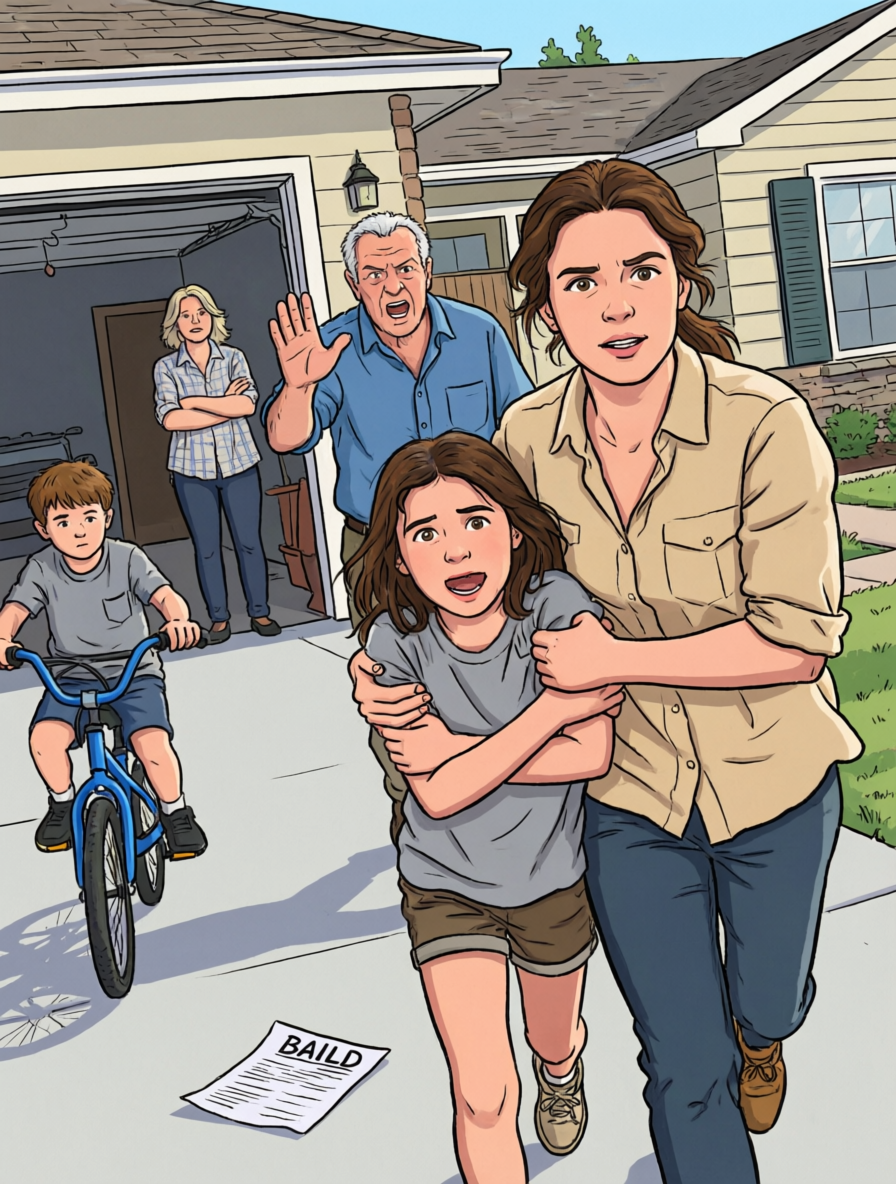
Emma pressed her palm to her cheek, her confusion far worse than tears.
“Grandpa,” she whispered, her breath hitching, “I didn’t do anything.”
My father grabbed the bicycle from her hands as if she had stolen it, his grip tight and unapologetic.
“Kids like you don’t deserve things this nice,” he growled, and then he turned to Mason. “Take it. You’ll use it better.”
Mason didn’t hesitate, hopping onto the seat with a grin that looked practiced, pedaling tight circles around us like this was entertainment instead of humiliation.
Emma tried to step forward, but my father pressed two fingers against her forehead and shoved her back with casual cruelty.
“Trash doesn’t get shiny toys,” he said flatly. “Your mother never learned that either.”
My mother crossed her arms from the porch, a small smile curling at the corner of her mouth like she was watching a show she’d seen before and approved of.
“You shouldn’t teach her to want things above her level,” she added coolly. “She’s already too sensitive, just like you.”
Carara laughed under her breath, and Nate didn’t say a word, which somehow made it worse.
“Good thing Mason got it,” my sister chimed in. “At least someone in this family isn’t pathetic.”
Emma’s tears fell then, large and silent, sliding down her cheeks as if they were too heavy to stay inside.
“Mom,” she whispered, tugging at my sleeve, “can we go?”
She wasn’t asking for the bike back.
She wasn’t asking for an apology.
She was asking to escape.
My father shouted after us as I took her hand and turned away.
“Don’t walk off like you’re somebody,” he called out. “You could barely afford gas last month. Don’t pretend you’re better than us.”
Emma squeezed my fingers, her voice breaking in a way I will never forget.
“Mom… is Grandpa right? Am I trash?”
I knelt in the driveway, ignoring the laughter behind us, and wiped her tears with hands that were shaking from restraint, not weakness.
“No,” I said, my voice calmer than I felt. “But he’s about to learn he can’t treat us like that.”
Because something had shifted inside me, something cold and deliberate that no longer cared about keeping the peace or earning approval from people who fed on humiliation.
That night I didn’t sleep.
Every time I closed my eyes I saw her tiny hand flying to her cheek, the disbelief in her face when someone she had hoped would be proud instead decided to punish her for daring to receive something good.
Rage burned, but I refused to let it explode recklessly because my father thrived on chaos and emotional reactions.
If I stormed back there screaming, he would label me dramatic, unstable, ungrateful.
He would win.
So I didn’t plan noise.
I planned consequence.
The next morning I woke Emma gently and told her we were going out, and when she asked if we were seeing Grandpa again, I told her no in a tone that closed doors permanently.
I dropped her at my friend Jenna’s house, one of the few people who knew the full history of my parents’ cruelty, and she hugged Emma tightly before looking at me with quiet understanding.
“Do what you need to do,” she said.
When I pulled into my parents’ driveway again, my father was washing his truck like nothing had happened, Mason’s laughter echoing faintly from the backyard, and I stepped out of the car with a steadiness that surprised even me.
“You put your hands on my daughter,” I said, standing close enough that he couldn’t pretend he hadn’t heard.
He smirked without looking away from the water running over his tires.
“You always were dramatic,” he replied. “Maybe if you raised her right, she’d learn respect.”
“You slapped her,” I repeated, because sometimes repetition is the only way to force someone to confront what they’ve done.
“She deserved to learn early that she’s not special,” he said with a shrug. “Neither are you.”
And in that moment, I realized he still believed I would swallow it like I always had.
He still believed I needed him.
He had no idea how wrong he was.
 :
: