I’m Derek Lawson. I’m thirty-five years old, and the first time my family came up my private drive after nearly ten years of pretending I didn’t exist, I was standing in my garage with grease on my hands and an old motorcycle on the lift.
It was a Saturday in late October, the kind of Texas afternoon that feels almost polished. Sunlight moved in clean bands across the concrete floor. The doors of the garage were open, and the air smelled like cut cedar, engine oil, warm metal, and the last dry leaves shaking loose from the live oaks that lined the road down to my gate. On the workbench behind me sat a tray of sorted bolts, a rag dark with oil, and a mug of coffee I’d forgotten to finish two hours earlier.
I was rebuilding a 1972 Triumph Bonneville that had been abandoned behind a storage unit in Waco for longer than most people keep marriages. The chrome was pitted, the tank had a crease down one side, and the wiring looked like someone had tried to solve a personal crisis with electrical tape. To most people, it would have looked like junk.
To me, it looked honest.
Broken things don’t pretend they’re whole. Rust doesn’t lie. A bent frame doesn’t smile at you across a Thanksgiving table and tell you family is everything while leaving you off every invitation list for a decade. Machines, at least, tell the truth. They show you exactly where the stress cracked them, where the neglect set in, where someone gave up.
People are harder.
People can rot in secret and still walk into your house wearing pearl earrings, pressed slacks, and the same polite expression they use at church luncheons.
I heard the first car before I saw it.
My property sits about forty minutes outside Austin, far enough from the city that the sky opens up at night, but close enough that contractors, architects, and clients can still get to me without acting like they’re crossing a border. The house itself sits beyond a coded gate and a winding limestone drive, past native grasses, a stand of oaks, and a man-made lake I designed myself because I liked the way water changed a place. It slows people down. It makes them look. It makes them understand, before they reach the front door, that somebody thought through every foot of land.
The sound of tires on gravel carried clearly.
One vehicle, then another, then a third.
I straightened slowly from the motorcycle and looked toward the drive.
First came a white Mercedes SUV I recognized even before it cleared the trees. My mother, Monica Lawson, had always believed German cars made people take you more seriously. Behind it was a black Lincoln Navigator that belonged to my grandmother, Patricia Whitaker, unless she’d traded it in for an identical newer model, which was the kind of thing she’d do. The third was a charcoal Range Rover, glossy, expensive, and driven like the owner expected the road to apologize for being there.
The vehicles rolled in together, slow and careful, as if the drive itself had made them uneasy.
I stood still for a second with the wrench in my hand.
Seeing them on my property felt like finding rats in your kitchen. Not because they were animals, but because you know what it means. Something got in. Something had been hiding. And now you were going to have to deal with it.
For almost ten years, my family had treated me like a closed road. They knew I existed, but they built routes around me. Holidays, weddings, birthdays, family reunions, baby showers, retirement dinners—none of those invitations found their way to me. At first I thought maybe it was an accident. Then I thought maybe it was punishment. Eventually I understood it was neither.
It was convenience.
They had decided who I was, and then they protected that decision like it was family property.
I was the disappointment. The kid who liked tools more than textbooks. The one who didn’t fit into the Whitaker-Lawson family mythology of degrees, promotions, club memberships, and quiet contempt disguised as standards. I was the son who left the University of Texas engineering program after two years because I wanted to build in the real world instead of sit in lectures talking about load distribution while someone else did the work. I was the grandson who chose trade school, job sites, concrete pours, steel beams, blistered hands, and payroll stress over internships arranged by men in navy blazers.
They had used the word phase for years.
“Derek is going through a phase.”
“Derek is still playing with tools.”
“Derek is trying to find himself.”
“Derek has always been more hands-on.”
That last one was said with a smile so thin it could cut fruit.
Then, when my construction company began to grow, when those early jobs turned into commercial contracts, custom homes, land development, municipal bids, and eventually one of the fastest-growing design-build firms in central Texas, they didn’t change their story. They simply stopped asking questions that might force them to.
I put the wrench down.
The cars stopped in front of the house.
Doors opened.
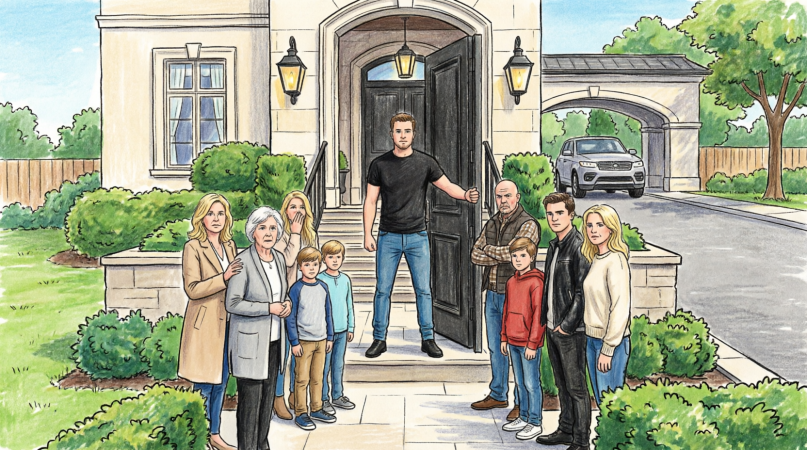
And out came the family that had spent years pretending I wasn’t worth a seat at their tables.
My mother stepped out first, smoothing the front of her beige cashmere sweater like she was arriving at a charity brunch instead of the home of the son she hadn’t called on Christmas in eight years. Monica Lawson was sixty, but she fought the number with money, discipline, and a private terror of becoming invisible. Her blonde hair was shaped into a precise shoulder-length bob. Her makeup was soft, expensive, and just obvious enough to look natural to people who didn’t know what natural looked like.
My father, Steve Lawson, got out on the driver’s side. Tall, still broad in the shoulders, with a golf tan and the permanent frown of a man who believed he had been disappointed by the world because it had not arranged itself entirely around him. He had made a career in commercial insurance, the kind of industry where handshakes, lunches, and knowing which men liked bourbon mattered almost as much as numbers. He had always spoken to me like I was a promising employee who’d failed probation.
Then came my grandmother.
Patricia Whitaker didn’t exit a car. She emerged.
At eighty-two, she still carried herself like a woman expecting the room to stand when she entered it. Her silver hair was swept back in a perfect shell, her cream coat draped over her shoulders, a string of pearls at her neck. She’d been born into enough money to believe comfort was moral proof. After my grandfather died, she became the uncontested queen of every family gathering, the woman who assigned seats, approved marriages, remembered every slight against herself, and forgot every cruelty she committed against others.
Behind them came my older brother Jake.
Jake was thirty-eight and still had the look people called handsome when they meant familiar. Sandy hair, blue eyes, strong chin, the golden boy packaging that had worked for him since childhood. He had been praised for everything I was ignored for. If Jake got a B, the teacher was too hard. If I got an A, the class must have been easy. If Jake crashed Dad’s car at seventeen, boys make mistakes. If I scratched the truck hauling lumber for a neighbor, I was careless. Jake had gone to law school, married well, divorced badly, married again, and apparently brought the second wife’s replacement or companion or damage-control blonde with him.
She stepped from the Range Rover wearing a camel coat and black heeled boots completely wrong for gravel. Late twenties, maybe early thirties. Perfect hair, perfect nails, lips shaped into the slight curve of someone who expected to be photographed at any moment. I didn’t know her then. Later I would learn her name was Brittany Hale, and that she had been engaged to Jake for eleven days and terrified of what she had agreed to.
Two cousins followed from the third vehicle: Tyler and Brandon Whitaker. Tyler was my age, restless, sharp-faced, always performing confidence. Brandon was a few years younger, quieter, heavier-set, with kind eyes he tried to hide because kindness had never been especially rewarded in our family.
They gathered in my drive and stared at the house.
That was the first gift they gave me, though they didn’t mean to.
They stared.
The home I had built didn’t whisper wealth. It didn’t decorate itself in obvious luxury. It simply stood there with the calm of something made by people who knew what they were doing. Limestone exterior cut from the region. Dark standing-seam metal roof. Steel-framed windows. Broad terraces. Native landscaping that looked wild from far away and intentional up close. A front door made from black walnut, twelve feet tall, hand-built in my own mill shop by a carpenter named Luis Ortega who cried when we hung it because his father had trained him on doors and never lived to see one of his sons sign his name inside the frame.
The house had no columns pretending to be Greek, no fountain shaped like a regret, no decorative nonsense copied from luxury magazines by people afraid of silence.
It was solid.
That was all I’d ever wanted.
I wiped my hands slowly on the rag and walked from the garage to the front entry. My boots sounded against the stone, each step measured. I was aware of my clothes—flannel shirt, dark jeans, work boots, a streak of grease near my wrist—but for the first time in my life, standing in front of my family, I didn’t feel underdressed.
I felt like the only person there wearing something real.
I opened the door before they could ring.
For a second, nobody moved.
They just stared at me the way people stare when a story in their head fails in public.
Their expressions arrived in stages. Surprise first. Then confusion. Then the slow, uncomfortable recalculation.
Because the version of me they had kept preserved was not this man. Their Derek was smaller. Their Derek was rough around the edges in a way they could dismiss. Their Derek was the kid at family dinners with sawdust in his hair, the one who smelled like work and didn’t know which fork Patricia wanted him to use for salad. Their Derek was supposed to be living in some modest house near a highway, maybe running a contracting business with a dented truck and a few guys paid in cash.
What stood in front of them was a man they didn’t know how to categorize.
I had my father’s height and my mother’s blue eyes, but nothing of their nervous need to be seen properly. At thirty-five, I was broad from years of lifting things heavier than opinions. My hands were rough, yes, scarred across the knuckles, callused at the base of the fingers, a thin white line on my thumb from a framing accident when I was twenty-two. But those hands had built companies, not just houses. They had signed payroll checks, donated operating room equipment, held a dying employee’s wife while she cried in a hospital hallway, and written letters of recommendation for kids who thought people like them didn’t get second chances.
Patricia recovered first, because Patricia always did. Her whole identity was built on being the first person to speak, the first person to define the room, the first person to make everyone else react to her frame.
“Derek,” she said, voice trying for warmth but landing stiff. “What a… beautiful home you have.”
I nodded once.
“Hard work pays off.”
It came out smoother than I expected. Not bitter. Not sharp. Just factual.
The silence that followed felt like a long pause in a song where everyone forgot the next line.
Monica stepped forward with a bright plastic smile—her specialty. The smile she used at country club brunches, at charity auctions, at funerals where she wanted people to think she was grieving more than she actually was.
“We were in town for the Johnson family reunion,” she said lightly, like this was all perfectly normal. “We thought we’d stop by since we heard you lived out this way.”
The Johnsons lived near Fredericksburg, more than two hours away. Even if they were “in town,” there was no casual stop-by involved. This was planned. Coordinated. Discussed. A group decision made in some restaurant or hotel suite where my name had been spoken not with affection, but with calculation.
I looked at each of them.
My father avoided my eyes.
Jake tried to smile and failed.
Brittany’s gaze flicked past me into the entryway and widened before she caught herself.
Tyler shifted his weight.
Brandon looked almost embarrassed to be standing there.
I opened the door wider.
“Do you want to come in,” I asked, “or are we having this conversation on the porch?”
They filed inside.
And that was when their eyes really changed.
Because the inside of my house didn’t give them anywhere to hide their surprise.
The entryway rose two stories, all stone, glass, warm wood, and quiet light. Sunlight came through the clerestory windows and fell across the imported limestone flooring, which held a cool temperature even in summer and radiant warmth in winter. A floating walnut staircase curved along the right side, held by hand-forged iron railings with a hammered texture you could feel under your palm. The walls held original art from Texas artists I knew personally, people whose work had dirt, memory, and weather in it.
No decorator had ordered my home by catalog.
Every piece had a story.
The bench by the door was made from a pecan tree struck by lightning on the property before construction began. The iron chandelier above the entry was built by a metalworker in San Antonio whose grandfather had shod horses. The console table beneath the painting had been my first attempt at furniture when I was nineteen, sanded down and refinished after years in storage because I wanted one imperfect thing from my beginning visible at the front of everything I’d become.
Tyler couldn’t help himself.
His mouth actually fell open.
“Man,” he said, half under his breath. “This place is… insane.”
I looked at him.
Tyler used to laugh at me for taking shop class seriously. Used to call me “tool boy” like it was clever. At sixteen, he once held up a wrench at Christmas and asked if it was my “college degree.” Everyone laughed except my grandfather, who was already sick and too weak to correct them. I remembered the sound of that laughter. It had followed me for years, not loudly, but persistently, like a loose screw somewhere in a wall.
“It’s home,” I said.
Brandon glanced up at the staircase. His face was open in a way that made him look younger. “You built all this?”
“My company did,” I said. “I designed a lot of it. Built some parts myself.”
My father made a quiet sound in his throat, almost a scoff, but not brave enough to become one.
Patricia heard it and gave him a glance. Not now.
That told me more than I needed to know.
They had rehearsed.
Monica touched the edge of the console table. “It’s very tasteful.”
Very tasteful.
That was Monica’s way of admitting she was impressed without surrendering authority. If she called something beautiful, she owed it sincerity. If she called it tasteful, she kept the upper hand.
I smiled faintly.
“Coffee?”
The question surprised even me.
Not because I wanted to play nice. Not because I wanted them comfortable. But because I needed to see this all the way through. I needed to watch them sit in the house they never imagined I could build. I needed to let them perform closeness after a decade of absence and witness the exact moment the mask slipped.
They accepted too quickly.
People who come only to visit say, “Oh, we don’t want to impose.”
People who come to ask for something sit down.
We ended up in the living room, my favorite room in the house because it felt the most honest. Twenty-foot ceilings. A stone fireplace faced with rock from my own property. A mantle cut from a single piece of mesquite that I had milled and finished by hand. Floor-to-ceiling windows looked out over the engineered lake, the meadow, and the line of oaks beyond it. The furniture was comfortable, not delicate. Deep leather couches, wool throws, a coffee table thick enough to survive generations.
I didn’t build the room to impress guests.
I built it because I liked winter mornings by firelight, summer storms rolling over the land, and evenings when my closest friends came over with pizza, beer, dogs, children, and too many opinions about football.
My family sat on the couches like they were afraid to leave fingerprints.
Monica kept darting glances toward the windows. Steve examined the stonework like he was searching for a flaw he could mention later to regain balance. Tyler leaned forward, restless. Brandon sat with his hands folded, looking from the fireplace to me and back again. Jake sat stiffly, shoulders tight, knee bouncing once before he stopped it with his hand.
Brittany perched with perfect posture, legs crossed, expression confident in a way that didn’t reach her eyes. She looked around not just with admiration, but with alarm. I had seen that look before from clients who realized too late that the quiet contractor at the table understood the budget better than they did.
I served coffee in ceramic mugs made by a woman in Marfa. Patricia lifted hers, inspected it, and said, “How rustic.”
“It holds coffee,” I said.
Brandon coughed into his cup.
That was the first almost-laugh of the afternoon.
It died quickly.
We did small talk. Weather. Austin traffic. The drive. The new developments west of town. Safe topics that floated around the real reason they were there like leaves around a drain. Everyone could see where the current was going. Nobody wanted to be the first to admit they’d stepped into the water.
Monica asked about the house, and I answered just enough to let them understand the scale. Six bedrooms, though only one was mine. A workshop. A library. A media room I rarely used unless my godson came over and demanded superhero movies. A pool behind the southern terrace. A guesthouse near the lake. Solar array hidden beyond the ridge. Rainwater collection. Geothermal components. Materials chosen to last.
I didn’t brag.
I stated facts.
That made it worse for them.
Bragging would have allowed them to dismiss me. Facts required adjustment.
My father asked about my company, Lawson Build & Design, as if remembering suddenly that asking questions was expected of a parent.
“How many employees now?” he said, voice casual.
“Direct payroll? One hundred and forty-two.”
His eyebrows moved despite himself.
“That many?”
“More if you count subcontractor crews we use regularly.”
“Must be a lot to manage.”
“It is.”
“Commercial mostly?”
“Commercial, custom residential, municipal work, some development partnerships.”
He nodded slowly. “And you own all of it?”
“I own controlling interest.”
Patricia’s eyes sharpened at that phrase.
Controlling interest.
There it was. The language she respected.
Not craft. Not work. Not building. Control.
Jake looked down into his coffee.
Brittany looked at him, then at me.
I saw a question form behind her eyes. Not about the company. About Jake.
Good, I thought.
Ask better questions than my family ever did.
Then Monica cleared her throat.
That sound.
That careful pause people make right before they ask for something they know they haven’t earned.
“Derek,” she began, “we’ve been thinking about family lately.”
My stomach tightened, but my face didn’t change.
I waited.
She set her mug down on the coffee table, aligning it carefully with the edge like order could make the words cleaner.
“You know, time goes by so quickly,” she said. “And then you look around and realize distance has formed where there shouldn’t have been distance.”
Distance had formed.
As if distance were weather.
As if it had drifted in overnight and settled between us without anybody opening a door.
My father nodded, taking his cue.
“We’ve all been busy,” he said. “Life gets complicated.”
I said nothing.
Patricia leaned back, watching me with the patience of someone waiting for a servant to understand instructions.
Monica continued, “Jake’s going through… some financial difficulties.”
There it was.
The real reason stepped into the room wearing polished shoes.
“With the divorce settlement,” she said gently, “and legal fees, and some business complications—”
Jake’s face hardened, not at the situation, but at the embarrassment of hearing it said aloud.
“Mom,” he muttered.
She touched his arm. “It’s family, sweetheart.”
Family.
The word landed between us like a tool dropped on concrete.
I leaned back slightly.
“Legal fees?” I asked.
Jake’s eyes flicked up and away. He didn’t meet mine.
My father jumped in, eager, as if he had rehearsed his part and couldn’t wait to arrive at the section where he sounded practical.
“I’ve also been looking at some investment opportunities,” he said. “In the construction sector. With your expertise and connections, we could put together something lucrative for the whole family.”
I almost smiled.
Not because it was funny.
Because it was so predictable it might as well have been scripted.
They hadn’t come here to reconnect.
They had come because they finally noticed I wasn’t struggling anymore.
Patricia, of course, delivered the line she thought would make it all sound noble.
“We’ve missed having you at family gatherings,” she said. “It’s time we put the past behind us and start acting like a real family again. Family takes care of family.”
My pulse beat steady in my ears.
I looked at them one by one.
Ten years of exclusion. Ten years of judgment. Ten years of them telling themselves I was a failure so they didn’t have to feel threatened by my choices. Ten years of weddings I learned about through Facebook posts from strangers. Ten years of Thanksgiving photos where my absence was so normal no one even had to explain it. Ten years of my mother leaving voicemails only when she needed a repair recommendation, my father texting only to ask if I “knew a guy” for a discounted patio, my brother never reaching out unless he needed a tool, a truck, or silence.
And now they wanted to put the past behind us.
As long as I opened my wallet.
I set my coffee down carefully.
“That’s interesting,” I said.
Nobody moved.
“Remind me,” I continued, calm, “when was the last family gathering I was invited to?”
The room changed.
Not dramatically. There was no gasp, no music, no thunderclap. Just a subtle tightening of bodies. Monica’s fingers froze on the handle of her mug. Steve’s jaw shifted. Tyler looked toward the window. Brandon lowered his eyes. Jake’s knee started moving again.
Patricia’s face remained composed, but her gaze cooled.
Monica opened her mouth.
Closed it.
Opened it again.
“Well,” she said finally, “you know how it is. Busy schedules and—”
“No,” I interrupted gently.
Not loud.
Not aggressive.
Just firm.
“I don’t know how it is. Why don’t you tell me?”
I saw it then—the moment they realized the old Derek wasn’t sitting in front of them anymore.
The old Derek used to crave approval so badly he’d swallow anything to be included. He’d laugh at jokes that hurt. He’d accept seating arrangements that made him feel small. He’d show up with gifts, with offers to help, with hope. He’d stand in kitchens after family dinners washing dishes nobody asked him to wash because usefulness felt like the closest thing to love.
That Derek didn’t live here anymore.
Jake finally spoke, voice tight.
“Derek, I know we haven’t been as close as we should’ve been.”
“Close?” I repeated softly.
He flinched as if I’d raised my voice.
I hadn’t.
“I haven’t received a call, a text, a birthday card, or a holiday message from anyone in this room in over eight years,” I said. “You got married—twice—and nobody told me. Grandma told people I was a construction worker who’d never amount to anything. Mom called me the family embarrassment. Dad told a client once that he had one son in law and one son in labor. And now you’re sitting in my living room talking about being close.”
Their faces changed one by one.
Tyler went pale.
Brandon swallowed hard.
Steve’s jaw clenched.
Monica blinked too fast.
Patricia’s eyes sharpened, like she wanted to cut me down with a look and was irritated to discover I no longer bled on command.
Jake’s shoulders slumped slightly.
The comfortable story they had told themselves—that the distance was mutual, that I chose to stay away, that I was difficult, proud, sensitive, busy, unreachable—began cracking under plain facts.
Tyler tried to smooth it over.
“Come on, man,” he said. “Maybe we all could’ve done better staying in touch.”
I stood up.
Not to intimidate them, though my height changed the room. I stood because my body wouldn’t let me sit there and listen to them sand down history until it became something smooth enough to hold.
“Let me tell you about staying in touch,” I said.
No one interrupted.
So I began.
One memory at a time.
Like laying boards down in a straight line so nobody could pretend they didn’t see the structure.
“When I started my company, I called Dad to tell him about my first big contract. A forty-unit renovation in Round Rock. I was twenty-six. I had slept four hours in three days putting that bid together. You know what he said?”
My father looked away.
I answered for him.
“He said, ‘That’s nice, son. Jake just got promoted.’”
Jake’s face tightened.
“When I bought this land and started planning the house, I sent Mom pictures because I was proud. She showed them to people and told them I was still playing with tools.”
Monica’s eyes flicked to Patricia as if checking whether denial was expected.
I didn’t stop.
“When Jake got engaged the first time, I offered to help pay for the wedding because I knew things were tight after Dad’s bad investment that nobody talks about. Mom told me they had it covered and suggested I just bring a nice gift. At the reception, I was seated with people I’d never met while Jake’s friends got the main family table. When he gave his speech thanking everyone who supported him, he thanked professors, bosses, buddies, bartenders, half the room. I wasn’t worth one sentence.”
Jake’s throat moved like he swallowed something sharp.
Brittany stared at him.
“I didn’t know that,” she said quietly.
Jake didn’t answer.
I looked at him.
“I’m not done.”
That was when Patricia’s hands trembled slightly around her cup.
And I knew the next part would hit hardest, because Patricia could dismiss emotion. She could dismiss pain. She had done it her whole life. But she could not dismiss being accurately quoted.
“At Grandpa William’s funeral,” I said, “I stood near the back because nobody saved me a seat. I was twenty-four. I’d been at his house every Sunday for six months fixing the ramp, repairing the bathroom, getting him in and out of the truck when he still wanted to see the lake. He taught me how to sharpen chisels. He told me never to be ashamed of work. And when the family obituary went out, it named every grandchild except me.”
Patricia’s lips pressed together.
“That was an oversight,” she said.
I looked at her.
“You edited it three times.”
The color moved in her face, faint but visible.
“Nobody meant—”
“Yes,” I said. “You did.”
The room went still.
Outside, wind moved across the lake, dragging a sheet of silver light across the water.
I thought of my grandfather then, not as he was in the coffin, but as he’d been before sickness thinned him. William Whitaker had been a big man with hands like carved oak and a laugh that filled rooms Patricia later ruled with silence. He had built bridges for the county, barns for neighbors, cabinets for daughters who grew up to pretend their comfort came from manners instead of labor. When I was little, he let me hold nails in a coffee can while he worked. He never called my curiosity a phase.
A week before he died, he squeezed my wrist and said, “You build straight, Derek. Even when people around you don’t.”
For years, I thought he meant houses.
I know better now.
Patricia set her cup down with a small, sharp sound.
“You always were dramatic,” she said.
There she was.
Not the grandmother trying for reconciliation. Not the matriarch speaking of family. The real Patricia. Annoyed. Cornered. Dangerous because she had never learned how to apologize without feeling robbed.
I nodded.
“And you always called the truth drama when it didn’t flatter you.”
Monica inhaled.
“Derek.”
“No,” I said, turning to her. “You don’t get to soften this. Not today.”
She looked wounded, but only because she expected the role to work.
I had seen my mother’s wounded face my entire life. It appeared whenever accountability entered the room. It had worked on my father. It had worked on Jake. It had worked on me for twenty-five years.
It didn’t work now.
I walked toward the fireplace and rested one hand on the mesquite mantle. The wood was warm from sunlight. I could feel the grain under my palm.
“I didn’t build this life to prove anything to you,” I said. “I built it because I had to. Because when I was younger, I realized no one in this family was ever going to catch me if I fell.”
That line seemed to unsettle Brandon more than anyone.
He looked up at me, and for a second I saw the boy he used to be—the quiet cousin sitting at the edge of rooms while Tyler performed and Patricia approved.
“Derek,” he said softly, “I’m sorry.”
The apology was so plain, so unpolished, that nobody knew what to do with it.
Patricia looked at him sharply.
He didn’t look back.
I studied him.
I believed him.
That was inconvenient, but truth often is.
My father cleared his throat. “Look, son—”
“Don’t call me that right now.”
He stopped.
A flicker of anger crossed his face. Beneath that, embarrassment. Beneath that, something else I couldn’t identify because I’d almost never seen it from him.
Maybe fear.
Steve Lawson did not fear people. He judged them, dismissed them, advised them, ignored them. But fear? That was new.
Maybe it wasn’t me he feared.
Maybe it was the realization that the son he considered least successful had become the only person in the room with actual power.
I picked up my phone from the side table.
Not to show off numbers. Not bank accounts. Not contracts.
Photos.
“These,” I said, turning the screen toward them, “are the people who actually showed up.”
The first photo was from a muddy job site after a storm. Me and my crew, soaked, covered in dirt, grinning like idiots because we had finished a foundation pour minutes before rain would have ruined everything. Luis stood beside me with one arm raised. Marisol from permitting had mud up to her knees. Ray, my foreman, was laughing so hard his hard hat had slipped backward.
“This is my foreman, Ray Maldonado,” I said. “He started with me when we had three trucks and more debt than sense. I helped him buy his first house last year.”
I swiped.
A little girl in a purple graduation gown, missing two front teeth, holding a certificate in front of a community center.
“My office manager’s daughter. Her name is Emily. I’m paying for her education. Not because anyone asked. Because her mother kept my company alive when I couldn’t afford mistakes, and because Emily earned it.”
I swiped.
A man in a clean button-down standing in front of a small office with a sign that read Ortega Concrete Solutions.
“Concrete crew leader I co-signed a business loan for when the bank laughed him out of the office. He paid me back early. Now he employs eighteen people.”
Patricia looked away, but not quickly enough.
I swiped again.
A ribbon-cutting ceremony in front of a hospital entrance. Children painted on the wall behind us. Doctors, nurses, donors, construction workers in clean boots, and a plaque with a name carved into it.
That one hit them hard.
Because the name on the wall was familiar.
William Whitaker Pediatric Recovery Wing.
Our great-grandfather’s name. The man who worked construction his entire life to keep food on the table. The man Patricia used to talk about with pride before she decided manual labor was acceptable only when safely buried in the past.
“The wing used to be a basement,” I said quietly. “Bad lighting. Old equipment. Families sleeping in chairs. Nurses doing miracles in conditions that made no sense. We fixed that.”
No one spoke.
I swiped again.
A group of students standing outside Austin Community College, holding tool belts, hard hats, welding masks, drafting kits.
“This is the trade scholarship fund I set up. Every year we pick students who want to learn a trade without drowning in debt. Tuition. Tools. Boots. Safety gear. Covered.”
I looked at Patricia directly.
“That’s the legacy I chose.”
Her lips trembled.
“Derek,” she said, voice thinner now. “We didn’t know.”
“You didn’t know because you never asked.”
That was the truth of it.
Simple.
Clean.
Unavoidable.
They had been too busy being embarrassed by me to ever be curious about me.
I put my phone away, and for a moment the living room felt larger, as if a wall I had carried inside my chest had finally been set down.
Monica wiped under one eye carefully, protecting her makeup.
“I made mistakes,” she said.
It should have been a beginning.
Instead, it sounded like an offering she expected me to accept because she had finally named the category.
I waited.
She added nothing.
No details. No memory. No ownership. Just a broad, tasteful regret.
Steve leaned forward, elbows on knees.
“We all did,” he said. “But Derek, you have to understand, from our perspective, we worried. You left school. You turned down opportunities. You didn’t follow a stable path.”
I laughed once.
It surprised all of us.
Not a loud laugh. Not cruel. Just involuntary.
“A stable path?” I said. “You mean Jake’s?”
Jake stiffened.
Steve’s face hardened.
“Your brother made something of himself.”
Brittany’s head turned toward Jake slowly.
There it was—the family reflex. Even in my house, even while asking for my help, my father reached for the old measuring stick.
I nodded.
“Let’s talk about that.”
Jake said, “Derek, don’t.”
But I was already looking at Brittany.
“Did Jake tell you why he needs money?”
She held my gaze.
“He said his ex-wife was being unreasonable,” she said carefully. “He said the firm partnership fell apart because of politics.”
I watched Jake close his eyes.
“Of course he did.”
Monica snapped, “This isn’t appropriate.”
“No,” I said. “What isn’t appropriate is bringing a woman into my home under false pretenses while asking me to fund whatever story he told her.”
Brittany’s posture changed. The polished confidence slipped, replaced by something more awake.
“Derek,” Jake warned.
I ignored him.
“Jake’s first divorce wasn’t expensive because his ex-wife was unreasonable,” I said. “It was expensive because he hid assets badly and tried to make her look unstable when she found out.”
Brittany’s face drained.
“That’s not—” Jake began.
“Careful,” I said. “I still know people.”
That quieted him.
It wasn’t a threat in the dramatic sense. It was a fact. In construction, development, permitting, legal disputes, real estate finance, charity boards, and city contracts, people talk. They talk over coffee. They talk in parking lots. They talk after meetings when the official language ends. For years, my family mistook my silence for ignorance.
Silence is not ignorance.
Sometimes silence is storage.
I looked at Brittany.
“His second marriage ended after he borrowed against property that wasn’t entirely his to borrow against. His ex found out because a lien notice came to the house. The legal fees are not from bad luck. They’re from consequences.”
Brittany stood up.
Jake reached for her hand.
She pulled away.
“Is that true?” she asked him.
Jake’s mouth worked, but no answer came.
Patricia’s voice cut through the room.
“Derek, enough.”
I turned.
“Enough?”
Her chin lifted.
“You are humiliating your brother.”
I looked at Jake. Then at my grandmother.
“No,” I said. “He did that. I’m just refusing to pay the cleanup bill.”
Patricia rose with surprising speed for a woman her age. “You think money makes you superior now?”
The room inhaled around us.
There she was fully.
No more family softness. No more careful appeal. The matriarch had come down from the portrait frame.
I faced her.
“No,” I said. “I think character does.”
Her eyes flashed.
“You were always resentful.”
“I was lonely.”
“You chose to separate yourself.”
“You locked the door and called it my preference.”
“You embarrassed this family.”
I smiled then, not because I was amused, but because something finally became clear.
“There it is.”
Monica whispered, “Mother.”
But Patricia kept going.
“You walked away from a future people would have killed for. You had opportunities. Your father had connections. We could have helped you become respectable.”
Respectable.
The word entered the room wearing a white glove and carrying a knife.
I thought about the men and women who had worked beside me in rain, heat, injury, and debt. I thought of Ray’s hands shaking the day he signed mortgage papers. Luis teaching apprentices to measure twice because wasted material was wasted dignity. Marisol sitting in city offices for hours to get permits unstuck. My crews pouring concrete at four in the morning because summer heat didn’t care about anyone’s comfort. My grandfather, breathing through pain, telling me a clean joint mattered even if nobody saw it.
Respectable.
I took one step toward Patricia.
“What part embarrassed you most?” I asked. “The work? The dirt? The fact that I stopped begging to be valued by people who had none to give?”
Her mouth opened.
No answer came.
I lowered my voice.
“You came here today because you need something from me. Not because you love me. Not because you missed me. Not because you woke up suddenly ashamed of what you did. You came because Jake needs money, Dad sees an investment angle, Mom wants the family picture repaired, and you—”
I stopped.
Patricia’s eyes narrowed.
“And I what?”
“You want control back.”
For the first time all afternoon, she looked genuinely shaken.
Because I had named the thing nobody in the Whitaker family was allowed to name.
Control had always been Patricia’s real inheritance. She controlled seating, invitations, emotional weather, family narratives. She controlled who was praised and who was pitied, who was forgiven and who was permanently marked. She controlled history by telling it first and loudest.
But my house, my land, my company, my money, my peace—none of it had passed through her hands.
And that offended her more deeply than my absence ever had.
Brandon stood slowly.
“Grandma,” he said, “maybe we should go.”
She turned on him.
“Sit down.”
He didn’t.
The room shifted again.
Small rebellions can sound quiet from outside. Inside a family system, they are earthquakes.
Brandon looked nervous, but he remained standing.
“I don’t think we came here for the right reasons,” he said.
Tyler stared at him. “What are you doing?”
“Saying what everyone knows.”
Patricia’s face hardened. “You have always been weak.”
Brandon flinched.
I felt something old and protective rise in me.
“No,” I said. “He’s just the first one besides me who got tired of mistaking cruelty for strength.”
Brandon looked at me then, and in his face I saw years I hadn’t been around to witness. Maybe Patricia’s control hadn’t only cut me. Maybe I had been so focused on surviving my own exclusion that I never considered the damage left inside the room after I was pushed out of it.
Tyler stood too, but not in support. In agitation.
“This is insane,” he said. “We drove all the way out here to ask for help, and now everyone’s acting like we’re criminals.”
“You drove all the way out here to ask for money,” I said.
He threw up his hands. “So what? You clearly have plenty.”
There it was.
The cleanest sentence anyone had spoken since they arrived.
Monica made a small horrified sound. “Tyler.”
“What?” Tyler snapped. “He does. Look around.”
I did look around.
At the stone. The windows. The craftsmanship. The quiet. The home I had built after years of sleeping in rental rooms, job trailers, and an apartment above a warehouse because every dollar went back into the company. I looked at the evidence of my labor and wondered how someone could stand inside it and see only extra.
“You’re right,” I said.
Tyler blinked.
“I have plenty.”
His expression softened with greedy relief.
I continued, “And not one dollar of it is owed to people who mocked the hands that earned it.”
The relief died.
Steve stood now, red creeping up his neck.
“You watch how you talk to this family.”
I looked at him for a long moment.
When I was twelve, that voice could stop me cold.
When I was sixteen, it could make me defensive.
When I was twenty-four, it could still make me explain myself.
At thirty-five, in the home I built, surrounded by people who needed me more than I needed them, it sounded tired.
“No,” I said.
My father stared.
Just one syllable.
No.
I could see him trying to find the old chain between us. Father to son. Authority to obedience. Disappointment to apology. But chains rust when left unused, and this one had snapped years ago without him noticing.
“No,” I repeated. “You don’t get to come into my house, ask for my resources, insult my life, and then demand respect because we share blood.”
His hands curled once, then relaxed.
Monica stood, tears bright now.
“Derek, please. This has gotten out of hand. We didn’t come to fight.”
“You came to take.”
“That’s unfair.”
“Is it?”
She pressed her lips together.
“What did you bring me?” I asked.
She looked confused.
“What?”
“You came here after nearly a decade. What did you bring? An apology? A memory? A birthday card you forgot to send? A photo of my nieces and nephews I’ve never met? A story about my grandfather? A single question about my life that wasn’t attached to your needs?”
Her face collapsed in tiny increments.
“Derek…”
“What did you bring, Mom?”
The word Mom hurt more than I expected.
Maybe it hurt her too. Maybe not.
She looked down.
Nothing.
They had brought nothing.
Not even shame, until I forced it into the room.
Brittany picked up her purse.
“Jake,” she said, voice low and flat, “I need the keys.”
Jake looked at her. “Brittany, come on.”
“The keys.”
He reached into his pocket slowly and handed them over.
Patricia glared. “Young lady, this is family business.”
Brittany looked at her with startling coldness.
“Apparently not,” she said. “Apparently it’s a loan meeting.”
Then she turned to me.
“I’m sorry,” she said. “I didn’t know.”
I nodded once.
“I believe you.”
She walked out without another word.
The front door closed behind her with the soft, heavy sound of good hardware doing exactly what it was designed to do.
Jake sat down slowly, as if his knees had lost interest in him.
For a moment, I almost felt sorry for him.
Almost.
But pity is not the same as responsibility.
And I had spent too many years confusing other people’s discomfort with my duty.
Patricia gathered herself.
“We can discuss specifics another time,” she said, reaching for dignity the way a drowning person reaches for driftwood. “Emotions are high.”
“No,” I said. “We’re discussing them now.”
She looked at me.
“I’m not investing in Dad’s construction opportunity. I’m not paying Jake’s legal fees. I’m not lending money to Tyler. I’m not restoring the family image. I’m not attending staged holidays so everyone can pretend forgiveness happened without repentance.”
Tyler barked a bitter laugh.
“Must feel good.”
I looked at him.
“It does.”
That shut him up.
Because people expect moral refusals to be painful. They expect you to suffer while doing the right thing, to prove you’re noble enough to deserve your boundary. But sometimes saying no feels good because your soul has been waiting years to hear it.
Jake leaned forward, face pale.
“Derek, I know I don’t deserve it. But I’m drowning.”
I studied him.
There he was. My brother. The boy who had once taught me how to throw a curveball before he realized praise was a limited resource in our house and hoarding it was safer. The teenager who let me take blame for a broken window because he had a game the next day. The law student who called me drunk once at two in the morning and said, “You ever feel like they love the idea of you more than you?” then never mentioned it again. The man who had built a life on charm, concealment, and rescue.
“I believe you,” I said.
His eyes lifted.
“And I hope you learn how to swim.”
It landed hard.
He looked destroyed, and for one raw second I wanted to take it back.
Not the refusal.
The cruelty of the phrasing.
But then I realized it wasn’t cruelty. It was truth stripped of the softness that had always made it easier for him to escape.
My father spoke quietly.
“That’s your brother.”
“Yes,” I said. “And I’m not his bank.”
Monica covered her mouth.
Patricia’s voice came low.
“You will regret turning your back on blood.”
I looked at her.
“No,” I said. “I regret how long I waited to turn toward myself.”
Silence.
Long. Heavy. Complete.
Then Brandon stepped away from the couch.
“I’m going to wait outside,” he said.
Patricia didn’t look at him.
Tyler followed, muttering something under his breath. Steve went next, stiff-backed. Monica hesitated, looking at me like she wanted to say something that might change everything but couldn’t find it because she had never practiced honesty without performance.
Finally, she whispered, “You were such a sweet little boy.”
That nearly broke me.
Not because it was loving.
Because it was another escape.
The past tense.
You were.
As if the child I had been existed separately from the man she hurt.
“I’m still him,” I said. “You just stopped recognizing sweetness when it stopped begging.”
She began to cry then.
Real tears, maybe. Or tears close enough to real that even she couldn’t tell the difference.
She left without touching me.
Jake remained.
He sat alone on my couch, hands clasped, eyes fixed on the floor.
Patricia waited near the doorway, fury contained beneath etiquette.
“Jake,” she said.
He didn’t move.
“Go ahead,” he said.
She stared at him.
“I said go ahead.”
For the first time in my life, I watched my grandmother fail to command a room.
Her mouth tightened. Then she turned and walked out.
The door closed again.
Jake and I were alone.
Outside, through the glass, I could see figures moving near the cars. Brittany stood by the Range Rover with her arms crossed, facing away from the others. Brandon was near the edge of the drive, looking at the lake. Tyler paced. Steve and Monica stood close together without touching. Patricia remained upright beside her Lincoln, a queen awaiting a carriage that had become a getaway car.
Jake finally spoke.
“I really am in trouble.”
“I know.”
“I didn’t think it would get this bad.”
“I know.”
He looked up then.
“I hated you for a while.”
That surprised me less than it should have.
“Why?”
He laughed without humor.
“Because you left.”
I waited.
“You left and made it look possible,” he said. “I stayed. I did everything right. School, law, marriage, Dad’s friends, Grandma’s approval. I became exactly what they wanted, and it still wasn’t enough. But you walked away, and somehow you built this.”
His eyes moved around the room.
“I told myself you were lucky. Or arrogant. Or secretly miserable. I needed that to be true.”
I sat across from him.
“Is that why you never called?”
“At first? Maybe. Later I was ashamed.”
“Of what?”
His face twisted.
“Of needing you.”
That was the closest thing to honesty I had ever heard from my brother.
It didn’t erase anything.
But it entered the room cleanly.
I leaned back.
“Jake, I would have helped you years ago if you’d come to me honestly.”
“I know.”
“No, you don’t. I don’t mean money. I mean help. Real help. A couch. A lawyer recommendation. A hard conversation. A place to land. But you didn’t want a brother. You wanted an emergency fund nobody knew you had to ask for.”
He closed his eyes.
“You’re right.”
Those two words were so rare in our family they almost sounded foreign.
I watched him carefully.
I wanted to believe this was the beginning of something. I also knew desperation can imitate repentance perfectly.
“Here’s what I’ll do,” I said.
His eyes opened, hope flashing.
“I’ll give you names. A financial counselor. A bankruptcy attorney if it comes to that. A therapist who works with men who have spent their lives confusing image with identity. I’ll make one phone call to get you appointments. That’s it.”
The hope dimmed, but didn’t vanish entirely.
“No money?”
“No money.”
He nodded slowly.
“I figured.”
“No,” I said. “You hoped.”
A faint, broken smile crossed his face.
“Yeah.”
I stood, and he stood too.
For a second, we faced each other like strangers at the edge of a bridge neither wanted to cross first.
Then he said, “I’m sorry, Derek.”
It was quiet.
No audience.
No performance.
No broad category.
Just the words.
I held his gaze.
“What are you sorry for?”
He looked down, then forced himself back up.
“For letting them treat you like you were less. For joining in. For liking that I was the favorite. For not calling. For the weddings. For Grandpa’s funeral. For coming here today because I needed something and pretending it was about family.”
The apology entered me slowly.
Not as healing.
As information.
“I hear you,” I said.
His face crumpled slightly because he understood I wasn’t offering absolution.
Not yet.
Maybe not ever.
But I had heard him.
And for the first time that day, maybe for the first time in years, one person in my family had spoken a true sentence and survived it.
I walked him to the door.
At the threshold, he stopped.
“You really built all this?”
“My company did.”
“But you?”
I looked toward the entryway, the staircase, the art, the walnut door, the view beyond the glass.
“Yeah,” I said. “Me too.”
He nodded.
“Grandpa would’ve loved it.”
That one found the soft place between my ribs.
I swallowed.
“Yeah,” I said. “He would’ve.”
Jake stepped outside.
The family turned toward him like defendants waiting for a verdict.
He didn’t give them one.
He walked to Brittany instead.
She said something I couldn’t hear. He answered. She shook her head, got into the Range Rover, and shut the door. Jake stood beside it for a moment, then walked toward my parents’ Mercedes.
That told me enough.
Maybe that engagement ended in my driveway.
Maybe that was the first bill he paid without my money.
I stood in the doorway as they gathered themselves to leave.
Patricia was the last to look back.
Her expression held fury, humiliation, and something that might have been grief if grief in her had not always been twisted through pride first.
“This isn’t over,” she said.
I nodded.
“For me, it is.”
Her mouth tightened.
Then she got into the Lincoln.
One by one, the cars pulled away. Tires whispered over the gravel. The engines faded down the long drive, past the oaks, beyond the gate, back toward the world where my family knew how to explain things in ways that made them innocent.
I watched until the last vehicle disappeared.
I didn’t feel angry.
Not anymore.
I felt free.
Freedom isn’t always dramatic. Sometimes it doesn’t arrive with shouting or slammed doors. Sometimes it comes quietly, while you stand barefoot in the truth of your own house and realize nobody can make you smaller without your help.
I closed the door.
The living room held their absence like a smell that would fade.
I collected the mugs.
Patricia’s was still half-full. Monica’s had lipstick on the rim. Steve had left his untouched after the first sip. Tyler’s was empty. Brandon’s had been placed carefully on a coaster. Jake’s cup sat between both his hands’ faint prints on the leather couch cushion.
I carried them to the kitchen.
My kitchen is large, but not showy. Walnut cabinets. Soapstone counters. A range big enough for meals I rarely cooked alone. On the far wall, open shelves held chipped mugs, cookbooks, bowls from local potters, and a framed photo of my grandfather standing beside me when I was nine, both of us holding hammers. He was laughing in the picture. I was looking at him instead of the camera.
I rinsed the cups one by one.
The water ran hot over my hands.
The house settled around me.
My phone buzzed.
A message from Ray.
Poker night tonight. You in?
I stared at the words and smiled.
Then another message came from Marisol.
Ray is pretending this is poker night but Alma made brisket and the kids want to swim. Bring yourself, not store-bought dessert. We know your tricks.
A third message from Luis.
If you are not here by seven, we are eating without you, jefe.
I typed back:
Family dinner? Wouldn’t miss it.
Then I stood there with the phone in my hand and realized something so simple it nearly made me laugh.
My family had just left.
My family was waiting.
Both sentences were true.
Only one of them warmed the room.
I went back to the garage and looked at the Triumph waiting patiently on the stand. Sunlight had shifted, touching the dented tank, the exposed wiring, the old engine opened like a chest.
Some things are worth restoring.
Some things require time, patience, honesty, replacement parts, and a willingness to admit what can be saved.
And some things are better left exactly where you found them.
For the next few hours, I worked.
That had always been the way I found my way back to myself.
When my hands moved, my mind stopped circling. I cleaned carburetor parts. Replaced cracked fuel lines. Checked the wiring harness. Made notes. Every small task had a beginning and an end. Every problem had evidence. Every correction mattered.
At six, I washed up, changed into a clean shirt, and drove down toward Ray’s place outside Dripping Springs.
Ray Maldonado lived in a ranch house he had bought the year before with his wife, Alma, and their three children. When I first met him, he was twenty-eight, recently laid off, furious at the world, and too proud to ask for steady work. He showed up on one of my early job sites because a plumber told him I needed laborers and warned him I was “young but not stupid.” Ray worked twelve hours that first day, corrected two mistakes I hadn’t noticed, and told me my material staging was costing me time.
I hired him full-time before he got back to his truck.
Now he ran field operations for Lawson Build & Design and scared lazy subcontractors more effectively than any contract clause.
His house was loud when I arrived.
That was the first thing I loved about it.
Not chaotic. Alive.
Children ran through the yard in socks. Smoke rose from the smoker near the back patio. Someone had music playing too loudly. Alma’s sister was laughing in the kitchen. Luis was arguing with Ray about whether brisket needed sauce, which was a dangerous thing to debate in Texas. Marisol sat at the patio table with a glass of iced tea, reviewing something on her tablet while pretending she wasn’t working.
Ray saw me and lifted his chin.
“You look like somebody tried to sell you a timeshare in hell.”
“Close,” I said.
He handed me a beer.
“Family?”
“Blood version.”
He nodded as if that explained everything.
Ray didn’t ask questions right away. That was one of the reasons I trusted him. He understood that men who have spent their lives being interrogated by people who don’t listen need space before they can speak.
Alma came out with a towel over one shoulder and kissed my cheek.
“You ate?”
“Not yet.”
“Good. Sit before Ray ruins my brisket with his opinions.”
“I am protecting tradition,” Ray said.
“You are protecting your ego.”
Luis raised his beer. “Both are overcooked.”
The kids dragged me toward the pool because they wanted to show me a game involving diving rings, pool noodles, and rules so complicated they seemed written by a committee of drunk lawyers. I let them explain it twice and still did it wrong. Emily, Marisol’s daughter, told me I was “bad at fun but improving.”
By the time the food was served, the sun had gone orange behind the trees.
We ate outside at two long tables pushed together. Brisket, beans, cornbread, grilled vegetables, potato salad, too many desserts despite Alma pretending she hadn’t made them. People talked over one another. Somebody spilled tea. Ray’s youngest fell asleep against my side halfway through dinner with a piece of cornbread still in her hand.
I looked down at that sleeping child, then around the table.
Ray and Alma arguing softly about school schedules. Luis telling a story with both hands. Marisol correcting him because he always exaggerated. Two apprentices from our trade program laughing at something on a phone. Emily asking me about college applications. Dogs waiting hopefully under the table. The sky deepening. The smell of smoke in the air.
This was what Patricia never understood.
Family wasn’t elegance.
It wasn’t blood arranged around a table under rules of rank.
It wasn’t loyalty demanded upward and rarely returned.
Family was the place where your body unclenched.
Ray caught my expression.
“You good?” he asked quietly.
I looked at the table again.
“Yeah,” I said. “I am.”
Later, after the kids were inside and the poker game had mostly turned into men and women sitting around a table losing small amounts of money while telling large lies, I told them what happened.
Not everything.
Enough.
Ray listened without interrupting. Luis swore in Spanish under his breath at least four times. Marisol’s face went still in that dangerous way that made city inspectors suddenly find missing paperwork. Alma leaned back with her arms crossed, eyes sharp.
When I finished, Ray said, “You gave him contacts?”
“Yes.”
“Good.”
Luis stared at him. “Good? I would have given him a map to the nearest bus stop.”
Ray shrugged. “He gave help. Not rescue. That is different.”
Marisol nodded. “Important difference.”
Alma looked at me.
“And your mother?”
“What about her?”
“She’ll call.”
“I know.”
“You answer?”
I thought about it.
“I don’t know.”
Alma reached across the table and squeezed my hand.
“You don’t have to decide before the phone rings.”
That sentence stayed with me.
You don’t have to decide before the phone rings.
People from families like mine often live years in advance of conflict. We prepare answers to questions not yet asked. We defend ourselves in imaginary rooms. We rehearse pain because surprise once cost us too much. It had never occurred to me that I could let the phone ring and decide then whether the person on the other end deserved me.
I drove home close to midnight.
The house was dark except for the entry lights and the low path lamps along the drive. The lake reflected a thin piece of moon. As I parked, my phone buzzed.
A text from an unknown number.
This is Brandon. I asked Jake for your number. I hope that’s okay. I’m sorry about today. I’m sorry about a lot more than today. You don’t have to respond. I just wanted to say it without Grandma in the room.
I stood beside my truck reading it twice.
Then I typed:
Thank you. I believe you.
Three dots appeared.
Disappeared.
Appeared again.
Finally:
Can I call sometime? Not to ask for anything. Just to talk.
I looked toward the house.
The old version of me would have said yes immediately, eager for proof that some part of the family still wanted him. The harder version might have said no just to protect the wound. The man standing in the driveway understood both impulses and trusted neither completely.
I wrote:
Sometime. Not tonight.
His reply came fast.
That’s fair. Goodnight, Derek.
Goodnight.
I went inside, locked the door, and slept better than I expected.
The next morning, the first call came at 8:12.
My mother.
I watched her name glow on the phone while coffee brewed.
Once.
Twice.
Three times.
I let it ring.
No voicemail.
At 8:34, my father called.
I let that ring too.
At 9:05, my mother texted.
We need to talk about yesterday.
I poured coffee.
At 9:07:
Your grandmother is very upset.
At 9:10:
Jake is devastated.
At 9:12:
I don’t understand how you could be so cold.
There it was.
Not even twenty-four hours.
The attempt to convert my boundary into their injury.
I set the phone facedown and made eggs.
At 10:30, Jake texted.
I made an appointment with the financial counselor you sent. Tuesday at 4. Thank you.
I read it standing at the island.
Then I replied:
Good. Keep it.
He sent:
I will.
Maybe he would.
Maybe he wouldn’t.
That was his life now, not mine.
By noon, Patricia had entered the field.
Her message arrived like a memo from a monarchy.
Derek, I expect you to call me today. Yesterday was unacceptable. Families have disagreements, but public disrespect is another matter. I am willing to discuss this privately if you are prepared to be civil.
I almost laughed.
Prepared to be civil.
I imagined my grandmother in her breakfast room, upright at the table, composing that text with one finger while a housekeeper moved quietly in another room. I could see her believing that the word expect still had authority.
I typed nothing.
Instead, I went to the workshop.
Sunday was usually my quiet day. I checked plans for the Hill Country library project, reviewed a few invoices, and spent an hour sketching an idea for a cedar pavilion near the lake. By late afternoon, I took the Triumph tank outside and began working carefully on the dent.
That was when Brandon called.
I almost didn’t answer.
Then Alma’s sentence returned.
You don’t have to decide before the phone rings.
The phone was ringing now.
I decided.
“Hey,” I said.
His voice came cautious. “Hey, Derek. Is this okay?”
“For a few minutes.”
“Yeah. Sure.”
There was a pause.
“I don’t know how to do this,” he admitted.
“That makes two of us.”
He exhaled, almost a laugh.
“I’ve thought about calling you before.”
“Why didn’t you?”
“Cowardice, mostly.”
Honest answer.
I leaned against the workbench.
“At least you know.”
“Grandma used to say you wanted nothing to do with us,” he said. “After a while, I think we all accepted it because it made things easier.”
“Easier for who?”
“For us.”
Another honest answer.
Brandon continued, “I should have questioned it. I mean, I did question it privately. But not out loud. And that’s not enough.”
“No, it isn’t.”
“I know.”
The absence of defensiveness made the conversation feel unfamiliar.
He told me he was living in Dallas now, working in logistics for a medical supply company, recently separated from his wife but trying to keep things decent for their son. He told me Patricia still controlled more of the family than anyone admitted because she controlled money, approval, and access to old trusts. He told me Tyler had borrowed from her twice and was terrified she would cut him off. He told me my father’s “investment opportunity” wasn’t just theoretical; Steve had already put money into a small development group that was overleveraged and needed someone with real construction credibility to make lenders comfortable.
I closed my eyes.
Of course.
“So they wanted my name too,” I said.
Brandon went quiet.
“Yes.”
The word didn’t surprise me.
But it clarified the scale of the visit.
They hadn’t only wanted cash. They wanted my reputation. My credibility. My company’s shadow cast over their bad decisions like shade.
“Did Jake know that?”
“I think so. But Jake was focused on his own mess.”
“And Mom?”
“She wanted everyone to make peace.”
“Meaning she wanted the outcome without the work.”
Brandon sighed.
“Yeah.”
I looked at the motorcycle.
“What about you?”
“What about me?”
“Why did you come?”
He took longer to answer.
“Because Grandma told me to,” he said finally. “And because I was curious. And because some part of me wanted the story about you to be wrong.”
That landed differently.
“Was it?”
“Completely.”
I smiled faintly.
We talked for twenty-seven minutes. Not long enough to rebuild anything. Long enough to mark a possible foundation.
Before hanging up, Brandon said, “Grandma’s going to escalate.”
“I know.”
“No, I mean really escalate. She’ll call people. She’ll tell the family you humiliated everyone because you think you’re better now.”
“She can.”
“She may try to mess with your reputation.”
That made me laugh softly.
“With who? Country club women who need contractors?”
“I’m serious.”
“So am I.”
There was a pause.
Then Brandon said, “You’re not scared of her.”
“No.”
“What’s that like?”
I looked out at the lake.
“Quiet.”
After we hung up, I stood in the garage for a long time.
Quiet.
That was exactly it.
Fear is noisy. It makes you explain. Justify. Prepare. Apologize before being accused. Love people in advance of their anger so maybe they won’t use it.
Without fear, the world had more space in it.
Patricia did escalate.
By Monday morning, two relatives I hadn’t heard from in years had texted vague messages about “healing” and “not letting success change your heart.” An aunt from San Antonio left a voicemail saying my grandmother was “fragile” and I should be ashamed for upsetting her at her age. A cousin’s wife sent a long message about forgiveness that mentioned God twice and accountability zero times.
I deleted most of them.
At work, I had bigger problems.
A delivery delay threatened the schedule on the Cedar Park civic center renovation. A subcontractor had installed the wrong window flashing on a custom home near Lakeway. A junior project manager had accidentally sent an internal cost breakdown to a client and was now sitting in my office looking like he might vomit.
His name was Caleb Price. Twenty-four. Smart. Earnest. First person in his family to work in management instead of field labor, which made him both proud and terrified.
“I’m so sorry,” he said for the third time. “I’ll understand if—”
“If you say I’ll understand if you need to let me go, I’m going to throw this stapler at you.”
He blinked.
I leaned back.
“Did the numbers expose anything dishonest?”
“No.”
“Were they inaccurate?”
“No.”
“Did you insult the client in writing?”
“No, sir.”
“Then you made an embarrassing mistake, not a fatal one.”
His shoulders dropped a fraction.
“We call the client,” I said. “We tell them it was sent unintentionally, but we stand by our pricing. We explain any line items they have questions about. Then we improve the file labeling system so this doesn’t happen again.”
He nodded quickly.
“Yes, sir.”
“And Caleb?”
“Yes?”
“Don’t turn one mistake into a personality.”
He looked at me, confused.
I clarified, “You made an error. You are not an error.”
Something moved across his face.
Relief, maybe.
Or recognition.
After he left, I sat alone in my office, staring at the door.
You made an error. You are not an error.
I wondered how different my life might have been if someone in my family had known how to say that to me.
Then I wondered whether I had learned it precisely because they didn’t.
That afternoon, my assistant, Nora, stepped into my office holding her tablet.
“You have a Patricia Whitaker on line two.”
I looked up.
“She said it’s urgent,” Nora added.
“I’m sure she did.”
Nora, who had worked for me for five years and knew more than she admitted, raised an eyebrow.
“Want me to say you’re in a meeting?”
“No,” I said. “Put her through.”
The phone beeped.
I let the silence sit for one second before speaking.
“Derek Lawson.”
Patricia’s voice came crisp. “That’s a very formal way to answer your grandmother.”
“It’s how I answer business calls.”
“This is not business.”
“That depends what you want.”
A pause.
Then, coldly, “You embarrassed this family.”
“You said that already.”
“And you seem not to understand it.”
“No, I understand. I just don’t value it.”
Her breath sharpened.
“You have become arrogant.”
“I became unavailable for mistreatment. I can see how that would look similar from your angle.”
“This cleverness is unattractive.”
“So was leaving me out of Grandpa’s obituary.”
Silence.
For a second, I thought she might hang up.
Instead, her voice changed.
“You think William would be proud of how you treated us?”
I closed my office door.
Slowly.
“My grandfather would be proud that I built a children’s hospital wing in his name.”
“That was manipulative.”
I laughed once under my breath.
“Donating millions to pediatric care was manipulative?”
“Using his name to shame me was.”
There it was again.
A child could receive treatment in a better recovery room, a family could sleep beside a hospital bed in dignity, nurses could work with proper equipment—but Patricia saw only Patricia.
“I didn’t use his name to shame you,” I said. “I used it to honor him. If you feel shame standing near that, ask yourself why.”
“You are not the only person who loved him.”
“No,” I said. “But I may be one of the few who understood what he respected.”
That wounded her. I could hear it.
Good, some old part of me thought.
Then another part, steadier, corrected it.
Not good. True.
Patricia lowered her voice.
“Your father needs help.”
So we had arrived.
“With his investment opportunity?”
“He made a commitment.”
“Bad commitments are still choices.”
“You could solve this easily.”
“I could.”
“And you won’t?”
“No.”
“Even if it damages your father?”
“My father is not a building I am required to repair.”
Her voice turned sharp.
“He gave you life.”
“And then spent most of it making sure I knew I had disappointed him.”
“You were difficult to understand.”
“No,” I said. “I was easy to understand. I liked building. I wanted respect. You all just disliked the implications.”
“What implications?”
“That the things keeping your world comfortable were made by people you looked down on.”
The line went quiet.
In my office, through the glass wall, I could see Nora pretending not to watch. Beyond her, the office moved—project coordinators at desks, estimators on calls, a framed blueprint of our first major build hanging near the conference room. The life I had built functioned around me, not because I controlled everyone, but because people trusted the structure.
Patricia finally said, “If you refuse to help, you may find certain doors closed to you.”
It was meant as a threat.
Once, it might have worked.
I smiled faintly.
“Grandma, the doors you control don’t lead anywhere I want to go.”
I hung up.
Nora looked up as I opened the office door.
“Everything okay?”
“Yes.”
She nodded, then said, “For what it’s worth, line two sounded expensive and mean.”
I laughed.
“That’s the family crest.”
By Wednesday, Steve tried a different route.
He showed up at my office without an appointment.
Nora called me from reception.
“Your father is here.”
I looked at the schedule. Ten minutes before a meeting with city officials.
“Put him in conference room B.”
When I entered, Steve was standing at the window overlooking the yard where trucks moved in and out, crews loaded materials, and a crane arm rose beyond the storage building like a question mark against the sky.
He turned.
For the first time in years, he looked older to me.
Not old. Just less permanent.
“Impressive operation,” he said.
“Thanks.”
He waited for me to sit.
I didn’t.
“What do you need?”
His mouth tightened.
“I came to talk man to man.”
That phrase carried almost every problem between us.
Man to man, in my father’s language, meant he wanted respect without vulnerability, practicality without emotion, agreement without apology.
“I have eight minutes,” I said.
His eyes flashed.
“Can’t spare more than that for your father?”
“No.”
He looked toward the yard again.
“You really hate us that much?”
I studied him.
“No.”
He seemed almost disappointed.
“Hate would require me to organize myself around you. I don’t.”
He absorbed that poorly.
“I made mistakes,” he said.
“Specificity would help.”
He exhaled hard.
“I shouldn’t have dismissed your work.”
I waited.
“I shouldn’t have compared you to Jake so much.”
I continued waiting.
“And I shouldn’t have come to your house with an agenda.”
That one cost him. I saw it in his jaw.
“Why did you?” I asked.
He looked down at the conference table.
“Because I’m in trouble.”
The words were flat.
No spin.
Progress.
I pulled out a chair and sat.
He sat across from me.
For the next six minutes, my father explained the investment. A residential development partnership near Georgetown. Promised returns. Misrepresented site conditions. Rising carrying costs. A lender getting nervous. Steve had put in more than he told Monica. Patricia had put in some through a trust vehicle, though she would never admit that part publicly. They needed a reputable construction firm to review the project, possibly step in, possibly stabilize the lender relationship.
“They said your involvement would solve confidence issues,” he said.
“I’m sure they did.”
“I didn’t realize how bad it was at first.”
“You didn’t want to.”
He rubbed his forehead.
“No. I didn’t.”
My meeting reminder flashed on the wall screen.
I stood.
“I’ll have my risk team look at the project documents if you send them.”
His head snapped up.
“But I am not attaching my name, company, capital, or relationships unless the deal makes sense on paper and survives due diligence. If it’s salvageable, we’ll discuss terms like any other business arrangement. If it’s not, I’ll tell you to exit or absorb the loss.”
He stared.
“You’d charge me?”
“Yes.”
“I’m your father.”
“You’re a man asking my company to evaluate a distressed investment.”
His pride wrestled visibly with his need.
“Fine,” he said.
“And Dad?”
He looked up at the word.
“If anything is hidden, if any number is softened, if any liability is left out because you think family means I should tolerate surprises, I’ll walk away permanently.”
He nodded once.
“I understand.”
I wasn’t sure he did.
But for the first time, he seemed willing to learn at market rate.
After he left, I went into the city meeting and discussed fire code compliance, budget constraints, and a disagreement over public restroom fixtures with people who were, compared to my family, refreshingly sane.
The documents arrived that evening.
They were worse than Steve had admitted.
Not fraudulent, exactly. But optimistic in the way people are optimistic when they need reality to become someone else’s problem. Soil issues. Drainage complications. Underestimated utility costs. A timeline that assumed permitting miracles. The project wasn’t dead, but it was bleeding.
My risk team reviewed it over forty-eight hours.
On Friday morning, I called Steve.
“I’ll send a formal report,” I said. “Short version: you need to stop funding current operations immediately, renegotiate with the lender, and bring in an outside project manager who reports to investors, not the developer. The site can be salvaged, but not at the margins you were promised.”
He was quiet.
“How much do I lose?”
“Best case? A lot. Worst case? More.”
He breathed out.
“And will you step in?”
“Not as an investor. Not as a rescue. My company can consult for a fee and help structure a recovery plan if all partners agree to transparency.”
He almost argued.
I could hear him almost do it.
Then he said, “Send the report.”
“I will.”
A pause.
“Derek?”
“Yes?”
“I should have asked about your company years ago.”
I looked at the phone.
It wasn’t an apology.
But it was a crack in the wall.
“Yes,” I said. “You should have.”
That weekend, Brandon came over.
He arrived alone in a modest Subaru with a car seat in the back, which somehow told me more about his life than anything he had said. He brought a box of kolaches from a bakery in West, because he remembered from childhood that I liked them. I had forgotten that he remembered.
We sat on the back terrace overlooking the lake.
For the first hour, conversation moved awkwardly. Work. Weather. His son, Noah. My company. Dallas traffic. The strange adult terrain of two people related by blood but separated by years of stories told by others.
Then he said, “I was there when they decided not to invite you to Christmas in 2017.”
I looked at him.
He swallowed.
“It was at Grandma’s house. Your mom said you’d probably be busy. Tyler said you’d show up in work boots and make things awkward. Grandma said, ‘Derek has chosen his path. We should respect it.’ Everyone laughed a little. Not because it was funny. Because they knew what she meant.”
I stared out over the water.
“Why are you telling me this?”
“Because you deserve confirmation. I think sometimes when everyone denies something, you start wondering if you imagined it.”
That sentence reached a place few apologies could.
I had wondered.
Of course I had.
When an entire family system agrees to edit reality, the person holding the original copy starts questioning the ink.
“You didn’t imagine it,” Brandon said. “They excluded you. On purpose.”
I nodded slowly.
“Thank you.”
His eyes were wet.
“I’m sorry I didn’t say anything then.”
“Me too.”
He nodded.
We sat quietly.
After a while, he said, “Noah asks why we don’t go to big family things much anymore.”
“What do you tell him?”
“That grown-ups can be complicated.”
“That’s generous.”
He laughed softly.
“Yeah. Well. He’s five.”
I looked at him.
“You can bring him next time.”
Brandon blinked.
“Next time?”
“If there is one.”
He smiled, small but real.
“I’d like that.”
There was a next time.
And another.
Not often. Not dramatic. Not some instant reunion scored by violins. Brandon came over with Noah one Sunday afternoon, and the kid fell in love with the lake, the workshop, and my dog, Hank, a mutt of uncertain heritage and absolute confidence. I taught Noah how to sand a scrap piece of cedar, and he took it home like treasure. Brandon helped me move lumber and told me more about his separation. I told him some of the lighter stories from early company days.
Trust returned the way good work happens: measured, repeated, checked for level.
Jake kept his appointment with the financial counselor.
Then the next one.
Then the bankruptcy attorney.
He texted me updates I didn’t ask for, maybe because reporting to someone honest made him less able to lie to himself. Brittany ended the engagement officially. He moved out of the condo he couldn’t afford and into a smaller apartment in San Marcos. He sold the Range Rover. He began court-ordered financial disclosures and, according to him, told the truth badly but completely.
I didn’t celebrate.
I didn’t rescue.
But when he texted, I usually replied.
Good.
Keep going.
Don’t hide anything.
Ask your attorney.
That is not my decision.
Proud of you for telling the truth.
The last one took me ten minutes to send.
When I did, he responded with only:
Thank you.
Monica tried several versions of contact.
First guilt.
Then nostalgia.
Then a long email about motherhood that centered her pain so thoroughly I almost admired the craftsmanship.
I didn’t answer until she sent something different three weeks after the visit.
I found the pictures you sent of the land years ago. I remember showing them to Patricia and making a joke. I told myself it was harmless. It wasn’t. I’m sorry I made your pride small so I could feel comfortable. You deserved better from me.
I read that one three times.
Then I called her.
She answered on the first ring.
“Derek?”
Her voice shook.
“I got your email.”
“Oh.”
“Thank you.”
She began crying immediately, and I almost ended the call because I knew that old trap. But then she did something unexpected.
She said, through tears, “You don’t have to make me feel better. I just wanted you to know I meant it.”
I sat down.
That was new.
We talked for eleven minutes. She asked one question about my life and let me answer fully. Then she asked another. She did not mention Jake. She did not mention Patricia being upset. She did not mention family holidays.
When we hung up, I felt tired but not violated.
That, too, was new.
Patricia did not apologize.
Not then.
Not the next month.
Instead, she worked the family network like a seasoned politician.
By Thanksgiving, I heard from three separate people that I had “made money and forgotten humility.” Someone said I had refused to help my father out of spite. Someone else said I had verbally attacked an elderly woman in my home. An aunt suggested I might be “under stress” and “not myself.” That last phrase amused me. In families like ours, “not yourself” often means “not the self we could manage.”
I hosted Thanksgiving at my house anyway.
Not for the Whitakers.
For the people who wanted to come.
Ray’s family. Luis and his wife. Marisol and Emily. Nora. Caleb, who had nowhere to go because flights to Ohio were too expensive. Brandon and Noah. To my surprise, Jake came too, bringing grocery-store pies and visible nervousness. Monica came alone for dessert, after what she called “the official family dinner” at Patricia’s.
My father didn’t come.
Patricia definitely didn’t.
We ate at two tables, then three, because I had underestimated how many people would say yes when invited without politics. The house filled with noise. Hank stole turkey from a child’s plate and became a legend. Noah spilled cranberry sauce on the rug, looked horrified, and learned that houses built to be lived in can survive red stains. Jake washed dishes beside Luis for forty minutes, awkward but trying. Monica stood in the kitchen watching me carve turkey and said quietly, “You look happy.”
“I am.”
She nodded, absorbing the fact like it hurt and healed at the same time.
Later, after most people had left and the house was a mess in the best possible way, Jake found me on the terrace.
“Can I tell you something without making it your problem?” he asked.
“That depends what it is.”
He smiled faintly.
“Fair.”
We stood side by side, looking at the dark lake.
“I used to think if I fell apart, nobody would love me.”
I said nothing.
“So I kept lying to look whole. To everyone. Wives. Clients. Mom. Dad. Myself.” He rubbed his hands together against the cold. “Now everyone knows I’m a mess, and weirdly, it’s quieter.”
“Truth usually is.”
He looked at me.
“I’m sorry I made you carry the role I was afraid of.”
“The failure?”
He flinched.
“Yeah.”
I looked at him for a long moment.
“You weren’t the one who assigned it first.”
“No. But I benefited.”
“Yes.”
He nodded.
“I’m trying not to anymore.”
“I can see that.”
His eyes shone in the terrace lights.
That was all I could give him.
It was enough for that night.
December came cold and clear.
The civic center project moved ahead. The Lakeway window flashing problem got fixed. Caleb never repeated the file mistake and became almost obsessive about document controls, which I let ride because some overcorrections are useful for a while. Steve accepted my company’s consulting proposal for the distressed development after three rounds of negotiation in which he tried twice to pull the father card and failed both times.
The project partners were not pleased to see us.
That was how I knew we were necessary.
Our report forced a restructuring. Losses were taken. Schedules were revised. One partner threatened litigation until my attorney explained discovery in a tone so pleasant it sounded like hospitality. Steve lost money, but not everything. Patricia lost some too, though she never admitted she had been involved.
In early December, my father called.
Not my office.
My cell.
“I owe you an apology,” he said.
I was standing in a half-framed library building wearing a hard hat and watching electricians argue about conduit placement.
“For what specifically?” I asked.
He sighed.
“You’re going to make me work for it.”
“Yes.”
A pause.
“For thinking I understood your business when I didn’t. For assuming what you built was less complicated than what Jake did because it involved construction. For coming to you only when I needed something. For not being proud out loud when I should have been.”
The job site noise continued around me. A saw started somewhere. Men shouted measurements. The building smelled like lumber and rain.
“Thank you,” I said.
“I don’t expect forgiveness immediately.”
“Good.”
He gave a low laugh.
“I suppose I deserved that.”
“You did.”
Another pause.
Then he said, “I am proud of you.”
I closed my eyes.
There are sentences you outgrow needing.
That doesn’t mean they don’t still find the bruise.
I opened my eyes and looked at the unfinished library around me. Steel beams. Wood framing. Men and women moving through coordinated effort. A public building rising from drawings into use.
“Thank you,” I said again.
It was the only safe answer.
On Christmas Eve, Patricia invited me to dinner.
She didn’t call. She sent a cream-colored envelope through actual mail, because Patricia believed paper gave demands class.
The invitation was formal.
Whitaker Family Christmas Eve Dinner
Seven o’clock
Patricia Whitaker Residence
Austin, Texas
At the bottom, handwritten:
It is time.
No apology.
No warmth.
Just command dressed as tradition.
I placed the invitation on my kitchen counter and looked at it for two days.
Monica called and said she hoped I would come but understood if I didn’t. That was also new.
Brandon said he was going for an hour because of Noah, but he’d leave if things got ugly.
Jake said he had not been invited.
That told me exactly what the dinner was.
Not reconciliation.
Optics.
Patricia wanted the missing piece restored to the family portrait, but only if the cracked gold frame remained untouched.
I almost threw the invitation away.
Then I thought of my grandfather.
Not because he would have wanted me to surrender. He wouldn’t.
Because he had taught me to inspect the structure before deciding whether to demolish.
So on Christmas Eve, I went.
Not in a suit.
Not in work clothes either.
Dark slacks. White shirt. Navy jacket. Boots polished but still boots. I brought no gift except a bottle of wine Patricia would consider insufficiently rare and a calm so complete it felt almost rude.
Her house in West Austin looked the same as it always had. White brick, black shutters, manicured hedges, wreaths large enough to require ambition. Inside, the air smelled like pine, perfume, beef tenderloin, and old money. The foyer chandelier glittered. Garland wound up the staircase. Silver-framed family photos covered the console table.
I was not in most of them.
That used to hurt.
Now it informed.
The room quieted when I entered.
Aunts. Uncles. Cousins. Spouses. Children who didn’t know me. People I had once wanted desperately to impress now looked at me with curiosity, discomfort, and the calculation that follows rumors.
Monica approached first.
“I’m glad you came,” she said.
“I’m here for dinner,” I said. “Not theater.”
She nodded.
“I know.”
Maybe she did.
My father shook my hand. It was awkward, but he looked me in the eye.
“Merry Christmas, Derek.”
“Merry Christmas.”
Brandon crossed the room and hugged me, which startled several people and amused me more than I showed. Noah attached himself to my leg and shouted, “Uncle Derek has a lake!”
That shifted the room again.
Children are terrible for family propaganda. They report joy without permission.
Patricia stood near the fireplace, wearing burgundy silk and pearls, watching.
After drinks were served, she tapped a spoon gently against a glass.
The room obediently quieted.
I almost smiled.
Some rituals die hard.
“I want to thank everyone for being here,” Patricia said. “Family has always been the center of my life. We have had our disagreements, as all families do, but Christmas reminds us that love requires grace.”
Several people glanced at me.
There it was.
A sermon aimed sideways.
Patricia continued, “I am especially pleased Derek decided to rejoin us tonight.”
Rejoin.
As if I had wandered off from a tour group.
Every face turned.
The old Derek might have frozen.
The newer one lifted his glass slightly.
“Thank you for inviting me.”
Patricia’s smile tightened.
Dinner began.
I was seated midway down the table, not beside Patricia, not at the far end either. A compromise seat. Family politics expressed through chair placement. To my left sat Brandon. To my right, an aunt named Carol who spent the first ten minutes asking questions about my business with the intensity of someone trying to determine whether rumors of wealth were exaggerated.
They were not.
Across from me, Tyler drank too much wine too quickly and avoided my eyes.
The meal was elegant and tense.
Children saved it from becoming unbearable. Noah asked whether my house had secret tunnels. A little girl named Sophie wanted to know if cranes had steering wheels. Someone’s toddler threw a roll. Adults pretended not to be grateful for the interruption.
After dinner, Patricia asked me to step into the study.
There it was.
The real invitation.
I followed her.
The study had been my grandfather’s once, though little of him remained. Patricia had replaced his worn leather chair, removed his drafting tools, and arranged shelves of books by color. But above the desk hung one thing she had not discarded: a black-and-white photograph of William Whitaker standing on a bridge project in 1968, hard hat under one arm, squinting into sunlight.
Patricia closed the door.
For a moment, neither of us spoke.
Then she said, “You have made your point.”
I looked at her.
“No, Grandma. I have lived my life. You experienced it as a point because you assumed you were the audience.”
Her face hardened.
“I invited you here in good faith.”
“No. You invited me because the family is talking, and for once you don’t fully control what they’re saying.”
Her hand tightened on the back of a chair.
“You enjoy this.”
“Less than you think.”
“But you do enjoy seeing me diminished.”
I considered lying.
Then I decided not to.
“A part of me does,” I said. “The part that remembers being diminished by you.”
That surprised her.
Not the feeling. The admission.
I continued, “But that part isn’t in charge.”
She looked toward William’s photograph.
“He adored you,” she said.
“Yes.”
“I resented that.”
The sentence entered the room so quietly I almost missed its significance.
I stared at her.
Patricia kept looking at the photograph.
“He saw something in you. Something practical and stubborn and alive. Your father wanted Jake to succeed. Monica wanted appearances. I wanted continuity. But William…” Her voice thinned. “William would watch you take apart some broken thing and look at you as if the future had entered the room carrying a toolbox.”
My throat tightened despite myself.
Patricia’s eyes shone, but no tear fell.
“After he died, you reminded me too much of him.”
I said nothing.
“That is not an excuse,” she added stiffly.
“No,” I said. “It isn’t.”
Her mouth trembled once.
“I don’t know how to apologize to you.”
That was the most honest thing she had ever said.
I leaned against the edge of the desk.
“You start by not making that my problem.”
She almost smiled.
Almost.
Then she sat slowly in the chair.
“I was ashamed of work because I spent my childhood watching my mother worry every time your great-grandfather came home injured, exhausted, underpaid, treated as disposable by men who invited him through the back door. I married into comfort and decided distance from labor meant safety. Then you chose labor, and I saw danger where you saw dignity.”
I listened.
This was not the apology.
But it was excavation.
“I should have been proud,” she said.
The words seemed to scrape her throat.
“Yes,” I said.
“I should not have excluded you.”
“No.”
“I should not have allowed your name to be left out of William’s obituary.”
“You didn’t allow it. You caused it.”
She closed her eyes.
“Yes.”
There it was.
A board set straight.
At last.
“I caused it,” she said.
The room shifted, not because everything was healed, but because reality had been named by the person who spent years burying it.
She opened her eyes.
“I am sorry, Derek.”
I looked at my grandmother, eighty-two years old, still proud, still difficult, still far more capable of harm than softness, sitting beneath a photograph of the man who had loved us both differently.
“I hear you,” I said.
Her face changed just enough for me to know she understood what I had given and what I had withheld.
Not forgiveness.
Not absolution.
Recognition.
It would have to be enough.
For then.
When we returned to the living room, nobody asked what happened. Patricia’s eyes were slightly red, and that was enough to rearrange the family’s understanding of gravity. Tyler looked terrified. Brandon looked hopeful. Monica looked at me with a question I did not answer. My father handed me a glass of water instead of commentary.
Small mercies.
I left before dessert became speeches.
Outside, the air was cold. Christmas lights glowed along the hedges. I stood beside my truck for a moment, breathing.
Jake called as I was pulling away.
“Survive?” he asked.
“Mostly.”
“Grandma?”
“She apologized.”
Silence.
Then, “What?”
“Don’t make me say it twice.”
He laughed softly, stunned.
“Wow.”
“Yeah.”
“You forgive her?”
I looked through the windshield at the road ahead.
“I don’t know yet.”
“That’s fair.”
A pause.
Then he said, “Merry Christmas, Derek.”
“Merry Christmas, Jake.”
At home, I changed clothes, made coffee, and went out to the garage.
The Triumph was nearly finished.
The tank had been repaired and painted a deep green so dark it looked black at night. The chrome had been cleaned, not replaced entirely, because I liked some evidence of age. The engine had fought me, but that only made the first successful turnover feel earned.
I rolled it out onto the driveway just after midnight.
Christmas morning, technically.
The air was sharp. The stars were bright. The house stood behind me, quiet and solid. I turned the key, adjusted the choke, and kicked.
Nothing.
I kicked again.
The engine coughed.
“Come on,” I muttered.
Third kick.
The motorcycle roared to life.
Not smoothly at first. It sputtered, complained, found itself, then settled into a rough, beautiful idle.
I laughed out loud.
There are sounds that feel like victory not because anyone else hears them, but because you know what it took to make them possible.
I let the engine run under the winter stars.
I thought about my family. The one I was born into. The one I built. The strange, unfinished bridge between them that might hold in places and collapse in others. I thought about Patricia in the study, my father on the phone, my mother trying to ask real questions, Jake in his small apartment choosing truth by inches, Brandon bringing his son to the lake.
I thought about the boy I had been, standing at the edge of rooms, hoping someone would make space.
I wished I could go back and tell him the truth.
Not that they would all come around.
Not that success would make them sorry.
Not that being right would stop hurting.
I would tell him this:
Build anyway.
Build when they laugh.
Build when they forget your name.
Build when your hands bleed and nobody claps.
Build when the people who should bless your foundation call it dirt.
Build because a life made honestly will one day shelter you better than their approval ever could.
The Triumph idled beneath me, alive again but not new.
That mattered.
Restored things are not untouched things. They carry evidence. A repaired tank. A polished scar. A replaced wire hidden under the seat. Strength does not require the absence of damage. Sometimes strength is damage understood, respected, and no longer allowed to decide the whole machine.
I shut off the engine and stood in the quiet that followed.
My phone buzzed.
A message from Patricia.
Thank you for coming tonight. William would have been proud of the man you became.
I read it twice.
Then I looked at the photograph of my grandfather in my memory: broad hands, bright eyes, sawdust on his sleeve, a laugh big enough to make a lonely boy feel chosen.
I typed back:
I know.
I didn’t add more.
For once, more wasn’t needed.
Spring arrived slowly that year, the way it does in central Texas, first with false promises, then all at once. Bluebonnets came up along the road to my gate. The oaks filled out. The lake warmed. The company entered its busiest season in three years, which meant my days began before sunrise and ended with plan revisions on the kitchen island.
Life did not become simple.
That’s not how life works.
Steve’s project remained messy. Jake relapsed into old habits once, hiding a letter from his attorney for three days before admitting it. Monica sometimes asked questions and then accidentally made the answers about her. Patricia apologized for specific things exactly twice more and then seemed exhausted by the practice. Tyler borrowed money from someone else and blamed me for making family “transactional,” which was so ironic even Brandon didn’t know where to begin.
But the old system had cracked.
Not shattered.
Cracked.
And cracks let air in.
In April, Lawson Build & Design broke ground on the new public library in Cedar Park. The ceremony was held on a windy morning with city officials, donors, local news, schoolchildren, and several of my crew standing awkwardly in clean shirts. I had given speeches before, but this one felt different.
Maybe because my mother came.
My father too.
Brandon brought Noah, who wore a clip-on tie and asked if he could operate the excavator. Jake stood near the back, thinner than before, looking tired but present. Patricia arrived last, leaning on a cane she pretended was only for uneven ground.
I saw them from the small platform.
For a moment, the sight moved through me in a complicated way.
Not triumph.
Not vindication.
Something quieter.
Witness.
They were witnessing what they had once refused to see.
When my turn came to speak, I looked out at the crowd, then at the unfinished land behind us, marked with stakes and flags, waiting to become something useful.
“I believe buildings tell the truth about what a community values,” I said. “A library says knowledge should not depend on income. It says children deserve doors into worlds their families may not know how to reach yet. It says a place can be practical and beautiful at the same time.”
The wind moved across the microphones.
“My grandfather, William Whitaker, taught me that good work matters even when nobody notices. Especially then. Because the things done carefully in the foundation decide what people can trust later.”
I saw Patricia lower her head.
I continued, “So that’s what we’re here to build. Not just walls, not just rooms, not just a project on schedule and under budget, though my team will make sure of that.”
A few people laughed.
“We’re here to build something that lasts long enough for children not yet born to feel welcome inside it.”
Afterward, people shook hands, took photos, made polite remarks. Noah got to sit in the excavator with the operator’s permission and nearly exploded from joy. My mother hugged me and whispered, “That was beautiful.” My father said, “Strong speech,” which was his version of emotional vulnerability in public.
Patricia waited until the crowd thinned.
Then she came to stand beside me, looking at the construction site.
“Your grandfather would have corrected the angle of that temporary fence,” she said.
I looked.
She was right.
I laughed.
“So he would.”
She smiled faintly.
Then she said, “I kept his tools.”
I turned to her.
“What?”
“William’s tools. Not all. Some. I told everyone they were donated, but I kept them in storage. I couldn’t look at them.”
The wind moved between us.
“I would like you to have them,” she said.
That was not a small thing.
In our family, objects often carried more truth than speeches.
“I’d like that,” I said.
She nodded.
“I’ll arrange it.”
“No,” I said. “I’ll come get them.”
Her eyes flicked to mine.
After a moment, she nodded again.
“Good.”
Two weeks later, I went to Patricia’s house and followed her into a storage room behind the garage. The tools were in three old wooden chests, dusty but dry. Hand planes. Chisels. Measuring tools. A brace drill. Clamps. A square with William’s initials scratched into the handle. The smell of old wood and metal rose when I opened the first chest, and suddenly I was nine years old again, standing in my grandfather’s workshop, holding nails like treasure.
I had to turn away for a moment.
Patricia pretended not to notice.
That was one kindness she knew how to offer.
I loaded the chests into my truck myself.
Before I left, she said, “Derek.”
I turned.
“I do not expect things to be easy between us.”
“They won’t be.”
She nodded.
“But I would like them to be true.”
I looked at her, this woman who had harmed me, loved my grandfather, controlled rooms, rewritten history, and now, near the end of her life, seemed to understand that truth was the only inheritance she could still give without poisoning it.
“So would I,” I said.
That summer, I built a workshop table using one of William’s old planes.
Not because I needed a table. I had plenty.
Because some acts are ceremonies when nobody is watching.
I set the table near the back wall of my garage, under a row of windows facing the oaks. I inlaid a small brass plate beneath the edge where only someone working would see it.
William Whitaker
Build straight.
The first person to use it was Noah.
He came over with Brandon on a hot Sunday, hair damp from the pool, face serious with the importance of making something. We built a small birdhouse from cedar scraps. His measurements were terrible. His glue lines were worse. He hammered like the nail had personally offended him.
It was perfect.
When he finished, he held it up and asked, “Is this good work?”
I crouched beside him.
“Did you try carefully?”
He nodded.
“Did you fix mistakes when you saw them?”
He nodded again.
“Did you give up?”
“No.”
“Then yes,” I said. “It’s good work.”
Brandon looked away.
I pretended not to notice.
Another kindness.
By the time my thirty-sixth birthday came in September, I had no expectation of family recognition. That was not bitterness. It was habit. I planned to spend the evening at Ray’s, where Alma had threatened to make enough food to damage property values.
At noon, Nora walked into my office carrying a stack of envelopes.
“Mail,” she said.
“Thrilling.”
She placed one envelope separately on my desk.
“This one looks expensive and mean.”
I recognized Patricia’s handwriting.
Inside was a card. Cream paper, of course.
Derek,
Happy birthday.
I do not know how to repair ten years of absence with a card. I suspect it cannot be done. But I am learning that repair is not the same as pretending something was never broken.
Your grandfather would tell me to use better materials and stop rushing the work.
I am trying.
Patricia
Behind the card was a photograph I had never seen.
Me at about eight years old, asleep on my grandfather’s workshop floor, curled beside a half-built cabinet. William sat nearby on an overturned bucket, looking down at me with an expression so tender it made my chest ache. On the back, in his handwriting, were the words:
Derek stayed all day. Good helper. Better company.
I sat at my desk for a long time.
Then I placed the photograph beside the framed blueprint of our first major project.
Some things return late.
Late is not nothing.
That evening, at Ray’s, there was brisket again, because according to Ray, birthdays required smoke and poor cholesterol choices. Luis gave me a ridiculous T-shirt. Marisol made a toast that was half insult and half blessing. Emily showed me her acceptance letter to a university engineering program and cried when I told her how proud I was. Caleb came with his girlfriend and brought homemade cookies that looked terrible and tasted excellent. Brandon and Noah arrived with a handmade card covered in construction stickers. Jake came late, carrying a toolbox.
Not new.
Old.
Beat-up red metal, scratched and dented.
“I found it in storage,” he said. “It’s yours.”
I looked inside.
Tools I had bought as a teenager. Some missing. Some rusted. A hammer I thought I had lost. A socket set my father once said I cared about more than my future.
“I took it when you moved out,” Jake admitted. “Not because I needed it. Because I was mad you left.”
I ran my hand over the handle.
“Why return it now?”
“Because I’m trying to stop keeping things that aren’t mine.”
I looked at my brother.
He looked back, ashamed but steady.
“Thank you,” I said.
Later, after food and noise and cake, I found my father standing beside the smoker with a beer in his hand, watching Ray teach Noah how to identify different cuts of wood by smell. Steve looked out of place, but not unwelcome. That was more than I would have predicted a year earlier.
“He’s a good man,” Steve said.
“Ray?”
“Yes.”
“The best.”
Steve nodded.
“I used to think men like him worked for men like me.”
I glanced at him.
He winced.
“I know how that sounds.”
“How does it sound?”
“Small.”
I waited.
He took a drink.
“I was small in ways I called standards.”
That sentence was worth more than many apologies.
“Yeah,” I said. “You were.”
He nodded slowly.
“I’m trying not to be.”
“I can see that.”
He looked at me then.
For once, there was no advice in his face.
Only regret.
“I missed a lot,” he said.
“Yes.”
“I can’t get it back.”
“No.”
“What do I do with that?”
I looked toward the table where people were laughing, toward Jake helping Alma carry plates, toward Brandon filming Noah with the birdhouse he had insisted on bringing, toward the life that had grown around the empty places my family left.
“You stop missing what’s in front of you now,” I said.
My father’s eyes shone.
He nodded.
A year after the day they arrived on my property, the Triumph and I took our first long ride.
I left before dawn on a cool October morning. The engine rumbled beneath me, imperfect and alive. I rode west through Hill Country roads, past limestone cuts, cedar breaks, dry creek beds, and fields just beginning to catch gold from the sun. The air smelled like dust, grass, and morning.
I stopped at a scenic overlook near a ridge my grandfather once took me to when I was little. Back then, he had pointed out bridges, fence lines, old barns, and water towers, explaining how every structure told a story about what people needed and what they feared.
I parked the bike and stood with my helmet in my hand.
The land stretched wide below me.
My phone buzzed.
A group message.
Ray had sent a photo of the poker table from the night before with the caption:
Derek absent. Cheating allegations unresolved.
Luis replied:
He is scared.
Marisol:
He is wise.
Alma:
He better bring dessert next time.
Then another message came, separate.
From Jake.
One year today since I came to your house for the wrong reason. I’m still cleaning things up. But I’m sober from lies for 365 days. That sounds dramatic, but it’s true. Thank you for not saving me. Thank you for not giving up completely either.
I looked at that message for a long time.
Then I replied:
Keep building straight.
A minute later:
Trying.
I put the phone away.
The sun cleared the ridge.
For a moment, I let myself think about what had happened that year not as a miracle, not as a perfect healing, but as a construction project nobody could fully blueprint in advance.
Some relationships had been demolished.
Good.
Some had been reinforced.
Some remained unsafe to occupy.
Some had surprising foundations beneath years of debris.
And me?
I was no longer standing outside the house of my own life waiting for someone else to open the door.
I had built the door.
I had built the rooms.
I had chosen who could enter.
That is the part people misunderstand about forgiveness and family and success. They think the story ends when the people who doubted you finally see your worth. They think the climax is their shock, their regret, their pale faces in your beautiful living room.
But that isn’t the ending.
That is only the moment the old lie loses power.
The real ending comes later, in quieter scenes.
A child sanding cedar at your grandfather’s workbench.
Your brother telling the truth when lying would be easier.
Your mother asking a question and letting the answer belong to you.
Your father learning the cost of respect.
Your grandmother placing old tools back into the hands of the person who should have inherited them all along.
Your chosen family saving you a chair without making you earn it.
Your own house lit warmly at the end of a long drive, not as proof, not as revenge, but as shelter.
I got back on the motorcycle.
The engine started on the second kick.
Not perfect.
Good enough.
I rode home under the wide Texas sky, past roads I knew and roads I didn’t, carrying my grandfather’s words like a level in my chest.
Build straight.
Even when people around you don’t.
Build straight.
Even when the frame is old.
Build straight.
Even when repair takes longer than anger.
By the time I reached my gate, the sun was high. The house came into view beyond the oaks, solid and quiet, stone and glass and wood, every line familiar. Hank was waiting near the garage, tail wagging like I had returned from war instead of a morning ride.
I parked beside the workshop and shut off the engine.
For a second, I heard nothing but ticking metal cooling in the sun.
Then my phone buzzed again.
Ray:
Family dinner tonight. You in?
I smiled.
Some questions become rituals because the answer matters less than the asking.
I typed back:
Wouldn’t miss it.
Then I opened the garage, rolled the Triumph inside, and set my helmet on the new worktable beneath the brass plate with my grandfather’s name.
The old toolbox Jake returned sat on the lower shelf. Patricia’s card was pinned above the bench. Noah’s crooked birdhouse hung outside under the eaves, occupied now by a stubborn little wren. The motorcycle gleamed in the morning light, scarred in places if you knew where to look, repaired in places nobody would see, alive because someone had chosen patience over disposal.
I stood there for a while, in the place where broken things came to be understood.
Not all restored.
Not all saved.
But understood.
And for the first time in my life, I understood myself without needing my family to agree.
I was not the disappointment.
I was not the embarrassment.
I was not the son who failed to become respectable.
I was a builder.
Of homes.
Of companies.
Of second chances with terms.
Of boundaries strong enough to hold love safely.
Of a life that did not collapse when people who abandoned it came back asking for keys.
Outside, wind moved through the oaks.
Inside, the house waited.
Not empty.
Never empty.
It held laughter still caught in corners, coffee mugs ready for morning, work boots by the door, plans on the desk, photographs on shelves, tools with old initials and new purpose, and a front door wide enough for welcome but strong enough to close.
That was the difference.
That was the whole lesson.
A good home is not a place everyone can enter.
A good home is a place where entry means something.
I turned off the garage lights and walked inside.
Dinner would be loud.
There would be too much food.
Luis would accuse Ray of ruining brisket. Alma would accuse everyone of standing in her kitchen while somehow also not helping. Marisol would bring paperwork she swore she wasn’t going to discuss. Emily would talk too fast about college. Brandon would arrive late because Noah had insisted on wearing boots. Jake might come, maybe not, depending on his meetings and his courage that week. My mother might stop by Sunday with questions she was learning not to rush. My father might call about the library project and pretend it was business before asking how I was. Patricia might send a note in handwriting that still looked like command but now sometimes carried truth.
None of it was perfect.
That was fine.
Perfect things make me suspicious.
Straight things matter more.
Honest things.
Useful things.
Things built with care.
I crossed the living room, past the stone fireplace and the mesquite mantle, past the windows looking out over the lake. For just a second, I saw them again as they had been that day—the family that arrived in expensive cars with empty hands, sitting stiffly on my couches, discovering too late that the man they dismissed had built a life beyond their reach.
I didn’t feel anger at the memory now.
I didn’t even feel victory.
I felt distance.
Clean, merciful distance.
The kind you need to see the whole structure.
Then the memory faded, replaced by sunlight on the floor, Hank’s nails clicking behind me, and the quiet certainty that nothing about my life needed their disbelief to make it real.
I made coffee.
I opened the back doors.
The lake shone.
And somewhere deep in the bones of the house, in the grain of the wood and the weight of the stone and the invisible strength of every beam set carefully into place, I felt the answer I had spent years trying to earn from people who had no right to withhold it.
You are enough.
Not because they came back.
Not because they apologized.
Not because the house was beautiful or the company successful or the bank accounts full.
Because I had been enough when I was nineteen with a cheap tool belt and no invitation.
Enough when I was twenty-four standing at the back of my grandfather’s funeral.
Enough when I was twenty-six sleeping in a truck outside a job site because rent and payroll both came due.
Enough when I was thirty-five opening the door to people who thought blood entitled them to the harvest of fields they had mocked while I planted.
Enough before proof.
Enough after proof.
Enough without witnesses.
I took my coffee outside and sat on the terrace.
A wren flew from Noah’s crooked birdhouse into the morning.
The motorcycle cooled in the garage.
My phone stayed quiet for once.
And I let the quiet stay.
Some things are worth restoring.
Some things are not.
But a life—your own life, the one you build when nobody is clapping, the one you keep choosing after every insult, every exclusion, every closed door—is always worth the work.
Always.
And mine, at last, was home.