“Lara,” she said, “please. We need to talk. We made mistakes. Your father and I… we just wanted to keep the family together. Clara is struggling. We’re struggling. We didn’t mean for any of this to happen.”
I listened to the message twice, waiting for something that sounded like real accountability. Waiting for the part where she said, We were wrong to disown you. We were wrong to treat you like a bank. We were wrong to invade your home.
Instead I heard the same old theme: we didn’t mean for consequences to happen.
Julian watched my face as I deleted the voicemail.
“You don’t have to respond,” he said.
“I know,” I replied.
He hesitated, then asked gently, “Do you want to?”
I thought about it. About what response would actually do. Would it heal anything? Or would it reopen the door they’d spent years trying to kick down?
“I want closure,” I admitted. “But I don’t think they can give me that.”
Julian reached across the table and squeezed my hand.
“Then give it to yourself,” he said.
So I did, in the only way I knew how.
I wrote my mother an email—not a conversation, not an invitation, just a boundary in words.
I told her I was glad they were safe. I told her I hoped they found stability. I told her I would not be in contact, now or in the future, and I asked her to stop trying to reach me through friends.
Then I blocked her address.
When I hit send, my hands shook, but my breathing felt deeper. Like I’d cut the last string tying me to a weight I’d carried for years.
Two days later, Julian and I got the call: our offer was accepted.
We hugged in the kitchen, laughing, and for a moment I forgot entirely about my parents, my sister, the debt, the bats, the broken windows.
I remembered what it felt like to build something with someone who wasn’t trying to take from me.
Part 7
Moving into our new house felt different than moving into my craftsman had. That first house had been my victory over scarcity, my proof that I could escape. This house was something softer: a beginning, not a defiant ending.
We painted the spare room into a shared office space. We argued over where to put the couch. We bought a ridiculous amount of plants because Julian believed we could “redeem your herb record,” and I told him that was optimistic bordering on delusional, which made him laugh.
And slowly, without me noticing exactly when, my nervous system unclenched.
I stopped flinching at unknown numbers. I stopped scanning every room for emotional landmines. I stopped expecting love to come with an invoice.
One afternoon, while unpacking the last box of kitchen stuff, I found something that made me sit down on the floor.
A photo album.
It was one I’d thrown in a box years ago and forgotten about. I flipped it open and saw old snapshots: me and Clara in Halloween costumes, Clara with her arm around my shoulders, both of us grinning. My dad holding me on his shoulders at a fair. My mom smiling behind a birthday cake.
For a moment, grief hit me so hard it stole my breath.
Julian found me sitting there and lowered himself beside me without a word.
“They look happy,” he said quietly, looking at the pictures.
“They were,” I whispered. “Sometimes.”
He didn’t correct me. He didn’t say, But they still loved you. He just let the sadness exist without trying to talk me out of it.
That night, I dreamed about my childhood home. In the dream, the front door was wide open, and the house was full of strangers walking in and out like it was a public building. I tried to close the door, but it wouldn’t move. Every time I pushed, more people appeared.
When I woke up, my heart was racing.
Julian rolled toward me, half asleep. “Bad dream?” he murmured.
“Yeah,” I said, staring at the ceiling. “Same one, different faces.”
He reached for my hand in the dark. “You’re here,” he said. “You’re safe.”
The next morning, I went for a run and thought about something I hadn’t fully allowed myself to consider:
What if my parents breaking into the wrong house wasn’t just a crime?
What if it was the final, undeniable proof that cutting them off was necessary?
For years, I’d wrestled with doubt. Even after they disowned me, a part of me wondered if I’d been too harsh. Even after they demanded I sell my home, a part of me felt guilty for not rescuing Clara.
But baseball bats don’t happen by accident. Private investigators don’t happen by accident. Breaking windows and spray-painting walls doesn’t happen because you “just love your family so much.”
That kind of behavior comes from entitlement. From a belief that other people exist to serve you.
My family had always believed that about me. They just hadn’t been forced to face the ugliness of it until the law got involved.
A few weeks later, Caitlyn texted me something she’d heard through the grapevine: Clara and Michael were fighting constantly in the cramped apartment with my parents. Michael blamed Clara for exaggerating the danger. Clara blamed Michael for “not providing enough.” My parents were exhausted, bitter, still convinced that if I’d just “helped,” none of this would’ve happened.
Reading it, I felt something unexpected.
Nothing.
No satisfaction. No urge to jump in. No desperate itch to fix it.
Just distance.
Julian noticed me staring at my phone and asked what was wrong.
“Nothing,” I said, and meant it. “Just… updates from the old world.”
He nodded like he understood exactly what that meant.
That weekend, Julian suggested we throw a housewarming dinner. Not a big party—just a few close friends. He said, “Let’s fill this place with good memories on purpose.”
So we did.
We cooked too much food. People brought wine and dumb board games. Someone spilled salsa on our new rug and panicked, and Julian laughed and said, “Congratulations, it’s officially ours now.”
I watched our friends in the kitchen, heard the easy chatter, and felt something settle into place.
This is what family can be, I thought.
Not DNA. Not obligation. Not guilt.
Choice.
Later that night, after everyone left, Julian and I stood in the quiet living room with empty plates stacked on the counter and the scent of garlic still in the air.
He wrapped his arms around me from behind and rested his chin on my shoulder.
“You seem lighter,” he said.
“I am,” I admitted. “I didn’t realize how much space their drama took up in my head. It’s like… the silence isn’t scary anymore.”
Julian kissed my cheek. “Good,” he said.
I turned in his arms to face him. “Can I tell you something without you worrying?” I asked.
He raised an eyebrow. “That depends entirely on what it is.”
I smiled faintly. “Sometimes I think about my parents breaking into that house,” I said. “And I realize… they thought they were destroying me. But really, they destroyed the last excuse I had to keep hoping.”
Julian’s expression softened.
“That sounds like a painful gift,” he said.
“It was,” I agreed. “But it’s still a gift.”
He studied me for a moment, like he was making a decision. Then he took a slow breath and said, “Speaking of gifts…”
I didn’t know what he meant until he stepped back, reached into his pocket, and my heart did something strange—like it recognized a moment before my mind did.
Julian got down on one knee.
My hands flew to my mouth instinctively. The room tilted slightly, like the air had changed density.
He opened a small box and revealed a ring that caught the light from the lamp, delicate but steady, like it belonged on a hand that built things.
“Lara,” he said, voice quiet but certain, “will you marry me?”
Tears sprang into my eyes so fast it felt like my body had been waiting to release them for years.
He continued before I could speak.
“We can build our life together,” he said. “Not the life your family tried to write for you. The real one. The one you deserve.”
I nodded, crying, laughing, shaking all at once.
“Yes,” I whispered. “Absolutely yes.”
He stood up and slid the ring onto my finger. When his hands touched mine, it felt like a promise that didn’t come with conditions.
I leaned into him, forehead against his chest, and let myself believe something I hadn’t believed in a long time:
That the future could be safe.
Part 8
We planned the wedding slowly, deliberately, like we were building it brick by brick instead of rushing to prove something to anyone. Julian’s parents were kind in a way that made me suspicious at first. The first time his mom hugged me, I stiffened instinctively, waiting for the moment she’d pull back and ask for something.
Instead she just said, “We’re so happy you’re here.”
No strings. No ledger.
It made me cry in their guest bathroom like a weirdo, but Julian just held me later and said, “You’re allowed to feel it.”
As the wedding date got closer, the occasional message from my old life still found a way to leak through. A distant cousin sent a Facebook message: Your mom is devastated you won’t talk to her. Another friend asked, gently, if I’d consider letting my parents attend the wedding “just to keep the peace.”
I stopped trying to explain. People who hadn’t lived it always wanted a simpler ending. They wanted the family reunion montage. They wanted forgiveness as a shortcut to comfort.
But peace you have to keep is not peace. It’s a hostage situation with nicer language.
One evening, about two months before the wedding, a letter arrived in our mailbox with my mother’s handwriting.
My stomach flipped.
Julian held it up like it was a suspicious package. “Do you want me to open it?” he asked.
I stared at the envelope. A part of me wanted to burn it. Another part wanted to rip it open and search for the impossible: proof that my mother had finally understood.
“Let’s open it,” I said, surprising myself.
Julian slid a finger under the flap carefully, then handed me the pages.
My mother’s writing slanted slightly, the letters pressed hard into the paper like she’d been gripping the pen too tightly.
Lara,
I don’t know if you’ll read this, but I have to try. Your father and I have had a lot of time to think. Losing the house, living the way we do now, it’s been hard. Harder than we ever imagined. We made choices we regret. We thought we were protecting Clara. We thought we were doing what family does. We see now that we hurt you. We were wrong to cut you off. We were wrong to demand your money. We were wrong to go to your house.
I know you may never forgive us. But I want you to know I am sorry. I miss my daughter. I miss the life we had. If you ever want to talk, we are here. If not, I understand.
Love, Mom.
I read it twice.
There were words in it I hadn’t heard from her in years: we were wrong.
But even as my chest tightened, I noticed what wasn’t there.
No mention of the private investigator. No mention of the bats. No mention of the innocent homeowner whose house they’d wrecked. No acknowledgment that they’d only faced consequences because the law forced them to. No recognition of the years of silence like I was disposable.
And the line that lodged under my ribs like a thorn:
I miss the life we had.
Not: I miss you, Lara, as you are.
I set the letter down slowly.
Julian watched my face. “How do you feel?” he asked.
I expected rage. Or grief. Or guilt.
Instead I felt… clarity.
“I think she’s sorry,” I said quietly. “But I don’t think she’s changed.”
Julian nodded. “Those can be different things,” he said.
I picked up the letter again, folded it neatly, and placed it back in the envelope.
“I don’t want revenge,” I said. “I don’t even want them to suffer. I just… don’t want them close enough to hurt me again.”
Julian reached for my hand. “Then they won’t be,” he said.
A week later, we met with a lawyer and set up something I’d avoided because it felt too extreme: a formal no-contact notice. Not a dramatic restraining order—there was no active harassment anymore—but a clear legal boundary, a documented line in the sand.
It wasn’t about punishment. It was about protecting the life I’d built.
The day we mailed the notice, I went into the backyard and sat under the oak tree. The leaves were starting to turn, the air smelling like fall. I stared at the garden beds Julian and I had built together, now filled with stubborn little green shoots that had miraculously survived my care.
I thought about my parents’ house, sold under pressure. About Clara, still chasing shortcuts. About my younger self in a studio apartment eating beans and dreaming of hardwood floors.
I had wanted freedom so badly I’d sacrificed comfort for years.
And I’d gotten it.
Just not in the way I expected.
When the wedding day came, the backyard was strung with lights. Friends filled the chairs. Julian looked impossibly happy, like the world had finally lined up with his heart.
As I walked down the aisle, I didn’t feel the usual movie-moment sadness about who wasn’t there. I’d grieved that already.
What I felt was something steadier:
Belonging.
Julian took my hands and whispered, “You’re here,” like he said in the dark after my nightmares. “You’re safe.”
We said our vows under the oak tree, and when Julian kissed me, my friends cheered so loudly the neighbors clapped from their porch.
Later that night, after the music softened and the last guest left, Julian and I stood barefoot in the grass, holding leftover cake on plates, laughing like teenagers.
“I’m married to you,” I said, like it was unbelievable.
Julian grinned. “You sure are,” he said. “Stuck with me now.”
I leaned into him, and the old fear—the fear that love was conditional, that it could be revoked—didn’t rise.
Because love like this didn’t demand I sell pieces of myself to earn it.
It just asked me to show up.
Part 9
Two years after the wedding, our son learned to walk.
It happened in the living room on a Tuesday afternoon while Julian was on a work call and I was kneeling on the rug with a toy dinosaur in my hand, making ridiculous roaring noises.
“Noah,” I coaxed, holding my arms out. “Come on, buddy. You can do it.”
Noah wobbled upright, chubby legs trembling, then took three determined steps toward me and collapsed into my arms with a delighted squeal.
I laughed so hard I cried. Julian rushed in from the office, half-panicked.
“What happened?” he demanded, then saw Noah grinning and me sobbing on the rug.
“He walked,” I choked out.
Julian dropped to his knees and pulled both of us into a hug, laughing into Noah’s hair.
In that moment, I thought about my parents—not in longing, not in anger, but like a distant weather system you remember exists somewhere.
Because having a child does something strange: it makes you understand, with brutal clarity, what you deserved when you were small.
Noah didn’t have to earn my love. He didn’t have to provide anything. He didn’t have to sacrifice his future to keep the family stable.
He was loved because he existed.
That was it.
Sometimes, when things were quiet, I wondered what my parents were doing now. Caitlyn still occasionally relayed news, though less often. Clara and Michael had separated, apparently, after one too many fights in the cramped apartment. Michael moved in with a friend. Clara bounced between “fresh starts,” always promising the next plan was the one.
My parents stayed in their small rental. My dad picked up part-time work at a hardware store, the kind of job he used to sneer at when he thought he deserved better. My mom worked evenings at a grocery store deli, slicing meats and telling customers to have a nice day with a politeness she never offered me when she was furious.
Caitlyn told me my mother sometimes asked about me quietly now, like she’d learned that pushing got her nowhere. She asked about my career. About whether I was happy. She asked if I had kids, but she never asked for my address.
Maybe the no-contact notice had scared her. Maybe time had softened her pride. Maybe she was simply tired.
One afternoon, when Noah was napping, I found myself standing in the hallway staring at the closet where we kept old boxes. I pulled one down, sat on the floor, and opened it.
Inside was the photo album from my childhood, the one that still made my chest ache when I flipped through it.
I turned pages slowly. My sister and I in matching pajamas. My parents smiling at a picnic. Me holding a science fair ribbon, beaming.
There had been love in those moments. I wasn’t imagining it.
But love, I realized, isn’t just what happens in the good snapshots. Love is what happens when things get hard. When someone disappoints you. When you don’t get what you want.
That’s where my family failed me.
They didn’t just hurt my feelings. They tried to take my future. When I refused, they tried to punish me. When punishment didn’t work, they tried crime. When crime backfired, they called it regret.
A softer knock sounded at the doorframe. Julian leaned against it, watching me.
“You okay?” he asked.
I held up the album slightly. “Just thinking,” I said.
He stepped in and sat beside me, shoulder against mine.
“About them?” he guessed.
“Yeah,” I admitted. “And about us. About how… different it can be.”
Julian glanced at the pictures. “You know,” he said gently, “you’re allowed to keep the good memories without inviting the bad behavior back in.”
I leaned my head against his shoulder. “I’m learning that,” I said.
That evening, after Noah went to bed, I wrote one more email.
Not to reopen contact. Not to negotiate. Not to ask for anything.
I wrote it to close a door I no longer needed to keep staring at.
Mom and Dad,
I received your letter. I’m glad you are safe and I hope you find stability and peace. I need you to understand that I am not reopening contact. I’m building a life that is healthy and calm, and that means keeping firm boundaries. I wish you well from a distance. Please respect this and do not attempt to contact me again.
Lara
I sent it, then blocked every remaining channel I could think of.
When I finished, I expected to feel guilty.
Instead I felt the same thing I’d felt the day I walked out of my parents’ house five years ago, only cleaner now:
Release.
Later, Julian and I stood in the backyard under the oak tree. The garden beds were full and thriving now. The string lights we’d used at the wedding still hung along the fence, glowing softly in the dark.
Julian slipped his hand into mine. “You did good,” he said.
I looked at the house—our house—warm light in the windows, Noah asleep inside, the future steady and ordinary in the best way.
“I did,” I said.
In the distance, a dog barked. Somewhere down the street, a neighbor laughed. The world kept turning, indifferent to old family drama.
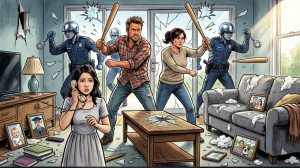
I thought about that body-cam footage again—the bats, the shattered glass, the furious entitlement on my mother’s face—and how I’d once believed it would destroy me.
It didn’t.
It did the opposite.
It proved, beyond argument, that walking away wasn’t cruel. It was necessary. It was survival. It was love for myself and for the life I wanted to build.
Because sometimes the greatest gift you ever get is the moment you stop trying to earn love from people who only offer it as a bargain.
And sometimes freedom looks like a front porch lit up at night, a child sleeping safely in the next room, and the quiet certainty that the people inside your home are there because they choose you—without conditions, without debts, without bats in their hands.
THE END!
Disclaimer: Our stories are inspired by real-life events but are carefully rewritten for entertainment. Any resemblance to actual people or situations is purely coincidental.