Clara shot up from the couch. “You’re supposed to help me,” she cried. “You’re supposed to care what happens to me.”
“Where was that loyalty five years ago?” I asked. “When all of you told me to get lost?”
My mother’s face twisted. “That was different.”
“How?” I demanded. “How was it different? I didn’t want to give away my future then, and I don’t want to give away my future now.”
Silence fell, heavy and judgmental.
I could feel their eyes on me, like I was the villain in their story.
“I’m not doing this,” I said, voice steady now. “Clara got herself into this mess. She can get herself out. If you want to help her so badly, sell your house and give her the money.”
My mother gasped like I’d cursed at her.
“This is the only house we have,” she said. “We’re old. We can’t start over like you can.”
I held her gaze.
“Then you understand exactly how I feel about my house,” I said.
I walked out.
Behind me, Clara called, “You’re making a huge mistake! These people don’t mess around!”
I turned back at the door.
“Neither do I,” I said.
I drove home feeling lighter and sick at the same time. Part of me wanted to vomit from the stress. Another part felt like I’d just pushed a boulder off my chest.
When I got home, I stood in my kitchen—the kitchen that caught morning light like gold—and stared at the place I’d built.
I knew, with a clarity that scared me, that they weren’t done.
Part 4
A week later, I heard a car door slam outside while I was making coffee. I looked out the window and nearly dropped the mug.
My parents were walking up my driveway like they owned the place.
For a moment, I couldn’t move. It felt like a nightmare where your body refuses to run.
I opened the door before they could knock, more out of anger than hospitality.
“What are you doing here?” I demanded. “How did you even get my address?”
My mother looked proud, like she’d solved a puzzle.
“Clara hired a private investigator,” she said.
“A private investigator?” I repeated, disbelief turning my voice sharp. “Are you serious right now?”
My father’s eyes were scanning my house, taking it in the way a shopper looks at a price tag. He whistled low.
“This is a nice place,” he said.
“Get off my property,” I snapped.
But my mother pushed past me and walked into my living room anyway, touching the back of my couch, examining a framed photo on the mantel like she was at an open house.
My father followed.
Shock froze me for half a second, then anger unfroze me.
“Don’t make yourselves comfortable,” I said. “You’re not staying.”
My mother was already walking from room to room, calculating.
“If you sold this house,” she said, “you could easily pay off Clara’s debt and still have plenty left over for a smaller place.”
My father spread his arms wide as if the space itself offended him.
“It’s just you living here,” he said. “You don’t need all this room.”
“What I need is none of your business,” I replied.
My mother’s eyes filled with tears on cue, like she could summon them with a switch.
“Clara is really scared,” she said. “They called yesterday. They said if they don’t get their money by the end of the month, something bad is going to happen.”
“Then maybe Clara should go to the police,” I said.
My father snorted. “The police can’t help with this. These aren’t the kind of people who care about restraining orders.”
I could feel my pulse in my throat.
“That is still not my problem,” I said. “You both need to leave. Now.”
My mother folded her arms like a stubborn child.
“We’re not leaving until you agree to help your sister.”
“Then I’m calling the police,” I said.
I pulled out my phone and started dialing before I could talk myself out of it. My father grabbed my arm.
“Don’t be ridiculous,” he hissed.
“Let go of me,” I said, yanking free. My voice shook, but my hand didn’t.
I stared them down. “If you don’t leave right now, I’m calling them. I’m serious.”
For a moment, I thought they might call my bluff. My mother’s jaw tightened. My father’s eyes narrowed. Then something flickered—maybe the realization that this could get real, that consequences existed outside family guilt.
My mother started sobbing louder.
“Fine,” she said, “but this isn’t over. If something happens to Clara, it’s on your head.”
“And if something happens to my financial security because I bail her out,” I said, “that’s on my head. At least this way, only the person who made the mess deals with the consequences.”
My father pointed at me, trembling with anger.
“You’re going to regret this,” he said. “Family is supposed to stick together.”
“You didn’t think that five years ago,” I replied.
They left, and I locked the door behind them with hands that wouldn’t stop shaking.
I stood in my living room, heart hammering, and realized something that made my skin go cold:
They weren’t just manipulative. They were escalating.
Julian called that night and listened while I vented. His voice was steady, calm, a hand on my back through the phone line.
“You did the right thing,” he said. “They can’t show up after five years and demand you fix their problems.”
“I know,” I said, though my voice sounded thin. “But I don’t trust them. I don’t think they’re going to stop.”
There was a pause, then Julian said carefully, “What do you want to do?”
I looked around my house—the house I loved, the house that had been my proof I could build something on my own—and felt a twist of grief.
“I’ve been talking to a realtor,” I admitted. “About selling eventually to move closer to you. I wasn’t ready yet. But now…”
“Now it might be safer to take away their leverage,” Julian finished gently.
The next morning, I called the realtor.
“Hey, it’s Lara,” I said, voice tight. “Remember we talked about putting my house on the market? I need to sell it as fast as possible.”
She sounded surprised. “Fast as possible?”
“I’ll take a discount,” I said. “Whatever it takes.”
She hesitated, then said, “I actually have a buyer who’s been looking in your area. If you’re serious about a quick sale, he’ll be interested.”
Three days later, she called with an offer. It was lower than I’d hoped, but fair considering the speed. I accepted immediately.
When I told Julian, he was quiet for a moment.
“Why the rush?” he asked, though his tone wasn’t accusing—just concerned.
I explained everything. The private investigator. The uninvited visit. The refusal to leave.
“I don’t want to live waiting for them to show up again,” I said. “I’d rather have the money somewhere safe, somewhere they can’t stare at and turn into a weapon.”
Julian exhaled softly. “That’s smart,” he said. “And… it means you can come stay with me sooner than we planned.”
A small spark of relief flickered in my chest.
“You’re okay with that?” I asked. “Me staying at your place while we figure out something permanent?”
“Are you kidding?” he said, and I could hear his smile. “I’ve been hoping you’d move here. This just speeds up our timeline.”
The closing happened fast. Paperwork signed. Keys handed over. My house—my hard-won dream—became someone else’s.
Julian drove out to help me pack. We loaded boxes into a moving truck, and I tried not to look too long at the empty rooms. The walls felt like they were watching me leave.
When the last box was loaded, I stood in the driveway and looked back at the porch, the windows, the garden bed I’d built with my own hands.
I felt grief, but underneath it was something stronger.
Relief.
My family couldn’t use my house as emotional blackmail anymore.
Julian put his arm around me. “You okay?” he asked.
I swallowed, then nodded.
“Yeah,” I said. “I’m good. Let’s go.”
We drove off, and with every mile, I felt the weight lift. Whatever happened with Clara and her debt, it wasn’t going to involve me.
For the first time in weeks, I let myself believe I was free.
Part 5
Living with Julian felt like stepping into a quieter universe. His apartment was warm and calm, filled with things chosen for comfort instead of show. A worn-in couch that had actually been sat on. Books that had cracked spines from being read. A kitchen that smelled faintly of coffee and rosemary because he cooked real meals like it was normal.
I worked remotely, so the transition was mostly emotional. I kept bracing for the next crisis, the next call, the next demand. But the days passed in steady rhythm. Morning meetings. Evening walks. Weekend house browsing for our future.
Sometimes, in the middle of an ordinary moment—like Julian handing me a mug of tea or laughing at a stupid commercial—I’d feel a wave of grief for the family I didn’t have. Not the family I lost, exactly, but the family I’d wished for.
Julian never rushed me through it. He didn’t tell me to forgive. He didn’t insist family was everything. He just let me talk, and when I fell silent, he stayed.
A month after I moved, my phone rang on a Tuesday morning. The caller ID showed a number I didn’t recognize, but it had my old hometown area code.
I almost let it go to voicemail. Then something in my gut tightened, and I answered.
“Hello?”
“Is this Lara Smith?” a man asked.
“Yes. Who’s calling?”
“This is Officer Hughes with the Lincoln Police Department,” he said. “I’m calling about an incident involving your parents, Wade and Susan Smith.”
My blood went cold.
“What kind of incident?” I managed.
“They were arrested last night for breaking and entering and destruction of property,” he said. “The homeowner wants to press charges.”
For a second, my brain refused to process the words.
“Breaking and entering where?” I asked.
There was a pause, like he was checking his notes.
“The address they broke into is listed as your former residence,” he said. “Is 847 Maple Street a house you used to own?”
My stomach dropped.
“I sold that house,” I said. “A month ago.”
Another pause, heavier this time.
“Then they didn’t know,” Officer Hughes said quietly. “That would explain… a few things.”
“What were they doing there?” I asked, voice rising.
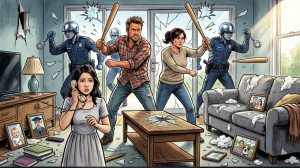
“That’s what we’re trying to figure out,” he said. “They caused significant damage to the interior of the home. Destroyed furniture, broke windows, spray-painted obscenities on the walls. The new owner came home to find them in his living room, smashing a coffee table with a baseball bat.”
I sank onto Julian’s couch, legs suddenly useless.
“You’re serious,” I whispered.
“Very,” Officer Hughes said. “The damage is estimated at around forty thousand dollars. Your parents claimed they believed it was still your house and that you’d wronged them.”
I closed my eyes. My heart was pounding so hard it made my ears ring.
“They said they were getting back at you,” he continued. “For abandoning your family.”
A laugh bubbled up—thin, shocked, not funny at all. “They abandoned me,” I said, but my voice sounded distant even to myself. Like the words belonged to someone else.
Officer Hughes asked for context, and I gave it. The five-year cutoff. Clara’s debts. The demands to sell my home. The private investigator. The uninvited visit. I told him everything, each sentence feeling like I was laying out evidence not just for the police, but for myself. Proof I hadn’t imagined the madness.
When I finished, he exhaled slowly.
“So they didn’t know you’d sold the house,” he said.
“No,” I said. “They probably went there to vandalize my property. Instead they destroyed some innocent person’s home.”
“That’s exactly what it looks like,” he agreed. “And I have to say—your parents are lucky they weren’t shot. The homeowner is a legal gun owner. He came in, heard the noise, and called 911 from his car. If he’d walked in—”
I opened my eyes, suddenly nauseous.
My parents could have been killed. Over a vendetta. Over money. Over Clara.
After I hung up, I sat frozen until Julian came out of his office and saw my face.
“What happened?” he asked immediately, crossing the room.
I told him, and as I spoke, his expression shifted from confusion to shock to a kind of quiet fury.
“That’s insane,” he said. “They could have gotten themselves killed. Or killed someone else.”
“I know,” I whispered. My hands were shaking. “They thought it was my house.”
Julian sat beside me and took my hand like he could anchor me to the couch.
“What do you need?” he asked.
I stared at the wall, seeing my mother’s proud face when she said private investigator, hearing my father’s voice saying you’re no longer part of this family.
“I need this to be real,” I said softly. “I need there to be consequences that don’t magically disappear because they’re my parents.”
And for the first time, I said something out loud that I’d never dared to say before, even in my own head.
“I don’t think they love me,” I said. “Not in the way parents are supposed to.”
Julian didn’t argue. He didn’t say, I’m sure they do, deep down. He just squeezed my hand tighter.
“I’m sorry,” he said. “You didn’t deserve any of that.”
Over the next few weeks, I got updates. The legal system moved slowly, but reality didn’t. My parents were facing serious charges. Their lawyer negotiated a plea deal to avoid jail time, but it came with restitution—full restitution—for the homeowner.
Forty thousand in damage, plus legal fees, plus court costs. It climbed close to sixty thousand total.
A friend from back home, Caitlyn, called me with the rest of the story like she was delivering gossip, except her voice kept catching, like even she couldn’t believe it.
“Lara,” she said, “they had to sell their house.”
I sat down at my kitchen table—Julian’s table, technically—and felt something sharp twist in my chest.
“They said it was the only house they had,” I murmured.
“I know,” Caitlyn said. “That’s the irony. They couldn’t afford the restitution any other way. So they sold it. And here’s the kicker—after they paid everything for the court and the homeowner, they gave the remaining money to Clara.”
My throat tightened.
“They did what they demanded you do,” Caitlyn said quietly. “But with their own house.”
I should’ve felt satisfied. Vindicated. But what I felt was a hollow ache, like watching a building collapse in slow motion. Even when consequences finally arrived, my parents still chose Clara.
“And it gets worse,” Caitlyn added, voice dropping. “Clara’s creditor problems? They weren’t what she said.”
“What do you mean?”
“Turns out the ‘dangerous people’ were basically just an investment firm,” Caitlyn said. “They were threatening to sue. Like, normal legal stuff. No broken kneecaps, no scary hitmen. Clara exaggerated everything to scare your parents. She made it sound like her life was on the line.”
I closed my eyes, anger rising hot and clean.
“So she lied,” I said.
“Yeah,” Caitlyn whispered. “And now your parents are renting a small apartment with Clara and Michael. All four of them in a two-bedroom. From what I hear it’s… bad. Lots of fighting.”
When I hung up, Julian found me staring out the window.
“You okay?” he asked.
I turned toward him, and to my own surprise, I smiled—small, tired, but real.
“I think I am,” I said. “I think… I’m finally done hoping they’ll become different people.”
Part 6
After the arrest, my family tried to reach me through mutual friends like I was a customer service line they could call when they needed to fix something. At first it was vague: Your mom wants you to know she misses you. Your dad is really upset. Clara’s having a hard time.
Then it became direct: They want to apologize. They want to explain. They want to see you.
Every time someone brought it up, I said no.
Caitlyn called again a few weeks later.
“Your mom asked me to tell you she’s sorry,” she said. “She said they realize they handled everything wrong. That they made terrible mistakes.”
“It’s too late for sorry,” I replied.
I didn’t say it with drama. I said it like stating a fact. Like telling someone the store is closed.
“They spent five years not caring whether I was alive or dead,” I continued. “Then they demanded I bankrupt myself for Clara. Then they committed actual crimes because I wouldn’t do what they wanted.”
Caitlyn sighed. “But they’re your family.”
I stared at the ceiling, feeling the old tug of guilt, the old conditioning, like a hook in my ribs.
“No,” I said firmly. “They’re related to me. Family doesn’t abandon you and then show up demanding money. Family doesn’t hire private investigators to stalk you. Family doesn’t break into houses with baseball bats because they don’t get their way.”
Julian was sitting across from me, listening. When I hung up, he reached for my hand.
“I’m proud of you,” he said.
The words made my eyes sting. Proud was not something my parents said to me unless it served a narrative.
In the months that followed, my life kept moving forward in a way that almost felt rude, like the universe hadn’t gotten the memo that my family was imploding.
Work was going well. I got a big promotion—one of those moments I would’ve once driven to my parents’ house to celebrate, craving their approval like oxygen. Instead, Julian took me out for dinner, toasted me with a cheap but bubbly bottle of champagne, and told me I’d earned it.
We started seriously house hunting in his area. Not because I needed a place to prove myself anymore, but because we wanted a shared future. A home that belonged to us, not to my family’s leverage.
One evening, after a long day of touring houses, we sat on Julian’s couch scrolling through listings. We were both tired and a little punchy, arguing playfully about whether a breakfast nook was necessary.
Julian nudged me with his shoulder. “This one has a backyard big enough for a garden,” he said, eyes bright. “You’d like that.”
I snorted. “Half my herbs died last time.”
“That’s because you loved them too aggressively,” he said, and I laughed—an easy laugh, unguarded.
Then his expression shifted slightly, thoughtful.
“You know,” he said, “when you moved in, you kept apologizing. For your family. For the drama. Like you were responsible.”
I looked down at my hands. “I felt responsible,” I admitted.
“And now?” he asked.
I thought about my parents selling their house. About Clara’s lies. About the body-cam footage frozen on my mother’s furious face.
“I still feel sad,” I said. “But I don’t feel responsible anymore.”
Julian’s smile was soft. “Good,” he said.
A week later, we found a house that felt right.
It wasn’t a craftsman like my old one, but it had its own charm—white siding, big windows, a sturdy oak tree out front that looked like it had been standing watch for decades. The kitchen was bright. The floors creaked in a way that felt lived-in, not broken. The backyard was a blank canvas.
We walked through it twice, then stood in the empty living room and looked at each other.
“I can see us here,” Julian said quietly.
I could too. And the realization hit me with a strange grief: this was the kind of moment people called their parents about. This was the kind of moment mothers cried happy tears.
Instead, I had Julian. I had friends. I had peace.
And it was enough.
That night, we sat at the table with paperwork spread out, making an offer. My phone buzzed with an unknown number from my hometown.
For a second, my chest tightened. I thought, What now?
I let it go to voicemail.
The voicemail was from my mother.
Her voice sounded small, fragile, the way it did when she wanted sympathy……..