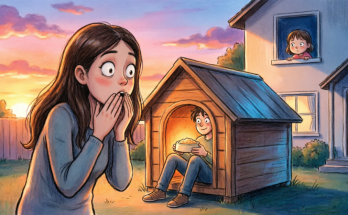
My wife had barely pulled out of the driveway when my seven-year-old slipped up beside me like a shadow and tugged my sleeve so hard her little fingers shook.
“Daddy,” she whispered, and the sound of her voice made the room feel smaller. “We have to get out right now.”
I smiled without thinking, the reflexive kind of smile you give when a kid is being dramatic about thunder or shadows. I ruffled her hair the way I always did when I wanted to reset her back to safe. “Out? Why? Did you hear the ice cream truck?”
She didn’t smile. She didn’t even blink.
Instead, she lifted a finger and pointed up the staircase.
Not a lazy point. Not a playful one. Her finger was rigid, trembling like it weighed a thousand pounds.
“We don’t have time,” she whispered. “We have to leave this house now.”
I stopped smiling.
The air didn’t actually change—no temperature drop, no gust through a window—but something in me shifted, something old and animal that lives beneath logic. Fathers learn patterns. Kids have tells when they’re pretending: the exaggerated tremble, the theatrical gulp, the peek at your face to see if you’re buying it.
This wasn’t that.
Her eyes were too wide and too fixed. Her lips were pale. Her shoulders were up around her ears like she was bracing for impact.
I followed her finger up the staircase.
The second floor landing was empty, sun slanting through the hallway window the way it always did in late afternoon. No movement. No sound.
And yet the silence felt wrong—too perfect, like a room that’s holding its breath.
The hum of the refrigerator in the kitchen suddenly sounded like thunder.
I knelt so my eyes were level with hers and put my hands on her shoulders, gentle but firm. “Hey. Sweetheart. What did you see?”
Her head shook violently, almost painful-looking. “No time.”
“What do you mean, no time?” My voice came out softer than I meant it to, like I was talking to a skittish animal. “Tell me what’s up there.”
She swallowed hard, throat bobbing. “We have to go,” she repeated, and her voice cracked. “Now. Now. Now.”
It would’ve been so easy to dismiss it. So easy to tell myself kids get spooked. Kids imagine monsters. Kids watch something online and then turn their own hallway into a horror movie set.
I tried to reach for that rational explanation and it slipped through my fingers.
Because my daughter wasn’t selling me a story.
She was begging me to believe her.
And underneath her fear, I felt my own—something that had no words yet but had weight.

I stood up, and in that moment I didn’t decide like a man in control of his life. I reacted like a father who suddenly understood that the cost of being wrong was too high.
“Okay,” I said, forcing calm into my voice like I was smoothing a blanket over a bed. “Okay. We’re leaving.”
Her shoulders sagged a fraction, relief breaking through terror.
I grabbed my keys off the counter. I didn’t even lock the back door out of habit. I didn’t turn off the TV. I didn’t check my pockets.
My hand was shaking. I noticed it and hated it and couldn’t stop it.
My daughter ran—not upstairs, not toward her room, not toward the little stuffed rabbit she slept with—but straight to the front door. When I opened it, sunlight hit us like we’d stepped into another world. The street looked normal. The neighbor’s dog barked. A lawnmower droned somewhere down the block. The sky was a clean, indifferent blue.
It didn’t look like a place where anything bad could happen.
But my daughter was still trembling.
I scooped her up without asking, because she was suddenly small in my arms, lighter than she should have been. Her heart hammered against my chest.
The front door swung shut behind us.
It closed with a soft click.
And that click sounded like a secret.
I set her into the back seat and buckled her in. Her hands clutched her little backpack to her chest like a shield. She didn’t even remember she didn’t need it. She just needed something between her and the world.
“Where are we going?” she asked, voice thin.
“The police station,” I said as I slid into the driver’s seat.
Her eyes lifted to mine in the rearview mirror. “Why?”
“Because someone scared you,” I said, and the words made it feel real as soon as they left my mouth. “And I’m not going to guess about that. I’m not going to shrug it off. We’re going somewhere with cameras and officers and locked doors.”
I turned the key in the ignition. The engine started. A normal sound. A mundane sound. Comforting, almost.
We pulled out of the driveway, and for half a block everything felt like it might still be normal. A father and his kid taking an unexpected drive. The same quiet street we’d driven down a hundred times.
Then my phone buzzed on the passenger seat.
One buzz. Then another.
I glanced at it without thinking.
Unknown number.
A text.
Too late.
My stomach dropped so fast it felt like my insides detached.
My fingers tightened on the steering wheel until my knuckles went white.
The world narrowed to sound and motion and a single pounding thought: How would a stranger know anything was too late? Too late for what?
I didn’t have time to answer, because the universe answered for me.
A boom ripped through the air behind us.
Not a pop. Not a crack.
A deep, concussive blast that slammed into the car like a fist.
The windows rattled. The steering wheel jerked. My daughter screamed—a sound so raw it made my chest seize.
I slammed the brakes instinctively, tires screeching. The car lurched to a stop at the curb.
For a split second there was nothing but ringing in my ears.
Then I looked in the rearview mirror.
And I saw my house.
Engulfed in flame.
Fire punched out of the upstairs windows like something alive. Black smoke curled into the sky in thick, ugly ropes. Pieces of debris tumbled into the yard. The front windows glowed orange, bright enough to turn the street into a nightmare-lit stage.
My breath left my body all at once.
My daughter’s hands flew to her ears. “Daddy!” she screamed, and the word was more than fear—it was accusation and relief and horror tangled together.
She had been right.
She had been right and if I’d laughed harder, if I’d insisted on brushing her off, if I’d taken one more minute to argue or reassure, we would have been inside that house.
A second later, distant sirens began to wail—neighbors already calling, the sound of an entire system waking up to disaster.
I fumbled for my phone and hit 911 with fingers that didn’t feel like mine. When the operator answered, my voice came out broken.
“My house—there’s an explosion—fire—my daughter and I just left—please, please send—”
She cut in with practiced calm. Address. Injuries. Safe location. Stay on the line.
I obeyed because there was nothing else to do.
Within minutes, the street filled with motion: fire trucks barreling in, squad cars sliding to a stop, neighbors spilling onto sidewalks in pajamas and slippers, hands over mouths. Someone cried. Someone shouted my name. Someone else shouted, “Get back! Get back!”
I pulled the car farther down the street, away from the growing chaos. I parked, left the engine running, and climbed into the back seat with my daughter because she wouldn’t stop shaking and I couldn’t let her sit alone in that fear.
She threw herself into my arms like she’d been holding herself together by sheer will and finally couldn’t anymore.
“It was upstairs,” she sobbed into my shoulder. “He was upstairs.”
“Shh,” I said, even though my own voice was trembling. “You did good. You did the best thing. You saved us.”
Her tears soaked my shirt. I held her tighter and stared through the window at the thick smoke and the flashing lights and the house that had been my life ten minutes ago turning into a burning shell.
An officer knocked on the window and motioned for me to step out.
I kissed the top of my daughter’s head and slid out of the car, legs unsteady. The officer was young—mid-twenties maybe—with the kind of face that still had softness in it. His eyes were sharp, though. Focused.
“Sir,” he said, glancing into the car at my daughter. “Were you inside when the explosion happened?”
“No,” I said. “We… we just left.”
“You live here?” he asked.
“Yes,” I said, and it felt absurd to answer “yes” when the thing I lived in was actively being eaten by fire.
He looked at me for a long moment, then nodded toward my daughter. “What made you leave?”
I swallowed, throat dry. “My daughter,” I said. “She told me we had to go. Right away.”
His eyebrows lifted slightly. “She told you to leave.”
“Yes,” I said. “She was—she was terrified. She pointed upstairs.”
The officer’s expression shifted. Not disbelief. Something closer to wariness.
He glanced toward the house, then back at me. “Okay,” he said. “I need you to come over here. Another officer will stay near your vehicle.”
They took my statement in fragments while firefighters battled the blaze. My words came out jagged, interrupted by the sound of sirens and hoses and the crackle of burning wood. I kept looking back at my daughter in the car, her face pressed to the window, eyes huge.
I didn’t see my wife anywhere.
That thought hit me suddenly, like I’d forgotten something obvious.
My wife had gone to the store.
Minutes before.
The fire. The explosion. The text that said too late.
And my wife—gone.
An investigator showed up as the fire started to die down. He was older, heavier, with graying hair and the calm manner of someone who has seen too much of the worst things. He introduced himself as the lead fire investigator. His eyes moved over the wreckage like he was reading a book.
By nightfall, the flames were mostly out, the house a blackened skeleton still smoldering. The air smelled like wet ash and melted plastic and something sharp underneath—chemical, maybe—making my nose burn.
The investigator pulled me aside, lowering his voice.
“Mr. Carter,” he said, “this wasn’t an accident.”
I stared at him as if he’d told me the sky wasn’t blue. “What?”
“Gas lines are intact,” he said. “No sign of faulty wiring. But upstairs…” He hesitated, glancing at my daughter, who now sat on the curb wrapped in a blanket one of the firefighters had given her. “Upstairs, in what looks like a storage closet, we found evidence someone’s been staying there.”
The world tilted.
“What do you mean staying there?” I asked.
He nodded once, grim. “Bedding. Food wrappers. A couple empty bottles. And a burner phone.”
A cold wave rolled through me. “Someone was living in my house,” I said, voice flat.
“Looks that way,” he replied. “And whoever it was, they used accelerant. This fire was meant to erase things.”
Erase.
Like the house wasn’t just collateral damage.
Like it was the goal.
Later, they took us to the police station. It felt surreal walking into a building that smelled like disinfectant and paperwork while my life smoldered down the street.
They put my daughter in a small interview room with crayons and paper, trying to make it less terrifying. Detective Ramirez came in—a man in his late thirties, lean, tired eyes, the kind of calm that comes from keeping your emotions locked up for work.
He spoke to my daughter gently, like he actually respected her as a person.
At first she wouldn’t talk. She held a crayon like it was a lifeline and stared at the paper. I sat beside her, close enough that she could lean into me.
“Sweetheart,” I said softly, “tell them what you saw. It’s okay.”
Her lips moved without sound. Then, finally, she whispered, “I saw him.”
Ramirez leaned forward slightly, careful not to crowd her. “Who did you see?”
She began to draw.
Not a house. Not a family. Not a stick-figure sun.
A person.
Tall. Dark.
No face.
Just hollow eyes shaded in so hard the paper almost tore.
“He was in mommy’s room,” she whispered.
My stomach clenched.
“He looked at me,” she continued, her voice small. “He put his finger here.” She pressed her finger to her lips. “Like this. Then he went upstairs.”
Ramirez’s eyes flicked to mine, and something in his expression told me he was taking this far more seriously than I wanted him to.
A uniformed officer stepped in and handed Ramirez a plastic evidence bag.
Inside was the burner phone.
It looked charred, edges warped, screen dead.
Ramirez set it on the table between us. “We pulled this from the upstairs closet,” he said. “It’s damaged, but the SIM card survived enough that our techs got one thread.”
He slid a printed sheet toward me.
A single contact, saved under the name E.
Last message sent an hour before the explosion.
She’s gone to the store. Do it now.
I stared at the words until they blurred.
My wife had left for the store minutes before my daughter begged me to run.
And someone—someone in my house—had been informed of that.
My throat tightened so hard it hurt. “Is my wife—” I started, then stopped, because the question felt poisonous.
Was my wife a victim?
Or was she part of it?
I didn’t get to sit with that question long, because the answer walked up in heels and panic and perfume.
By the time my wife returned, the house was already a blackened husk, police tape snapping in the breeze like yellow scars. Neighbors stood in clusters, whispering, eyes wide. Fire crews were packing up hoses.
She ran toward us, dropping grocery bags on the sidewalk. Milk burst across the pavement. Apples rolled into the gutter.
“Oh my God,” she cried, voice breaking. “What happened?”
Her eyes darted from me to our daughter, then to the ruins.
And it was strange—because there was fear in her eyes, yes.
But not shock.
Not disbelief.
Fear, sharp and knowing, like a person who sees the consequence of a plan going wrong.
Detective Ramirez watched her closely, then stepped forward, asking where she’d been, whether she’d seen anyone near the house, whether she’d noticed anything unusual.
My wife answered quickly. Too quickly. Her words came out polished, like she’d rehearsed them in the car.
“The store,” she said. “I was at the store. I—I came back and—”
“What store?” Ramirez asked.
“Target,” she blurted.
I looked at the crumpled receipt still in one of the grocery bags. The ink was smudged from spilled milk, but the store name was clear.
A corner market.
Not Target.
My wife’s eyes flicked to the receipt for half a second, then away. Her mouth opened, closed.
Ramirez didn’t call her on it right then. He just nodded, made notes, and turned to me.
“For tonight,” he said quietly, “we’re arranging a temporary safe location. Until we know who was in that house and whether they’re still nearby.”
A safe house.
Those words didn’t belong to my life. They belonged to crime shows, to other people’s stories.
But my house was ash, and my daughter kept flinching at every sound, and my wife was lying about the store.
So we went.
The safe house was a small, plain rental owned by the city—nothing personal on the walls, nothing warm. It smelled like fresh paint and borrowed time. They gave us a room for my daughter and a room for us, and a police unit sat outside in an unmarked car.
My daughter fell asleep fast, exhaustion finally overpowering fear, but I couldn’t. I lay in bed staring at the ceiling while my wife lay beside me, too still.
At some point, long after midnight, I turned toward her.
“Where exactly did you go today?” I asked quietly.
She stiffened like I’d touched a bruise.
“I told you,” she said. “The store.”
“What store?” I asked again.
A beat too long. “Target.”
I didn’t raise my voice. I didn’t accuse. I just reached over to the nightstand and held up the receipt.
“This says Corner Mart,” I said.
Her eyes widened. “Oh. I—Target was crowded, so I stopped at—”
“Someone set our house on fire,” I cut in, voice low. “The cops found a burner phone upstairs with messages. Someone knew you were gone when it started.”
Her face went pale so fast it looked like all the blood drained out at once.
“What?” she whispered. “Kevin, you can’t think I—”
“Why not?” I asked, and the simplicity of the question shocked even me.
She sat up, hands shaking as she reached for the glass of water on the nightstand.
She missed it entirely and knocked it over. Water spilled across the table, soaking the wood, dripping onto the carpet.
“Kevin,” she said, voice trembling, “please don’t say things like that. You don’t know what you’re talking about.”
But the tremor in her voice told me I did.
I didn’t push further then. Not because I believed her, but because I needed more than denials. I needed facts. Proof. Something solid enough to hold in court, in my mind, in the place where trust used to live.
So I lay back down and pretended to sleep.
Near midnight—closer to one, maybe—I heard her shift. The mattress dipped. The soft sound of feet on carpet. She slipped into the bathroom with her phone.
The door clicked shut.
I waited until her footsteps were masked by the sound of the fan, then I got up quietly and padded to the door. I pressed my ear against it.
Her voice was low, urgent.
“No,” she hissed. “He suspects.”
A pause. A whisper I couldn’t make out.
“I can’t. Not now,” she said. “He has the girl with him. Just lay low. I’ll figure something out.”
The girl.
Our daughter.
My stomach turned to ice.
The door creaked as she moved, and I backed away into the hallway just as she opened it.
She froze when she saw me standing there in the dim light.
For a second, neither of us breathed.
“Who were you talking to?” I asked.
Her mouth opened, closed.
Then she whispered one word, like it was pulled out of her against her will.
“E.”
The name from the burner phone.
The name my daughter had unknowingly drawn in hollow eyes.
Now on my wife’s lips.
For thirteen years, I thought I knew the woman I married. The woman who laughed at my stupid jokes, who held our daughter when she was sick, who curled into my side on the couch like my body was home.
That night, staring at her pale face in the hallway of a borrowed safe house, I realized I didn’t know her at all.
And whatever game she was playing, it wasn’t about love.
It was about erasing us.
The next morning, I didn’t confront her.
Not directly.
Instead, I became the calm man she needed me to be so she could keep lying.
I made coffee. I spoke softly. I asked my daughter if she wanted pancakes like nothing had shattered. I watched my wife move around the safe house like a trapped animal, eyes flicking to the windows, checking her phone whenever she thought I wasn’t looking.
She avoided my eyes. She avoided my touch. She avoided anything that felt like intimacy, because intimacy requires truth.
Around noon, Detective Ramirez came by.
He didn’t knock. He simply appeared in the kitchen doorway after the officer outside let him in. He held a folder like it weighed too much.
He set it on the table and slid it toward me.
“We ran what we could off the SIM,” he said. “Only one number in and out. Prepaid line registered under a fake ID.”
My wife appeared in the doorway behind him. She looked small suddenly, wrapped in one of the safe house’s scratchy blankets like it could protect her.
“But the payments,” Ramirez continued, tapping the folder, “were made with a card linked to your wife’s personal account.”
The world didn’t tilt this time.
It cracked.
My wife froze mid-step. The grocery bag in her hand slipped to the floor. Apples rolled across the tile, bumping gently into the baseboard like they were trying to escape too.
“That’s impossible,” she said quickly. Too quickly. “It must be a mistake.”
Ramirez didn’t blink. “We’ll keep digging,” he said. “But you should know: whoever this E is, your wife’s been funding him for months.”
Months.
I saw it then—not just the fire, not just the burner phone, but a long, slow thread of choices leading here. Late-night “errands.” Unexplained charges I’d brushed off as shopping. The new perfume that wasn’t for me. The way she sometimes flinched when my phone buzzed, as if any interruption might expose her.
And the worst part—the part that made my skin crawl—was realizing my daughter had seen through the lies before I had.
When Ramirez left, my wife stood in the kitchen like the air had been sucked out.
“Kevin,” she started, voice shaking, “you don’t understand—”
“Who is he?” I asked.
Her lip trembled. For a second, I thought I saw the wife I once knew—fearful, human, about to confess.
Then it vanished, replaced by a mask so cold it made her eyes look different.
“You don’t understand,” she said again, but now it was less apology and more defense. “He needed help.”
“Help?” I echoed……….