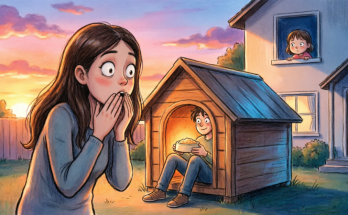
There it was. The family solvent. Joke. Lighten up. Don’t make this weird. Don’t make us name what just happened.
I heard my own voice answer before I had fully decided what I was going to say.
“That’s the problem,” I said. “You think everything is a joke as long as it’s happening to somebody else.”
Nobody laughed at that.
Brooke looked from Mason to me, then to the chair, and I watched comprehension begin to dawn in stages across her face. Not all at once. First discomfort. Then embarrassment. Then the slower, harder thing underneath: recognition that she had been enjoying a version of the evening built on somebody else’s humiliation and hadn’t noticed until it threatened to stain her too.
Mr. Whitaker spoke next, his voice clipped and precise.
“You invited this man,” he said to Mason, “to your engagement dinner and sat him next to a trash bin?”
Mason rolled his shoulders back, trying to recover some version of swagger. “It was just a bit. He always takes things personally.”
My mother straightened in her seat and gave the room a smile that was trying desperately to pass for control. “Let’s not blow this out of proportion,” she said. “Eli is just being dramatic. He’s always been sensitive.”
I almost laughed.
Sensitive. That old family diagnosis. My reaction was always the problem. Never the thing that caused it. It didn’t matter if the issue was being left out, talked over, used, or publicly humiliated. If I had a feeling about it, suddenly the feeling became the offense.
The waiter cleared his throat again, the poor man trapped in a psychological crime scene with a payment processor deadline. “I’m sorry to interrupt,” he said, “but the restaurant does need to close the tab on the private section. If the card on file won’t be used, I’ll need another form of payment.”
No one answered him.
I started toward the exit.
That’s when my father finally found his voice.
“Eli, come on,” he said. “You already paid for half. You might as well just finish it.”
That sentence did something no insult had quite managed to do. It stripped the whole thing to its skeleton.
Not You’re right, this was wrong.
Not Sit down, son, we made a mistake.
Not Mason, apologize.
Just a reminder that I had already contributed, so maybe I should keep contributing because the machine was built to run on my silence and my money.
I stopped and turned back.
“You’re right,” I said. “I did pay the deposit.”
I could feel every eye on me, but for the first time in years it didn’t shrink me. It sharpened me.
“I called three restaurants to find one with a rooftop view because Mason said he wanted the skyline in the pictures. I shifted the date around his football schedule. I paid for the floral arrangements because Mom said the standard centerpieces looked cheap. I put down the five-hundred-dollar nonrefundable deposit without blinking.” I took one step closer. “And I showed up alone, on time, in a suit, with champagne and a card, to support my brother.”
Mason’s face had gone red across the cheeks. My mother looked stricken now, but only because the room had become public in the wrong way.
“And what did I get in return?” I asked, though I wasn’t really asking anyone. “A folding chair next to a garbage bin and a line about family only.”
Then I looked at Mason.
“So now,” I said, “you get to figure it out. You and your real family.”
He stood so abruptly his chair legs screeched.
“You’re making a scene.”
“No,” I said. “I’m drawing a line.”
And then I walked away.
I didn’t take the elevator. I didn’t want the smallness of it, the intimacy. I took the stairs all the way down, my dress shoes striking metal and concrete hard enough to sting through the soles. By the time I reached the sidewalk my hands were shaking so badly I had to loosen my tie twice before I managed to get air into my lungs.
The city at night can feel like permission. Nobody looking too closely. Everybody headed somewhere. Streetlights making hard edges out of everything. I walked three blocks before I realized I was still carrying the unopened bottle of champagne. It felt absurdly heavy, like a symbol from a short story I hadn’t asked to be trapped inside.
I thought maybe that was the end of it.
Maybe there would be angry texts, then awkward silence, then some version of reconciliation built on everybody pretending the main issue had been my timing. That’s how these things usually went in my family. Harm happened, then the person who reacted became the problem to be managed.
But the dinner had landed in the wrong ecosystem for that. Brooke’s family was involved. Money had been made visible. Optics had cracked. And once people outside your family see how you behave when you think only your own rules apply, the story gets harder to contain.
My phone lit up before I even got home.
First Mason: Dude, seriously? You couldn’t just pay and talk to me after?
Then Mom: You embarrassed us in front of Brooke’s whole family. Was that your goal? Revenge?
Revenge. As if refusing to subsidize my own humiliation were somehow a theatrical overcorrection.
I left both unanswered.
When I finally got home, I set the champagne on the kitchen counter, took off my shoes, and sat at my table in the dark. My apartment was quiet in the best way—no one needing anything, no one waiting for me to restore a mood. I stayed there for maybe twenty minutes, just breathing, before my phone rang again from an unknown number.
It was Brooke.
Her voice, when I answered, was lower and more careful than I’d ever heard it. Without Mason beside her, without my mother cooing over her, she sounded younger. Less polished. More real.
“Hi,” she said. “I know this is weird.”
“You could say that.”
A brittle little laugh. “Can I ask you something?”
“Sure.”
“Did you really pay for everything? The deposit, the flowers, all of it?”
I leaned back in my chair. “Yeah.”
There was a pause on the other end, the kind where you can hear someone reorganizing what they thought they knew.
“They told my dad you offered,” she said. “That it was your idea.”
I stared at the dark window over my sink.
“I never offered,” I said. “Your future mother-in-law asked if I could help with the reservation. I said yes. That’s it.”
Another silence.
“Well,” Brooke said finally, “my dad is furious.”
I didn’t say anything.
“He thought you were doing it as some grand voluntary gesture,” she went on. “But now he’s saying he never would have agreed to that place if he’d known it was being paid for by someone they basically shoved in the corner.”
That sentence was ugly enough to be useful. Nobody in my family would ever have phrased it that plainly.
“I’m not calling to drag you into anything,” she said quickly. “I just thought you should know.”
I thanked her and we hung up, but I was still sitting at the table staring at the champagne bottle when the deeper realization started settling in. For once, the consequences of my family’s behavior might not land on me. They might land on the people who’d spent years assuming I would absorb them.
Over the next few days, the whole thing escalated with a speed that would have been almost funny if it hadn’t been my life.
The family group chat came back to life first. The one with my parents, Mason, me, two aunts, one cousin, and a floating layer of spouses who rarely participated unless there were baby pictures involved. Usually it was a graveyard of stale emojis, blurry food photos, and my mother’s aggressively cheerful “Happy Friday, family!” texts.
Suddenly it was a war room.
Mom: Eli, we need to talk. Call me.
Mason: You seriously messed things up with Brooke’s family. You owe us a fix.
Dad: This is getting out of hand. Just apologize and let’s move on.
I stared at that last line for a long time.
Apologize for what exactly? For declining to finance my exclusion? For naming reality in a room that preferred performance? For not protecting my family from the consequences of how they treated me?
I said nothing.
That was when I realized the dinner had not been an isolated event. It had only made visible a role I’d been playing for years without fully naming it. I was the emergency contact. The designated driver. The backup wallet. The son who stepped in when Dad’s hours got cut, when the car needed repairs, when Christmas gifts hadn’t been bought, when Mason couldn’t make rent and Mom said he was “in a bad headspace.” I had become, through repetition, something they felt entitled to lean on.
And entitlement is always most offended by the first boundary.
Mom sent me an email two days later.
Not a text. Not a call. An actual email with the subject line Please, which was manipulative enough to be almost artful.
It was five paragraphs long and full of the kind of language people use when they desperately want reconciliation without accountability. She said she never meant to hurt me. She said she hadn’t realized I felt excluded. She said that, in the excitement of the evening, misunderstandings had snowballed. She said it would mean so much to the family if I could sit down with Mason and smooth things over.
Nowhere in that email did the word sorry appear.
Nowhere did she say what had happened was cruel.
Instead, it was all we didn’t realize, you misunderstood, let’s not let one silly night destroy the bond we’ve built.
I stared at that line—the bond we’ve built—for a long time.
What bond?
The bond where I drove three hours on Christmas Eve because Mason forgot to shop and Mom cried that she couldn’t bear an uneven pile under the tree?
The bond where I canceled a trip to Spain two years earlier because Dad needed surgery and they couldn’t afford a home nurse, so I covered the extra care and spent my vacation week sleeping on their couch?
The bond where I co-signed the loan on their second car because Dad’s credit was wrecked and then said nothing when Mason borrowed it “for a week” and kept it for six months?
The bond where I set up a shared checking account for Mason when he was unemployed and needed a temporary place to route payments until he got organized, and somehow that temporary arrangement stretched into a year while his gym membership and subscriptions quietly bounced against money I had left in there?
I let the email sit unanswered.
Then Aunt Karen called.
That surprised me more than Brooke’s call had.
Karen was my mother’s sister, a woman who ran an interior design firm with surgical precision and never wore colors that looked accidental. She wasn’t warm exactly, but she was sharp, which in my family had always made her both useful and faintly dangerous. She had the kind of face that could convey complete contempt with a single raised eyebrow, and unlike most people in my family, she didn’t bother sweetening her observations if she thought sugar would insult the truth.
“Eli,” she said when I answered, “I heard about the dinner.”
“Of course you did.”
“I’m not calling to scold you.”
That made me sit up.
“Then why are you calling?”
“Because,” she said dryly, “it’s about time someone shook the damn tree.”
I actually laughed. First real laugh since the rooftop.
Karen exhaled softly. “Look, I know how your parents are. They’ve leaned on you too hard for too long because it was convenient. And Mason—” she paused, then let the sentence sharpen on purpose—“has always treated you like an accessory to his life. A support beam, not a brother.”
I rubbed a hand over my face. “I appreciate that.”
“I’m not finished,” she said. “Your mother called me yesterday and asked if I’d talk some sense into you.”
“And?”
“And I told her you didn’t need sense. You needed space. And that maybe it was time they figured out how to function without using you as scaffolding.”
I sat very still after that.
It’s a strange thing to be accurately seen by someone who has no history of comforting you. The truth lands differently when it comes from a person who owes you nothing emotionally and has no interest in making you feel better just for the sake of ease.
Karen continued, more gently than I’d ever heard her. “You know, your problem isn’t that you’re too serious. It’s that you’ve spent years acting like being useful is the same thing as being loved.”
That one hurt.
Which is how I knew it was true.
Later that night, Mason texted again.
Bro, Brooke’s dad just canceled the wedding venue deposit. Said we’re not aligned in values. Fix this now.
Not Can we talk?
Not I’m sorry.
Not I was out of line.
Fix this.
As if I were still on staff.
That was the moment something in me stopped entertaining the possibility that all this was just immaturity on his part. Mason did understand, at least on some level. He understood perfectly well that he had humiliated me. He just believed I was obligated to continue being useful afterward.
I decided to fix something, just not what he meant.
That night I logged into the shared account I had once set up for him “temporarily.” There wasn’t a fortune in it—just a few thousand dollars I’d left sitting there because closing it had always felt like a small act of betrayal, and I was too well-trained to prioritize my own boundaries over the appearance of brotherly generosity. Mason still had a few things linked to it. Spotify. Some meal delivery app. A gym membership he absolutely did not need if he was serious about his recurring “fitness reset.”
I transferred the remaining balance into a new private savings account under my own name.
Then I called the bank and closed the joint line entirely.
The next morning Mason called four times in twelve minutes. When I finally answered, his voice was already pitched high with panic.
“What did you do?”…………..