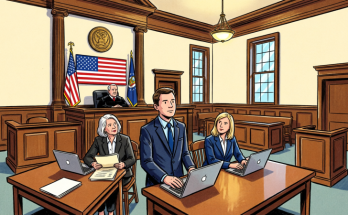
He removes the document.
Reads it once.
Reads it again.
Takes off his glasses.
When he looks up, he is no longer merely the tired county judge I watched preside over zoning disputes when I was seventeen and bored on civics field trips. He looks, for one brief unsettling instant, like the officer he used to be. Spine straighter. Face cleaner. Every line sharpened by recognition.
He looks at me.
Then at the phoenix pin.
Then at Gerald Davis.
“Mr. Davis,” he says, and his voice lands with a new weight. “You have built this case on the premise that Elena Vance is a ghost. You have accused her of fraud, theft, and habitual idleness. You have implied that the absence of accessible public records is evidence of a fabricated life.”
No one breathes.
“I have before me a verified statement of service from the Director of National Intelligence,” he continues. “It confirms that Elena Vance has maintained continuous active federal service for the relevant period. It further confirms that the entity referenced as North Atlantic Logistics Group is a lawful cover designation established under federal authority. The blank spaces you describe are not evidence of failure. They are evidence of protected service.”
Robert’s jaw goes loose.
Ashley makes a sound I have never heard from her before—small, wet, involuntary.
Judge Miller continues, and now even Gerald has stopped trying to interrupt.
“For the last fifteen years, Elena Vance has served in senior operations leadership under the Central Intelligence Agency.”
The room does not merely fall silent.
It goes cold.
There are revelations that come with noise—gasps, exclamations, falling objects. This one strips sound away instead. The jurors look at me and then quickly away, as if eye contact itself might now be classified. Gerald’s hand tightens on his legal pad until the corner bends. Robert is breathing through his mouth. Ashley is staring at me like I have risen from a grave she had personally helped fill.
Judge Miller is not finished.
“The logistics group you mocked,” he says to my father, “was not an invented company. It was a tier-one cover mechanism. The lack of a LinkedIn page is not a sign of laziness. It is the sign of work so sensitive the law forbids its casual disclosure. She was not hiding in Washington, Mr. Vance. She was serving the country whose flag you have spent this morning draping over your own grievances.”
I do not look at Robert then.
I look at the back wall of the courtroom and feel, for the first time in longer than I can say, the peculiar ache of being accurately seen.
Judge Miller sets the document down.
“Bailiff,” he says. “Secure the doors. No one enters or exits until the court has completed an in camera clarification of the record.”
The bailiff moves immediately.
Gerald clears his throat, but what comes out of him is no longer argument. It is panic with a bar number.
“Your Honor, surely this—”
“Counsel,” Judge Miller says, “I suggest you stop speaking until you understand the scale of the error you have made.”
Gerald stops.
Robert does not.
“She was just an analyst,” he says, voice cracking. “She told us she was an analyst.”
I finally turn toward him.
I do not raise my voice. I have learned, over years in rooms where men confuse volume with truth, exactly how sharp quiet can be.
“I told you what you were cleared to know, Robert,” I say. “You were not asking questions because you wanted to know me. You were accepting answers because they fit the story you preferred.”
The last of the fight leaves his face not in a collapse, but in fragments. Mouth first. Then eyes. Then the set of his shoulders, which have carried arrogance for so long they seem structurally confused without it.
He looks older in that instant than I have ever seen him.
Not because truth ages people. Because it removes the posture youthfully held by power.
Judge Miller turns back to the documents on his bench, then to the original filings, then to Marcus.
“Counsel, does the limited disclosure address the employment clause of the trust in full?”
“It does, Your Honor. It confirms continuous lawful employment and active public service. It also notes that the decedent was advised by counsel that such proof could be provided under seal should the clause ever be challenged.”
My mother, even dead, outmaneuvering them from the grave.
I feel that like warmth and grief at the same time.
Judge Miller nods once. Then he looks at Gerald Davis and Robert Vance with a face stripped clean of county politeness.
“I am dismissing this complaint with prejudice.”
The words land one by one, each harder than the last.
“Furthermore, the court is issuing sanctions against the plaintiff in the amount of forty-five thousand two hundred dollars for legal fees, bad-faith filings, and the administrative burden improperly placed upon federal review channels. In addition, the court awards the defendant fifty thousand dollars in damages for defamation to be paid from the plaintiff’s personal share of the estate.”
Gerald closes his eyes.
Ashley covers her mouth.
Robert just stares.
He opens his mouth once, closes it, then finally manages, “We didn’t know.”
There it is. The last refuge.
Ignorance.
As if ignorance were a weather event and not a set of choices made repeatedly over years.
“How were we supposed to know?” he asks, and for one split second I hear something almost childlike in it. Not innocence. Panic stripped of polish.
I stand.
The witness box rail is lower than it looked from seated height. I step down carefully, smoothing the skirt of my suit without really thinking about it. The phoenix pin catches light once. Marcus watches me but does not move to intercept. He knows I do not need rescuing from this room anymore.
“You weren’t supposed to know the details,” I say. “But you were supposed to know me.”
My voice carries cleanly because the room has made itself small enough to hold it.
“You were supposed to know that the daughter who worked ten-hour days in the fields as a child did not become a parasite because she moved to a different city. You were supposed to know that a woman doesn’t become worthless just because her labor is not visible to men who only recognize themselves in calluses and public titles. You were supposed to know that when money kept appearing at exactly the moment this family needed it, when Ashley’s degree got funded, when Mother’s treatments were somehow covered, when the irrigation system got replaced before the farm collapsed—you were supposed to know that maybe the daughter you dismissed was not absent. Maybe she was the reason you survived your own pride.”
Ashley lifts her face then, tears sliding hard and fast now, but I cannot tell whether they are for me, for herself, or for the version of our family that has just been unmasked beyond repair.
Robert whispers, “Elena…”
I do not stop him with cruelty. I stop him with accuracy.
“The nurses,” I say, turning slightly toward him as I move toward the aisle. “The private ones you refused to pay because you didn’t want strangers in the house. Those reimbursements you called theft? That was me. The one hundred thirty-six thousand that saved the farm four years ago? Also me. Ashley’s scholarship? Me too.”
Ashley makes a broken sound.
“I did not do any of it because I loved the legacy,” I continue. “I did it because my mother loved you. But that debt is settled now.”
Marcus steps aside to clear my path.
Judge Miller says nothing. He does not need to. There is something like respect in the set of his mouth when I pass the bench, and that is enough. More than enough.
I move through the gallery without looking at anyone directly. Past Ashley, who cannot meet my eyes. Past two jurors who were prepared to convict me of the story they already liked. Past the pew where my father’s old friend from the feed store sits with his hands folded too tightly together, suddenly unsure what kind of town tale he will be able to tell after today.
At the heavy oak doors, I pause only long enough to hear Robert say my name again. Not Elena the accusation. Elena the child. Elena the daughter. Elena the thing he could not name.
I do not turn.
I push through.
The hallway outside the courtroom is brighter than it should be after all that dim old wood. Marble floors. Clean air. A vending machine humming near the elevators. A clerk carrying files past me without slowing because to her this is only Thursday and she has deadlines.
Freedom rarely arrives with music. More often it sounds like ordinary building noise after a room of judgment has finally shut behind you.
Marcus catches up before I reach the elevator.
He does not say congratulations. Men like Marcus know better than to confuse victory with relief.
He hands me my briefcase.
“The director wants a debrief at 0800,” he says. “He said your judicial restraint was noted.”
I let out the smallest breath of laughter.
“I was balancing the books.”
Marcus’s mouth almost twitches. That is the closest he comes to smiling in public.
We wait for the elevator in silence. I can feel the adrenaline now that the room is gone—not a rush, exactly, but the body’s slow acknowledgment that it has been braced against impact for hours and may stop if it chooses. My hands are steady. That surprises me less than it once would have. There is a steadiness you earn after enough years making decisions under pressure. Courtrooms are just another kind of room.
When the elevator arrives, we step in.
The mirrored back wall gives me a clean view of myself at last. Dark suit. Hair pinned low. Eyes older than I remember them looking. Silver phoenix on my lapel.
I reach up, unfasten it, and place it in the velvet-lined box inside my briefcase.
For fifteen years I accepted the terms of invisibility because the work required it. I let my family call me vague, remote, lazy, arrogant, strange. I let neighbors pity my “mysterious office job.” I let Robert tell himself I was nothing because I thought the silence was neutral. Necessary, yes. But neutral.
It wasn’t neutral.
Silence costs. It doesn’t only protect. It erodes. It creates room for lesser narratives to root themselves where your name should be.
My mother knew that. She left me a hinge in the door.
Today I used it.
By the time I reach the parking lot, the rain has cleared. The sky over Fairfax is the pale hard blue that comes after weather has spent itself. I unlock my car, get in, and sit for a moment with both hands on the steering wheel.
Across the lot, the courthouse windows throw back squares of white light. Somewhere inside, Robert Vance is learning what it feels like to be looked at and not believed. Ashley is probably crying. Gerald Davis is calculating the fastest path to minimizing professional humiliation. Judge Miller is sealing documents no one in town will ever fully understand.
And me?
I am thinking about my mother.
About the way she stood in that hallway and insisted my portrait stay where it was.
About the way she never asked for more truth than I was allowed to give.
About the way she prepared for this fight without ever telling Robert she had done it.
About the sentence she said over tea on that rainy afternoon: He’ll call you a ghost, so I put a hinge in the door.
I wish she had lived long enough to see it open.
My phone vibrates once in the console. A secure notification. Not family. Not Ashley. Not some local reporter who heard a rumor and wants a quote. Work.
The world has not paused because my father finally met the truth. It never does. That is one of the strange mercies of service. Whatever shatters personally, the mission clock keeps moving.
I start the car.
As I pull out of the courthouse lot, my mind flickers through scenes not as wounds now, but as evidence finally filed in the correct place.
Robert at the kitchen doorway calling me a phase.
My mother bringing me cake in the night.
Ashley cashing a scholarship check she never traced.
The irrigation line running again after the grant “appeared.”
My portrait taken down after the funeral.
The blank patch of wallpaper.
The black envelope on Marcus’s desk that morning before court.
Judge Miller’s hand stilling when he saw the pin.
My father saying, We didn’t know.
My own answer: You were supposed to know me.
That is the heart of it. Not that my family lacked access to secrets. They were never entitled to those. The failure was simpler and more devastating. They chose the version of me that cost them the least to understand. Then they punished me for fitting it too well.
The road bends east as I merge toward the highway. The sun is climbing now, bright enough to flatten the fields at the edge of the city into strips of gold and frost. Langley waits where it always waits—behind trees, behind gates, behind silence that means something different now than it did this morning.
I think about the word ghost.
In my father’s mouth it meant absence, failure, nothingness. A daughter who left and therefore ceased to matter except as grievance.
In my world, ghosts are different. They are the ones who move through locked spaces and unseen channels, carrying weight without witness, changing outcomes without getting their names attached to the result. They are not empty. They are disciplined.
For too long, I let those meanings collapse into each other. I let my service justify my erasure in places it should not have touched.
Not anymore.
When I reach the beltway, traffic is already thick. Brake lights thread ahead of me in long red lines. A truck on my right is carrying lumber. A woman in a silver sedan is singing to herself hard enough I can see the shape of it through her windshield at the light. The ordinary world continues, unaware that one county courtroom has just learned the limits of its own imagination.
I keep driving.
There will be paperwork tomorrow. Debriefings. A briefing packet I need to review before dawn. Marcus will call by evening with the sealed transcript protocol. Dana from estate administration will likely want to know whether I wish to enforce the damages immediately or through structured disbursement. Ashley may write. Robert may not. My mother will still be dead when I get home.
None of that changes.
But something fundamental has.
I am no longer carrying their story about me just because my work taught me how to carry silence.
That ends here.
The farmhouse can keep its faded wallpaper.
The county can keep its gossip.
Robert can keep the memory of the moment the judge read the truth and his face fell apart under it.
Ashley can keep the cardigan bought with money she never knew was mine.
I am done shrinking to fit what they can tolerate.
At the next light, I glance at the briefcase on the passenger seat. The velvet box with the phoenix pin rests inside it. Small. Unassuming. Cold metal shaped like rebirth. We use symbols in my line of work because sometimes a symbol is the only public thing you’re allowed to keep.
When the light changes, I drive into it.
For fifteen years I was a ghost in their bank accounts, a ghost in their narratives, a ghost in a house where my portrait could be replaced by a tractor calendar and they thought that meant I had vanished.
But ghosts are only powerless in stories told by people who do not understand what haunts them.
I do now.
And as the road carries me toward Langley and the morning opens clean and hard ahead of me, I realize I am no longer a ghost in my own story.
I am the author.
And at last, finally, unmistakably, I am seen.