Part 7
Mason’s life didn’t collapse all at once. It leaked.
First, his pride took a hit. Then his marriage started cracking under the weight of reality. Brianna had loved the idea of living in my duplex because it came with a story she could brag about: family helping family, upgraded master bedroom, stability without sacrifice.
When that story died, she turned on Mason.
He started calling more, at first to argue, then to bargain. Each time, I held the same line: apply, pay, behave.
He didn’t like lines. He liked loopholes.
One afternoon, Linda called me. “Mason showed up,” she said quietly. “He says he’s here to ‘take back what’s his.’”
My stomach tightened. “What did he do?”
“He demanded his old office,” she said. “The one he barely used. And he told the guys you’re ‘temporary.’”
I closed my eyes. “Put him on speaker.”
Linda hesitated, then did.
“Mason,” I said into the phone, voice calm.
His tone jumped. “Oh, so now you want to talk.”
“I’m talking,” I said. “You’re trespassing.”
“This is my dad’s company,” he snapped.
“It’s not,” I replied. “And you know that.”
He lowered his voice, trying something softer. “Zee… come on. This is humiliating.”
I didn’t take the bait. “Leave the building. If you want to work here, apply for a position. If you show up again without permission, I’ll have Ariel escort you out.”
He went quiet. Then, bitterly, “You really changed.”
I stared at my desk, at the tidy stack of contracts waiting for my signature, at the life I’d built with no one’s help. “No,” I said. “I finally stopped pretending.”
He hung up.
That night, Piper—who rented one of my other properties now, a small condo I’d bought as an investment—texted me a photo of Mason’s social media post. It was vague, but pointed.
Some people forget where they came from when they get money. Family means nothing to them anymore.
The comments were split. Some relatives agreed. Some old friends of Mason’s agreed.
But then something unexpected happened.
Employees of Wade Mechanical started commenting too.
Not by name—some used initials, some used burner accounts—but the message was consistent: Zelda saved our jobs. Zelda fixed payroll. Zelda showed up when you didn’t.
Mason deleted the post within an hour.
A week later, he called me from his own number, which meant he’d gotten around the block by using a new phone.
I let it go to voicemail.
His voice sounded different. Smaller.
“Zee… it’s bad,” he said. “Brianna wants to move in with her mom. She’s saying I failed.”
I didn’t feel satisfaction. I felt a strange, heavy quiet. Because Mason wasn’t a monster. He was a product of a family that taught him he’d always land on his feet, even if someone else had to become the ground.
He called again the next day. I answered.
“What do you want, Mason?” I asked.
A pause. “I want help.”
I leaned back in my chair. “Help with what?”
“With… everything,” he said, voice tight. “I can’t afford rent where we are. My credit is wrecked. Brianna’s furious. Dad’s barely speaking to me. And you’re… you’re just fine.”
There was resentment in it, but also something else—confusion. As if he genuinely didn’t understand how someone survived without being carried.
“I’m not ‘just fine,’” I said. “I’m working. Hard. Like I always have.”
He exhaled. “So what, you’re going to let me drown?”
I thought about Leah and Carter. I thought about how kids shouldn’t pay for adult entitlement. I also thought about every time Mason had let me drown emotionally because it never affected him.
“I’ll offer you a path,” I said carefully. “Not a rescue.”
“What’s that mean?”
“It means you apply to rent one of my properties at market rate,” I said. “And if your credit doesn’t qualify, you can use a co-signer who isn’t me. Or you can rent somewhere else. It also means you go to financial counseling. I’ll pay for the first three sessions if you show proof you attended.”
Mason’s voice rose. “Counseling? Like I’m broken?”
“Like you’re untrained,” I said calmly. “You were never taught consequences. Now you need tools.”
He went silent.
“And,” I added, “if you want a job at Wade Mechanical, you apply for an open role. If you get hired, you show up on time, you do the work, and you don’t talk about me like I’m temporary.”
His laugh was hollow. “You’re serious.”
“I’m serious,” I said. “This is what adults do. They earn.”
Another long pause.
Finally, Mason said, quieter, “Okay.”
He didn’t apologize. Not then. But he didn’t demand either. And for Mason, that was movement.
Over the next month, he attended counseling. He applied for a warehouse logistics role—something real, measurable. Linda interviewed him like any other candidate. The first time she called me after, she sounded almost amused.
“He looked shocked when I asked him about his experience,” she said. “He thought the last name would do the job.”
“Did he do okay?” I asked.
“He did… okay,” she said. “But he’s going to have to learn humility.”
“Then it’ll be a growth position,” I replied.
Mason got hired on a probationary basis. He started working early mornings, loading parts, tracking inventory. He came home tired. Brianna didn’t like tired Mason. She liked entitled Mason.
She left anyway.
Leah and Carter stayed with Mason half the week. The kids adjusted faster than the adults.
My mother blamed me. My father blamed Mason. Everyone blamed someone else because blame was the family hobby.
But in the quiet spaces between the drama, something started changing.
Not everyone changed.
But the ecosystem did.
And that mattered.
Part 8
A year after the dinner that cracked everything open, my life looked different in ways I’d once assumed were impossible.
Wade Mechanical was stable. Not perfect, but steady. The restructure plan had worked, and the company had a new reputation in town: reliable, transparent, professional. We landed a municipal contract that my father would’ve never qualified for because it required rigorous documentation and ethics clauses.
My father—Harold—showed up twice a week as a consultant. He hated being “just” a consultant, but he followed the agreement because he didn’t have a choice. Some days he looked at me with simmering resentment. Other days, he looked tired.
My mother tried to pretend nothing had happened. She invited me to holidays with fake sweetness. She told relatives she was “so proud” of my success. She avoided mentioning the lawsuit like it was a bad smell.
Mason kept his job. He didn’t love it. It bruised his ego. But he did it. He learned to read inventory sheets. He learned what it felt like to be accountable to someone who wasn’t family.
One afternoon, he asked if we could talk.
We sat on my front steps, the same ones he’d tried to force open with an old key. The wood was freshly painted now.
“I didn’t understand,” he said suddenly, staring at his hands. “How you did it. The duplex. The company. Everything.”
I waited.
He swallowed. “I thought… I thought you were just lucky. Or that you’d found some trick.”
My laugh was quiet and bitter. “Yeah. That’s what Dad said too.”
Mason looked up, eyes tired. “It wasn’t a trick. It was work.”
“Yes,” I said simply.
He nodded slowly. “I’m… sorry.”
The word landed awkwardly, like it didn’t know where to sit.
“For what?” I asked.
He opened his mouth, then closed it, then tried again. “For acting like you owed me. For letting Mom and Dad treat you like… like you didn’t matter. For not stepping in.”
I felt my throat tighten. Not because his apology fixed everything, but because it was the first time Mason had ever admitted the truth out loud.
“I accept,” I said quietly. “But I’m not going back to the old setup.”
“I know,” he said. “I don’t want to either.”
That was the closest thing we’d ever had to a sibling relationship.
My biggest surprise came from my father.
In month fourteen, Linda flagged an irregularity: an old vendor payment request routed through Harold’s email. It wasn’t huge, but it wasn’t authorized. When we traced it, it led to a small attempt to shift funds—nothing that would bankrupt us, but enough to remind me that entitlement doesn’t disappear overnight.
I called my father into my office.
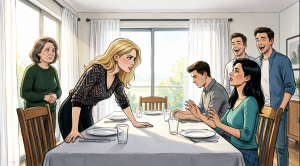
He sat across from me, jaw tight. “So now you think I’m stealing,” he said.
“I think you tried to,” I replied, sliding the documents forward. “Explain it.”
He stared at the papers, then at me. His face moved through anger, then embarrassment, then something that looked like grief.
“I was trying to fix something,” he said quietly.
“What?” I asked.
His voice cracked, barely. “Your mother doesn’t know how bad it got. The debts. The fear. I didn’t want her to know I failed.”
I leaned back, watching him carefully. It wasn’t an excuse. But it was the closest he’d come to honesty.
“You did fail,” I said. “But not because you struggled. Because you lied and tried to take. And because you kept feeding Mason like he’d never need to stand.”
Harold’s eyes shone with anger and shame mixed together. “I wanted him to have what I didn’t.”
“And I wanted to have what you refused to see,” I said. “Which was respect.”
Silence.
Then my father did something I’d never seen him do.
He lowered his head.
“I’m sorry,” he said. The words were rough, like pulling nails. “I didn’t know how to… how to be proud of you. You didn’t need me. And it made me feel useless.”
The admission hit me unexpectedly. Not because it justified him. Because it explained him.
I exhaled slowly. “Trying to undermine me won’t make you useful,” I said. “It will make you unemployed.”
He nodded once. “I understand.”
I held his gaze. “This is your last chance.”
“I know,” he said again, and this time his voice sounded like he meant it.
We implemented stricter controls. Two-signature approvals. Clearer policies. Transparency that didn’t rely on trust alone.
Because love can be rebuilt.
But systems should never depend on hoping people behave.
That winter, I hosted Thanksgiving in my duplex. Not because I wanted to reclaim family tradition, but because I wanted to create my own.
I invited Mason and the kids. I invited Linda and a few employees who didn’t have family nearby. I invited friends from my business circle who’d celebrated my wins without trying to own them.
My parents didn’t come. My mother said it was “too strange.”
Fine.
At my table, laughter was real. It wasn’t a weapon. It wasn’t a way to pressure someone into surrender.
It was just… laughter.
After dinner, Leah tugged my sleeve. “Aunt Zelda,” she said, “Dad says you’re the boss.”
I smiled. “I’m one of them.”
She nodded solemnly. “Can you teach me to be a boss?”
My chest warmed. “Yes,” I said. “But first I’m going to teach you something better.”
“What?”
“How to never let anyone tell you your life belongs to them.”
Part 9
Three years after the dinner that changed everything, I stood on the front porch of a different house.
Not the duplex.
This one was mine outright—no mortgage, no fear. A small craftsman with a wide porch and a backyard big enough for a garden I never had time for before. I kept the duplex as a rental asset under Zelda Holdings. It paid for itself, and it reminded me where I started.
Inside the new house, the smell of cornbread and roasted turkey filled the air. Thanksgiving again, but the version I chose.
Mason arrived first, carrying a pie from a bakery he’d discovered and insisted was “life-changing.” Leah and Carter ran past him, shoes thudding, laughing.
“Rules,” I called lightly from the kitchen.
Leah skidded to a stop. “Shoes off!”
Carter groaned but complied.
Mason leaned into the doorway. He looked different now. Still Mason, still stubborn, but steadier. Less entitled. More present. His job at Wade Mechanical had moved him up slowly—not by last name, but by effort. It had changed him in ways counseling alone never could.
“Need help?” he asked.
I handed him a dish towel. “You’re on dishes.”
He rolled his eyes, but smiled. “Yes, boss.”
Linda arrived next with her wife, both of them dressed casually, carrying a casserole and a bottle of sparkling cider. My friends came, filling the house with voices that felt like chosen family.
Then, a knock.
My stomach tightened, instinctively.
I opened the door and found my parents.
My mother stood stiffly, holding a store-bought pie like a peace offering. My father’s hands were empty, shoulders slightly hunched.
They looked older. Not ancient. Just… less certain.
“Zelda,” my mother said carefully.
“Mom,” I replied.
Harold cleared his throat. “We… wanted to come.”
I didn’t step aside immediately. Boundaries don’t disappear because someone shows up with pie.
“Why?” I asked.
My mother’s mouth tightened, but she didn’t lash out. That was new. “Because… we’ve missed things,” she said quietly. “Leah and Carter talk about you like you hung the moon.”
Mason appeared behind me, drying his hands. He looked at them, then at me, waiting.
I held the silence a moment longer. Then I stepped back. “Come in.”
They entered slowly, as if the house might reject them.
At dinner, my mother tried to control the conversation out of habit—asking questions that sounded like judgments—but she caught herself more than once. My father spoke less. He listened more. It wasn’t miraculous. It was awkward and real.
After the meal, when people drifted to the living room, my father lingered near the doorway.
“Zelda,” he said quietly.
I turned.
He swallowed. “I want you to know… the company is doing well. Better than I ever managed.”
I nodded once. “It is.”
He looked at his hands. “You saved it.”
“I stabilized it,” I corrected. “The employees saved it.”
He nodded, then finally looked at me. His eyes were wet. “I didn’t deserve that.”
The admission didn’t erase the past. But it cracked something open.
“No,” I said softly. “You didn’t. But they did.”
He exhaled slowly, like the truth hurt but also relieved him. “I’m sorry,” he said again, and this time it wasn’t about losing power. It was about losing years.
My mother hovered nearby, listening, her face tight.
I didn’t rush to forgive. Forgiveness isn’t a switch. It’s a process with conditions.
“I’m willing to try,” I said. “But the old rules are gone.”
My mother’s eyes flickered. “Rules?”
“Yes,” I replied. “You don’t plan my life. You don’t use guilt. You don’t treat my work like community property. If you want to be in my life, you respect that my no means no.”
Silence.
Then my mother nodded, small and reluctant, like agreeing to reality.
My father nodded too. “Okay,” he said. “Okay.”
Later, after they left, Mason and I stood on the porch watching taillights disappear down the street.
“You okay?” he asked.
I breathed in the cold air. “Yeah.”
He nudged my shoulder lightly. “You did it, you know.”
“What?” I asked.
“You got free,” he said.
I looked out at my yard, at the warm light spilling from my windows, at the life inside that didn’t depend on anyone else’s approval.
“I didn’t just get free,” I said. “I built free.”
When I went inside, Leah was on the couch drawing something. She held up the paper proudly.
It was a picture of a house with a big porch and a woman in the doorway. Above it, in messy kid handwriting, were the words: Aunt Zelda’s Home.
My chest tightened.
I knelt beside her. “That’s beautiful.”
Leah beamed. “Dad says you own everything.”
I smiled gently. “I don’t own everything.”
She frowned. “Then what do you own?”
I thought about my duplex. My company. The contracts and employees and systems. The long nights. The silent sacrifices.
Then I thought about the real thing I’d taken back.
“My choices,” I said.
Leah nodded like that made perfect sense.
And in that moment, I knew the ending wasn’t my family losing. It wasn’t me winning. It wasn’t deeds or eviction notices or black envelopes.
It was this: a life no one could move into without permission.
A table where love didn’t come with strings.
A future built in my own name.
THE END!
Disclaimer: Our stories are inspired by real-life events but are carefully rewritten for entertainment. Any resemblance to actual people or situations is purely coincidental.