We talked for 45 minutes. I walked Amanda through the timeline, sent her the photos I’d taken, gave her the hospital’s media contact for verification. She asked smart questions about my family’s history, about previous incidents, about why I’d stayed in contact despite the red flags. That’s the thing people don’t understand about family abuse.
Amanda said, “Everyone asks why you didn’t cut them off sooner. But when it’s your parents, your siblings, people you’ve known your whole life, you keep hoping they’ll change. You keep believing it can’t really be as bad as it seems.” “Exactly,” I said, relieved someone understood, and they’re good at making you doubt yourself.
My mother would say I was too sensitive. My father would say I was overdramatic. After a while, you start wondering if maybe they’re right. But you know they’re not right. Your daughter is in the ICU. Yeah, I said quietly. I know now. I opened Facebook first. My mother had 483 friends. My father had 392. Vanessa had 618.
Marcus had 441. Uncle Howard had 357. Many were mutual connections, extended family, church members, neighbors, colleagues. I created a post. I included photos of Emma in the hospital, careful to show the burns, but not her face directly to protect her privacy. I wrote out exactly what happened step by step without embellishment or emotion, just facts and timestamps.
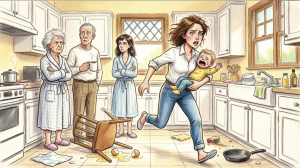
On Saturday, November 18th, at approximately 7:45 a.m., my 4-year-old daughter Emma accidentally sat in the wrong chair at breakfast during our family gathering. My sister, Vanessa Patterson, responded by throwing a hot cast iron skillet at her face, causing second and third degree burns covering 12% of her body. When I tried to confront her, my mother told me to stop shouting because Emma was disturbing everyone’s mood.
My father said some children just ruined peaceful mornings. On Tuesday, November 21st, while Emma was hospitalized and recovering, Vanessa gained unauthorized access to her hospital room and disconnected her monitoring equipment. Emma’s heart stopped for 43 seconds before nurses discovered the tampering. My uncle Howard Patterson, upon learning of this second attempt on my daughter’s life, stated, “Some kids just aren’t meant to make it.
I am posting this to inform everyone of who these people truly are. Police are investigating both incidents. I will be pursuing all available criminal and civil remedies. I tagged every family member who’d been present. I posted it publicly. Then I sent screenshots to my parents’ church, including the pastor and several prominent members.
I sent the information to Uncle Howard’s employer. He was a financial adviser at a large firm in Phoenix. I sent it to Vanessa’s workplace. She managed a boutique in Columbus. I contacted Marcus’s wife, Jennifer, separately. She’d been quieter during the hospital visit, standing behind my brother.
I’d seen something in her eyes that looked like horror. Jennifer, this is Rachel. I need you to know exactly what happened and what your husband defended. I sent her the folk timeline with evidence. Within 30 minutes, she called me back crying. Rachel, I had no idea. Marcus told me Emma had gotten hurt in an accident, that you were being overdramatic.
I didn’t know Vanessa deliberately. I can’t even say it. I’m so sorry. Are you still with him? I’m packing my bags right now. I’m going to my sisters in Toledo. I can’t be married to someone who would defend this. Jennifer became my first ally. She sent me additional text messages from the family group chat I’d been excluded from.
Messages where they discussed handling me. Messages where Vanessa called Emma a brat who needed to learn boundaries. Messages where my mother suggested they should all just deny everything and claim Emma had grabbed the skillet herself. I forwarded everything to Detective Harris. The Facebook post went nuclear within 3 hours.
Over 200 shares, comments flooded in. Disgust, horror, calls to report them all to child protective services. Several people recognized my parents from church and said they’d be alerting the congregation leadership. My mother called from a number of hadn’t blocked. I answered, “Rachel, what have you done?” Her voice was shrill.
People are calling us monsters. The pastor requested we not attend services this Sunday. Your father’s golf buddies are asking questions. Good, I said calmly. You are monsters. You enabled someone to severely burn my daughter and then tried to cover up a murder attempt. Nobody tried to murder anyone. You’re being hysterical.
Mom, there’s video footage of Vanessa disconnecting the monitors. There are text messages where you all discussed lying to police. I have recordings of the voicemails you left me. Everything is documented. Silence on the other end. You destroyed this family, she finally said. No, you did. I’m just making sure everyone knows about it. She hung up.
Uncle Howard’s employer called me two days later. A compliance officer named David Brennan explained that several clients had contacted the firm expressing concerns about Howard’s character. They were launching an internal investigation and had placed him on administrative leave. Your uncle works with retirees and families, David explained.
Trust is paramount in this field. If these allegations are true, he’s violated every ethical standard we have. They’re true. I have police reports and hospital records. Howard was fired within the week. Vanessa lost her job at the boutique after the owner received dozens of messages from the Facebook post. The boutique depended heavily on local clientele and online reputation.
They couldn’t afford to be associated with someone who’ assaulted a child. Detective Harris called on Friday with an update. We’ve reviewed all the evidence, including the security footage from the hospital. We’re charging Vanessa Patterson with aggravated assault for the Skillet incident and attempted murder for the hospital incident.
The DA believes we have a strong case for both. What about the others? They were accessories. It’s complicated with the family members who were present for the first incident. We’re looking at potential child endangerment charges for failing to render aid or contact authorities. Your uncle’s statement at the hospital could potentially qualify as conspiracy or accessory after the fact, but that’s harder to prove.
The DA’s office is reviewing all options. It wasn’t perfect, but it was something. Vanessa was arrested on Monday, November 27th. Her bail was set at $750,000 given the severity of the charges and the fact that she’d already attempted to harm the victim once while in the hospital. My parents tried to help her raise it, but word had spread throughout their community.
Nobody wanted to be associated with them. Vanessa sat in county jail for 5 weeks before finally making bail through a bondsman who charged her an exorbitant premium. The Detroit Free Press article came out 2 days after her arrest. Amanda Cruz had written a devastating piece titled When Family Becomes the Enemy: A Michigan Mother’s Fight for Justice After Her Daughter’s Assault.
The article included everything: photos of Emma Burns, transcripts of my mother’s voicemails, screenshots of the family group chat, and expert commentary from child psychologists about familial abuse patterns. The article went viral. Within 24 hours, it had been shared over 50,000 times. National news outlets picked it up.
Good Morning America reached out requesting an interview. Dr. Phil’s producers called. The Ellen Degenerous show wanted us to appear. I declined most of them. Emma was still recovering, still processing trauma. The last thing she needed was to be paraded on national television. But I did agree to one interview with a local news station, primarily because they promised to keep Emma’s face hidden and focus on the legal and systemic issues rather than sensationalism.
The interview aired on a Thursday evening. I sat across from the anchor, a woman named Denise Patterson, who’d been covering local news for 20 years. She asked thoughtful questions about how the system had failed, Emma, about what changes needed to happen to protect other children in similar situations. “What do you want people to take away from your daughter’s story?” Denise asked near the end.
“I want people to understand that family isn’t sacred just because of blood,” I said, looking directly into the camera. “If your family member hurts a child, your child, any child, you have a moral and legal obligation to protect that child. Loyalty to an abuser isn’t love, it’s complicity.” The segment ended with information about how to report child abuse and resources for families dealing with domestic violence.
My phone exploded after the broadcast. Hundreds of messages from strangers sharing their own stories of family abuse of relatives who got away with hurting children because nobody wanted to break up the family. Some were supportive. Some accused me of being vindictive. One message from a woman named Susan particularly struck me.
My brother did something similar to my son 12 years ago. I chose family peace over pressing charges. My son hasn’t spoken to me in 8 years, and I don’t blame him. You’re doing the right thing. The publicity had unintended consequences. Someone recognized my parents at a grocery store and confronted them in the produce section.
According to witnesses, a young mother with two kids approached my father and said, “You’re the grandfather who let that baby get burned. You should be ashamed.” Other shoppers joined in. My parents left their card and hurried out. Good. They deserve to feel uncomfortable. They deserve to be recognized and judged. My father’s employer, he worked part-time as a consultant for a construction firm, quietly let him go.
The company’s HR director called to inform me they’d received numerous complaints from employees who didn’t feel comfortable working alongside him. We have a zero tolerance policy for child endangerment, she explained. Even if the charges are pending, the court of public opinion has spoken. My mother lost her book club, her bridge group, and her place in the local garden society.
Membership committees voted to remove her, citing conduct incompatible with our values. She tried to fight it, threatened to sue for discrimination, but her lawyer advised against it. Any lawsuit would just bring more attention to what she’d done. The social consequences were working exactly as I’d hoped. These people had built their entire identities on being upstanding community members.
They cared deeply about appearances, about reputation, about what the neighbors thought, destroying that matter to them more than any legal penalty ever could. But I wasn’t satisfied yet. Criminal charges were pending, yes, but I wanted more. I wanted them to understand viscerally what they’d done.
I wanted them to feel a fraction of the fear and helplessness Emma had felt. My parents were charged with child endangerment and failure to report child abuse. They faced misdemeanor charges rather than felonies, but it was enough to destroy their standing in the community. Their church officially asked them to find another congregation.
Dad lost his position on the local planning commission. Mom was removed from her volunteer role at the elementary school. Marcus faced public humiliation, but no charges. Jennifer filed for divorce and got it fast-tracked through the courts. She testified to his awareness and approval of the coverup attempt. He lost most of their assets in the settlement.
Uncle Howard faced no criminal charges, but losing his career at 65 was devastating enough. At that age, he’d be starting over in an industry that runs on reputation. His reputation was obliterated. Emma stayed in the hospital for 3 weeks total. She underwent her first skin graft procedure during week two with doctors planning additional reconstructive surgeries over the coming years as she grew.
The scarring on her face and neck will be permanent, though plastic surgeons say they can minimize it with continued treatment. The physical recovery was hard, but the emotional impact was worse. Emma developed severe anxiety around meal times. She’d panic if she sat in the wrong spot or thought she’d done something wrong.
We started therapy immediately, both individual sessions for her and family therapy for us. She still has nightmares about that morning. She’ll wake up screaming and I’ll hold her while she sobs about the hot pan and her face hurting. She asks me why Aunt Vanessa hurt her, why grandma and grandpa didn’t help? Why anyone would do that to a little girl? I don’t have good answers.
How do you explain to a 4-year-old that some people are cruel? That even family can be monstrous? That the adults who should have protected her chose themselves instead? Vanessa’s trial is scheduled for September, about 10 months after the incident. The prosecutor is confident we’ll get a conviction on both charges. With Emma’s injuries documented, the video evidence of the hospital tampering, and the text messages showing premeditation and cover up, the case is solid.
Vanessa’s lawyer has tried to negotiate a plea deal, but the DA’s office has refused anything less than significant prison time. They want this to go to trial. My parents’ case will be heard in July. Their lawyer is arguing that they didn’t understand the severity of the situation, that they’re elderly and confused, that they shouldn’t be held responsible for their daughter’s actions.
It’s pathetic watching them play victims after what they did. The civil suits are still pending. Janet Peterson filed against Vanessa, my parents, and Uncle Howard for damages covering Emma’s medical bills, future surgeries, therapy costs, and pain and suffering. The total claim is $3.2 million. We’ll probably never collect most of it, but I want the judgment on record.
I wanted to follow them forever. Janet was brilliant in her strategy. She didn’t just file a straightforward personal injury suit. She filed separate claims for emotional distress, loss of familiar relationships, intentional infliction of emotional harm, and civil conspiracy. Each claim required my family members to hire separate attorneys because their interests conflicted.
Vanessa’s lawyer wanted to blame my parents for not supervising properly. My parents lawyer wanted to blame Vanessa for acting independently. Uncle Howard’s lawyer wanted to distance him from everyone. “This is what we call scorched earth litigation,” Janet explained during one of our strategy sessions. “We’re not just seeking damages.
We’re making them fight each other. We’re ensuring they can never present a united front again. Every deposition, every discovery request, every motion, it’s designed to expose their dysfunction and force them to betray each other to save themselves.” During Vanessa’s deposition, her lawyer tried to argue she’d been under extreme stress, that Lily had special dietary needs, that she’d reacted out of protective maternal instinct when she saw Emma at Lily’s place setting.
Janet destroyed that argument in minutes. Mrs. Patterson, is it your testimony that throwing a scalding hot cast iron skillet at a 4-year-old child’s face is a reasonable protective response? I didn’t mean to hit her face. I was just trying to scare her away from the table. So, you admit you intentionally threw a hot skillet at a small child? I I just wanted her to move.
Did you consider using words? Perhaps saying, “Emma, that’s Lily seat.” Vanessa had no good answer. The deposition transcript was damning. Janet sent copies to the prosecutor handling the criminal case, who added it to their evidence file. My parents deposition was even worse. Under oath, they couldn’t maintain their denials. My mother admitted she’d seen Emma unconscious on the floor and had chosen not to call 911 because she didn’t want to overreact.
My father admitted he’d known Vanessa had thrown the skillet, but had assumed Emma wasn’t badly hurt because she wasn’t screaming. “Mr. Patterson, your granddaughter was unconscious,” Janet said coldly. She had visible burns on her face. “At what point does a child’s injury become severe enough to warrant calling emergency services?” “I don’t know,” he mumbled.
“I thought Rachel was handling it.” “By handling it, you mean you allowed your daughter to carry an unconscious, severely burned child to her car alone while you finished your coffee?” He didn’t answer. The most surprising development came from my father’s side of the family. His sister, Aunt Caroline, reached out 3 weeks after everything happened.
She’d seen the Facebook post through a mutual connection. “Rachel, I am so deeply sorry,” she said over the phone. “I had no idea you were dealing with that. Your father and I haven’t spoken in years because of similar issues. He’s always believed family loyalty means covering for each other’s worst behavior. She connected me with other relatives I’d lost touch with, cousins, second cousins, family friends who distanced themselves from my parents over the years. A pattern emerged.
My parents had a history of protecting Vanessa from consequences, of minimizing her aggressive behavior, of prioritizing appearances over reality. One cousin, Michelle, told me about a Thanksgiving 15 years ago where Vanessa had pushed her down the stairs during an argument. Michelle had been pregnant at the time. She’d miscarried 3 days later.
My parents had convinced everyone it was an accident, that Michelle was clumsy, that making accusations would tear the family apart. Vanessa had never faced consequences for that either. Learning this history made me feel simultaneously validated and enraged. How many people had my sister hurt? How many times had my parents enabled her? How many victims were told to be quiet for the sake of family harmony? Emma is still 4 years old.
It’s been 6 months since that November morning, and her fifth birthday is coming up next month in June. We’ve been planning a small celebration with just a few close friends, people who’ve supported us through this nightmare. She started prek with an ayat that accounts for her anxiety and medical needs. We enrolled her in a small private program that specializes in children with trauma histories.
The other kids ask about her scars sometimes. She’s learned to say, “I got hurt, but I’m okay now.” Which her therapist taught her. She’s still sweet, still gentle, still makes up songs about butterflies and clouds, but she’s also more cautious now. She asks permission before sitting down. anywhere. She flinches if someone moves too quickly near her.
She watches people carefully, looking for signs they might hurt her. I hate what they stole from her. That easy innocence, that assumption of safety, that trust in family. She’s almost 5 years old and already knows people can be cruel for no reason. But I also see her resilience. She’s braver than most adults I know. She’s learning to advocate for herself in therapy.
She tells me when she’s scared or sad. She’s building a life despite what happened to her. As for my family, I haven’t spoken to any of them since that hospital stay. They’re all blocked on every platform. I moved us to a new apartment with better security. I changed our phone numbers. I informed Emma’s school that under no circumstances should my parents, sister, brother, or uncle be allowed anywhere near her.
Jennifer is the only one I maintain contact with. She sends cards on Emma’s birthday and Christmas. She testified at the preliminary hearings, providing crucial evidence about the family’s coverup attempts. She’s rebuilding her life, too. Working as a parallegal in Toledo and dating a man who actually has a conscience. People sometimes ask if I regret how I handled it.
If I think I went too far by making everything public, by pursuing every possible consequence, by salting the earth of my family’s reputation. I don’t regret a single thing. They tried to kill my daughter twice. They showed no remorse. They blamed her for ruining their morning, for disturbing their mood, for not being meant to make it. They protected their own comfort over a four-year-old’s life.
Those 20 minutes after Uncle Howard made his statement, I spent them methodically dismantling every protection they built around themselves. I exposed them to their community, their employers, their friends, their church. I made sure everyone knew exactly who they were. Did it bring Emma’s innocence back? No. Did it heal her scars? No.
But it ensured they couldn’t do this to another child. It showed Emma that I would move heaven and earth to protect her. It demonstrated that actions have consequences, even within families, even when people try to hide behind blood relations. Emma asks me sometimes why we don’t see grandma and grandpa anymore. I tell her that some people hurt others and then don’t feel sorry about it.
I tell her that we only keep people in our lives who are kind and safe. I tell her that family is about love and protection, not just sharing DNA. She seems to understand as much as a 4-year-old can. Last week, she drew a picture in school of our family. It was her, me, and Aunt Jennifer. No one else. When her teacher asked about grandparents, Emma said, “We don’t have those, just us.
” The teacher called me concerned. I explained the situation in vague terms, family estrangement, safety concerns, ongoing legal matters. The teacher was understanding and noted it in Emma’s file. Looking at that drawing, seeing Emma’s vision of family as just the people who actually love and protect her, I felt oddly proud.
She already understands something many adults never learn. That you can’t keep toxic people in your life just because you share blood. Vanessa’s trial starts in three months. I’ll be there every day with Emma’s medical records, photos, timeline, and testimony. I’ll watch them play the security footage of her disconnecting those monitors.
I’ll hear the prosecutors lay out exactly what she did and why. I’ll watch her face whatever consequences the justice system deems appropriate. And I’ll know that I did everything possible to protect my daughter and prevent this from happening to anyone else. Some people think revenge is ugly. Maybe it is. But sometimes it’s also necessary.
Sometimes it’s justice. Sometimes it’s the only way to prove that hurting children isn’t acceptable. That family doesn’t mean immunity. That mothers will burn down the whole world to protect their babies. In those crucial minutes after Uncle Howard made his statement after Vanessa had tried to murder my daughter in her hospital bed, I spent them methodically dismantling every protection they built around themselves.
I exposed them to their community, their employers, their friends, their church. I made sure everyone knew exactly who they were.