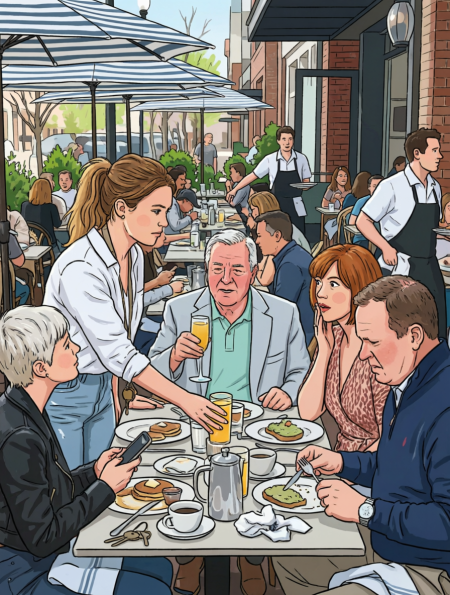
“My girl, I’m so glad you’re enjoying the apartment I got you.”
Grandpa’s mimosa hovered in the air like a tiny sun caught mid-rise, sparkling with pulp and bubbles. His smile was wide, proud, harmless—one of those smiles that belonged in photo albums and holiday cards. The kind you expect from a man who still sends birthday checks in crisp envelopes and calls you “kiddo” even when you’re old enough to pay taxes.
But the moment the words left his mouth, the entire brunch table went rigid, as if the air itself had turned to glass.
I froze mid-sip.
Orange juice burned down my throat, bright and acidic, and for a second my lungs forgot how to work. I felt the heat crawl up my neck. My fingers tightened around the stem of my water glass, knuckles whitening, because if I let go I might drop it, and if I dropped it I might break—right there, right under the chandelier, in front of plates of eggs Benedict and family members who had spent a decade perfecting the art of looking past me.
My mom’s painted lips parted in confusion. She blinked hard, like the sentence had to be processed twice before it could become real. My sister lifted her eyes from her phone in slow motion, expression sharpening in that familiar way—half annoyance, half calculation. And my dad…
My dad dropped his fork.
It hit his porcelain plate with a sharp clink that sounded like a bell in a church. A small noise, but in the silence that followed, it rang like a verdict.
I could feel my heartbeat behind my eyes.
I stared at Grandpa, willing my face to stay calm. I was twenty-seven years old, and I’d learned a long time ago that crying in front of this family didn’t earn comfort. It earned commentary. It earned lectures about composure and toughness and “not making a scene.”
So I swallowed the burn in my throat and wiped my hands on the napkin in my lap, slow and deliberate, as if controlling that small movement might keep everything else from flying apart.
“I live in a basement,” I whispered.
Grandpa’s smile faltered.
“What?” he asked, blinking once, then again, like he’d misheard me over the clatter of the restaurant.
My chest felt tight, but my voice came out steadier than I expected. “I never got any apartment,” I said, louder this time, the words landing cleanly on the tablecloth between us. “I’ve never gotten any apartment.”
A hush dropped like a storm cloud. It didn’t feel like silence so much as pressure—the kind that builds before something gives way. The restaurant around us kept moving, forks scraping plates, servers weaving between tables, laughter bubbling from somewhere near the bar, but at our table, the world had stopped.
Grandpa set his mimosa down slowly. “Kayla,” he said, my name gentle on his tongue, “what are you talking about?”
My mom’s hand trembled as she reached for her coffee. The cup rattled against the saucer, and a drop spilled onto the white tablecloth like a tiny bruise.
My sister stopped chewing, her jaw working once, then stilling. My dad coughed and reached for his water like he had something stuck in his throat—like a lie had lodged there and suddenly become too big to swallow.
I looked at all of them, one by one, taking in their faces the way I’d learned to scan a room when I was trying to figure out who might hurt me. Except this time, the danger wasn’t physical. It was the kind of danger that turns your life into a story other people tell without your permission.
“You never sent me anything, Grandpa,” I said again, carefully, because I wanted the words to be impossible to twist. “I’ve been living in a windowless basement for four years. The only gift I’ve gotten from this family in a decade was silence.”
Grandpa’s chair scraped back an inch. “Wait—hold on,” he said, voice rising, confusion shifting quickly into something sharper. He turned his head toward my father. “Daniel… I wired the down payment to you. Four years ago. I told you it was for Kayla’s condo. You told me you surprised her after graduation.”
The air in my lungs turned to ice.
My mouth went dry. A shiver ran up my spine, but I forced myself to breathe. I refused to let my body betray what my face wouldn’t.
Dad’s face had gone pale—ashen, like someone had switched off the light behind his skin. He stared at the table, not at Grandpa, not at me, not at anyone. His hands were folded too tightly, the veins visible across his knuckles.
My mom turned slowly toward him, her expression tightening with each fraction of movement. “You said you helped her find a cute place downtown,” she whispered, voice thin with something that might have been disbelief or dawning horror. “You said you… you said you helped her.”
I watched my father. I watched the way his throat moved as he swallowed. I watched his jaw shift as if he was chewing on an excuse.
“Dad,” I said, and my voice surprised me with how calm it sounded. It didn’t shake. It didn’t crack. It landed.
He flinched at the sound of it, just slightly, like the word had weight.
“I…” he began.
I lifted a hand—not dramatic, just firm. “No,” I cut in. “Don’t.”
My sister inhaled sharply, a small gasp that tried to disguise itself as a cough. Grandpa’s face tightened, his lips pressing together, his eyes narrowing in a way I’d rarely seen. He looked like someone had punched him without leaving a bruise.
Dad tried again. “I meant to—”
“You meant to keep it,” I said. The sentence came out without rage, and somehow that made it sharper. “You meant to keep it, and you did.”
The table felt like it was crackling now, the way air crackles before lightning. Heat rose in my face, but I held it. I held it because I was tired of being the one who burned.
“You told me to work harder,” I continued, the words slipping out like a truth I’d been carrying in my ribs. “To stop expecting handouts. All that time you let me scrub other people’s floors while you pocketed the money that was meant to give me a start.”
Dad’s eyes flicked up for half a second, then away again, as if looking at me might make him accountable.
Grandpa’s hands clenched on the table edge, knuckles whitening. My mother’s lips trembled. My sister’s phone lay forgotten beside her plate, screen still glowing with some paused video that suddenly felt absurd.
I pushed my chair back and stood. My hands were shaking, but I didn’t let my voice do it.
“I wasn’t going to say anything today,” I said, and my gaze moved across the table, meeting eyes that slid away one by one. “But since we’re celebrating birthdays, maybe it’s time we all stop pretending.”
And then I walked out.
Behind me, chairs screeched. Footsteps fumbled. Someone hissed my name. A server stepped aside quickly, confusion on her face.
I didn’t stop.
The hallway outside the restaurant was quieter, carpeted, smelling faintly of lemon cleaner and perfume. But inside me, something was boiling—rage, grief, humiliation, and beneath it all, a strange relief. Like I’d finally cracked the glass everyone had been watching me through.
I pushed through the doors into the parking lot. Cold air hit my face, sharp and clean. I inhaled hard, trying to steady myself. I didn’t cry. Not this time. My tears had been spent in cheaper places, alone, where no one would accuse me of being dramatic.
Footsteps came fast behind me.
“Kayla—wait!”
Grandpa’s voice.
I turned.
He stood a few feet away, breath visible in the cold, his shoulders slightly hunched as if the last twenty minutes had aged him. His smile was gone. In its place was something I hadn’t seen from him in years.
Pure, unfiltered sorrow.
“You seriously… never got the apartment?” he asked, voice rougher now, like the words scraped on the way out.
I shook my head. Once. Simple.
Grandpa stared at me as if the world had shifted under his feet.
“I’ve been renting a basement from a woman who smokes so much her walls are yellow,” I said, because now that the door was open, the truth wanted out. “There’s a boiler next to my bed. My rent’s paid in cash because she doesn’t believe in banks. I’ve eaten dinner sitting on the floor more nights than I can count.”
Grandpa’s throat worked as he swallowed. He looked down at the pavement, then back at me, eyes glassy.
“Your father said you didn’t want help,” he whispered. “He said you were being independent.”
A bitter laugh escaped me before I could stop it. It sounded ugly, like something torn.
“I asked him for a job lead once,” I said, voice flat. “He said—he said, ‘Try flipping burgers first.’” I mimicked his tone, the same dismissive shrug. “‘Builds character.’”
Grandpa’s eyes flicked down again, shame and anger wrestling across his face.
“He told me you were ungrateful,” Grandpa admitted. “That you moved into your dream place without even thanking me.”
My laugh this time had no humor at all. “I didn’t know there was anything to thank you for,” I said quietly.
Grandpa rubbed a hand over his face, dragging it down slowly like he was trying to wipe away the last four years. “I trusted him,” he said.
I didn’t reply. There was nothing comforting to offer. Trust was the whole problem.
The silence stretched between us, but it didn’t feel empty. It felt like something new was being built in it—something honest, even if it hurt.
Then Grandpa said something that surprised me. “I want to fix this.”
I folded my arms across my chest, partly for warmth, partly because my body needed something to hold onto. “How?”
He looked at me directly. “I want to see where you live.”
My head snapped up. “Why?”
“Because if it’s as bad as you say,” he said, voice tightening, “and I believe it is… then he stole from both of us.” He paused, jaw clenching. “And I’m done letting anyone lie to me.”
Something in his tone—cold and final—made my chest loosen just slightly. Not because it erased what happened, but because it meant someone was finally standing beside me instead of behind the lie.
That night, I drove Grandpa to my place.
He didn’t say much as we left the warm glow of the restaurant district and headed toward the part of town that never made it into my mother’s social media posts. The roads narrowed. Streetlights flickered. The buildings leaned a little, old brick and tired siding, the kind of neighborhood that smelled like cigarettes and damp concrete.
I parked beside the cracked curb and led Grandpa down the crumbling side steps to the basement door. The overhead bulb flickered weakly as I unlocked it, the light buzzing like an insect trapped in glass.
The scent hit us immediately—old smoke, mildew, something metallic from the boiler. It wasn’t a smell you noticed after living there long enough. It became background, like a constant hum of apology.
I stepped aside and gestured dramatically, because sarcasm was the only shield I had left.
“Welcome to my palace,” I said.
Grandpa stepped inside.
He looked around slowly at the secondhand couch with a torn armrest, at the leaning bookcase I’d found on the curb and tried to stabilize with cardboard shims, at the stained ceiling tiles that sagged slightly in one corner like they were tired of holding up water damage. His gaze moved to the tiny bed shoved up against the laundry machine, the sheets carefully tucked as if neatness could make the space feel less like a hiding place.
His face didn’t change for several seconds.
Then he sat on the edge of my bed and let out the saddest exhale I’d ever heard.
“This is what you’ve been living in,” he said, voice barely above a whisper.
I nodded. “Since college ended.”
Grandpa’s eyes glistened. He blinked hard, but a tear escaped anyway, tracking down the side of his face.
“He said…” Grandpa started, then stopped, swallowing. “He said he was saving the rest for your wedding.” His voice cracked on the last word, as if he couldn’t believe the lie even as he spoke it.
“There is no rest,” I said. My voice was flat now, stripped of sarcasm. “You gave him seventy thousand dollars. That money disappeared the moment it hit his account.”
Grandpa stared at the floor, then back at me. Something in his gaze hardened. He stood abruptly, and in that moment he looked less like the warm man who toasted with mimosas and more like the man who had raised my father—someone who knew how to be firm when it mattered.
“Tomorrow,” he said, voice like steel, “we’re going to the bank and the lawyer.”
He looked around my basement one more time, anger filling the space the sadness had occupied. “And after that,” he added, “I think your dad and I need to have a very long conversation.”
I didn’t smile.
But inside, something shifted—small, subtle, like the moment you feel a locked door finally turn.
The next morning, I woke up to the smell of burnt coffee and the sound of Grandpa on the phone.
The basement walls were thin enough that sound carried. I lay still on my bed, listening. My landlady’s footsteps thudded overhead. A dog barked somewhere. The boiler kicked on with a groan that rattled my headboard.
Grandpa’s voice cut through it all.
“I don’t care if it’s Sunday,” he said, and I could hear the edge in his tone, a coldness I had never heard from him. “Howard, find the paperwork. I want every transfer traced, every cent accounted for, and I want you to draft a letter stating I no longer authorize Daniel Whitmore to act on my behalf in any financial capacity.”
Howard. The family lawyer. The man my father always joked about at holidays, calling him “old-school,” as if that was quaint.
Grandpa’s voice didn’t soften. “Yes. Today. And I want the bank records. If we have to subpoena, we will.” A pause. Then: “Because my granddaughter has been living in a basement. That’s why.”
Silence on the line, then Grandpa’s sharp exhale. “Good. Call me back when you have it.”
I lay there staring at the ceiling tile above me, the one with the faint brown ring from some long-ago leak. My chest felt tight, but it wasn’t panic. It was recognition. Like I had been holding my breath for years and someone had finally noticed.
I padded down the short hallway barefoot, cold concrete biting my feet, and stopped where Grandpa couldn’t see me. I didn’t want him to turn around and find me crying like some grateful child. I didn’t want to give him the burden of my emotion. My pride was stubborn that way.
But listening to him speak like that—cold steel, no apology—made something long dormant in me feel seen.
By noon, we were sitting in a crisp wood-paneled office downtown.
Grandpa had pulled strings to get an emergency appointment. The bank manager, a prim woman in her fifties with silver hair and glasses on a chain, clicked through records on her screen. Her lips pressed tightly together as she scrolled, as if the information was unpleasant even for her to witness.
“I do see the transfer here,” she said finally, adjusting her glasses. “From Mr. Whitmore’s account to Daniel Whitmore… marked as gift for Kayla’s condo.”
She turned the monitor toward us.
The date was there.
The exact amount.
Seventy thousand dollars.
Grandpa’s fingers hovered over the edge of the desk, steady now, controlled. He didn’t look shocked anymore. He looked like a man watching a bridge inspection confirm what he already suspected: a fracture in a place that wasn’t supposed to crack.
My throat tightened. Seeing it on the screen made the betrayal feel physical, like a bruise you can finally point to.
The bank manager clicked again.
And my stomach dropped.
A second transfer appeared five days later—my father moving the entire amount into a separate investment account under his name. No mention of me. No note. No nothing.
My hands curled into fists in my lap so tightly my nails dug into my palms.
Grandpa stared at the screen in silence. He didn’t swear. He didn’t raise his voice. His stillness was worse than anger. It was the stillness of a man who had reached the end of his patience.
Then he asked, calm as winter: “Can I get a printed copy of all that?”
“Yes, sir,” the banker said quickly, already rising.
When she stepped away, Grandpa turned to me.
“He betrayed you,” Grandpa said quietly, “and he lied to me.” His eyes held mine, steady, certain. “This isn’t just family drama, Kayla. It’s theft.”
I nodded slowly.
His mouth tightened. “Don’t worry,” he began. “I’ll handle it.”
Something in me—something tired and stubborn—lifted its head.
I shook my own head. “No,” I said quietly. “We’ll handle it.”
Grandpa’s eyes flicked over my face, and for a moment, I saw the grandfather I’d always known—warm, protective, slightly guilty for not noticing sooner.
Then he nodded, once. “Alright,” he said. “Together.”
That afternoon, we drove straight to my parents’ house.
I hadn’t stepped foot there in years.
The same house where I used to decorate cupcakes with Mom at the kitchen counter, frosting sticking to my fingers while she laughed and told me I’d make someone a great wife someday. The same house where Dad once taught me how to ride a bike in the driveway before he started ignoring my calls. The same house where my sister threw a party the week I moved out and left my stuff on the lawn because she didn’t want “my junk” in the hallway.
Standing in front of it again felt like standing before an old wound you thought had healed—only to realize it had simply scarred over.
Grandpa rang the doorbell.
Dad opened the door half confused, half annoyed, as if anyone showing up unannounced was an inconvenience. His expression shifted the moment he saw both of us.
His eyes widened. His jaw tightened. His gaze flicked to me, then away.
“Dad,” Grandpa said, voice firm. “We need to talk.”
“I’m kind of busy—” my father began, forcing a laugh that didn’t land.
“Sit down,” Grandpa said.
He didn’t raise his voice. He didn’t need to.
Something about Grandpa’s tone—flat and authoritative—made my father step back automatically, like muscle memory from childhood.
Mom hovered in the background, brows furrowed, eyes darting between faces like she could sense a storm but didn’t know where it would strike.
My sister peeked down the staircase, head tilted, sensing tension like a vulture senses heat.
We gathered in the living room.
The same living room I’d sat in at seventeen when Dad told me college was “expensive” and I’d better choose something practical. The same living room where Mom smiled politely when my sister announced she was “taking time to find herself” and Dad said, “That’s good, honey,” like time and money were endless for her.
Grandpa placed a thick folder on the coffee table.
Dad didn’t even look at it.
And then Grandpa dropped the hammer.
“You told me Kayla was living in the apartment I bought her,” Grandpa said, each word controlled, precise. “But the money never made it there. You took it. You stole it. And you lied. To your daughter and to me.”
Dad chuckled nervously. “Come on, Dad,” he said, leaning back like he could posture his way out of this. “You’re blowing this out of—”
“She’s been living in a basement,” Grandpa snapped, voice suddenly sharp, the first crack of real anger. “Eating on the floor. Working two jobs. While you used her money to pad your investments.”
Mom’s hand flew to her mouth. “Daniel,” she whispered. “Tell me this isn’t true.”
Dad’s jaw clenched. His eyes flicked to Mom, then away, as if choosing which lie to feed first.
“I was holding it for her future,” he said quickly, as if the sentence was noble enough to erase the theft.
“Don’t,” I said, and my voice cut through the room like a blade. “Just don’t. Don’t lie again.”
Dad’s eyes flashed. For a moment, I saw irritation there—anger that I was speaking, anger that I was refusing to be the quiet one.
“You told me I was lazy,” I continued, words shaking loose now, not from lack of control but from being tired of swallowing them. “Entitled. That I didn’t deserve help. Meanwhile, you were living off the money meant to give me a chance.”
 :
: