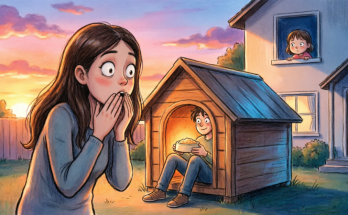
“Security. Remove this useless woman.”
My stepmother said it into a microphone in front of two hundred guests—two hundred people dressed in black tie and diamonds, gathered under crystal chandeliers that threw light like glitter across the Whitmore Hotel ballroom.
And my father—Richard Paxton, the man everyone in that room had come to celebrate—stood three steps away in a custom Tom Ford tuxedo, looked down at the carpet, and said absolutely nothing.
No, “Diane, stop.”
No, “That’s my daughter.”
No, “Laura, come here.”
Nothing.
I didn’t run. I didn’t cry. I didn’t even blink fast, because the body does strange things when the humiliation is public and the betrayal is familiar. I stood there in the center aisle with my mother’s pearl earrings cooling against my skin, the velvet box in my hand, and I watched the room decide what I was.
Some people looked away immediately, as if shame could be avoided by turning the head. Others stared with a kind of hungry curiosity, the same expression you see on drivers slowing down for an accident.
The jazz quartet stopped mid-song. The bartender froze with a bottle tilted over a glass. Even the waiters in crisp black jackets paused like someone had hit a silent button on the night.
Two men in dark suits appeared beside me—so quickly it was clear they’d been waiting. One leaned toward my ear, voice low and practiced.
“Ma’am, we’ve been asked to escort you out.”
I looked at the stage. Diane stood there in cream silk, diamonds at her throat, her smile calm as a surgeon. Meredith—her daughter, my stepsister—had her phone raised, filming. That detail landed like a second humiliation. She wasn’t shocked. She was collecting content.
I turned to my father.
Richard Paxton’s hands were folded in front of him like a man waiting for someone else to finish speaking at a meeting. His eyes stayed on the floor.
I could have begged. I could have demanded. I could have thrown the velvet box like a grenade and watched it bounce across the marble.
Instead, I walked.
I set the box gently on the nearest table. Not tossed. Not slammed. Placed—as if it mattered that the last thing I did in that room was careful.
Then I said, not loudly, not with drama, just clearly enough for the cluster closest to hear, “I came for you, Dad. Not for her. But I see your choice.”
I turned toward the doors.
The guards walked with me—not gripping my arms, not yanking, because the Whitmore Hotel doesn’t do messy. They guided me the way you guide a disturbance out of a room full of polite people who want to pretend they’re not witnessing cruelty.
Behind me, Diane’s voice returned to the microphone with perfect composure.
“I’m so sorry about that, everyone,” she said, as if a spill had occurred. “Now—where were we?”
The jazz resumed before the doors even closed.
I stepped into the lobby, then out into October air sharp enough to feel like a slap. The cold hit my face and finally, finally, my lungs remembered how to breathe.
I stood on the front steps of the Whitmore Hotel, marble beneath my shoes, and listened to the muffled music bleeding through the walls—Cole Porter, laughter, glass clinking, a world continuing as if I hadn’t just been erased in front of two hundred people.
I gave myself sixty seconds.
Sixty seconds to feel everything I’d swallowed for twenty-three years rise up like a tide: the humiliation, the loneliness, the sick certainty of how easy it had been for them to do this. How prepared they were. How practiced.
Sixty seconds for every Christmas card I wasn’t in. Every Thanksgiving at the smaller table. Every time someone called me “difficult” because I had a pulse and a memory.
When the sixty seconds ended, I stood.
Because my mother did not teach me to sit on other people’s steps.
I pulled out my phone and made a call that would collapse an entire carefully built illusion.
“Rebecca Stone?” I said when she answered.
Her voice was crisp, professional. “Yes.”
“This is Laura Paxton,” I told her. “I’m ready to proceed with the segregated fund transfer. Tonight.”
There was a pause—brief, controlled, the pause of someone confirming identity and protocol. I had warned her this call might come. The only surprise would have been if it didn’t.

“I’ll need your digital signature and the authorization code from Mr. Aldridge,” she said. “If I receive both, I can execute within forty-five minutes.”
“You’ll have them in ten,” I said.
I hung up. My hands weren’t shaking. That’s the part people don’t understand. Rage doesn’t always look like screaming. Sometimes it looks like a woman sitting in her car with a laptop and a steady pulse, letting arithmetic deliver the justice other people refuse to offer.
Within forty-seven minutes, I had moved $17 million into a trust she didn’t know existed, and every family-funded account linked to that pool froze like a heart stopping mid-beat.
Then I turned off my phone.
When I turned it back on, there were fifty-six missed calls and my entire family was standing at my front door.
But they weren’t there to apologize.
They were there because a legal document they’d never seen had just collapsed twenty years of my stepmother’s careful planning.
My name is Laura Paxton. I’m thirty-four years old.
And this is the night I stopped being invisible.
But you can’t understand what happened in that ballroom—what it took for me to walk out without breaking—unless you understand the structure beneath it. The hidden beams and load-bearing walls of my family. The architecture of how a girl can be slowly moved from the center of her own life to the margins, one “kindness” at a time.
Let me take you back eleven months, to the day I received an email from a dead woman.
My mother, Catherine Hail, died when I was eleven.
Ovarian cancer. Eight months from diagnosis to funeral. Eight months of appointments and whispered phone calls, casseroles from neighbors, my father’s forced optimism curdling into exhaustion. Eight months of my mother growing thinner in ways that didn’t make sense to a child—how can a person disappear while they’re still standing in front of you?
What I remember most isn’t the hospital, or the day my father’s suit hung oddly on him at the funeral because grief had made him smaller. It’s the kitchen table.
Our kitchen table was maple wood scarred with years of family life—knife marks, water rings, a small burn from a candle my mother once forgot. It was where homework happened, where Christmas cookies cooled, where my mother and I sat the way other mothers and daughters might sit at a piano bench.
Except my mother didn’t teach me music.
She taught me structure.
She’d roll out craft paper—a big brown roll that smelled faintly of glue—and set drafting pencils beside it like tools in a surgeon’s tray. Then she’d draw.
Not doodles. Not childish sketches.
Floor plans.
She’d sketch the bones of a building, the load-bearing walls, the joists, the hidden geometry that held everything up, and she’d say, “See, Laura? Everything beautiful starts with structure.”
I didn’t know then she was an architect. No one ever used that word about her. I didn’t know she had her own firm, her own clients, her own name on documents. I just knew my mother understood buildings in a way that made them feel alive.
Sometimes she’d show me photos on her phone—old stone libraries, firehouses, schools—buildings with history in their walls. She’d tap the screen and tell me what the eye missed: where water damage started, how a foundation settles, why an arch holds.
“People look at a building and think it’s just what you see,” she’d say. “But what matters is the part you don’t see. The things holding it up.”
Then she’d look at me, and her voice would soften. “Same with people.”
During those eight months, she kept drawing with me even when her hands shook. Even when she had to pause to breathe. Even when she had to sit down with her head against the back of the chair as if the effort of being alive had become heavy.
When I was eleven, I believed my mother was unstoppable.
I also believed my father loved her enough to keep her name alive after she was gone.
I was wrong about one of those things.
Eight months after the funeral—eight—my father married Diane Hartwell.
People love to explain that kind of choice with grief. “He was lonely,” they say. “He needed support.” As if a child doesn’t count as support. As if the word “lonely” excuses replacing a woman’s presence like swapping a painting on a wall.
I remember the morning he told me.
I was sitting at the kitchen table drawing a floor plan of our house from memory, like my mother had taught me. I was trying to hold onto something familiar. The pencil scratched softly across paper. My father sat down across from me, hands clasped, face carefully arranged.
“You’re going to have a new mother, sweetheart,” he said.
I stared at him. The words made no sense. It felt like he’d told me we were getting a new sun.
I didn’t know how to say, I don’t want a new one. I don’t want an updated version. I want the one who taught me how to see.
So I said nothing.
That was the first time I chose silence.
It would not be the last.
Let me tell you about Diane.
Diane Hartwell was the kind of woman who could walk into a room and rearrange it without moving a single piece of furniture. She did it with tone, with timing, with the particular talent of making every suggestion sound like kindness and every command sound like a question.
She wore Chanel tweed the way other women wore denim—casually, constantly, as if it simply appeared on her body each morning. Her hair was always honey-blonde and blown out in the exact same style. Her nails were always perfect. I never once saw Diane Paxton look unprepared.
That should have been my first warning.
The first few months after the wedding, she played the role everyone applauds: the attentive stepmother, the woman who “took on” a grieving child. She brought me hot chocolate, asked about school, insisted on driving me to soccer practice.
But even as she smiled, she was building something.
Not a family.
A hierarchy.
Within a year, the Thanksgiving seating chart changed.
I went from sitting next to my father to sitting at the smaller table in the sunroom. Diane framed it like consideration.
“You’re so much more comfortable away from the crowd, aren’t you, Laura?” she said, her voice warm, her hand on my shoulder. Behind her, the main dining room filled with laughter and clinking glasses—adult conversation I wasn’t invited into.
I was twelve. I didn’t even know how to name what she was doing, only that it hurt. When my father looked toward the sunroom, I waited for him to say something.
He didn’t.
He smiled at Diane as if she’d solved a problem.
By year three, the family Christmas card featured Diane, my father, and Meredith—Diane’s daughter from her first marriage, born two years after me. Meredith stood between them in a red velvet dress, blonde hair curled, smiling as if she’d been born into that frame.
I was told the photographer ran out of time before my solo shots.
By year five, my bedroom became Diane’s yoga studio. My things were boxed and moved into the guest room.
“You’ll be leaving for college soon anyway,” Diane said breezily. “No point wasting space.”
Wasting space. That was the phrase.
As if I were furniture.
Diane introduced Meredith to people as “our daughter.” She introduced me as “Richard’s daughter from before.”
Before—like I was a rough draft my father had revised.
And my father let it happen, one eraser stroke at a time, because Diane’s tears were louder than my silence.
Richard Paxton was not a villain. That’s what made it worse.
A villain you can hate cleanly. A villain gives you clarity.
My father loved me. I know he did. I have evidence—small, scattered moments that still glow in my memory like embers.
When I was fourteen, he picked me up from school on a random Tuesday. No warning, no reason. He just showed up at the curb in his black sedan and nodded toward the passenger seat.
“Get in,” he said.
I climbed in, confused, and he drove west, past the grocery store and the high school football field, to the edge of town where an old stone building was being demolished. We sat in the car and watched the wrecking ball swing, each impact sending a shudder through the structure.
My father was quiet a long time. Then he said, softly, “Your mother would have fought to save that building.”
It was the last time he said her name.
After that, Catherine Hail Paxton became a ghost in her own house. Her photographs disappeared from the hallways. Her books were boxed. Her name was replaced by Diane’s in every sentence, every tradition, every toast. And my father—my loving, cowardly father—let it happen because it was easier to lose my mother again than to stand up to the woman who had replaced her.
I grew up learning the rules: don’t be too loud, don’t be too needy, don’t make Diane look bad in front of anyone. If Diane smiled, I smiled. If Diane wanted something, we did it. If Diane cried, my father folded like paper.
Silence became my survival skill.
When I left for college, I took a battered cardboard box with me.
My mother’s box.
It held her leather-bound notebook, a few drafting pencils, a photograph of her on a construction site with sawdust in her hair and the biggest grin I’d ever seen. It held old birthday cards and a small collection of things that smelled faintly like her—paper and cedar and that floral soap she used.
I carried the box from my Westchester bedroom to my dorm, to my first apartment, then to Brooklyn Heights—my third-floor walk-up brownstone with warped hardwood floors and ten-foot ceilings and morning light that came in like honey. I didn’t open the box often. Some grief you keep sealed because you’re afraid the air will change if you let it out.
I became a restoration architect.
If you don’t know what that means, you’re not alone. Most people don’t. My family certainly didn’t.
Restoration architecture is not glamorous. It’s not sleek Manhattan penthouses or Hamptons beach houses. It’s the buildings people have forgotten—crumbling libraries, nineteenth-century firehouses, schoolhouses with collapsed roofs. Structures that have been dismissed as worthless because it’s easier to demolish than to repair.
I loved them for that.
I loved how they required patience. How they forced you to listen. How you couldn’t fake the work. You couldn’t slap on a fresh coat of paint and call it done. You had to strip back the decay, find the original bones, and decide what could be saved.
Some days I crawled through attic spaces with a flashlight between my teeth, covered in plaster dust, smelling mold and old wood. Some days I stood in an abandoned building and ran my hands along cracked brick, imagining the hands that had laid it a century ago.
I earned $110,000 a year—perfectly good money, honest money. But in the Paxton world, where Meredith’s Instagram sponsorship deal could be worth $200,000 for posting photos of handbags, my career was a punchline.
At family dinners—when I was grudgingly invited—Diane would tilt her head and say, “And Laura, have you found anything more… stable yet?”
As if my work were a hobby I’d outgrow.
As if saving a century-old library from collapse were less real than unboxing a purse on camera.
My father would look at his plate. He always looked at his plate.
I drove home in my Subaru Outback—seven years old, paid off, 200,000 miles—and told myself it didn’t matter.
I became very good at telling myself it didn’t matter.
Last Christmas, Meredith patted the hood of my car in the driveway and said, “Cute car. Very you.”
She said it the way someone compliments a child’s drawing.
I didn’t answer.
What none of them knew was that six weeks earlier, the Historic Preservation Society had awarded me their highest honor for the Carnegie Library Project—a crumbling library in the Hudson Valley I had fought to restore when everyone else wanted to tear it down.
I didn’t tell them.
I’d stopped offering good news to people who only knew how to diminish it.
That library would change everything.
I just didn’t know it yet.
Eleven months before my father’s retirement party, on a gray afternoon in Brooklyn, I was kneeling on my apartment floor sorting through my mother’s box for the first time in years.
The brownstone creaked with its usual old-house sounds. A radiator hissed. Somewhere outside, a siren wailed and faded. Sunlight angled through the east-facing windows, catching dust motes like tiny floating stars.
I pulled out the notebook, the pencils, the photograph. I ran my thumb over my mother’s grin, felt the familiar ache in my chest.
Then, at the very bottom of the box, beneath a stack of old birthday cards, I found an envelope I had never noticed before.
Cream-colored. Heavy stock. The kind of paper you choose when you want the words to survive time.
On the front, in my mother’s handwriting—slanted, confident, unmistakable—it read:
For Laura, when she’s ready.
My hands shook as I opened it.
Inside was a single sheet of personal letterhead.
And the letterhead didn’t say “Catherine Paxton, homemaker” or any other softened version of my mother. It said:
Catherine Hail
AIA – Hail Architecture and Preservation
My breath stopped.
My mother had been a licensed architect. Not in the loose, “she liked drawing” way. In the official, “she built things that held” way.
No one had ever told me.
Not my father. Not Diane. Not a single person in twenty-three years.
Below the letterhead, in that same slanted hand, were words that felt like they reached through time and grabbed my wrist.
My darling girl,
There are things about our family’s money I need you to understand when you’re old enough. I’ve made arrangements to protect what’s yours.
Mr. Aldridge has everything. Find him.
Tucked behind the letter was a business card:
Thomas Aldridge, Esquire
Trusts and Estates
I sat on my apartment floor for a long time, the letter trembling in my hand. I felt like someone had slid open a hidden door in my life, revealing a corridor I’d never known existed.
Then I opened my laptop and searched his name.
Thomas Aldridge was sixty-seven and still practicing. His office was in Midtown Manhattan—twelve subway stops from my front door.
I wrote an email with my full name and a sentence that felt surreal:
“My mother was Catherine Hail Paxton. She left me a letter. She told me to find you.”
He responded within two hours.
The subject line read:
I’ve been waiting for this email for twenty-three years, Miss Paxton.
My stomach flipped.
He said he had a document I needed to see. He said it could only be discussed in person.
And he asked how soon I could come.
I went the next morning.
The subway ride felt like traveling through layers of my own life. Brooklyn Heights to Manhattan, the familiar tunnels, the smell of metal and damp concrete, strangers scrolling on phones, a man eating a bagel like it was the most important thing in the world.
I held my mother’s letter in my bag like a key.
Aldridge’s office was on the fourteenth floor of a pre-war building on Madison Avenue. The elevator was slow. The hallway was dim. The door was solid oak with a brass nameplate that looked like it hadn’t been updated since the nineties.
Inside, the office looked exactly like a trust attorney’s office should: floor-to-ceiling bookshelves filled with leather-bound volumes, a mahogany desk buried under neatly stacked files, the air smelling faintly of paper and old cologne.
And on the wall behind his chair—framed—was a photograph of my mother I had never seen.
She was young, wearing a hard hat, standing in front of a half-built building, smiling like she’d just been told the best joke in the world.
The sight of her—alive in a way my memory couldn’t fully reconstruct—hit me so hard I had to sit down before my knees gave out.
Thomas Aldridge was silver-haired and deliberate. He spoke the way careful lawyers speak: every sentence measured before it was released.
“Your mother retained me in 2003,” he said, “when she first learned about the cancer. She wanted to ensure that her assets—specifically the inheritance she brought into the marriage from the Hail family—would be protected for you.”
He placed a leather-bound document on the desk between us.
Forty pages. My mother’s signature in blue ink on the final page.
“The trust agreement of 2004,” he said.
He explained it in plain English, because my mother had asked him to, twenty-three years in advance.
Catherine Hail had entered the marriage with seventeen million dollars in inherited family wealth. That money had been placed into the Paxton family trust—but with a critical distinction.
It was designated as segregated funds. Walled off. Legally separate from the rest of the trust’s assets even if it sat in the same pool.
Then Aldridge slid a second document across the desk.
“Your mother signed an amendment in 2006,” he said, “six months before she passed.”
I stared at the paper. My mother’s handwriting in the margin: for my girl.
“It designates you, Laura Catherine Paxton, as the sole beneficiary of the segregated funds,” Aldridge continued. “Effective upon your thirtieth birthday. No co-signature required. No trustee approval needed.”
My throat tightened.
“Does my father know?” I asked.
Aldridge paused. It was the kind of pause that answers you before words arrive.
“Your father was present when the original trust was established,” he said quietly. “He has always known.”
The room seemed to tilt.
“And Diane?” I asked…………………………………………………………………………………………………………………………….