Part 1
I used to think the worst thing about my marriage was Sunday dinner.
Not the food—Linda could cook. It was the way she served it, like every spoonful came with a judgment. Too much salt. Too little ambition. Too much emotion. Too much me.
My name is Emily Johnson. I’m thirty-two, and for five years I tried to be the kind of wife a man like David would be proud of. I tried to be patient. I tried to be kind. I tried to treat Linda’s constant criticism like weather: unpleasant, unavoidable, something you dress for.
David always said, “That’s just how she is.”
As if that made it okay.
We lived in Charleston, in a second-floor apartment with squeaky hardwood floors and a balcony that looked out over an oak tree that dropped leaves like it was paid to. I worked as an editor at a small publishing house downtown. David worked in finance—long hours, expensive shirts, a job that came with a permanent buzz of stress he insisted he could handle.
We’d wanted a baby for a long time. Not in the vague, someday way. In the calendar-and-doctor-visits way. In the quiet disappointment way, month after month, when “maybe” turned into “not this time.” When I finally got pregnant, I cried so hard I scared myself. David hugged me and laughed, and for a brief, glowing moment I believed we were about to become the kind of family you see in holiday commercials—warm, steady, safe.
Linda’s attitude shifted the second David told her.
She started calling more. She asked how I felt. She brought over “vitamin teas” in little jars with handwritten labels. She told people at church she was “over the moon.” She patted my belly like I was her project, not a person.
David took it as proof of a miracle: his mother finally accepting me.
I wanted to believe it too.
My pregnancy was mostly normal until the third trimester. Swelling that came faster than my shoes could keep up with. Headaches that felt like a band tightening behind my eyes. Dizziness that showed up in grocery store aisles, turning the bright packages into a spinning carousel. The doctor called it mild anemia at first, then said, “Let’s keep an eye on your blood pressure.”
David came to the first few appointments. He held my purse, rubbed my back, asked the doctor questions. Then, gradually, “work got crazy.” He started dropping me off instead of going in. He’d text, “Call me after,” and I’d sit in the waiting room alone with other couples flipping through baby name books.
I told myself it was temporary. I told myself it wasn’t personal.
Then came my cousin Sarah’s birthday dinner.
It was supposed to be easy. A family gathering at a cozy café near our place. Fifteen people tops, laughter, cake, a few pictures of my belly that I would pretend not to hate. I didn’t want to go. I felt heavy and tired and weirdly fragile, like my body was a glass ornament that could crack from a sharp sound.
Sarah begged. David insisted.
“Fresh air will be good for you,” he said, like I was a houseplant.
At the café, everyone smiled at me too brightly. “Look at you!” “You’re glowing!” “How much longer?” I perched in a chair that felt too small, sipped water, and tried to ignore the way my hands looked puffy. David sat beside me, but he kept checking his phone. Every time it buzzed, his mouth tugged into a quick smile he didn’t seem to notice.
Two hours in, the room tilted.
It started with black specks at the edges of my vision, like someone had shaken pepper over my eyes. Then the nausea hit—thick, sudden. My heart thumped too fast, then too slow, then too fast again.
“David,” I whispered, leaning toward him, “I feel really bad. We need to go.”
He glanced at me like I’d interrupted something important. “Right now? The cake isn’t even—”
“Please.”
Something about my face must’ve convinced him, because he pushed his chair back, muttered apologies, and guided me out. The evening air was cooler, and for a second I thought I’d be okay. Then I took three steps and my knees went soft.
The taxi ride home is a blur of streetlights and nausea. I remember gripping the door handle and counting breaths the way the prenatal instructor taught us: in for four, out for four. It didn’t help.
When we got to our building, the elevator was still broken, same as it had been for a week. David sighed like it was a personal insult.
“Come on,” he said, already halfway up the stairs.
By the second floor, my lungs felt too tight. By the third, my ears rang. I clutched the railing and tried to tell my legs they belonged to me.
“David,” I said, voice thin, “I need an ambulance.”
He rolled his eyes—actually rolled them—and reached for his phone.
Then the intercom buzzed.
David paused, thumb hovering over the screen. He picked up. “Hello?”
Linda’s voice crackled through, bright and alert. “Son, I was in the area. Thought I’d stop by. You didn’t answer my call earlier.”
David looked at me, then back at the intercom like the decision had already been made for him. “We’re upstairs,” he said. “Come on up.”
My stomach dropped.
Five minutes later, Linda swept into the apartment like she owned it. She wore a crisp blouse and lipstick the color of dried cherries. Her eyes landed on me slumped on the couch, and her mouth tightened with something between irritation and triumph.
“Oh, Emily,” she said. “Not this again.”
David hovered, phone still in hand. “Mom, she fainted on the stairs. She says she needs an ambulance.”
Linda’s gaze snapped to his phone. “Don’t,” she said, sharp enough to cut. “Don’t call.”
“Mom—”
“She’s pretending,” Linda said, lowering her voice like she was sharing a secret only mothers understood. “Pregnancy isn’t an illness. She’s dramatic. She’s trying to control you.”
I tried to protest, but my tongue felt thick. My arms tingled, then went numb. The room pulled away, as if the couch was sliding down a hill.
David’s face wavered above me, unsure, anxious, obedient.
“David,” I whispered. “Please.”
Linda leaned closer. Her perfume was heavy and sweet, like flowers left too long in a vase.
“Don’t, son,” she said. “Don’t call. She’s pretending.”
The last thing I heard was David’s phone screen clicking dark.
Then everything went black.
Part 2
When I woke up, I was staring at a ceiling that had a crack shaped like lightning running through it. White walls. The smell of disinfectant. A quiet, steady beeping that made my heart race before I realized it wasn’t mine.
I tried to move and felt a tug in my arm. An IV line. My throat was dry like I’d swallowed sand.
“Hello?” I croaked.
A nurse appeared, young and tired-eyed, with a kind mouth that looked like it practiced gentleness on people who didn’t deserve it.
“Easy,” she said, adjusting my pillow. “You’re in the county hospital. Maternity unit.”
Hospital. The word didn’t fit in my head at first. Then panic hit.
“The baby,” I said, hand flying to my belly. “Is my baby okay?”
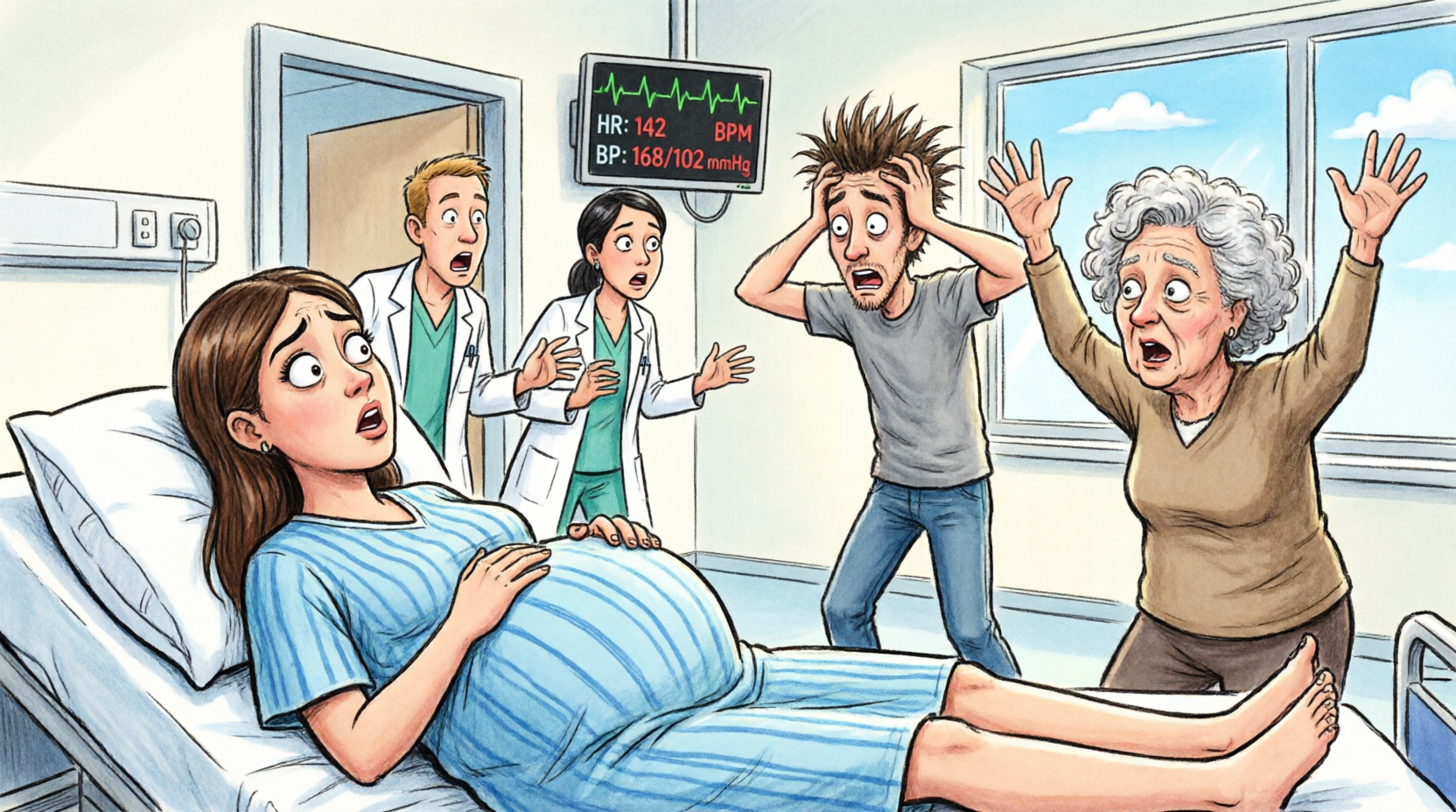
The nurse glanced at a monitor near the bed. I followed her eyes—and froze.
Two heart rate lines were displayed. Two distinct rhythms. One strong and steady. One faster, fluttery, like a bird trapped in a box.
My mouth opened, but nothing came out.
The nurse softened her voice. “Both heartbeats are there,” she said. “Try to breathe.”
Both.
I tried to sit up and a wave of dizziness shoved me back down.
“What happened?” I asked. “Who brought me here? Where’s my husband?”
She hesitated, the smallest pause, but I noticed it anyway. “An ambulance brought you in,” she said carefully. “A neighbor called. No one’s here right now.”
A neighbor.
Not David.
Not Linda.
A neighbor had saved me.
Tears burned behind my eyes. I blinked them back because crying felt like it might crack something open in me I couldn’t afford to lose.
A plump doctor with short hair and calm hands came in a little later. She introduced herself as Dr. Reyes and checked my blood pressure twice, frowning deeper each time.
“You gave us a scare,” she said. “Your blood pressure was dangerously high when you arrived. You have preeclampsia.”
I’d heard the word in prenatal classes, the way you hear about rare storms—unlikely, but devastating if they show up.
Dr. Reyes explained it slowly: high blood pressure, swelling, protein in the urine. Risk of placental complications. Risk to me. Risk to the baby.
“And the… the other heartbeat?” I asked, my voice thin.
Dr. Reyes paused, like she was deciding how to say something that didn’t want to be said.
“When we did the ultrasound,” she said, “we saw something unexpected.”
I stared at her.
“You’re carrying twins,” she said.
The room went silent except for the beep-beep-beep of the monitors.
“That’s impossible,” I whispered. “I’ve had ultrasounds.”
“It’s rare, but it happens,” she said. “A hidden twin can be missed depending on positioning, especially if they share space in a way that makes one hard to detect.”
My hands shook. I pressed them to my belly, as if I could feel the truth through skin.
“There’s more,” Dr. Reyes continued, and her voice was gentler now. “One of the babies is smaller. Behind in development. The blood flow readings aren’t ideal. We’re monitoring very closely.”
My brain snagged on one phrase: not ideal.
“Are they going to die?” I asked, blunt because fear strips away politeness.
Dr. Reyes didn’t lie. “There’s a risk,” she said. “But they’re both fighting. And so are you.”
I swallowed hard. “How long do I have to stay?”
“Until it’s safe,” she said. “Maybe until delivery. We’ll try to manage your blood pressure. If things worsen, we may have to deliver early.”
After she left, the nurse brought me my phone. The screen was cracked. There were missed calls and a few messages from David.
Emily, how are you?
Text me when you wake up.
Mom says you need rest. Visiting will make it worse.
I read them twice, then set the phone down like it burned.
He hadn’t come.
He hadn’t even asked to come.
He’d listened to Linda—again—over his wife, over his unborn child, over common sense.
I stared at the two heartbeats on the monitor, one strong and one struggling, and I felt something shift inside me. A new kind of clarity. Not gentle. Not hopeful. Sharp.
That night, my mother drove in from out of town so fast she barely slept. She burst into my room looking wrecked and furious and relieved all at once. She hugged me carefully, like I was made of glass.
“Sweetheart,” she whispered. “I’m here. I’m here.”
My friend Jessica came later with a bag of essentials and the kind of rage that warmed a room. “If I see your husband,” she muttered, “I’m going to say things that will get me banned from this hospital.”
I tried to smile, but the fear sat too heavy in my chest.
Because now there were two babies.
Two lives.
And I didn’t know if the people who were supposed to protect us actually wanted us to survive.
Part 3
The next few days blurred into a routine of blood pressure cuffs, blood draws, ultrasounds, and the constant, relentless beeping of monitors that never let me forget what was at stake.
My mom took over everything—calling my job, bringing my favorite blanket, setting up a schedule with Jessica so I was never alone too long. Every time I drifted into sleep, I dreamed of a beach where two tiny figures stood far away. Sometimes one figure faded, and I woke up sweating, hand clamped over my belly like I could hold them in place through sheer will.
David didn’t show up for two full days.
He called once, voice tense and distant. “How are you feeling?”
“I’m in the hospital,” I said, unable to keep the bite out of my voice. “With severe preeclampsia.”
“I know,” he said, as if the word hospital was something that happened to other people. “I’m just… I’m overwhelmed.”
“David,” I said, “we’re having twins.”
Silence.
“What?”
“Twins,” I repeated. “One of them is smaller. There are complications.”
Another silence. Then, “Are you sure?”
I almost laughed. “The doctors seem pretty sure, David.”
He exhaled like he was trying to keep himself together. “I’ll come tomorrow,” he said quickly. “I promise. I just—Mom—”
I cut him off. “Don’t,” I said. “Don’t say her name like it’s an excuse.”
He didn’t argue. He just said, “I have to go,” and hung up.
When he finally came, he brought white roses—my favorite—and wore the face of a man trying to look like he belonged in the role he’d abandoned. He kissed my forehead. He apologized. He said he was scared.
I wanted to believe him. I wanted to fold into the comfort of someone else taking over. But my trust had cracked in a way I couldn’t pretend not to see.
After he left, I couldn’t sleep. My mom dozed in the chair by the window, exhausted. Jessica had gone home. The hallway outside my room was quiet.
I grabbed my phone and started scrolling mindlessly—emails, messages, anything to keep my mind from spiraling. My inbox was stuffed with junk, work threads, appointment reminders. Then I noticed something odd: an email in the trash folder, deleted but not gone.
It was from David.
We never emailed. Ever.
My skin prickled. I opened it.
Dear Anna,
I can’t get you out of my head…
Mom thinks I should stay with Emily until the birth. Make sure the baby is fine. And then we can be together.
I felt like the air left my lungs.
I read it again, slower, like a person rereading a car accident report because their brain refuses to accept the details.
He wasn’t just cheating.
He was planning.
He and Linda—together—were treating my pregnancy like an obstacle to manage until it was convenient to discard me.
My hands shook so badly I had to set the phone down. The monitor beeped louder in my ears, my blood pressure ticking up just from the shock. I stared at the ceiling, fighting the urge to scream.
Dr. Reyes’s warning echoed in my head: no stress.
But how do you keep calm when the person you married is secretly mapping out your replacement?
I called the nurse and asked to speak to a doctor. Dr. Reyes came in, took one look at my face, and sat down beside me.
“What happened?” she asked.
I handed her my phone.
She read the email, jaw tightening, then looked at me with a kind of controlled fury that made me feel less alone.
“I’m so sorry,” she said quietly.
“I can’t do this,” I whispered. “I’m stuck here, and he’s—he’s—”
“Emily,” she said, firm and gentle at once, “right now, your job is to keep your body steady for your babies. Everything else—everything—can wait until they’re safe.”
I wiped my face with shaking fingers. “What do I do?”
“You don’t confront him,” she said. “Not now. You don’t let him see you know. You protect your nervous system the way you’re protecting your children. You survive first. Then you decide.”
It wasn’t satisfying. It wasn’t justice. But it was strategy.
That night, I forced myself to text David something bland: Thanks for the flowers. The doctor says I need rest.
He replied: Love you. I’ll come tomorrow.
I stared at the words Love you and felt nothing but a cold, flat disbelief.
Because love doesn’t leave you unconscious on the floor.
Love doesn’t consult its mother before calling an ambulance.
Love doesn’t write plans to another woman while your wife is carrying your children.
I fell asleep with my hand on my belly, whispering to both babies, promising them something I wasn’t sure I could deliver yet.
I will protect you.
Even if it means I have to protect you from your own father.
Part 4
Three nights later, a knock came at my hospital door after visiting hours.
I assumed it was a nurse.
But when I looked up, a young blonde woman stood in the doorway, eyes wide and wet with fear.
“Emily?” she asked softly.
My stomach tightened. I already knew before she said her name.
“I’m Anna,” she whispered.
The world narrowed to a single point.
“Come in,” I said, my voice steady in a way that didn’t match how hard my heart was punching my ribs.
She stepped inside and closed the door behind her. She looked like she’d rehearsed this a hundred times and still couldn’t get it right.
“I didn’t know what to do,” she said quickly. “I didn’t even know if I should come. But… I can’t live with it.”
I didn’t speak. I just watched her, because I’d learned that silence makes people tell the truth faster.
“I’ve been seeing David,” she admitted. “Six months. He told me your marriage was basically over. That you were roommates. That he was staying because you got pregnant and he couldn’t leave you like that.”
A bitter laugh tried to crawl up my throat. I swallowed it down.
“And then,” she continued, “I overheard him and his mother.”
My fingers went cold.
Anna’s eyes flicked to my belly, then back to my face. “They were talking about… getting rid of the pregnancy.”
I felt my vision blur for a second. “What do you mean?”
She swallowed. “Linda said there were pills. Something that could cause contractions. Make it look natural. She said if you lost the baby, David could finally leave and no one would blame him.”
My mouth went dry. “And David?”
Anna’s voice broke. “He didn’t argue. He said it was the only way.”
The room tilted the way it had at Sarah’s dinner. The same sick slide into unreality.
I heard Linda’s voice again: She’s pretending.
I heard David’s hesitation. His obedience.
A truth settled in me like a stone.
They hadn’t just failed to help me.
They might have helped cause it.
Anna wiped her cheeks with the back of her hand. “I ended it with him,” she said. “I thought I was the problem. Then I heard you were in the hospital and I—I thought maybe they already did something.”
I stared at her, and to my surprise, I didn’t feel rage at her. Not really. She was a piece of the puzzle, not the person who built the trap.
“Thank you,” I said, voice thin. “For telling me.”
She blinked, stunned. “You’re not… angry?”
“I don’t have the energy to waste on the wrong target,” I said.
Anna nodded, trembling. She wrote her number on a scrap of paper and placed it on my bedside table. “If you need me,” she whispered. “If anyone asks… I’ll tell the truth.”
When she left, I stared at the door for a long time. Then I pressed the call button for the nurse with a calmness that felt eerie.
An on-duty physician came—Dr. Kim, younger than Dr. Reyes, with sharp, careful eyes. I told him everything: the collapse, Linda’s refusal, the hidden twins, the email, Anna’s confession.
He listened without interrupting. When I finished, he exhaled slowly.
“Emily,” he said, “what you’re describing is extremely serious.”
“I know.”
“If someone gave you medication without your consent,” he continued, “that’s assault. Potentially attempted harm to you and the fetuses. But we need proof.”
“I have Anna,” I said. “And my timeline.”
He nodded. “We can run a toxicology screen,” he said. “It’s not perfect—some drugs clear quickly. But we can try. And we can preserve the results.”
My throat tightened. “Do it,” I said.
Blood was drawn. Samples were taken. Dr. Kim leaned closer and lowered his voice.
“Until we know,” he said, “do not eat or drink anything your husband or mother-in-law brings you. Only hospital food or items from people you trust.”
I nodded, because I already felt the shape of the truth.
That night, I didn’t sleep. I watched the monitors and listened to my babies’ heartbeats like they were a lifeline. The smaller one still ran faster, still struggled, but it was there.
In the morning, Dr. Kim came back with a folder. His face was carefully neutral, but his eyes were intense.
“We found trace metabolites consistent with misoprostol exposure,” he said.
The words didn’t land at first. Then they did, and my stomach turned.
Misoprostol. A medication used to induce uterine contractions.
Used in medicine. Used in miscarriages. Used in abortions. Used—if you wanted to force nature’s hand.
My hands shook as I gripped the blanket.
“It’s a small amount,” he said quickly. “You’re being treated, and your vitals are improving. But yes—this suggests you were exposed.”
I stared at him. “So I’m not crazy.”
“No,” he said firmly. “You’re not.”
He paused, then added, “The hospital can document this. We can preserve the lab work. If you choose to involve law enforcement, you’ll have medical evidence.”
I thought of David’s face, of Linda’s smug certainty, of the way they’d left me on the floor alone.
Something inside me went cold and clear.
I wasn’t just fighting for my marriage anymore.
I was fighting for custody of my own life.
Part 5
After the test results, everything became a performance.
David came every day with his anxious smile and his carefully chosen gifts—magazines, flowers, baby socks. He stopped bringing food once I told him the doctor had ordered a strict diet. He nodded like he believed me, but his eyes sharpened, watchful.
Linda came twice, each time dressed like she was attending a brunch, not visiting a woman she’d accused of faking unconsciousness.
“Oh, Emily,” she cooed, taking my hand. “You gave us such a scare. But you’re better now. See? I told David you just needed rest.”
I smiled back, because smiling was safer than screaming.
Inside, I was a locked door.
My mom and Jessica became my real team. They brought food I trusted. They kept my room filled with warmth so fear couldn’t settle in the corners.
One afternoon, Linda tried to tighten her grip.
“I’ve been thinking,” she said, smoothing her skirt. “Twins are a lot. You should move in with me after you’re discharged. I have three bedrooms. I can help you properly.”
I felt my heart rate jump. Not from fear of hard work—fear of proximity.
“No,” I said simply. “We’re staying in our apartment. My mom is here.”
Linda’s smile twitched. “Your mother is… older.”
“My mother is fifty-three,” I said. “Same as you.”
David stood by the window, silent. The old David would’ve defended Linda. The old David would’ve told me to stop being difficult.
To my surprise, he cleared his throat. “Mom,” he said, “Emily’s right. We’ll be better in our own place.”
Linda’s eyes flashed. For a second her mask slipped, and I saw the anger beneath it.
Then she recovered. “Of course,” she said sweetly. “Whatever you want.”
After they left, Dr. Reyes came in and closed the door behind her.
“I heard,” she said quietly.
I stared at her, exhausted. “They want control,” I whispered.
Dr. Reyes nodded. “And you’re not giving it to them,” she said. “Good.”
That night, I finally told my mom and Jessica everything—the email, the test results, Anna’s visit, Dr. Kim’s confirmation.
My mother went pale, then furious, then very still in a way that scared me more than shouting.
Jessica said, “Okay,” like she was switching into action mode. “We’re not winging this. We’re planning.”
Over the next week, they worked like a small crisis team.
Jessica called a family law attorney she knew through a friend. My mom found an apartment rental close to the hospital—small but clean, with space for cribs. Dr. Reyes documented everything carefully in my chart and arranged for copies of relevant labs to be preserved.
Anna agreed to write a statement and speak to authorities if needed. She texted me once: I’m sorry. I didn’t know. I’ll tell the truth.
As my blood pressure stabilized and the swelling eased, the smaller twin began to catch up. Ultrasounds showed improved blood flow. Nurses smiled when they checked the monitors.
“He’s a fighter,” one of them said, rubbing my shoulder.
I started to believe we might make it.
The plan became simple: keep my body stable, keep the babies inside as long as it was safe, and get out of the hospital without letting David or Linda corner me into isolation.
A week before the scheduled delivery, Dr. Reyes recommended a planned C-section at thirty-five weeks. Safer for twins, safer with my history.
David reacted with a strange calmness. He nodded, asked a few questions, then said, “Okay. Whatever you think is best.”
But his eyes didn’t look happy.
They looked like a man recalculating.
Linda’s reaction was worse. She smiled too hard and said, “Early babies can be… complicated.”
I stared at her and thought: You were counting on that.
The night before my surgery, I didn’t dream of the beach.
I dreamed of a locked door finally clicking shut.
 :
: