Part 1
I was halfway through the bland piece of chicken they threw on my plate when my sister decided it was time to make me the punchline.
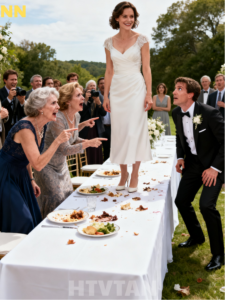
The ballroom looked like a magazine spread—crystal chandeliers dripping light, gold-trimmed chairs, tables dressed in linen so white it felt aggressive. Everyone shimmered. Everyone smiled. The kind of wedding where the air itself smelled expensive.
My place card sat at the far edge of the room, close enough to the service door that every time it swung open, a gust of kitchen heat and clattering trays reminded me exactly where I belonged in their eyes. My name was misspelled, letters squeezed together like an afterthought. A tiny insult, but my family never wasted an opportunity to make something small feel sharp.
The plate in front of me held a thin slice of chicken, overcooked green beans, and a scoop of mashed potatoes that had the texture of glue. I’d seen better meals on airplanes. But my sister, Camille, had posted her menu tasting online months ago. Lobster. Filet. Truffle everything. So when I looked at my plate, I understood immediately.
This wasn’t a mistake.
This was theatre.
I sat there anyway, chewing slowly, not because I was hungry, but because I had spent my whole childhood learning the same survival skill: be quiet, take what you’re given, don’t give them a reaction.
Camille’s laugh cut through the room—high and bright, practiced. The laugh she used when she wanted people to look at her.
She stood up, delicate in her gown, radiant under the lights. She was the kind of beautiful that made strangers forgive her for being cruel. Her new husband, Grant, stood beside her with a glass raised and a smile that didn’t quite reach his eyes. He’d been grinning all night like a man who’d won something.
Camille tapped her spoon against her champagne flute. The sound rang sharp as a bell.
“Hi, everyone!” she announced, and the room turned toward her, eager for whatever charm she’d rehearsed. “I just want to thank you for being here for the most important day of my life.”
Applause. Cheers. Phones lifted for photos.
She continued, voice syrupy. “And I want to give a special thank you to my family.”
She glanced toward my mother and father, who sat at the front table like royalty. My mother wore a dress with enough sparkle to signal satellites. My father sat upright, serious, as if the wedding were an extension of his reputation.
Camille’s eyes swept the room, then landed on me.
Her smile sharpened.
“And of course,” she said, “I want to thank my brother for showing up.”
A ripple of laughter moved through the guests, confused but willing. People laugh when they sense a joke is expected. They don’t want to be the only one not in on it.
Camille lifted her glass a little higher. “Honestly, we’re all lucky he even got an invitation. Aren’t we?”
More laughter. Louder this time.
My mother chuckled too, the sound cutting deeper than anything Camille said. My father smirked faintly like Camille had made a clever point.
Camille leaned forward. “I mean… he’s always been the family embarrassment. But I guess even the black sheep deserves a seat somewhere, right?”
The guests laughed again, and I watched the way their eyes flicked toward me—curious, entertained, relieved that it wasn’t them.
I kept chewing. Kept my face neutral. Kept my hands still.
Because if you react, they win twice.
Camille ended her toast with something sweet about love and fate and finding her soulmate, and the room clapped. The band struck up another song. The night rolled forward as if nothing had happened.
No one came over to check on me. No one asked if I was okay. The staff moved around the tables with the quiet efficiency of people trained not to exist.
I looked at my chicken again, the dry edges curling, and I thought of being twelve years old at our dining table.
My sister had steak that night. Thick. Juicy. My plate had leftover pasta with a watery sauce.
I’d asked, not even accusing, just confused, “Why does Camille get steak and I don’t?”
My mother hadn’t looked up from her wine glass. “Because she deserves it,” she’d said. “You don’t.”
That sentence had shaped me more than any school lesson ever did.
It taught me what they believed my worth was.
It also taught me something else, later, after I left home and stopped asking for anything.
Silence has teeth. And mine had grown sharp.
I hadn’t come to the wedding because I wanted to be part of it.
I came because there are some rooms you have to return to, just once, to close a door properly.
Camille was laughing with her bridesmaids now, leaning into photos, letting the light make her glow. My mother watched her like Camille was proof she had done life correctly. My father looked proud, as if Camille’s marriage were an investment with a high return.
I set my fork down.
The chair legs scraped against the marble floor when I stood, loud enough to cut through the music for half a second. People nearby glanced over. Nobody stopped me. Nobody asked where I was going.
My mother’s eyes followed me with a smirk that said, Good. Leave. You were never supposed to be here.
Camille didn’t even look in my direction.
I turned toward the exit, the service door behind me swinging again, releasing the scent of roasted garlic and butter that I wasn’t allowed to taste.
I took three steps.
That’s when I felt it—someone’s gaze locking onto mine with sudden force.
I turned my head slightly.
Grant, the groom, had gone still.
His face drained of color so fast it looked like someone had flipped a switch. His hand tightened around his champagne flute, knuckles whitening. His lips parted as if he’d forgotten how to speak.
For a heartbeat, I saw pure horror in his eyes.
He whispered a single word, barely audible, but close enough to reach me through the air.
“Boss?”
The ballroom froze.
The laughter that had been bubbling around Camille’s table stopped mid-breath. Conversations stalled. Forks paused halfway to mouths. Even the band faltered, notes stretching thin before dying out.
Camille blinked, confused, her smile slipping. My mother’s smirk evaporated.
Grant stared at me like he’d just realized he’d been dancing on a trapdoor.
And in that sudden silence, I understood something with a calm that felt almost gentle.
They had no idea who I was.
Part 2
It’s funny what people assume when they’re certain you’re beneath them.
All my life, my family decided my story for me. They wrote it early and never revised it. Camille was the diamond—polished, displayed, praised. I was the coal—dirty, forgettable, useful only if I could be burned to keep someone else warm.
They didn’t hide it, not really. They just framed it as truth.
When I brought home straight A’s in middle school, my mother said, “That’s nice,” then asked Camille if she needed help picking an outfit for her dance recital.
When I got a scholarship offer, my father said, “Don’t get cocky. People like you don’t go far. You’re lucky.”
When Camille won a pageant in high school, they threw a party with a cake shaped like a crown.
When I graduated college, my mother forgot to come.
By the time I was twenty, I stopped trying to convince them I deserved space in their world. I moved out with two suitcases and the kind of emptiness that comes from realizing the people who were supposed to love you had never actually seen you.
They didn’t call. They didn’t ask where I was going.
It hurt. And then, slowly, it didn’t.
I learned how to live without begging for scraps. I learned how to build my own table.
I started in a windowless office with a cheap desk and a secondhand laptop, working for a logistics company that moved goods for big retailers. The work was brutal. Deadlines, contracts, negotiations with people who expected a young woman to fold when they raised their voice.
I didn’t fold. I listened. I watched. I learned.
And I had something my family didn’t understand: a long memory and a longer patience.
I moved up fast, not because anyone handed me anything, but because I became the person who could solve problems no one else wanted. I could read a balance sheet like a map. I could hear the fear behind a client’s anger. I could anticipate obstacles before they formed.
Within five years, I was running divisions. Within eight, I had my own investment group—quiet, private, built on relationships and results rather than flashy headlines. I didn’t need my name on billboards. I needed leverage.
People called me “sir” on conference calls because they assumed leadership sounded like a man. I didn’t correct them. Let them underestimate me. It made negotiations easier.
I learned how to operate from the shadows because shadows kept me safe.
My family never asked what I did. They never cared enough to wonder how I paid rent, how I traveled, how I went from struggling to stable. To them, I was still the useless one. The embarrassing one.
It worked in my favor.
When Camille announced her engagement to Grant Holloway, it floated across my life like distant thunder. I only knew because an aunt who still followed Camille online sent me a screenshot of the engagement photo: Camille’s hand up, diamond ring flashing, Grant grinning like he’d just closed a deal.
Grant’s name caught my attention because I recognized it from a different world.
Holloway Event Group. Mid-tier but growing. Weddings, corporate galas, “luxury experiences.” Their business model was ambitious and fragile, dependent on cash flow and credit. The kind of company that looked impressive from the outside and held together with borrowed money on the inside.
It was also the kind of company my investment group occasionally stabilized—quietly—when the right opportunity appeared.
I didn’t connect the dots right away.
Then the wedding invitation arrived.
The envelope was thick, expensive paper, my name printed in elegant script. It came with a note from my mother: Family is family. Don’t embarrass us.
Not: We want you there.
Not: We’d like to share this day.
Just: Don’t embarrass us.
I laughed out loud when I read it. A short, surprised sound. Not because it was funny, but because it was so predictable.
Camille didn’t want me at her wedding because she missed me. She wanted me there because pictures look better when the family appears complete. Because guests ask questions when siblings are missing. Because her image needed a prop.
Fine.
I went.
I didn’t go in a flashy suit. I didn’t arrive with a date. I wore something simple, understated, expensive only if you knew fabric and tailoring. I kept my hair neat, my posture calm, my face unreadable.
I watched as the seating chart placed me as far away as possible. I watched my mother’s eyes flick toward me like she was checking whether I’d behave. I watched Camille glide past without even a hug, only a quick scan to confirm I looked appropriately small.
Then dinner happened.
The scrap meal. The misspelled name. The toast where Camille called me worthless with a smile.
And I sat there, chewing chicken like cardboard, feeling not rage but a steady click of gears.
Because humiliation is a weapon.
And weapons can be taken.
When I stood to leave, the room didn’t care.
But Grant did.
Grant’s pale face, his whispered “Boss,” was the first crack in the facade.
Because in my world, “boss” wasn’t a casual word. It meant hierarchy. It meant power. It meant the person who signed the checks, who held the contracts, who decided whether you rose or fell.
Grant knew me.
Not as Camille’s brother.
As the person who controlled the funding that kept his company afloat.
The silence in that ballroom wasn’t just surprise.
It was the sound of my family’s story collapsing.
Camille’s confusion shifted into irritation. She leaned toward Grant, whispering through her smile, “What are you doing?”
Grant didn’t answer her.
My mother stood halfway from her seat, face stiff with a question she didn’t want to ask.
My father’s smirk had vanished, replaced by a wary squint.
Grant took one shaky step toward me.
“Ms. Vale,” he said, voice low, respectful, terrified.
There it was.
My real name, spoken with recognition.
Camille’s mouth opened slightly. My mother’s eyes widened.
My father looked between Grant and me like he was trying to solve a puzzle with missing pieces.
I turned fully now, letting the room see my face, really see it, without the old posture of apology.
“Grant,” I said calmly.
He swallowed hard. “I didn’t— I didn’t know,” he whispered.
“Clearly,” I replied.
Camille laughed, a brittle sound, trying to patch the moment with charm. “What is this? Some kind of joke?”
Grant didn’t laugh with her.
He looked at Camille like he was seeing her for the first time, and not in a romantic way.
My mother’s voice came out tight. “Grant, why are you calling him—”
“Her,” Grant corrected automatically, almost panicked. “Her.”
That single correction landed like a stone.
My family’s assumptions weren’t just about worth. They were about identity. About how thoroughly they’d ignored me, how little they’d bothered to learn who I became.
I could feel eyes on me from every direction now. Guests leaning forward, curious. Business acquaintances. Local politicians. Vendors. People who mattered to Camille’s image.
The perfect stage.
Camille’s voice rose, sharp. “Grant, who is she?”
Grant’s throat bobbed. His hands trembled around his glass. “She’s—” He stopped himself, glancing at me like he was asking permission to speak my name out loud.
I gave him nothing. Just silence.
Because silence, used correctly, is power.
Part 3
Camille stepped closer, her gown whispering across the marble like she owned the floor.
“Okay,” she said, laugh still brittle, eyes shining with anger. “Whatever this is, it’s not funny. We’re in the middle of my wedding.”
Her voice carried, and people turned fully toward us now. You could feel the curiosity ignite like a match. Weddings are supposed to be scripted. Anything unscripted becomes a spectacle.
My mother moved beside Camille, lips pinched. My father stood slowly, as if standing made him more authoritative.
“Explain,” my mother demanded, like she still had that right.
Grant looked like he might pass out. His eyes flicked around the room, catching faces he recognized—important clients, investors, people whose perception mattered. He understood the danger of public embarrassment. He understood that this room could be a launchpad or a crater.
His gaze kept returning to me, as if I were the only solid thing in the chaos.
I felt an old instinct tug at my ribcage: smooth it over. Make it easier. Keep peace.
Then I remembered Ellie—no, that was a different life, a different story. But the lesson was the same. Peace that only exists when you swallow your own dignity isn’t peace. It’s submission.
I looked at Camille, then my mother, then my father.
And I realized the most important truth: they weren’t confused because they cared. They were confused because they were afraid.
My father cleared his throat. “What’s going on?” he asked. His voice was firm, but his eyes gave him away—uncertain, calculating.
Grant’s voice cracked. “Sir, I—” He stopped, swallowed, and tried again. “Mr. Holloway is— our company is—”
“Grant,” I said gently, and he snapped quiet immediately.
That, right there, was the moment my mother understood. She saw the way he obeyed my tone, how quickly he stopped talking, how he watched me for cues. Her face shifted—not to apology, not to remorse, but to alarm.
Because she recognized hierarchy when she saw it.
“Who are you?” Camille hissed, and in her voice I heard the fear she’d always buried under cruelty.
I could’ve answered with my title. With my net worth. With the names of the companies I controlled through holding groups and private investment entities. I could’ve made it flashy.
But I wasn’t here for flash.
I was here for truth.
“I’m the person you kept feeding scraps to,” I said calmly, loud enough for the nearest tables to hear.
Camille’s cheeks flushed. “What are you talking about?”
I nodded at my plate, still on the table behind me, the dry chicken untouched now. “That,” I said. “The meal you gave me. The seat you gave me. The toast you gave me.”
My mother’s mouth tightened. “Don’t start,” she warned, like she still believed warnings worked.
I tilted my head. “Don’t start what? Telling the truth?”
A hush spread wider. People were listening now—really listening. Some guests looked uncomfortable. Others looked entertained. Camille’s friends watched with wide eyes, the way people do when drama is happening to someone else.
Camille tried to laugh again, but it sounded thin. “You’re being dramatic. It’s just dinner. You always do this.”
My father added, “Stop making a scene.”
I looked at him. “You mean stop making you uncomfortable,” I said.
Grant’s face was still pale. He leaned closer to Camille, whispering urgently, “We need to talk. Now.”
Camille jerked away. “Not now. He’s ruining everything.”
“She,” Grant hissed, voice shaking. “And you have no idea what you’ve done.”
That sentence carried farther than he intended. People heard it. I saw heads tilt, whispers begin like smoke.
My mother’s eyes narrowed. “Grant,” she said sharply. “Explain yourself.”
Grant looked trapped between the family he’d just married into and the woman who effectively signed his company’s lifeline.
He chose survival.
“She’s an investor,” he said, and his voice was barely controlled. “A major one.”
Camille blinked. “An investor?” She laughed once, disbelieving. “In what, a lemonade stand?”
Grant flinched. My mother’s face hardened.
My father stepped forward, chest puffed. “Are you telling me my—” He stopped, because even he couldn’t say “my child” without choking on the unfamiliar phrase.
Grant swallowed. “Ms. Vale’s firm has… significant positions,” he said carefully. “In several entities. Including—” He looked at me again, pleading.
I let the silence stretch, just long enough to make people lean in.
Then I spoke.
“Grant’s company,” I said calmly, “has been propped up for the last eighteen months by a private equity infusion.”
Grant’s face tightened, because he knew what I was about to do.
“That infusion,” I continued, “came from a holding group that answers to me.”
Camille’s mouth opened. Closed. Opened again.
My mother’s voice came out strangled. “That’s not possible.”
“It’s possible,” I said softly, “because you never cared enough to find out what I do.”
My father looked stunned, but his mind was already shifting into opportunist mode. I could see it: calculations, potential advantage, how to reframe this.
He cleared his throat. “Well,” he said, trying to recover, “if that’s true, then we should talk privately.”
I almost smiled. There it was. Not apology. Not shame. Strategy.
Camille’s voice rose again, panicked now. “This is insane. Grant, tell them he’s lying.”
Grant didn’t speak.
Camille turned to me, eyes wild. “If you’re so important,” she snapped, “why didn’t you ever say anything?”
I held her gaze. “Because you never asked,” I said. “And because I didn’t need your approval to build a life.”
My mother stepped closer, lowering her voice like she could contain the damage by shrinking it. “You’re embarrassing us,” she hissed.
I leaned slightly toward her. “You embarrassed me first,” I said quietly. “For years.”
Her eyes flashed, anger mixing with something that almost looked like fear.
Camille tried to pivot, smile returning in a desperate attempt. She turned to the guests. “Okay, okay,” she said, laughing too loudly. “Family drama, right? Let’s not—”
I raised my hand gently.
The room quieted again, as if my gesture had volume.
Camille froze mid-laugh.
I looked at the guests now, the people Camille had invited to witness her perfection. Business owners. Society friends. People who mattered in her world.
“I’m going to leave,” I said evenly. “I came tonight because I thought maybe, for one evening, you could act like family.”
Camille scoffed, but her voice lacked confidence now. “Family? Please.”
I nodded, as if agreeing. “Exactly,” I said.
Grant’s shoulders sagged slightly, like he knew what was coming next.
My father’s voice sharpened. “You’re not going to ruin your sister’s wedding.”
I looked at him. “I didn’t ruin it,” I said. “I just stopped absorbing the damage quietly.”
I turned to Grant, letting my voice drop just enough to feel personal.
“You should have told them who paid for this wedding,” I said.
Grant flinched as if I’d struck him.
Camille’s eyes widened. “What?” she demanded.
My mother’s face drained, because she understood what “paid for this wedding” meant. It meant debt. It meant obligations they didn’t control.
I straightened, voice calm, sharp enough to cut through the chandelier light.
“Every flower,” I said, “every glass of champagne, every vendor contract… is tied to financing you don’t recognize.”
I paused.
“But you will,” I added. “Very soon.”………………