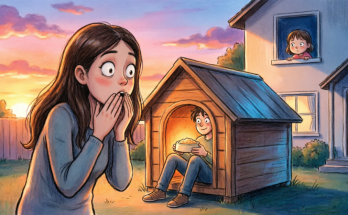
“Damaged goods,” Mom said loudly at my sister’s baby shower. “Too broken to ever be a mother.” Thirty pairs of eyes turned toward me, full of pity. I simply smiled and glanced at my watch. That’s when the door opened. Maria, my nanny, walked in—guiding my two-year-old triplets. Behind her stood my husband, Dr. Alexander Cross, head of neurosurgery, holding our newborn twins. Mom’s teacup slipped from her hand when my husband calmly announced…

The air inside the Wellington Conservatory smelled of expensive lilies, vanilla buttercream, warm champagne, and judgment so carefully disguised as celebration that most people in the room probably mistook it for perfume.
I had not tasted that particular atmosphere in three years, but the second I crossed the marble threshold, it coated the back of my throat like ash.
The conservatory had always been my mother’s favorite place to hold court. Attached to the eastern side of my parents’ estate in Greenwich, Connecticut, it was a glass-and-steel cathedral of money, filled with white orchids, polished stone, manicured palms, and furniture chosen less for comfort than for the way it photographed in society pages. On winter mornings, when I was a child, the windows fogged at the edges and made the whole room feel dreamlike. In summer, it was too bright, too controlled, too perfect, as if even sunlight had been trained to enter the room with proper manners.
That afternoon, the room had been transformed into a shrine to motherhood.
Pastel pink roses climbed around the doorways. Cream-colored ribbons looped over the backs of gilded chairs. A dessert table near the windows held a three-tiered cake decorated with sugar peonies, tiny fondant baby shoes, and a plaque that read WELCOME, LITTLE WELLINGTON HEIR in gold script. Crystal flutes rang softly as guests laughed in delicate bursts, each sound floating upward toward the vaulted glass ceiling.
I stood just inside the entrance, one hand adjusting the silk cuff of my blouse.
It was a nervous habit I thought I had abandoned years ago. Apparently, old houses remember old versions of you and hand them back the moment you step inside.
In the center of the room sat my younger sister, Chloe, perched on a velvet chair that had been arranged like a throne. Her hands rested protectively over the curve of her pregnant belly. She wore pale pink, of course. Chloe always wore whatever role had been assigned to her with convincing softness. Her blond hair fell in loose waves over one shoulder. Her cheeks were flushed. Her smile was bright but not entirely free.
Even from across the room, I could see the strain around her eyes.
She was glowing, as everyone kept saying. But she was also performing.
We all performed for Eleanor Wellington.
My mother stood beside Chloe, hovering over her like a hawk guarding a nest it intended to claim as its own. Eleanor was sixty-three, though no one would have dared say it aloud. Her hair was still the same icy blond she had maintained since her forties. Her skin was smooth in the expensive, tight way of women who believed age was a personal failure. She wore a cream Chanel suit, pearls at her throat, and the expression of someone who expected the room to rise and set according to her will.
For a moment, she did not see me.
I almost turned around.
That is the truth.
I had spent three years telling myself I was free of her. Free of this house, these people, the little social rituals where cruelty wore gloves and smiled for photographs. I had married without inviting her. I had built a life two hours away in Boston, a loud, messy, joyful life filled with children, work, and love she knew nothing about. I had survived diagnoses, surgeries, humiliation, grief, treatments, losses, and the kind of loneliness that turns a woman’s bones into steel.
Yet there, standing in the doorway of the conservatory, I was twenty-seven again. Twenty-seven and newly abandoned. Twenty-seven and crying in my childhood bedroom while my mother explained, in the calm voice she used for menus and funerals, that a woman who could not produce children was an ornamental object at best.
I inhaled.
You are thirty-two, I reminded myself. You are not here to be chosen. You are not here to be forgiven. You are not here to be approved.
You are here because your father asked.
That was the part I kept returning to.
My father, Richard Wellington, had texted the night before from a number my mother did not know he used.
She wants the whole family there, Elara. Just make an appearance. For peace.
Peace.
In my family, peace was never the absence of violence. It was the pause while everyone reloaded.
Still, I came.
Not for Eleanor. Not even entirely for Chloe. I came because part of me wanted, just once, to stand in the room where I had been labeled broken and decide for myself what the ending looked like.
I stepped farther inside.
“Elara?”
My mother’s voice cut through the room like the edge of a knife hidden under silk.
Conversations near the entry slowed. Several heads turned. Mrs. Higgins, who had been my mother’s favorite gossip relay station since I was in middle school, lifted her chin with the eager alertness of a dog hearing a treat bag open. Beside her, Sylvia Sterling—never Lady Sterling, though she behaved as if Connecticut had secretly maintained a peerage for her convenience—tilted her champagne flute and watched.
My mother walked toward me with measured steps.
She did not hurry. Eleanor Wellington did not hurry unless someone was bleeding on one of her rugs. Even then, she preferred to supervise.
“Mother,” I said, keeping my voice even. “The decorations are lovely.”
She stopped a foot away from me, close enough to invade my space but not close enough to embrace. Her eyes moved over me in a practiced scan: hair, makeup, blouse, skirt, shoes, jewelry. She inspected me the way a jeweler inspects a diamond for cracks, though in my case she always hoped to find them.
“I’m surprised you came,” she said.
Her lips curved into a pitying smile.
“I told your father it would be too painful for you. Being around all this… life.”
She gestured vaguely toward the room, toward the flowers, the strollers, the pregnant women, the cake, the soft pink monument to everything she believed I had failed to become.
I looked past her shoulder at Chloe. My sister had seen me now. Her smile trembled slightly before she lifted one hand in a small wave.
“I’m happy for Chloe,” I said. “Why would it be painful?”
Eleanor sighed.
It was a theatrical sigh, a sound calibrated to be overheard. Mrs. Higgins and Sylvia Sterling paused just close enough to pretend they were not listening.
“Oh, darling,” my mother said. “We don’t have to pretend. We all know about your situation.”
There it was.
Situation.
In the Wellington family, words were chosen carefully, not to spare feelings but to sharpen injury.
“The struggles,” she continued, placing one cold hand on my arm. “It’s brave of you to show up, knowing you’re… well, incompatible with this world.”
Incompatible.
That one was new.
Usually, when she was feeling less creative, she preferred barren, defective, unfortunate, or the phrase that had ended my relationship with her altogether: damaged goods.
“I’m doing just fine,” I said, gently removing my arm from under her hand.
“Are you?” She tilted her head. “You look tired. And that dress… is it off the rack? Oh, Elara. I always worried that without a husband to take care of you, you’d just fade away.”
She did not know.
None of them knew.
They did not know about Alexander.
They did not know about the brownstone on Beacon Hill where five children had turned every polished surface into a battlefield of toys, fingerprints, spilled milk, and impossible joy. They did not know that the severe endometriosis she had used as proof of my failure had been a battle I fought with surgeons, specialists, hormones, needles, and more hope than I thought a human body could hold. They did not know about Italy, about vows said under olive trees, about the ring under my glove, about the art gallery I did not merely work in but owned.
Most importantly, they did not know about the children.
Leo.
Sam.
Maya.
Noah.
Grace.
Five names my mother had never been allowed to turn into social currency.
I opened my mouth.
For one heartbeat, I nearly dropped the truth right there between the cucumber sandwiches and the champagne.
Then I stopped.
Not yet.
The timing mattered.
Alexander was parking the car. He had insisted on checking the car seats one more time before bringing everyone inside. That was Alexander: brilliant enough to perform twelve-hour surgeries on human spines, meticulous enough to adjust a toddler’s chest clip by half an inch in a parking lot.
“I’m just here to wish Chloe well,” I said.
Eleanor gave me a dismissive little smile and turned away.
“Well, grab a glass of champagne. It’s not like you have to worry about drinking, is it?”
The women behind her tittered into their flutes.
The sound grated against my nerves, but I smiled anyway.
I had practiced that smile. Not the polite one. Not the old one I used to wear to survive dinner. This was something colder. A locked door in the shape of courtesy.
I crossed the room slowly, accepted a glass of sparkling water from a waiter, and moved into a quiet corner near a cluster of potted palms. From there, I could see the entire conservatory: Chloe on her velvet throne, Mother arranging attention around her, the guests grouped by wealth, usefulness, and gossip value, and my father standing near the buffet table with a glass of untouched scotch in his hand.
Dad saw me.
His expression changed at once—relief first, then guilt.
Richard Wellington had always looked like a man who wanted to be kinder than he was brave enough to become. Tall, silver-haired, carefully dressed, he had spent his life earning money in commercial real estate and surrendering emotional authority at home. In public, people respected him. In private, he obeyed the weather system that was my mother.
He lifted one hand slightly.
I nodded.
He looked as though he might come over, then glanced at Eleanor and stayed where he was.
Of course.
I checked my watch.
1:14 p.m.
Five minutes.
Five more minutes of being the cautionary tale, and then the room would tilt.
I watched Chloe open gifts.
Cashmere blankets. Silver rattles. A hand-painted bassinet. A set of monogrammed bibs. A stroller that cost more than some used cars. Every time Chloe lifted tissue paper, the room made soft appreciative sounds. My sister smiled and thanked everyone, but I kept seeing that tightness in her eyes.
Chloe had been the golden child, but gold is still a cage when someone else owns the key.
Growing up, I had been the sharp one. The difficult one. The one with questions, opinions, edges. Chloe had been softness. She learned early that compliance earned affection. If Mother said pink was her color, Chloe wore pink. If Mother said ballet was elegant, Chloe danced until her toes bled. If Mother said a good marriage mattered more than a good degree, Chloe let her anthropology fellowship lapse to marry Ethan Marlow, a polite, handsome investment banker from a family with the correct kind of money and the emotional range of hotel furniture.
I did not hate Chloe for surviving differently than I did.
But I also no longer mistook survival for innocence.
She had watched plenty.
She had stayed silent.
A waiter passed with cucumber sandwiches. I waved him away.
My stomach was too tight.
It was not the insults. Not only the insults. It was the history they carried.
Five years earlier, I had been engaged to Preston Vale, a wealthy, handsome heir my mother adored because he came with old money, a Newport house, and a last name that appeared on museum walls. I had not loved him enough. I knew that now. At the time, I thought love might grow from stability if I watered it patiently.
Then came the pain.
The surgeries.
The diagnosis.
Severe endometriosis. Scarring. Complications. Reduced fertility. Words delivered by doctors in rooms that smelled of antiseptic and pity.
Preston held my hand at first.
Then his mother asked for a private conversation with my mother.
Then Preston began using phrases like “family expectations” and “future uncertainty.”
Then Eleanor came into my childhood bedroom one afternoon, sat at the edge of my bed, and explained my worth to me.
“The bloodline matters, Elara,” she said while I cried into a pillow like a girl half my age. “Preston’s family has obligations. A woman who cannot produce an heir is like a vase that cannot hold water. Decorative, perhaps, but ultimately useless.”
Decorative, perhaps.
Ultimately useless.
The engagement ended two weeks later.
Preston sent a letter instead of facing me.
My mother told people the split was mutual.
I left the next morning with two suitcases, a laptop, and the last check from a trust my grandmother had secretly left me. I moved to Boston, rented a room above a bookstore near Brookline, enrolled in a graduate program in art history, and spent the first year learning how to sleep without waiting for my mother’s voice to tell me what part of myself was disappointing.
It took longer than I like to admit.
Freedom is not the same as healing. Freedom is only the locked door between you and the person who used to hurt you. Healing is what happens after, in the quiet, when no one is chasing you but you still keep running.
I earned my master’s degree. Then I took a job at a small gallery on Newbury Street. The owner, an eccentric widow named Beatrice Langford, took one look at me and said, “You have the expression of a woman who has survived money. You’ll do well here.”
I did.
Art gave me a language my family had never controlled. It allowed brokenness to be visible and still valuable. Cracked ceramics repaired with gold. Torn canvases restored carefully. Sculptures made from discarded metal. Paintings where grief looked not like failure but evidence that something had mattered.
When Beatrice decided to retire, she sold me the gallery on terms so generous I cried in her office.
“Don’t make that face,” she said. “I’m not giving you charity. I’m investing in taste.”
That gallery became mine.
Cross & Vale Gallery—after I married, I changed the name again to Cross Gallery because Preston Vale deserved to disappear even from typography—grew from a charming but fragile business into one of Boston’s most respected contemporary spaces. We represented emerging artists, handled private collections, and consulted for museums. My mother still believed I worked in “a shop.”
I let her.
Then came Alexander.
I met him at a charity auction for pediatric neurology research. He was standing in front of a mixed-media installation made of repurposed surgical steel, staring at it as though it had insulted him.
“You hate it,” I said.
He turned, startled, then smiled.
“I’m trying not to.”
“Why?”
“Because the artist donated it, and the cause is important.”
“That’s noble. Incorrect, but noble.”
His laugh was the first thing I loved about him, though I did not know it yet.
Dr. Alexander Cross was not old money. He was not a social climber. He did not come from the kind of family Eleanor considered useful. His father had been a mechanic in Worcester. His mother was a nurse. He had gone through public schools, scholarships, medical training, impossible hours, and now stood as one of the best neurosurgeons in New England.
He worked with his hands and his mind. He spoke carefully. He listened fully. He had no patience for cruelty disguised as tradition.
On our third date, I told him about my medical history.
I told him early because I had learned the cost of delayed truth. We were sitting in a small Italian restaurant in the North End, candlelight trembling between us, and my hands were cold around the stem of my water glass. I explained the diagnosis, the surgeries, the uncertainty, the possibility that I might never carry a child.
I expected the shift.
The withdrawal.
The polite distance.
Alexander reached across the table and took my hand.
“Elara,” he said, “I’m falling in love with you. Not your uterus.”
I laughed before I cried.
He married me in Italy two years later, in a tiny ceremony at a villa outside Florence, with twelve friends, Beatrice as my witness, and no one from the Wellington family present. My dress was ivory silk. My bouquet was olive branches and white roses. Alexander cried so openly during the vows that the photographer later told me half the best pictures were unusable because he made everyone else cry too.
I sent my father one photo afterward.
He replied: You look happy, kid.
I did not reply to my mother’s message three hours later.
How could you humiliate us like this?
After the wedding came the long road through fertility treatment.
People like my mother call children miracles when they want to make motherhood sound effortless and divinely assigned to women they approve of. I had no patience for that by then. My children were love, yes. They were miracle, yes. But they were also science. Hormone injections. Blood draws. Ultrasounds. Egg retrievals. Embryo grading. Waiting rooms full of women pretending not to watch one another’s faces. Bills that looked like mortgage documents. Losses so early some people would not have counted them but my body did.
Alexander was with me through all of it.
He learned the medication schedule better than I did. He warmed syringes in his hands. He held me when I raged. He sat on bathroom floors. He whispered into my hair after the second failed transfer that we were still a family even if it stayed just the two of us.
Then came the transfer that worked too well.
Triplets.
Leo, Sam, and Maya arrived early, fierce and tiny, after a pregnancy that felt less like glowing and more like negotiating with gravity. They spent time in the NICU. We lived by monitors and feeding schedules. We learned how to sleep in ninety-minute fragments. We learned the difference between tired and transformed.
Two years of beautiful chaos followed.
Then, six months before Chloe’s baby shower, I got sick in the mornings and assumed stress.
It was not stress.
Noah and Grace arrived eight weeks before the shower, natural conception, twins, impossible and real.
Five children under three.
Five.
There were days our Boston brownstone looked like a daycare center had collided with a laundry truck. There were bottles in odd places, tiny socks in my purse, pacifiers under furniture, crayon marks on a wall Alexander swore he would repaint and never did. There were nights when all five children cried in overlapping waves and Alexander and I looked at each other across the nursery like soldiers trapped behind enemy lines.
It was exhausting.
It was ridiculous.
It was the most alive I had ever been.
And my mother thought I was a barren spinster fading away in a studio apartment.
I checked my watch again.
1:17 p.m.
“Elara!”
Chloe’s voice drew my attention. She was waving me toward the center of the room, smiling with uncertainty.
The room quieted slightly as I approached. It is astonishing how quickly people can scent family tension, especially wealthy women with nothing urgent to do. I crossed the polished floor, my heels clicking softly.
“Hi, Chloe,” I said. “You look beautiful.”
She reached for my hand.
“I’m so glad you came.”
For a moment, she sounded genuine, and that hurt more than I expected.
“I missed you,” she said quietly.
“I missed you too.”
She squeezed my fingers.
“It’s hard, isn’t it?”
“What is?”
She glanced down at her belly, then around the room.
“All this. Mom said you might feel… jealous.”
The sympathy in her eyes was worse than malice because it meant she believed the role my mother had assigned me.
Poor Elara.
Barren Elara.
Lonely Elara.
The sister who had failed at womanhood and should be handled with kind pity when not being corrected outright.
“I’m not jealous, Chloe,” I said. “I have a very full life.”
“Oh, sure,” Eleanor interrupted, appearing beside us as if summoned by the possibility of a private conversation she did not control. She placed a hand on Chloe’s shoulder, claiming the moment. “Elara has her little job. At the museum, is it?”
“Gallery,” I said. “I own an art gallery.”
“Right. A shop.”
The word landed exactly where she intended.
She turned toward the guests and raised her voice. My stomach tightened because I recognized the posture. Eleanor was about to create a lesson using me as the chalkboard.
“You know, everyone,” she announced, voice ringing through the conservatory, “we should all be extra kind to Elara today. It takes a lot of strength to celebrate a sister’s joy when you know you’ll never experience it yourself.”
The room went still.
Thirty faces turned toward me.
Chloe whispered, “Mom, don’t.”
But she did not stand.
She did not remove my mother’s hand from her shoulder.
She did not say enough.
“No, it needs to be said,” Eleanor continued. “We spend so much time pretending, and pretending helps no one. Some women are built for family, for legacy. Some women carry life forward. And some women are just… different.”
She looked directly at me.
“Damaged goods, really. Too broken to ever have children.”
There it was.
The phrase had left the private room where she first used it and entered the air in front of witnesses.
For one second, I heard nothing.
Not the clink of glasses. Not the fountain outside. Not Chloe’s small gasp. Not my father’s sharp intake of breath from across the room.
Only my own heartbeat.
The old Elara might have gone pale. Might have cried. Might have turned and left so my mother could later say she had been too fragile to handle reality.
But the woman standing there had been through operating rooms, IVF clinics, NICU alarms, sleepless nights, marriage, business ownership, and five children calling her Mama in overlapping voices.
I felt heat rise in my face, but it was not shame.
It was fury.
Not wild fury. Not uncontrolled.
A clean, white flame.
I smiled.
Slowly.
Eleanor faltered for half a second.
“Is that what you think, Mother?” I asked.
My voice carried clearly to the back of the room.
“That a woman’s worth is defined solely by her ability to reproduce? And that without it, she is damaged?”
Eleanor lifted her chin. “I’m just stating facts, darling. Reality is harsh.”
“Reality,” I repeated. “Yes. Let’s talk about reality.”
I turned toward the double oak doors at the entrance of the conservatory.
My watch read 1:19 p.m.
Perfect.
“You might want to put your teacup down,” I said. “You have shaky hands.”
The heavy oak doors groaned as they were pushed open from the outside.
Every head turned.
At first, Eleanor looked merely annoyed. She was prepared, I think, to scold a waiter for interrupting the emotional execution she had staged. Her lips parted. Her shoulders squared.
But it was not a waiter.
Maria Alvarez strode into the conservatory with the practical confidence of a woman who had once managed six toddlers during a nor’easter power outage and considered society women a minor inconvenience. Maria had been our nanny since the triplets were seven months old. She was warm, sturdy, and absolutely unflappable. That day, she wore a navy dress and comfortable shoes, her dark hair pinned back, and both hands gripping the handle of a custom triple-wide stroller that looked less like baby equipment and more like something designed by a military contractor.
Inside sat Leo, Sam, and Maya.
My two-year-old triplets.
Leo clutched a stuffed dinosaur with one hand and a cracker with the other. Sam blinked solemnly at the chandeliers. Maya, delighted by any room full of faces, immediately waved.
A collective gasp tore through the conservatory.
It was not polite. Not controlled. It was raw, shocked air leaving thirty lungs at once.
Maria maneuvered the stroller between the gift table and a cluster of chairs, then parked beside me.
“Sorry for the delay, Mrs. Cross,” she said cheerfully. “Sam dropped his pacifier in the fountain outside, and Leo tried to negotiate with a statue.”
“Thank you, Maria,” I said.
I reached down and smoothed Sam’s hair.
He looked up at me and said, “Mama.”
One word.
That was all it took.
My mother’s face changed as if something inside her had cracked loudly enough for only she to hear.
“Whose children are these?” she asked.
Her voice was thin.
Before I could answer, the doors opened again.
Alexander stepped inside.
He filled the doorway without trying. Six-foot-two, broad-shouldered, wearing a charcoal suit that looked understated until anyone who knew tailoring looked twice. But it was not the suit that changed the room. It was his presence. Alexander carried authority the way some people carry scent. Calm. Unmistakable. No need for volume.
In his left arm, he held Noah.
In his right, Grace.
Our newborn twins, eight weeks old, slept against his chest, swaddled in soft cream blankets. Noah’s tiny fist rested near Alexander’s lapel. Grace’s cheek was pressed to his shirt.
Alexander’s eyes found mine first.
Not the guests. Not my mother. Not the spectacle.
Me.
He walked through the room, passed Mrs. Higgins with her hand over her mouth, passed Sylvia Sterling blinking like a startled owl, passed Chloe frozen beside her throne, and came directly to me.
He kissed my forehead.
“Sorry I’m late, love,” he said, his voice deep enough to carry easily. “The hospital board meeting ran long. Being Chief of Neurosurgery involves more paperwork than they tell you in med school.”
Several more gasps.
Someone whispered, “Chief?”
Someone else whispered, “Dr. Cross?”
Alexander turned slightly, presenting the twins with unconscious pride, then looked directly at Eleanor.
“You must be Eleanor,” he said.
His tone was polite.
The edge beneath it could have cut glass.
“Elara has told me very little about you. Which, having met you for ten seconds, I now understand was an act of mercy.”
My mother dropped her teacup.
It struck the saucer with a sharp clatter, tipped sideways, and spilled Earl Grey across the white linen tablecloth and down the front of her cream designer suit.
She did not seem to feel the heat.
“Five?” she whispered.
Her eyes moved from the stroller to the twins to me and back again.
“You have… five?”
“Triplets and twins,” I said, lifting Leo from the stroller and settling him on my hip. He immediately rested his head on my shoulder, heavy and trusting, the universal posture of a child who knows exactly where he belongs.
“It turns out I wasn’t broken, Mother. I just needed to be away from the person who was breaking me.”
Chloe stood slowly.
She moved toward the stroller, one hand on her belly, her face pale with shock.
“Elara,” she breathed. “They’re yours?”
“Yes.”
“Biologically?” she asked.
The question was not cruel, but it carried years of our mother’s poison.
Alexander answered before I could.
“Every single one,” he said. “Though I like to think the stubbornness comes from their mother. The volume may be a joint contribution.”
Maya waved at Chloe.
Chloe covered her mouth.
“But how?” Eleanor demanded, shock beginning to twist into indignation. “You lied. You let us believe—”
“I didn’t lie,” I said. “I simply stopped giving you access to information you had proven you would weaponize.”
“You hid my grandchildren from me!”
“No,” I said. “I protected my children from you.”
A hush fell over the room again, but this time it was different. Moments earlier, the silence had been heavy with pity for me. Now it was charged with something much sharper: the collective realization that the story everyone had accepted was false, and the woman who had told it was exposed.
I looked around at the guests.
Some seemed embarrassed. A few looked fascinated. Mrs. Higgins looked positively alive with gossip, though not in the direction my mother preferred. Sylvia Sterling was staring at Alexander with awe.
“Dr. Alexander Cross?” Mrs. Higgins said, stepping forward before she could stop herself. “The neurosurgeon? The one who developed the Cross Protocol for spinal repair?”
Alexander nodded once.
“That’s me. And this is my wife, Elara Cross. Gallery owner, mother of five, and the strongest person I know.”
Wife.
Mother of five.
Strongest person I know.
Each phrase landed in the conservatory like a stone placed carefully over a grave.
Eleanor looked as though she might collapse, but pride held her upright.
“You should have told me,” she said.
“No.”
“I had a right to know.”
“No,” I said again. “You had opportunities to love me. You had opportunities to apologize. You had opportunities to ask whether I was alive, happy, safe, married, healing. You did not have a right to my children.”
Her mouth opened.
I did not let her speak.
“My children are not trophies for your vanity. They are not props for your Christmas cards. They are not evidence you can present at the club to prove your bloodline survived. They are human beings, and I vowed long before they were born that they would never be exposed to the kind of love that keeps score.”
I shifted Leo higher on my hip. He had begun playing with the pearl button at my collar.
“You called me damaged goods,” I continued. “You said I was a broken vase. But look at me now, Mother. My cup runneth over.”
I had practiced that sentence in the bathroom mirror that morning.
Alexander knew. He had heard me from the shower and applauded with a toothbrush in his mouth.
I said it anyway, and the room held it.
For once, Eleanor had no reply ready.
Her eyes flicked to Noah in Alexander’s arm. Something greedy entered her face.
“Can I…” Her voice cracked. She took a step forward and reached toward him. “Can I hold one?”
Alexander moved back.
It was a small step.
It was a wall.
“No,” he said.
Eleanor blinked.
“Excuse me?”
“You don’t get to hold them,” I said.
“Elara.”
“No. You don’t get to be grandmother in public after being executioner in private. You don’t get photographs. You don’t get introductions. You don’t get to tell your friends about them as if you did anything but try to convince me my life had no value without them.”
“They’re my grandchildren.”
“They are my children.”
The difference filled the room.
Chloe began crying quietly.
“Elara, please,” she said. “This is family.”
I looked at my sister, and my anger softened at the edges. Chloe had not created this room. She had only learned how to survive it by becoming its centerpiece.
“Family protects you,” I told her. “Family doesn’t watch you bleed and call it weakness. I’m happy for you, Chloe. I truly am. I hope your baby brings you joy beyond anything you can imagine. But my family…”
I turned to Alexander, to Maria, to the stroller, to Noah and Grace sleeping against their father, to Leo warm against my chest.
“My family is leaving.”
Eleanor’s composure shattered.
“You can’t just walk in here, drop this bomb, and leave,” she snapped. “What will people think?”
For a second, I stared at her.
Then I laughed.
It was not polite. Not strategic. Not controlled.
It was genuine, bubbling, almost joyful.
“Oh, Mother,” I said. “After all this time, you still think I care what these people think?”
I turned to Maria.
“Let’s load them up. We have a dinner reservation.”
“Yes, ma’am,” Maria said, smiling so broadly I thought she might actually enjoy the chaos.
We began moving toward the doors.
The room parted for us.
That was the part I remembered later: not the gasps, not the teacup, not Eleanor’s ruined suit, but the way people stepped aside. For years, I had moved through this house as though apologizing for taking up space. That afternoon, I walked through carrying a child, with my husband beside me and four more children in front of me, and the room made room.
“Elara!”
My father’s voice stopped me near the threshold.
I turned.
Richard Wellington stood by the buffet table. His scotch remained untouched. Tears shone in his eyes.
He had said nothing when my mother insulted me.
Nothing when she used the phrase damaged goods.
Nothing when the room became a stage for my humiliation.
But now he looked at the children, then at me, and his face crumpled with something like regret.
“They’re beautiful,” he said softly. “You did good, kid.”
Kid.
The word nearly reached some old, hungry place in me.
Nearly.
I nodded.
“Goodbye, Dad. Call me if you ever decide to stop being a spectator in your own life.”
His eyes closed.
I did not wait for an answer.
We stepped out into the cool afternoon air.
The world outside the conservatory seemed absurdly clean. Sunlight filtered through the trees. Somewhere, birds were singing. A valet near the driveway pretended not to have witnessed society gossip detonate from within the building. The sky was bright, almost painfully blue.
At the SUV, Alexander helped me buckle Leo into his seat. Maria handled Maya and Sam with expert speed. Noah and Grace slept through everything, tiny and indifferent to generational warfare.
Alexander looked at me over the car seat.
“You okay?”
I thought about the room behind us, my mother’s face, Chloe’s tears, my father’s silence, the years of shame that had led to this single moment of revelation.
“I’m better than okay,” I said. “I’m done.”
He smiled.
“You were incredible in there. ‘My cup runneth over’? Very poetic.”
“I practiced.”
“I know. I heard you in the shower.”
“You were supposed to pretend you didn’t.”
“I was too proud.”
He kissed me.
It was brief, because children have no respect for cinematic timing and Sam had begun shouting, “Snack! Snack! Snack!” from the second row.
We loaded the stroller, counted every child twice, and pulled out of the driveway.
One.
Two.
Three.
Four.
Five.
As the SUV passed the conservatory windows, I looked in the side mirror.
Eleanor stood on the front steps, one hand pressed to her ruined suit, watching us leave. She looked like a ghost haunting a house that had just discovered it no longer held the treasure.
I did not wave.
For ten minutes, none of the adults in the car spoke.
The children filled the silence. Maya sang a song composed almost entirely of the word “hi.” Leo narrated every passing tree. Sam requested crackers with the intensity of a man negotiating ransom. Noah made soft newborn grunts. Grace slept as if family drama was beneath her.
Then Maria, from the back seat, said, “Mrs. Cross?”
“Yes?”
“I have worked for many families.”
“I know.”
“That was the best baby shower I have ever attended.”
Alexander laughed first.
Then I did.
By the time we reached the restaurant in Boston, my hands had stopped shaking.
That night, after the children were fed, bathed, pajamaed, sung to, negotiated with, and finally asleep, Alexander and I sat on the kitchen floor because every chair in our house seemed to have laundry, toys, or a baby blanket on it.
He handed me a glass of wine.
“Actual wine,” he said. “Because you are not pregnant.”
“For the first time in what feels like a decade.”
We clinked glasses quietly.
The brownstone was a wreck. Blocks scattered across the floor. A burp cloth hung from the back of a chair. Someone had stuck a dinosaur sticker to the baseboard. A bottle warmer hummed on the counter. The dishwasher needed unloading. The laundry room contained a situation we had both agreed not to examine until morning.
It was perfect.
“Do you regret it?” Alexander asked.
“No.”
“Not even the timing?”
“No.”
“Your sister?”
I leaned my head against the cabinet behind me.
“That part hurts.”
“She seemed shocked.”
“She believed the story she was given.”
“Do you want to let her in?”
I considered that.
“I don’t know yet.”
Alexander nodded.
He never rushed me toward forgiveness. That was one of the ways he loved me best.
“My father will call,” I said.
“Will you answer?”
“Maybe.”
“Your mother?”
“She’ll call too. I won’t answer.”
He looked into his wine.
“She may try to contact the gallery.”
“She can try.”
“The hospital board already knows not to discuss my family.”
“Of course they do.”
“I told security months ago.”
I turned to him.
“You did what?”
“Elara, your mother once called you defective in writing. I assumed caution was appropriate.”
I loved him so much in that moment it nearly hurt.
“You planned for her.”
“I plan for surgical complications, toddlers with markers, and emotionally abusive aristocrats of Connecticut. It’s all risk management.”
I laughed.
Then, without warning, I cried.
Not dramatically. Not loudly. Tears simply rose and spilled over, and I pressed my hand to my mouth because some part of me still hated being seen in pain. Alexander set down his glass and moved beside me.
“I know,” he said.
He did not ask what was wrong.
He knew grief could coexist with victory.
“It was the way she reached for Noah,” I whispered. “As if she could still have him. As if the children were just… proof she’d won anyway.”
Alexander’s jaw tightened.
“She won’t touch them unless you choose it.”
“I don’t choose it.”
“Then she won’t.”
I nodded.
Outside, Boston traffic moved faintly beyond the windows. Inside, our baby monitor crackled softly, then quieted. A house full of children slept above us because science, luck, medicine, stubbornness, love, and refusal had carried us here.
“I used to think if I ever had children, it would prove her wrong,” I said.
Alexander took my hand.
“And did it?”
“No.”
He waited.
“I proved her wrong before them,” I said slowly. “I just didn’t know it yet.”
He kissed my knuckles.
“That’s right.”
My phone began buzzing the next morning at 6:42.
I was in the nursery, feeding Grace, while Noah slept in the bassinet beside me and the triplets roared downstairs like tiny unpaid demolition contractors. Alexander had left at five-thirty for an early surgery. Maria would arrive at eight. Until then, I was holding the line with one arm, half a cup of coffee, and the hardened instincts of a woman who had once negotiated with three toddlers over which banana was “too banana.”
The first call came from Dad.
I let it ring.
Then came a text.
Please call me. Your mother is spiraling. Chloe is upset. We need to talk.
We need to talk.
No. He needed to repair.
There was a difference.
Next came Chloe.
I stared at her name for a while before opening the message.
I don’t even know what to say. They’re beautiful. I’m sorry. I should have stopped Mom. I want to talk when you’re ready.
That one hurt.
Because it was closer.
Because it did not immediately ask me to make things easier.
Then Mother.
Her first message was predictable.
How dare you humiliate me in front of my friends.
Then:
Those children are my blood. You had no right to hide them.
Then:
Dr. Cross seems impressive. I don’t understand why you kept him from us.
Then:
People are asking questions. Call me immediately.
Not once did she mention what she had said.
Not once did she say she was sorry.
At 7:20, Mrs. Higgins sent a Facebook friend request.
I laughed so suddenly Grace startled against me.
By noon, gossip had outrun oxygen.
Beatrice called from the gallery.
“My darling,” she said, “I just received a call from a woman named Sylvia Sterling asking whether you truly own Cross Gallery or whether that was ‘family exaggeration.’ I told her you own it, run it, saved it from my retirement, and once rejected a private collector so thoroughly he sent apology flowers. I may have embellished slightly.”
“You did not.”
“No. But I enjoyed the tone.”
“Thank you, Bea.”
“She also asked about your husband. I said Dr. Cross is a serious man and that anyone bothering his wife usually develops a sudden interest in privacy.”
“That sounds like you.”
“I am a patron of the arts, dear. Drama is part of the job.”
By evening, my father called again.
This time, I answered.
“Elara.”
He sounded older than he had the day before.
“Dad.”
A pause.
“I don’t know where to begin.”
“Begin with the truth.”
He inhaled slowly.
“I’m sorry I didn’t stop her.”
My eyes closed.
Not enough.
But not nothing.
“You never do.”
“I know.”
“Do you?”
Silence.
Then, softer, “I think I’m beginning to.”
I shifted the phone to my other ear and looked across the kitchen at Leo and Sam building a block tower while Maya supervised with authoritarian delight.
“Why did you call?”
“Because I saw my grandchildren for the first time yesterday.”
“My children.”
“Yes,” he said quickly. “Your children. I know.”
“Do you?”
“Elara, please.”
The old plea.
Please don’t make this hard.
Please don’t ask me to stand.
Please let sadness count as accountability.
I had been trained to soften when my father sounded wounded. He had always seemed gentler than my mother, and for years I mistook gentleness without action for goodness. But a soft voice can still enable harm.
“I will not bring them around Mother,” I said.
He exhaled.
“She’s furious.”
“That is not my problem.”
“She says you staged it to shame her.”
“She staged my humiliation. I corrected the record.”
“She doesn’t see it that way.”
“I know. That is why she doesn’t get access.”
Another pause.
“Can I see them?” he asked.
That question reached me.
Not because he deserved it automatically, but because he asked without demanding.
“Not yet.”
His breath caught.
“Elara—”
“Dad. Not yet. If you want a relationship with me, with them, it cannot happen through Mother. You cannot report back to her. You cannot send photos. You cannot tell her details. You cannot be her window.”
“I don’t know if I can do that.”
“Then you have your answer.”
He was quiet for a long time.
In the background, I could hear a door close. Maybe he had moved away from her. Maybe not.
Finally, he said, “I moved into the guest room last night.”
I leaned against the counter.
“Why?”
“Because when we got home, your mother spent two hours talking about what people would think. Not once did she say she regretted what she said to you.”
I said nothing.
“I sat there,” he continued, voice breaking slightly, “and realized I had watched her hurt you my whole life and called my silence neutrality.”
The room blurred a little.
Maya looked over.
“Mama sad?”
I smiled quickly and shook my head.
“No, baby.”
Dad heard her.
“Oh,” he whispered.
It was such a small sound, so full of wonder, that I almost let him in too quickly.
Instead, I said, “You have work to do.”
“I know.”
“Do it for yourself. Not for access.”
“I’ll try.”
“Trying is not enough forever.”
“I know,” he said again.
This time, I believed he might.
Chloe came to Boston three weeks later.
Not to the house at first. I asked her to meet me at a park near the Charles River because neutral ground seemed wiser. She was seven months pregnant by then, round and uncomfortable, wearing a loose sweater and sneakers instead of the pink uniform Mother preferred. She looked younger without Eleanor arranging her.
I arrived with Alexander, Maria, all five children, and enough snacks to provision a small expedition.
Chloe stopped walking when she saw us.
Her eyes filled immediately.
“Oh my God,” she whispered.
Leo hid behind my leg. Sam stared at her with suspicion. Maya waved because Maya considered strangers an audience. Noah slept. Grace hiccupped.
Chloe laughed and cried at the same time.
“They’re real,” she said.
I smiled despite myself. “Very.”
“I know that sounds stupid. I just… after Mom started telling people she thought you hired actors—”
“She said that?”
Chloe winced.
“Among other things.”
Alexander lifted an eyebrow.
“I should be insulted,” he said. “If I were an actor, I’d have better lighting.”
Chloe laughed again, wiping her face.
That helped.
We sat on a bench while the triplets explored nearby under Maria’s supervision. Alexander walked with the twins in the stroller, giving us space but staying close enough to remind Chloe that my life came with witnesses now.
“I’m sorry,” Chloe said.
She said it before I had to ask.
“For what?”
“For believing her,” she said. “For pitying you. For letting her talk about you like that. For not calling you after Preston. For… God, Elara, for so many things.”
The apology was messy.
It did not sound practiced.
Good.
“I was angry at you for leaving,” she admitted. “Not because you were wrong. Because when you left, I became the only daughter in the house. And Mom’s attention felt good until it didn’t.”
I looked at her.
She placed one hand on her belly.
“She’s already planning everything,” Chloe said quietly. “The nursery. The christening. Which preschool. Which clubs. She corrects how I sit, what I eat, how much weight I’ve gained. She calls him ‘our baby’ sometimes.”
A cold feeling moved through me.
“Chloe.”
“I know.”
“Do you?”
She looked up, frightened.
“I don’t know how to stop her.”
That was the first time my golden-child sister sounded like a woman asking for help instead of permission to continue pretending.
I watched Maya chase a pigeon with pure, inefficient joy.
“You start with no,” I said.
Chloe let out a humorless laugh.
“You make that sound easy.”
“It isn’t.”
“How did you do it?”
“I left.”
She looked down.
“I don’t know if I can.”
“You have a husband.”
“Ethan thinks Mom is intense but harmless.”
“Of course he does. She isn’t aimed at him.”
Chloe’s mouth trembled.
“She said if I don’t let her be involved, I’ll regret isolating myself. She said babies need grandmothers. She said I’m emotional and ungrateful.”
“She said the same things in different words to me.”
“I know that now.”
For a moment, I saw us as children: Chloe in a pink tutu, me with scraped knees and a book under my arm, both of us orbiting a woman whose approval lit and burned with equal force.
“I’m not ready to bring you fully into the children’s lives,” I said.
Pain crossed her face, but she nodded.
“I understand.”
“That doesn’t mean never.”
“Okay.”
“You can meet them slowly. With boundaries. Away from Mother.”
“I can do that.”
“If you report back to her, we stop.”
“I won’t.”
“If you try to make me forgive her, we stop.”
“I won’t.”
“If you use my children to make your life with her easier—”
“I won’t,” she said, tears spilling. “I swear. I’m tired, Elara. I’m so tired of being her good daughter.”
That sentence did more to reopen the door between us than any perfect apology could have.
Because I believed it.
Chloe met the children that day.
Maya decided Chloe’s belly was “baby house.” Sam offered her a cracker, then took it back. Leo eventually showed her the dinosaur. Noah woke and screamed through most of the introduction. Grace slept through democracy, as usual.
Chloe left exhausted and glowing in a way that had nothing to do with performance.
Two months later, she delivered a baby boy, Henry James Marlow.
Mother was in the waiting room.
So was I.
That was Chloe’s choice, made after several long conversations and one intense argument with Ethan, who finally began to understand that Eleanor’s “help” came with ownership papers. Chloe allowed our mother to visit, but only after the birth, only for thirty minutes, and no social media photos. When Eleanor protested, Chloe said no.
The word shook in her mouth.
But she said it.
I stood beside her hospital bed holding Henry while Chloe slept.
Eleanor entered looking wounded and furious under a mask of grandmotherly joy. She saw me holding the baby and froze.
“Elara,” she said.
“Mother.”
Her eyes flicked toward Henry.
“My grandson.”
“Chloe’s son,” I corrected.
Her mouth tightened.
The old battle flared in her face. Then she looked at Chloe, pale and exhausted, and perhaps realized that if she pushed too hard, she would lose this child too.
She said nothing.
It was not growth.
Not yet.
But silence, for Eleanor Wellington, was sometimes the first thing close to surrender.
The months after the shower became a strange season of rearrangement.
My mother tried every route back into my life except the one marked accountability. She sent gifts to the gallery: flowers, books, a framed photograph from my childhood, a silver rattle engraved with all five children’s initials though I had never given her permission to know them. I returned the rattle. The flowers went to a retirement home down the street. The photograph I kept for reasons I did not want to examine.
She wrote letters.
The first accused me of cruelty.
The second accused Alexander of controlling me.
The third said motherhood had clearly made me unstable.
The fourth, sent after my father stopped sleeping in their bedroom entirely, shifted tone.
Elara,
I know hurtful things were said. Perhaps by both of us. I would like to move forward. Whatever our differences, I am still your mother. The children deserve their grandmother.
Mother
I read it once.
Then handed it to Alexander.
He read it and said, “She apologizes like a hostage negotiator with no hostages.”
I laughed.
Then I cried a little.
Because part of me still wanted a different letter.
Dear Elara, I was wrong.
Dear Elara, you were never broken.
Dear Elara, I loved control more than I loved you safely.
Dear Elara, I am sorry.
That letter never came.
My father began therapy.
I would not have believed it if he had not told me himself, awkwardly, during a phone call one evening while I was folding laundry and Alexander was trying to convince Sam that toothbrushes were not optional.
“I’m seeing someone,” Dad said.
I froze.
“A woman?”
“A therapist,” he said quickly.
“Oh.”
Then, despite everything, I laughed.
He laughed too, embarrassed.
“She says I have conflict avoidance.”
“Groundbreaking.”
“I deserved that.”
“Yes.”
He sighed.
“I also deserved worse.”
It was slow with him.
At first, we spoke once a week. Then he came to Boston alone and met Alexander properly, without Mother narrating. We took him to the park. He saw Leo fall off a low step, start to cry, then stop when Maya announced, “Ground rude.” Dad laughed so hard he had to sit down.
He did not take photos.
He asked first.
That mattered.
Six months after the shower, he held Grace on our living room couch while she slept against his chest, and tears ran down his face without sound.
“I missed so much,” he whispered.
“Yes,” I said.
“I’m sorry.”
“I know.”
“I don’t know how to make it right.”
“You don’t make it right. You make it different.”
He nodded.
“I can do different.”
For the first time, I thought maybe he could.
Mother, meanwhile, grew more isolated.
Not socially. Eleanor Wellington would have friends as long as she had a dining room, a liquor cabinet, and the ability to wound people subtly enough that they admired the technique. But inside the family, the structure shifted. Chloe set boundaries because Henry gave her courage she had never been able to summon for herself. Dad stopped smoothing every conflict. I remained beyond her reach. Even Ethan began quietly redirecting her when she tried to take over Chloe’s nursery, schedule, or holiday plans.
Control hates nothing more than coordination among its former subjects.
She escalated.
She told the bridge club I had used a surrogate and was too ashamed to admit it. When someone pointed out that surrogacy would not explain both triplets and twins unless my life was a medical documentary, she pivoted. She suggested Alexander had children from a previous marriage. Then that we had adopted “under unusual circumstances.” Then, according to Chloe, she implied I had exaggerated the number of children for attention.
“Mom,” Chloe reportedly said, “everyone saw them.”
Eleanor answered, “People see what they’re told to see.”
That sentence explained my childhood better than any therapist ever had.
Three months after the shower, on a bright morning in Boston, I sat at the kitchen island drinking coffee while chaos moved around me in its usual formation.
Leo was attempting to feed a banana slice to his stuffed dinosaur.
Maya stood on a step stool singing a song composed entirely of the word “No,” with variations in pitch.
Sam had fallen asleep in his high chair with syrup on his cheek.
In the living room, Noah and Grace were on a playmat doing tummy time with the emotional commitment of people forced into unpaid labor.
Alexander stood at the sink washing bottles in surgical silence, the same intense focus he brought to spinal repair now applied to formula residue.
My phone buzzed.
Chloe.
Mom is still furious. She told the bridge club you used a surrogate and that Alexander is actually an actor you hired. Dad moved into the guest room permanently.
I smiled.
Let her talk, I typed. Fiction is the only place she has any power left.
Three dots appeared.
Then:
I’d like to come visit. Just me. No Mom. I want to know them. And you.
I looked at Alexander.
He was now trying to wipe syrup off Sam’s face without waking him, a procedure more delicate than some surgeries.
“Chloe wants to visit,” I said.
He looked up.
“Do you want that?”
“I think so.”
“Then yes.”
I typed:
Okay. Come Saturday. But leave the judgment at the door.
Her answer came immediately.
I’ll leave Mom at the door too.
That Saturday, Chloe arrived wearing jeans, sneakers, and no makeup except mascara. She brought muffins from a bakery and a stuffed giraffe larger than Noah. She stood in the foyer of our brownstone and looked overwhelmed before anyone even touched her.
Then the triplets found her.
Maya demanded to know if Chloe’s baby lived outside now.
Leo showed her seven dinosaurs in order of importance.
Sam sat in her lap for five full minutes without speaking, which Maria later described as “the papal blessing.”
Chloe held Grace and cried.
She fed Noah a bottle.
She watched Alexander kneel to tie Maya’s shoe while simultaneously answering a hospital call with calm authority, and later whispered to me, “He really is a neurosurgeon.”
I stared at her.
“I’m sorry,” she said quickly. “Mom got in my head.”
“Yes,” I said. “She does that.”
At lunch, while the children napped in staggered shifts and Maria took a well-earned break, Chloe and I sat at the kitchen table.
“I want to be different with Henry,” she said.
“You can be.”
“What if I become like her without noticing?”
That fear, more than anything, made me trust her.
“Then you let people tell you,” I said. “And you believe them before the damage becomes permanent.”
She nodded slowly.
“Did you ever worry?”
“Every day.”
“You?”
“Of course. When Leo cries and I get overwhelmed, I hear her voice sometimes. Not because I want to. Because it lived in me for so long.”
“What do you do?”
“I apologize when I’m wrong. I leave the room when I need to calm down. I let Alexander correct me. I remind myself that children are not reputational projects.”
Chloe looked down at her coffee.
“I think Henry feels like a project to Mom.”
“Then don’t hand her the blueprint.”
She laughed softly.
“I missed you.”
“I missed who we could have been.”
That hurt both of us.
But it was true.
The rebuilding between us was not sentimental. It was awkward, uneven, interrupted by crying children and old reflexes. Sometimes Chloe defended Mother without realizing it, and I would go cold. Sometimes I overcorrected and treated Chloe like a threat when she was simply clumsy. But she kept showing up. She kept accepting no. She kept asking how to be helpful and then actually listening.
That was new.
When Henry was six months old, Chloe asked if I would take him for a weekend while she and Ethan went away.
I said yes.
She cried on the phone.
“Why are you crying?” I asked.
“Because I trust you more than Mom.”
“That’s good.”
“It feels terrible.”
“That’s also probably good.”
Henry came for the weekend.
Our house with six children under three and a half was not a house. It was a weather event. Alexander built what he called “baby command central” in the living room. Maria brought her niece as backup. I drank coffee at 9 p.m. and regretted nothing. Henry slept better than our twins, which I tried not to take personally.
When Chloe picked him up Sunday afternoon, she stood in the doorway and watched me kiss his forehead.
“I think this is what family is supposed to feel like,” she said.
“What?”
“Exhausting, but safe.”
Yes.
That was exactly it.
Mother’s first real attempt came almost a year after the shower.
Not an apology. An attempt.
She appeared at the gallery on a rainy Thursday afternoon, wearing a charcoal coat and pearls. I saw her through the glass door before she entered and felt my body react before my mind did—shoulders tightening, breath shortening, jaw setting.
Trauma is efficient. It does not wait for context.
Beatrice, who still worked part-time whenever she felt like “preventing my taste from becoming too marketable,” glanced up from the front desk.
“Oh,” she said. “The dragon.”
“Bea.”
“What? She has excellent posture and terrible energy.”
Mother stepped inside, shaking rain from her umbrella.
The gallery was quiet. White walls. Warm lighting. Large abstract canvases from a young artist in Maine. A bronze sculpture near the center. No lilies. No champagne. No audience chosen by her.
That mattered.
“Elara,” she said.
“Mother.”
Beatrice remained visibly at the desk.
Mother glanced at her.
“I was hoping we could speak privately.”
“No.”
Her mouth tightened.
“I see.”
“What do you want?”
She looked around the gallery.
“It’s larger than I expected.”
“You’ve never been here.”
“No.”
She paused in front of a painting composed of layered fragments of blue and gold.
“I read about your latest exhibition.”
“Did you?”
“Yes.”
Another pause.
“I didn’t realize you were so respected.”
There it was again. The old framework. Respect as surprise. Value discovered only after other people assigned it.
“What do you want?” I repeated.
She turned back to me.
“I want to meet my grandchildren.”
“No.”
Her nostrils flared.
“Elara, it has been nearly a year.”
“Yes.”
“I am your mother.”
“Yes.”
“This punishment is excessive.”
“Punishment would require me to organize my life around hurting you. I am not. I’m protecting my children.”
“From what? An old woman who wants to love them?”
“From a woman who called their mother damaged goods in a room full of people.”
She looked away.
“I was upset.”
“No. You were comfortable.”
That struck.
Her eyes flashed.
“You think motherhood makes you morally superior now?”
“No. Motherhood made me understand exactly how monstrous your choices were.”
Her face changed, only slightly.
“You have no idea what it was like raising you.”
“I know what it was like being raised by you.”
Beatrice made a small sound behind the desk. A cough, maybe. Or approval disguised as one.
Mother lifted her chin.
“I did the best I could.”
“No, you did the best you wanted.”
The rain tapped against the gallery windows.
For a moment, she looked older. Not softer. Just older.
“If you keep them from me,” she said, voice low, “they’ll ask about me someday.”
“Yes.”
“What will you tell them?”
“The truth in age-appropriate language.”
Her lips parted.
“That I hurt you?”
“Yes.”
“That I said cruel things?”
“Yes.”
“That you chose distance because I was unsafe?”
“Yes.”
She swallowed.
The word unsafe seemed to land more heavily than cruel. Cruel could be dismissed as style. Unsafe was structural.
“I don’t want to be remembered that way,” she said.
I felt something in my chest twist.
“Then become someone else.”
Her eyes filled, but no tears fell. Eleanor Wellington could produce tears in public when useful, but this was not that. This was something rawer, and because it was raw, she seemed almost frightened by it.
“I don’t know how.”
That was the closest she had ever come to honesty.
I should say this part carefully: I did not forgive her in that moment. I did not invite her to dinner. I did not show her photographs. I did not soften the boundary because she finally admitted ignorance. But I did recognize the difference between manipulation and a crack.
“Start with Chloe,” I said.
She frowned.
“What?”
“Start with the daughter who still allows you access. Stop trying to control Henry. Stop calling him your baby. Stop correcting her weight, clothes, house, schedule, marriage, and feeding choices. Stop treating motherhood like a performance review. If you cannot respect the child you can see, you will never meet the ones you cannot.”
She stared at me.
“That’s your condition?”
“It is one condition. Not the only one.”
“And if I do?”
“Then maybe, someday, we discuss the next step.”
Her face tightened at maybe.
Good.
Certainty had always made her careless.
She left without saying goodbye to Beatrice.
When the door closed, Beatrice looked at me.
“That was either progress or a very elegant hostage exchange.”
“Both.”
“Families are dreadful.”
“Not all.”
“No,” she said. “The ones worth keeping are usually exhausting in more interesting ways.”
Mother did try with Chloe.
Not perfectly. Not consistently. But enough that Chloe called me one night in shock because Eleanor had asked before posting a photo of Henry and then accepted the answer no.
“She looked like she swallowed a lemon,” Chloe said, “but she didn’t argue.”
“That’s something.”
“She also called him my son.”
“Out loud?”
“Out loud.”
“Document it.”
“I considered sending a press release.”
Months became years.
The children grew with the alarming speed adults warn you about and you ignore because you are too tired to imagine time passing. The triplets turned three, then four. Leo became obsessed with birds and declared he would either become an ornithologist or a dinosaur, depending on market conditions. Sam developed a love of puzzles and silence, making him the only Cross child who understood indoor voice. Maya led everything: games, rebellions, snack negotiations, and one memorable attempt to unionize bedtime.
Noah and Grace went from newborns to toddlers who moved as a coordinated unit of destruction. Noah climbed. Grace investigated. Together, they emptied drawers, relocated shoes, and once covered the downstairs bathroom mirror in diaper cream with an artistic confidence I still privately admired.
Our house remained loud.
Our life remained full.
I learned that abundance was not always peaceful. Sometimes abundance screamed because someone’s banana broke in half. Sometimes abundance had a fever at 2 a.m. Sometimes abundance meant Alexander and I passing each other in the hallway like exhausted shift workers, whispering, “Which one is crying?” with the urgency of air traffic controllers.
But abundance was also Leo falling asleep with one hand in my hair. Sam asking if clouds get tired. Maya telling a stranger at the grocery store that Mommy owns “paintings and five babies.” Noah laughing every time Alexander sneezed. Grace pressing her forehead to mine when she wanted my attention and refusing to accept substitutes.
My mother had called me a vase that could not hold water.
She had never understood that I was not a vase.
I was the well.
Eventually, after two years of consistent behavior with Chloe, after six therapy sessions she admitted to attending only because Dad “would not stop using therapy vocabulary at breakfast,” after one handwritten apology that still contained too much self-defense but also contained the sentence I was wrong to call you damaged, I agreed to let Eleanor see the children.
Not meet them fully.
See them.
At a park.
With Alexander present.
With Maria nearby.
For one hour.
She arrived fifteen minutes early and sat on a bench wearing a navy coat, hands folded tightly in her lap. She looked smaller outside her own settings. No conservatory, no pearls of power, no audience. Just a woman waiting to be evaluated by a daughter she had spent years believing would always seek her approval.
The children knew only that they were meeting “Mommy’s mother.”
Maya asked, “Is she nice?”
I answered honestly.
“She is learning.”
Maya considered that.
“I am learning cartwheels.”
“Similar, but emotionally harder.”
Eleanor stood when we approached.
Her eyes moved over the children, and hunger flashed there again—love, vanity, regret, longing, all tangled together. But she did not rush. She did not reach. She looked at me first.
“May I say hello?”
Progress.
“Yes.”
She crouched carefully, though her knees clearly disliked it.
“Hello,” she said. “I’m Eleanor.”
Maya looked at her.
“I’m Maya. I’m the boss.”
Eleanor blinked.
Alexander coughed into his fist.
“I can see that,” Eleanor said.
Leo held up a feather he had found.
“This is from a pigeon, but I wanted a hawk.”
“A hawk would be harder to negotiate with,” Eleanor said.
Leo seemed to respect that.
Sam hid behind Alexander’s leg. Noah tried to eat mulch. Grace stared at Eleanor with the unblinking judgment of a very small magistrate.
The hour was not magical.
It was not a movie scene.
Eleanor asked careful questions. She overstepped twice; I corrected her twice; she accepted it once and struggled the second time. She brought gifts, but when I said only one small item each and no monogrammed anything, she complied. She did not ask for photos. At the end, she said, “Thank you for allowing this.”
Allowing.
Not giving me.
Not finally.
Allowing.
That mattered too.
In the car afterward, Maya asked, “Is she still learning?”
“Yes.”
“Slow.”
“Very.”
“Like Noah with shoes.”
“Exactly.”
I laughed so hard Alexander had to take over driving conversation for a minute.
Did Eleanor become a perfect grandmother? No.
People who spend a lifetime equating love with control do not become safe because they want access. She had to be taught every boundary repeatedly. She lost privileges more than once. Once, after she told Maya that girls should sit “prettily” instead of climbing rocks, Maya told her, “My body is for doing things,” which made Alexander whisper, “That’s my girl,” so fiercely I nearly cried.
But Eleanor did change in measurable ways.
She asked before touching.
She stopped using the phrase my babies.
She learned to bring books instead of heirloom silver.
She apologized to Sam after interrupting him.
She attended one of Leo’s preschool bird presentations and did not correct the teacher.
She told Maya she was brave after Maya fell off a scooter and got back on.
She once sat on our kitchen floor in her cream trousers while Grace placed stickers on her sleeve and did not complain.
Was part of it performative? Probably. Eleanor would always be aware of audience, even when the audience was toddlers. But behavior repeated under boundaries can become a path, and sometimes the path changes the walker.
My relationship with her remained cautious.
I did not go back to calling her Mom.
I did not seek comfort from her.
I did not tell her everything.
But I stopped flinching when her name appeared on my phone, and that was not nothing.
Chloe became my sister again before Eleanor became anything close to a mother.
That surprised me, though perhaps it shouldn’t have. Chloe had been trapped too, just in a prettier cage. Mother’s approval had shaped her life so thoroughly that dissent felt like falling. Henry gave her a reason to learn gravity would not kill her.
She finished the anthropology fellowship she had abandoned years earlier, part-time at first, then with growing hunger. Ethan, to his credit, learned. Slowly, but sincerely. He started saying no to Eleanor with the careful dread of a man defusing a bomb, and eventually with the calm of someone who realized the bomb only worked if everyone agreed to panic.
Chloe came to the gallery openings.
I went to Henry’s preschool events.
Our children became cousins not in name only, but in the sticky, loud, fight-over-toys way that counts. Henry and Maya formed an alliance that concerned every adult in both households. Leo taught him bird facts. Sam taught him puzzles. Noah and Grace taught him the legal limits of chaos.
One summer, when the triplets were six and the twins were four, Chloe and I rented a beach house in Maine for a week with all six children, Alexander, Ethan, Maria for three days, and more sunscreen than any group of humans should require.
On the second night, after the children finally slept, Chloe and I sat on the deck wrapped in blankets, listening to waves.
“I used to think you abandoned me,” she said.
I looked at her.
“When you left after Preston. I was so angry. Mom said you were selfish. Dad said you needed space. I thought, why does she get space? Why does she get to leave me here?”
I let the waves fill the pause.
“I didn’t think I had a choice,” I said.
“I know that now.”
“I’m sorry you were left with her.”
“I’m sorry I believed her about you.”
We sat quietly.
Then Chloe said, “Do you think we would have been friends if we had grown up in a normal family?”
I laughed.
“No idea. You liked ballet and pink ruffles. I liked old paintings and arguing.”
“You still like arguing.”
“Only when I’m right.”
“So always?”
“Mostly.”
She smiled into her wine.
“I think we would have found each other eventually.”
I looked through the window at the sleeping children tangled in sleeping bags on the living room floor.
“We did.”
Years later, people would tell the story of the baby shower as if it were a single, sparkling act of revenge.
They loved the drama of it.
The marble conservatory. The insult. The doors opening. Triplets in a tactical stroller. The famous neurosurgeon husband. The newborn twins. Eleanor dropping her teacup. My line about the cup running over. The exit.
It was satisfying. I won’t pretend otherwise.
There are few pleasures as clean as watching a person’s cruelty collapse under the weight of facts.
But the truth is, that moment was only the visible part.
The real story began much earlier, in a bedroom where a mother told her daughter she was useless. In a clinic where hope was measured in follicles and lab calls. In a gallery where I learned broken things could be valuable. In a restaurant where a surgeon held my hand and refused to reduce me to biology. In a nursery where three premature babies taught me that life can be terrifying and generous at the same time.
The real victory was not shocking Eleanor.
It was building a life she had no power to define.
One afternoon, when the children were older, Maya found a photograph in a drawer.
It was from the baby shower, taken by someone—probably Mrs. Higgins, judging by the angle and shamelessness—at the exact moment Maria rolled in the stroller. In the background, Eleanor’s face was frozen in disbelief. I stood beside the stroller, one hand on Leo’s head, my posture straight, my mouth curved in the beginning of that dangerous smile.
Maya, now eleven, studied it.
“Is this when Grandma found out about us?”
“Yes.”
“She looks weird.”
“She was surprised.”
“Why didn’t she know?”
I sat beside her on the floor.
We had told the children parts of the story over time, never all at once. They knew Grandma Eleanor had not been kind to me when I was younger. They knew we had boundaries because some adults needed help remembering how to treat people. They knew families could change but only when safety came first.
Now Maya was old enough for more.
“She believed something untrue about me,” I said. “And she treated me badly because of it.”
“What did she believe?”
“That I couldn’t have children. And that if I couldn’t, I mattered less.”
Maya’s face changed.
“That’s stupid.”
“Yes.”
“And mean.”
“Very.”
“But you had us.”
“Yes.”
“What if you didn’t?”
The question landed exactly where it should.
I looked at my daughter—the child my mother would have praised for existing while missing the whole point.
“Then I would still have mattered,” I said.
Maya nodded slowly.
“Good.”
Then she looked at the photo again.
“I like your face here.”
“Do you?”
“You look like a queen who just won a war.”
I laughed.
“I felt like a mother who was very tired.”
“Same thing,” Maya said.
She was not entirely wrong.
When my mother died many years later, there were five grandchildren and one great-nephew at the funeral who knew her not as the monster from the conservatory, but as a complicated old woman who brought books, asked before hugging, sometimes said the wrong thing, and always carried peppermints in her purse.
I had mixed feelings about that.
Of course I did.
Grief for an abusive parent is never clean. It comes layered with anger, relief, sadness, pity, old longing, and a strange guilt that you did not become what they needed soon enough to save them from themselves. Standing at her graveside, I held Alexander’s hand and watched my father cry openly. Chloe stood beside me, Henry between us, his shoulders shaking.
The children were quiet.
Eleanor had changed enough to be mourned by them.
Not enough to erase what came before.
Both things were true.
At the reception afterward, held not at the conservatory but at Chloe’s house by her insistence, Mrs. Higgins approached me with a paper plate of sandwiches.
“She was very proud of you, you know,” she said.
The old me might have smiled politely and accepted the revision.
The woman I had become said, “Eventually.”
Mrs. Higgins blinked.
Then, to my surprise, she nodded.
“Eventually,” she agreed.
That was the closest society ever comes to confession.
My father moved to Boston two years after Eleanor’s death.
Not into our house, though the children campaigned for it. He bought a condo ten minutes away, joined a walking group, and became the kind of grandfather who showed up to school plays with flowers from the grocery store and cried at every performance regardless of quality. He never remarried. He did keep going to therapy, which he referred to as “maintenance,” as if his emotional life were a classic car.
One evening, while we sat on my back patio watching the children chase fireflies, he said, “Do you ever think about that day at the shower?”
“Sometimes.”
“I should have stopped her.”
“Yes.”
“I don’t know why I didn’t.”
“Yes, you do.”
He looked at me.
I had stopped rescuing him from truth.
After a moment, he nodded.
“I was afraid of her.”
“I know.”
“That’s a poor excuse.”
“Yes.”
He watched Leo help Grace catch a firefly in a jar, then release it because Sam gave a lecture on insect rights.
“I missed years because I was afraid,” he said.
“Yes.”
“I’m trying not to miss what’s left.”
I reached over and took his hand.
“You’re here now.”
His fingers tightened around mine.
Sometimes that is not enough.
Sometimes it is still worth saying.
Alexander and I grew older in the house that once felt too chaotic to survive.
The triplets became teenagers, which made toddlerhood seem, in retrospect, like a mild administrative challenge. Leo did become an ornithologist in spirit if not yet profession, filling his room with field guides and waking before dawn to identify birds by sound. Sam turned his puzzle mind toward coding and music composition. Maya became exactly the kind of girl who made adults say “strong-willed” when they meant “inconveniently articulate.”
Noah remained a climber, then a runner, then a boy who could not pass a tree without testing its branches. Grace became quiet and fierce, a child who watched before speaking and then said one sentence that reduced adults to silence.
The gallery grew.
Alexander became department chair, then stepped down years later because administration made him “miss honest bleeding.” Beatrice lived to ninety-one and left me a collection of letters so insulting and affectionate I still read them when I need courage. Maria stayed with us until the twins entered kindergarten, then opened a childcare consulting business after I bullied her into letting me invest.
Life did what life does.
It expanded beyond the wound.
That is what people who are still in pain do not always believe. They think the thing that hurt them will remain the center forever. Sometimes it does for a while. The pool. The bedroom. The diagnosis. The baby shower. The word damaged. But if you build carefully, if you protect the small good things long enough, the wound becomes one room in a much larger house.
You may still pass through it.
You do not have to live there.
On our twenty-fifth wedding anniversary, Alexander and I returned to Italy.
Just the two of us.
The children, all old enough by then to be trusted not to burn down Boston without supervision, threw us a sendoff dinner that included speeches, burnt garlic bread, and a slideshow Maya described as “emotionally devastating but visually inconsistent.”
In Florence, Alexander and I visited the villa where we had married. The olive trees were still there. The stone terrace looked smaller than I remembered. Most sacred places do.
We stood beneath the arch where we had said our vows.
“You once told me you were falling in love with me, not my uterus,” I said.
Alexander laughed.
“Romantic and anatomically precise.”
“It worked.”
“I was terrified you’d think it was too blunt.”
“I did.”
“You married me anyway.”
“Eventually.”
He took my hand.
“Do you ever wonder what our life would have been like if it had just been us?” he asked.
I looked out over the hills.
“Yes.”
“And?”
“I think it would have been beautiful too.”
He turned to me.
That truth had taken years to settle fully inside me.
My children were not the proof of my worth. They were people I loved. My marriage was not redemption for Preston’s rejection. It was a partnership. My fertility was not a verdict that got overturned. It was one part of a body, one chapter of a life.
If we had never had children, Eleanor still would have been wrong.
That was the final freedom.
“I’m glad it’s this life,” I said. “But I would have mattered in the other one too.”
Alexander kissed my hand.
“You always did.”
When we came home, the house was loud again within minutes.
Suitcases in the hallway. Grace arguing with Maya about borrowed boots. Noah announcing he had only slightly damaged the garage door. Sam playing piano in a way that suggested heartbreak or poor sleep. Leo calling from the backyard because a hawk had landed on the fence and this was apparently an emergency requiring all available adults.
I stood in the foyer, jet-lagged and surrounded by noise, and laughed.
Not because anything was easy.
Because it was full.
Years after the Wellington Conservatory lost its power over me, Chloe sold the estate.
It had passed to Dad after Eleanor died, then to both of us in a complicated arrangement we simplified immediately. Neither of us wanted to live there. The conservatory had become less a room than a historical hazard. Chloe suggested selling to a private buyer. I suggested donating part of the grounds to a foundation for women rebuilding after medical trauma and family abuse.
In the end, we did both.
The main house sold to a family with four children and two golden retrievers. The conservatory and surrounding gardens were converted into an event and retreat space operated by a nonprofit Chloe and I funded together. We named it The Whitcomb Center after our maternal grandmother, the only woman on that side of the family who had ever sent me birthday cards with handwritten notes instead of checks.
The first retreat hosted there was for women dealing with infertility, pregnancy loss, and medical trauma.
I was invited to speak.
I almost declined.
Then I stood once more under the glass ceiling, in the room where my mother had called me damaged goods, and looked out at women sitting in chairs arranged not for judgment but for listening.
I told them a version of the truth.
Not the dramatic one. Not the baby-shower explosion, though I mentioned it enough to make them laugh in the right places.
I told them that bodies are not moral report cards.
That motherhood is not the rent women pay to exist.
That children, when they come, are not proof of victory over those who doubted you.
That grief does not make you defective.
That envy, rage, longing, relief, and love can all sit in the same room without requiring you to choose only one.
That sometimes the people who call you broken are only angry you stopped breaking in the direction they preferred.
At the end, a woman in the front row raised her hand.
“Did you forgive your mother?”
I looked toward the windows.
Outside, the white roses had been replanted. Less formal now. Wilder.
“No,” I said. “Not in the way people usually mean. I stopped needing her to understand the damage before I could heal. Later, she changed enough for a limited relationship. That mattered. But forgiveness wasn’t a door I opened for her. It was a room I stopped living in.”
The woman nodded and began to cry.
Afterward, Chloe found me near the fountain outside.
“You know,” she said, “Mom would hate what we did with this place.”
“Yes.”
“She’d say the wrong sort of people are using it.”
“Definitely.”
Chloe smiled.
“Good.”
We stood together in the garden where the old power of the house had thinned into memory.
Henry, now lanky and thirteen, ran past with Noah and Grace, all three of them laughing too loudly for the solemnity of the occasion. Maya was filming something for a school project. Leo had found a bird nest and was explaining ethics to a groundskeeper. Sam sat beneath a tree with headphones, writing music no one was allowed to hear yet.
Chloe looked at them.
“Do you ever think about how close we came to becoming her?”
“Yes.”
“And?”
“I think our children saved us from some of it. But we saved ourselves first.”
She nodded.
“That sounds right.”
Near sunset, I walked alone into the conservatory.
The room was quiet now. The marble had been softened with rugs. The velvet throne was gone. The dessert table area had become a circle of chairs. No lilies. No gold script. No curated shrine to anyone’s fertility. Just light, plants, and space.
I stood where I had stood that day with Leo on my hip and five impossible truths around me.
For a moment, I heard it all again.
Damaged goods.
The doors opening.
Mama.
Five?
My cup runneth over.
Then the memory shifted.
Not vanished. Shifted.
The room no longer belonged to Eleanor’s cruelty.
It belonged to every woman who would sit there and be told she was whole before anyone asked what her body had produced.
It belonged to Chloe and me, sisters who had crawled out of different rooms in the same burning house.
It belonged to my children, who would know the story but never be required to carry it.
It belonged to the version of me who had walked in trembling and walked out done.
I touched one hand to the back of a chair.
“Fly,” Leo had whispered once, pointing at a bird through our kitchen window years ago.
I had held him then and thought of escape.
Now, standing in the old conservatory, I understood something more.
Flying was not just leaving.
It was returning without landing in the cage.
I walked out into the evening light, where my family—not the one that had assigned me worth, but the one built from love, boundaries, science, stubbornness, apology, and chosen repair—waited in noisy clusters across the lawn.
Alexander saw me first.
He smiled.
The same smile from Florence. From the NICU. From the kitchen floor. From the day he walked into the conservatory carrying our twins and changed the weather of my life.
“You okay?” he called.
I looked back once at the glass room.
Then at him.
Then at the children, loud and alive beneath the open sky.
“I’m better than okay,” I said.
And this time, done no longer meant finished with pain.
It meant finished with shrinking.
It meant the story was mine now.
All of it.
The broken parts.
The golden seams.
The overflowing cup.
The open door.
The flight.