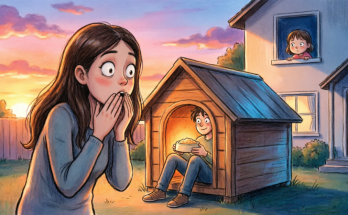
I stopped breathing.
Because children ask questions adults spend years avoiding directly.
Finally Ethan answered carefully.
“Yes.”
Emily looked furious suddenly.
“Then why didn’t you act like it?”
There it was.
The distinction that matters most.
Love as feeling versus love as behavior.
Ethan nodded slowly.
“Because feeling love and practicing love are different skills.”
God.
That answer hurt because of how true it was.
“So what changed now?” Emily demanded.
“How do we know this version of you isn’t fake too?”
Ethan accepted that blow quietly.
“You don’t.”
No argument.
No performance.
“You shouldn’t trust words quickly after someone breaks trust repeatedly.
You watch patterns instead.”
That visibly affected her.
Because it was emotionally responsible advice.
The kind healthy adults give children.
Late.
But still valuable.
“I spent years teaching you the opposite,” Ethan admitted.
“I taught you promises matter more than consistency.
That charm matters more than accountability.”
He shook his head slowly.
“That’s probably the worst thing I ever did.”
Silence returned.
Outside, snow slid softly from tree branches.
Finally Emily asked the question I knew terrified her most.
“Are you going to disappear again?”
Ethan looked stunned by the vulnerability beneath it.
“No,” he said immediately.
“Not unless you ask me to.”
She searched his face carefully.
Children become experts at studying emotional sincerity after betrayal.
“I don’t know what I want yet,” she admitted quietly.
“That’s fair.”
“I’m still angry.”
“You should be.”
“I don’t forgive you.”
Another nod.
“Okay.”
No pressure.
No guilt.
No emotional manipulation.
That mattered enormously.
Because true remorse allows other people ownership over their emotions.
Finally Emily whispered:
“I just don’t want to feel scared every time someone I love disappoints me.”
Oh God.
There it was.
The real damage.
Not money.
Not prison.
Not headlines.
Fear attaching itself permanently to love.
I wrapped my arm around her immediately.
Ethan looked shattered hearing it.
“I’m so sorry,” he whispered.
And for the first time all evening, I believed the apology reached the correct target.
Not himself.
Not his guilt.
Her.
After a long silence, Emily suddenly stood.
“I need air.”
Then she disappeared upstairs before either of us could stop her.
The house fell silent again.
Ethan stared at the empty staircase with visible devastation.
“I broke something in her,” he said quietly.
I answered honestly.
“Yes.”
He nodded slowly like he expected nothing else.
Then after a long pause:
“Did she ever stop checking the locks twice?”
That startled me.
“You noticed that?”
“I notice everything now.”
There was no self-pity in the statement.
Just grief.
“That’s the punishment nobody talks about,” he whispered.
“Seeing the permanent shape of what you damaged.”
I looked at him carefully across the table.
“You don’t get to drown in guilt either, Ethan.”
His eyes lifted slowly.
“What?”
“Guilt can become selfish too.
People sit inside it because feeling horrible seems easier than rebuilding trust slowly.”
That hit him hard.
Good.
“Emily doesn’t need you destroyed,” I continued quietly.
“She needs you reliable.”
He absorbed that silently.
Then nodded once.
“You’re right.”
For years I waited desperately for him to become emotionally honest.
Funny how painful it still felt once it finally happened.
Upstairs, floorboards creaked softly.
Emily moving around her room.
Still processing.
Still hurting.
Still trying.
Like all of us.
Ethan stood slowly and grabbed his coat.
“I should go.”
Probably.
Yes.
But before he reached the door, I stopped him.
“One thing.”
He turned.
“You don’t get credit for finally telling the truth.”
He nodded immediately.
“I know.”
“But,” I added carefully,
“you do get a chance to keep telling it.”
Something in his face cracked quietly then.
Not relief.
Hope.
Very small.
Very fragile.
But alive.
And sometimes healing begins exactly there.
Not with forgiveness.
With honesty surviving long enough to become consistency.
Lesson Learned — Educational Meaning of the Story
This chapter explores one of the deepest emotional truths in family trauma:
love and harm can coexist painfully inside the same person.
The story teaches that many harmful people are not entirely devoid of love.
Instead, they lack emotional discipline, accountability, and moral consistency.
That distinction is psychologically important because it explains why betrayal inside families feels so confusing and devastating.
Another major lesson is that apologies alone do not rebuild trust.
Trust returns through observable patterns over time:
honesty,
reliability,
consistency,
and respect for boundaries.
The chapter also highlights the difference between feeling love and practicing love.
Many people sincerely love others emotionally while still behaving selfishly, irresponsibly, or destructively.
Healthy love requires action, not merely emotion.
Emily’s fear —
“I don’t want to feel scared every time someone I love disappoints me” —
captures how betrayal reshapes nervous systems.
Trauma teaches people to associate attachment with danger.
The continuation also teaches that guilt itself can become self-centered if it replaces meaningful change.
True accountability requires sustained behavioral transformation, not endless emotional collapse.
Finally, the chapter demonstrates that healing conversations are rarely clean or cinematic.
They are awkward,
painful,
unfinished,
and emotionally exhausting.
But honest conversations interrupt generational silence and create the possibility of healthier relationships moving forward.
Character Analysis — Deep Psychological Exploration
Laura:
Laura now functions as the emotional anchor of the family.
She balances empathy with boundaries exceptionally well.
Psychologically, Laura has moved beyond survival mode into active emotional leadership.
She no longer protects people from truth to preserve comfort.
Her statement —
“Emily doesn’t need you destroyed. She needs you reliable.”
— reflects profound emotional wisdom.
Laura understands that accountability must eventually produce constructive behavior rather than endless self-condemnation.
Ethan:
Ethan’s transformation becomes increasingly credible because he accepts emotional consequences without demanding emotional absolution.
His explanation that he became dangerous “one excuse at a time” reflects psychologically realistic moral deterioration.
Most destructive behavior develops gradually through normalized selfishness and rationalization.
Importantly, Ethan now understands trust behaviorally instead of emotionally.
Earlier in life, he relied on charm, promises, and emotional intensity.
Now he recognizes consistency as the true measure of character.
His greatest growth is learning to tolerate other people’s anger without centering his own pain.
Emily:
Emily continues demonstrating remarkable emotional intelligence for her age.
Her questions are emotionally precise because children instinctively seek moral clarity.
She struggles with one of trauma’s hardest contradictions:
someone can genuinely love you while simultaneously harming you.
Psychologically, Emily is rebuilding her internal model of trust.
Her fear that love itself may become unsafe reflects classic attachment disruption after betrayal.
However, her willingness to engage emotionally rather than shut down completely reveals resilience.
She is not becoming emotionally numb.
She is learning discernment.
Part 18 — The Woman At The Grocery Store
Three weeks passed after Ethan’s visit.
Not magically healed weeks.
Not movie-ending weeks.
Real weeks.
The kind where life continues doing ordinary things while everyone quietly carries emotional bruises underneath their coats.
Emily still checked locks twice before bed.
Sometimes three times.
I still woke up at 2:00 AM occasionally reaching for a husband who no longer slept beside me.
And Ethan…
Ethan texted every Wednesday and Sunday exactly like he promised.
No emotional pressure.
No guilt.
No “please answer.”
Just consistency.
Wednesday:
Thinking about Emily’s science fair today.
Hope it went well.
Sunday:
I found the recipe for those blueberry pancakes she liked.
No hidden walnuts this time.
Tiny things.
Predictable things.
At first Emily ignored every message completely.
Then she started reading them over my shoulder silently.
Then one night she asked:
“Did Dad actually ruin pancakes with walnuts once?”
I snorted unexpectedly.
“He absolutely did.
Twice.”
That earned the smallest smile.
Progress often arrives dressed like something insignificant.
But healing never moves in a straight line.
I learned that the hard way on a rainy Thursday afternoon at the grocery store.
I was standing near the dairy section comparing yogurt prices when I heard my name behind me.
Not “Laura.”
My old name.
“Mrs. Whitmore.”
I turned automatically.
And there she stood.
Vanessa Carlisle.
The woman Ethan had nearly married after our separation.
For one strange second my brain refused to connect her polished appearance with the wreckage she represented in my life.
She looked exactly how expensive heartbreak imagines itself:
perfect hair,
camel-colored coat,
diamond earrings small enough to look tasteful but large enough to cost several mortgage payments.
But her face startled me.
Because she looked exhausted.
Not physically.
Morally.
Like someone carrying a version of themselves they no longer fully respected.
Neither of us spoke immediately.
Finally she smiled awkwardly.
“Hi.”
There are moments where your body remembers pain before your mind catches up.
Mine certainly did.
This was the woman who attended charity events beside Ethan while divorce paperwork was still drying.
The woman who accidentally posted vacation photos before our daughter even understood we were permanently separating.
The woman whose existence turned my family into gossip for half the city.
And yet…
Standing there now, she looked less triumphant than haunted.
I answered carefully.
“Hello, Vanessa.”
She glanced toward my cart nervously.
“No wine and no frozen pizza?
You’re healing better than I expected.”
That surprised an unwilling laugh out of me.
“Congratulations.
You’re the first person this month to joke about my emotional collapse successfully.”
Her smile flickered briefly.
Then disappeared.
“I owe you an apology.”
Ah.
There it was.
The thing exhausted people eventually come searching for once denial becomes too heavy to carry comfortably.
I should have walked away.
Probably.
Instead I stood there holding Greek yogurt while emotional history prepared to unload itself beside discounted cheese sticks.
“What for specifically?” I asked calmly.
Vanessa inhaled slowly.
“Honestly?
Probably enough things to require alphabetical organization.”
Interesting answer.
Not defensive.
Not performative.
Specific.
That made me stay.
We moved toward the small coffee stand near the front windows mostly because neither of us wanted this conversation happening beside refrigerated eggs.
Rain tapped softly against the glass while we sat across from each other at a tiny round table that felt wildly insufficient for the emotional weight involved.
Vanessa wrapped both hands around her coffee cup before speaking again.
“I used to tell myself you were cold,” she admitted quietly.
“That your marriage was already emotionally dead.
That Ethan stayed because of obligation.”
I listened silently.
“People always need moral shortcuts when they’re participating in someone else’s destruction,” she continued.
“You invent narratives that make your choices feel less ugly.”
Well.
That was brutally self-aware.
“I’m not interested in humiliating you,” I said carefully.
“But honesty matters here.
Did you know he was still trying to reconcile with me while seeing you?”
Vanessa closed her eyes briefly.
“Yes.”
The truth landed harder because she didn’t soften it.
“He kept saying he was confused,” she whispered.
“That he didn’t want to hurt anybody.
That he needed time.”
Classic.
Men requesting emotional patience while detonating multiple lives simultaneously.
“I believed him because believing him protected me from seeing myself clearly.”
There it was again.
Personal accountability.
Rare.
Painful.
Valuable.
I studied her carefully.
“You loved him.”
Not a question.
Vanessa laughed once sadly.
“I loved the version of him that existed when he needed something from me.”
God.
That sentence hit deep.
Because I recognized it instantly.
She noticed my reaction too.
“That expression means you understand exactly what I mean.”
Unfortunately…
yes.
“When did it fall apart?” I asked quietly.
Vanessa stared down into her coffee.
“The first time he lied to me using the exact same tone he once used to reassure me about you.”
Oof.
There are few moments more psychologically devastating than realizing you were not special.
Just next in line.
“He started hiding things constantly,” she admitted.
“Small lies at first.
Then bigger ones.”
She looked up at me finally.
“Did he always need admiration like oxygen?”
I almost answered immediately.
Then stopped.
Because the truthful answer was more complicated.
“No,” I said slowly.
“I think he needed validation because deep down he never liked himself very much.”
Vanessa stared at me carefully.
“That’s an incredibly compassionate thing to say about someone who hurt you.”
“Compassion and access are different things,” I replied.
“I can understand him without reopening my life to chaos.”
That visibly affected her.
Because emotionally mature boundaries confuse people accustomed to dramatic relationships.
Vanessa looked out the rain-covered window quietly.
“I thought winning him meant something.”
Ah.
The hidden wound finally appeared.
Not love.
Competition.
“She made me feel old,” I admitted softly before I could stop myself.
“When everything first happened.”
Vanessa’s eyes widened instantly.
“You?”
She laughed in genuine disbelief.
“Laura, half the women at those fundraisers wanted to be you.”
That startled me.
Because pain narrows perception brutally.
“I used to watch you walk into rooms,” Vanessa continued quietly,
“and think:
That’s what stability looks like.”
I nearly laughed myself.
Stability.
If only she knew how many nights I cried in bathroom mirrors trying desperately to become emotionally acceptable enough to keep my marriage alive.
Funny how suffering hides beneath polished surfaces.
“You know the worst part?” Vanessa whispered.
“What?”
“He talks about regret constantly now.”
I looked down at my coffee immediately.
Dangerous territory.
“I’m not telling you that because I think you should reconcile,” she added quickly.
“Honestly, I think you’re healthier apart.”
That honesty made me trust her slightly more.
“But he’s different now,” she admitted.
“Quieter.
Careful.
Like somebody finally forced him to meet himself without distractions.”
That sounded accurate.
Painful.
But accurate.
Vanessa sighed heavily.
“I ended things because I realized something awful.”
“What?”
“I wasn’t actually building a relationship with him.
I was helping him escape accountability temporarily.”
Damn.
That was emotionally advanced insight.
Most people spend years avoiding conclusions like that.
Rain continued sliding down the windows quietly around us.
Finally Vanessa asked the question she’d clearly been building toward the entire conversation.
“Do you hate me?”
Straightforward.
Good.
I considered it honestly.
“No,” I said finally.
She looked genuinely shocked.
“I hated what happened,” I clarified.
“I hated how selfish everyone became.
I hated watching my daughter get hurt.”
I paused carefully.
“But hatred requires emotional energy I’d rather spend rebuilding my own life.”
Vanessa cried silently then.
Not dramatically.
Not manipulatively.
Just quietly.
“I’m sorry,” she whispered.
“For all of it.”
And strangely enough…
I believed her.
Not because apologies erase damage……………………………………