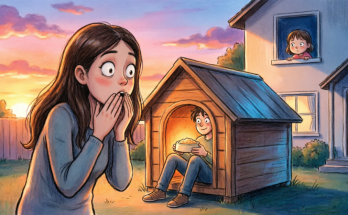
When I went back into the room, my granddaughter was eating crackers from a little packet the nurse had brought and swinging her legs under the exam table paper. I sat beside her and asked what kind of cake she wanted for her birthday.
“Chocolate with strawberries,” she said.
“That’s ambitious.”
“Not that much chocolate,” she clarified. “And maybe whipped cream too. But not the kind that tastes fake.”
“I’ll make a note.”
“Can I get a dog when I’m eight?”
“Your father would be the person to ask.”
“I ask him every week.”
“And what does he say?”
“He says maybe when I’m older.”
“That’s what fathers say when they mean no but don’t want to be unpopular.”
She grinned at that, and for one blessed second she looked exactly like the child she was supposed to be.
The results came back that afternoon.
The doctor sat across from me in a small consultation room with a printout in her hand and the same controlled stillness in her face. My granddaughter was in the next room with a nurse and a coloring sheet of pumpkins and bats because it was almost Halloween.
The doctor set the paper down and folded her hands.
“The screen is positive for diphenhydramine,” she said, “and for compounds consistent with several common over-the-counter sleep aids.”
The room seemed to narrow around her voice.
“The levels are elevated,” she continued, “not acutely dangerous as a one-time dose, but consistent with repeated administration over a prolonged period. In a child her size—”
I interrupted her. “She weighs thirty-eight pounds.”
The doctor paused. “Yes. In a child of that size, regular exposure can cause chronic fatigue, impaired attention, memory disruption, and, over time, possible developmental impact in areas like retention and concentration.”
I looked down at my hands on the table.
They did not look like my hands.
They looked like someone else’s hands. Old hands. Veined hands. Hands that had built retaining walls and bridges and kitchen cabinets and a cradle once, years ago, for the child who was now the father of the little girl in the next room.
“This wasn’t an accident,” I said.
“No,” the doctor said. “This pattern doesn’t happen by accident.”
There are moments when knowledge becomes irreversible. That was one of them. It wasn’t the porch-step question, though that had started it. It wasn’t even the doctor’s suspicion in the hallway. It was this: a fluorescent-lit room, a printed page, and another adult saying out loud what your instincts have been fighting to name.
“What happens now?” I asked.
“I’ve already called Children’s Protective Services,” she said. “A caseworker will be assigned within twenty-four hours. I strongly advise that you do not return her to that home tonight.”
“I won’t.”
She nodded once. “Good.”
Then she gave me the number for the family advocacy center, a packet on emergency kinship placement, and one sentence that I have thought about many times since.
“You need to call her father now,” she said.
That was the part I had been dreading almost more than the test results.
My son was thirty-six years old then. He worked in logistics for a regional distribution company and had built a life the way he did most things: steadily, without spectacle, by showing up early and doing what needed doing. He was a good man. Not a dramatic man. Not especially intuitive in the way his mother had been, but decent to the bone and devoted to his daughter in that deep, practical way that doesn’t announce itself much but never fails when counted on.
He had been with his wife nine years.
They had married when my granddaughter was one.
He believed, as many decent men do, that love and routine and work were enough to identify the shape of a family. He did not understand that some disasters live inside routine so neatly you mistake them for normal until something small names them.
I sat in my truck with my granddaughter buckled in the backseat eating the peanut butter crackers the nurse had sent with us, and I called him.
He answered on the second ring. There was warehouse noise behind him—forklift beeps, metal, distant voices.
“Dad?”
“I need you to find somewhere quiet.”
He did not ask why. I heard the warehouse noise recede, then a door close.
“All right,” he said. “What’s wrong?”
I told him.
I started with the porch.
Then the clinic.
Then the doctor.
Then the tox screen.
Then the word sedative.
Then Children’s Services.
Then the sentence I had been holding back because once I said it aloud, there would be no possibility of any of us pretending later that I had been uncertain.
“I am not bringing her back to the house,” I said.
He did not speak.
Five seconds passed.
Then ten.
“Say that again,” he said finally, but it came out strange, like the words had to force their way around something lodged in his throat.
“The test was positive,” I said. “Repeated use. For months, apparently.”
There was a sound on the line then that I have never had a proper word for. Not crying. Not disbelief. Something older and more animal than either. The sound a body makes when the mind has been handed information too terrible to admit all at once.
“I’m leaving right now,” he said.
“Don’t go home.”
Silence.
“Why?”
“Because I need you to hear the rest before you do anything at all.”
He breathed once, hard. “Where are you?”
“I’ll take her to my house.”
“I’ll meet you there.”
It took him forty minutes, which meant he must have driven like a madman.
By the time he got there, my granddaughter was sitting at my kitchen table with a glass of chocolate milk and my old bird field guides spread open in front of her. She liked the glossy pages with the warblers best. My wife had once said that watching a child study bird books was proof the human race occasionally deserved to continue.
When my son came through the door, he went first to his daughter.
He did not ask me anything. He didn’t even set down his keys. He dropped to one knee beside her chair and put both arms around her so suddenly she nearly tipped her milk.
“Daddy,” she said, startled. “You’re early.”
He held her tighter.
I looked away then because there are some private griefs a father deserves not to have witnessed, even by his own father. I busied myself at the sink, rinsing a clean glass that did not need rinsing.
When he came into the kitchen a few minutes later, his daughter was on the couch under the blue-and-yellow quilt my wife had made twenty years ago, already asleep.
His eyes were red, but his face was composed.
My son has always been like me in that respect. He keeps himself together when something practical is required of him. He breaks later, alone.
He stood across from me at the counter and asked, “Why?”
I knew what he meant.
Why would a mother do this to her own child?
There is no single clean answer to a question like that, not one that satisfies the moral mind. The explanation came in pieces over the next several days, from what my granddaughter said to the caseworker and child advocate, from what the police found, from what a neighbor volunteered, from messages on a phone later entered into evidence.
But even then, the explanation never became the same thing as understanding.
At first all I could say was, “I don’t know.”
That wasn’t enough for him.
So I said, “What matters tonight is not why. It’s what you do next.”
He sat at the kitchen table and folded his hands so tightly I thought the knuckles would split.
“What am I supposed to do?”
Not desperate. Not dramatic. Quiet. Specific. Like a man asking for instructions because he has suddenly realized the machinery in front of him is more dangerous than anything he has ever been trained to operate.
“You do the next thing,” I said. “And then the next one after that.”
He looked at me.
“Starting tonight,” I said.
He nodded once.
The caseworker came the following morning.
She was a composed woman in her forties with tired eyes and a leather tote bag and the bearing of someone who had spent years sitting in kitchens exactly like mine delivering exactly this kind of news. She was not warm, but she wasn’t cold either. There is a particular kind of professional kindness that doesn’t perform softness because the work itself is too serious for that. She had that.
She spoke to my granddaughter first, alone but with the door open. I sat in the next room and listened to the rhythm of her voice without making out the words. My granddaughter asked once, “Am I in trouble?” and the caseworker said, clearly enough for me to hear, “No. Absolutely not.”
I have been grateful for that sentence ever since.
Later she spoke with my son and me at the kitchen table while my granddaughter colored at the far end with my wife’s old jar of pencils.
She asked about schedules. Who worked when. Who handled bedtime. Whether there had been prior concerns. Whether my granddaughter had seemed unusually tired over the summer and fall. Whether either of us had noticed changes in school performance, appetite, mood, memory.
That was when the guilt began to sharpen.
Yes, my granddaughter had seemed more tired lately.
Yes, she’d been foggy in the mornings sometimes.
Yes, she’d had a teacher comment on her daydreaming more this year.
Yes, she had started forgetting small things she used to remember.
All of it had had explanations at the time. School. Growth spurts. Sleepovers. Seasonal drift. We had done what people do when they trust the adults around a child—we interpreted within the safety of that trust.
The caseworker did not judge us for that. At least not aloud.
My daughter-in-law denied everything at first.
That much I learned in fragments because I was not present for all of the interviews. She said my granddaughter must have gotten into the medicine cabinet. She said she had occasionally given her children’s allergy medicine when she seemed restless. She said I was a meddling old man who had never approved of her, which, if I’m being honest, was at least adjacent to the truth, though not for any reason that would excuse what she had done.
But the tox screen told a story her explanations couldn’t hold.
So did the kitchen search.
In the back of a cabinet behind olive oil and red wine vinegar, officers found a bottle of liquid diphenhydramine, two nearly empty boxes of over-the-counter sleep aids, and a plastic measuring dropper tucked beneath a stack of cloth napkins. There were also receipts, dates, and, later, messages that aligned too neatly with my son’s late shifts to be coincidence.
The neighbor across the cul-de-sac told the caseworker she had noticed a man coming around on nights my son worked late. Not every late shift, but often enough. A dark sedan. Different parking angles. Lights on in the living room later than usual. Once, laughter on the patio around ten-thirty, while the little girl’s bedroom light had already been dark for hours.
By the time the police put the pieces together, the reason, if you can call it that, had become ugly in its simplicity.
She had wanted her daughter asleep.
Not a little sleepy. Not quiet in bed with a book. Unavailable.
No witness. No interruption. No small feet wandering into the hallway asking who was downstairs laughing.
She had turned her own child into an obstacle to manage.
When my son heard that, he did not react the way I might once have expected. He didn’t throw anything. He didn’t shout. He sat at my kitchen table with his hands folded and stared at the grain in the wood as if he could force the meaning of it into some shape his mind could survive.
Then he said, “I don’t understand how I didn’t see it.”
There are questions that have to wait their turn.
I told him so.
“Later,” I said. “When she’s safe. When the legal pieces are moving. When the house is no longer in play. Then you can sit with that question for as long as you need. Right now it is not useful.”
He nodded.
He nodded a lot in those first days, the way men do when they are holding themselves together with instruction because feeling would knock the rest loose.
He filed for divorce eleven days later.
No drama. No spectacle. No threat. No attempt to negotiate the heart of what had happened into something more convenient. He did it the same way he approached most painful necessities in life: directly, quietly, without performance.
My granddaughter stayed with me.
The fall turned cold.
The leaves dropped.
My house, which had been too quiet since my wife died, filled with the sounds of a child again—water running too long in the upstairs bathroom, drawers opening and closing, whispered conversations with stuffed animals at bedtime, questions about whether robins stayed in Ohio for winter and if not where exactly they went.
The first weeks were not easy………..
Click Here to continuous Read Full Ending Story👉: Granddaughter’s Porch Conversation Changed Everything_part3(ending)