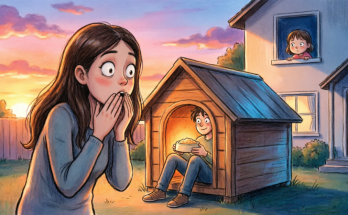
She had nightmares. Not every night, but often enough. Sometimes she would wake disoriented and cry because she didn’t know where she was. Once she wet the bed, which she had not done in years, and was so ashamed afterward that she tried to strip the sheets herself before I woke up. I found her in the laundry room at six in the morning dragging the bedding behind her like a penitent.
“Sweetheart,” I said.
Her face folded in on itself.
“I’m sorry,” she whispered.
That word nearly leveled me.
I knelt down and told her there was nothing to apologize for, not then, not ever, not for that.
Children will apologize for damage done to them if the world teaches them early enough that trouble sticks to the smallest person in the room.
She asked questions too. Questions children ask because they know something terrible has happened but do not yet understand the logic of it.
Why did Mom do that?
Did she still love me?
Was I bad when I was asleep?
Am I ever going back to the house with the tire swing?
Each question felt like a nail I had to remove carefully so it didn’t split the wood.
I answered as honestly as I could without handing her adult poison she was too small to carry.
I told her sometimes grown-ups make terrible choices and those choices have nothing to do with how lovable a child is.
I told her her father loved her more than he loved anything in the world.
I told her I loved her more than I had words for, which was true and insufficient.
I told her she had done absolutely nothing wrong.
When she asked if her mother still loved her, I said, “I think your mother has something wrong in the way she makes choices. That is different from you being unlovable.”
It was not a perfect answer.
There are no perfect answers to a child asking whether the person who harmed her did so from lack of love.
But she nodded very seriously, the way she did when she was storing something for later, and went back to her birds.
I thought about my wife constantly through those months.
What she would have said.
How she would have sat on the edge of the bed at night and smoothed the hair back from our granddaughter’s forehead and found the exact sentence that would land like shelter instead of explanation.
I had never envied the dead before. Not really. I did then. Because my wife had always known the language of comfort better than I did, and here I was trying to construct it out of plain wood and honest effort and whatever instinct I had inherited from being loved by her for thirty-eight years.
By January, the legal machinery had moved from accusation into process.
My daughter-in-law’s attorney negotiated a plea.
She pleaded guilty to one count of child endangerment. She received a suspended sentence, supervised probation, mandatory parenting classes, psychiatric evaluation, and court-ordered supervised visitation only, pending further review.
I will not pretend it felt like enough.
It did not.
My son and I sat in my living room the evening after the plea was entered and stared at the opposite wall for a long time without saying much. The television was off. The dog we did not yet own had not yet filled the silence. The house ticked with winter heat.
Finally I said, “The court has done what the court is going to do. The rest is our work.”
He nodded.
He got full physical custody.
That mattered more than the sentence, in the end. Not emotionally. Practically.
Because from that point on, protecting her no longer depended on the moral insight of the woman who had failed to protect her in the first place.
He moved into a rental house two miles from mine while the divorce finalized.
It was a plain place in Westerville with beige siding and a small front porch and a yard just big enough to matter to a child. There was a great oak tree in the back, wide-armed and solid. My granddaughter saw it the first day and said, “This one’s better for a tire swing.”
It was the first time she had mentioned a swing without flinching.
So in April, when the weather softened, we put one up.
My son did most of the ladder work because I am sixty-three, not dead, but not stupid either. I steadied the base, held the rope, and objected where appropriate. My granddaughter supervised in the grave, exacting manner of small girls who have survived too much and would like, at least once, to control something uncomplicated.
“Higher,” she said.
“Not that high,” my son replied.
“A little higher.”
I said, “The engineer in this family would like a word.”
She laughed then.
A full laugh. Not a careful one. Not a polite one. The kind that comes from the body before the mind has time to check whether joy is safe.
I stood there with one hand on the ladder and felt something pass through me that was not happiness exactly. Something quieter. Stronger. The feeling of a structure that had been under strain beginning, slowly, to bear weight again.
We took her to a pediatric specialist in February for follow-up testing.
The urgent care doctor had recommended it, and once you have entered this particular part of the world—screens, caseworkers, lawyers, developmental checklists—you learn quickly that follow-up is not optional if you want to sleep later.
The specialist was a calm man with silver hair and the patient eyes of someone who had spent thirty years translating parental fear into medically useful questions. He ran a full developmental assessment. Memory, attention, processing, retention, language, behavioral observation.
My granddaughter sat through most of it with a seriousness that broke my heart.
At one point she was asked to repeat a short list of words back in order, and when she stumbled, she looked instantly ashamed, as if performance itself had become moral. The specialist noticed. He smiled at her and said, “That one was hard. It was supposed to be.” I wrote his name down after that because I wanted to remember the sort of man he was.
When he reviewed the results with my son and me, my granddaughter was in the waiting room with crayons and a paper crown someone from the front desk had given her.
“Her cognitive functioning is within normal range,” he said. “Attention scores are a little below midpoint for her age, but not alarmingly so. Given the circumstances and duration, I would not be surprised if much of that normalizes with time, routine, and the removal of the sedating agent.”
I asked the question directly because that is the kind of man I am.
“Will there be lasting damage?”
He did not offer false certainty.
“I can’t promise that there will be none,” he said. “But I can tell you that children are resilient in ways that still surprise me after decades of this work. The most important variables now are stability, routine, and the presence of attentive, loving caregivers.”
“She has those,” I said.
He nodded. “Then her prognosis is good.”
I drove home alone from that appointment because my son had taken my granddaughter for ice cream afterward. I sat in my driveway for several minutes before going inside.
The oak in my backyard was just beginning to bud, pale green against a cold gray sky.
I thought about the Tuesday morning in October when a little girl had looked up at her grandfather and said the words because she trusted, without even knowing she was trusting, that he would know what to do with them.
How close it had come to being missed.
How easily I could have smiled and said, “I’m sure Mommy’s just trying to help you sleep, sweetheart.”
How many more months might have passed.
How much harder it might have been to undo.
People often ask me now what I felt in those months.
Relief is part of it, yes.
Anger too. Anger remains, if I’m being honest. I suspect it will remain until I die. Not hot anger anymore. Not the sort that makes a man slam his fist into a wall. Something older and steadier. The kind that sits in the bones and clarifies certain things forever.
Grief is there too. Grief for the mornings my granddaughter woke up heavy and confused and believed that was simply how mornings felt. Grief for the trust taken from her by the very person who should have guarded it. Grief for my son, who now had to rebuild fatherhood in the shadow of a house he had once believed was ordinary and safe.
But underneath all of that, deeper than I expected, was gratitude.
That she said it.
That she did not decide the strange juice was just one more fact about life and keep it to herself.
That I was the person she chose.
I spent most of my adult life calculating how much weight a system could bear before it failed. Bridges mostly. Road structures. Reinforcement loads. Shear forces. Expansion stress. I retired five years ago and thought those kinds of calculations belonged to my professional life.
They don’t.
You never stop doing them. You just start applying them to human things.
A child says seven words on a porch. What follows? How much stress can the family carry? Where does the crack begin? What has to be shored up first? Which support is load-bearing and which was decorative all along?
My granddaughter got her golden retriever in May.
That had been non-negotiable in her mind since sometime shortly after Christmas when she informed us, in a tone of grave policy, that “a dog would help the house feel less empty.”
My son resisted for three weeks.
Then he caved, as fathers who love their daughters deeply and are healing something in themselves often do.
The dog was an enormous pale creature with outsized paws and no sense of his own dimensions. She named him Chester. He knocked over two lamps, chewed one sneaker, stole half a grilled cheese off my plate the second Sunday he was in the house, and fell asleep each night at the foot of her bed as if he had been specifically assigned to guard her from anything dark and unnecessary ever again.
He followed her room to room.
He watched doors.
He lifted his head at every unfamiliar car.
I loved him immediately.
We have dinner together every Sunday now. My son, my granddaughter, Chester, and me.
Sometimes it’s roast chicken. Sometimes spaghetti. Once, disastrously, my son attempted salmon and Chester stole an entire filet off the counter while we were setting the table, and my granddaughter laughed so hard she slid off her chair.
She tells me about school. About friends. About what Chester did this week that was either very funny or very bad, usually both. Her teachers say she’s attentive now. Engaged. Bright. She remembers assignments. She volunteers answers. She draws birds in the margins of her math worksheets and can identify warblers faster than most adults I know.
She is catching up.
That is what healing looks like in a child, I think. Not grand speeches. Not visible forgiveness. Catching up to the self she might have been if nothing had interrupted her development in the dark.
One Sunday evening, a few months after everything had settled into the shape of new routine, my son stepped out to take a call and it was just the two of us at the kitchen table. Chester had placed his ridiculous head on her knee and was making small, dramatic sighing noises the way he does when he believes himself neglected.
She was tracing the wood grain on the table with one finger when she asked, very quietly, “Grandpa?”
“Yes, sweetheart?”
“Were you scared when I told you about the juice?”
I thought about lying.
I thought about giving her the easy grandfather answer. No, honey. Grandpa wasn’t scared. Grandpa knew exactly what to do.
But children who have been failed by adults do not need more performance. They need something truer.
So I said, “Yes.”
She looked up at me.
“I was terrified.”
She considered that in silence for a moment.
“But you didn’t act scared.”
“No,” I said. “I didn’t.”
She kept tracing the grain with her finger.
“Is that what you’re supposed to do?” she asked. “When you’re scared?”
I thought about it before answering because children notice when adults lie fastest about courage.
“When someone you love needs you,” I said, “being scared is allowed. Letting the scared stop you is not.”
She listened very carefully.
“That’s not something you’re born knowing,” I went on. “It’s something you practice. Over and over. You do the next thing even while you’re scared, and after enough times, that becomes the thing you know how to do.”
She was quiet.
Chester groaned dramatically and shifted his head to the other knee.
Then she nodded.
“Okay,” she said. “I’ll practice.”
She was eight years old.
Eight years old and already talking about practicing bravery as if it were piano or multiplication or tying your shoes.
I don’t know whether she understood how much that sentence meant to me. I hope one day she does.
I drove home that night the long way, through neighborhoods my wife and I used to wander through on summer evenings when the windows were down and we had nowhere we particularly needed to be. The streetlights were on. A dog barked somewhere two blocks over. Porch lights glowed on neat little ranch houses and split-levels and colonials full of people having ordinary dinners and ordinary arguments and, one hoped, ordinary love.
I thought about what it takes to look at a small person and decide, without hesitation, that their safety is worth whatever it costs you.
It should be the easiest calculation in the world.
For some people, somehow, it isn’t.
I thought about my granddaughter on those back porch steps in October, looking up at me and handing me the thing she did not yet have the language to explain.
I heard her.
That is the only thing I am absolutely certain I did right from the first second.
Everything else followed from that.
So if you have someone small in your life—a child, a grandchild, a niece, a nephew, the kid next door who lingers too long on your porch because your house feels easier than theirs—and something they say does not sit right with you, don’t wait.
Don’t tell yourself you are overreacting.
Don’t decide the disruption isn’t worth it.
Don’t weigh family peace against a child’s unease and call that prudence.
Ask the question.
Make the call.
Take them to the doctor.
Be the person they thought you were when they said the words.
Because children are saying the words all the time, one way or another. Not always clearly. Not always in language that sounds urgent to adult ears. Sometimes it comes as a complaint about juice. Sometimes it comes as a stomachache, a new fear, a shrug, a silence where there used to be noise.
Hear them anyway.
That Tuesday morning in late October, my granddaughter did not know she was putting the weight of the world into my hands.
She only knew something was wrong and that her grandfather might understand.
So I listened.
And because I listened, she sleeps now with a ridiculous golden retriever at the foot of her bed, in a house with a tire swing in the backyard and a father who has learned that love must sometimes become action faster than thought. She wakes up clear-eyed. She remembers her mornings. She draws birds and argues about cake frosting and tells me Chester is both the best and worst dog in the world.
Which, in my experience, is exactly what a child ought to be doing.
One thing at a time.
Starting tonight.
That was the advice I gave my son in the worst of it, and it remains the best advice I know for any kind of collapse.
You don’t fix everything at once.
You do the next necessary thing.
Then the one after that.
And you keep your eyes on the person you’re doing it for.
That is how you carry the weight.
That is how things hold.