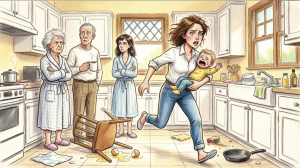
My mother appeared in the doorway, still in her bathrobe. Rachel, stop shouting. Take her somewhere. She’s disturbing everyone’s mood. I stared at her in disbelief. My daughter was unconscious with secondderee burns and my mother was worried about the mood. Dad walked in from the kitchen with his coffee mug. Some children just ruined peaceful mornings.
He shook his head like Emma had merely spilled juice instead of being assaulted by her own aunt. She sat in Lily’s chair. Vanessa said flatly, crossing her arms. She started eating Lily’s breakfast. I made that specially for my daughter. The casualness in her voice sent ice through my veins. I gathered Emma into my arms, her small body limp and terrifyingly still.
I’m taking her to the hospital. Someone needs to call the police. Don’t be dramatic. My mother snapped. Vanessa was just startled. You know how protective mothers can be. I didn’t wait to hear more. I grabbed my keys and phone from the entry table and carried Emma to my car. My hands were shaking so badly I could barely buckle her into her car seat.
She was breathing, but she hadn’t opened her eyes. The burns looked even worse in the morning sunlight. The drive to Mercy General took 11 minutes. I ran every yellow light and may have rolled through a stop sign. I kept talking to her the whole way, begging her to wake up, promising her everything would be okay, even though I had no idea if it would be.
The ER staff took her immediately. A nurse named Patricia helped me with the intake forms while two doctors examined Emma. They transferred her to the pediatric burn unit within 30 minutes. Dr. Dr. Sarah Chen, the attending physician, explained that Emma had sustained second and third degree burns covering approximately 12% of her body, concentrated on her face, neck, and left shoulder where the pan had made contact.
“We’re going to keep her sedated for now,” Dr. Chen said gently. “The pain would be unbearable otherwise. We need to monitor for infection and assess whether she’ll need skin grafts.” I sat in the chair beside Emma’s hospital bed, holding her tiny hand. They’d wrapped most of her head and shoulder in specialized burn dressings, and Ford dripped clear fluids into her arm.
Monitors beeped steadily, tracking her heart rate and oxygen levels. My phone had been buzzing non-stop. I finally looked at it around 11. 17 m calls from my mother. 12 texts from Vanessa saying I was overreacting. Three voicemails from dad telling me to come back to the house so we could discuss this rationally. I blocked all their numbers.
Around 2:00 in the afternoon, I heard voices in the hallway. My entire family had shown up. I stood and walked to the doorway, blocking their entrance. “You need to leave,” I said quietly. “Rachel, don’t be ridiculous,” my mother said, trying to push past me. “We came to see Emma. The woman who burned her is standing right behind you. You defended her.
None of you are coming near my daughter.” Vanessa stepped forward. It was an accident. I got scared when I saw someone at Louis’s place. I reacted. You threw a cast iron skillet full of hot food at a four-year-old child because she sat in the wrong chair. “She shouldn’t have been there,” Vanessa said, her jaw tight.
“I specifically set that spot for Lily.” A nurse appeared and asked them to keep their voices down. I told her these people had assaulted my daughter and I didn’t want them anywhere near her room. She nodded seriously and said she’d update the visitor restrictions immediately and notify security. They dispersed, but I saw them in the hospital cafeteria later sitting together, eating sandwiches, talking like nothing had happened.
Marcus caught my eye and shrugged as if to say, “What can you do?” The first two days blurred together. Hospital security had flagged my family members in their system, but I remained vigilant. A social worker named Karen Menddees visited on Sunday afternoon. She explained that the hospital had already filed a report with child protective services and the police as they’re mandated to do for any suspected child abuse.
Detective Bryce Harris will be coming by tomorrow to take your statement, Karen said gently. CPS will also need to interview you and assess Emma’s home environment, though that’s standard procedure. Given the circumstances, I don’t anticipate any issues there. Emma developed a fever that evening, spiking to 103.4°. The doctor started her on antibiotics for a possible infection.
I didn’t sleep, didn’t eat much, just sat beside her bed watching the monitors. Monday morning, Detective Harris arrived as promised. She was a woman in her mid-40s with kind eyes and a nononsense demeanor. She took detailed notes while I walked her through everything. The breakfast incident, my family’s reactions, their comments, their behavior at the hospital.
I’ve already reviewed the hospital’s report and spoken with Dr. Chen, she said. We’re treating this as aggravated assault. The burns alone constitute a serious felony. I’ll need to interview your family members as well. They’ll lie, I said flatly. Most perpetrators do, but we have medical evidence. hospital staff witnesses and your testimony. That’s usually enough.
She gave me her card and told me to call if anything else happened. Tuesday morning, Emma finally woke up. She was confused and in pain despite the medication. She asked for water and then asked why everything hurt. I had to explain what happened in the simplest terms I could manage.
She started crying which made the burn stretch and hurt more which made her cry harder. Dr. Chen came by during afternoon rounds and said Emma was showing signs of improvement. The infection appeared to be responding to treatment. They’d need to keep her at least another week for observation and to begin the first stages of wound care. I went to the hospital cafeteria to grab coffee and a sandwich around 4:00.
I’d been surviving on vending machine food and whatever the nurses could spare. I was gone maybe 20 minutes total. I came back to find two nurses rushing into Emma’s room. One was checking the monitors while the other examined Emma’s four line. I pushed through them, my heart hammering. Her alarm got disconnected.
One nurse said, “Confusion and alarm evident in her voice. The central monitoring station lost her signal about 10 minutes ago. I’ve been doing rounds on this floor.” The other added, “I saw a woman leave this room around 3:55. I assume she was approved family. Nobody is approved.” I said, my voice rising. I had everyone blocked from visiting.
They pulled up the visitor log on the computer station. Someone had come in around 3:50 p.m. and told the floor staff she was Amazon, claiming I’d call down and approved a brief visit while I got food. The receptionist, new to the shift and unfamiliar with the detailed restrictions, had allowed it. I explicitly had her banned from this floor, I said, my hands clenching into fists.
She’s the one who put Emma here in the first place. The nurse’s face went pale. I’m so sorry. The note in the system wasn’t flagged prominently enough. This is a serious security breach. I ran into the hallway and caught a glimpse of Vanessa near the elevators. She looked back at me with this smirk, this satisfied little smile before the doors closed.
I ran back to Emma’s room where Dr. Chen had arrived. She was checking Emma’s vitals and examining all the equipment. Emma’s heart rate was erratic. The monitor showed she’d flatlined for approximately 43 seconds before the nurses caught it during their manual room checks. “This doesn’t make sense,” Dr. Chen murmured. “There’s no medical reason for this. Her condition was stable.
I told her about Vanessa, about the burns, about everything. Dr. Chen’s expression hardened. She called hospital security immediately. Uncle Howard appeared in the doorway. “What’s all the commotion?” “Someone tried to kill my daughter,” I said, my voice shaking. He looked at Emma at the doctors working over her and shrugged.
“Some kids just aren’t meant to make it, I suppose. Something snapped inside me. I lunged at him, but Dr. Chen caught my arm. Let security handle this,” she said firmly. Hospital security arrived and escorted Howard out. Dr. Chen reported the incident to both hospital administration and called Detective Harris directly. The detective arrived within 40 minutes.
“We’re going to pull security footage immediately,” Detective Harris said grimly. “If your sister did what you’re describing, she’s looking at attempted murder charges.” “Emma stabilized over the next few hours, but Dr. Chen recommended moving her to a different floor with stricter security protocols.
They transferred us to a private room in the pediatric ICU where visitor access required badge authorization and photo ID verification. I sat in the chair beside Emma’s new bed, staring at my phone. Those critical 10 minutes when Vanessa had been alone with my daughter. 10 minutes that could have ended Emma’s life.
10 minutes that proved my family wasn’t just negligent or cruel, but actively murderous. I pulled out Detective Harris’s card in my phone. Then I opened my laptop and started documenting everything systematically. every text message from my family, every voicemail. I created a timeline of events with precise timestamps.
I gathered photos I’d taken of Emma’s burns in the ER. I requested copies of the hospital security footage through the patient advocate office. Within 30 minutes of starting my documentation, I made my decision. Legal justice would come, but it would take months, maybe years. I needed something immediate. I needed them to feel the weight of what they’ve done right now.
But documentation wasn’t enough. My family had tried to kill my daughter twice now. Once with a cast iron skillet. Once by disconnecting her hospital equipment. They felt entitled to do it. Protected. They needed to understand there were consequences. I called Detective Harris first. She answered on the second ring.
Detective, this is Rachel Morrison. We spoke earlier about my daughter. Yes. How is she doing? Stable. Thankfully, I need to file formal assault charges against my sister Vanessa for the original incident. I also want to press charges for the hospital incident. We’re already investigating both, she said. I’ve requested the hospital security footage.
Can you come down to the station tomorrow to give a more detailed statement? Absolutely. I have text messages and voicemails from my family as well. Evidence of their attitudes about what happened. Detective Harris sounded pleased. Bring everything you have. Next, I called the lawyer. Janet Peterson specialized in family law and personal injury.
I’d found her through an online search while Emma was sleeping. She agreed to meet me at the hospital the following morning. But legal action takes time. Charges take time. Trials take time. Within the hour, I needed something more immediate. I thought about my family sitting in that cafeteria eating sandwiches unbothered. I thought about Uncle Howard’s words, about my mother prioritizing mood over her granddaughter’s life, about my father’s comment on ruined mornings.
They operated on the assumption that family loyalty meant protection from consequences. They believed their actions existed in a bubble where normal rules didn’t apply. I was going to pop that bubble. But first, I needed to understand the full scope of what I was dealing with. I started going through old family photos on my phone, old text message threads, old emails.
Patterns emerged that I’d been too close to see before. Three Christmases ago, Vanessa had accidentally broken Emma’s favorite doll after Emma had played with one of Lily’s toys. My mother had scolded me for letting Emma cry about it, saying I was raising her to be too sensitive. Two summers back during a family barbecue, Vanessa had shoved Emma into the pool when Emma had gotten too close to where Lily was playing.
Emma had been three, couldn’t swim yet, and I’d had to jump in fully clothed to pull her out. Vanessa had laughed and said Emma needed to learn not to bother older kids. My father had agreed, saying Emma was clingy. Last Thanksgiving, Vanessa had served Emma a plate with food Emma was allergic to, something I’d mentioned multiple times in the family chat.
When Emma’s face started swelling and I’d had to use her EpiPen, Vanessa had claimed she forgot about the allergy. My mother had accused me of being overprotective and suggested I was making up food allergies for attention. Every incident had been dismissed, minimized, turned around to make me the problem for reacting.
I tried to maintain family relationships because that’s what you’re supposed to do. You’re supposed to forgive. You’re supposed to believe people can change. You’re supposed to give family the benefit of the doubt. But sitting there in that hospital room watching Emma’s small chest rise and fall under the bandages, I understood something crucial.
The benefit of the doubt isn’t a renewable resource. Eventually, the pattern becomes undeniable. Eventually, protecting your child means walking away from people who refuse to protect her. My phone buzzed. A text from my brother Marcus from a number I hadn’t blocked. You’re tearing this family apart over an accident. Mom and dad are devastated.
Vanessa’s kids are asking why Aunt Rachel hates them. Think about what you’re doing. I stared at the message for a long moment. Then I typed back, “Vanessa threw a hot pan at a four-year-old’s face. She disconnected life support equipment. Those aren’t accidents. The only thing I’m thinking about is keeping my daughter alive.
” He responded immediately. “You always overreact. Remember when you threw that fit about the pool thing? Emma was fine. Kids are resilient.” Emma almost drowned because your sister pushed her. She was 3 years old. She needed to learn to be more careful. I blocked his new number, too.
A nurse came in to check Emma’s vitals around 6:00. Her name was Patricia, the same one who’ helped me with intake forms that first day. She’d been especially kind, bringing me coffee and crackers when she noticed I wasn’t eating. “How are you holding up?” she asked gently while adjusting Emma’s four. “I’m managing,” I said, which was a lie.
I was operating on fury and adrenaline, running on maybe 4 hours of sleep in 3 days. Patricia glanced at the door, then lowered her voice. I saw what happened with the visitor log earlier. I wanted you to know I reported it up the chain. What that woman did coming in here and tampering with equipment that’s not just against hospital policy.
That’s criminal. We take patients safety seriously. Thank you, I said, my throat tight. I appreciate you saying something. I have a daughter, Patricia said simply. If anyone did to her what was done to yours, I’d burn the world down. You do what you need to do. After she left, I thought about her words. Burn the world down.
Maybe that’s exactly what I needed to do. I pulled up my laptop again and started researching Michigan’s mandatory reporting laws, parental liability statutes, civil litigation precedents for assault cases involving minors, criminal charges for failing to render aid, hospital negligence protocols. The more I read, the angrier I became.
My parents weren’t just morally culpable. They were legally obligated to help Emma or at minimum call 911. Instead, they told me she was disturbing the mood. That’s not just cruel, it’s criminal neglect. I found a legal database and searched for similar cases. There was a precedent in Michigan where grandparents had been successfully prosecuted for child endangerment after failing to seek medical care for an injured grandchild.
The case had resulted in both jail time and a permanent ban from contact with minors. I bookmarked everything, saved PDFs, built a folder on my laptop labeled evidence with subfolders for medical records, witness statements, legal precedents, and family communications. Around 8:00 p.m., my phone rang from an unknown local number.
I almost didn’t answer, but something made me pick up. Mrs. Morrison, this is Amanda Cruz. I’m a reporter with the Detroit Free Press. I came across your Facebook post about what happened to your daughter. I was wondering if you’d be willing to discuss it for an article I’m writing about family violence and institutional failures.
My first instinct was to say no. I didn’t want to be a news story, but then I thought about Vanessa’s smirk in the elevator, about my uncle’s casual dismissal of Emma’s life, about how many times my family had gotten away with things because nobody outside the family knew. What kind of article? I asked. I cover child welfare issues.
I’m particularly interested in cases where multiple adults failed to protect a child, where there’s a systemic breakdown. Your situation seems to fit that pattern. I’d like to tell your daughter’s story if you’re comfortable with it. Would you use our names? That’s up to you. I can use pseudonyms if you prefer, but I’ll be honest, stories with real names and real details tend to have more impact.
They make it harder for people to dismiss as hypothetical or exaggerated. I looked at Emma, still sleeping under the influence of pain medication. Her face was suthed in bandages. She’d done nothing wrong except sit in the wrong chair and it had nearly killed her. Use our real names, I said. Use everything. People need to know this happened……………………………
Click Here to continuous Read Full Ending Story👉: Sister Threw a Fit Over My 4-Year-Old’s Breakfast Mistake_PART2(ENDING)