They’re happy, healthy, love children who know nothing about you. They have a grandmother who shows up for them, who loves them unconditionally, who would never dream of hurting them. They don’t need you. I’m their real grandmother. She protested weakly. No, I corrected her. You’re the woman who threw them away. Barbara is their real grandmother.
She’s the one who has earned that title. My mother’s face crumpled. Your father wants to leave you money, his insurance policy, his pension, everything. He wants to provide for the twins. I don’t want his money. I said, “Keep it. Donate it. I don’t care. I don’t want anything from any of you except for you to stay away from us. Your sister wants to apologize, too.
She tried. She’s out on parole. She’s changed. We’ve all changed. I hope you have, I said, honestly. I hope you’ve become better people. But that doesn’t mean I have to let you back into our lives. You made your choice that night in the storm. Now live with the consequences. I went back inside and closed the door.
I watched through the window as my mother stood on my porch for several minutes before finally walking away. I felt no triumph in turning her away, but I also felt no regret. Some bridges, once burned, should stay ashes. My father died 3 months later. I didn’t attend the funeral. I received a letter from his lawyer informing me that despite my refusal, he’d left his entire estate to Emma and Lucas in trust.
The money would be theirs when they turned 18. I couldn’t refuse it on their behalf, but I made sure it went into accounts I couldn’t access. If they wanted to reject it when they were adults, that would be their choice. Vanessa showed up at my office a year after my mother’s visit. My receptionist turned her away, but she left the letter.
I debated throwing it away unopened, but eventually curiosity got the better of me. The letter was full of apologies and explanations. She’d been brainwashed by our parents, she wrote. She’d been so focused on being the perfect daughter that she’d lost her humanity. Prison had broken her, rebuilt her, made her see clearly for the first time.
She wasn’t asking for forgiveness just for me to know she regretted everything. I wrote back once a short email. I believe you regret it. I believe prison changed you, but that doesn’t obligate me to forgive you or allow you into my life. I hope you find peace, but you won’t find it with me.
She didn’t respond, and I never heard from her again. My mother tried a few more times over the years, always through letters, never showing up in person again. I read them all, but never replied. Eventually, they stopped coming. Emma and Lucas are teenagers now, bright and funny and kind. They know the basic facts of what happened when they were babies, but it’s ancient history to them.
They can’t imagine being related to people capable of such cruelty. Sometimes I catch them looking at me with this expression of awe, amazed that I survived what I went through. You’re the strongest person I know. Mom, Emma told me on my birthday last year. I hugged her tight, breathing in the scent of her shampoo, feeling the solid warmth of her presence.
I’m only strong because I had you and Lucas to be strong for. People sometimes ask if I regret not forgiving my family. They bring up platitudes about forgiveness being for the forgiver, about how holding on to anger only hurts yourself, about the importance of family. I listen politely and then explain that forgiveness isn’t mandatory.
Some actions are unforgivable and that’s okay. I don’t spend my days consumed with rage or bitterness. I built a beautiful life despite what happened, not because I forgave. I succeeded in spite of them, not through reconciliation with them. My peace came from creating my own family, my own definition of love, my own understanding of what people deserve from each other.
Barbara is 80 now, still sharp as attack, still showing up for every school play and soccer game and birthday party. She’s the grandmother my children deserved, the mother I needed. When people see us together, they never question our relationship. Love is visible in ways biology never will be. My business employs 12 people now.
I’ve made a name for myself in the industry, won awards, built something I’m proud of. I date occasionally, though I’m in no rush to marry again. My children are my priority, and any partner I choose will have to understand that. Sometimes late at night when the house is quiet and the twins are asleep, I think about that night in the storm.
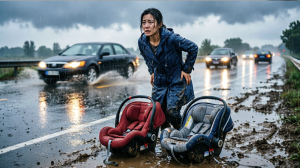
I remember the feeling of the rain on my face, the weight of those car seats in my arms, the absolute certainty that I might not survive. And then I look around at the life I’ve created, at the safety and warmth and love that fills every corner of this house. And I know I made it. I didn’t just survive that night. I won not because my family suffered consequences, though they did.
Not because I got financial compensation, though I did. I won because I refused to let their cruelty define me. I won because I chose to be better than them, to love more fiercely, to build instead of destroy. My children will never know what it’s like to be abandoned by people who should protect them.
They’ll never question whether they’re worthy of love. They’ll grow up knowing that family is something you create through choice and commitment, not something you’re stuck with through accidents of birth. And if my biological family is somewhere out there feeling regret, living with the knowledge of what they lost, that’s their burden to carry, not mine.
I have better things to do than waste my energy on people who threw me away. I have a life to live, children to raise, and a future to build. The storm passed long ago.
ENDING