My granddaughter called at 2 am: “Grandpa… I’m at the police station. My stepmother beat me… But she told them I attacked her. Dad believes her, not me!” When I walked in, the officer went pale and said, “Sir… I didn’t know who she was calling…”
Part 1
The worst phone calls always come after midnight.
I learned that over thirty-one years as a federal investigator, and I do not say it lightly. I have answered phones in cheap motel rooms, in government offices under fluorescent lights, in parking lots outside crime scenes, and once from the front seat of a Bureau sedan while rain hammered the windshield so hard my partner and I could barely hear dispatch. After midnight, phones do not ring for good news. They ring because something has gone wrong and the world has run out of polite hours to hide it.
But none of that experience prepared me for seeing my fourteen-year-old granddaughter’s name glowing on my screen at 2:47 a.m.
My name is Robert Callaway. I am sixty-three years old, retired now from the FBI’s Atlanta field office, where I spent most of my career working violent crimes and domestic abuse cases before convincing myself four years ago that I was done chasing truth through rooms full of lies. I moved into a quiet house in Marietta, Georgia, planted tomatoes that grew better when I stopped giving them advice, and told myself my remaining job in this life was simple.
Read books.
Drink coffee on the porch.
Attend every school play Emma Callaway performed in until she got too old to want me there.
For a while, I believed retirement had made me ordinary.
Then my phone rang.
“Grandpa?”
Emma’s voice was so small I nearly did not recognize it. She was whispering and crying at the same time, the words broken apart by fear, each breath catching like she was trying not to make too much noise even though she was no longer in the house where someone had taught her silence.
“Emma?” I sat up immediately, one hand reaching for the lamp. “Where are you?”
“At the police station,” she whispered. “Cobb County. Sandy Plains Road.”
The room around me sharpened.
“What happened?”
“She said I attacked her,” Emma said, and the words came out faster, panic overtaking caution. “Victoria said I attacked her with a kitchen knife. She has a cut on her arm, and the police brought me here, and Dad is coming, but he talked to her first, Grandpa. He sounded angry. Not scared for me. Angry.”
I was already out of bed.
My knees complained, my back stiffened, but none of it mattered. Old habits returned with frightening ease: locate shoes, wallet, keys, weapon safe, phone charger, jacket. Gather information while moving. Keep your voice calm because panic spreads fast in children and victims.
“Emma, listen to me,” I said. “Do not say another word to anyone until I get there.”
“But Grandpa—”
“Not another word,” I repeated, gentler this time. “Ask the officer at the desk if you can wait quietly. Tell him your grandfather is on the way.”
There was a small sound on the other end, a breath that almost became a sob.
“She locked me in my room,” Emma whispered. “For three days. She wouldn’t let me out. I was trying to get to the phone in the kitchen when she found me, and she grabbed the knife herself. Nobody believes me. Please come. Please.”
Something cold moved through me.
Not shock. Not even anger yet.
Recognition.
I had heard versions of that sentence too many times from frightened people sitting under bad lighting while someone with authority had already decided their fear was inconvenient.
“I’m coming,” I said. “I love you. Do not talk until I’m there.”
I told her everything would be all right, though I had no proof of that yet.
Sometimes adults lie to children because the truth is too heavy to hand over the phone.
The drive to the precinct took eleven minutes.
I know because I watched the clock the entire way.
Marietta was dark, the streets slick from a passing storm, the traffic lights blinking over empty intersections like tired sentries. I drove faster than I should have but slower than I wanted, because one thing my years in the Bureau taught me was that getting there did not help if you arrived useless. My mind ran through possibilities with the merciless speed of training.
Victoria Hartwell.
My son Daniel’s second wife.
She had been in our family for two years, officially for eighteen months, since she and Daniel married at a vineyard outside Dahlonega after the accident that took my daughter-in-law Karen. Karen had been a kindergarten teacher, the kind of woman who laughed at her own jokes and made sweet potato pie so good grown men lowered their voices while eating it. Losing her to a wrong-way driver on I-285 broke something in Daniel I never figured out how to reach.
He coped the way some men do.
Work first.
Then distraction.
Then a polished woman who knew how to walk into grief wearing silk and call herself stability.
Victoria was chief operations officer of a healthcare technology company in Midtown Atlanta. She spoke in a voice calibrated to sound warm and authoritative at the same time, the kind of voice boardrooms reward and teenagers mistrust. She wore expensive blouses, hosted charity luncheons, and had no children of her own, though Daniel kept telling me she was wonderful with Emma.
“Emma just needs time,” he said.
“Teenagers resist stepparents. It’s textbook.”
“Karen’s been gone nearly three years. She needs a stable female presence.”
I had watched Emma carefully through those two years.
That is what I did. I watched.
I noticed the way she sat differently when Victoria was at family dinners, shoulders tucked inward, hands in her lap, eyes lowered more than a girl her age should lower them. I noticed she answered questions with one-word responses if Victoria was within earshot. I noticed she stopped asking me to attend her school plays, even though when she was little she had once made me pinky-swear I would never miss one.
When I asked her directly, she looked at me in a way I knew too well.
Not afraid of me.
Afraid of what telling me might cause.
I should have pushed harder.
That thought sat in my chest like a stone the whole drive.
The Cobb County precinct on Sandy Plains Road looked harsher at night, all brick, glass, bright lights, and the low constant hum of official machinery. I walked in through the front doors with my jacket zipped halfway, my badge long retired but my posture apparently not, because the young officer at the front desk straightened before he meant to.
His nameplate read Garrett.
He could not have been more than twenty-six.
“I’m Robert Callaway,” I said. “I’m here for Emma Callaway.”
Something shifted behind his eyes.
It was small, but I caught it.
“I’ll notify Detective Prior,” he said.
“I asked to see my granddaughter.”
“Yes, sir. Detective Prior has taken a personal interest in the matter.”
He said it carefully.
Too carefully.
The kind of sentence someone has been told to deliver exactly as phrased.
I leaned forward slightly.
“Officer Garrett,” I said, lowering my voice, “you have a fourteen-year-old minor in this building at nearly three in the morning, claiming confinement and assault by a stepmother who has accused her of a knife attack. I am her grandfather. I am here now. I will see her.”
His throat moved.
“Yes, sir.”
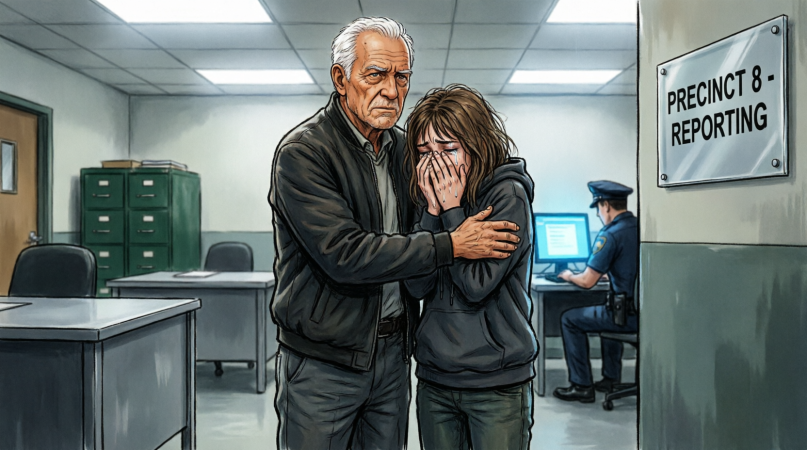
They had her in a small room off the main hallway, sitting in a plastic chair beneath fluorescent lighting so bright it made every bruise look honest. A paper cup of water sat untouched on the table in front of her. She wore an oversized sweatshirt, leggings, and sneakers without socks. Her hair was tangled, her face pale except where it was not.
When I came through the door, she crossed the room so fast the chair scraped behind her.
“Grandpa.”
She hit my chest and broke.
I wrapped my arms around her and held on, but my eyes had already started working.
Dark crescent under her left eye.
Swollen lower lip.
Faint yellowing along the cheekbone.
And around both wrists, half-hidden under her sleeves, marks that brought thirty-one years of field experience back into focus like a lens clicking.
Not rope burns exactly.
More like chafing from something softer, maybe cloth strips, maybe zip ties padded with fabric, worn and pulled against skin repeatedly over time.
Not one struggle.
Not one night.
Days.
I held her tighter, because for one second, the retired part of me vanished completely.
“Show me,” I said softly.
She pulled back, trembling, and pushed up both sleeves.
The marks circled her wrists.
My stomach went cold.
Part 2….
Emma told me everything between sobs.
Victoria had locked her in her room three days earlier after Emma tried to call her school counselor from her phone. Victoria took the phone, then brought meals twice a day and left them outside the door without speaking directly to her. On the third night, Emma waited until she heard the television downstairs, slipped out, and went for the landline in the kitchen.
Victoria found her while she was dialing.
There was an argument.
Victoria grabbed a knife from the cutting block, Emma grabbed her wrist to stop her, and they struggled. The knife fell. Then Victoria picked it up from the floor, pressed the blade against her own forearm, and called 911 before Emma could say one word.
I looked at my granddaughter’s wrists again.
Then her face.
The bruise under her eye had yellowing edges, meaning it was not fresh from that night. The lower lip swelling looked older too. The wrist marks were consistent with prolonged restraint, not a sudden domestic incident in a kitchen.
These were not the marks of a child who had attacked a grown woman.
These were the marks of a child who had been confined.
The door opened without a knock.
A heavyset man in a rumpled blazer stepped inside, carrying a notepad and the tired confidence of someone who had already decided the room was his.
“Detective Shawn Prior,” he said.
I did not offer my hand.
He explained that Victoria Hartwell had been transported to Wellstar Kennestone Hospital with a laceration requiring sutures. He explained that Emma’s fingerprints were on the knife handle. He explained that Daniel Callaway had been contacted and was en route after going directly to the hospital when Victoria called him.
Then he said that pending Daniel’s arrival, Emma remained in department custody as a minor involved in a domestic incident.
I let him finish.
Then I spoke quietly.
“The injuries on my granddaughter’s wrists and face are inconsistent with the events of a single evening.”
Prior looked at me.
“I understand you’re concerned, sir.”
“I spent thirty-one years with the Bureau working violent crimes and domestic abuse cases,” I said. “What I’m observing is consistent with prolonged confinement and repeated physical abuse.”
His expression tightened.
“Your assessment is noted, but it is not official. You are no longer a federal agent.”
“I’m aware,” I said. “And by eight this morning, I will be filing a formal complaint with the Cobb County District Attorney’s office regarding the failure to photograph and document this minor’s injuries upon intake, which is standard procedure under Georgia’s mandatory reporting requirements for suspected child abuse.”
The room changed.
Not dramatically.
Prior did not raise his voice. He did not flinch. But his eyes stayed on mine a beat too long, then dropped to his notepad, and I knew we understood each other.
For the next ninety minutes, I documented everything.
Every bruise. Every wrist mark. Every swelling. Every inconsistency in the preliminary intake report. I photographed with my phone systematically, the way I would have documented any crime scene, each image framed, dated, and backed up before anyone could decide the injuries were inconvenient.
Then I called Patricia Oay, a former colleague still working out of the Atlanta field office, and left a voicemail with enough detail that she would know exactly what I was asking without my saying too much on a recorded line.
Daniel arrived at five in the morning.
He had come from the hospital, and his eyes were red, but his jaw was set in the way it gets when he has already made a decision and doesn’t want to hear arguments against it.
SAY “OK” IF YOU WANT TO READ THE FULL STORY — sending you lots of love ❤️👇 👇
In 31 years working as a federal investigator, I learned that the worst phone calls always come after midnight. It doesn’t matter how many cases you’ve worked, how many doors you’ve knocked on at 3:00 in the morning, how many times you’ve delivered news that shattered someone’s world when your own phone rings at 2:47 a.m.
And the number belongs to your 14-year-old granddaughter. Something cold moves through you that no amount of experience can prepare you for. My name is Robert Callaway. I’m 63 years old. I spent the better part of my adult life as a special agent with the FBI’s Atlanta field office, working violent crimes and domestic abuse cases before retiring four years ago to a quiet house in Marietta, Georgia, where I planned to grow tomatoes, read books, and attend every single one of my granddaughter’s school plays.
I thought my days of chasing the truth through a maze of lies were finished. I was wrong about that. Emma’s voice on the phone that Tuesday night was barely recognizable. She was whispering and crying at the same time and the words came out broken and stumbling. She said she was at the Cobb County precinct on Sandy Plains Road.
She said the police had brought her in. She said her stepmother had a cut on her arm and was telling the officers that Emma had attacked her with a kitchen knife. She said her father was on his way, but that he’d already spoken to her stepmother on the phone, and he sounded angry, not worried. Then she said the thing that made me pull my shoes on before she finished the sentence.
Grandpa, nobody believes me. I’ve been locked in my room for 3 days. She wouldn’t let me out. I was trying to get to the phone in the kitchen when she found me, and she grabbed the knife off the counter herself. Grandpa, I’m so scared. Please come. Please. I told her not to say another word to anyone until I arrived. I told her to ask the officer at the desk to let her wait quietly and that her grandfather was on the way.
I told her I loved her and that everything was going to be all right, even though I had no idea yet whether that was true. The drive to the precinct took 11 minutes. I know because I watched the clock the entire way. Her stepmother was Victoria Hartwell. She had been in our lives for 2 years since my son Daniel married her in a small ceremony at a vineyard outside Delana 18 months after the accident that took my daughter-in-law Karen away from us.
Karen had been a kindergarten teacher who laughed at her own jokes and made the best sweet potato pie I’ve ever tasted and losing her the way we did a wrongway driver on. I285 on a Sunday afternoon broke something in Daniel that I watched him try to repair by throwing himself into his work as a commercial real estate developer and eventually into the arms of a woman he met at a charity gala in Buckhead.
Victoria was polished in the way that expensive things are polished. She was the chief operations officer of a healthcare technology company headquartered in Midtown. A woman who wore silk blouses on weekdays and spoke in a voice calibrated to communicate both warmth and authority simultaneously.
She had no children of her own. Daniel told me she was wonderful with Emma. He said Emma just needed time to adjust. He said all teenagers resist stepparents at first, that it was textbook, that Karen had been gone for nearly 3 years and Emma needed a stable female presence in her life. I had watched Emma carefully over those two years.
I had noticed the way she held herself differently at family dinners. The way she answered questions with one-word responses when Victoria was in the room. The way she’d stopped asking me to come to her school plays, even though she’d once made me promise to attend every single one. When I asked her about it directly, she looked at me the way children look when they’ve been told to keep quiet about something.
Not afraid of me, but afraid of what telling me might cause. I should have pushed harder. That knowledge sat in my chest like a stone the entire drive to the precinct. The officer at the front desk was a young man named Garrett, who couldn’t have been more than 26. When I gave my name and told him I was there for Emma Callaway, something shifted behind his eyes.
He told me the lead detective on the case, a man named Shawn Prior, had taken a personal interest in the matter. He said it with the careful neutrality of someone relaying information they’ve been told to relay in exactly that way. I asked to see my granddaughter immediately. They had her in a small room off the main hallway, sitting in a plastic chair under fluorescent lighting with a paper cup of water she hadn’t touched.
When I came through the door, she was across the room and in my arms before I had fully registered the bruising on her face, a dark crescent under her left eye, a swollen lower lip, and something worse, something that made my 31 years of field experience, snap back into focus like a lens clicking into place.
Around both of her wrists, half hidden by the sleeves of her sweatshirt, were the unmistakable marks of restraint. Not rope burns. Exactly. More like the kind of chafing you see when something soft, a zip tie, a cloth strip has been worn and pulled against skin repeatedly over a period of days.
She told me everything between sobs. Victoria had locked her in her room 3 days before after Emma had tried to call her school counselor from her phone. Victoria had taken the phone. She had brought meals to the door twice a day and left them outside without speaking to Emma directly. On the third night, Emma had waited until she heard the television on downstairs and slipped out to use the landline in the kitchen.
Victoria had come in while Emma was dialing. There was an argument. Victoria grabbed the knife from the cutting block on the counter. Emma grabbed her wrist to stop her. They struggled. The knife fell. Victoria reached for it on the floor and pressed the blade against her own forearm, then called 911 before Emma could say a word.
I examined the marks on Emma’s wrists the way I had examined evidence for three decades. The pattern was consistent with prolonged restraint over multiple days, not a single incident. The bruising on her face had the yellowing edges that indicate injury sustained at least 48 hours earlier. Not that night.
These were not the marks of someone who had attacked another person with a kitchen knife. These were the marks of someone who had been confined. The door opened. A heavy set man in a rumpled blazer came in without knocking. He introduced himself as Detective Prior and looked at me the way people look at someone they’ve been warned about but are not yet certain how to handle.
He told me that Victoria Hartwell had been transported to Wellstar Kennstone Hospital with a laceration requiring sutures. He told me that Emma’s fingerprints were on the knife handle. He told me that Daniel Callaway had been contacted and was in route from the hospital where he’d gone directly upon receiving Victoria’s call and that pending Daniel’s arrival, Emma was in the custody of the department as a minor involved in a domestic incident.
I told him quietly that the injuries I was looking at on my granddaughter’s wrists and face were inconsistent with the events of a single evening. I told him I had spent 31 years with the bureau working violent crimes and domestic abuse cases and that what I was observing was consistent with prolonged confinement and repeated physical abuse.
He told me that my assessment, while noted, was not official and that I was no longer a federal agent. I told him that I was aware of that and that by 8:00 that morning, I would be filing a formal complaint with the Cobb County DA’s office regarding the failure to photograph and document the minor’s injuries upon intake, which was standard procedure under Georgia’s mandatory reporting statutes for suspected child abuse.
Something shifted in the room, not dramatically. Prior didn’t flinch or raise his voice, but he looked at me for a long moment and then looked at his notepad, and I knew we understood each other. I spent the next 90 minutes photographing every inch of Emma’s injuries with my phone, documenting them systematically, the way I would have documented any crime scene and writing detailed notes on the preliminary intake report, which contained three factual inconsistencies I intended to address in the morning.
I also called my former colleague at the bureau, an agent named Patricia Oay, who now worked out of the Atlanta field office, and left her a voicemail explaining the situation in enough detail that she would understand what I was asking when she called back. Daniel arrived at 5:00 in the morning. He had come from the hospital and his eyes were red, but his jaw was set in the way it gets when he has already made a decision and doesn’t want to hear arguments against it.
He looked at Emma sitting next to me and his first words were not her name or a question about whether she was all right. He said, “Emma, how could you do this?” She looked at him the way children look when the person they trusted most in the world has just confirmed their worst fear. She didn’t raise her voice. She simply said, “Dad, please.
You didn’t see what happened.” Daniel said Victoria had spent 2 years trying to make a home for her. He said Victoria had paid for her piano lessons and driven her to soccer practice and tried to build a relationship with her and Emma had repaid all of that with hostility and resentment and eventually with violence. I said, “Daniel, look at her wrists.
” He said the doctors at the hospital thought Emma might have inflicted the marks herself, that Emma had always had a difficult relationship with authority, that Emma had never truly accepted the fact that Karen was gone. I had never in 31 years of my career felt the particular species of helplessness I felt in that room at 5 in the morning watching my son look at his daughter’s bruised face and choose not to see it.
It wasn’t that he was a bad man. Daniel is not a bad man, but grief does things to people. Guilt does things to people. And Victoria Hartwell, I was beginning to understand, had been doing things to both of them for 2 years. Detective Prior returned with paperwork. He said that given the circumstances and given that Victoria had chosen not to press formal charges at this time, Emma would be released to her parents’ custody with the understanding that she remain available for further questioning.
I said Emma would be coming home with me. Daniel said I didn’t have the legal right to make that determination. I said that as a Georgia resident over the age of 18 with a documented relationship to a minor who showed signs of ongoing physical abuse, I absolutely had the standing to request an emergency temporary protective order and that I intended to contact the juvenile court the moment it opened.
I said that the alternative was for Daniel to allow Emma to spend the next several days in my home while everyone calmed down and that if he was confident the truth was on his side, he had nothing to worry about. We stood there for a long moment. I could see him recalculating. Victoria wasn’t there to guide his responses.
And underneath the anger, there was something else. A flicker of something he didn’t want to look at directly. He agreed. Emma would stay with me for a few days. in the car. She fell asleep before we reached the highway. I drove in silence and let myself think. I knew Victoria’s type. I had spent 31 years learning to recognize it.
The public image was always immaculate, accomplished, generous, devoted. Behind closed doors, the control was absolute. The manipulation was patient and methodical. And the most dangerous thing about people like Victoria Hartwell was not their cruelty. It was their intelligence. The first thing I did the next morning after Emma had slept 8 hours and eaten a real breakfast was call my former colleague Marcus Webb, who had retired from the bureau 5 years before me and now ran a private investigations firm in Buckhead. I told
him I needed everything he could find on Victoria Hartwell’s background with particular attention to any prior marriages or relationships involving children. While Marcus worked, I drove to Emma’s school, Lacer High School in Marietta, and asked to speak with her guidance counselor, a woman named Deborah Finch.
Miss Finch was careful and measured in the way that school administrators learn to be when they sense legal exposure. But as I walked her through what I had observed, she became less guarded. She told me that Emma’s academic performance had declined significantly over the past 18 months, that she had withdrawn from her friend group, that on two occasions, teachers had reported what they described as unusual bruising, which had been addressed in meetings with the family, at which Victoria had been present and had offered explanations that Miss Finch
acknowledged quietly. She had accepted without pushing further. I asked her if Emma had ever attempted to reach out through any official school channel. Miss Finch paused. She said Emma had sent an email to the school counseling department 3 weeks earlier asking about confidentiality rules around reporting suspected abuse.
The email had been flagged and reviewed. A follow-up meeting had been scheduled. Before the meeting could occur, Victoria had appeared in the front office and personally requested that the guidance counselor respect the family’s privacy during what she described as a difficult adjustment period for their daughter. That was the week before Emma was locked in her room.
Marcus called me back on the second day. His voice had the particular flatness it gets when he’s found something that genuinely disturbs him. Victoria Hartwell had been married once before to a man named Gregory Doss, a software engineer from Alpharetta. The marriage had lasted 3 years. Gregory had a son named Tyler from a previous relationship, a boy who had been 7 years old when Gregory and Victoria married and 10 years old when the divorce was finalized.
The custody arrangement from the divorce awarded Tyler exclusively to his father. The records from the proceeding were sealed. What Marcus could access were court adjacent documents, a guardian ad lightum report that had been referenced in a subsequent family court filing which noted that Tyler Doss had displayed significant behavioral changes consistent with a stressful home environment during the period of his father’s second marriage and that the child had made statements to a school counselor regarding treatment at home that were deemed
credible by the courtappointed evaluator. Tyler was now 16 years old and living in Alpharetta with his father. I took the Alpharetta exit the next morning. Gregory Doss answered the door in workclo, clearly about to leave for the day. When I explained who I was and why I was there, he stood very still for a moment and then stepped back and let me inside. He didn’t make coffee.
He sat across from me at the kitchen table and folded his hands and looked at the surface between us. He said he had tried to warn Daniel. When he heard about the engagement through a mutual professional contact about 2 years prior, he had found Daniel’s office number and called. Daniel had not returned the call.
When he called a second time, he reached Daniel directly, and Daniel had told him politely but firmly that whatever issues he had with his ex-wife were his own business and had nothing to do with his family. He said what had happened to Tyler had taken 4 years of therapy to begin to address. He said the pattern Victoria used was consistent and deliberate.
A long period of affection and apparent warmth while the child’s parent was present, followed by escalating control, isolation, and punishment when the parent was away or distracted. He said, “The brilliant and terrifying thing about Victoria was that she never lost her composure in public. She was always the most reasonable person in the room.” he said.
She nearly destroyed my son. And the worst part was that I didn’t see it until he started waking up screaming at night. I thought he was just having trouble accepting the divorce. I thought he was acting out. I was wrong about that for almost 2 years and my son paid for it. I asked if he had documentation from the custody proceedings.
He went to a filing cabinet in his home office and came back with a folder that he set on the table between us. He said he had kept everything. He said he always knew the way you know certain things that one day someone would come to his door asking exactly these questions. On the drive back to Marietta, I called Patricia Oay and told her what I had.
She listened without interrupting, which is how I know Patricia is taking something seriously. She said, “Robert, you’re not an active agent. I can’t authorize an investigation based on what you’re bringing me.” I said I understood that. I said what I needed was for her to listen and to tell me whether what I was describing rose to the level of federal interest given Victoria’s position at a company that processed healthcare data across state lines and whether certain digital forensic tools that I no longer had access to might be relevant to a
separate inquiry she might see fit to open on her own initiative. Patricia was quiet for a long moment. Then she said, “Tell me again about the 3 days Emma was confined.” Victoria moved fast. She always moved fast when she sensed pressure. 4 days after the incident, I received a call from the Cobb County DA’s assistant, a man named Brian Hollis, who told me that Victoria Hartwell had formally filed charges against Emma for aggravated assault with a deadly weapon.
He said there was digital evidence, text messages sent from Emma’s phone in the weeks prior that contained threatening language directed at Victoria. He said there were two witnesses who could attest that Emma had made statements about wanting her stepmother gone. I went to Emma immediately. She looked at me with a kind of exhausted clarity that I recognized from victims who have been disbelieved so many times they’ve stopped being surprised by it.
She said she hadn’t sent any threatening messages. She said she hadn’t spoken to anyone outside the house about Victoria in weeks because Victoria monitored everything, her phone, her laptop, her communications with friends. That last sentence landed on me like a key turning in a lock. I called a digital forensic specialist I had worked with during my last 3 years at the bureau, a woman named Sandra Quan, who now consulted privately. I explained the situation.
She came to my house the next afternoon and spent 4 hours with Emma’s phone. What she found was not what I had expected. It was worse and it was better. The threatening messages had in fact been sent from Emma’s phone, but the metadata attached to them told a different story. The messages had been composed and transmitted using a remote access protocol, a sophisticated piece of software used primarily in corporate security environments that had been installed on Emma’s phone without her knowledge. The software allowed a
separate device to access Emma’s phone remotely, read her messages, and send new ones while the phone was sitting untouched on Emma’s nightstand. Sandra said, “This is enterprise level software. This isn’t something someone downloads from an app store. This is the kind of tool that a technology operations executive would have access to through her company’s security department.
I asked if she could prove it in court. She said, “Absolutely. The fingerprints on this are specific to a particular software vendor that I can identify and the authentication logs will show what device was used to initiate the remote sessions. If we can subpoena those logs, you have her. But to subpoena anything, we needed a prosecutor willing to go to a judge.
And Detective Prior had made it clear in the careful way that people communicate these things without ever saying them directly that the Cobb County Department’s interest was in closing this case, not opening it wider. I had known the Fulton County District Attorney casually for years through professional channels.
I called her directly. Margaret Chen was 61 years old, had been a prosecutor for 27 years, and had exactly zero tolerance for what she referred to as institutional cowardice. I told her everything. I gave her Marcus Webb’s findings on Gregory Doss, Sandra Quan’s analysis of the remote access software, the photographs of Emma’s injuries, the documentation from Tyler Doss’s custody file, and the timeline of Victoria’s escalating behavior leading up to the incident.
Margaret listened without speaking until I was finished. Then she said, “Robert, what you’re describing is a pattern of criminal child abuse spanning at least two children over a period of 6 or 7 years. That’s not a domestic dispute. That’s a predator with a system.” She said the jurisdictional lines were complicated given that the incident had occurred in Cobb County, but that she had a mechanism available to her if we could produce sufficient cause.
She said she needed 48 hours. She also said something else that I filed away carefully. She said that Detective Prior’s unusual level of personal involvement in the case had not gone unnoticed in certain circles. She said she had heard his name adjacent to Victoria Hartwells before in the context of a charitable foundation that Victoria’s company sponsored and that had a fundraising gala the previous spring at which Prior had been notably present.
I spent those 48 hours putting the file together with the precision I had learned in three decades of federal work. every photograph, every timeline, Sandra’s technical report, Gregory Doss’s documentation, the school counselor’s communications, the guardian ad lightums observations from the custody case, the specific language of George’s mandatory reporting statutes, and the specific ways in which standard intake procedure had not been followed when Emma arrived at the precinct.
On the second morning, I drove to Gregory’s house again. I needed him to be willing to testify. He was quiet for a long time after I asked. Tyler was in school. The house was still. Gregory looked out the window at the yard where I imagined his son had played at some point before the years with Victoria had taken something from him.
That therapy was still slowly giving back. He said, “I’ve spent 6 years trying to move past this, trying to let Tyler move past it.” I said I understood that. I said I wasn’t going to pretend this would be simple or painless. I said that somewhere right now there was a 14-year-old girl sleeping in my guest room who had been locked in a room for 3 days and whose father still wasn’t sure whether to believe her and that the woman who had done it to Emma had done the same thing to Tyler and that without Gregory’s documentation and his
willingness to speak Victoria Hartwell was going to walk back into that house and Daniel was going to let her. He said, “Does her dad know? Does Emma’s dad know about Tyler?” I said, “Not yet.” I said I was working on that, too. He said, “Tell him about Tyler before anything else. A father needs to hear it from another father.
” I went to Daniel’s office the next afternoon. I called ahead and told him it was important and that I needed an hour. He looked tired when I arrived, tired and angry in the particular way of someone who doesn’t know where to put his anger because he can feel it shifting towards something he doesn’t want it to point at.
I didn’t argue with him. I put the folder on his desk and I walked him through it piece by piece. Gregory Doss, Tyler, the pattern that the custody evaluator had documented, the remote access software on Emma’s phone, Sandra’s report, the photographs of Emma’s wrists with timestamps proving the injury was days old.
He didn’t speak for a very long time. When he finally looked up from the folder, his face had changed in a way I hadn’t seen since the week after Karen died. There are certain moments when a person understands that the architecture of a belief they’ve been living inside has been built on false foundations and they have to stand very still while it comes down.
That was what I watched happen to my son in that office. He said she called me from the hospital the night it happened. Before I even spoke to Emma, she called me. She was crying. She said Emma had finally gone too far. She said she’d been trying to protect me from how bad it had gotten. She said Emma needed professional help. He stopped.
I believed her over my own daughter. I said, “She’s very good at what she does. She had me fooled for 6 months.” He said, “Dad, I left Emma in that house.” I said, “Then let’s make sure you don’t leave her there again.” Margaret Chen filed an emergency petition with the Superior Court of Fulton County the following morning, citing the crossjurisdictional nature of the digital evidence and invoking a specific provision of Georgia’s child protection statutes.
The judge granted a warrant for the seizure of digital devices belonging to Victoria Hartwell, including the enterprise security software server associated with her company account, which stored access logs for all remote sessions initiated from her credentials. Victoria was in a meeting at her office in Midtown when agents from the GBI, Georgia Bureau of Investigation, arrived with the warrant.
The seizure was coordinated quietly and efficiently, which is how these things need to be done when the subject is intelligent and knows how systems work. The data recovered from the server was extensive. There were the authentication logs Sandra had predicted. Time-stamped records of 18 separate remote access sessions initiated from Victoria’s work laptop to Emma’s phone, composing and sending messages over a period of 6 weeks.
There were the home security system records. Victoria had installed a comprehensive camera system throughout the house, ostensibly for security purposes, and the footage was backed up to a private cloud account registered to her company’s server. The warrant covered those records, too. The footage was the thing that changed everything.
It ran to hundreds of hours over 24 months. The agents and the GBI digital forensics team spent 3 days reviewing it and extracted a documented record of what had been happening inside that house. Emma being systematically excluded from meals. Emma being spoken to in ways that never rose to screaming Victoria was too careful for screaming, but that constituted a sustained and methodical verbal dismantling.
Emma being locked in her room and having her food slid under the door on a tray. And then the night of the incident, captured from two different angles by cameras that Victoria had apparently forgotten, were pointed at the kitchen. Victoria retrieving the knife from the block herself.
the struggle, the knife on the floor, and then the sequence that made Margaret Chen’s assistant, a 29-year-old attorney who had seen a great deal of difficult material in her career, leave the room for several minutes before she could continue working. Victoria Hartwell, picking the knife up off the kitchen floor, looking directly into the camera she believed was her own private documentation system, and pressing it deliberately and carefully to the inside of her forearm.
She was arrested on a Thursday morning, 3 weeks after Emma had called me from the precinct at 2:47 a.m. The charges included aggravated battery of a minor, false imprisonment, cruelty to children in the first degree, and fabrication of evidence. When the investigation into Detective Prior was completed two months later, he was charged with two counts of obstruction and one count of official misconduct.
He had not physically abused anyone, but he had shephered Emma’s intake at the precinct in a way designed to protect Victoria’s version of events, had failed to document the child’s injuries, and had attempted to delay the DA’s investigation by withholding a routine intake report for 11 days. He lost his job and his pension and pleaded to a lesser charge that carried no jail time, which Margaret Chen considered insufficient, but accepted as the realistic outcome of the available evidence. The trial took place 8 months
later in Fulton County Superior Court. The evidence was, as Margaret had predicted, comprehensive. the security footage, the remote access logs, Gregory Doss’s testimony delivered in a quiet and measured voice that carried across the courtroom in a way that made certain members of the jury visibly uncomfortable.
Tyler’s therapist, who had treated him for 4 years and could speak to the documented psychological impact without identifying Tyler by name. Sandra Quan’s technical analysis. The medical examiner’s confirmation that Emma’s injuries were consistent with prolonged restraint and repeated blunt force trauma over a period of days.
Emma testified she was 15 by then and she wore her dark hair down and she sat in the witness chair and she told the truth clearly and without hesitation. I sat in the front row and watched her, and I thought about Karen, who had been Emma’s age once, and about all the things she would have wanted to say to the daughter she’d raised.
When Emma described the night Victoria locked her room the first time, the sound of the key in the lock, the specific quality of the silence that followed, there was no sound in the courtroom at all. Victoria Hartwell was convicted on all counts. The judge sentenced her to 14 years in a Georgia state correctional facility.
Given that the conviction involved a pattern of abuse against multiple children over an extended period, the prosecutor had argued successfully for an enhanced sentence under George’s recidivist provisions. 14 years was not the maximum possible, but it was real and it was enough. After the verdict, Daniel stood in the hallway outside the courtroom with Emma beside him, her hand in his, and he didn’t say anything for a long time.
I stood a few feet away and gave them the space. Eventually, he looked at me and said, “I don’t know how to fix what I did.” I said, “You start by showing up. Every day without conditions, you show up.” Emma looked at her father and then she leaned her head against his shoulder and he put his arm around her and the three of us stood there in that courthouse hallway.
and I thought about all the ways truth arrives too late and all the reasons it still matters that it arrives. 3 months after the trial, Margaret Chen called me with a proposal. She wanted to develop a formal protocol for the Fulton County DA’s office and ideally for departments across the state governing the intake and documentation procedures for minors brought in on domestic incident charges.
where signs of abuse were present. The protocol would mandate immediate medical forensic examination, would prohibit officers with personal connections to any party from handling intake, and would establish a dedicated digital forensics rapid response unit specifically for cases involving juvenile victims where evidence of digital manipulation was suspected.
She said she wanted to call it the Callaway Protocol. I told her I’d prefer she name it after Emma. The Emma Callaway protocol was adopted by the Fulton County DA’s office in the spring and has since been formalized as a recommended procedure across 11 Georgia counties. A version of the digital forensics component has been referenced in pending federal legislation regarding the admissibility of remotely manipulated digital evidence in juvenile proceedings.
I testified before a state legislative committee on a Tuesday morning in March. And sitting in the gallery behind me were Emma, Daniel, Gregory Doss, and Tyler, who was 17 by then and had driven down from Alpharetta with his father to be there. Tyler and Emma met for the first time in that gallery. They didn’t speak much. But when the hearing ended and we were all walking out together, Tyler said to Emma very quietly, “I believed for a long time that it was my fault, that I had done something to deserve it.
” Emma said, “I believed that, too.” He said, “When did you stop believing it?” She thought about it. She said, “When my grandfather showed up, I am not a sentimental man. My wife would tell you that and she would mean it as a criticism delivered with affection. But I stood in that granite floored state house hallway and I felt something that I did not have a professional word for after 31 years of professional vocabulary.
I felt that the particular 2:47 a.m. phone call that had pulled me out of bed and driven me through dark streets toward a precinct building had been in some sense that I couldn’t fully articulate. the thing I had spent my entire career getting ready for. Not the case, not the conviction, the call itself, the fact that there was someone who would pick up.
Emma is 15 now, almost 16. She’s back in school full-time. She joined the theater program, which she had quit 2 years earlier when Victoria started scheduling family activities over every performance date. She had a lead role in the fall production of a one-act play. And Daniel and I sat in the second row of the school auditorium on a Thursday evening in October and watched her.
And at one point, Daniel reached over and gripped my arm without saying anything. The way men of a certain generation communicate the things they can’t put into words. After the show, Emma found us in the lobby. She was still in her stage makeup and she had a bouquet of flowers that a friend had given her and she grabbed me first and then her father and the three of us stood there in the bright lobby noise of a high school theater space with other families moving around us.
And I thought about 31 years of work and what it adds up to. It doesn’t always add up to what you expect. Some of the cases I worked had clean outcomes and left me feeling nothing. Some of them still wake me up. The math of a career in this kind of work is not linear and it doesn’t always comfort you in the ways you think it will.
But there are moments, not many, but some, when the truth lands exactly where it needs to land and protects exactly who it needs to protect, and you can stand in a lobby with flowers and stage makeup, and the particular joy of a teenager who performed well, and know that on a Tuesday morning, 3 weeks before Christmas, that particular child is safe, and that some portion of what made that possible was a decision you made at 2:47 in the morning to pick up the own.
Daniel cooks dinner every Sunday night. Now he calls it a new tradition, which is the word people use when they mean they are trying to build something over a wound. He makes Karen’s sweet potato casserole, which he learned from her recipe cards imperfectly at first and then slowly with more confidence.
Emma sits at the kitchen counter and talks to him while he cooks, which is something she had stopped doing for 2 years without either of them fully acknowledging the absence. I come most Sundays. I sit in the living room and listen to the sounds of that kitchen, the clattering of pots, the conversation drifting out through the doorway, the particular quality of ordinary noise that means a family is healing.
And I think that this is what all of it was for. Not the protocol, not the 14-year sentence, not the legislative testimony or the commenation from the DA’s office or the letter I received from Gregory Doss that I keep in my desk drawer. The sound of that kitchen on a Sunday evening, Emma laughing at something her father said.
A family broken and repaired and imperfect and present. That is what the truth when you are willing to chase it all the way to its end can sometimes give you