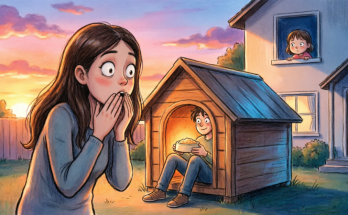
A deaf farmer marries an obese girl as part of a bet; what she pulled out of his ear left everyone stunned. The morning Clara Vance became a bride, snow fell over the Montana mountains with a somber patience, as if the sky itself knew that this was not a day of celebration, but one of resignation. Twenty-three-year-old Clara looked into the cracked mirror of the adobe farmhouse and, with trembling hands, smoothed her mother’s wedding dress. The yellowed lace smelled of camphor, of years kept away, and of broken promises. She wasn’t shaking from the cold. She was shaking from shame. Her father, Julian Vance, knocked on the door.— “It’s time, sweetheart.” Clara closed her eyes for a second.
— “I’m ready,” she lied.
Clara called it by its real name.
A sale.The man she was to marry was named Elias Barragan. He was thirty-eight years old, lived alone on an isolated ranch among pines and ravines, and in the town of Saint Jude, everyone said the same thing about him: that he owned good land and spoke to no one. Some called him surly. Others, crazy. Most simply called him “the deaf man.”Clara had only seen him twice. The first time, months ago, when he walked into the general store for salt, nails, and coffee. Tall, broad-shouldered, silent as a shadow. The second, a week before the wedding, when her father brought him to the house. Elias had stood in the living room, snow melting on his boots, and did not say a single word. He pulled a notebook from his pocket, wrote something with a short pencil, and handed it to Julian.
“Agreed. Saturday.”Nothing more.
No courtship. No questions. Not a single sign of excitement.The ceremony lasted less than ten minutes. The minister pronounced the words like someone fulfilling an uncomfortable obligation. Clara repeated the vows with a voice that didn’t feel like her own. Elias simply nodded when necessary. When the moment came for the kiss, he barely brushed her cheek with his lips and stepped away immediately.He didn’t seem happy.
He didn’t seem cruel, either.
That, strangely enough, left Clara even more unsettled.
The trip to the ranch took almost two hours. He drove the wagon in silence. Beside him, she kept her hands clasped in her lap and watched the white landscape stretch as far as the eye could see. Upon arriving, she found a solid wooden house, a corral, a barn, a well, and beyond that, forest and mountain. No neighbors. No nearby lights. Only wind, snow, and an immense silence.Elias helped her down and led her inside. The house was austere but clean. A table, two chairs, a lit fireplace, a small kitchen, and a bedroom at the back. He pulled out the notebook again and wrote:
“The bedroom is yours. I will sleep here.”
Clara looked at him, surprised.
— “That isn’t necessary.”
He wrote again.
“It’s already decided.”
That night, while unpacking her small suitcase in the room, Clara cried for the first time since it all began. She made no sound. She just let the tears fall onto her mother’s old dress, as if each one were burying a piece of the life she was never going to have.
The first days were cold in every sense. Elias woke before dawn, went out to tend the cattle, fix fences, or chop wood, and returned with his clothes smelling of smoke and wind. Clara cooked, swept, sewed, and washed in silence. They communicated through the notebook.
“Storm coming.”
“Need to check the well.”
“The flour is in the top drawer.”
Nothing more.
However, on the eighth day, something changed.
Clara woke in the middle of the night to a harsh, muffled sound, like the groan of a man trying to be quiet. She left the room and found Elias on the floor by the fireplace, his hand pressed against one side of his head. His face was contorted in pain, his skin damp with sweat, and his body tense like a string about to snap.
Clara knelt beside him.
— “What’s wrong?”
He couldn’t hear her, of course. But he saw her mouth move and, with a trembling hand, reached for the notebook. He wrote just two crooked words.
“Happens often.”
Clara didn’t believe him. No one who “happens often” ends up like that, writhing on the floor.
She brought him a damp cloth, helped him lie back, and stayed by him until the spasm subsided. Before falling asleep, Elias wrote a single sentence.
“Thank you.”
From then on, Clara began to observe. She saw how, some mornings, he would involuntarily move his hand to the right side of his head. She saw bloodstains on the pillow. She saw the way he held back the pain, as if he had made it part of his routine. One night, she asked him in writing how long he had been this way.
Elias answered:
“Since I was a child. The doctors said it was related to my deafness. That there was no cure.”
Clara wrote back:
“Did you believe them?”
He took a while to answer.
“No.”
Three nights later, Elias fell from his chair in the middle of dinner. The thud echoed sharply off the floor. Clara rushed to him. He was convulsing in pain, clutching his head. She brought a lamp close to his face, carefully pulled back his hair, and looked inside the inflamed ear. What she saw turned her blood to ice.
There was something in there.
Something dark.
Something alive.
It moved.
Clara recoiled for a moment, her heart about to burst, and then took a breath like someone leaping into a void. She prepared hot water, fine sewing tweezers, and alcohol. Elias, pale and sweaty, looked at her with distrust and fear. She wrote with a steady hand:
“There is something inside your ear. Let me take it out.”
He shook his head violently. He snatched the notebook and wrote:
“It’s dangerous.”
Clara took the pencil and replied:
“It’s more dangerous to leave it there. Do you trust me?”
Elias held her gaze for a few eternal seconds. Then, very slowly, he nodded.
Clara worked with her pulse shaking, but with determination set in her chest. She introduced the tweezers little by little, while he gripped the edge of the table until his knuckles turned white. She felt resistance. Then a tug. And suddenly, something came out writhing between the metal.
Everyone laughed when my mother-in-law tried to put a cat collar on my newborn and blurted out: “She’s the stray kitten my son brought home,” but I recorded everything… and that video changed our lives forever.
The gathering was at my husband’s family home in the Hamptons, one of those mansions where everything smells of expensive flowers, wood wax, and old money. They had decorated the living room with hydrangea arrangements, cream-colored ribbons, and a dessert table so perfect it looked like it belonged in a magazine. The aunts of my husband, Alexander, walked around with glasses of sparkling wine, commenting on dresses, doctors, travels, and last names. I stood by the large window, holding my newborn daughter, Lucy, trying to ignore the knot in my stomach that always appeared when I was around them.
I didn’t come from that world. I am a pediatric nurse, the daughter of a teacher and a retired accountant from a quiet suburb in Pennsylvania. I married Alexander for love, not for a name or an inheritance. But from day one, my mother-in-law, Victoria Sterling, made it clear that in her opinion, I was a “pretty mistake” that her son would eventually have to correct.
She never insulted me to my face. Her style was more refined. More polished. More cruel.
“Madison, you’re so brave for mixing into such a different environment,” she told me once, smiling in front of everyone.
Or that other time, when she found out about my pregnancy:
“How quickly some women move to secure their place.”
That Sunday, however, she no longer wanted to disguise anything.
She approached me with a small box in her hand and spoke in that sweet voice she used when she wanted to humiliate someone without getting her hands dirty.
“I brought a special little gift for the baby.”
Several people turned around. I smiled out of politeness and opened the box.
Inside was the collar.
I felt my body go cold.
Before I could react, Victoria let out a loud laugh and held it up in front of everyone.
“Well, if this little baby is the stray kitten my son picked up, we’ll have to put something decent around her neck, won’t we?”
The room erupted in laughter.
Not a nervous laugh. Not an uncomfortable laugh.
They truly laughed.
I saw two cousins cover their mouths to keep from bursting out. I heard an aunt say: “Oh, Victoria, what a wit.” My face was burning. I hugged Lucy tighter as she began to shift uncomfortably in my arms.
“Please, don’t,” I said in a low voice, taking a step back.
But Victoria moved closer, amused, as if the moment belonged to her.
“Don’t get dramatic, Madison. It’s a joke.”
And with a perfectly manicured hand, she tried to fasten the collar onto my daughter.
Lucy broke into tears.
My daughter crying. My mother-in-law laughing. The entire family watching the spectacle as if it were after-dinner entertainment.
And right then, in that instant, I understood something that changed me forever:
If I didn’t defend my daughter, no one else was going to do it.
I pulled out my phone with a trembling hand. I pretended to check a message. I activated the camera. And I recorded.
I recorded Victoria’s laughter.
I recorded the collar.
I recorded her hand reaching for my baby’s neck.
I recorded the laughter of those who didn’t lift a finger.
Then I put the phone away, picked up my bag, and walked out of the room with Lucy pressed to my chest, while my mother-in-law was still saying behind my back:
“Oh, look at that! Sensitive on top of everything else.”
I didn’t look back.
Because I already knew something that no one in that house suspected.
They hadn’t just humiliated me.
They had just handed me the proof that was going to tear this family apart.
I couldn’t believe what was about to happen…
My hands were still shaking as I strapped Lucy into her car seat.
She had finally stopped crying, but her tiny breaths still trembled, like her body remembered what had just happened… even if she didn’t understand it.
I got into the car, closed the door, and for the first time—
I let myself break.
Tears streamed down my face, silent, uncontrollable.
Not just from humiliation.
From rage.
From the terrifying realization that the people who were supposed to be her family… had just treated my daughter like a joke.
I looked at my phone.
The video was still there.
Every second of it.
Victoria’s voice.
The laughter.
The collar.
My baby crying.
I stared at the screen for a long time.
Then I did the only thing that felt right.
I sent it.
Not to social media.
Not yet.
I sent it to Alexander.
Three minutes passed.
Then my phone rang.
— “Madison…” His voice was tight. Too tight. “Tell me this isn’t real.”
I closed my eyes.
— “It is.”
Silence.
Then—
— “Stay where you are. I’m coming.”
He arrived in less than twenty minutes.
He didn’t say a word when he saw my face.
He just got into the driver’s seat… and drove back to the house.
My stomach dropped.
— “Alexander… what are you doing?”
— “Ending this.”
His voice was cold.
Colder than I had ever heard before.
When we walked back into that living room, the party hadn’t stopped.
Laughter. Glasses clinking. Conversations flowing like nothing had happened.
Victoria was in the center of it all.
Perfect. Composed. Untouchable.
Until Alexander spoke.
— “Turn it off.”
The room fell silent.
Every head turned.
Victoria smiled, confused.
— “Darling, what’s wrong?”
Alexander didn’t answer.
He walked to the center of the room, pulled out his phone…
And played the video.
At full volume.
No one laughed this time.
No one moved.
The sound of Lucy crying filled the room like a crack in glass.
Victoria’s smile froze.
— “Alexander, this is being taken out of—”
— “Out of context?” he cut her off, his voice sharp. “You tried to put a collar on my daughter.”
The word daughter hit the room like a slap.
An aunt looked away.
One of the cousins lowered her glass.
No one defended her.
For the first time…
Victoria looked uncertain.
— “It was a joke—”
— “She was crying,” Alexander said. “And you were laughing.”
Silence.
Heavy. Crushing.
Then he turned, looking at everyone in that room.
— “And all of you…” he added quietly, “you thought it was funny.”
No one spoke.
Because there was nothing to say.
That should have been the end.
But it wasn’t.
Because I still had the video.
And this time…
I posted it.
I didn’t expect what happened next.
Within hours, it spread.
Comments poured in.
Thousands… then hundreds of thousands.
People weren’t laughing.
They were furious.
Outraged.
Strangers defended my daughter more fiercely than her own family ever had.
And Victoria Sterling—
The woman who built her life on reputation, image, and control—
Started to fall.
Invitations disappeared.
Partnerships quietly ended.
Friends stopped calling.
Because no amount of elegance could erase what people had seen with their own eyes.
A week later, she came to our door.
For the first time…
She didn’t look untouchable.
— “Madison,” she said, her voice softer than I had ever heard it. “I think we need to talk.”
I held Lucy a little closer.
Then I looked at her—
Not as someone I feared.
Not as someone I needed to impress.
Just as a woman who had crossed a line she could never uncross.
— “No,” I said calmly.
And I closed the door.
That video didn’t just expose her.
It freed me.
Because that night, I learned something I will never forget:
You don’t need to belong to their world…
To protect what matters in yours.