The woman looked down at the bag of Tupperware, as if she were also carrying inside it all the months I had left them in front of that door.—”Come in,” I said, even though my apartment was a mess, even though the onion was still cut open on the chopping board, even though I felt that one extra word could break me. She walked in slowly. Not like a visitor. Like someone returning to a place where they left something buried.
She sat on the kitchen chair and placed the bag on her lap. I turned off the stove because the oil was starting to smoke. The smell of onion hung between us, harsh, familiar, much like any given afternoon with Mr. Arthur yelling at me from the hallway that my soup looked like mop water. —”My name is Claire,” she said. “I’m the oldest daughter.” I didn’t know what to say.
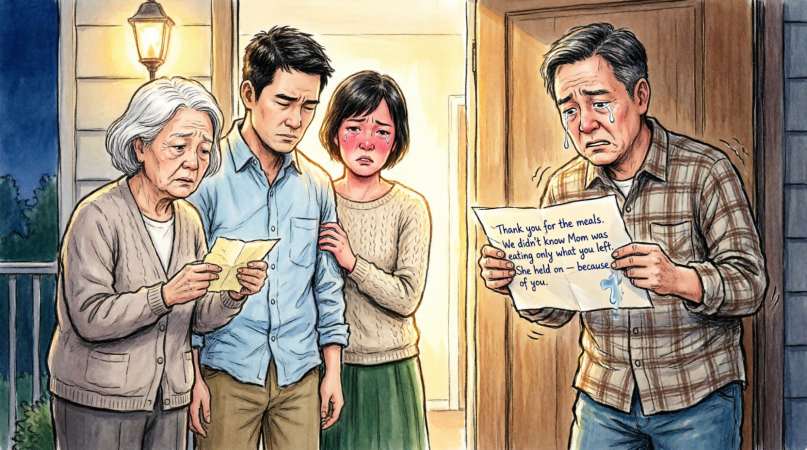
For months, Mr. Arthur had talked about his children the way one talks about people living in another country, even if they only lived forty minutes away. “Claire was always the most serious one,” he would say. “Even as a little girl, she sounded like a lawyer, even when asking for a popsicle.” I had imagined her as distant, cold, the kind of person who answers calls in a rush and sends money so they don’t have to send affection.
But the woman in front of me didn’t look cold.
She looked guilty.
And guilt, when it arrives late, ages you faster than the years.
—”My dad talked about you a lot,” she said.
I pressed my fingers against the table.
—”About me?”
She smiled without joy.
—”Not by your name. He never told us your name. He called you ‘the soup girl’.”
I felt a pang in my chest.
—”I’m not exactly a girl anymore.”
—”To him you were,” she replied. “To him, anyone who could still climb stairs without complaining was a kid.”
I wanted to laugh.
What came out sounded more like a sigh.
Claire opened the bag and took out my Tupperware containers one by one. They had been washed with an absurd delicacy. Some had lids that didn’t even close right anymore. One had a burnt corner because I once set it too close to the stove. Another had “lentils” written in marker. I recognized it and wanted to hug it, as if the plastic held something of his hands.
—”We found this in his kitchen,” she said. “They were all arranged on a shelf. Washed. Dried. Some had little pieces of paper inside.”
—”Paper?”
She swallowed hard.
She reached into the yellow envelope and pulled out several folded pieces of paper.
—”My dad started writing when he realized he was forgetting things. The doctor told us he should write down names, routines, medications. He turned it into something else.”
She handed me the first piece of paper.
Mr. Arthur’s handwriting trembled, but it was still elegant, the kind of old-school cursive learned from penmanship drills, not quick text messages.
I read:
“Monday. The neighbor brought soup. She said she had leftovers. She lies very poorly. The soup was good, but I’m not going to tell her because then she’ll get a big head. Reminder: she has a hidden laugh. Ask her for her name.”
I covered my mouth.
Not because I wanted to cry.
But because I was already crying.
Claire handed me another page.
“Wednesday. Tomato rice. It lacked a little garlic, but you can tell she made it with patience. When she knocked on the door, she didn’t run away. She stayed. That counts more than the garlic.”
Another one.
“Friday. Mild chili without any spice. What kind of punishment is it to live in America and not be able to eat spicy food? The neighbor said it was for my blood pressure. She scolded me exactly like Mary used to. It made me mad. It made me glad.”
The kitchen felt small.
As if the walls were closing in to listen, too.
—”We didn’t know,” Claire said.
Her voice broke at the edges.
—”We didn’t know how much he depended on you.”
I looked up.
—”He didn’t depend on me. I just left him food.”
Claire shook her head.
—”No. You don’t understand. He stopped eating almost entirely after he started getting confused. My brother would order him groceries through an app, I would come on Sundays… sometimes every other Sunday…” she closed her eyes. “We thought that was enough. That as long as he had beans, milk, bread, and medication, it was enough.”
I didn’t say anything.
Because I, too, had often thought that leaving a Tupperware and going back to my life was enough.
—”But the food was going bad,” she continued. “We would find rotting tomatoes, stale bread, unopened cans. He would say he had already eaten. He’d say he wasn’t hungry. He said food didn’t taste like anything to him anymore. And then you started knocking on his door.”
She looked toward the window, as if she could see her dad’s door from there.
—”In a notebook, he wrote that he got his appetite back because someone was waiting for his response.”
Something inside me folded.
I didn’t know a person could be sustained by soup.
I didn’t know a teasing comment could be a walking cane.
I didn’t know that sometimes you aren’t feeding the body, but the reason to get up from the chair.
Claire pulled a different piece of paper from the envelope. Thicker. Carefully folded. It had my name written on it, even though it wasn’t my name.
It said:
“For my Mystery Neighbor.”
—”This is the note,” Claire whispered. “He wrote it three days before he died. That day my brother came to see him, and he handed it to him. He told him: ‘When I’m no longer here, find her. But first, ask for her forgiveness.’”
I looked at her, confused.
—”Forgiveness? For what?”
Claire pressed her lips together.
—”Because we… we got mad at you.”
For a second, I didn’t understand.
—”At me?”
—”When we found the Tupperware, at first we thought horrible things. That maybe you were charging him. That maybe you had sneaked into his house. That maybe you wanted something from him. My brother was very upset. My dad had some savings that didn’t show up in the bank, and…” she put a hand to her forehead. “It was unfair. It was cruel to even think it. But when a family knows they’re guilty, they look for someone to blame so they don’t have to look in the mirror.”
I stood still.
The onion on the chopping board started crying for both of us.
—”You didn’t know me,” I said, because it was the only thing I could say.
—”No,” she replied. “And yet you knew him better than we did in his final months.”
The phrase fell onto the table like a broken plate.
I wanted to defend her from herself. Tell her no, that surely wasn’t true, that you can’t erase a whole lifetime for a few months of soup. But I remembered Mr. Arthur calling me Mary. I remembered the television turned on so the house wouldn’t sound dead. I remembered his laugh when I told him that if he kept criticizing my food, I was going to start charging him.
And then I understood that Claire’s pain didn’t need quick comfort.
It needed to stay there.
To breathe.
—”Can I read it?” I asked.
She nodded.
I took the paper.
My hands were shaking so much the letters danced.
“Mystery Neighbor:
If you are reading this, it means i’ve already done the rude thing of dying without saying a proper goodbye. I’m sorry. When you get old, you lose a lot of things: hair, strength, memory, friends, teeth, patience. But I hadn’t lost my shame yet, and I’m embarrassed to leave owing you so many Tupperwares.
I don’t know your name. I asked for it many times in my head, but when I had you in front of me, it slipped away. Then I got scared to ask because I thought: ‘What if she already told me? What if she realizes my world is erasing itself?’ So I left you as Mystery Neighbor, which sounds like a Cary Grant movie.
I want you to know something.
The first time you left soup at my door, I wasn’t going to eat that day.
Not for lack of food.
For lack of desire.
I had burned the soup because I put the pot on and sat down to wait for Mary to yell from the living room: ‘Arthur, it’s going to stick!’ But Mary didn’t yell. The house stayed quiet. And I just stared at the wall until the smoke started. When you knocked, I thought it was her. Look how foolish. Then I opened the door and it was you, looking scared, asking if I was okay.
I said yes.
I lied.
We old folks lie a lot about that.
We say ‘I’m fine’ because we don’t want to be a bother. Because we’ve already seen how people look at their watches when we talk. Because we feel our sadness is a bulky piece of furniture that no one knows where to put.
That soup tasted like a Sunday.
Not because of the chicken, which was a bit sad, excuse me, but because someone had thought of me long enough to serve me a plate.
After that, I started waiting for your footsteps.
Not the food.
Your footsteps.
I would hear the elevator, the neighbor from 3B dragging her sandals, the delivery boy bringing up pizzas, but your footsteps were different. You walked as if asking for permission, even in the hallway. Then you would knock, and I would act dignified, taking a little while so you wouldn’t notice I was already on the other side of the door with my cane in hand.
Sometimes I criticized your food because I didn’t know how to say thank you without crying.
Thank you.
For the lentils.
For the beans.
For the mild chili, even though i’ll never forgive you for that.
Thank you for letting me talk about Mary as if she still mattered.
Thank you for not making a weird face when I called you Mary.
Thank you for scolding me when I forgot to drink water.
Thank you for not treating me like I was dead ahead of time.
Now for the important part.
My children are not bad people.
Don’t let my loneliness make you think that.
My kids are tired people. Trapped people. People who think that loving is paying bills, bringing medicine, answering the phone when possible. I was like that with my mother, too. I sent her money and thought that meant I was keeping her company. Life is very mocking: one day it sits you in the very chair where you left someone waiting.
If they go to you, please don’t hurt them with what I didn’t know how to tell them. Tell them I forgave them before they asked for my forgiveness. Tell them I didn’t die angry. Tell them yes, it hurt, but love also hurts when it’s far away, not just when it’s missing.
In the pantry, behind the coffee canister, I left a tin box. It’s not a treasure, don’t get excited. There are some of Mary’s recipes. She used to say that food is the most humble way of saying ‘stay a little longer.’ I want you to have them. Not because you cook perfectly—I would never put that in writing—but because you understood something that took me eighty years to learn:
Sometimes a plate of food doesn’t save a life forever.
But it extends it just enough for that life to feel loved for one more day.
And one more day, when you are alone, is a miracle.
Don’t cry too much.
Well, cry a little, so it doesn’t look like I left without making an impact.
And if you ever make tomato rice again, add more garlic.
With affection and eternal hunger,
Arthur.“
I couldn’t finish it sitting down.
I stood up with the letter pressed against my chest and walked to the window. Outside, the Astoria afternoon looked the same as always. A man was selling street food on the corner. A dog barked from some balcony. A kid yelled that he didn’t want to do his homework. Life had the indecency to continue.
I wanted it to stop for just a little bit.
Even if just out of respect.
Claire was crying silently behind me.
It wasn’t a loud cry.
It was worse.
It was the kind of crying that takes years to form, built on unsaid sentences, unmade calls, postponed visits, “i’ll go next week,” “I can’t right now,” “i’ll call him tomorrow.”
I turned back to her.
—”Your dad loved you very much.”
She let out a broken laugh.
—”I know. That’s the worst part. That I know.”
She took a tissue from her purse and wiped her eyes.
—”My brother is downstairs. He couldn’t bring himself to come up. He thinks you hate us.”
—”I don’t know you well enough to hate you.”
—”That’s exactly what my dad would say.”
For the first time, we both smiled.
A small smile.
The kind that is born where it still hurts.
—”Do you want him to come up?” I asked.
Claire hesitated.
—”He needs to see you. But he’s also ashamed.”
—”Shame climbs stairs just like everybody else.”
She let out a brief, surprised laugh, as if she didn’t remember that you can laugh in the middle of grief without betraying anyone.
Five minutes later, Claire’s brother was sitting in my living room.
His name was Richard.
He had Mr. Arthur’s jawline and the gaze of someone who hadn’t slept in days. He wore a crisp, ironed shirt, expensive shoes, and red eyes. In his hands, he held a blue tin box painted with white flowers. I recognized it without ever having seen it. It was Mary’s box.
Richard didn’t look at me at first.
He looked at the table.
He looked at my hands.
He looked at anything but my face.
—”I’m sorry,” he blurted out.
It wasn’t a pretty apology.
It was a raw, clumsy apology, like a falling rock.
—”I’m sorry for thinking badly of you. I’m sorry for not coming sooner. I’m sorry for…” he swallowed hard. “I’m sorry for leaving him alone.”
Claire put a hand on his arm.
He gently brushed it off, not out of rejection, but because some guilt you want to carry without help.
—”I was the one who said my dad was exaggerating,” he continued. “That all old people get sentimental. That if we visited him too much, he would become dependent. Can you believe that stupidity? Dependent. As if needing company were a flaw.”
I didn’t know what to do with his pain.
I didn’t want to absolve him because I wasn’t a judge.
I didn’t want to punish him because I wasn’t the victim.
So I did the only thing I had learned to do when words weren’t enough.
I went into the kitchen.
—”Have you eaten?” I asked.
They both looked at me like I had spoken in another language.
—”No,” Claire said.
—”Then wait.”
—”We don’t want to be a bother,” Richard said.
I opened the refrigerator.
—”Your dad used to say that saying that was just an elegant way to stay hungry.”
Richard covered his face with his hand.
And he cried.
He cried the way men cry who were raised to hold it in until the body demands it all at once. Claire got up to hug him. He folded over her shoulder like a very large child.
I put rice on the stove to heat.
Beans.
Some shredded chicken.
It wasn’t a special meal. There was no fancy roast, no party soup, no dessert. It was what I had. Apartment food, for a random Saturday, for an improvised mourning.
I served three plates.
And when I put them on the table, I felt an absence so clear that I almost reached for another plate.
The fourth one.
Mr. Arthur’s.
I froze.
Richard noticed.
—”Set it,” he said.
—”What?”
—”The plate. Set it, too.”
Claire looked at him.
—”Richard…”
—”Please.”
I took out a bowl. I served rice, beans, and chicken. I placed it at the end of the table, where no one sat.
For a few seconds, no one spoke.
Then Richard opened the tin box.
Inside were handwritten recipes, old photographs, a handkerchief embroidered with the initials M.A., a yellowed ticket from a dance in Central Park, and a little bag with dried seeds.
—”What’s that?” I asked.
Claire took the bag and smiled sadly.
—”Rosemary. My mom saved seeds like they were gold.”
I touched the recipes with my fingertips.
Mary’s handwriting was round, cheerful, different from Arthur’s. On the first page, it said:
“Chicken noodle soup for sad days: start with patience and finish with lemon.”
Below, in Mr. Arthur’s handwriting, someone had added years later:
“And with a neighbor, if you’re lucky.”
My throat closed up again.
We ate unhurriedly.
At first, in silence.
Then Claire started telling how, when she was a little girl, her dad braided her hair so tight it felt like he was trying to stretch her ideas. Richard shared how Mr. Arthur taught them to ride bikes in Prospect Park, and when he fell, instead of helping him up, he said: “Look at that, you already learned how to land.”
I told them about the salt.
About the mild chili.
About the time I brought him jello and he told me that wasn’t dessert, it was just water with a superiority complex.
Richard laughed so hard he had to take his glasses off.
And suddenly, Mr. Arthur’s house, which for weeks had smelled like goodbye in my memory, started to smell like something else.
Like a return.
Not of him.
But of what he had left behind.
When they finished eating, Claire asked if she could see the hallway.
I didn’t understand, but I nodded.
The three of us walked out.
Mr. Arthur’s door was closed. It still had the building management’s tape stuck to the side, that cold mark of procedure, of inventory, of “no one lives here anymore.”
Claire stood in front of it.
—”When we were kids,” she said, “my dad always waited for us outside. Even if we came up late, even if he had already scolded us over the phone, even if we were grounded. He would sit in a chair by the door. He said no one should arrive at a house without someone welcoming them.”
Richard lowered his head.
—”And he arrived many times with no one there.”
The sentence lingered in the air.
I looked at my own door.
I remembered all the times I had arrived loaded down with bags, exhaustion, problems I told no one about. All the times I walked in fast, locked the door, and thought: “Finally alone.” As if being alone was rest, and not also a risk.
—”Sometimes I heard him,” I said.
They both looked at me.
—”Heard who?”
—”Your dad. At night. He spoke softly. I thought he was watching TV. But sometimes the TV was off. I think he was talking to your mom.”
Claire closed her eyes.
—”He never stopped talking to her.”
Richard pulled something out of his shirt pocket.
It was a key.
—”We want to give you this.”
I took a step back in fear.
—”No.”
—”Let me explain,” Claire said. “It’s not for you to look after the apartment or anything like that. We’re going to pack things up, sort out the paperwork, sell or rent, we don’t know yet. But my dad requested something.”
Richard held out the key.
—”He wanted you to go in once. Alone. He said there was something on the table for you, besides the box.”
—”I can’t.”
—”Yes, you can,” Claire said. “He wanted to say goodbye.”
I looked at the door.
My entire body resisted.
Because as long as I didn’t go in, an absurd part of me could imagine him inside, asleep in his armchair, waiting to criticize my food. But if I went in, I would confirm what I already knew: that houses are left orphaned, too.
I took the key.
It was cold.
Richard and Claire went downstairs to buy coffee, or so they said, to leave me alone. I waited until their footsteps faded on the stairs. Then I slipped the key into the lock.
The door opened with a groan.
Mr. Arthur’s apartment smelled like dust, old wood, and that faint cologne older men use, a mix of cheap aftershave and laundry soap. The living room was tidy. Too tidy. The turned-off television looked like a closed eye. Draped over the back of the armchair was his brown sweater.
I didn’t touch it.
Not yet.
I walked slowly.
In the kitchen, the burnt pot was still on the stove, washed but stained black at the bottom. I stepped closer and, without meaning to, I smiled.
—”You really can burn water,” I whispered.
On the table was a small envelope.
And on top of the envelope, a salt shaker.
I laughed.
I laughed while crying, like a crazy person, alone in a dead man’s kitchen.
I picked up the salt shaker.
It had a label taped to it:
“So you have no more excuses.”
I opened the envelope.
Inside was a photo.
Mr. Arthur and Mary in Central Park, young, dancing. He in a light suit, she in a floral dress. They looked at each other as if the world wasn’t enough for them. Behind them, barely visible, a balloon stand, trees, people paused in an afternoon that no longer existed.
On the back of the photo, Mr. Arthur had written:
“Take us to eat with you when you make something delicious.”
Below was another, shorter note.
“And if you can, open the window every now and then. This house forgets to breathe.”
I went to the living room and opened the window.
The street noise rushed in: horns, voices, a food vendor in the distance, the massive murmur of the city. The curtains barely moved, as if someone had let out a sigh.
Then I saw it.
In a corner of the dining room, against the wall, was a wooden chair with an embroidered cushion. Resting on it was a notebook.
I opened it.
It wasn’t a full diary. It was lists.
“Things I don’t want to forget.”
Mary laughed when she lied.
Claire cries at movies with dogs.
Richard hates cilantro, but eats it so we don’t argue.
The mystery neighbor cooks better when she’s sad.
Ask her not to eat alone.
The last line hit me.
Ask her not to eat alone.
I sat down in the chair.
The notebook remained open on my lap.
I thought I had been the one to see him.
I thought I was the one who noticed his loneliness, his forgetfulness, his hunger.
But Mr. Arthur had seen me, too.
He had seen my plates served in front of the television. My groceries bought for one. My laugh coming through the wall, followed by no other noise. He had seen that I left food at his door and then went back to eat standing in my kitchen, with no table set, no voice, no one to tell me if my life needed more salt.
I felt ashamed.
Not of him.
Of myself.
Because sometimes you help others so you don’t have to look at your own empty space. You give soup so you don’t have to admit you are also cold.
I stayed there for a long time.
I don’t know how long.
Until I heard a soft knock on the door.
—”Are you okay?” Claire asked from outside.
I wiped my face with my sleeves.
—”Yes.”
I lied.
Just like Mr. Arthur lied.
But this time, I opened the door.
Richard and Claire walked in with coffee, pastries, and the carefulness of someone who doesn’t want to step on a memory. I showed them the notebook. Claire read it first. Then Richard. When he got to the line about cilantro, he let out a choked laugh.
—”I knew it,” Claire said. “I kept telling him you hated cilantro.”
—”And I told him no, because my mom put it in everything.”
—”That’s exactly why he added more.”
Richard stared at the notebook.
—”‘Ask her not to eat alone,’” he read softly.
None of us said anything.
The phrase included all three of us.
That afternoon, we took some things from the kitchen. Not to empty it. To understand it. We found duplicate cans of tuna, sixteen chamomile tea bags, folded receipts, a bag full of rubber bands, prayer cards, expired medications, and a school photo of Claire with crooked teeth.
We also found, taped to the refrigerator, a sheet of paper with my supposed weekly menu.
“Monday: Soup or something that looks like it.
Tuesday: Not a food day, do not disturb.
Wednesday: Tomato rice.
Thursday: Wait without looking hungry.
Friday: Surprise.
Saturday: Maybe she won’t come. Don’t get sad.
Sunday: Kids. Act happy.”
Claire put a hand to her chest.
—”I came on Sundays,” she said.
—”He would dress up,” I said. “He’d put on a collared shirt.”
Richard looked at the fridge as if he wanted to apologize to the pharmacy magnet holding the paper.
—”He told us he was perfectly fine.”
—”He wanted you to have peace of mind.”
—”He gave us too much peace of mind,” Claire said.
I shook my head.
—”No. You let yourselves have it.”
It was the first time I said something harsh.
I regretted it as soon as it came out.
But Claire wasn’t offended. On the contrary, she nodded.
—”Yes.”
Richard took a deep breath.
—”Yes.”
And there I understood something: some words aren’t knives, even though they cut. Sometimes they are scalpels. They hurt because they open up the places where the silence has festered.
When it got dark, we left the apartment. Claire locked the door and stared at it.
—”I don’t know what we’re going to do with all this.”
—”You don’t do something with all this all at once,” I said. “You do it little by little. Like beans simmering.”
Richard smiled.
—”Did my dad say that too?”
—”No. I say that when I want to sound wise.”
They went down to the parking garage, and I went back to my kitchen with the tin box, the salt shaker, the photo, and the notebook.
The onion was still on the chopping board, now withered. I threw it away.
I didn’t cook that night.
For the first time in weeks, I didn’t make extra food.
I poured myself a glass of water, placed the photo of Arthur and Mary next to the salt shaker, and sat at the table.
The chair across from me was empty.
But it didn’t look like an enemy anymore.
The next day, Sunday, I woke up early.
I don’t know why.
Maybe because the body remembers routines even when the heart doesn’t want to. I got up, made coffee, and opened Mary’s recipe box. I chose the first one: chicken noodle soup for sad days.
I went to the market.
I bought chicken, carrots, zucchini, potatoes, chickpeas, cilantro even though Richard hated it, and a bunch of rosemary because Mary’s seeds deserved earth but also memory. The lady at the stall asked me if I was cooking for a family.
I almost said no.
But I heard myself answer:
—”Yes. Something like that.”
In the afternoon, I made the soup unhurriedly. I added enough garlic. Enough salt. Enough patience. As it boiled, the steam fogged up the windows, and the apartment smelled just like the hallway used to when Mr. Arthur was still around.
At three o’clock, someone knocked on my door.
It was Claire and Richard.
But they weren’t alone.
Behind them was a young woman holding a little boy’s hand. The woman had Claire’s eyes and the impatience of a twenty-something. The boy was holding a plastic dinosaur.
—”This is Maya, my daughter,” Claire said. “And this is Liam.”
The boy looked at me seriously.
—”My mom says you used to feed my great-grandpa.”
I didn’t know how to answer.
—”Your great-grandpa also fed my patience,” I said.
Liam wrinkled his nose.
—”Can you eat that?”
—”With enough lemon, yes.”
They came in.
Then came another of Richard’s sons, a tall young man who greeted me awkwardly. After him, the neighbor from 3B, who had smelled the soup and peeked in “just to see if everything was okay.” Then the super, using the excuse of bringing a receipt. In less than an hour, my apartment had more people in it than it had since I moved in.
And I, who had always thought my kitchen was too small, discovered that kitchens stretch when someone is hungry.
I served bowls.
A lot of them.
The last one I placed at the corner of the table.
Mr. Arthur’s.
No one mocked it.
No one said it was weird.
Liam was the only one who asked:
—”Whose is that one?”
Richard knelt next to him.
—”Your great-grandpa’s.”
—”But he died already.”
—”Yes.”
—”Then how is he going to eat?”
Claire froze.
I placed a folded tortilla next to the bowl.
—”With us,” I said. “When we talk about him.”
Liam thought about it.
Then he placed his dinosaur next to the bowl.
—”So he doesn’t eat alone.”
Claire burst into tears.
Maya hugged her.
Richard walked over to the window.
The neighbor from 3B blew her nose with a napkin.
I looked at the bowl, and for the first time since that rainy night, I didn’t feel the absence tearing something away from me.
I felt him sit down.
I felt him keeping us company.
I felt him critiquing the soup.
—”It needs salt,” I said out loud, imitating his voice.
Everyone went quiet.
Then Richard, with a trembling smile, picked up Mr. Arthur’s salt shaker and raised it like a toast.
—”Well, buy yourself a salt shaker.”
Laughter filled the apartment.
And it was a laugh so alive, so unexpected, that for a second I swore someone tapped softly on the other side of the wall, just like when Mr. Arthur wanted to get my attention without getting up.
I didn’t say anything.
There are miracles that get ruined if you try to explain them.
After that Sunday, something changed in the building.
Not all at once.
Not like in the movies where everyone becomes good after a death. Real life isn’t that obedient. The neighbor from 3B kept complaining about the noise. The super kept losing packages. Maya kept arriving late. Richard kept hating cilantro. Claire still cried sometimes when she saw a brown sweater.
But we started to see each other.
Truly.
The following week, the neighbor from 2A left pastries at the door of a student who always came home in the early hours of the morning. The super carried a bag of oranges up for the lady in 4C, who had a cold. Richard had the hallway light fixed, the one that had been flickering like a lost soul for months. Claire put a note in the elevator:
“Community meal on the first Sunday of every month. Bring what you can. If you can’t bring anything, bring yourself.”
She signed it with her name.
But below, someone added with a marker:
“And salt, just in case the mystery neighbor is cooking.”
I knew who it was.
Richard denied it.
Very poorly.
The first Sunday, seven people showed up.
The second, fifteen.
The third, we had to set up tables in the hallway. Someone brought chicken. Someone brought rice. Someone brought iced tea. The neighbor from 3B brought jello, and I had to bite my tongue to keep from saying it was just water with a superiority complex.
A month later, Claire arrived with a potted plant.
—”My mom’s seeds,” she said.
We planted the rosemary in an old planter by the building’s entrance. Liam made a sign with crayons:
“Mary’s Rosemary. Do not pick because Mr. Arthur will haunt you.”
No one picked it.
Not even the dogs.
Three months passed.
Mr. Arthur’s apartment remained closed, but it no longer felt abandoned. Claire and Richard decided not to sell it yet. They cleaned it, painted the walls, and left some furniture. One afternoon they asked me to come up.
When they opened the door, the living room looked different.
They had placed a large table in the center. Mismatched chairs around it. On one wall they hung photos of Arthur and Mary, framed recipes, and a handwritten page:
“Food is the most humble way of saying: stay a little longer.”
Below it, on a shelf, were my Tupperwares.
All of them.
Washed.
Organized.
Like little plastic witnesses.
—”We want to turn it into a neighborhood dining room,” Claire said. “Nothing formal. No foundations or speeches. Just… a place where someone can knock if they don’t want to eat alone.”
Richard cleared his throat.
—”We gave it a name.”
They pointed to the wall next to the kitchen.
There, painted in blue letters, it said:
“The Decent Soup House.”
I laughed so hard I almost had to sit down.
—”It was the absolute most my dad would have accepted to say,” Richard said.
—”Don’t let it go to your head,” Claire added, imitating his voice.
That day we inaugurated The Decent Soup House with a massive pot of chicken noodle soup. Neighbors came whom I didn’t even know existed. A widowed man from the first floor who always ate at diners. A nurse who slept during the day and lived on coffee. A delivery guy who sometimes sat on the stairs waiting for orders. Two little girls who asked if they could do their homework at the table because it was too noisy at their house.
No one asked who deserved to eat.
No one asked for explanations.
The only requirement was to sit down.
And stay a little while.
At first, I cooked almost everything.
Then others started bringing things. The lady from 4C made rice pudding. The super made egg sandwiches with a dignity no one expected. Maya learned to make chicken tortilla soup and showed it off as if she had won an international award. Richard kept picking the cilantro out of everything, but without hiding it anymore.
Claire came every Wednesday.
Sometimes she talked a lot.
Sometimes she just washed dishes.
One day, as we were drying glasses, she said to me:
—”I thought my dad’s death had left us without a home.”
I looked at her.
—”And it turns out it left us one full of people,” she finished.
I didn’t answer.
Because it was true.
Also because I was learning that not all silences mean abandonment.
Some mean gratitude.
One rainy afternoon, almost identical to that first night, a young woman arrived at the dining room. She had swollen eyes, a soaked jacket, and a grocery bag with only two things: white bread and a can of tuna.
She stayed by the entrance, afraid to come in.
—”Do you sell food here?” She asked.
—”We don’t sell,” I said. “We serve.”
—”I don’t have money.”
—”That’s good, because we wouldn’t know where to ring you up.”
She looked at me suspiciously.
—”So then what?”
I pointed to a chair.
—”Then you sit.”
She sat on the edge, ready to bolt.
I served her hot soup.
She held the bowl with both hands, as if it were a campfire.
She ate slowly at first. Then ravenously. Then crying.
No one looked at her weirdly.
That was an unwritten rule of The Decent Soup House: when someone cries over their soup, everyone pretends to be very busy with the tortillas.
When she finished, the woman helped me wash her bowl.
—”My name is Tessa,” she said. “I live in the building across the street. Today… today I didn’t want to go back home.”
I didn’t ask why.
Not yet.
I gave her a Tupperware with more soup.
—”For tomorrow.”
She took it and stared at the lid.
—”Do I have to return it?”
I thought of Mr. Arthur.
Of his washed Tupperwares.
Of his little notes.
Of the way life turns around with a clean spoon in hand.
—”When you can,” I said. “And if you can’t, return yourself.”
Tessa came back.
And then she came back again.
Over time she told us that she was running from a man who had convinced her she wasn’t even worth the plate she ate off of. Claire helped her find legal advice. Maya got her clothes for interviews. The neighbor from 3B, who was a gossip but not useless, found out about a safe room for rent. Richard lent her money without making it feel like charity.
One Sunday, Tessa arrived with a pot of chili.
—”It turned out kind of ugly,” she said.
I tasted a spoonful.
It lacked salt.
I felt a sweet shiver.
—”It’s decent,” I replied.
And everyone laughed, even though Tessa didn’t understand why.
That’s how Mr. Arthur continued playing pranks after he died.
A year after he passed away, Claire organized a special meal. She didn’t want to call it a death anniversary because she said it sounded like funeral paperwork. She called it “Gratitude Sunday.”
We placed the photo of Arthur and Mary on the main table. Liam, now taller and full of questions, brought paper flowers. The lady from 4C made rice pudding. Richard prepared, against all odds, a salsa with cilantro.
—”A miracle?” I asked him.
—”Therapy,” he answered.
Claire read a part of her dad’s letter out loud. Not all of it. Just the line about the plate of food and the miracle of one more day. Many cried. Others looked down. Tessa clutched her Tupperware to her chest.
I didn’t cry at first.
I felt strangely calm.
Until Liam approached with a folded piece of paper.
—”My mom says you keep letters,” he said.
—”Depends on who writes them.”
—”I wrote this one.”
I opened it.
It said, in big, crooked handwriting:
“Thank you for giving soup to my great-grandpa. My mom says because of you we got to know him better. I don’t remember him much, but when I eat here I feel like I do. Also thank you for not letting my dinosaur eat alone.”
Below was a drawing: a table, a lot of people, a green dinosaur, and a little old man with a cane saying: “Needs salt.”
Then I cried.
A lot.
Not just a little.
That night, when everyone left, I stayed alone in The Decent Soup House. I washed the last plates. Put away the bread. Turned off the lights one by one. Before locking up, I sat in Mr. Arthur’s chair, the one with the embroidered cushion.
On the table was his salt shaker.
We had used it so much the lid was getting loose.
I held it in my hands.
—”Well, sir,” I said to the empty air. “Look at the mess you made.”
The apartment creaked in the wind.
The window was open.
Outside, the city breathed.
—”Just don’t let it go to your head,” I whispered, imitating his tone. “The soup is still just decent.”
Then, from the hallway, I heard footsteps.
For an instant my heart did an absurd thing.
It waited.
The door was ajar. A shadow peeked in.
It was Tessa.
She held an empty Tupperware in her hands.
—”I’m sorry,” she said. “I thought everyone was gone.”
I smiled.
—”Someone’s still here.”
She lifted the Tupperware.
—”I came to return it.”
I took it.
It was washed.
Dry.
Inside was a folded piece of paper.
Tessa blushed.
—”I was too embarrassed to say it out loud.”
When she left, I opened the note.
“Today I ate with you guys and I wasn’t afraid to go back home. Thank you for one more day.”
I stared at those words until they became blurry.
One more day.
That was everything.
That was so much.
I put the note in Mary’s tin box, next to Arthur’s letter, the recipes, the photo, Liam’s drawing, and the little notes from the Tupperwares. The box couldn’t even close properly anymore. It was full of small proofs that the world could still be kind in portions.
Before leaving, I served a little bit of soup in Mr. Arthur’s bowl.
Not because I believed he would come eat it.
But because some absences deserve a place setting.
I placed a folded piece of bread next to it, the salt shaker, and Liam’s dinosaur, which had been forgotten again.
I turned off the light.
I locked the door.
And for the first time since I moved to that old building in Astoria, I didn’t walk back to my apartment feeling like I was returning to being alone.
I walked hearing voices behind me.
Claire’s laugh.
Mary’s scolding in some recipe.
Richard’s clean tears.
Tessa’s shy “thank you.”
The fake roar of Liam’s dinosaur.
And, clearly, as if crossing the wall of time, Mr. Arthur’s voice:
—”Mystery neighbor…”
I stopped in the hallway.
There was no one there.
Just the new lightbulb, the rosemary pot by the entrance, and the smell of soup lingering on the walls.
I smiled.
—”What is it, Mr. Arthur?”
The silence answered with that strange tenderness houses sometimes have when they are no longer dead.
I opened my door.
On my kitchen table there was a plate waiting for me.
Just one.
But this time it didn’t look sad.
I served myself soup, added lemon, a little salt, and sat down slowly.
Before tasting it, I raised my spoon toward the photo of Arthur and Mary that now lived on my shelf.
—”To you, Mr. Arthur,” I said. “And to everyone who still needs one more day.”
I tasted the soup.
It was good.
Not perfect.
Good.
Though, if he had been there, he surely would have wrinkled his nose, tapped the table with his cane, and said it lacked garlic.
And I, of course, would have yelled from my kitchen:
—”Then cook it yourself!”
But that night there was no answer.
Just a warm peace.
A full silence.
A house that finally didn’t sound dead.
And the salt shaker, in the center of the table, shining under the light as if it held, between its white grains, the simplest and most sacred way of staying:
A served plate,
An open chair,
An unlocked door,
And someone on the other side saying:
—”Come in. There’s still soup.”
The next morning, I found Tessa’s Tupperware hanging on my doorknob.
It wasn’t empty.
Inside were three meat pies wrapped in a napkin, a little bag of green salsa, and a hurriedly written note:
“So you don’t have to cook today. You deserve to have someone leave you food, too.”
I stood in the hallway, with the warm Tupperware in my hands, feeling a strange shame. It wasn’t the shame of receiving. It was the shame of giving for so long without having learned how to accept.
Because no one teaches you that.
They teach us to help, to be useful, to carry bags, to say “I got it,” to make a pot of food for twenty even when we haven’t had breakfast ourselves. But receiving a plate without feeling like we have to pay it back immediately… that’s much harder.
I went back into my apartment and placed the meat pies on the table.
Three.
One for me.
One for the memory.
One in case someone knocked.
I laughed out loud at the thought. Before, if someone knocked on my door, I would turn the volume down, walk without making a sound, and peek through the peephole waiting for them to leave. Now I left food ready just in case the world showed up hungry.
The first of the meat pies was a jalapeño one.
It was quite spicy.
—”This one really had chili, Mr. Arthur,” I said, looking at the photo. “Not like your hospital chili.”
I ate slowly. No TV. No phone. With Tessa’s Tupperware open in front of me as if it were an answer.
Outside, the building started its symphony: buckets clanking, keys jingling, heels clicking, a kid crying because he didn’t want to wear his uniform, the neighbor from 3B yelling at someone not to leave trash on the stairs, the super whistling the same song as always without knowing more than two notes.
And amidst all that noise, the house didn’t sound dead.
It sounded difficult.
It sounded alive.
That afternoon I went to the market with the list of ingredients for Sunday. We had agreed to make beef stew. It was Maya’s idea; she said a community kitchen without stew was like a party without a gossiping aunt. Claire offered to bring bread. Richard said he would bring radishes, lettuce, and oregano because “that doesn’t require talent.” Tessa promised to make lemonade with chia seeds. The neighbor from 3B signed up for jello again, and no one had the heart to stop her.
I bought corn, beef, garlic, onion, and a little sack of patience.
While I was picking out peppers, a voice called to me from the spice stand.
—”Are you the lady from The Decent Soup House?”
I turned around.
It was a completely white-haired, short lady, with a grocery bag almost bigger than she was. She had lively, dark eyes, the kind that don’t ask for permission to stare.
—”Depends on who’s asking,” I replied.
The lady smiled.
—”My name is Alice. I live on the street behind you. Tessa told me you guys don’t chase anyone away over there.”
I felt something warm in my chest.
—”We usually don’t chase people away. Unless you try to steal the salt shaker.”
The lady didn’t get the joke, but she laughed anyway.
—”My husband died two months ago,” she said suddenly, like someone dropping a heavy bag on the floor. “Ever since, I make coffee for two. Then I get mad because there’s extra. Then I drink it cold so I don’t have to accept that there’s extra.”
The spice vendor pretended to rearrange the cinnamon sticks.
I left the peppers on the scale.
—”We’re making beef stew on Sunday,” I said. “You can come.”
—”I don’t want people to pity me.”
—”Then don’t let them. Bring lemons.”
Alice looked at me for a long time.
Then she nodded.
—”That I can bring.”
Sunday arrived with a bag full of lemons and a photograph of her husband tucked inside her grocery bag. She didn’t take it out at first. She sat near the window, like someone who needs an exit in sight. She ate a little. Then a little more. Then she asked for more broth “just to warm up the bread.” Finally, when Liam started handing out napkins like a fine dining waiter, Alice took out the photo.
—”He was Jack,” she said.
The table leaned toward her without moving.
That was something we had learned at The Decent Soup House: when someone pulls out a photo, you listen. It doesn’t matter if the food gets cold. The dead don’t speak on their own; they need someone to lend them a voice.
Jack had been a truck driver. He liked singing boleros at five in the morning. He hated cactus, but he bought it because Alice loved it. He had a laugh so loud it once woke up the neighbor’s baby from across the street. Alice talked about him for twenty minutes, and the more she talked, the less she looked like a widow and the more she looked like a woman who still had a whole life trapped in her throat.
When she finished, Liam raised his hand.
—”Do we set a plate for him too?”
Alice froze.
Claire looked at me.
Richard stopped slicing radishes.
Tessa pulled the pitcher of water to her chest.
I went for a bowl.
I placed it next to Mr. Arthur’s.
Alice looked at it as if we had just opened a window right in the middle of her chest.
—”Jack liked his stew with lots of lettuce,” she whispered.
—”Then say no more,” Richard said, tossing a handful in.
That Sunday there were two empty bowls taking up space.
And no one ate less because of it.
On the contrary.
It seemed like the table grew every time we made room for someone who was no longer there.
But it wasn’t all pretty.
Important things rarely stay pretty for very long.
A few days later, the building management posted a notice at the entrance:
“It is strictly prohibited to hold gatherings, distribute food, or use common areas for unauthorized activities. Complaints have been received regarding noise, odors, and the entry of non-residents.”
The paper was signed by the building manager, a man named Oliver who lived in 5A and used words like “regulations” and “cohabitation” as if they were stones.
The neighbor from 3B was the first to rip the notice down.
—”Non-residents my foot!” She yelled. “No one is going to tell me who can eat in my building.”
—”Mrs. Higgins,” I told her, “don’t rip it down. We need to read it.”
—”I already read it. It says pure nonsense.”
But the problem wasn’t the paper.
It was what came behind it.
The next day, Oliver knocked on the door of The Decent Soup House right as we were serving vegetable soup. He walked in without saying hello. He wore a white shirt, a pen in his pocket, and carried a clipboard under his arm. He looked at the tables, the Tupperware, the pots, at Tessa serving water, at Alice slicing lemons, at Liam doing homework in a corner, and his face wrinkled up like a wet rag.
—”This cannot continue,” he said.
No one answered.
I wiped my hands on my apron.
—”Good afternoon to you, too.”
—”I’m not joking. This apartment is zoned as a residence, not a soup kitchen.”
—”Mr. Arthur’s memory lives here,” Mrs. Higgins said from a chair. “That counts.”
Oliver ignored her.
—”There are health risks, legal liabilities, unknown people walking through, nuisance odors…”
—”A nuisance from the smell of soup?” Richard asked. “That takes having a raw soul.”
Oliver pointed at him with the clipboard.
—”You don’t even live here.”
—”My dad lived here.”
—”Your dad passed away.”
That phrase landed badly.
Very badly.
Claire, who until then had been serving rice, set her spoon down.
—”My dad passed away in this building after living alone for far too long,” she said with a sharp calm. “What we are doing here is the exact opposite of abandoning him.”
—”I’m not talking about feelings,” Oliver replied. “I’m talking about rules.”
—”How sad,” I said.
He looked at me.
—”Excuse me?”
—”That you can’t talk about both at the same time.”
Oliver took a deep breath, as if we were all spoiled children.
—”You have one week to suspend these gatherings. If not, I will call a board meeting and we will proceed according to the bylaws.”
He left, leaving the door open.
No one spoke for an entire minute.
Then Liam looked up from his notebook.
—”Are they going to take the soup away?”
The question did more damage than the threat.
Claire crouched down in front of him.
—”No, my love.”
But her voice wasn’t sure.
I couldn’t sleep that night.
I sat in my kitchen with Mr. Arthur’s notebook open. I reviewed the lists, the little notes, Mary’s recipes, looking for an answer the way someone looks for a dry twig to start a fire. But the dead don’t resolve paperwork. The dead leave questions disguised as memories.
“Ask her not to eat alone.”
That line seemed to stare at me.
—”Now what, Arthur?” I murmured.
The photo didn’t answer.
But next to the photo was the salt shaker.
I picked it up, turned it between my fingers, and then I remembered something Mr. Arthur had told me on a random afternoon, while I was bringing him meatballs.
—”People get used to complaining because they think that’s how they participate,” he told me. “But put a spoon in their hand and they don’t know what to do with so much power.”
At the time, it seemed like one of his weird, stubborn old man phrases.
Now I understood.
The next day, I made a list.
Not of complaints.
Of hands.
Claire knew how to organize.
Richard knew how to talk with documents.
Maya knew how to mobilize people on social media.
Tessa knew how to listen without scaring people off.
Mrs. Higgins knew how to find out everything before anyone else.
Alice knew how to cook for a crowd because she had raised six kids and three nephews.
The super knew who came in, who left, who was in need, and who pretended they weren’t.
I knew how to make soup.
That was not nothing.
That week we didn’t suspend The Decent Soup House.
We opened it earlier.
But instead of serving food right away, we set up a table in the hallway with coffee, pastries, blank sheets of paper, and a poster board that said:
“What does this building need so it doesn’t die from the inside?”
At first, people walked by glancing sideways.
Then someone wrote: “Fix the leak on the fourth floor.”
Another: “Don’t leave Mrs. Alice alone.”
Another: “Turn the music down after 11 PM.”
Another: “Someone teach me how to use my phone to make doctor’s appointments.”
Another, in a child’s handwriting: “Soup on Sundays.”
By noon, the poster board was full.
Oliver came down when he saw the group gathered.
—”What is the meaning of this?” He asked.
—”Civic participation,” Richard said, smiling as if he had just bitten into a sweet lemon. “You wanted rules. We want community.”
—”You can’t use the hallway for propaganda.”
—”It’s not propaganda,” Claire said. “It’s a diagnosis.”
Oliver blinked.
He wasn’t expecting that word.
Maya, who was recording discreetly on her phone, stepped closer.
—”My grandfather died alone behind that door,” she said. “And no one in this building had a rule to notice that. Maybe the rulebook needs to feel hungry, too.”
Oliver turned red.
—”I am not going to argue in front of cameras.”
—”Then argue in front of your neighbors,” I said.
And as if the phrase had summoned them, they started coming out.
The lady from 2A.
The late-night student.
The man from 1C, who always smelled of aftershave and sadness.
The nurse.
The super.
Mrs. Higgins, of course, with her arms crossed and the face of someone who had been waiting for a fight since breakfast.
Claire raised her voice.
—”We are not asking to turn the building into a market. We just want to keep opening one apartment twice a week so no one eats alone. We can organize ourselves, clean up, register guests, respect hours, take voluntary donations. But locking the door isn’t going to fix the noise, the smells, or the loneliness.”
Oliver hugged his clipboard to his chest.
—”We have to vote.”
—”Let’s vote,” Mrs. Higgins said.
—”Not now.”
—”Of course now. Or do you need to go fetch your soul and come back?”
Someone laughed.
Oliver glared at her.
The assembly took place three days later, in the courtyard.
I had never seen so many people together in the building. Some went out of curiosity, others for food, others because Mrs. Higgins told them that if they didn’t come down, she herself would go up and bang a spoon on a pot at their door.
We set up plastic chairs. Claire brought copies of a proposal. Richard talked about schedules, cleaning, cooperation, and liability. Maya presented testimonies. Tessa didn’t want to speak, but finally, she stood up.
She wore a borrowed blue blouse, her hands clasped in front of her.
—”I don’t live in this building,” she said. “On paper, I am a non-resident. But one night I came here because I was afraid to go back to where I lived. They gave me soup. They didn’t ask too many questions. They didn’t charge me. They didn’t make me feel like trash. Thanks to that table, I now have a room, a job, and people who know my name. If that’s a problem for your rulebook, maybe your rulebook needs to sit down and eat.”
No one clapped at first.
Because when a truth walks in, it first rearranges the furniture.
Then Alice stood up with the photo of Jack in her hand.
—”I do live nearby, but ever since my husband died, I wasn’t really living much either. I was just breathing. At that table, I was able to say his name without people telling me to ‘get over it.’ I vote for the soup.”
Mrs. Higgins raised her hand.
—”I vote for the soup and against the flavorless jello the lady from 4C brings.”
—”Hey!” Yelled the lady from 4C.
—”Well, we’ll sort that out later.”
The laughter broke the tension.
Then the student from 2A spoke up, the one we all thought was rude because he always walked in with headphones on.
—”I come home late because I work and study,” he said. “Many nights the only thing I eat is bread. The lady from 2A left pastries for me twice. I didn’t know it was because of this. I can help with cleaning.”
The nurse said she could check blood pressure once a month.
The super said he could keep a log of visitors, but asked not to have to use a computer because “those things smell like trouble.”
Richard offered to buy a fire extinguisher.
Claire proposed operating hours.
Maya proposed a group chat.
Oliver listened, his face looking smaller and smaller.
When the time came to vote, almost everyone raised their hand.
Almost.
Oliver didn’t.
And a married couple from 4B didn’t either, but the wife ended up saying she didn’t oppose it “as long as they didn’t make spicy stew because the smell gave her heartburn.”
That’s how The Decent Soup House stopped being a prank and became an agreement.
Not entirely legal.
Not perfect.
But legitimate.
That night, we put a pot of coffee and pastries on the table. There was no big meal. No one had the energy. But everyone stayed a while, as if they didn’t want to break the victory.
Oliver approached when almost everyone had left.
I was putting glasses away.
—”Don’t think I agree with everything,” he said.
—”I don’t think that.”
—”My mother lives alone in Brooklyn.”
I looked at him.
He wasn’t looking at me. He was looking at Mr. Arthur’s salt shaker.
—”She’s eighty-six. I send her money. A lady helps her with the cleaning. I call her… well, not every day. But often.”
I didn’t say anything.
I had learned not to fill silences before knowing what they carried.
Oliver swallowed hard.
—”Yesterday she called me three times and I didn’t answer because I was in a meeting. When I called her back, she told me she just wanted to ask if I remembered how my dad made his eggs with salsa. I lost my patience. I told her to look it up on the internet.”
The clipboard was no longer in his hands.
He looked less like a building manager and more like a son.
—”I went to see her today,” he continued. “She had two boiled eggs on the table. Cold. She said she was waiting for me to stop being busy.”
I felt Mr. Arthur peeking out from some corner of the air.
—”Bring her on a Sunday,” I said.
Oliver shook his head quickly.
—”No. She doesn’t go out much.”
—”Then take soup to her.”
He looked at me.
—”Would you give me some?”
—”No.”
His face tensed.
—”i’ll teach you how to make it,” I said.
And for the first time since I’d known him, Oliver didn’t have a rule ready.
The following Wednesday he showed up in my kitchen with a notepad.
—”Don’t laugh,” he said.
—”I make no promises yet.”
I taught him how to make chicken noodle soup. He washed the vegetables poorly. He peeled the potato as if he were interrogating it. He added too little salt out of fear. He slightly burned the rice. I didn’t correct all of it. There are things you need to learn half-wrong so they become yours.
When he finished, he tasted a spoonful and wrinkled his face.
—”It’s plain.”
—”It’s decent.”
He stared at the pot.
—”My mother is going to say it lacks garlic.”
—”Then there’s still time for you to love her.”
Oliver looked down.
He didn’t answer.
But the next day, the super told me he saw him walk out with a pot wrapped in a towel, looking terrified.
Two weeks later, a new note appeared on the poster board, written in elegant handwriting:
“Thank you for teaching my son that soup doesn’t come from an app. Mrs. Helen, Oliver’s mother.”
We taped it next to the photo of Mr. Arthur.
—”Well, look at that,” Mrs. Higgins said. “Even the rulebook has a mom.”
The House grew.
And with growth came new problems.
We ran short on money for gas. We lacked bowls. Sometimes there were too many people and not enough chairs. Sometimes people came wanting to take food for five and never come back. Sometimes someone got mad because there was no meat. Sometimes sadness walked in with muddy shoes and left us exhausted.
One night, after a difficult shift, Claire sat with me in the kitchen. Her hands were red from washing dishes.
—”We can’t save everyone,” she said.
—”No.”
—”Sometimes I feel like this is going to get out of hand.”
I looked at the empty pot.
At the bottom, there were a few grains of rice stuck to it.
—”Mr. Arthur also let the soup get out of hand that very first time.”
Claire smiled.
—”And look at the mess it caused.”
—”A decent mess.”
She rested her head against the wall.
—”My dad would be happy.”
—”And critical.”
—”Happy and critical.”
We sat in silence.
Then Claire said something she had been wanting to say for a while, but neither of us dared to touch on.
—”You never told us your name, did you?”
I laughed softly.
It was true.
Between “neighbor,” “soup lady,” “ma’am,” “kiddo,” “you,” everyone had ended up calling me what Mr. Arthur had named me: Mystery Neighbor. At first it was an accident. Then a habit. Then a refuge.
—”My name is Helen,” I said.
Claire opened her eyes wide.
—”Helen?”
—”Yes.”
—”Like Oliver’s mom.”
—”That’s why I didn’t say it. The soup was going to get confusing.”
Claire burst out laughing.
But then she looked at me tenderly.
—”Helen,” she repeated. “How pretty.”
It sounded weird in her mouth.
My name had been stored away for so long that it felt foreign. For months I was the neighbor, the one who cooked, the one who knocked on doors, the one who carried pots, the one who didn’t eat alone because she was always busy making sure others didn’t eat alone.
Helen.
A person.
Not just a function.
That night, when I returned to my apartment, I wrote my name on a little piece of paper and put it inside one of my own Tupperwares.
“Reminder: my name is Helen.”
I kept it in Mary’s box.
Just in case I ever forgot.
Time continued to march forward with that mix of rush and slowness that grief has when it begins to turn into life.
December arrived.
Astoria filled with lights in the windows, cider stands, piñatas hanging like clumsy stars. The Decent Soup House smelled of cinnamon, guava, and cheap baked cod because someone insisted it was possible to make it “affordable” and almost gave us sodium poisoning.
We decided to host a dinner.
Not exactly a Christmas dinner, because everyone had their own beliefs, their own absences, and their own family dramas. We called it “Dinner for Those Who Don’t Fit Where They Should.”
More people showed up than expected.
A recently divorced man who didn’t want to spend the night at a Denny’s.
A young woman who worked at a pharmacy and missed the last bus to New Jersey.
Oliver’s mom, Mrs. Helen, who arrived on her son’s arm with a pot of green bean casserole.
Tessa arrived wearing a green dress. She looked different. Not because she wasn’t scared anymore, but because fear was no longer leading her by the hand.
Alice brought lemons, even though they weren’t needed. She said she didn’t go anywhere without lemons because you never know when life is going to need a little acidity.
Liam arrived with his dinosaur, now sporting a little red bow tie.
At nine o’clock, when everyone was seated, Claire asked for silence.
—”We want to do something,” she said.
Richard was by her side with a box wrapped in newspaper.
I felt something coming toward me.
—”No,” I said immediately.
—”You don’t even know what it is,” Richard replied.
—”I know that face. It’s a ceremony face.”
Maya took me by the shoulders and made me sit down.
—”Let yourself be loved, Helen.”
My name in her voice made several people turn around.
—”Helen?” Asked Mrs. Higgins. “That’s your name?”
—”Oh, Mrs. Higgins, don’t act like you haven’t checked my mailbox at least once.”
—”Suspecting is one thing, confirming is another.”
Everyone laughed.
Richard placed the box in front of me.
—”We found something else belonging to my dad,” he said. “We didn’t give it to you before because… well, because we didn’t understand it until now.”
I opened the box.
Inside was a green-covered notebook.
It wasn’t the notebook of lists.
It was older.
The first few pages had calculations, phone numbers, copied recipes, names of medications. But halfway through, the handwriting changed. It was still Mr. Arthur’s, but firmer, from before his memory started playing dirty tricks on him.
I read the title of one page:
“Things I would do if I weren’t too embarrassed to ask for help.”
I felt the entire dining room fade away a little.
I turned the first page.
“1. Invite the neighbors over for soup on Thursdays.
Put a chair outside so someone will sit down and chat.
Tell Claire to come without groceries, just with time.
Ask Richard not to talk to me like I’m a chore.
Teach a kid how to play dominoes.
Dance one last time with Mary, even if it’s alone.
Don’t die without someone knowing what to do with my recipes.”
The next page had a clumsy drawing of a long table.
Around it, stick figures representing people.
At the top he wrote:
“Dining Room for Those Left Waiting.”
I covered my mouth.
Claire was crying.
Richard too.
Mrs. Helen, Oliver’s mom, made the sign of the cross without saying a word.
—”My dad dreamed this up before we did,” Claire said. “But he was too embarrassed to ask for it.”
Richard took a deep breath.
—”So we want to change the sign.”
He stood up and removed the temporary cloth that was hung on the wall. Behind it, they had placed a wooden plaque. It wasn’t elegant. It was simple, hand-painted.
It said:
“The Decent Soup House of Mr. Arthur and Mrs. Mary.
A Dining Room for Those Who No Longer Want to Wait Alone.”
I couldn’t speak.
I stood up slowly and touched the wood.
They had drawn a pot, a salt shaker, and a little green dinosaur in the corner.
—”Liam insisted,” Maya said.
—”It was necessary,” Liam said, very seriously.
Then Richard put on some music.
A swing song.
The song crackled a bit from an old speaker, but it filled the apartment in a way that no pot of soup ever had.
Claire held her hand out to me.
—”My dad used to dance with my mom in Central Park,” she said. “You know that better than anyone.”
—”I don’t know how to swing dance.”
—”We don’t know how to live without him either, and look, here we are.”
I accepted her hand.
We danced clumsily between the tables. Claire cried and laughed. Richard pulled Mrs. Helen up to dance. Oliver, stiff as a broomstick, ended up moving his feet while his mom told him he had the rhythm of an electric bill. Tessa danced with Alice. Mrs. Higgins danced alone because, according to her, no one was on her level.
And at one point, I don’t know how to explain it without it sounding like a lie, I felt the air shift.
Like when someone walks in without opening the door.
I looked toward the corner of the main table.
The two bowls were there: Mr. Arthur’s and Jack’s. Next to them, Mary’s photo. The salt shaker gleamed under the yellow lights. The steam from the cider rose as if someone were breathing softly.
For a second, I saw Mr. Arthur.
Not with my eyes.
With another part of me.
He was leaning on his cane, looking at the mess with that expression of his, disapproving so he wouldn’t cry. By his side, Mary was smiling like in the photo, her floral dress swaying slightly. They didn’t say anything. They didn’t need to.
I closed my eyes.
And I danced.
After dinner, when everyone left, Claire, Richard, and I stayed behind to clean up. It was almost two in the morning. The city outside was cold. Inside the House remained dirty plates, confetti, napkins, half-empty glasses, and that sweet sadness that parties leave behind when they’re over.
Richard found something under Mr. Arthur’s chair.
—”What’s this?”
It was a small envelope.
Old.
Yellowed.
It wasn’t there before. Or maybe it was and no one had seen it. It had a name written on it:
“Helen.”
My heart stopped.
—”That’s for you,” Claire said.
I took it carefully.
The handwriting wasn’t Mr. Arthur’s.
It was Mary’s.
It couldn’t be.
Mary had died seven years before I moved into the building.
I sat down because my legs wouldn’t hold me up.
I opened the envelope.
Inside was a recipe and a note.
“For whoever finds this box when Arthur no longer remembers where he put it:
If you are reading this, surely my stubborn old man was left alone longer than he would admit to confessing. I ask you a favor: don’t believe him when he says he doesn’t need anything. He needs coffee. He needs music. He needs someone to ask him if he’s eaten and not accept the first ‘yes’.
Arthur has the bad habit of acting strong when he is broken. If it falls to you to keep him company, don’t try to fix his sadness. Feed him. Sit down. Let him talk about me even if he repeats the same stories. Repeated stories are the way old folks knock on the door from the inside.
And if you are also alone, don’t play the brave one. Bravery that doesn’t let anyone in turns into a cage.
I’m leaving you my recipe for tomato rice. There’s no secret to it. The secret is not making it for just one person if you can avoid it.
With affection,
Mary.”
Below was the recipe.
And at the end, like a joke reaching across the years, she wrote:
“P.S. Add garlic. Arthur always thinks it’s missing.”
I don’t know how much I cried.
Claire sat next to me.
Richard stood, looking out the window.
—”My mom was waiting for you, too,” Claire whispered.
I hugged the letter to my chest.
For months I thought I had arrived at that door by accident. By smoke. By the smell of burnt soup. By a forgotten pot. But sitting there, with the handwriting of a dead woman speaking to me as if she had seen me hide my loneliness behind an apron, I understood that some doors don’t open by chance.
They open because someone, before leaving, left the latch loose.
The next day, I made Mary’s tomato rice.
Not for the soup kitchen.
For me.
I followed the recipe with almost religious obedience: very ripe tomatoes, enough garlic, onion, hot broth, rice washed until the water ran clear. I fried it slowly. Covered it. Lowered the flame. I waited without stirring it, even though I wanted to.
While it cooked, I set two plates on my table.
Then I hesitated.
I pulled out a third.
And then a fourth.
I stared at the table full of place settings.
Then there was a knock.
I opened the door.
It was Oliver with a small pot.
—”My mom made beans,” he said. “She says rice without beans is just decoration.”
Behind him appeared Tessa with tortillas.
Then Alice with lemons.
Then Liam, who came to retrieve his dinosaur and ended up staying.
Then Claire and Richard with bread.
My apartment filled up again.
But this time, it didn’t surprise me.
I served rice.
They tasted it.
Everyone went quiet.
—”What?” I asked, nervous.
Richard put his spoon down.
—”It tastes like my mom.”
Claire covered her mouth.
—”It does.”
I looked at Mary’s photo.
—”Then it turned out right.”
—”It needs salt,” Liam said.
We all turned to look at him.
The boy’s eyes widened, scared.
—”What? Did I say something wrong?”
Richard started to laugh.
Claire too.
I picked up Mr. Arthur’s salt shaker and passed it to Liam.
—”No, my love,” I said. “You said exactly what you were supposed to say.”
Years passed.
Not many.
Enough for Liam to stop bringing dinosaurs and start bringing nervous girlfriends to the dining room. Enough for Tessa to open a small diner with Maya and put “Decent Chili” on the menu. Enough for Oliver to become the House’s fiercest defender, threatening anyone who wanted to shut it down with bylaws. Enough for Alice to slip away peacefully one early morning, with her photo of Jack on the nightstand and a sliced lemon next to her glass of water.
Her bowl remained on the table.
Next to Mr. Arthur’s.
Next to Jack’s.
Someone once said there were already too many empty bowls.
Mrs. Higgins replied:
—”The only thing empty here is your judgment.”
No one said it again.
One day, Claire arrived with news.
—”We’re going to open another Decent Soup House,” she said.
—”Another one?”
—”In the neighborhood where Tessa lives. There’s a lady who wants to lend her patio on Saturdays.”
—”This is going to turn into an uproar,” I said.
—”My dad would be unbearably proud.”
And so it was.
It didn’t become a large or famous organization. We weren’t on TV. We didn’t have uniforms, or pretty logos, or perfect speeches. The pots just kept multiplying.
One in Astoria.
Another in the Bronx.
Another in Brooklyn.
Another at the home of a retired teacher who said her noodle soup could reconcile enemies.
Every place had its salt shaker.
Every place had a chair for someone who was no longer there.
Every place had a rule written in the center of the table:
“You don’t ask why they came. You ask if they want more.”
I continued living in the same apartment.
Not because I couldn’t leave.
But because I didn’t want to anymore.
Sometimes, in the mornings, I still smelled imaginary smoke and woke up thinking Mr. Arthur had burned water again. Then I would open the door and find the hallway full of life: a bag of bread hanging on a doorknob, a note from Claire, a lemon from Alice that someone kept leaving even though she was gone, an old drawing from Liam taped up, a pot someone returned late but clean.
The Tupperwares came and went.
Some didn’t come back.
Others came back with notes.
“I got a job.”
“My mom ate today.”
“I didn’t cry today.”
“Thank you for waiting for me.”
“It needed garlic.”
Mary’s box had to be swapped for a bigger one.
Then for two.
Then for a whole cabinet.
An archive of gratitudes, of sadnesses, of survived hungers. Sometimes new people asked why we kept crumpled pieces of paper. I would tell them:
—”Because they’re receipts.”
—”For what?”
—”That someone arrived right on time.”
One afternoon, many years after that first burnt soup, I was left alone in the original House.
I walked slower now.
My knees hurt when it rained.
My hands, once quick at chopping onions, had become clumsy. Sometimes I forgot where I left my keys. Sometimes I walked into the kitchen and didn’t know what I was looking for. When that happened, I looked at Mr. Arthur’s notebook and felt less afraid.
Memory doesn’t vanish all at once.
It evaporates like steam.
But as long as there was someone on the other side of the door, maybe you weren’t completely lost.
That day, Liam—who was no longer a boy, but a tall young man with a scruffy beard—was in charge of the soup. I watched him from Mr. Arthur’s chair.
—”It needs salt,” I said.
Liam didn’t even turn around.
—”I know. I’m waiting for you to say it so the tradition doesn’t die.”
—”Rude.”
—”I learned from the best.”
I watched him move around the kitchen with confidence. He chopped vegetables, tasted the broth, gave instructions. Tessa arranged bowls. Maya checked a list. Claire, with visible gray hair, hung a new photo on the wall. Richard taught dominoes to two kids who wouldn’t stop cheating.
The table was full.
The empty bowls were too.
Mr. Arthur.
Mary.
Jack.
Alice.
Mrs. Helen.
And other names that had arrived, eaten, loved, and departed.
I stood up slowly and walked over to the shelf where the original salt shaker sat. We didn’t use it much anymore because the lid barely closed. We kept it there, next to the very first letter.
I picked it up.
It weighed very little.
Almost nothing.
The way things weigh when they’ve already given everything.
Claire approached.
—”Are you okay?”
I smiled.
—”Yes.”
She looked at me with that face of not believing me. The same one I had learned to put on when Mr. Arthur said “perfectly fine.”
—”Helen.”
My name in her mouth didn’t sound strange anymore.
It sounded like home.
—”I’m tired,” I admitted.
—”Sit down. We’ll keep going.”
Before, that phrase would have hurt me. I would have felt it as a replacement, as a warning that I was no longer needed. But that afternoon it gave me an enormous peace.
We’ll keep going.
That was all a life could ask for.
Not to last forever.
Just to leave a table where others would keep serving.
I sat down.
Liam placed a bowl of soup in front of me.
—”With lemon,” he said. “No extra cilantro. Enough garlic. And yes, I know, it’s decent.”
I tasted a spoonful.
The flavor took me back to that first Monday. To the smoke. To the door. To Mr. Arthur’s eyes waiting for someone who wasn’t coming back. To my clumsy lie: “I had leftovers.” To his voice coming through the wall: “It needed salt!”
I laughed.
Then I cried.
No one pretended not to see me this time.
Claire took my hand.
Richard placed the salt shaker next to my plate.
Tessa kissed my forehead.
Liam sat across from me.
—”What are you thinking about?” He asked.
I looked at the table.
The people.
The photos.
The bowls.
The pot.
The open door.
—”I’m thinking that I didn’t start this out of kindness,” I said.
Liam frowned.
—”Then why?”
I smiled toward the window, where the Astoria afternoon flowed in golden and noisy, just like always.
—”Because of the smell.”
No one fully understood.
They didn’t need to.
Some stories aren’t explained.
They are served.
That night, before closing up, I asked to be left alone for a moment. Everyone protested, but they obeyed. The House was left in silence, though not empty. Never empty.
I walked up to the main table and placed the salt shaker in the center.
Then I pulled a note from my purse that I had written that morning. It was very hard to write. Not because I didn’t know what to say, but because saying goodbye always seems exaggerated until it becomes necessary.
I left it inside a clean Tupperware.
One of the first ones.
The one with the burnt corner.
The note said:
“For whoever finds this when I can no longer open the door:
Don’t wait for someone to smell like smoke to knock.
Don’t wait for a plate to come back untouched to ask.
Don’t wait for a chair to be empty to make room for it.
People don’t always say ‘I’m hungry’ when they’re hungry.
Sometimes they say ‘I’m fine’.
Sometimes they say ‘I don’t want to be a bother’.
Sometimes they complain about the salt.
Give soup.
But also let yourselves be given to.
Ask for names.
Repeat them.
Save recipes.
Return Tupperwares.
Forgive late if you couldn’t do it early.
And when someone arrives not knowing if they deserve to sit down, tell them the only thing that truly matters:
Come in. There’s still soup.
With affection,
Helen.
The Mystery Neighbor.”
I closed the Tupperware.
I turned off the light.
And right before stepping out, I thought I heard a dry cough, a cane tapping softly on the floor, an old, teasing voice from the kitchen:
—”Now that turned out good.”
I stopped.
I smiled.
—”Don’t go getting soft on me, Mr. Arthur.”
The silence stayed warm.
I opened the door.
On the other side, everyone was waiting for me in the hallway, even though I had asked them to leave.
Claire.
Richard.
Tessa.
Maya.
Liam.
Oliver.
Mrs. Higgins with a blanket in her arms.
—”It’s cold,” she said, as if that explained the tears.
I looked at them, one by one.
And I finally understood what Mr. Arthur had meant by a house that didn’t sound dead.
It wasn’t the television.
It wasn’t the radio.
It wasn’t filling the air with noise to scare away the absence.
It was this.
Waiting footsteps.
Ready hands.
Names spoken.
An open door.
An entire community refusing to let someone disappear without the hallway noticing.
Liam offered me his arm.
—”i’ll walk you, Helen.”
I took it.
We walked slowly to my apartment.
When I arrived, I saw something hanging on my door.
A Tupperware.
New.
Blue.
Inside was tomato rice.
On top, a collective note, written in several different handwritings:
“So you don’t have to cook tomorrow. You also deserve one more day.”
I put a hand to my chest.
And this time I didn’t try to hide my tears.
I opened my door.
The house smelled of coffee, old wood, stored soup, of memories that no longer hurt the same way.
I put the Tupperware on the table.
I took out a plate.
Then another.
And another.
Not because I was going to eat with ghosts.
But because I had finally understood that a table with available seats calls to life.
I served rice.
I added a little salt.
I tasted it.
It was good.
Not perfect.
Good.
Outside, in the hallway, someone let out a loud laugh. Another answered. A pot clanged against a door. Mrs. Higgins scolded Liam for running. Claire called my name. Richard asked where the salt shaker went. Tessa answered that it was in its place, where it always is.
I raised my spoon toward the photo of Mr. Arthur and Mary.
—”To you,” I whispered. “To those who arrived late. To those who can still arrive.”
And as I ate, I realized that not all endings close.
Some stay like a pot on low heat.
They keep releasing steam.
They keep calling people over.
They keep warming up plates when it rains outside.
Some endings don’t say goodbye.
They say:
—”Come in.”
And on the other side of the door, someone answers.
This time, yes.
This time, right on time.