The Call at 3:47 A.M.
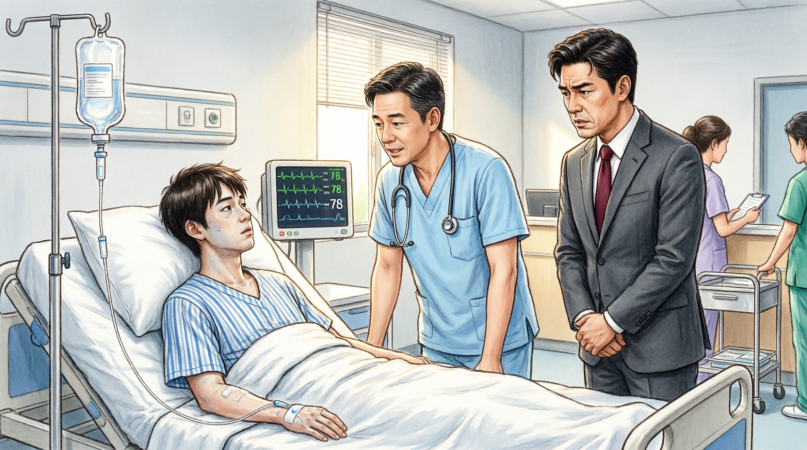
The call came at 3:47 a.m. on a Friday morning while I was sitting alone in my home office, reading through surgical schedules for the upcoming week. The house was quiet in the particular way only a house at that hour can be quiet, with the refrigerator humming in the kitchen and the soft ticking of an old brass clock on the bookshelf behind me sounding louder than it ever did during the day. I remember the exact minute because I looked at the phone before answering and felt my chest tighten the instant I saw the name on the screen. Ethan. My son was twenty-two years old, a graduate student at State University three hours away, and he never called me in the middle of the night unless something was seriously wrong. Ethan was many things—bright, independent, stubborn in the way young men often are when they are trying to prove to the world they can manage on their own—but he was not dramatic, and he was not the sort of person who reached for help lightly. By the time I swiped the screen to answer, some primitive part of my brain already knew the night had just split into a before and an after.
“Dad,” he said, and there was no mistaking the strain in his voice. It was tight, clipped, threaded through with pain. “I’m at Mercy General’s ER.”
I was already standing before he got to the next sentence.
“The doctor is refusing to treat me,” he said. “He says I’m faking my symptoms for drugs. I’ve been here for two hours. Dad, something’s really wrong. It hurts so bad I can barely stand.”
My keys were in my hand before I consciously remembered reaching for them. “Tell me exactly what you’re feeling.”
He took a shaky breath, and I could hear the effort it cost him. “It started around midnight. Sharp pain in my lower right abdomen. It’s gotten worse every hour. I’m nauseous. I threw up twice. I have a fever. I tried to explain all of it, but the doctor just kept asking about my drug history and looking at me like I’m some junkie.”
Lower right quadrant pain. Nausea. Vomiting. Fever. The words arranged themselves in my mind with terrifying clinical efficiency. After thirty-one years in medicine—twenty-three years as a general surgeon and eight as chief of surgery at St. Catherine’s Hospital—you do not hear that cluster of symptoms without seeing a differential diagnosis assemble itself immediately. Appendicitis. Acute appendicitis until proven otherwise. And if an emergency room physician had allowed two hours to pass without proper assessment and treatment, the situation could already be moving from urgent to catastrophic. An inflamed appendix could perforate. Perforation could lead to peritonitis, sepsis, shock, death. There are moments in medicine when time feels abstract, like something you measure in schedules and wait times and OR blocks. Then there are moments when you understand with perfect clarity that thirty minutes can be the difference between a routine laparoscopic procedure and a child-sized coffin.
“Who’s the attending physician?” I asked.
“Dr. Vance. Dr. Leonard Vance.” Ethan swallowed audibly. “He barely examined me. He did this quick palpation, barely touched my stomach, then told the nurse to give me Tylenol and discharge me. Dad, I’m not making this up. Something is wrong.”
I backed out of the driveway so fast the gravel sprayed under the tires. “Listen to me carefully. Do not let them discharge you. Tell them your father is Dr. Garrison Mills, chief of surgery at St. Catherine’s Hospital, and I am on my way. Do not leave that ER, Ethan. Do you understand me?”
A pause. Then, smaller: “Yeah.”
“If your appendix ruptures because they delayed treatment,” I said, hearing the controlled fury in my own voice, “people are going to lose their medical licenses.”
I ended the call and pointed the car toward the highway. The dark road ahead was empty, the dashboard glowing blue against my hands. I have spent my life believing in medicine, not in the naïve way laypeople sometimes imagine doctors do, but in the hard, earned way that comes from seeing what good medicine can save and what bad medicine can destroy. I have operated in the middle of the night on ruptured aneurysms, bowel perforations, gallbladders gone septic, appendixes that should have come out six hours earlier but did not because someone hesitated, someone missed a sign, someone assumed instead of examined. One of the things that had always made my blood boil was when physicians let bias override clinical judgment. I had seen it more often than I liked to admit. Young men with tattoos were more likely to be labeled drug seekers. Women with pain were more likely to be told they were anxious. Black patients were more likely to have their symptoms minimized. Poor patients were more likely to be judged before a single lab was drawn. Hospitals rarely liked to say this aloud, but medicine was not immune to arrogance, laziness, or prejudice. Sometimes it rewarded them.
And Ethan, my son, looked exactly like the kind of patient a lazy doctor might dismiss. Both arms sleeved in tattoos. Long hair. Nose ring. He had spent years curating an appearance that older men in starched coats often interpreted as a challenge. But Ethan had never touched hard drugs in his life. He was finishing a master’s degree in environmental science. He spent his weekends volunteering at wildlife rehabilitation centers, bottle-feeding orphaned fox kits and scrubbing cages at a raptor rescue outside campus. He wrote papers on wetland restoration and carried granola bars in his backpack because he worried about other students skipping meals. He was, in ways that embarrassed him whenever I said it aloud, one of the kindest human beings I knew. The thought of some smug ER physician taking one look at him and deciding he was a liar made my grip tighten around the steering wheel so hard my knuckles hurt.
The drive to Mercy General took me two hours and thirty-eight minutes. I know because I checked the clock each time I ended a call, and I spent nearly the entire drive on the phone. I called Ethan first, more than once, both to keep him from being discharged and to monitor the progression of his symptoms as best I could from eighty miles away. His pain was getting worse. He had trouble sitting upright. He felt feverish and weak. The nausea came in waves. At one point he said, in a voice he was trying and failing to keep steady, “Dad, it feels like something is tearing inside me.” That sentence lodged in my ribcage and stayed there.
Between calls to him, I started calling colleagues. Medicine is a smaller world than outsiders think. Give a doctor a name, a hospital, and fifteen minutes, and he can usually find someone who trained with that physician, worked with him, referred to him, or heard the stories people only tell each other in hallways and conference bars. I made three calls before I got the one that mattered. Dr. I. Simmons had worked with Leonard Vance years earlier and did not sound surprised when I told him why I was asking.
“Garrison,” he said flatly, “Vance is a lazy doctor coasting on credentials. He profiles patients. Makes snap judgments. Doesn’t do the diagnostic work if he thinks he’s already figured them out from across the room. I’ve heard he’s especially bad with young men. Assumes they’re all addicts looking for a fix.”
“Has he ever been disciplined?”
A humorless sound came through the speaker. “Complaints, yes. Consequences, no. Mercy has protected him. Administration settles quietly. Keeps things from becoming official whenever it can.”
“What kind of complaints?”
“Inadequate care. Dismissed symptoms. Delayed diagnoses. The usual pattern.” Simmons lowered his voice slightly, though there was no one else on the line. “If your son is as sick as you think he is, don’t waste time arguing. Get there. Get another physician involved. And document everything.”
When you have spent as much time in hospitals as I have, you develop an instinct not just for illness but for institutional failure. I did not like the sound of any of it. A physician with a pattern. Complaints that never stuck. Administration that preferred quiet settlements over formal accountability. A culture in which nurses’ concerns could be brushed aside. I had seen the machinery before. Medicine protects its own until public scandal makes that protection more expensive than discipline. The families left in the wake of that calculation seldom recover as neatly as the legal files suggest.
By the time I pulled into Mercy General’s parking lot at 6:31 a.m., dawn was just beginning to dilute the horizon into gray. The front entrance lights cast long reflections across wet pavement. I barely remember shutting off the engine. I only remember walking through the emergency department doors with my hospital ID clipped visibly to my coat and the kind of fury I have spent a professional lifetime learning to keep under surgical control. Emergency departments have their own atmosphere—too bright, too cold, too full of interrupted suffering. The air smelled faintly of antiseptic and burnt coffee. A child was crying somewhere beyond triage. A television mounted in the corner ran a muted morning news program no one was watching. It took me less than a minute to find Ethan because a nurse standing by the desk looked at my face and knew instantly I was not there for directions.
“He’s in the curtain bay on the left, near the back,” she said quietly.
I found him curled on his side on a gurney in a curtained alcove, pale and sweating, one arm wrapped across his abdomen as if instinct alone could protect the place that hurt. He looked younger than twenty-two in that moment. Not like a graduate student living three hours from home. Not like the self-sufficient young man who argued with me about conservation policy and laughed too loudly at bad movies. He looked like a boy trying not to cry in front of strangers. A nurse was taking his vitals, and when she saw me approach, she straightened.
“Sir, are you family?”
“I’m his father. Dr. Garrison Mills, chief of surgery at St. Catherine’s.”
Her eyes widened just slightly, then she glanced toward Ethan with unmistakable concern. “I’ve been worried about him,” she said in a lowered voice. “His fever has gone up to 102.3. His pain keeps increasing. I’ve asked Dr. Vance twice to reassess him, but he keeps saying the patient is exhibiting drug-seeking behavior.”
For a heartbeat I had to force myself not to turn around immediately and go looking for Vance. I stepped to Ethan’s bedside. His skin had that gray, damp cast I have learned to fear. He was holding his right side protectively, every movement careful and incomplete. “Ethan,” I said, keeping my voice level, “I need you to try to straighten out for me.”
He tried. The effort triggered a sharp gasp that seemed to rip straight through him. “Can’t,” he said through clenched teeth. “Hurts too much.”
I performed the gentlest palpation I could manage, and the moment my hand touched his right lower quadrant, he flinched so violently he almost came off the table. Rebound tenderness. Guarding. The involuntary rigidity of a body trying to protect an inflamed, contaminated abdomen. Five hours of progressive pain. Fever climbing. Tachycardia. The puzzle had assembled itself. This was not merely appendicitis. This was likely a ruptured appendix, maybe recent, maybe already spilling contamination into the peritoneal cavity. My mouth went dry.
“Where is Dr. Vance?” I asked.
The nurse hesitated only long enough to decide honesty mattered more than politics. “Room Four.”
I pulled the curtain aside and walked straight there. Through the open doorway I saw a man in his mid-forties in scrubs and a white coat, leaning casually against the counter, laughing with another physician while reviewing a chart. It struck me immediately how relaxed he looked. Not busy. Not burdened. Relaxed. The other physician glanced up as I approached, saw my expression, and stepped back without a word.
“Dr. Vance.”
He turned toward me with the lazy professional smile doctors reserve for impatient family members. “Yes? Are you a relative of one of the patients?”
“I’m Dr. Garrison Mills,” I said, “chief of surgery at St. Catherine’s Hospital. I am also the father of Ethan Mills, the twenty-two-year-old male you have been refusing to treat for the past five hours despite clear symptoms of acute appendicitis.”
The change in his face was almost surgical in its stages. First the smile vanished. Then confusion. Then recognition, as my name and title landed. Then something very close to fear. Color drained out of him. “Chief of surgery,” he said, almost under his breath. “I didn’t realize he was your son.”
I took a step closer. “You didn’t realize, or you didn’t care until you heard my title?”
He blinked. “He said his name was Ethan Mills. I didn’t connect—”
“That ‘Mills’ is a common surname? Or that it shouldn’t matter?” My voice stayed quiet, which was more effective than yelling would have been. “You are a physician. Your obligation is to assess and treat patients based on symptoms and findings, not appearance. My son presented with right lower quadrant abdominal pain, nausea, vomiting, and fever. That is appendicitis until proven otherwise. Instead of ordering labs, imaging, and a proper abdominal exam, you labeled him a drug seeker and prescribed Tylenol. Do you understand what you’ve done?”
He tried to gather himself, squaring his shoulders in that way mediocre men do when they want to borrow authority from posture. “Mr. Mills presented with vague complaints and a history inconsistent with serious pathology. His pain level seemed exaggerated, and he specifically asked for narcotic pain medication, which is a red flag for drug-seeking behavior.”
“Did he ask for narcotics,” I said, “or did he ask for pain relief after sitting in your emergency room for hours in agony?”
Vance’s jaw tightened.
“Did you run labs?” I asked. “Did you order a CT scan? Did you document a proper differential diagnosis? Did you perform a complete abdominal examination with assessment for rebound tenderness, guarding, rigidity, or peritoneal signs? Or did you take one look at a young man with tattoos and decide he was a junkie?”
He crossed his arms. “I used my clinical judgment based on fifteen years of experience. Not every patient with abdominal pain needs extensive imaging. Hospitals don’t survive by ordering CTs for everyone who claims they’re in pain.”
“Clinical judgment requires clinical assessment,” I said. “Show me his chart.”
There was the briefest pause—the pause of a man deciding whether refusal would incriminate him more than compliance—then he turned to the computer terminal. He pulled up Ethan’s file, and I scanned the notes. What I read made my hands start to tremble. Vital signs documented: elevated temperature, elevated heart rate, elevated respiratory rate. Objective signs of systemic illness. Then the physical exam note: Patient states he has abdominal pain. Mild tenderness noted on palpation. No obvious acute pathology. Patient appears to be exaggerating symptoms. Likely drug-seeking behavior. Prescribed acetaminophen 500 mg and recommended discharge.
That was it.
No full abdominal assessment. No notation of McBurney’s point tenderness. No rebound evaluation. No guarding. No rigidity. No labs. No imaging. No meaningful differential diagnosis. No justification beyond an assumption disguised as judgment. I looked up from the screen.
“This isn’t a medical assessment,” I said. “This is malpractice.”
His face flushed. “You can’t come into my ER and throw that word around because you disagree with a clinical decision.”
“This is not disagreement. This is negligence. Your own chart documents signs of systemic illness, and you did nothing with them.”
He opened his mouth again, but I was already taking out my phone. “I am calling Dr. Andrea Whitmore, chief of emergency medicine. I am requesting an immediate surgical consult for my son. And after that, I am filing a formal complaint with the state medical board about your negligent care.”
When I turned away from him, I heard him say my name, but I did not stop. Back in Ethan’s curtained bay, he was trying to sit upright and failing, his face pinched with pain. “Dad,” he said, “it’s worse.”
I put a hand on his shoulder. “I know. We’re getting you help right now.”
Andrea Whitmore answered on the third ring with the sharp alertness of someone who had spent decades being woken by emergencies. She and I knew each other professionally from conferences, joint committee work, and the small fraternity of physicians who still believed hospital administration should fear poor medicine more than bad press.
“Andrea,” I said, “I need you to listen carefully. Twenty-two-year-old male. Five-hour history of progressive right lower quadrant pain, nausea, vomiting, fever. No diagnostic workup completed. Symptoms consistent with acute appendicitis, likely ruptured or on the verge. The attending on duty is Leonard Vance, and he has been treating the patient as a drug seeker.”
There was a beat of silence, then a muttered curse. “I’m twenty minutes away,” she said. “I’m calling in Raymond Kowalski from general surgery right now to assess him. And Garrison…” She exhaled. “I’m sorry. Vance has been a problem for a while. We haven’t had enough documented incidents to force action. This may be the case that finally does it.”
Raymond Kowalski arrived in fifteen minutes, still zipping his jacket as he walked into the bay. He was young, maybe early thirties, with the kind of focused intensity I recognized immediately as the mark of a surgeon who took every patient personally. He introduced himself to Ethan directly—not to me, not to the chart, but to the patient first—then explained exactly what he was going to do before he touched him. Even in that small detail, the contrast with Vance was infuriating. Proper care is often not dramatic. It is simply attentive, systematic, humane. Kowalski examined Ethan thoroughly, and as he worked, his expression hardened.
“Significant rebound tenderness,” he said. “Guarding. Rigidity. McBurney’s point is exquisitely tender.” He looked at me. “Given the five-hour progression and the fever, I’m very concerned about perforation.”
“What do you want?” I asked.
“CBC, CMP, inflammatory markers, blood cultures if his temp climbs any higher. CT abdomen and pelvis with contrast, stat.” Then, after one glance back at Ethan, “Honestly, based on presentation, this is appendicitis until proven otherwise. The delay is the issue now.”
The machine of care finally lurched into motion. Blood was drawn. A line was hung. Orders were entered. Ethan was taken to CT. I stood beside the doorway of the imaging corridor and watched them wheel him away, one hand on the rail of the stretcher. He looked exhausted, scared, and insultingly young under the fluorescent lights. The anger I felt by then had split into two distinct things: the father’s terror, hot and immediate, and the surgeon’s cold recognition that this case was about to become evidence. Every minute without treatment. Every ignored nursing note. Every missing line in that chart. Every physiological sign Vance had chosen not to interpret correctly because his bias had offered him an easier story. Evidence.
The CT results came back forty-three minutes later. I did not need the radiologist’s report to know what I was seeing, but I read it anyway because words matter later. Ruptured appendix with adjacent free fluid. Inflammatory changes throughout the right lower quadrant. Findings consistent with acute perforated appendicitis and early peritonitis.
Andrea Whitmore had arrived by then. She was in her fifties, tall and spare, with steel-gray hair pulled back from a face that gave away almost nothing unless she wanted it to. She reviewed the images, closed the chart, and turned toward the nurses’ station where Vance was pretending to occupy himself with paperwork.
“Dr. Vance,” she said, loud enough for half the department to hear, “my office. Now.”
Then she looked at me. “Dr. Mills, we’re taking your son to surgery immediately. Dr. Kowalski will be attending. I’m bringing in Dr. Lisa Chen—” She stopped, corrected herself. “Dr. Lisa Warren to assist. One of our best general surgeons. Your son is going to be fine. But this should never have happened.”
They wheeled Ethan toward the OR at 8:15 a.m., nearly seven hours after his symptoms had started and almost seven hours after the period in which a straightforward appendectomy might have spared him far worse. I walked alongside the gurney, one hand wrapped around his. He looked up at me as the doors to the surgical corridor approached.
“Dad,” he said quietly, “I’m scared.”
I squeezed his hand. “I know. But you’re in good hands now. Dr. Kowalski is excellent. They’re going to fix this. You’re going to be okay.”
He swallowed, and his eyes shone in a way that told me he was still trying to be brave for my sake. “I wasn’t making it up,” he said. “I wasn’t faking for drugs.”
Click the button below to read the next part of the story.⏬⏬
Part2: My son called from the emergency room before dawn and said, “Dad, the doctor is refusing to treat me. He says I’m faking it for drugs.” When I got there, the doctor’s s…