The moment my marriage truly ended, my husband was standing in our marble kitchen telling me to stop grieving my father on schedule. My name is Sarah Miller, and for ten years I lived inside the manicured illusion of Greenwich, Connecticut, where old money softened everything except the cruelty that fed on it. To the outside world, Mark Reynolds and I were polished, enviable, the sort of couple photographed at charity galas and whispered about at country club dinners. He was handsome, magnetic, brilliant in the predatory way certain men are when the world keeps rewarding appetite. I was quieter, easier to underestimate, a woman with a fine arts degree tucked away behind a life of fundraising lunches, carefully chosen dresses, and the exhausting labor of making a ruthless man appear civilized. I had traded oils and canvas for hostess lists and seating charts because I believed, for far too long, that sacrifice was one of the dialects of love.
By the time my father died, the house had become a museum of temperature-controlled resentment. It was fifteen thousand square feet of curated wealth, mostly funded by my family’s money, though Mark loved to speak of it as if he had willed the stone and steel into existence himself. My father, a self-made tech mogul with a brutal instinct for fraud in all its forms, had always seen straight through Mark’s thousand-watt charm. He never started open wars over it. He simply watched, noted, and waited. Three weeks after the funeral, I was standing barefoot on the freezing kitchen floor holding my father’s old Patek Philippe, the one he wore so long the leather strap had molded to him like a second skin, when Mark finally stopped pretending to tolerate my grief. He tightened the knot of his Tom Ford tie in the reflection of the dark oven glass and snapped that my father would want us to move forward. The lawyers, he reminded me, were waiting for my signature on the transfer documents. We had an image to maintain, and my grieving daughter routine was becoming embarrassing.
He said it without looking at me for long, which made it worse. There was no anger in his face, only irritation, the cool disgust of a man delayed from reaching money he believed was already his. My father had left behind an estate worth fifty million dollars, and Mark had spent the last two weeks pushing for me to move it into what he called a joint family trust for tax purposes. Even then I knew the phrase was camouflage. Nothing in Mark’s world was ever for family if it could be for Mark instead. Rumors had already begun drifting through the country club about his increasingly obvious mentorship of Tiffany Vance, a younger real estate associate whose ambition was matched only by her greed. I stood there with tears drying on my face and understood with stunning clarity that my husband was not waiting for me to heal. He was waiting for me to sign. I didn’t fight. I didn’t accuse. I simply nodded, left him standing in the kitchen, and carried my father’s watch into the silence of the house.
That night, unable to sleep, I went into Mark’s office to print a shipping label. His laptop sat half-open on the desk, glowing faintly in the dark. On the desktop was a folder titled Exit Strategy. The arrogance of it took my breath first. The contents took everything else. Inside was a meticulous legal and financial plan laying out exactly how he intended to divorce me the moment the inheritance was transferred. Every step had been mapped. Every asset had been considered. Every advantage had been calculated. He meant to use my father’s death to fund the clean execution of my life.
Part 2: The File That Ended the Marriage
I did not confront him the next morning. By then confrontation felt vulgar, too intimate for what I had just learned. Confrontation belongs to people still hoping for truth, remorse, some last-minute revelation that the person they loved was merely frightened or stupid instead of fundamentally corrupt. I wanted no explanation from Mark. I wanted precision. While he was out at what he called a breakfast strategy meeting, I opened the drawers in his office and found an old iPad he had forgotten to unsync from his iCloud account. I sat behind his desk with the curtains drawn against the winter light and began to scroll through months of messages between him and Tiffany.
They were not just having an affair. They were curating my humiliation like a shared hobby. They joked about my grief. They mocked the way I still believed Mark when he said he was working late. Tiffany wrote that I was pathetic. Mark answered that once I signed on Monday, he would file on Tuesday. He promised her the five-carat ring she wanted, bought with my father’s signature. He told her I would not have enough left to hire a serious lawyer. Every line cut cleaner than the one before because it revealed not only betrayal, but appetite sharpened by contempt. He didn’t simply want out of the marriage. He wanted me stripped, legally cornered, and used up in the process.
I did not smash the iPad, though the urge trembled in my hands. I closed it carefully, like a surgeon closing a chest before moving to the next stage of the operation. Then I called the only man my father trusted more than his own instincts. Elias Thorne had been our family’s estate attorney for years, a brilliant, unsentimental strategist with a memory like a vault and the patience of a man who knows ruin can be made to arrive exactly on time. When he answered, I did not waste words. I told him it was time to trigger the contingency clause. I told him I wanted everything sealed off from Mark so completely that the man would be left grasping at air. Elias did not sound surprised. He sounded satisfied, almost relieved, as if my father had built this possibility into the architecture of my future long before I ever admitted I needed it.
The next forty-eight hours unfolded under the kind of secrecy that feels almost sacred. Elias’s team drafted decoys. Real documents disappeared behind layers of protection. The inheritance was rerouted into an offshore trust in Zurich, locked so far beyond Mark’s reach it might as well have been buried on the moon. I played my role flawlessly. I let him think grief had softened me into compliance. I let him hand me legal packets with that infuriating tone of managerial patience men like him use when they believe a woman is finally becoming sensible. On Sunday evening he came into the study smelling faintly of Tiffany’s jasmine perfume and held out a Montblanc pen.
“Sign the papers, Sarah,” he said, so sure of the ending he could barely contain the greed in his voice. “Let’s secure our future.”
I signed.
What Mark saw was surrender. What I actually signed was a wall. Fifty million dollars moved not into a joint family trust, but into a structure he could never touch, never contest meaningfully, never charm his way around. By the time he kissed the top of my head like a man blessing a docile wife, he had already lost everything he thought he was about to win
Part 3: The Last Night in Greenwich
Success made him reckless almost instantly. Certain the money would clear into our shared world within days, Mark began spending against it before it existed. He took out staggering bridge loans against his real estate firm to posture for Tiffany. He booked private flights, ordered bespoke suits, put down nonrefundable deposits on a penthouse in Tribeca, and moved through the week like a conqueror rehearsing his coronation. I watched the whole performance with a stillness that surprised even me. The colder I became, the more he relaxed. Arrogance is a marvelous anesthetic. It kept him from noticing that I was packing my life into three discreet suitcases while he was planning his victory lap.
The final rehearsal of his delusion came at the Greenwich Country Club spring gala. Mark stood under chandeliers with a glass of Macallan in one hand and Tiffany Vance tucked just a little too close against his side, speaking to our entire social circle as if the future belonged to him by divine grant. He toasted new beginnings, expansions, massive things coming to the Reynolds portfolio. His smile flashed. Tiffany leaned in, radiant with the confidence of a woman who believed she was about to inherit the spoils of another woman’s life. I stood a few feet away with sparkling water in my hand and let him talk himself deeper into fantasy.
When he paused for applause, I smiled and told him I had made sure everything was exactly where it belonged. He grinned as though I had blessed him. That was the kind of man he was. He could hear a warning as worship if it protected his ego long enough.
The night before my flight, I slept in the guest room. At dawn, my bags were already in the trunk of a black car idling in the circular drive. Before I left, I walked into the master bedroom one last time and placed a velvet Tiffany box in the center of his side of the bed. Empty. Beneath it sat a black folder dressed to resemble the final inheritance confirmation from the bank. What it actually contained was the beginning of his collapse. By the time he opened it, I planned to be in the air.
At 9:45 the next morning I was sitting in the First Class lounge at JFK, staring out at the tarmac while my heart pounded like a second engine under my ribs. Elias had arranged for a private investigator to monitor Mark’s movements in real time. The updates came in by text. At 9:50, Mark and Tiffany walked into the Tiffany & Co. flagship on Fifth Avenue. At 9:56, he was being obnoxious to staff. At 9:58, Tiffany had selected a yellow diamond ring that cost more than most people earn in years. I watched the clock on my phone tick toward ten and felt every nerve in my body sharpen into waiting.
At exactly 10:00, when the banks opened, I sent Elias one word. Execute.
Part 4: The Ten-Minute Collapse
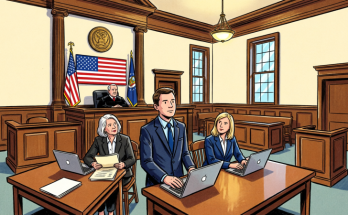
What happened next was not chaotic. It was exquisite. Elias’s team moved with the efficiency of people who understand that revenge is not screaming or smashing. Revenge, done properly, is timing. Every joint account Mark and I shared was closed at once. Every secondary card linked to my name died in the same instant. A judge, having reviewed the Exit Strategy file and the evidence of financial coercion, signed an emergency restraining order freezing Mark out of the Greenwich estate. The doors didn’t begin to close. They were already shut.
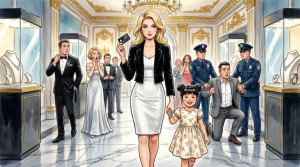
On Fifth Avenue, Mark threw the black card onto Tiffany’s velvet tray like a man performing wealth rather than spending it. She squealed, threw her arms around his neck, and told him she always knew she was the right woman for him. The clerk smiled politely and ran the card. Red light. Negative beep. He ran it again. Another refusal. Mark laughed the way men laugh when they are certain reality is having a temporary administrative glitch. He said fifty million had moved into the account that morning. He told the clerk to try again. The clerk checked the system, then looked up with a colder professionalism than retail usually allows.
The account had been closed ten minutes earlier. There was a fraud flag on Mark’s name. He had instructions to retain the card.
The clerk dropped the black card into a lockbox beneath the counter.
There are few things in life more beautiful than watching a predator discover he is not, in fact, the apex thing in the room. Mark shouted. Demanded a manager. Demanded his bank. Demanded recognition. Security began to move toward him. Tiffany, reading the sudden shift with the instinct of a woman who had attached herself to power rather than a person, backed away one small step at a time until she was no longer beside him at all.
At 10:05 my flight began boarding. I handed over my passport and walked down the jet bridge with a calm so complete it felt almost supernatural. By the time I fastened my seatbelt, Elias sent the final message I needed. Fifty million dollars had transferred successfully into the Zurich trust. The plane pushed back from the gate, engines roaring, and I looked out at the gray runway knowing Mark Reynolds had just lost the only future he had ever valued.
When his driver took him back to Greenwich, the estate gates no longer opened for him. The code had been changed. The pedestrian locks had been changed. On the immaculate cobblestone drive sat six heavy black trash bags containing his suits, his golf clubs, and his collection of watches. Taped to the top was the restraining order. He was locked out of the house his ego had mistaken for his own. He was shut off from the money he had already leveraged into bridge loans and private obligations. By the time he understood how deep the hole was, Tiffany had vanished entirely. Her number went dead. Her brokerage affiliation changed overnight. The mirror that once reflected his greed so flatteringly refused to hold his image once it stopped shining.
Part 5: London, and the Laws That Finished Him
I did not go to London to hide in luxury. That was Mark’s fantasy of women like me—that we simply drift from one upholstered cage to another, funded forever by someone else’s empire. I went to Chelsea, to a small light-filled studio I had purchased quietly in my own name months earlier with my own money. No family office. No marital structure. No credit line bearing Mark’s fingerprints. I unpacked my three suitcases, plugged in a cheap coffee maker, and slept fourteen hours in the kind of silence that does not feel lonely because it is finally free of surveillance.
The legal war that followed was short, brutal, and almost embarrassingly one-sided. Mark tried to sue for a share of the inheritance, but Elias destroyed the claim before it could properly stand up. The Exit Strategy file entered the record as evidence of premeditated fraud. The judge dismissed Mark’s case with prejudice. The same man who had mapped out my financial ruin now found himself caught inside documents he wrote with his own hands, trapped by the confidence that had once made him feel invincible.
As the months passed, private updates reached me from Elias and the investigator. Mark moved into a grim little rental on the outskirts of Stamford. The custom suits disappeared. The car went. The firm, leveraged against phantom wealth, collapsed under the weight of his own borrowing. He had no house, no Tiffany, no social sheen left to preserve. He called, emailed, tried every path still open to him. I remained digitally impenetrable. There are few luxuries more restorative than not answering a man who spent years treating your silence as entitlement.
Eventually Elias forwarded him something far crueler than any insult. It was a link to a British Vogue feature on a gallery opening in London. The photo showed me standing in front of one of my own paintings, expressionist and dark, a composition of consuming shadow cut through with one severe line of light. The piece was called The Parasite’s Shadow. It had already sold for one hundred thousand dollars. I had not simply survived him. I had resumed becoming myself, publicly and profitably, outside his frame of reference.
Somewhere in a cheap apartment, Mark read the divorce decree he had signed in panic and finally noticed the language Elias had woven into the fine print. Every bridge loan he took during those delusional days of anticipated inheritance remained solely and personally his. Nearly two million dollars. No assets to cover it. No wife to drain. No father-in-law’s legacy to consume. Only gravity at last doing what gravity does.
Part 6: The Inheritance That Was Never About Money
A year later, London tasted like rain and possibility. That is the only way I know to describe it. I stood on the narrow iron balcony of my Chelsea studio overlooking the Thames, holding my father’s Patek Philippe in one hand and feeling the cold evening air move through my lungs without obstruction for what felt like the first time in years. For a decade I had been folding myself smaller to fit inside Mark’s appetites, waiting for him to love me as much as he loved access. But my father had not built a fortune so I could be devoured by a husband with expensive ties and a predator’s smile. He had built it so I would never have to beg for my own sovereignty.
That understanding changed what I did with the money. I did not simply lock it away and live off the interest like a decorative exile. I used a substantial part of it to establish a foundation providing legal and financial support for women escaping coercive control and financial abuse. My father believed in architecture, in systems, in building things that held under pressure. He would not have wanted me merely rich. He would have wanted me armored, and useful, and able to build armor for others.
Updates about Mark came rarely by then and mattered less each time. One acquaintance saw him working as a low-level leasing agent for a strip mall developer in New Jersey, swallowed whole by a life so diminished it no longer deserved hatred. He had become ordinary in the saddest way possible: not humbled into grace, but hollowed into consequence. Tiffany was gone. The Greenwich persona was gone. The man who once paraded through gala rooms as if he owned the city now spent his days renting out mediocre retail space in an ill-fitting jacket.
One evening my assistant, a bright grad student from the Royal College of Art, looked up from her laptop in my studio and told me the foundation had just received an anonymous ten-million-dollar wire transfer. Her voice shook when she said it. Attached to the transfer was a note. Just one line.
Your father would be proud. Now, keep building.
I stood there with charcoal on my thumb and my father’s watch ticking against my wrist, and for the first time in that whole long year, tears came without bitterness. The final inheritance had never been the money itself. It was freedom. It was witness. It was the quiet, devastating knowledge that my father had seen further than I had, prepared further than I had, and loved me enough to make escape possible before I even understood how badly I would need it.
I smiled through the tears and turned back toward the canvases waiting in the evening light.
Because that was the real ending.
Not Mark’s fall. Not Tiffany’s disappearance. Not the Zurich trust, the courtroom, or the ruined bridge loans.
The ending was that I was mine again.
And this time, I intended to stay that way