He closed his eyes, and a tear slipped down his temple.
“Don’t,” he rasped. “You came.”
That night, while he slept, I sat in the hospital chair and tried to make sense of the impossible.
I kept seeing the dust on the wedding photo.
The expired milk.
The padlock.
The scraping sound.
And underneath all of it, the memory of Rachel’s voice on the phone weeks earlier—hysterical, shattered, convincing.
I’d heard real grief in my career.
Rachel had sounded like that.
Unless it was something else.
Unless she’d been performing.
The thought made my stomach turn.
Detective Morrison came back the next morning with an update.
“Your daughter is not in Riverside,” she said.
I stared at her.
“She’s… not?”
“We tracked her SUV,” Morrison said. “A traffic camera picked it up heading west two days ago. She may be out of state by now.”
My throat went tight.
“So she ran,” I whispered.
Morrison’s expression didn’t change.
“We’re working on locating her. We also pulled records related to the death certificate. There’s no Dr. Chen at County Medical who signed that form.”
My hands went numb.
“It was forged,” I said.
“It appears that way,” Morrison confirmed.
She slid a plastic evidence bag across the small table.
Inside was a crumpled piece of paper.
A receipt.
Hardware store.
Padlock. Chain. Screws.
Purchased three weeks ago.
The date made my skin prickle.
Morrison watched me carefully.
“Do you recognize the handwriting on the back?” she asked.
I leaned closer.
There were notes scrawled there—measurements, a list.
I recognized the sharp, neat style immediately.
Rachel.
My chest felt hollow………………………
“She always wrote like that,” I whispered.
Morrison nodded.
“We also have a name,” she said. “A man associated with your daughter recently. Derek Moss.”
The name hit me with a faint sense of familiarity.
“Her personal trainer,” I murmured, and nausea rose.
I’d met Derek once, months ago, at a charity 5K Rachel convinced me to walk with her. He’d been tan, smiling, the kind of man who looked like he spent his entire life in mirrors.
He’d shaken my hand and called me “ma’am” like he was charming someone on purpose.
Rachel had laughed at something he said, a bright, easy laugh I hadn’t heard from her in years.
At the time, I’d been glad she had someone keeping her active.
Now, the memory tasted bitter.
Morrison spoke again.
“We’re going to need you to think back,” she said. “Any time your daughter mentioned finances. Insurance. Property. Any conflict between her and James.”
I closed my eyes.
There had been tension.
Not screaming fights. Not the kind you can point to and say, there, that’s the moment everything broke.
But little things.
Rachel complaining James wasn’t “motivated.”
James getting quiet whenever money came up.
Rachel talking about “building the life we deserve,” as if life were something you could purchase if you tried hard enough.
I’d chalked it up to stress.
Now, every small memory felt like a piece of a larger picture coming into focus too late.
Two days later, the police arrested Rachel at a hotel in Los Angeles.
I didn’t hear it from the news first.
Detective Morrison called me.
“We have your daughter in custody,” she said.
I sat down so fast my knees nearly gave out.
Rachel.
In custody.
Across the country.
“With Derek Moss,” Morrison added. “He’s cooperating.”
I stared at the wall.
“What did you find?” I asked, voice thin.
Morrison exhaled.
“They had life insurance claim forms in her luggage,” she said. “Filled out. Ready to submit. They also had a burner phone with messages detailing a plan. And we recovered a laptop with a document that appears to be a fabricated note.”
My mouth tasted like metal.
“It was all planned,” I whispered.
“Yes,” Morrison said. “And we’re still untangling how many people were involved. There are payments. Transfers. A doctor. A funeral home.”
I closed my eyes.
My mind flashed to the closed casket.
The flowers.
The pastor’s gentle voice.
The sympathy cards.
And underneath all of it, James breathing in a basement.
I gripped the phone until my fingers hurt.
“What happens now?” I asked.
“Now we build the case,” Morrison said. “And we keep Mr. Hartley safe.”
When James was stable enough, the detectives interviewed him.
They didn’t do it like TV.
No harsh lights. No shouting.
They sat in his hospital room with a small recorder and spoke gently, like they were handling something fragile.
Because they were.
I sat in the corner, barely breathing.
James’s voice was still raw, but his mind was clear enough to remember.
And the story that came out of him made me feel like the floor had shifted under my life.
Rachel had been having an affair with Derek for months.
Not a flirtation.
Not a “maybe.”
A relationship.
Secret messages.
Stolen afternoons.
Plans whispered in gym parking lots.
James had suspected.
He confronted her.
According to him, Rachel didn’t cry.
She didn’t deny it.
She looked at him with a calm that scared him more than anger.
“She said she deserved more,” James told Detective Morrison, voice shaking. “She said I was dragging her down.”
The day it happened, James said Rachel offered him coffee.
“Like normal,” he murmured. “Like she was trying to make peace.”
He drank it.
Then his body went heavy.
The room tilted.
He remembered Rachel’s face above him as he slid out of consciousness.
Not panicked.
Not tearful.
Focused.
“She was talking on the phone,” he whispered. “I heard her say… ‘Now.’”
When he woke, he was in the basement.
His wrists were restrained.
His head pounded.
Rachel stood over him holding a small cooler.
“Don’t make this harder,” she told him, voice flat.
James swallowed hard.
“She said she wasn’t going to kill me,” he told the detective. “Not yet. She said she needed time. She needed me to sign things.”
Over the next days, she came down with paperwork.
The deed.
Account forms.
Documents he didn’t fully understand at first because his mind was foggy from whatever she’d given him.
If he refused, she left him in darkness longer.
If he begged, she smiled like it didn’t matter.
Derek came sometimes, James said.
Not every day.
But enough.
He’d hear footsteps overhead, laughter, music.
He’d hear the basement door open, and Derek’s voice—too cheerful, too careless.
“Man, you could’ve had it all,” Derek once told him, like James was a loser who’d missed a business opportunity.
James’s throat tightened as he spoke.
“I kept thinking of my mom,” he whispered. “Of Helen. Of you. I kept thinking… someone will notice. Someone will come.”
He scratched on the underside of the basement door with his nails when he could, careful not to draw too much attention.
He rationed his energy.
He listened.
He waited.
He survived.
“Sometimes I’d hear cars,” he told Morrison. “People leaving. People arriving. I’d try to call out but my voice… it was gone. And then I heard you. Above me. Calling Rachel’s name. And I thought… this is it. This is the last chance.”
He swallowed.
“So I scratched,” he whispered. “And I prayed you’d hear it.”
I covered my mouth, sobbing silently.
James looked at me.
“You did,” he said.
And I couldn’t tell if he meant that as gratitude or as a reminder of how close we’d come to losing him.
Detective Morrison asked him about the funeral.
James’s face tightened.
“Rachel told me she already had the doctor,” he said. “She told me she could make paperwork say anything. That nobody would question it because people believe what they want to believe. People believe a grieving widow.”
He paused.
“She told me there was a body,” he whispered. “Someone who wouldn’t be missed.”
My stomach rolled.
I thought of the closed casket.
Of the pastor saying, “We are gathered to remember James.”
Of me touching the wood and feeling comfort in its certainty.
God forgive us, I thought.
What did we bury?
As the case grew, more details surfaced.
Detective Morrison didn’t tell me everything at once. Maybe she thought it would break me.
Maybe she was right.
But pieces came out over time.
Rachel had paid a doctor ten thousand dollars to forge medical documentation.
She’d paid someone connected to a funeral home to move the process along.
She’d arranged a closed-casket service and leaned into grief as cover.
She’d staged a “note” on James’s laptop.
But she hadn’t wanted James dead immediately.
She needed signatures.
She needed time to funnel money out of joint accounts.
She needed to line up a new life before she cut the old one loose.
It was calculated.
It was cold.
And the part that haunted me most was how she’d used something sacred—mourning—to disguise it.
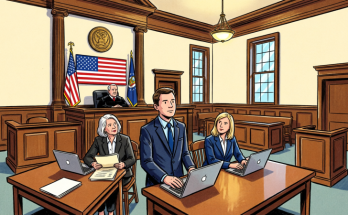
I attended the first hearing because James asked me to.
“I can’t do it alone,” he said, voice still thin.
So I went.
The courthouse smelled like metal detectors and old paper. The hallways were crowded with people who looked tired—families, lawyers, victims, defendants.
I’d spent years walking those hallways in my career.
This time, it felt like I was walking through someone else’s nightmare.
Rachel sat at the defense table in a neat blouse, hair brushed, face composed.
If you didn’t know what she’d done, she could have been any woman waiting for a meeting.
Her eyes met mine once.
There was no apology there.
No tears.
Just something guarded.
Like she was still choosing what story to tell.
James sat beside me, shoulders tense.
Helen sat on his other side.
James’s brother, Tom, stood behind us, jaw clenched.
The prosecutor spoke in measured terms—kidnapping, fraud, forgery, attempted murder.
The words sounded clinical.
But behind them was a man in a basement.
A mother at a funeral.
A spare key that almost didn’t get used.
Rachel’s lawyer tried to paint a different picture.
He talked about mental health.
About stress.
About marital conflict.
He suggested Rachel had been “trying to protect James from harming himself.”
Helen made a sound under her breath that could have cut glass.
James’s hand tightened around mine.
I stared straight ahead, forcing myself to breathe.
If I’d learned anything in my career, it was that courts are hungry for stories.
And whoever tells the most believable one wins.
Rachel had been counting on that.
But the evidence didn’t leave much room.
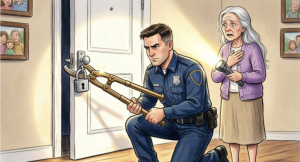
The chains.
The padlock.
The hardware receipt in her handwriting…………………………………..