Last night my son hit me. This morning I got out the lace tablecloth, baked biscuits, made grits with butter, fried eggs, browned sausages, and set out the good china as if it were Christmas.
When he came downstairs with that superior smile that had recently been chilling me to the bone and said, “So you finally learned,” I still hadn’t seen the man sitting at my table.
It wasn’t the hardest blow I’d ever received in my life.
But it was the most definitive one.
Because there’s a kind of pain that doesn’t come from the force of a blow, but from the truth that accompanies it. The truth that the person in front of you no longer sees you as a mother.
He no longer sees you as someone to protect, listen to, or even respect. He sees you as an obstacle.
Like a maid. Like a useful presence while she obeys, and disposable as soon as she says no.
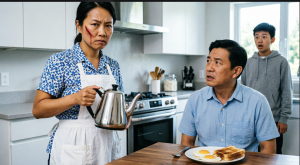
My son Ethan was twenty-three years old. He was almost ten centimeters taller than me, filled the door frames with his shoulders, and walked around the house with that restless energy of someone who no longer distinguishes between frustration and entitlement.
If someone had asked me six months earlier if I thought he would be capable of raising his hand to me, I would have answered no. I would have said he was going through a rough patch.
That he had lost a job. That the breakup with his girlfriend had upset him. That he had been angry at the world for too long and unwilling to admit it.
I defended him more than any sensible person would have.
I defended her shouting when she started talking to me as if I were a clumsy employee.
I defended his demands when he stopped asking me for things and started demanding them.
I defended the slammed doors, the broken dishes, the early mornings when I returned smelling of beer and resentment.
I even defended fear, although I never called it by its name.
I kept telling myself he was my son. That he was lost, not rotten. That if I was patient, if I didn’t shame him, if I gave him time, if I didn’t confront him in the wrong way, something in him would fall back into place.
Mothers are experts at calling what is already danger “hope.”
Last night, when I told him I wasn’t going to give him any more money, he looked at me with an expression I hadn’t seen him have as a child, or as a teenager, or even on his worst days.
It was a look that was both empty and hot, as if all its rage had been left speechless and needed to come out somewhere.
“Don’t talk to me like that,” I said, trying to keep my voice firm.
He let out a short, ugly laugh.
“Like what?” he asked. “Like the only person in this house who’s still doing something?”
That hurt more than I should admit. Because I was the one paying the mortgage, the electricity, the water, the gas for the car he used, the food he demanded, and even the parking tickets that mysteriously appeared in the mailbox.
I was the one still working half-days at the county library after knee surgery because the house couldn’t stay afloat. But logic is useless when someone has turned gratitude into humiliation.
“That’s enough, Ethan,” I said. “I’m not going to finance another night, another tantrum, another lie.”
And don’t you ever talk to me again as if I owe you anything.
I saw him tense up. It was barely a change in his jaw, a hardening around his eyes. A second later, his hand shot out and hit me on the side of my face.
He didn’t throw me to the ground.
It didn’t leave a scandalous mark on me.
There was no blood, no broken teeth, no cinematic scream.
There was silence.
The silence was so brutal that I felt the hum of the refrigerator and the ticking of the clock on the stove become enormous.
I stood with one hand on the counter, breathing slowly, because if I did anything else, I was afraid I would break right there.
Ethan looked at me as if he couldn’t believe what he had done… and then he did something even worse.
He shrugged.
As if that wasn’t the end of something.
As if I were going to absorb it, justify it, and carry on as always.
She stormed upstairs, slamming the door behind her. I stayed in the kitchen. I didn’t even cry right away. Crying would have meant I was still dwelling on my feelings.
And at that moment, the only thing I thought of was a phrase so simple that I was ashamed I hadn’t accepted it sooner:
I am no longer safe in my own home.
The lamp above the sink was still on. Outside, in the backyard, the motion-activated light illuminated the fence for a moment and then went out again.
The house looked exactly the same as always. The same paint on the wall. The same bowl of artificial lemons on the table. The same display cabinet with the china I almost never used. But something had changed forever.
At 1:15 in the morning, I went up to my room, sat on the edge of the bed and picked up the phone.
It had been ten years since I had called David Miller after midnight.
In fact, I had hardly called him at all for years.
David and I had been married for eighteen years.
We got divorced when Ethan was thirteen, after too much accumulated fatigue, too many disagreements turned into walls, too many ways of hurting each other without yelling.
It wasn’t a scandalous divorce, but it was a sad one. David moved two hours away for work.
Ethan, who was already entering that cruel age when pain needs easy culprits, decided that his father was one of them.
At first there were tense calls, cancelled visits, and increasingly long silences.
Then came the half-finished university studies, the poorly completed projects, the wrong friendships, the fury. And between father and son, a chasm remained so deep that neither knew how to bridge it.
I didn’t help either.
More than once I chose the peace of the day over the underlying truth. More than once I softened what Ethan was doing so that David wouldn’t react harshly.
More than once I hid how bad things were because I was ashamed to admit I was losing control of the situation. I thought that protecting Ethan from the consequences was still being his mother.
I didn’t realize that I was also protecting him from reality.
When David answered, his voice sounded thick and sleepy.
—¿Helen?
I wasn’t speaking and he was already fully awake.—What happened?
There was a pause. It was my turn to say it out loud. And saying it out loud made it real.
—Ethan hit me.
Not another word.
I didn’t have to explain the volume of the blow, the color of the fear, or the shame of that kitchen.
On the other end of the line, David stopped breathing for a second. Then he said, with a calmness that made me tremble:
—I’m leaving now.
I hung up and stared at the phone as if it were some unfamiliar object. I didn’t feel relief immediately. I felt something more difficult. I felt like a door had closed.
That there was no going back. That the next morning couldn’t resemble any other morning we had lived under that roof.
I didn’t sleep.
At four o’clock I turned on the stove. Not because I was hungry, but because I needed to do something with my hands. I took out flour, milk, and butter. I put water on for the coffee. I opened the glass cabinet.
Touching the fine china reminded me of old-fashioned celebrations, when Ethan was little and would ask why certain dishes only came out on special occasions. “Because there are days,” I would tell him, “that deserve to be remembered.”
That morning would be remembered.
Not for celebration.
By decision.
David arrived shortly after six. I saw him park in the driveway from the kitchen window.
He was wearing a dark coat, his hair was grayer than the last time I had seen him up close, and he had a brown folder under his arm.
When she came in, she didn’t ask pointless questions or offer empty comfort. She looked me in the face.
Then he looked at my hands. After that, he surveyed the kitchen as if he were surveying the battlefield.
“Where is it?” he asked.
-Sleeping.
She nodded. Her eyes rested on the set table, the lace tablecloth, the steaming coffee pot.
“You always did this when you were about to make a big decision,” he said.
I didn’t smile, but a part of me remembered that David knew me from before I became a woman who hid things.
“I didn’t want this to look like a fight,” I replied. “I wanted it to look like what it is.”
—And what is it?
I looked at the cups, the cutlery, the plate of freshly baked biscuits.
—The end of something.
David placed the folder on a chair and took a step closer.
—Helen, before I go downstairs, I need to ask you one thing. And I’m not going to question your answer. I just need to know. Do you want us to get him out of this house today?
He didn’t ask me if I still loved him. He didn’t ask me if I was sure. He didn’t ask me if I felt guilty. He asked the only thing that mattered.
I closed my eyes for a moment.
I thought of Ethan at eight years old, falling off a bicycle and looking for me before crying.
I thought of Ethan at twelve, proud of having cooked me overly salty scrambled eggs on Mother’s Day.
I thought of Ethan at seventeen, furious, hurt, convinced that the whole world owed him an explanation.
I thought about Ethan last night, hitting me and going upstairs like I was the problem.
I opened my eyes.
—Yes —I said—. Today.
David simply nodded, like a judge accepting a statement. He took the folder, opened it, and showed me what was inside.
There was a copy of the application for a protection order that a lawyer from his office had prepared at dawn.
There was a bank access transfer document so that Ethan couldn’t touch another dollar of my accounts.
There was a no trespassing notice already drafted, ready to be presented if he refused to leave.
There was also a folded brochure for a residential center forty minutes away, specializing in anger management, addiction, and domestic violence.
And above all, there was a blank sheet of paper with space for my signature.
It wasn’t a revenge folder.
It was a folder of reality.
“I’m not going to force you to use all of this,” David said. “But if you protect him again today, tomorrow will be worse. And next time, he might not just hit you.”
I looked down at the papers. The black ink seemed more honest than all the excuses I had made in the last year.
At ten past seven, we heard the stairs creaking.
Ethan arrived with messy hair, a gray t-shirt, his eyes still puffy from sleep, and that heavy way of walking that seemed like a challenge directed at the whole house.
She entered the kitchen smelling the coffee, looked at the plates, the tablecloth, the china, and a slow smile spread across her face.
“So you finally learned,” she said, grabbing a biscuit without asking my permission. “It’s about time.”
I didn’t answer.
I picked up the coffee maker and poured a cup in front of the occupied chair.
That’s when Ethan looked up.
The biscuit slipped from his fingers and fell onto the plate with a thud.
—What the hell is he doing here?
David sat upright, his hands clasped, his back straight, without a hint of theatricality. And yet his stillness filled the kitchen more than any shout.
“Sit down, Ethan,” he said.
My son didn’t move.
—I asked you what he’s doing here.
—And I told you to sit down.
David didn’t raise his voice. There was no need. I had forgotten that true control doesn’t always sound loud.
Ethan looked at me, searching for the usual crack, the space where I intervened to soften, postpone, or translate. He didn’t find it.
-Mother.
I didn’t answer.
—Sit down—I repeated.
It was a small word, but it came from somewhere new. Ethan noticed. I saw it in his eyes. David saw it too. After a tense second, my son dragged a chair and plopped down abruptly.
—This is ridiculous.
David slid the brown folder to the center of the table.
“The ridiculous thing,” he said, “is that you’ve come to believe you can terrorize your mother and still eat breakfast as if nothing’s wrong.”
“I didn’t terrorize her,” Ethan blurted out. “We had an argument.”
—Only spotted.
—It was a push.
—Only spotted.
—You don’t know what happened.
“I know exactly what happened,” David said. “And I also know everything that happened before.”
Ethan let out a bitter laugh.
—Of course. Now you’re coming across as a great father. After ten years.
David looked at him for a long time before answering.
—I’m not here to defend myself against you. I’m here for her.
That sentence did something strange to the room. It was as if, suddenly, the air itself changed hands. For years, Ethan had known how to divide us.
I turned back to myself, to David’s absence, and thus always maintained a place from which to manipulate history. But that morning there weren’t two sides fighting over him. There were two adults seeing clearly what he had done.
Ethan turned towards me.
—Did you call him to ambush me?
—I called your father —I said— because last night my son hit me and I finally understood that I couldn’t go on with this alone.
He remained still.
Perhaps it was the first time in months that he heard me without hearing fear or pleading in my voice.
David opened the folder and took out the first sheet
PART 2 — THE BREAKFAST DECISION
David opened the folder and took out the first sheet.
He didn’t rush. He didn’t look angry. That was the worst part.
He looked… finished.
“This,” he said calmly, sliding the paper toward Ethan, “is a protection order application.”
The words didn’t land immediately.
Ethan blinked, then laughed — that same ugly, dismissive laugh from the night before.
“You’re joking.”
No one laughed with him.
The kitchen stayed quiet.
Even the clock seemed to hesitate between seconds.
“You hit your mother,” David continued. “And today, you’re going to choose what happens next.”
Ethan leaned back in his chair, crossing his arms.
“Choose what?” he said. “You gonna call the police? Throw me out? Go ahead.”
He looked at me.
Waiting.
Waiting for me to soften it.
To interrupt.
To save him.
For years, I had.
That morning… I didn’t.
“I already called someone,” I said quietly.
That made him pause.
Not fear.
Confusion.
“What are you talking about?”
David didn’t answer. He simply reached into the folder again… and placed a small object on the table.
A key.
A simple, metal key with a red plastic tag.
Ethan frowned.
“What is that?”
“A room,” David said. “At a residential center. Forty minutes from here.”
Silence.
“You’re sending me to rehab?” Ethan scoffed. “I’m not an addict.”
“It’s not just for addiction,” David replied. “Anger. Violence. Accountability.”
Ethan’s chair scraped loudly against the floor as he stood up.
“This is insane.”
“No,” I said.
My voice surprised even me.
“It’s the first sane thing I’ve done in a long time.”
He turned to me, eyes sharp now.
“You’re kicking me out?”
“I’m giving you two options,” I said, holding his gaze.
“Option one: You take that key, you go there today, and you start fixing your life.”
I paused.
“Option two…”
David slid the second paper forward.
“…we sign this. And you don’t come back here again.”
Ethan looked between us.
For the first time…
I saw something crack.
Not guilt.
Not yet.
But something close to uncertainty.
“You wouldn’t do that,” he said.
It wasn’t confidence.
It was hope.
The same kind I had lived on for months.
I shook my head slowly.
“I should have done this sooner.”
He laughed again — louder this time, but there was something forced in it.
“You think this is going to fix anything?” he snapped. “You think I’m the problem?”
“No,” David said quietly.
“We think you’re responsible.”
That hit him.
Harder than any slap.
Ethan grabbed the key from the table and stared at it.
For a second, I thought…
Maybe.
Maybe he would choose it.
Maybe the boy I raised was still somewhere inside him.
Then he threw it.
It clattered across the kitchen floor.
“I’m not going anywhere,” he said. “This is my house too.”
David didn’t move.
But his voice changed.
Not louder.
Colder.
“No,” he said. “It isn’t.”
💣 FINAL PART — THE DOOR CLOSES
What happened next… was not loud.
There was no shouting.
No chaos.
Just consequences.
David stood up slowly and picked up the paper Ethan had ignored.
He placed it in front of me.
The blank line at the bottom stared back.
My name waiting.
My hand trembled slightly as I picked up the pen.
Not because I doubted the decision.
But because I finally understood what it meant.
This wasn’t just about removing him from the house.
It was about removing the illusion that love meant endless forgiveness.
I signed.
The sound of the pen scratching against paper felt louder than anything Ethan had ever broken in this house.
He stared at me.
Really stared this time.
As if seeing me for the first time.
“You’re serious,” he said.
I nodded.
“Yes.”
Everything after that moved quickly.
Too quickly for denial.
David made the call.
Not dramatic. Not emotional.
Just facts.
Within twenty minutes, there was a knock at the door.
Ethan’s confidence cracked the moment he saw who was standing there.
Not just one person.
Two.
Calm. Professional.
Unmoved.
“This is ridiculous,” he muttered, stepping back.
But he didn’t argue much.
Because for the first time…
The situation wasn’t something he could manipulate.
He went upstairs to pack.
I stayed in the kitchen.
I didn’t follow.
I didn’t help.
I didn’t stop him.
Each footstep above me felt like a chapter closing.
Not just his.
Mine too.
When he came back down, he had a small bag slung over his shoulder.
Smaller than I expected.
As if part of him still believed he would be back.
He stopped near the door.
Didn’t look at David.
Didn’t look at the officers.
He looked at me.
“You’re really choosing him over me?”
That question…
It could have destroyed me a week ago.
But now, I saw it clearly.
This wasn’t about choosing one person over another.
It was about choosing reality over denial.
“I’m choosing myself,” I said.
“And I’m choosing the version of you that doesn’t hurt people.”
He didn’t respond.
Not with anger.
Not with apology.
Just silence.
Then he turned…
And walked out.
The door closed softly behind him.
No slam.
No drama.
Just a quiet, final sound.
The house didn’t feel empty.
It felt… still.
Like something toxic had finally been removed from the air.
David stood beside me, not saying anything.
He didn’t need to.
We both knew this wasn’t a happy ending.
It was a necessary one.
I walked back to the table.
The coffee was cold.
The biscuits untouched.
The lace tablecloth slightly wrinkled.
A breakfast prepared for a moment that had already passed.
I sat down.
And for the first time in months…
I allowed myself to cry.
Not because I had lost my son.
But because I had finally stopped losing myself.
👉 “Related Story” or “What happened next…”
“My daughter locked me out of my own house… but she forgot one thing I still had.”
It was raining the night my daughter told me I didn’t live there anymore.
Not shouting.
Not a fight.
Just… a sentence.
“You should stay somewhere else tonight.”
At first, I thought she was joking.
Because this was my house.
The one I bought with my husband before he died.
The one where I raised her.
The one where every wall still carried pieces of our life.
But she didn’t smile.
She stood there in the doorway, arms crossed, keys in her hand, like a stranger who had rehearsed this moment too many times.
“I mean it, Mom,” she said. “You need to go.”
I remember looking past her into the living room.
The lamp was on.
The couch I picked was still there.
The photo of her at eight years old — missing her front tooth — still sat on the shelf.
Everything was the same.
Except… I wasn’t welcome anymore.
“Did I do something?” I asked.
She let out a slow breath like she was tired of explaining something obvious.
“You don’t get it, do you?”
That tone.
That same tone I used to hear when she was a teenager — frustrated, sharp, full of something deeper than anger.
But this time… it wasn’t a phase.
“I’ve been taking care of you for years,” she continued.
“Paying bills, fixing things, dealing with everything. And you just sit here like nothing’s changed.”
I blinked.
“Taking care of me?” I repeated softly.
I was the one paying the mortgage.
The one covering groceries.
The one who still woke up early to clean, cook, maintain the house after my arthritis started getting worse.
But somehow… in her version of reality, I had become the burden.
“I’m tired, Mom,” she said.
“I want my own life.”
There’s something people don’t tell you about motherhood.
It’s not the screaming, or the sleepless nights, or the sacrifices that break you.
It’s the moment your child rewrites the story…
and you realize you don’t exist in it the same way anymore.
“So what are you saying?” I asked quietly.
“I’m saying you should find somewhere else to stay,” she replied. “Just for a while.”
“For how long?”
She hesitated.
That hesitation told me everything.
I looked at her hand.
She was holding my house keys.
“Give me my keys,” I said.
“No.”
Just that.
No explanation.
No apology.
“Emily,” I said, trying to stay calm. “This is my home.”
She stepped outside and pulled the door halfway closed behind her.
“Not anymore,” she said.
And then…
She locked it.
I stood there in the rain for a long time.
Not because I didn’t know what to do.
But because my mind refused to accept what had just happened.
At some point, I walked down the street.
I didn’t have my purse.
Didn’t have my medication.
Didn’t even have a jacket.
Just the clothes I was wearing and the sound of rain following me like a memory.
I ended up sitting under the bus stop shelter three blocks away.
It smelled like wet concrete and old cigarettes.
I sat there… and I thought about all the times I had protected her.
All the times I said:
“She’s just stressed.”
“She didn’t mean it.”
“She’ll come around.”
Mothers are experts at turning warning signs into excuses.
Around midnight, I reached into my pocket.
And that’s when I felt it.
Something small.
Cold.
Metal.
I pulled it out slowly.
And I almost laughed.
Because Emily had taken my keys…
But she forgot one thing.
The spare key.
Not the one for the front door.
Not the one she knew about.
The old one.
The one my husband had made years ago…
For the back entrance.
The one I never told her about.
I stared at it in my hand while the rain kept falling.
And for the first time that night…
I didn’t feel helpless.
I felt something else.
Something I hadn’t allowed myself to feel in years.
Clarity.
Because suddenly, this wasn’t just about getting back inside the house.
This was about something much bigger.
I stood up.
Walked back slowly.
Quietly.
The lights were still on.
The house looked warm from the outside.
Like nothing had changed.
I walked around to the back.
My hands were shaking… but not from the cold.
The key slid into the lock easily.
Too easily.
I paused.
Because I knew…
Once I turned it,
there would be no going back to pretending everything was okay.
I opened the door.
The house was silent.
I stepped inside.
Closed the door behind me.
And that’s when I heard it.
Voices.
Not just hers.
A man’s voice.
Low. Laughing.
Comfortable.
I moved closer.
Slowly.
Carefully.
And then I saw them.
In my living room.
On my couch.
Emily…
and a man I had never seen before.
But that wasn’t what made my stomach drop.
It was what she was saying.
“This will be easier once she’s gone for good.”
I froze.
Because suddenly…
I understood something I hadn’t even considered before.
This wasn’t about space.
This wasn’t about independence.
This was about…
getting rid of me.
“…and that was the moment I realized my daughter had already decided my future.”
I didn’t move.
I didn’t breathe.
I just stood there in the hallway, my hand still on the wall, listening to my own house… like I was the intruder.
“This will be easier once she’s gone for good.”
Emily’s voice didn’t shake.
It didn’t sound angry.
It sounded… practical.
The man laughed softly.
“You’re sure she won’t fight you on it?”
“She won’t,” Emily replied. “She never does.”
That sentence hit harder than anything she had done that night.
Because she was right.
For years… I didn’t.
I stayed silent when she disrespected me.
I stayed calm when she raised her voice.
I stayed patient when she crossed lines no child should ever cross.
I called it love.
She called it weakness.
I stepped back quietly.
Every instinct in me wanted to run… to leave… to pretend I hadn’t heard anything.
But something inside me… something that had been asleep for years…
finally woke up.
I turned and walked back to the kitchen.
My hands were steady now.
Too steady.
I reached for the drawer.
The one next to the stove.
Inside, beneath old receipts and rubber bands…
was a small folder.
Documents.
Papers I had prepared months ago…
but never had the courage to use.
Because deep down… I always believed she would change.
I picked them up.
Closed the drawer.
And walked back toward the living room.
This time…
I didn’t hide.
I stepped into the light.
Emily froze.
The man beside her sat up straight, confused.
For a second…
no one spoke.
Then Emily’s face changed.
Not fear.
Not guilt.
Annoyance.
“You’re back?” she said flatly.
I looked at her.
Really looked at her.
And for the first time…
I didn’t see my little girl.
I saw a stranger sitting in my house.
“Yes,” I said calmly. “I’m back.”
She rolled her eyes.
“You shouldn’t be here.”
I stepped forward.
Placed the folder on the table.
“Neither should he,” I replied.
The man stood up slowly.
“Maybe I should—”
“No,” Emily cut him off. “Sit.”
He hesitated… then sat back down.
I opened the folder.
Spread the papers across the table.
“I heard everything,” I said.
Silence.
Then Emily laughed.
Not nervous.
Not defensive.
Confident.
“Good,” she said. “Saves me the trouble of explaining.”
Something inside my chest… broke.
Not loudly.
Not violently.
Just… quietly.
“And what exactly were you planning?” I asked.
She leaned back.
Crossed her arms.
“To sell the house,” she said.
My heart skipped.
“It’s not yours to sell,” I replied.
She smiled.
“That’s where you’re wrong.”
She reached over… and picked up one of the papers from the folder.
Not mine.
Hers.
A document I had never seen before.
“You signed it,” she said.
My stomach dropped.
“I never—”
“Yes, you did,” she interrupted.
“Three months ago. Remember? When you had that flare-up and couldn’t even hold a pen properly?”
I remembered.
The hospital visit.
The medication.
The blurred days.
“You said it was insurance paperwork,” I whispered.
Emily tilted her head.
“I said it was important.”
The room felt like it was closing in.
“You tricked me…” I said.
“No,” she replied calmly. “I used what you gave me.”
She tapped the paper.
“Power of attorney.”
My knees almost gave out.
“And once the house is sold,” she continued, “you’ll be placed somewhere comfortable. Don’t worry… I’m not heartless.”
Comfortable.
Like I was furniture.
Like I was something to be relocated.
The man beside her shifted uncomfortably.
“You didn’t say it was like this…” he muttered.
Emily didn’t even look at him.
“This is exactly what it is,” she said.
I stood there.
Holding onto the edge of the table.
And in that moment…
everything became clear.
This wasn’t sudden.
This wasn’t emotional.
This was planned.
For months.
By my own daughter.
I took a slow breath.
Then I did something she didn’t expect.
I smiled.
A small one.
But real.
Because for the first time in years…
I wasn’t confused.
I reached into the folder.
Pulled out the last document.
And slid it across the table.
Emily glanced down.
Her expression didn’t change at first.
Then…
it did.
“What is this?” she asked.
“A correction,” I said.
She read it again.
Faster this time.
“No…” she whispered.
The man leaned over.
His eyes widened.
“You transferred it?” he asked.
I nodded.
“Two months ago.”
Emily looked up at me.
“You couldn’t have—”
“I could,” I said. “And I did.”
Silence filled the room again.
“The house…” I continued, “is no longer in my name.”
Her face went pale.
“And not in yours either.”
She stood up abruptly.
“Then whose is it?!”
I held her gaze.
“For sale,” I said softly.
Her breath caught.
“And the money?” she demanded.
I paused.
Then answered.
“Already allocated.”
“To where?”
I didn’t look away.
“To a residential program.”
She blinked.
“Not for me,” I added.
Silence.
Heavy.
Unavoidable.
“For you.”
The man stepped back.
“Emily… what is she talking about?”
Emily shook her head.
“No. No, you can’t—”
“I can,” I said.
My voice didn’t rise.
It didn’t need to.
“You wanted control,” I continued.
“You wanted to decide where I go, how I live, what happens to me.”
I took a step closer.
“So I made a decision first.”
Her hands were shaking now.
“You can’t force me into anything.”
I tilted my head slightly.
“No,” I said.
“But I can stop protecting you.”
That hit.
Hard.
Because that’s what this had always been.
Protection.
And I had just taken it away.
The man grabbed his jacket.
“I’m out,” he said quickly.
Emily didn’t stop him.
She just stared at me.
“You’re choosing this?” she asked.
I looked around the house.
One last time.
Then back at her.
“No,” I said.
“I’m choosing myself.”
I walked past her.
Toward the door.
And for the first time…
she didn’t try to stop me.
Behind me, I heard her voice.
Small.
“Mom…”
I paused.
Just for a second.
Then I kept walking.
Because some endings…
don’t need to be softened.
They need to be final.