The phone rang at exactly 8:00 on a wet Tuesday morning, and that alone was enough to make my heart kick once against my ribs.
At my age, people do not call early unless somebody is dead, dying, or too selfish to know the difference.
I was standing in my kitchen in Portland, holding a chipped blue coffee mug and staring out at the rain sliding down the window above the sink. The maple tree in my backyard looked blurred and ghostly through the glass. My house was too quiet, the way it had been for three years now, ever since my daughter Isidora died and took the noise of family life with her.
The phone rang again.
I set the mug down. The coffee trembled inside it.
“Hello?”
“Wyatt, it’s Clyde.”
My son-in-law sounded breathless, irritated, and in a hurry, as if my voice were an obstacle standing between him and whatever mattered more. That had become his tone with me after Isidora’s funeral—tight, clipped, permanently armored.
“Clyde,” I said. “Everything all right?”
“No. I need a favor. Big one.”
There was a car door slamming in the background. Wind. An engine. I pictured him talking with one hand on a steering wheel, already halfway gone before I had agreed to anything.
“What kind of favor?”
“Emergency trip to Seattle. Client crisis. I need you to take Zach for a week. Maybe less.”
For one bright instant, my chest warmed.
My grandson.
I barely saw the boy anymore. After Isidora died, Clyde had begun finding reasons to keep distance between us. Scheduling conflicts. School. Sports. Illness. Too much homework. The excuses changed, but the result was always the same.
“Of course,” I said quickly. “You know I’d love to have him. Bring him over. I’ll make up the guest room.”
“I’m already on my way. Thirty minutes.”
“Wait,” I said. “Does he need anything? Clothes? Medicine? How’s school? Is there—”
But the line had gone dead.
I stood still, listening to the empty buzz.
Thirty minutes later, tires squealed in my driveway so hard I nearly dropped the coffee mug all over the kitchen floor.
By the time I got to the front door, Clyde’s Mercedes had stopped crooked by the curb, engine still running. He got out only long enough to yank open the back door. Zach climbed out slowly, clutching a backpack so overstuffed it looked bigger than his torso.
“Hey,” I called. “Come in for coffee. We’ve got time.”
“Can’t,” Clyde said, already moving backward. “Flight at noon.”
He never met my eyes. Not once.
“Zach, be good for Grandpa.”
The boy nodded.
“Clyde,” I said sharply, stepping off the porch. “Hold on. Does he need any medication? Is there a school packet? What’s going on in Seattle?”
“He’s fine,” Clyde snapped. “Everything’s in the bag. I’ve got to go.”
The car door slammed. The tires spun again. Then he was gone, disappearing down the street so fast it looked less like travel and more like escape.
I looked down at the child standing on my porch.
Ten years old. Thin. Quiet. Shoulders drawn inward like he was trying to disappear inside his own bones.
I forced a smile.
“Well, buddy,” I said softly, “looks like you’re stuck with me.”
He gave me a tiny nod.
I bent and hugged him, and the first thing I noticed was how little there was of him.
His shoulders felt narrow as broom handles under my hands. Not a growing boy’s sturdy frame. Bird bones. Fragile. Light.
Something cold and old slid into my stomach.
Still, I stepped back, kept my voice cheerful, and said, “You hungry? I was thinking pancakes. Chocolate chip. Your mom used to say my pancakes could make a saint sin.”
At the mention of his mother, something flickered behind his eyes—grief, maybe, or memory—but it vanished so fast I could have imagined it.
He nodded again.
Inside, I set his backpack by the hall table and headed for the kitchen. I reached for my old mixing bowl, the white ceramic one with a chip on the rim. Isidora used to tease me that I kept it only because I was sentimental and cheap in equal measure.
Maybe she was right.
I cracked eggs into the bowl and spoke over my shoulder, because silence with a child can feel too heavy unless you stir a little life into it.
“Your mom loved these pancakes,” I said. “Used to eat six at a time when she was your age. I thought I was raising a daughter, but really I was raising a raccoon in human form.”
No answer.
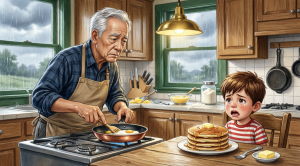
I added milk, flour, cinnamon, extra chocolate chips. I turned, smiled, and found Zach sitting at the table with his hands folded in his lap, staring so intently at the empty plate in front of him that my smile faltered.
The batter hissed when it hit the pan.
I made the first pancake perfectly. Golden brown, crisp around the edge, soft in the center. The second and third followed. Soon I had a stack high enough to make any ten-year-old grin.
I set the plate in front of him with butter melting down the sides and syrup soaking into every layer.
“There we go,” I said. “Eat before they get cold.”
He did not move.
He just stared at the pancakes.
“Buddy?” I asked lightly. “What’s the matter? Don’t tell me you’ve gone healthy on me.”
Nothing.
I pulled out the chair across from him and sat down.
“Zach.”
Slowly, he looked up.
He had Isidora’s eyes. Dark brown, solemn, too expressive when she was little and too guarded by the time she was grown. But what I saw in them now was something I had spent thirty-two years recognizing in other children’s faces.
Fear.
Not fear of me.
Fear of the food.
His voice came out as a whisper so faint I nearly thought it was the house settling.
“Am I allowed to eat today?”
My entire body went cold.
The spatula slipped out of my hand and hit the stove with a metallic clatter.
“What?”
His mouth trembled.
“Am I allowed,” he repeated, and then his face crumpled all at once, “to eat today?”
He burst into tears.
Not loud tears. Not dramatic ones.
Those are the tears children cry when they still believe an adult might comfort them.
These were different. These were the tears of a child who had learned crying was dangerous and could not hold it in one second longer anyway. His shoulders shook violently. He gripped the edge of the table with both hands as if the room itself were tipping beneath him.
Steam rose from the pancakes between us.
Rain tapped at the kitchen window.
And I sat frozen, staring at my grandson while thirty-two years of social work training roared back into my body like a fire finding oxygen.
I had interviewed abused children in kitchens like this one.
I had watched them say impossible things in impossible tones.
I had seen bruises under sleeves, malnutrition under oversized shirts, terror hiding inside good manners.
But never—never—had the child at the center of that moment had my daughter’s eyes.
I took a breath. Another. Wiped my hand on a dish towel because it had started to shake.
Then I sat down across from him and made my voice gentle.
“Zach,” I said, “you can always eat here. Do you understand me? Always.”
He stared at me, crying hard enough now that his breath hitched.
“I made these for you. Nobody is going to take them away.”
That did it.
His fork clattered against the plate as he grabbed it, and then he ate as though he had been underwater and food was air.
He didn’t taste. He devoured.
Syrup ran down his chin. He barely chewed. He finished the first three pancakes in less than a minute and reached for more before he had swallowed the last bite.
I got up and brought the rest of the stack.
He ate all of them.
Then he looked at the empty plate like he was ashamed.
“Do you want more?” I asked.
He hesitated, then nodded.
I turned back to the stove so he wouldn’t see my face.
Because in that moment, I already knew two things with terrifying certainty.
First, that something was very wrong.
And second, that I was about to stop being a retired man and become a dangerous one.
I had retired from Child Protective Services at sixty-five with a bad back, mild hypertension, and the kind of fatigue that seeps into your marrow after three decades of seeing what people can do to children.
Most men my age took up golf.
I took up quiet.
I had earned it, I thought.
For thirty-two years I had walked into apartments that smelled like mildew and whiskey, into houses where wallpaper peeled over black mold, into kitchens with empty refrigerators and living rooms with broken locks and bruised children sitting too still on too-small couches. I knew every flavor of lie a parent could tell. I knew what fear sounded like when it dressed itself as shyness. I knew how hunger changed the way a child moved around food.
And I knew, before Zach finished his fourth pancake, that I had seen this pattern before.
I put a glass of orange juice in front of him.
“Take your time,” I said.
He nodded without looking up.
I leaned against the counter and asked the question carefully, gently, the way I had asked it a thousand times before without sounding like a trap.
“When’s the last time you had pancakes, buddy?”
He swallowed.
“A long time.”
“Yeah? What do you usually eat for breakfast?”
He stared at the plate.
“Sometimes cereal.”
“Sometimes?”
He took a breath that rattled in his chest.
“If my homework was right. Or if my room was clean. Or if I didn’t talk back.”
I gripped the edge of the counter.
“And if those things weren’t right?”
He kept his eyes down.
“Then I wait till lunch at school.”
The rain outside grew heavier, drumming against the house.
I made another batch while he ate.
“How often does that happen?”
He counted on syrupy fingers.
“Two. Three. Sometimes four.”
“A week?”
A nod.
My throat tightened.
I set a fresh pancake on his plate.
He looked up at me like he could not believe there was still more.
Something in me cracked.
“Eat,” I said softly.
He did.
After breakfast, I told him to take a hot shower and change into clean clothes. I said it casually, like any grandfather might, but really I needed time to think and I needed, if possible, a closer look.
His backpack held only three outfits, one toothbrush, no pajamas, and a math workbook with dog-eared corners. No allergy medicine. No extra shoes. No comfort item. Nothing that said someone expected a child to be away from home for a full week.
That bothered me more than I wanted to admit.
While the shower ran upstairs, I stood in the kitchen staring at the sticky plate, the empty juice glass, the fork bent slightly from how hard he had held it, and I felt the old machinery of my mind begin turning again.
Document.
Observe.
Do not assume.
But act.
I moved through the house with a steadiness that did not match the violence in my chest. I took my phone from my pocket and opened a fresh note.
Tuesday, 8:53 a.m.
Subject: Zachary Garrett.
Age: 10.
Initial observations: thin appearance, hypervigilant behavior around food, verbal statement: “Am I allowed to eat today?” followed by intense emotional response. Consumed large quantity of food rapidly. Possible food restriction at home.
Then I stopped typing.
Subject.
The word made me sick.
I deleted it.
My grandson.
I kept writing.
When the shower stopped, I waited in the hallway with a towel draped over my shoulder like I was there by accident.
“Need anything, buddy?”
The bathroom door opened a crack. “No, Grandpa.”
“Okay.”
As he turned back toward the mirror, his shirt rode up and I saw it.
Bruises along the inside of his upper arm.
Not one bruise.
Several.
Old yellowing marks layered beneath newer purple-green ones, roughly oval, exactly where adult fingers would wrap around a child’s arm to restrain, drag, or shake.
My vision narrowed.
I did not move. Did not gasp. Did not let him see that I had seen.
“Take your time,” I said. “I’ll put clean towels in the guest room.”
“Okay.”
I went downstairs, sat at the kitchen table, and pressed my palms flat against the wood until the wave of anger passed enough for me to think again.
It did not pass completely.
It just became useful.
I called my son in Japan.
Isaac answered on the seventh ring with a voice thick from sleep and military fatigue.
“Dad? What’s wrong?”
“When did you last see Zach?”
A pause. “What?”
“When.”
“Christmas, maybe? Why?”
“He’s here. Clyde dropped him off for a week.”
“That’s good, isn’t it?”
“No.”
Silence on the line.
I looked toward the staircase, lowered my voice, and said, “He asked me if he was allowed to eat today.”
Isaac woke up instantly.
“What?”
“You heard me. And he’s thin. Too thin. I saw bruises on his arms.”
“Jesus Christ.”
“I need a lawyer.”
“How much?”
“Five thousand to start.”
“Done.”
I shut my eyes.
“Isaac.”
“Yeah?”
“I think your nephew’s being abused.”
There was a long silence across the Pacific.
Then my son said, with terrifying calm, “Save him.”
“I intend to.”
When I hung up, I went to my office.
At the very back of the bottom drawer, under old tax returns and expired warranties, lay the two things I had not touched since retirement: my worn composition notebook full of field protocols and my old leather badge holder, empty now but still molded to the shape of authority.
I picked up the notebook.
The cover was soft from years of use.
Inside were pages of my handwriting—intake templates, interview reminders, timelines, body-map sketches, phrases to avoid, signs of coercive control, trauma-informed approaches, everything my life had once required me to remember.
I turned to a blank page and wrote at the top:
Case File: Zachary Garrett
Then I stared at it.
Drew one hard line through Case File.
And wrote above it:
For Isidora’s Son
The first mistake I made was on Wednesday.
The first good thing I did was wait until Thursday to admit it.
Children tell you the truth when they feel safe. Every good social worker knows that. Push too hard and they vanish behind whatever walls helped them survive.
I knew this. I had taught it. I had corrected rookies who forgot it.
And still, on Wednesday afternoon, I let my fear outrun my patience.
Morning had gone quietly enough. I made scrambled eggs, toast, and sliced strawberries. Zach ate every bite with the same concentrated urgency he had shown with the pancakes. Not frantic this time. Just careful, fast, and watchful, like a boy who had learned food could disappear if he did not claim it soon enough.
After breakfast, I suggested we spend the day inside because the rain had turned cold and heavy. He nodded. That seemed to be his safest word.
He sat at the coffee table with paper and colored pencils. I sat nearby pretending to read War and Peace, though the book I held was really an old trick from the field: I had hollowed out the center years earlier to hide a small digital recorder during hostile interviews.
I was retired. I was in my own home. I had no legal right to conduct an investigation.
But I also knew how quickly stories change when abusers realize somebody is paying attention.
The recorder caught the soft scrape of colored pencils and the patter of rain.
“What are you drawing?” I asked.
“My house.”
I leaned forward.
The picture showed a square structure in black and gray, every window shaded dark, no people outside, no sun, no grass, only a front porch and a door drawn with heavy downward pressure, over and over, as if the door mattered more than the house.
“That’s a serious-looking place,” I said gently.
He shrugged.
“Do you like living there?”
Another shrug.
Silence stretched. I should have left it alone.
Instead, I said, “Can I ask about those bruises on your arm?”
The change in him was instant.
His entire body stiffened. His face flattened. His eyes dropped.
I felt the failure before he even spoke.
“I don’t want to talk about it.”
“That’s okay,” I said too quickly. “You don’t have to be scared.”
“I’m not scared.”
“You can tell me if your dad grabbed you.”
He stood so fast the colored pencils rolled off the table.
“I said I don’t want to talk about it!”
He ran to the guest room and slammed the door hard enough to rattle the picture frames in the hallway.
I sat there, staring at the recorder hidden in a Russian novel, and wanted to swear at myself.
Thirty-two years of experience, and in one stupid burst of panic I had sounded exactly like every adult who wanted disclosure on their schedule instead of the child’s.
I left him alone for two hours.
Then I knocked softly and offered lunch through the closed door.
“Turkey sandwich,” I said. “And chips. No questions included.”
Silence.
A minute later, the door opened just enough for a thin arm to take the plate.
That was progress, but not enough.
That night, after he fell asleep, I made chocolate chip cookie dough because Isidora used to insist all healing worth doing started with butter and brown sugar. I burned the first batch because rage and baking do not mix. The second batch came out right.
On Thursday morning, I set the mixing bowl on the counter and said, “Want to help?”
He hovered at the kitchen doorway.
“I won’t ask about anything you don’t want to talk about,” I said. “Scout’s honor.”
“Were you a scout?”
“No. I was a terrible camper. Mosquitoes loved me and I didn’t trust the woods.”
A tiny smile.
He came closer.
We baked in silence at first. Then I told him stories about his mother stealing raw dough and blaming the dog we never had. About how she once hid cookies in her dresser and forgot them until the ants held a convention. About how she laughed with her whole face.
His shoulders loosened a little.
The kitchen smelled warm and sweet and safe. The sort of smell children remember years later when they are trying to decide whether a place counts as home.
When the first batch was done, I handed him a cookie still too hot to hold.
He bit into it, winced, then smiled for real.
And because safety had begun to return, truth followed.
“Dad says Mom made me soft,” he said without looking up.
I kept my face neutral.
“Does he?”
“He says I cry too much.”
I set another spoonful of dough on the tray.
“What happens when you cry?”
He stared at the cookie in his hand.
“Then I don’t get dinner.”
I did not speak.
Maybe he needed the space.
Maybe I needed it.
Finally I said, “Has that happened a lot?”
He nodded.
“How often?”
“Three times last week.”
My hand tightened around the spoon.
“And breakfast?”
He looked at me with such open shame that for a moment I hated every adult who had ever made a child feel guilty for hunger.
“Sometimes breakfast too. If I didn’t fix the thing I did wrong.”
“What kinds of things?”
He counted on his fingers exactly the way he had with the pancakes.
“Homework. Shoes not lined up. Talking back. Crying. Forgetting the light. Being loud.”
Each word landed like a stone.
“Does your dad hit you?”
He shook his head quickly.
“No belts. No fists,” he said, using the flat reciting tone of a child who has already argued the case in his own mind. “Just grabs hard sometimes. Or makes me stand outside. Or locks the food.”
Locks the food.
I said nothing for so long that he finally looked up.
“You’re mad.”
“Yes,” I said honestly. “But not at you.”
He nodded as though he understood that better than most children would.
After that, information came in pieces over the next two days. Never in a straight line. Never because I demanded it.
He told me his father checked homework like an auditor and spoke to him like a correctional officer. He told me dinner depended on performance. He told me the kitchen cabinets had padlocks. He told me sometimes he sat on the porch at night in pajamas until his father decided he had learned enough.
He told me all of this while drawing dogs we did not own, while eating macaroni and cheese, while standing on a chair at my kitchen sink washing strawberries.
He never cried when he spoke of it.
Children save their tears for the moment they realize what happened to them was not normal.
That moment had not fully arrived yet.
But it was coming.
On Friday I called Yolanda Pierce, my former supervisor.
She answered on the second ring, brisk as ever.
“Wyatt Coleman. Either someone died or you finally took up line dancing and need advice.”
“I need unofficial guidance.”
“Ah,” she said. “So worse than death.”
I told her everything.
She did not interrupt once.
When I finished, I heard her exhale through her nose.
“You documented?”
“Yes.”
“Photos?”
“Observed bruises. Haven’t photographed them directly yet. He’s skittish.”
“Audio?”
“Some. More disclosures now, voluntary.”
“Medical evaluation?”
“Not yet.”
“Then listen carefully,” she said. “You already know too much to pretend this is a family matter. You need to file.”
“I know.”
“But you also know family cases are ugly. Especially when the reporting party is a relative. They will say you’re biased.”
“I am biased,” I said. “I am biased toward children eating breakfast.”
“Good answer. Not legally sufficient.”
“I need them to move fast.”
“If you file today, maybe. But Wyatt…”
“What?”
“Don’t become the whole agency by yourself. You hear me? You’re retired. You are not authorized to investigate beyond reasonable documentation.”
I looked through the kitchen doorway at Zach sitting cross-legged on the rug, drawing with his tongue slightly sticking out the way Isidora used to.
“He’s my grandson.”
“I know. That’s why I’m warning you.”
I filed the report that afternoon.
Not online. Never online for something like this.
I drove downtown, signed in, sat in a hard plastic chair under a poster that said Every Child Deserves a Safe Home, and waited until Yolanda herself came out to take me back.
I handed her a folder thick with notes.
She read the first page standing up.
Then she sat down.
By the time she finished the second, anger had entered her face.
“This is enough to open,” she said.
“It’s enough to remove?”
“Maybe,” she said. “Not yet. But the medical component could change that.”
“I don’t have time. Clyde comes back Tuesday.”
She looked up sharply.
“He left the child with you while underfeeding him?”
“Yes.”
“Jesus.”
She signed the intake form with hard, decisive strokes.
“All right,” she said. “We open the case. Home visit within forty-eight hours. Medical exam as soon as possible. And Wyatt?”
“Yes?”
“He will know it was you.”
“Good.”
I should tell you something here that I did not admit aloud then.
For the first forty-eight hours, my anger was clean.
Useful.
Simple.
A child was hungry. A man had made him that way. My job was to stop it.
But by the fourth day, memory got involved. Memory always complicates judgment.
I found an old photo album in the hall closet while looking for extra blankets.
There was Clyde at twenty-nine, hair longer, smile easier, holding newborn Zach against his chest with the dazed look of a man who has just learned love can terrify him because now it can be taken away.
There was Clyde crouched on a beach helping toddler Zach build a sandcastle while Isidora laughed in the background, pregnant with the baby she would never carry to term.
There was Clyde at Christmas wearing the ridiculous reindeer sweater my daughter bought him because she loved turning serious men into temporary fools.
I sat on the hallway floor with the album open on my knees and stared at the evidence of another version of him.
Happy once.
Gentle once.
Then came the accident.
A rainy November evening. A drunk driver at an intersection. My daughter gone before midnight despite six hours in surgery and every machine the hospital could throw at her.
After that, Clyde changed.
Of course he changed.
Grief changes everybody.
But grief does not excuse cruelty.
Still, when I closed that album, I understood something I had not wanted to understand:
I was not preparing to destroy a cartoon villain.
I was preparing to go to war against a man who had once loved my daughter well enough that she chose him.
That knowledge didn’t stop me.
But it made every step heavier.
Clyde returned Tuesday morning like nothing was wrong.
That was the part that chilled me most.
People imagine abusers rage constantly. They imagine monsters announce themselves. Often they do not. Often they straighten their collars, arrive on time, and say thanks for the favor.
His Mercedes pulled into the driveway at 9:03.
I had spent the morning making French toast for Zach and trying to memorize the sound of his laughter at a ridiculous cartoon squirrel. I knew, before the car even stopped, that the child I had just begun to reach was about to fold inward again.
He heard the tires and went pale.
“Go get your bag,” I said softly.
He stood in the kitchen doorway, not moving.
“Buddy.”
“Do I have to?”
The question cut deeper than it should have because children are not supposed to ask it like that.
I crouched in front of him.
“I’ve done something,” I said quietly. “There are people who are going to help. I need you to be brave a little longer, okay?”
His eyes filled.
“Will you tell him I told?”
“No,” I said. “I will never do that.”
He nodded.
Clyde knocked once and walked in without waiting. He smelled like aftershave and airport coffee.
“Morning,” he said.
“Come in,” I replied. “We need to talk.”
“I’m in a rush.”
“So am I.”
He looked at Zach, then at the untouched half of my French toast on the stove.
“Ready, champ?”
Zach gripped the strap of his backpack.
I stepped between them with all the quiet of a man who knows volume wastes energy.
“He’s thin,” I said. “He needs a doctor.”
Clyde’s jaw flexed.
“He’s fine.”
“He has bruises.”
“Kids bruise.”
“He asked me if he was allowed to eat.”
For the first time, his eyes sharpened.
He said nothing.
Which told me more than denial would have.
I held his gaze.
“Take care of him,” I said. “He’s all we have left of her.”
Something dark passed across Clyde’s face.
“I know exactly what he is,” he said.
He turned toward the door.
And at that moment I knew the home visit had not happened yet.
I also knew it would not matter.
Because now he was alerted.
I watched them drive away with a weight in my chest that bordered on panic.
Then I did the next right thing.
I went across the street to see Winnifred Sutherland.
Winnie was seventy-two, widowed, half-deaf in one ear, and better informed than most intelligence agencies because she believed curtains were for decoration, not privacy.
She let me in wearing a floral apron and carrying tea she had not offered yet.
“You look terrible,” she said cheerfully. “Sit down.”
I sat.
She studied me for exactly three seconds.
“This is about the boy, isn’t it?”
I looked up.
“You’ve noticed things?”
“Oh, honey,” she said, lowering herself into the chair across from me. “Hard not to.”
For the next twenty minutes, Winnie gave me everything.
She had seen Zach sitting on the porch at night in pajamas. Seen him trying the locked front door. Heard Clyde shouting often enough to turn up her television. Seen the boy outside in February cold. Seen him watch other neighborhood children play while he stayed on the steps.
“Why didn’t you call someone?” I asked, more sharply than I meant to.
She flinched, then lifted her chin.
“Because old women who say they saw a child crying on a porch get called nosy,” she said. “And because I kept telling myself surely his own father couldn’t be what it looked like.”
Shame washed over me. Not at her. At all of us.
All those years I had preached that suspicion should be reported, not solved privately.
And still neighbors hesitate, teachers hesitate, grandparents hesitate, because no one wants to be wrong and everyone wants abuse to belong to somebody else’s zip code.
“You’ll talk to CPS?” I asked.
“In a heartbeat.”
“Maybe court too.”
She gave me a hard little smile.
“Oh, Wyatt. I’ve been waiting forty years for a legally sanctioned reason to destroy a man with testimony.”
That was Winnie.
God bless her.
The home visit happened the next morning.
I was not there, but I heard every detail within the hour.
Yolanda called from her car.
“They found the cabinets locked,” she said without preamble. “Padlocks. Actual hardware-store padlocks on lower kitchen cabinets. Freezer with a combination lock. Zach’s room practically bare. Narrow bed, one blanket, no personal decorations besides school papers.”
My hand tightened around the receiver.
“And the exam?”
“Scheduled for this afternoon. But Wyatt…”
“What?”
“He tried to shut the door on us. We had police present, so that didn’t work. Then he claimed it was all structure. Discipline. Limited access to snacks for behavior management.”
“Behavior management,” I repeated.
“Yeah.”
“Does he hear himself?”
“They never do.”
The medical exam came back worse than I feared.
Weight far below expected range. Vitamin deficiencies. Evidence of chronic undernourishment, not just selective eating. Bruises in various stages of healing consistent with forceful gripping.
Systematic.
Long-term.
The doctor used those words.
When Yolanda told me, I sat down slowly at my kitchen table and stared at the bowl of apples I had bought for Zach as if ordinary fruit itself had become an indictment.
Then my phone buzzed.
Clyde.
I let it ring twice before answering.
“You son of a bitch,” he shouted before I said hello.
I put him on speaker and set the phone down.
“I take it CPS visited.”
“You did this.”
“I reported what I observed.”
“You had no right.”
“He’s my grandson.”
“He’s my son.”
“And you are starving him.”
Silence—ragged breathing, the sound of fury looking for a useful shape.
Then, low and venomous: “You’ll never see him again.”
I almost laughed.
Thirty-two years in family systems had stripped me of the ability to be impressed by threats from men already losing.
“Get a lawyer,” I said. “You’re going to need one.”
I hung up before he could answer.
Then I called Ivonne Palmer, the best family attorney I could afford if I sold half my camera collection and my pride along with it.
She met me that afternoon in a glass office tower downtown, reviewed my documentation, and looked at me over the rim of her glasses with something like respect.
“Mr. Coleman,” she said, “most clients show up with stories. You showed up with evidence.”
“I had practice.”
“So I gathered.”
“Can I win custody?”
“With this?” She tapped the stack of notes and Polaroids. “You can do better than win. You can make a judge angry.”
I leaned back for the first time all day.
“Good.”
But victory did not arrive in a straight line.
That would have been too kind.
Within a week, the neighborhood knew.
Not because I told them.
Because Winnie accidentally-on-purpose told Diane Chen at the coffee shop, and Diane told Robert Murphy at the hardware store, and Robert told the school librarian, and by Friday half the block was quietly paying attention to Clyde Garrett.
That mattered more than people think.
Systems move on paperwork.
Communities move on shame.
Soon I had statements from two neighbors, then four, then seven. A teacher who admitted Zach had been hoarding crackers and apple slices for months. A school counselor who now regretted accepting Clyde’s explanation that the boy was “sensitive.” A crossing guard who said Zach always looked over his shoulder before speaking.
It was never one dramatic witness.
It never is.
It was accumulation.
Pebble after pebble until a wall stood where denial used to.
Supervised visitation between me and Zach was approved while the investigation continued.
The first time I saw him at the CPS playroom, he launched himself at me so hard my back nearly gave out. He wrapped both arms around my middle and buried his face in my shirt.
“Grandpa.”
I closed my eyes.
“Hey, buddy.”
He did not let go for almost a minute.
Clyde sat in the corner, jaw like stone, while the caseworker took notes. Every time he spoke, Zach went rigid. Every time I spoke, the child leaned closer.
Trauma writes its own testimony on the body long before language catches up.
After the visit, I sat in my car and cried for the first time since Isidora’s funeral.
Not because I was weak.
Because I was furious.
Because a child should not cling to safety like it might expire.
Because no matter how many cases you work, it never becomes ordinary when the child knows your voice.
That evening, Isaac called from Japan.
“How’d it go?”
“He asked if he could stay with me forever.”
Silence.
Then my son said, “Then make that happen.”
I intended to.
I truly did.
And then Cecilia Garrett arrived and made everything harder.
She came on a Friday evening just before dusk, wearing a charcoal suit so sharp it looked weaponized.
Clyde’s sister.
I knew of her, of course. Successful attorney in Seattle. No children. Limited contact with the family. Impressive reputation. Ruthless in court.
She stepped onto my porch holding a leather briefcase and the sort of confidence wealthy lawyers cultivate when they have never once wondered whether they could cover rent.
“Mr. Coleman,” she said. “May I come in?”
“No.”
She smiled faintly.
“That’s all right. I’m coming in anyway.”
And before I could decide whether to physically block a woman in four-inch heels, she was already in my living room, setting her briefcase on the coffee table like she had every right on earth to occupy my house.
I disliked her immediately.
“That’s trespassing,” I said.
“That’s rhetoric,” she replied. “Sit down.”
I remained standing.
She opened the briefcase and slid a folder toward me.
“Recognize this?”
I looked down.
My stomach dropped.
It was my old disciplinary complaint from three years before retirement.
Dismissed, yes.
But not erased.
Back then I had pushed hard on a case involving a politically connected family. Too hard, according to the complaint. I had documented beyond agency comfort, circumvented internal hesitation, and used personal judgment to keep a child from being returned too quickly.
The complaint was dismissed after review.
The child was later found safe.
I had never regretted my choices.
But paper can be made to sound ugly when the wrong person is holding it.
Cecilia watched my face and knew she had landed the blow.
“You see the problem,” she said.
“It was dismissed.”
“Dismissed is not the same as flattering.”
I looked up.
“What do you want?”
“To protect my nephew.”
Her tone was cold, measured, infuriatingly reasonable.
“My brother is unwell,” she said. “Grief, financial collapse, clear parenting failure. On that much we agree. But you? You are not objective. You are angry. You have a history of blurring personal emotion with professional authority. And now you’re using a child to settle old grief with the man who survived your daughter.”
Every word was chosen for damage.
“Get out,” I said.
She ignored it.
“I’m filing for third-party custody. I live in Seattle. I have resources, stability, no professional baggage, and no vendetta. The court will have to consider whether Zachary is safer with a neutral guardian than with either of the two people currently making him the center of a blood feud.”
“He doesn’t know you.”
“He doesn’t know me yet,” she said. “And children can know many things if introduced correctly.”
The rage that moved through me then was so pure I had to grip the chair behind me to stay still.
“He needs family.”
“He needs safety,” she replied. “Those are not always the same.”
Then she picked up the folder, tapped it once, and said the cruelest thing she could have said because she was smart enough to know where to aim:
“Isidora would not want this.”
The room went silent.
I could hear the clock in the hallway.
The old refrigerator motor kicking on in the kitchen.
My own breathing.
When I spoke, my voice had gone dangerously quiet.
“You do not get to use my daughter’s name in my house.”
She lifted one shoulder.
“In court, Mr. Coleman, houses won’t matter. Evidence will.”
Then she left.
I stood there for a long time after the door closed, staring at the dent her briefcase had made in the couch cushion and feeling something I had not felt in years.
Doubt.
Not about Clyde.
About myself.
Isaac flew in from Japan the next day.
He arrived exhausted, carrying military posture and his mother’s stubborn mouth.
We sat with Ivonne in her office while rain striped the windows.
“She’s good,” Ivonne said. “Which means we stop thinking like the obvious petitioner and start thinking like the only credible solution.”
“How?” Isaac asked.
“We prove three things,” Ivonne said, ticking them off with manicured fingers. “One, Clyde is unsafe. Two, Cecilia is functionally a stranger. Three, Wyatt is not simply better than Clyde. He is the child’s established emotional anchor and only stable attachment figure.”
“And the disciplinary file?” I asked.
Ivonne shrugged. “We don’t hide it. We contextualize it. You were accused of overstepping while protecting a child. Frankly, jurists sometimes call that Tuesday.”
Isaac barked a short laugh. I didn’t.
Because under the strategy, a harder truth had begun to surface.
Was I fighting for Zach?
Yes.
Was I also fighting Clyde for Isidora, for all the fury I had swallowed at the cemetery, at the hospital, at every holidays-since?
Maybe.
And if both were true, what then?
That question followed me for days.
The answers came from places I did not expect.
First from a therapist.
Then from Clyde himself.
And finally, from Zach.
I met with Dr. Marcus Webb, a therapist Clyde had seen briefly after Isidora died. He would not violate confidentiality, but he did speak in careful hypotheticals that told me more than a direct admission ever could.
“If a grieving widower,” he said, hands folded, “showed signs of repeating rigid control methods from his own childhood… if food deprivation had been normalized in that household… if loss triggered a regression into the only model of discipline he knew… then yes, I would be concerned about generational trauma becoming abuse.”
“His father did this to him,” I said.
Dr. Webb did not answer.
He didn’t have to.
That knowledge punched a hole in the simplicity of my anger.
A week later, despite Ivonne’s objections, I met Clyde at Laurelhurst Park.
Public place. Daytime. Phone recording in my pocket.
He looked terrible.
Grief had once made him handsome in a tragic way. Now it had simply hollowed him out. Dark circles. Cheeks sunken. Shirt wrinkled. The polished edges gone.
He sat on a bench opposite me and stared at the duck pond for a long moment before speaking.
“I know why you came,” he said.
“Then save us time.”
He laughed once, bitterly.
“You always hated me.”
“No,” I said. “I didn’t.”
“You thought I wasn’t good enough for her.”
“I thought nobody was good enough for her.”
That landed. I saw it.
Then he rubbed both hands over his face.
“When she died,” he said, “everything turned into noise. Bills. Calls. Condolences. That house. Her closet. Her toothbrush by the sink. Zach crying all night. Me trying to work because somebody had to. Everybody saying be strong, be strong, be strong.”
He laughed again, and this time it nearly broke.
“My father never let weakness happen in our house. If I cried, I went hungry. If I forgot something, I sat outside. If I talked back, I lost dinner. And for years I swore I’d never be him. Then one day Zach spilled milk and started crying and I heard my father’s voice come out of my own mouth like it had just been waiting there.”
I said nothing.
“First time I locked the pantry,” he continued, staring straight ahead, “I told myself it was structure. Routine. Kids need rules. Then it got easier. Every time he did something wrong, I made it about discipline. About becoming strong. Really it was about control. Because everything else in my life felt out of control and I could still control him.”
His hands shook.
“I know how that sounds.”
“It sounds like abuse,” I said.
He swallowed.
“Yeah.”
“Why Seattle?” I asked. “Why dump him on me for a week?”
That got a different expression. Shame.
“The school counselor called. Said they were getting concerned. Said if I didn’t come in, they’d report. I panicked. I thought if he stayed with you a week, maybe he’d gain a little weight and calm down and…”
“And what?”
“And maybe nobody would notice.”
The honesty of it stunned me.
He covered his face with both hands.
“I know you think I’m a monster.”
I looked at him for a long time.
“I think monsters don’t usually know what they are,” I said. “You do.”
He nodded once.
“I don’t want him with Cecilia.”
“He may not end up with either of you,” I said.
That broke something in him.
“He loves you,” Clyde whispered. “Even when Isidora was alive, he always loved you most after her.”
I felt that in my chest like a wound.
“What do you want from me?” I asked.
He dropped his hands and finally looked straight at me.
“Take care of him,” he said. “Better than I did.”
For one terrible second, I saw the young man from the old photographs. The one my daughter had chosen.
Then the moment passed.
“Go to therapy,” I said. “For real. Not to impress court. To stop becoming your father.”
“I started.”
“Good.”
He stood to leave.
“Wyatt?”
“Yes?”
“I did love her.”
I looked down at my hands.
“I know,” I said.
And I hated that I knew.
Court was set for August.
Those two months felt longer than some years.
Evidence multiplied. So did fear.
Cecilia hired a child psychologist to argue for neutral placement. Ivonne hired a better one. Winnie recruited half the neighborhood into polished, indignant witness preparation. Isaac extended his leave as long as the military would permit, then moved into my guest room and quietly repaired every loose hinge in the house as if sturdy doors might count as emotional support.
Meanwhile, Zach lived in foster respite for three weeks because the court had not yet ruled on temporary permanent placement, and those were the hardest weeks of all.
He hated transitions.
Hated not knowing where he would sleep.
Hated being watched while eating.
The caseworkers did their best, but institutional safety is still institutional. It has forms. It has fluorescent lights. It has the smell of disinfectant and donated toys.
Every supervised visit with me ended the same way.
He held on too long.
He asked when he could come to my house.
He asked whether the pancakes were still his.
He asked once, very quietly, “If I go with Aunt Cecilia, will she lock the food too?”
I knelt and took his face in my hands.
“No one is ever locking food around you again.”
He searched my eyes, testing whether promises had weight.
Then he nodded.
That night I went home, sat at my kitchen table, and realized something important:
I was no longer fighting merely to remove him from harm.
I was fighting not to let him become untethered.
There is a second kind of damage adults rarely measure well—the damage of saving a child from danger only to drop him into emotional exile afterward.
He knew my house.
He knew the smell of the hallway, the sound of the pipes, where I kept the jam, which floorboard creaked outside the guest room. He knew my voice at breakfast. He knew what safe looked like there.
That mattered.
It mattered enough that even Cecilia’s polished arguments could not erase it.
The hearing lasted two days.
Judge Iris Caldwell had silver hair, sharp eyes, and the expression of a woman who had seen every form of manipulative performance humans were capable of in wool suits.
Cecilia opened first.
She was excellent. I will give her that.
She framed Clyde as obviously unfit, then pivoted to me as passionate but compromised—an aging former CPS worker with a documented tendency to over-identify, overreach, and turn child welfare into personal crusade.
“Mr. Coleman is not malicious,” she said smoothly. “But the court must ask whether righteous anger makes for sound long-term guardianship. My client offers stability without emotional contamination.”
Emotional contamination.
A phrase so bloodless it almost made me admire her.
Then Ivonne rose.
She did not perform.
She dismantled.
She walked the judge through the medical records first, because facts about a child’s body are harder to sentimentalize away. Weight charts. Bruise assessments. deficiency markers.
Then the photographs.
Then the audio transcript.
Then the school documentation.
Then the neighbor statements.
Piece by piece, she built a shape too solid to dodge.
“Your Honor,” she said finally, “this child did not run toward a theory of safety. He ran toward a person. Attachment matters. Stability matters. Context matters. Mr. Coleman is not some opportunistic relative. He is the child’s surviving maternal grandfather, former protector by profession, and current protector by action.”
Winnie testified like a tiny avenging angel.
Mrs. Brennan, the teacher, testified with tears in her eyes when she described Zach hiding crackers in his backpack.
Yolanda testified with clean, devastating precision.
Then came Clyde.
He lasted eleven minutes on direct examination before he unraveled.
Under cross, when asked whether he had withheld food as punishment, he first called it structure.
Then correction.
Then finally, because the evidence was too thick to fight, he called it what it was.
Wrong.
When Ivonne asked whether his own father had used the same methods on him, Clyde went very still.
The courtroom held its breath.
Then he said, quietly, “Yes.”
“Did you hate him for it?”
“Yes.”
“And yet you repeated it on your son?”
He broke there.
Not theatrically. Not usefully. Just completely.
“I didn’t mean to become him,” he said, voice cracking. “I didn’t know I already had.”
No one moved.
Even Cecilia looked away.
Then came the child psychologist’s report from the court evaluator.
Not Zach in person—the judge had wisely limited direct exposure—but the conclusions were read into the record.
The child presented with signs of chronic food insecurity, hypervigilance, trauma-related sleep disturbance, and fearful attachment toward father. The child showed strongest secure response to maternal grandfather. Third-party placement with paternal aunt would introduce an additional disruption and sever the only currently trusted familial bond.
That, more than anything, ended Cecilia’s case.
She knew it too.
The disciplinary complaint came up. Of course it did.
I answered every question directly.
Yes, there had been a complaint. Yes, I had pushed beyond agency comfort. Yes, I had made enemies. No, the complaint had not been sustained. Yes, I would make the same choices again if a child’s safety required it.
“Because you are incapable of restraint?” Cecilia asked.
“No,” I said, looking straight at the judge. “Because children don’t get another childhood while adults debate their optics.”
That line stayed in the air.
When court recessed, Isaac gripped my shoulder hard enough to hurt.
“Mom would’ve liked that one,” he whispered.
I nearly lost my composure then.
But the moment that stays with me most is not anything said under oath.
It is what happened at the very end, while everyone was gathering papers and waiting for the judge to return with the ruling.
Clyde turned in his seat and looked at me.
Not with hatred.
Not even with resentment.
Just exhaustion.
And with the smallest movement of his head, he nodded once.
As if to say: Do what I could not.
A week later, the ruling came down.
Full legal custody to me.
Immediate.
Clyde’s parental rights were not permanently terminated, but were suspended pending a minimum of six months of documented therapy, parenting intervention, nutritional education, and supervised contact only if recommended by the court and Zach’s therapist.
Cecilia’s petition denied for lack of established relationship and because further disruption was deemed harmful.
When the words were read aloud, I felt no triumph.
Only relief so intense it bordered on pain.
I was sixty-eight years old, suddenly responsible for a traumatized ten-year-old boy, and I had won.
God help me, I had won.
Zach moved in with three boxes.
That was his whole life.
Three cardboard boxes and one backpack.
Not enough for a childhood.
The first night, he slept in the room at the end of the hall—the same room he had used during that first week, now painted a calmer shade of blue because Isaac and I spent a whole Saturday changing it from the original beige. We put up blackout curtains, a lamp with a dimmer switch, shelves for books, a weighted blanket recommended by his therapist, and a small lockbox he could control himself for private treasures.
Control, when given back correctly, is medicine.
At 2:17 a.m., he screamed.
I was out of bed before I fully woke.
When I reached his room, he was twisted in the sheets, breathing like he had run miles, eyes unfocused.
“Zach. Zach, it’s Grandpa.”
He flinched until I switched on the lamp and he saw my face.
Then he started crying.
Not silent tears this time.
Child tears. The kind that say, I am hurt and still believe someone might help.
I sat on the edge of the bed and let him cling to me until he calmed.
“Bad dream?”
He nodded into my shirt.
“Did I do something wrong?” he whispered.
The question almost undid me.
“No,” I said. “Nothing. You are home. Bad dreams don’t mean you did anything wrong.”
That became our ritual for months.
Nightmares.
Reassurance.
A glass of water.
Sometimes toast at 2:30 in the morning because sleep after fear is easier when the stomach is full.
The food hoarding took longer.
I found granola bars in his pillowcase. Crackers under his mattress. Apple cores wrapped in napkins inside his desk drawer. At first I made the mistake of throwing them away and he panicked so badly he vomited.
After that, his therapist corrected me.
“Don’t remove the safety behavior all at once,” she said. “Replace it with a safer version.”
So we bought a small basket for his room.
Filled it together every Sunday.
Crackers. Granola bars. fruit leather. Pretzels. Shelf-stable juice boxes.
“This is your snack basket,” I told him. “It gets refilled no matter what. You never have to earn it.”
He looked at the basket for a long time before asking, “Even if I mess up?”
“Especially then.”
The first time he believed me enough to leave food untouched in the basket overnight, I nearly celebrated.
Healing happens in absurdly quiet victories.
He also flinched less over time.
At first, if I reached for a dropped fork too fast, his shoulders jumped. If Isaac laughed too loudly from the living room, Zach’s eyes went wide. If a cabinet closed sharply, he froze.
We learned to narrate movement.
“Coming around your left.”
“Reaching for the milk.”
“Door’s going to close.”
“Your uncle’s vacuuming, not an earthquake.”
That may sound ridiculous, but predictability is kindness for a nervous system that has lived ambushed.
School improved too.
Mrs. Brennan helped more than she knew. She arranged discreet extra snack access, then gradually phased it out as his panic eased. She never made him read aloud without warning. She paired him with gentle kids, not loud ones. When he forgot homework, she corrected him without volume.
One afternoon in October she called me and said, with pleased amazement, “He laughed today. In class. Full laugh.”
I sat down right there by the phone.
“Thank you,” I said.
“For what?”
“For noticing.”
There were practical struggles, of course.
My pension was not designed for sudden fatherhood. Shoes cost more than logic justifies. Therapy copays bred in drawers. Groceries vanished now that I housed a child who, finally safe, was catching up on years of hunger.
My knees hurt. My back hurt. My patience sometimes frayed when homework became a battlefield of tears and perfectionism.
Once, after he spilled orange juice at breakfast and instantly burst into apologies, I heard my own voice come out too sharply:
“For heaven’s sake, Zach, it’s just juice.”
He recoiled.
Immediate. Visible.
And there it was—that tiny, dangerous generational spark adults like to think belongs only to monsters.
I went still.
Then I knelt and said, “I’m sorry. I raised my voice. You did not deserve that.”
He blinked at me.
“You’re saying sorry?”
“Yes.”
“Grown-ups can do that?”
“Yes,” I said. “The good ones should.”
He thought about that for a second.
Then, solemnly, “Okay.”
We cleaned the juice together.
That matters too—the apologies, the repairs, the proof that authority does not have to mean domination.
By November he had gained eight pounds.
By December he had friends over twice.
By Christmas he ate too many cinnamon rolls, groaned dramatically, and fell asleep on the couch with frosting on his cheek while Isaac took photographs and I pretended not to cry in the kitchen.
It was not a miracle.
He still had bad days.
Still asked permission too much.
Still apologized before speaking sometimes.
But he had begun to inhabit his own life again.
And that, for a child who had once asked whether he was allowed to eat, felt holy.
Clyde completed therapy.
Not performatively.
Truly.
At least enough that his therapist and the court evaluator both recommended one supervised meeting in a public park near the end of January.
I let Zach decide.
That part was nonnegotiable for me.
We sat at the kitchen table with hot chocolate while rain crawled down the window.
“You don’t have to,” I said.
He traced circles in the condensation on his mug.
“Will you be there?”
“Yes.”
“Will Uncle Isaac?”
“If you want.”
He thought for a long time.
Then: “I want to see if he still sounds scary.”
That was such a child answer and such a wise one that I nearly smiled.
“All right,” I said.
We met at Laurelhurst Park.
Same place where I had met Clyde months before. Cold air, wet benches, bare winter trees.
Clyde arrived on foot.
No expensive coat. No performance smile. Just a man who looked humbled in the deepest possible way.
He stopped several feet away.
“Hi, Zach.”
Zach held my hand tighter.
“Hi.”
Already, that was more than I expected.
Clyde did not try to approach.
“I’m not going to hug you,” he said. “Not unless you ask.”
Good.
Someone had taught him something.
They sat on separate benches with me between at first, then a little farther back when Zach signaled he wanted room.
The conversation was awkward and small and painfully careful.
Clyde asked about school. About math. About whether Zach still liked astronomy. Zach answered in one-word replies for ten minutes straight.
Then Clyde did the bravest thing I had seen from him.
He stopped trying to look decent.
He looked directly at his son and said, “I hurt you. What I did was wrong. You were not bad. You were never bad. I was.”
The wind moved through the trees.
Zach stared at him.
“You said Mom made me weak,” he whispered.
Clyde shut his eyes.
“I know,” he said. “That was cruel and false. Your mother made you kind. I was too broken to see the difference.”
Tears stood in Clyde’s eyes, but he did not use them like tools. He simply let them be there.
“I’m sorry,” he said. “And I know sorry doesn’t fix it.”
Zach looked down at the muddy ground.
Then at me.
Then back at Clyde.
“You were scary,” he said.
“I know.”
“I thought if I was perfect, you’d love me.”
Clyde made a sound then—a low, wrecked sound from somewhere below speech.
“Oh, buddy,” he whispered. “I did love you. I just made it feel like love had rules. That was my fault. Not yours.”
We did not get a reconciliation that day.
Thank God.
Real healing almost never arrives on schedule for audience satisfaction.
What we got was better.
We got truth told plainly.
We got responsibility without excuse.
We got a child watching an adult finally hold the whole weight of what he had done.
At the end of the hour, Clyde stood.
“Thank you for seeing me,” he said.
Zach gave a tiny nod.
Then, just before Clyde turned to leave, Zach said, “I like Grandpa’s pancakes better.”
There was a beat of stunned silence.
Then Clyde laughed through tears.
“I bet you do.”
It was the first honest sound between them in a year.
Maybe two.
Maybe longer.
When he walked away, Zach watched him go but did not reach for me until Clyde was almost out of sight. Then he slid his hand into mine.
“How do you feel?” I asked.
He considered.
“Sad,” he said. “But not the bad kind.”
I squeezed his hand.
“I know what you mean.”
Spring came back to Portland inch by inch.
Rain softened. Tulips pushed through Winnie’s flowerbeds. Isaac returned to Japan for six more months with promises of video calls and a suitcase full of ridiculous novelty socks for Zach. The house settled into a rhythm that felt less like emergency and more like family.
Saturday pancakes became sacred.
Snack basket Sundays continued.
Therapy stayed on the calendar.
Clyde’s visits remained supervised and infrequent, but they grew steadier. No miracles. No easy forgiveness. Just slow work. The kind most people avoid because it is dull and repetitive and asks for humility every single time.
One evening in April, I found Zach in the living room looking at my camera collection.
The old Polaroid sat on the shelf beside a Leica, a Nikon, and the Hasselblad that had cost more than my first car and embarrassed me every time I admitted buying it.
“You wanna see how this works?” I asked.
He nodded.
I took down the Polaroid and placed it carefully in his hands.
“This camera’s older than your uncle,” I said. “Maybe older than civilization.”
He smiled.
I showed him the viewfinder, the flash, the satisfying mechanical feel of the shutter button.
“Point it at something you want to keep,” I said.
He lifted it toward me.
“Hold still, Grandpa.”
I obeyed.
Click.
The camera spat out the square.
He watched the image develop with the reverence children reserve for magic that can be held.
“Can I take another?”
“Sure.”
This time he aimed at the kitchen doorway with the late light spilling through it. Then at the bowl of lemons on the table. Then at Winnie’s cat prowling along the fence outside.
By dinner, four damp Polaroids were lined up on the counter like proof that attention itself could be inherited.
Later that night, while he brushed his teeth, I looked at the first one he had taken of me.
I looked tired.
Older than I felt, somehow and exactly as old.
But I was smiling in a way I had not smiled for years.
Not performative.
Not brave.
Just present.
I set the photo by Isidora’s picture on the mantel.
“Your boy’s all right,” I told her softly.
Maybe I imagined it, but the house felt warmer afterward.
The last part of this story is not dramatic.
No courtroom twist.
No final public humiliation.
No villain dragged away by consequence while violins swell.
Real life rarely grants those.
What it grants, when you are lucky and stubborn and willing to keep choosing love after anger has exhausted itself, is quieter.
A child who stops asking permission to eat.
A night without screaming.
A report card with handwriting steadier than before.
A father who may never be safe enough to trust fully again, but who no longer hides behind denial.
A grandfather who learns that rescuing is the easy part.
Staying is harder.
In June, almost a year after that Tuesday morning, I woke before dawn and went downstairs to make coffee.
The house was still.
Rain tapped gently against the kitchen window—the kind of soft summer rain Portland does just to remind you it can.
I set out the blue mug with the chip in it.
Then a second mug.
I still did that sometimes. Habit. Grief. Love. Who knows.
But this time, before the old ache could settle in, I heard footsteps padding down the stairs.
Zach came into the kitchen in socks and a T-shirt, hair crooked from sleep.
“You making pancakes?”
“Was thinking about it.”
He grinned.
“Can I help?”
And there it was.
Not Am I allowed to eat today?
Not Do I have to earn breakfast?
Just the ordinary entitlement of a safe child assuming morning will include food, warmth, and participation.
It nearly brought me to my knees.
Instead I handed him the mixing bowl.
“Crack the eggs,” I said. “Not on the counter this time. We’re trying to run a civilized operation.”
“I only got shell in them once.”
“You got shell in them seven times.”
“Grandpa.”
“Truth matters.”
He laughed.
We cooked together while the rain brightened the windows and the kitchen filled with butter and sugar and the kind of peace that does not arrive by accident. It is built. Daily. Imperfectly. On apology, routine, witness, and love with teeth.
When the pancakes were ready, I set down two plates.
He picked up his fork without fear.
Without hesitation.
Without asking anyone’s permission.
And as he dug in, syrup already sliding toward his wrist, he looked up at me with his mother’s eyes—still hers, always hers—but lighter now, less shadowed, more ten years old than trauma had once allowed.
“These are still the best,” he said.
“I know,” I replied. “I’m very gifted.”
He rolled his eyes.
Then he ate.
And this time, thank God, it was just breakfast.
THE END.