“Because I like it. Because it matters. Because Grandpa Chester worked his whole life, even when he did not have to. And I think I finally understand why.”
She understands. She knows me well enough to understand. I do not need a mansion or a fancy car. I do not need to prove anything to anyone. What I need is the same thing Grandpa Chester needed. The simple satisfaction of a day’s work. The warmth of a family that loves me. The peace of knowing that the things that matter are taken care of.
My father called once, about two months after I went to the bank. It was the first time he had called me in years. Usually communication went through my mother, filtered and sanitized, keeping up appearances.
“Declan,” he said, his voice stiff and awkward, “I have been thinking about the situation. About your grandfather’s estate.”
“What about it?”
“I think we got off on the wrong foot. I think there were misunderstandings. I think if we sat down together, we could work something out. Something that would be fair to everyone.”
“Fair to everyone,” meaning you get a share of the money.
“It is family money, Declan. It should stay in the family.”
“It is staying in the family. My family. My wife and my son.”
“That is not what I mean, and you know it.”
“I know exactly what you mean, Dad. You mean you want a piece of something you did nothing to earn. You want to benefit from a man you spent thirty years ignoring. You want to be rewarded for treating your own father like he was beneath you.”
“I did not treat him like—”
“You visited him twice in nine years. You laughed at his passbook. You called him senile. You told Preston and Bridget that whatever he left would be worthless because he had never accomplished anything worth talking about.”
Silence on the line.
“The answer is no, Dad. Not now. Not ever. The money stays where Grandpa Chester wanted it to stay, with the grandson who showed up.”
I hung up.
He has not called since.
I visit Grandpa Chester’s grave every Sunday. I bring lemonade, the same kind he always made, and I sit on the grass beside his headstone and I talk to him. Sometimes Naomi comes with me. Sometimes Theo comes too, though he does not fully understand yet why we go or who we are visiting.
“This is your great-grandpa,” I tell him, pointing at the headstone. “He loved you very much. He used to hold you when you were a baby and sing old songs that his mother taught him.”
“Was he nice?” Theo asks.
“He was the nicest person I ever knew.”
“Nicer than you?”
“Much nicer than me. I am still learning how to be like him.”
Theo thinks about this for a moment in that serious way four-year-olds have when they are trying to understand something important. Then he walks up to the headstone and pats it gently, the way he pats our dog when he wants to show affection.
“Hi, Great-Grandpa,” he says. “I hope you have good lemonade in heaven.”
I have to turn away so he does not see me cry.
“Theo is getting big,” I tell Grandpa Chester during my visits. “He started kindergarten this year. He is already learning to read. He loves dinosaurs and trucks and helping me in the garage. You would be so proud of him. Naomi says hello. She misses you. She still talks about how kind you were to her at the wedding, how you made her feel like part of the family when my actual family made her feel like an outsider. I saw Dad last week at a family thing. He would not look at me. Neither would Preston or Bridget. Mom said maybe we could work something out with the money. I said no. I hope you are not disappointed that I did not share with them. I hope you understand why. I hope you knew, Grandpa. I hope you knew at the end how much you meant to me. I hope you knew that the money was not why I visited. I hope you knew that I would have come every Sunday even if there was nothing in that passbook except fifty cents and a dream.”
The wind moves through the trees. A bird sings somewhere nearby. And I like to think he can hear me. I like to think he knows.
There was a letter I should mention, not in the passbook, but at the bank, a sealed envelope held in a safe deposit box to be delivered to me when I claimed the account.
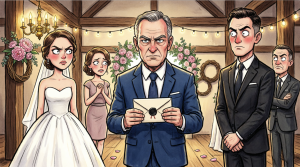
“Dear Declan,” it read. “If you are reading this, you finally went to the bank. I am glad. I was starting to worry you never would. I know what they said about the passbook. I know your father laughed. I know they all called me senile, called me broke, called me a fool. I heard every word. But I also know you kept the passbook. You did not throw it away. You did not let them convince you it was worthless. You trusted me, even when everyone else told you not to. That is why the money is yours. Let me tell you the story. In 1971, your grandmother and I won a lawsuit against the steel mill. They paid us $15,000 for my injury, for the months I could not work, for the pain and suffering I endured. Everyone expected us to spend it. Everyone expected us to finally live a little after years of scraping by. But Rose had a different idea. She said, ‘What if we did not spend it? What if we saved it instead? What if we lived like we had never received it and let it grow year after year until it became something worth having?’ So that is what we did. We put 8,000 in the bank, high-yield savings, and we added to it every month. Two hundred dollars, rain or shine, for 52 years. Rose managed it at first. Then I learned when she got sick. We watched it grow from thousands to tens of thousands to hundreds of thousands to millions, and we never touched it. Not once. Why? Because we did not need it. We had each other. We had our little house, our old truck, our simple pleasures. What would money have given us that we did not already have? But we knew you might need it someday. You and Naomi and the children you would have. We watched you grow up. Watched you become the only member of the family who understood what really mattered. And we decided, Rose and I, that when we were gone, it would all go to you. Your father will be angry. He will say it is not fair. But fair has nothing to do with it. Love has everything to do with it. And you were the only one who loved me, Declan. The only one who saw me as more than a poor old man waiting to die. Use the money wisely. Live simply, the way your grandmother and I lived. Give your children security, not stuff. And remember always that the richest person in the room is not the one with the most money. It is the one who knows what matters. I love you, grandson. I am proud of you, and I will be watching from wherever I end up to see the man you become. Your grandfather, Chester. P.S. The truck is worth keeping. I put a lot of miles on her, but she has a lot of miles left. Take care of her, and she will take care of you.”
I still drive that truck. The 1987 Ford that my grandfather gave me before he died. It is old and loud and gets terrible gas mileage. I could buy a new one. I could buy ten new ones. But every time I turn the key and hear that engine rumble to life, I hear my grandfather’s voice. I feel his hand on my shoulder. I remember who I am and where I came from. And that is worth more than any amount of money in any bank account in the world.
THE END.