Sergio’s smile collapsed slowly, as if his face had forgotten how to hold that expression. Rocío stopped behind him, clutching her oversized handbag, her eyes darting between the officers, the boxes, and me.
One of the officers spoke first.
“Señor Lozano, we’re here to ensure Mrs. Martín can collect her belongings without interference. We also need to inform you a report has been filed.”
Sergio laughed once, short and disbelieving.
“A report? For what?”
I watched him carefully, noticing for the first time how quickly arrogance could turn into confusion when the situation was no longer under his control.
“For assault,” the officer replied calmly.
Silence filled the apartment.
Rocío shifted her weight and whispered something to Sergio, but he brushed her off with an irritated wave, still staring directly at me.
“You’re serious?” he asked.
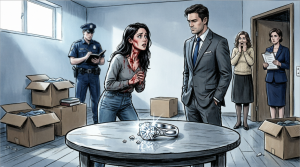
I didn’t answer immediately. My cheek throbbed under the thin medical bandage, and the smell of antiseptic mixed strangely with the familiar scent of our living room.
“Yes,” I finally said.
Sergio’s eyes flicked to the wedding ring resting on the police report.
“You’re going to destroy everything because of a cup of coffee?”
The words hung in the air like a stain.
One of the officers glanced at me, perhaps expecting anger or tears, but what I felt instead was a calm so heavy it almost frightened me.
“It wasn’t the coffee,” I said quietly.
For years I had practiced patience the way some people practice religion. I forgave forgotten birthdays, humiliating jokes at dinners with his friends, the endless small loans to Rocío.
But something inside me had shifted that morning.
Not cracked.
Shifted.
And there was no way back.
Rocío stepped forward cautiously, as if approaching a nervous animal.
“Elena, come on,” she said with forced sweetness. “You’re exaggerating. Sergio just lost his temper.”
I looked at her handbag, the one she had asked me to buy two months earlier because the previous one had suddenly become “too old.”
“Did he lose his temper,” I asked softly, “or did he think there would be no consequences?”
She opened her mouth, then closed it again.
Sergio crossed his arms.
“You always do this,” he said. “You make everything dramatic. You act like a victim.”
The word victim made something cold settle inside my chest.
For a moment I wondered if he truly believed what he was saying, or if it was simply easier for him to believe it.
The officer cleared his throat.
“Mrs. Martín has finished collecting her belongings. You will receive formal notice regarding the complaint.”
Sergio finally seemed to notice the empty shelves.
The half-bare closet.
The missing laptop.
The boxes stacked near the door.
His expression changed again, but this time the confusion was deeper.
“What did you take?” he demanded.
“My things,” I replied.
“This is my house too.”
“No,” I said calmly. “It isn’t.”
Rocío frowned.
“What does that mean?”
I turned toward the hallway where the documents from the property purchase used to be stored, remembering the day I signed them years before I even met Sergio.
“This apartment is in my name,” I said.
Sergio blinked.
“That’s just paperwork.”
“No,” the officer corrected gently. “Legally, it isn’t.”
For a second Sergio looked as though someone had tilted the floor beneath him.
“You’re kicking me out?”
The question sounded almost childish.
I studied his face.
For years I had waited for moments when he might show remorse, doubt, even a hint of vulnerability.
But now that moment had finally arrived, and what I felt was not satisfaction.
Only exhaustion.
“I’m not kicking you out,” I said.
“I’m leaving.”
The distinction seemed to confuse him even more.
Rocío looked between us, clearly calculating what this meant for her own comfort.
“So where are you going?” she asked.
“I don’t know yet.”
The truth felt strangely liberating.
For the first time in years, my next step was not determined by Sergio’s temper or Rocío’s requests.
It was simply… mine.
Sergio suddenly stepped forward, his voice sharper.
“You can’t just walk away and ruin my life over something stupid.”
I noticed the officers straighten slightly.
“What ruins lives,” I said quietly, “is thinking other people belong to you.”
The words surprised even me.
I hadn’t planned them.
They had simply arrived.
Sergio ran a hand through his hair.
“You’re being irrational.”
“Maybe,” I admitted.
“But I’m also done.”
He stared at me for a long moment, searching my face as if expecting to find the hesitation that had always been there before.
But something fundamental had changed.
I wasn’t trying to convince him anymore.
I was simply telling the truth.
And truth, once spoken clearly, has a strange weight.
Finally he scoffed.
“Fine. Go stay with your mother for a few days. You’ll calm down.”
“My mother d!3d three years ago,” I said.
The words landed with quiet finality.
Sergio looked away first.
Rocío shifted again, clearly uncomfortable now that the situation was no longer amusing.
“Well,” she said awkwardly, “we can talk later. No need to involve police.”
But it was already involved.
The officers were standing in the middle of the living room, silent witnesses to the life we had just finished dismantling.
I picked up the last box.
It was lighter than the others.
Inside were small things: photographs, a notebook, the coffee maker.
Objects that had once felt permanent.
Sergio watched me walk toward the door.
“You’ll regret this,” he said.
Maybe he believed that.
Maybe he needed to believe it.
Because if I didn’t regret it, then something else would have to be true.
Something far more uncomfortable.
That he had crossed a line he could never uncross.
I paused at the doorway.
Not because I was uncertain.
But because there was one final decision left.
The officer closest to me spoke gently.
“Mrs. Martín, we can escort you out.”
I nodded, then looked back at Sergio.
For years I had protected his image.
With friends.
With family.
Even with myself.
Every insult had been “stress.”
Every humiliation had been “a bad day.”
Every demand had been “temporary.”
But the police report on the table changed everything.
It turned private silence into public truth.
And that truth would follow him.
At work.
With neighbors.
In court.
I realized then that the final choice wasn’t about leaving.
Leaving was already done.
The real choice was something deeper.
Whether to continue protecting the man who had hurt me.
Or to protect the woman who had finally chosen herself.
The apartment felt unbearably quiet.
Sergio looked at me with something close to fear now.
“Elena,” he said more softly.
For the first time that evening, he used my name without anger.
“You’re really doing this?”
I thought about the years behind us.
The mornings like this one that had ended differently because I had apologized.
The arguments I had softened.
The truths I had swallowed.
Then I looked at the bandage on my cheek.
And I understood something simple.
A marriage doesn’t collapse in one moment.
But sometimes one moment reveals the collapse that has been there for years.
“Yes,” I said.
And I walked out.
The hallway outside smelled faintly of cleaning products and someone’s dinner cooking two floors below.
Ordinary life.
Unaware that something enormous had just shifted inside me.
The elevator doors opened with a quiet metallic sound.
I stepped inside with the officers and the boxes.
As the doors closed, I realized I wasn’t trembling anymore.
Not from pain.
Not from fear.
Only from the strange, unfamiliar sensation of freedom beginning.
And somewhere upstairs, in the apartment that was legally still mine but emotionally already gone, Sergio Lozano was finally seeing something he had never expected.
What was no longer there.