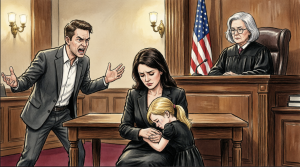
The words hit the courtroom like a thrown glass.
“Take your brat and go to hell.”
He didn’t mutter it under his breath the way people do when they want to keep their ugliness private. He let it fly—sharp, deliberate—so it would ricochet off the paneled walls and land in every lap, every notebook, every pair of listening ears. Even the court clerk, fingers mid-strike over the keyboard, froze for a heartbeat as if the sentence had snapped the air itself.
I kept my gaze lowered to the table in front of me, to the varnished wood worn smooth by decades of forearms and paperwork. There were tiny scratches in the finish, hairline grooves like the memory of someone’s anxiety carved into the surface. I followed one with my eyes as if it mattered more than what my husband had just shouted.
My daughter sat close enough that her knee pressed into mine. Her hand—small, warm, trembling—latched onto the sleeve of my blazer like fabric could become a rope bridge across a canyon. She had been so brave all morning. Quiet. Too quiet for a child who should have been thinking about cartoons and snack time, not legal terms and courtroom rules. Every few minutes she would tug at my sleeve, a tiny check-in: Are you still here? Are we still safe?
The judge, a woman with gray hair pulled into a neat twist and glasses balanced low on her nose, didn’t slam her gavel. She didn’t raise her voice. She simply looked at my husband the way you look at someone who has walked into a library shouting and expects applause.
“Lower your voice, sir,” she said, calm as winter.
He didn’t apologize. He didn’t even pretend to. He sank back into his chair like a man settling into a seat he believed belonged to him, like this room and everyone in it existed as an audience for his grievance. His jaw worked once, twice, grinding something invisible between his teeth.
He had already said everything he wanted to say over the past few months. That I was useless. That I had never contributed anything meaningful. That the house, the business, the savings—all his. That our daughter had been “turned against him,” as if children were radios you could re-tune with the right hand on the dial.
Today was supposed to be the final hearing.
Quick. Clean. Paperwork. Signatures. A ribbon tied around the mess so he could walk out and tell people he’d “handled it” like everything else.
At least that was what he believed.
I listened as his lawyer—polished, courteous, voice trained to sound reasonable even when it wasn’t—began listing the assets my husband expected to keep. It came out like a grocery receipt: the house, the business accounts, the retirement funds, the investment portfolio, the vacation property his parents had “helped with,” as if that phrase should erase all the years I had spent keeping his life stitched together.
My husband leaned back with that particular posture he wore when he wanted to look unconcerned: shoulders loose, chin slightly lifted, one hand draped over the armrest. The faintest smirk sat at the edge of his mouth, the expression of someone who had already rehearsed the victory speech.
I had seen that smirk in other rooms.
In our kitchen, when he told me the numbers didn’t matter because he “handled the important stuff.” In the hospital waiting room the night our daughter was born, when I asked him to stay and he told me he had meetings, as if labor were a minor inconvenience. At dinner parties, when he made jokes about me “not understanding business,” and everyone laughed because the joke was safer than discomfort.
The judge listened without interrupting. She made notes with a pen that moved in steady, unhurried strokes. She didn’t look impressed. She didn’t look irritated. She looked like someone who had learned long ago that patience was not the same as agreement.
When my husband’s lawyer finished, he placed his hands on the table, palms down, as if to conclude the matter with a flourish.
“Your Honor, as previously submitted, we are requesting the division reflected in the final declarations. My client has been the primary financial contributor to the marriage, and—”
The judge raised a hand, not abrupt, just definitive.
“One moment,” she said, and reached for a sealed folder on her bench—thick, official, edges still sharp. It hadn’t been there at the start of the hearing. Or if it had, it had blended into the pile of files like another piece of expected routine.
The courtroom shifted, as subtle as a breeze changing direction. The judge adjusted her glasses. The folder’s seal caught the light for a second, white and clean, like a fresh bandage.
My husband’s pen tapped once against the table, impatient. Then again. A small sound, but it grated on my nerves because I recognized it. That tap meant he believed time belonged to him.
“Your Honor,” his lawyer began, polite smile fixed, “we were under the impression all financial declarations had been finalized.”
The judge did not answer immediately. She opened the folder with the careful precision of someone handling a document that mattered. Paper whispered against paper. The kind of sound that seems louder in a room full of breath held too tightly.
She skimmed the top page.
Then she looked up—not at my husband, not at his lawyer.
At me.
It wasn’t a stare. It wasn’t suspicion. It was something rarer in that room: recognition without familiarity. Thoughtfulness. As if she had just been handed a piece of a puzzle and was checking whether it fit the shape she had been given.
My stomach tightened. I felt my pulse in my throat. Beside me, my daughter’s grip on my sleeve became firmer, as if she could feel the tension rise through my skin.
The judge looked down again.
“This document,” she said, voice steady, “was submitted early this morning by the estate attorney of the late Eleanor Whitaker.”
My husband frowned as if the name were a mispronounced word. He leaned slightly toward his attorney, whispering something that made the attorney’s mouth twitch, a half-smirk of dismissal.
He had never heard the name before.
But I had.
The moment it left the judge’s lips, the air in the room shrank around me. Eleanor Whitaker. Even after years of silence, even after life had moved forward in the relentless way it does, that name still carried weight in my chest like a stone.
My husband shifted in his chair, irritation creeping into his posture. The hearing was supposed to be predictable. He had scheduled lunch with a client afterward—he’d told me that, not because he cared what I did with my day, but because he wanted me to know I was a minor appointment on his calendar.
Instead, the judge continued, turning a page.
“Ms. Whitaker’s estate attorney has submitted documentation confirming a beneficiary designation finalized three weeks before Ms. Whitaker’s passing.”
My husband’s lawyer lifted an eyebrow with a practiced expression of confusion.
“Your Honor,” he said, “I’m not sure how that relates to the divorce proceedings.”
The judge turned another page with the same calm, and for the first time her voice carried the faintest edge—not anger, not impatience, but certainty.
“It relates,” she said, “because the designated beneficiary listed here is present in this courtroom.”
A murmur fluttered along the back row where a couple of legal interns and observers sat, their curiosity suddenly awakened. My husband glanced around as if expecting some stranger to stand up, as if the beneficiary might be a surprise witness who had wandered into the wrong room.
Then he let out a small laugh, dismissive, under his breath.
“Probably a clerical mistake,” he muttered.
I didn’t move. I didn’t let my face change, because I had learned over years of living with him that any reaction was a handle he could grab. Joy, fear, confusion—he would twist it into whatever story benefited him.
But inside me, something was accelerating. A memory, a flash of a different office, a different life: fluorescent lights, stacks of binders, Eleanor’s voice cutting through chaos with crisp clarity. The smell of burnt coffee and printer toner. The hum of late-night work and the ache of integrity in your bones when doing the right thing costs you sleep.
Eleanor Whitaker hadn’t been part of my life for years. Most people in that courtroom had never heard her name. In the story my husband told about me, there wasn’t room for mentors or past careers. There was only his narrative: I had been dependent, idle, lucky to have been chosen.
But once, a long time ago, Eleanor had been my supervisor, then my mentor, then—quietly—something like family. Back when I worked at Whitaker Consulting, before I left to support my husband’s business full-time. Back when my world was numbers and ledgers and compliance regulations, not diaper bags and school pickup lines.
The judge folded her hands on the bench.
“The estate totals approximately thirty-two million dollars,” she said.
Silence slammed down so hard it felt physical.
My husband’s pen stopped tapping. His jaw slackened for the smallest moment, then tightened again. Thirty-two million had a way of changing the temperature in a room. You could almost feel people recalibrating, rewriting assumptions in real time.
My husband’s head turned toward me, slowly, as if his neck resisted the movement. When his eyes landed on my face, there was something I hadn’t seen in a long time.
Not anger.
Not contempt.
Uncertainty.
He blinked once, then twice, as if he was trying to clear a smudge from his vision.
“That’s impossible,” he said, and his voice had thinned. There was no courtroom bravado in it now, no theatrical cruelty. Just disbelief that the world might have moved outside his control.
The judge glanced down and continued.
“Ms. Whitaker updated her estate documents three weeks before her passing. According to the accompanying letter, she wished to ensure that the person who stood by her during the most difficult period of her career would be protected.”
My husband’s lawyer leaned forward, suddenly alert in a way he had not been ten minutes ago.
“Your Honor,” he said carefully, “I assume the beneficiary listed is a relative or charitable organization.”
The judge shook her head slightly.
“The sole beneficiary named in the will is—” She paused briefly, eyes scanning the line. Then she looked up. “The petitioner in this case.”
Every set of eyes turned toward me.
It was a strange kind of spotlight. Not warm, not flattering. Bright in a way that made you feel exposed. I kept my hands folded in my lap so no one could see them tremble. My daughter’s fingers clung tighter, then loosened, then clung again, a rhythm of fear and hope.
My husband’s face went blank for a second, like a screen that had lost signal.
“No,” he said, the word more breath than sound. “No, that—she wouldn’t—”
The judge’s voice remained calm as weather.
“Ms. Whitaker’s letter states that she wanted to ensure the person who demonstrated integrity and loyalty under extreme pressure would have security.”
Integrity.
Loyalty.
Words my husband used only when they served him.
He stared at the folder as if he could will the pages to rearrange themselves into something he preferred.
I felt a memory rise, sharp and detailed: Eleanor in her office, sleeves rolled up, hair coming loose from its clip, eyes red from exhaustion but voice steady. She had been under federal investigation for months—not because she had done anything criminal, but because someone in her firm had been careless, maybe unethical, and regulators didn’t care who had meant well. The firm’s clients were panicking. Staff were quitting. Competitors were circling like sharks.
And in the middle of it, someone from another firm approached me with an offer—an absurd amount of money in exchange for information they could use to siphon clients. The kind of offer that would have changed my life in one signature.
I remembered sitting in my car afterward, hands on the steering wheel, staring at the dashboard while my heart hammered, because temptation isn’t always glamorous. Sometimes it feels like relief. Sometimes it feels like a doorway out of fear.
I remembered walking back into the building and going straight to Eleanor, telling her what had happened. I remembered her face—no dramatics, no theatrics. Just a long, silent look as if she were measuring the weight of my choice.
Then she nodded once.
“I won’t forget this,” she said.
I hadn’t expected her to.
Life had pulled me away. Marriage, motherhood, my husband’s business—his dreams became the center, and mine were expected to orbit around them. Eleanor and I exchanged holiday cards for a while, then less often, then not at all. It wasn’t bitterness. It was distance. The ordinary kind that makes you realize you can lose people without meaning to.
The judge closed the folder.
“And legally,” she added, “that inheritance is solely hers.”
The words hung there like a hinge turning.
Because suddenly, the balance of this divorce—this carefully choreographed takedown my husband had staged—didn’t look the same anymore.
My husband’s attorney recovered first, because that’s what trained professionals do when a grenade rolls onto the floor. He smoothed his expression, straightened his tie, and stood slightly.
“Your Honor,” he said, “the inheritance may be separate property, but it should not affect the division of marital assets already established.”
His tone was measured, but the quick glance he shot toward my husband said everything: we need a new plan.
My husband had spent months confident I would walk away with almost nothing. He had negotiated like a man who believed I had no leverage. He had filed statements describing me as financially dependent, incapable of maintaining stability. Those statements had been central to his requests, not only for property but for custody………