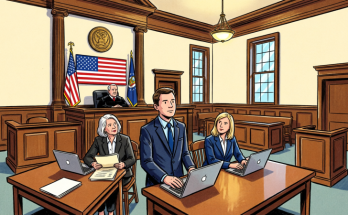
The bailiff called our case like he was reading a grocery list—flat voice, no pause for grief, no respect for the dead—and my sister stood up before the final syllable even landed. She didn’t rise like someone honoring our grandfather. She rose like someone claiming him.
Victoria wore a tailored cream coat over black, the kind of “quiet luxury” that turns heads without asking permission. It wasn’t a mourning outfit. It was a statement. Her hair was smooth and expensive, pinned in place like she couldn’t afford a single loose strand in a room where control mattered. Her face was dry. Not one red-rimmed eye, not a hint of swollen grief. When she looked at me, there was no sadness in her gaze—only calculation, as if she’d already run the numbers on how much I was worth to her.
Behind her, our parents sat in the second row like they belonged at her shoulder instead of mine. My mother’s hands were folded with solemn precision, as if she were at church. My father stared straight ahead, jaw set the way it got when he’d decided something and couldn’t be moved—business meeting face, not funeral face. Not family face.
The judge adjusted his glasses, the motion slow, practiced, as if he’d seen too many families turn a death into a fight over paperwork. He scanned the file. His eyes were tired but sharp.
Victoria’s attorney rose with the smooth confidence of someone who’d billed more hours than most people had lived days. Slick suit, soft voice, expensive watch that caught the fluorescent courtroom light every time he moved his hands. He approached the counsel table with a thin stack of papers and slid them forward like a blade.
“Your Honor,” he said, voice calm and almost kind, “we’re moving for an immediate transfer of the estate to my client, effective today.”
The words landed in my chest like a heavy stone.
Effective today.
As if a man’s life could be reduced to a signature and a stamp. As if my grandfather’s house, his accounts, his investments, the legacy he’d built with stubborn hands and stubborn pride, could be scooped up in a single motion and poured into my sister’s pockets while I sat there as an inconvenience.
My mother nodded faintly behind the attorney, solemn as a witness at a baptism. My father nodded too, a small, decisive dip of his chin that felt like a verdict before the judge ever spoke.
The judge didn’t look at them first.
He looked at me.
“Ms. Hail,” he said, tone flat. “Do you object?”
Victoria’s lips twitched, barely, like she could taste my humiliation already. She’d been waiting years for this moment. Waiting for the day she could stand in a room full of strangers and have an authority figure confirm what our family had always implied: that Victoria was the important one, and I was the problem.
My pulse climbed into my throat. I felt it there, thick and loud.
“I do,” I said.
The words came out steady, and I was proud of that, because my hands wanted to shake, and my stomach wanted to fold into itself.
Victoria’s attorney smiled faintly, patronizingly, as if he’d just watched a child raise a hand in class to argue against gravity. “On what grounds?” he asked. “We have a petition. We have supporting declarations. We have your parents’ corroboration. We have—”
“I’m not giving you my argument,” I said, keeping my eyes on the judge instead of the attorney. “Not yet.”
The judge blinked once. “Not yet?”
“I want to wait until the last person arrives,” I said.
The courtroom shifted. Not dramatically, but in the way a room changes when someone says something unexpected. A few heads turned. A few pens paused.
Victoria let out a small laugh that didn’t hold humor. “This is ridiculous,” she said before her attorney could stop her. “There is no one else.”
My father finally turned his head slightly toward me, the way he used to when I was a teenager and he wanted me to feel the shame of embarrassing the family in public. “You always do this,” he muttered, loud enough for the front row to hear. “Make it a spectacle.”
The judge leaned back, the chair creaking softly. “Ms. Hail,” he said, voice measured, “this is probate court, not the stage. If you have an objection, it must be legal and timely.”
“It’s legal,” I said calmly. “And it’s timely. But it isn’t my place to explain it.”
Victoria’s attorney stepped forward again, all polished patience. “Your Honor, we’re requesting emergency appointment because Ms. Hail has been uncooperative. There are assets that must be protected, and my client is the responsible party.”
Responsible.
That word was always used like a weapon in my family. It didn’t mean honest. It didn’t mean kind. It meant obedient. It meant controllable. It meant: give us what we want and don’t ask questions.
My mother sighed softly, a performance sigh. “She’s grieving,” she told the judge, nodding toward Victoria as if my sister were the fragile victim in this story. “She doesn’t understand how these things work.”
Victoria’s eyes stayed on me, bright and cold. “I’m just trying to keep everything from falling apart,” she said, voice smooth enough to sound reasonable. “Grandpa would want it handled properly.”
I stared at her and thought about how quickly she’d found a lawyer, how quickly the petition appeared, how polished my parents looked sitting behind her like backup singers. I thought about our grandfather’s hands—calloused, steady, proud. I thought about how he used to say, “Properly means with receipts.”
The judge turned a page in the case file. “This petition requests full authority over the estate,” he said, reading carefully. “It alleges the respondent is unfit to participate and may interfere.”
Victoria’s attorney nodded. “Correct.”
“And you want me to grant it today?” the judge asked.
“Yes, Your Honor,” the attorney replied. “Effective immediately.”
The judge’s eyes returned to me. “Ms. Hail,” he said again. “What is your objection?”
I kept my posture steady, hands folded neatly on the table. I could feel the blood pounding behind my ears, but I forced my voice to stay calm.
“My objection is that they’re asking you to act without the full record,” I said. “They want you to sign something permanent based on partial information.”

Victoria laughed sharper, the sound of someone who’d never been told no. “There is no hidden record,” she snapped. “He died. This is what happens.”
The judge’s expression didn’t change, but his patience thinned. “Miss Hail,” he said to Victoria, “you will not speak out of turn.”
My father’s lips tightened. My mother’s eyes narrowed, offended at being corrected.
Victoria’s attorney tried to salvage with politeness. “Your Honor, if Ms. Hail wishes to delay, we object. The estate cannot wait.”
I didn’t look at him. I looked at the judge.
“It will not be a delay,” I said. “It will be a few minutes.”
The judge exhaled through his nose and looked toward the courtroom doors, weighing whether to entertain me or cut me off.
“Whom are we waiting for?” he asked.
I answered with the simplest truth I could say out loud.
“The person who actually controls the inheritance,” I said.
Victoria’s expression tightened for the first time, a tiny crack in her composed mask. She started to say, “That’s me,” automatically—because that’s what she’d trained herself to believe—then stopped when the judge’s gaze flicked her way.
The judge leaned forward slightly. “Ms. Hail,” he said to me, “if this is a tactic—”
“It isn’t,” I said. “I’m asking you to let the record arrive before you sign anything.”
A beat of silence.
Then the doors opened.
Not a dramatic swing. Not a theatrical entrance. Just a clean, controlled push, as if someone was entering a workplace, not a battlefield.
A man stepped into the courtroom wearing a black suit so plain it resembled a uniform. No flashy tie. No jewelry. No smile. He carried a single envelope in one hand and a calm expression that made it clear he didn’t care who in this room had money.
He didn’t look at my parents.
He didn’t look at my sister.
He walked straight to the clerk’s desk like he belonged there.
He held up the envelope, spoke clearly, and said my name.
“Ms. Hail.”
The judge blinked and reached for his glasses again. He looked at the envelope like it didn’t belong in his courtroom.
The man didn’t raise his voice. He didn’t explain himself. He simply placed the envelope on the clerk’s desk with one hand and said, “This is for the court from the trustee.”
The word trustee hit the room like a sudden shift in weather. You could feel it. The way my parents stiffened. The way Victoria’s attorney’s posture changed—subtle, but real. The way Victoria’s eyes narrowed, scanning, calculating.
The judge took the envelope, read the return address, and his mouth moved as if he’d spoken before he intended to.
“That can’t be,” he muttered.
He held the envelope between two fingers and turned it once, then looked at the return address again, as if the ink might change if he stared hard enough.
Then he ripped it open.
No flourish. Just a clean tear, as if he wanted the paper to stop pretending it mattered more than what was inside.
The courtroom went so quiet I could hear Victoria’s attorney shifting his weight.
The judge pulled out a folded document printed on thick stock. There was an embossed seal in one corner. A signature block so formal it looked like something that lived in vaults.
He scanned the top line, and his jaw tightened.
Then he read the sender aloud.
“Hawthorne National Bank, Trust Department.”
Victoria’s face flickered. Not fear, exactly. More like surprise—like someone who’d walked into a room expecting a handshake and found a locked door.
She’d spent her entire life orbiting money. Hearing a bank’s name in open court should have made her look powerful.
Instead, it made her look caught.
The judge continued reading. “This is a notice of trust administration,” he said, voice shifting into that precise tone judges use when the document in their hand changes the entire case. “It states the decedent’s assets were placed into a revocable trust, and that the trust became irrevocable upon death.”
Victoria’s lawyer rose quickly. “Your Honor, we’re in probate—”
The judge didn’t look up. “Sit down,” he said.
Victoria’s attorney froze for half a second, then sat like a man who’d just been reminded the room did not belong to him.
The judge turned another page. “And this,” he said, softer, “is a certification of trust identifying the trustee.”
He paused as if the next line contradicted everything Victoria had told him.
Then he read it.
“Successor trustee: Hawthorne National Bank, Trust Department.”
My parents stiffened visibly. They were looking for control. Families like mine always were. But a bank didn’t care about control the way people did. A bank cared about documents. Terms. Risk.
Victoria’s attorney tried again, voice recovering. “Your Honor, even if there is a trust, probate still has jurisdiction over—”
The judge finally looked up, and when he did, the room went colder. “Counsel,” he said, “your motion requested immediate transfer of all inheritance to your client effective today.”
“Yes, Your Honor,” the attorney replied carefully.
The judge touched the paper with one finger. “This trust certification states in plain language that the probate estate is minimal and the majority of assets are held in trust.”
He turned to the clerk. “Mark this as received.”
Then he looked at Victoria—not as my sister, not as a grieving granddaughter, but as a petitioner who had just tried to seize something she didn’t own.
“Ms. Hail,” he said, “did you know your grandfather established a trust with a corporate trustee?”
Victoria lifted her chin. “He was influenced,” she said quickly. “He didn’t understand what he was signing.”
The judge didn’t argue with her feelings. He simply lifted another page.
“This notice includes a copy of the trust’s execution affidavit and list of witnesses,” he said. “It also includes an attorney certification that the decedent signed with full capacity.”
My father’s mouth tightened. My mother’s eyes narrowed, searching for a new angle, a new story.
The judge’s eyes moved down the page again, and then his lips pressed together. He read a line once in silence.
Then he read it aloud, slowly, so nobody could later claim they misunderstood.
“No contest clause. Any beneficiary who files a petition to seize trust assets in violation of the trust terms forfeits their distribution.”
Victoria’s attorney’s face drained of color so quickly it was almost shocking.
Victoria’s eyes widened a fraction, then narrowed, as if she could intimidate ink into rewriting itself.
My mother unclasped her hands for the first time.
The judge looked up. “Counsel,” he said to Victoria’s attorney, “you filed a motion for immediate transfer of all inheritance to your client.”
“Yes, Your Honor,” the attorney said, and his voice was no longer smooth.
“You understand this clause is enforceable,” the judge said.
The attorney swallowed. “Your Honor, we dispute the validity—”
“You can dispute it,” the judge cut in. “But you don’t get to pretend it isn’t there.”
He looked back at me. “Ms. Hail,” he said, “you asked to wait until the last person arrived. Was this the person?”
“Yes,” I said, and even though my pulse was climbing into my throat, my voice stayed level. “The trust department is the trustee. They control distribution.”
The man in the black suit—still standing near the clerk as if he were part of the courtroom’s machinery—spoke for the first time.
“Your Honor,” he said calmly and clearly, “I’m not here to argue. I’m here to provide notice and confirm the trustee’s position.”
The judge gestured once. “State it.”
The man didn’t look at my parents. He didn’t look at Victoria. He looked at the judge.
“The trustee does not recognize the petitioner’s request,” he said. “The trustee will not distribute assets to anyone based on a motion filed today. The trustee will administer according to the trust terms and requests dismissal of any attempt to seize trust-controlled assets through probate.”
Victoria snapped, “You can’t just—”
The judge raised his hand sharply. “Miss Hail,” he said, voice snapping like a ruler on a desk, “you will not speak out of turn.”
Victoria shut her mouth, but her breathing changed—faster now, thinner.
Her attorney stood again, scrambling for ground. “Your Honor, at minimum, we move to compel production of the full trust. We question whether my client was improperly removed or whether there is undue influence by the respondent.”
The judge’s eyes didn’t soften. “Undue influence is a serious allegation,” he said. “And you just watched evidence of attempted coercion aimed at the decedent that did not come from the respondent.”
My father’s jaw twitched.
The judge turned back to the man in black. “Has the trustee delivered the trust instrument to counsel?” he asked.
“Yes, Your Honor,” the man replied. “A complete copy was delivered to both sides yesterday afternoon via certified service.”
My mother’s head snapped toward Victoria’s attorney like a whip.
Yesterday afternoon.
Meaning they knew—or should have known—about the no contest clause before they filed anyway.
The judge let that sink in, letting the silence do its work. Then he looked at Victoria.
“Ms. Hail,” he asked, “did you receive the trust documents yesterday afternoon?”
Victoria’s lips parted, and for the first time she looked less like an executive and more like someone trapped. “I—”
Her attorney jumped in quickly. “Your Honor, we received a packet—”
The judge cut him off. “Counsel, if you received a packet containing a no contest clause and still filed a motion demanding all inheritance effective immediately, I want you to understand what that looks like to this court.”
The attorney stood still, mouth slightly open, as if he’d forgotten what words were supposed to do when the judge stopped buying them.
The judge turned to the clerk. “Set a hearing,” he said. “Sanctions. And I want the trustee’s letter entered into the record.”
He looked directly at Victoria, and his voice turned colder.
“And Ms. Hail—if you are a named beneficiary and you triggered forfeiture today, you may have cost yourself more than you intended.”
Victoria’s face tightened into something ugly.
Her eyes met mine, and the hatred there wasn’t just about money. It was about how the institution she expected to crown her had just labeled her a risk.
Then she did what she always did when she couldn’t win with paperwork.
She tried to win with a new story.
“Your Honor,” she said abruptly, voice louder, turning to the bench with practiced urgency, “I need to put something on the record.”
The judge’s eyes narrowed. “What?”
Victoria looked directly at me and said the one phrase my parents had been saving like a bullet.
“Elder abuse.”
The courtroom shifted again, but this time it wasn’t surprise. It was gravity. Because elder abuse wasn’t a family argument. It wasn’t a civil spat. It was a serious allegation that could detonate lives.
The judge’s expression changed—not because he believed her, but because now the court had to decide whether she had proof or whether she was about to commit suicide by false allegation in open court.
“Elder abuse,” Victoria repeated, louder, as if volume could convert accusation into evidence.
My mother’s face softened immediately into performance grief, eyes shining suddenly as if she’d been waiting for her cue. My father leaned back in his chair, eyes narrowing, like this was the plan they’d been holding in reserve.
Victoria’s attorney stood beside her like an emergency exit that had been unlocked.
“Your Honor,” he said, “we request an immediate investigation. The respondent isolated the decedent, restricted access, and coerced him into signing documents that benefited her.”
The judge didn’t react like a daytime television audience. He reacted like a judge. He leaned forward slightly and his voice turned sharper.
“Counsel, these are serious allegations. What evidence do you have today?”……………………………..
Click Here to continuous Read Full Ending Story : “Sister Tried to Steal Inheritance in Court. Then the Trustee Sent an Envelope. The Judge Went Pale.__PART2