PART 3 — THE REAL SEVEN VON TRAPP CHILDREN
Millions of viewers know them as Liesl, Friedrich, Louisa, Kurt, Brigitta, Marta, and Gretl.
But none of those were the real names of Captain von Trapp’s seven children.
The real children were:
Rupert, Agathe, Maria, Werner, Hedwig, Johanna, and Martina.
Hollywood didn’t simply change their names.
It also changed their ages and, in some cases, their sexes.
One of the biggest differences involved the eldest child.
In The Sound of Music, the oldest is Liesl, the teenage girl who famously sings about being “sixteen going on seventeen.”
But in real life, Georg’s eldest child was a son named Rupert.
And by the time the family left Austria in 1938, Rupert was already in his twenties and had trained as a doctor.
There was another major difference the movie never showed.
When the von Trapps left Austria, there were no longer just seven children in the family.
Maria and Georg had already welcomed two daughters of their own, Rosmarie and Eleonore.
That meant nine children were part of the family when they left Austria.
Later, after the family reached America, Maria gave birth to another son, Johannes, in 1939.
Altogether, Georg von Trapp became the father of ten children.
But changing the children may not have been Hollywood’s most surprising alteration.
The romance at the heart of The Sound of Music was also very different in real life.
Georg really did fall for Maria.
But Maria’s feelings were much more complicated.
And when Georg asked her to stay with him, the reason she said yes was not quite the sweeping love story millions of moviegoers remember.
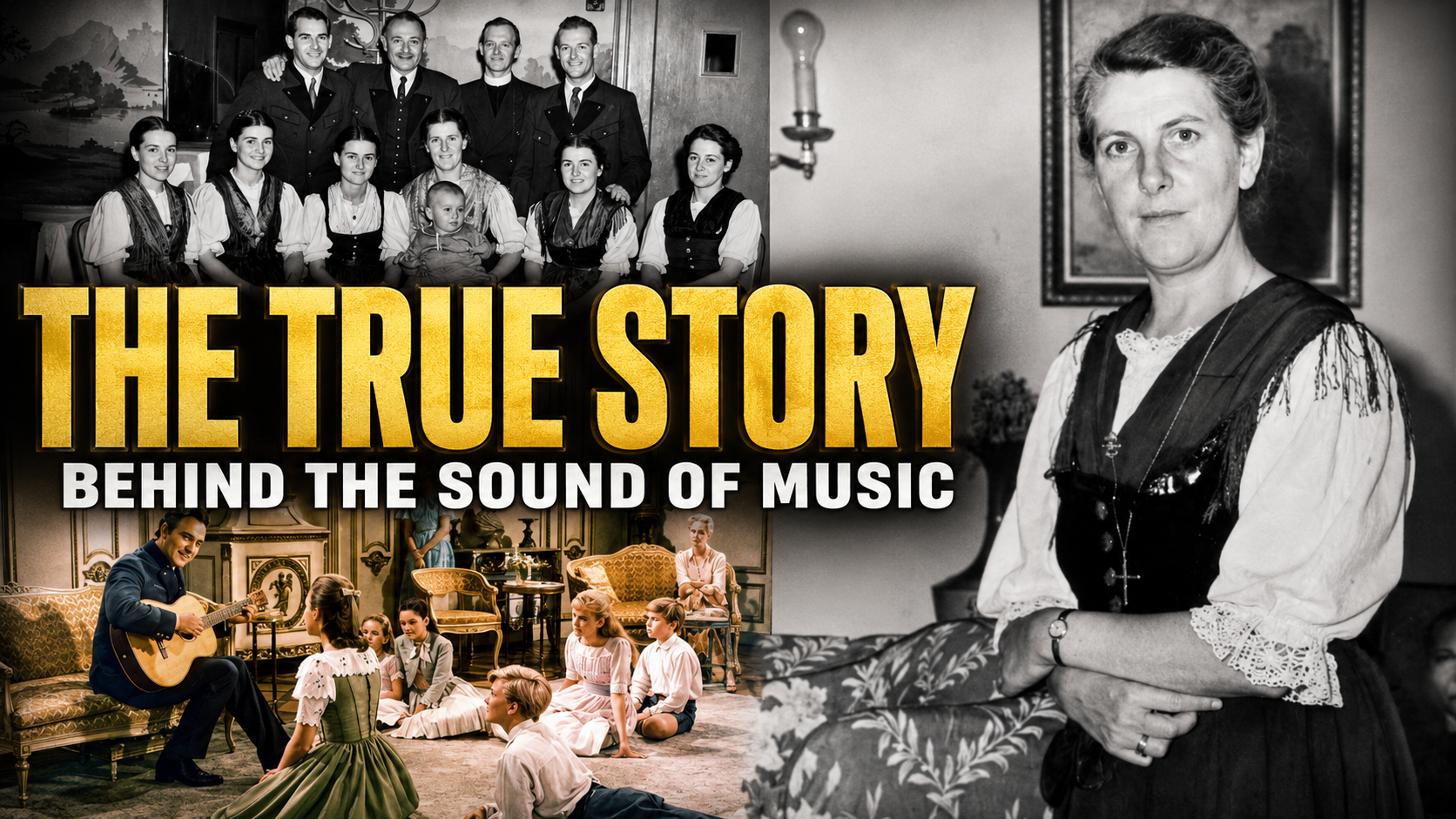
PART 4 — MARIA AND GEORG’S REAL LOVE STORY
For millions of fans, the romance between Maria and Captain von Trapp is one of the most beautiful parts of The Sound of Music.
In the movie, Maria gradually falls in love with Georg.
Their feelings grow through quiet glances, jealousy, dancing, and finally the realization that they belong together.
But the real story was much more complicated.
Georg was about 25 years older than Maria.
After Maria arrived at the von Trapp home in 1926, she became deeply attached to the children.
Georg, meanwhile, developed feelings for Maria.
Eventually, he asked her to stay and become a second mother to his children.
But Maria was torn.
She had entered Nonnberg Abbey believing that religious life was her future. She had never expected a temporary teaching assignment to end with a marriage proposal.
And most surprisingly, Maria later acknowledged that she was not initially in love with Georg in the romantic way the movie suggests.
Her strongest emotional attachment was to the children.
Maria returned to the convent for guidance about what she should do.
Ultimately, she accepted that her future was with the von Trapp family.
Maria and Georg married on November 26, 1927.
And that date reveals another enormous difference between history and Hollywood.
In The Sound of Music, their wedding appears to happen shortly before the family flees Nazi-controlled Austria.
In reality, Maria and Georg had been married for more than ten years before they left Austria in 1938.
During those years, their family grew.
Maria gave birth to Rosmarie in 1929 and Eleonore in 1931.
But their comfortable life was about to change.
The von Trapps would lose much of their wealth, and the music they had once enjoyed privately as a family would suddenly become something far more important.
It would become their livelihood.
And eventually, it would help carry their name far beyond Austria.
PART 5 — HOW THE VON TRAPPS BECAME A SINGING FAMILY
The Sound of Music gives us the impression that Maria arrived at the von Trapp home, taught the children to sing, and transformed them into a musical family.
The truth was different.
Music had already been part of the von Trapp household for years.
But in the 1930s, something happened that pushed the family toward performing professionally.
They lost much of their wealth.
Like many families during the economic turmoil of the Great Depression, the von Trapps faced serious financial problems.
The grand lifestyle they had once known could no longer continue in the same way.
Servants were dismissed.
Rooms in their home were rented to boarders.
And the family began looking for new ways to support themselves.
One of those boarders would become extremely important to their future.
His name was Franz Wasner, a Catholic priest with considerable musical knowledge.
Wasner recognized that the family had something special.
With his guidance, their casual family singing became much more disciplined and professional.
Then came an opportunity that changed everything.
The von Trapps entered a singing competition in Salzburg.
And they won.
Soon, invitations to perform began arriving.
The family that had once sung together mainly for pleasure was now appearing before audiences.
They performed traditional Austrian folk songs, religious music, and other works, eventually becoming known as the Trapp Family Singers.
For Georg, however, turning his children into professional performers was not an easy decision.
This wasn’t the glamorous career the family had dreamed about.
It was partly born from necessity.
But their voices were beginning to carry them far beyond their home in Salzburg.
And just as their musical future began taking shape, Austria itself was changing.
In 1938, Nazi Germany annexed Austria.
Suddenly, the von Trapps faced decisions far more serious than money or music.
They would have to decide whether they could continue living in the country they loved.
And the choice they eventually made would create one of the most famous escape scenes in movie history.
Except the real escape looked nothing like the one Hollywood showed us.
PART 6 — WHEN THE NAZIS TOOK CONTROL OF AUSTRIA
By 1938, the von Trapps had survived financial hardship and transformed themselves into a successful singing family.
Then everything changed.
In March 1938, Nazi Germany annexed Austria.
For the von Trapps, the new political reality brought difficult choices.
Captain Georg von Trapp was strongly opposed to the Nazis.
According to historical accounts, he refused an offer to serve in the German navy.
The family also faced pressure surrounding their musical career.
They had opportunities to cooperate with the new regime, but doing so would have meant accepting a government they did not support.
The decision became increasingly clear.
They needed to leave Austria.
But leaving meant walking away from the country they loved, their home, and much of the life they had built.
By this point, Maria and Georg had been married for more than a decade, and there were nine children in the family.
The danger surrounding their decision also made their story perfect material for Hollywood years later.
In The Sound of Music, the von Trapps perform at the Salzburg Festival while Nazi officials watch from the audience.
Then they disappear during their escape and eventually climb through the Alps on foot toward freedom.
It is one of the most memorable endings in movie history.
But that isn’t how the real family escaped.
There was no secret nighttime journey across the mountains.
There were no children struggling through the Alps carrying luggage.
And there was another problem with Hollywood’s version that Maria herself later found amusing:
The geography didn’t make sense.
If the von Trapps had crossed the mountains from Salzburg in the direction suggested by the movie, they would have headed toward Germany—not Switzerland and freedom.
So how did the real von Trapp family escape Nazi-controlled Austria?
They went to a railway station.
They carried their belongings with them.
And then, in full view of everyone around them, they boarded a train.
What happened next was far less dramatic than Hollywood’s mountain escape—but it was completely real.
PART 7 — THE FAMOUS ESCAPE THAT NEVER HAPPENED
For generations of viewers, the image is unforgettable.
Maria, Georg, and the children quietly make their way across the Alps, leaving Nazi-controlled Austria behind as they climb toward freedom.
It is the perfect Hollywood ending.
But the real von Trapps never escaped Austria that way.
They left by train.
And they did it in broad daylight.
Rather than telling everyone they were fleeing permanently, the family presented their departure as another journey connected to their singing career.
They packed their belongings and instruments and headed for the railway station.
There was no dramatic trek across the mountains.
No secret nighttime crossing.
No children climbing through the Alps with heavy suitcases.
They simply boarded a train and left.
But simple did not mean risk-free.
Austria was now under Nazi control, and the von Trapps were leaving behind their home and the country where most of their lives had taken place.
Their first destination was Italy.
Georg had been born in territory that later became part of Italy, which meant he had Italian citizenship and the family could travel there legally.
From Italy, their journey continued through Europe.
They later traveled to London before crossing the Atlantic to the United States, where their singing career would enter an entirely new chapter.
The truth may not have the cinematic drama of a family disappearing into the mountains.
But imagine what the real moment must have meant.
Nine children.
Their parents.
Their musical conductor, Franz Wasner.
Their belongings and instruments.
A railway platform.
And the knowledge that the home they were leaving behind might never truly be theirs again.
The train pulled away from Austria, but the von Trapp story was far from over.
Thousands of miles away, in the mountains of Vermont, the family would eventually find a place that reminded them of the homeland they had left behind.
And what they built there still exists today.
PART 8 — WHAT HAPPENED TO THE VON TRAPPS AFTER THEY LEFT AUSTRIA?
Leaving Austria wasn’t the end of the von Trapp family’s story.
In many ways, it was the beginning of an entirely new one.
After traveling through Europe, the family eventually came to the United States and continued performing as the Trapp Family Singers.
Life in America was very different from the privileged world they had once known in Austria.
They traveled from city to city, performing for audiences and building a new reputation through their music.
Then they found a place that felt strangely familiar.
Stowe, Vermont.
The green mountains and countryside reminded the family of Austria.
In 1942, the von Trapps purchased a farm there and began putting down permanent roots.
Their Vermont home eventually grew into something more.
In 1950, the family began welcoming guests to a 27-room lodge.
Captain Georg von Trapp never lived to see how famous his family’s story would eventually become.
He died in 1947.
Maria continued moving forward.
Her memoir about the family helped bring their extraordinary story to a much larger audience.
In 1959, The Sound of Music opened on Broadway.
Then, in 1965, Julie Andrews and Christopher Plummer brought Maria and Georg to the screen in the movie that would make the von Trapp name famous around the world.
Hollywood changed a great deal.
It changed the children’s names.
It changed Georg’s personality.
It simplified Maria and Georg’s relationship.
It compressed years of history into a much shorter timeline.
And, most famously, it replaced a train journey with a dramatic escape across the Alps.
But beneath all those changes was a remarkable true story.
A real family lost much of its fortune.
They turned their love of music into a profession.
They watched Nazi Germany take control of their homeland.
They made the painful decision to leave Austria.
And they started again thousands of miles away.
Maria von Trapp died in 1987, but the family’s connection to Vermont did not disappear.
The property they created in Stowe grew into the von Trapp Family Lodge & Resort, which remains connected to their descendants today.
So the next time you watch the final scenes of The Sound of Music, remember what really happened.
The mountains were Hollywood.
The train was real.
But perhaps the most surprising thing of all is this:
The true von Trapp family didn’t need Hollywood’s version of the story to be extraordinary.
Their real life already was.
THE END
LIKE and SHARE to get more, thanks