The third crack of the rolling pin did not sound like something that belonged inside a home.
It was too sharp.
Too ordinary.
Too much like wood hitting a counter, except this time the sound went through my leg and into a part of me that had been quiet for years.
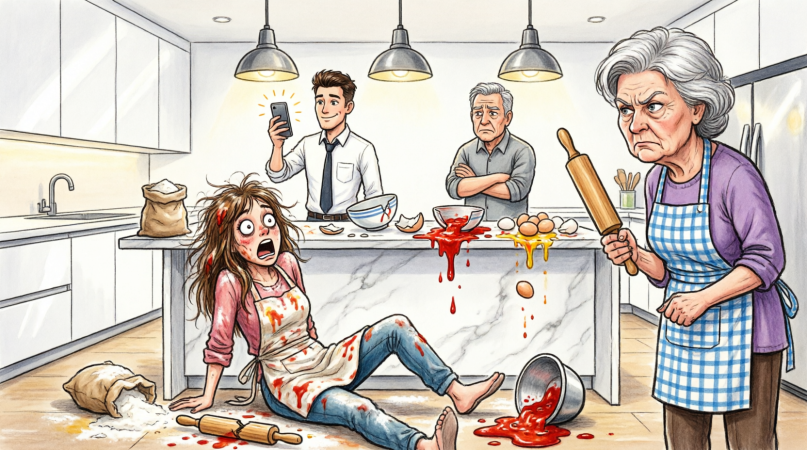
I fell hard onto the kitchen tile.
The floor was cold against my hip, and the smell of green salsa rose up around my face because the bowl had tipped when I went down.
Cilantro stuck to my palm.
A shard of ceramic pressed into the soft skin below my wrist.
For a second, I could not even scream.
Pain had a shape I had never known before.
It started in my shin, shot up through my knee, and seemed to close around my throat from the inside.
Linda Carter stood above me with the rolling pin in both hands.
Her chest lifted and fell like she had just fought off a burglar instead of attacking her daughter-in-law over soup.
“That’s what happens when you disrespect me in front of my son,” she said.
All I had said was that the broth was too salty.
That was it.
Frank had high blood pressure, and Linda had dumped in seasoning without looking while she talked over me about how women these days were too opinionated.
I said, “Maybe Frank shouldn’t eat too much of that.”
In a normal family, someone might have said thank you.
In the Carter family home in San Antonio, concern was treated like rebellion.
Frank leaned against the refrigerator with his arms folded, staring at my leg without changing expression.
He was Ethan’s father, Linda’s husband, and the kind of man who survived every room by pretending not to see what happened in it.
The refrigerator hummed behind him.
A small American flag magnet held up a grocery list on the freezer door.
The list had milk, eggs, and paper towels written in Linda’s square handwriting.
It was strange what the mind notices when the body is trying not to break apart.
“Ethan,” I whispered.
My husband appeared in the hallway with his phone in one hand.
His white work shirt was still tucked in, still clean, still sharp along the collar because he had always looked most respectable in the moments when he was least kind.
“What happened now?” he asked.
I remember the word now.
Not what happened.
Not are you hurt.
Now.
Like my body on the floor was only the latest interruption in a long series of inconveniences.
“Your mother broke my leg,” I said.
He looked at Linda.
Linda lifted her chin.
Then he looked back at me and sighed.
“You exaggerate everything.”
I had been married to Ethan for six years.
In those six years, I had learned how he liked his coffee, how he folded towels, how he went silent whenever his mother criticized me because silence let him keep both women in place.
At first, I told myself he was tired.
Then I told myself he hated conflict.
Then I told myself marriage meant patience.
A woman can forgive being overlooked for a long time.
What she cannot survive forever is realizing silence was never peace.
It was training.
Linda set the rolling pin on the counter as if she had finished using it for biscuits.
Frank asked if the soup was still hot.
Ethan stepped over the edge of the salsa and turned on the sink.
None of them called an ambulance.
None of them touched my shoulder.
None of them even lowered their voices when dinner continued around me.
Forks scraped plates.
A chair leg dragged.
The television murmured from the other room.
Linda wiped the cabinet door with a dish towel while my shin pulsed so violently that spots appeared at the edge of my vision.
I tried once to pull myself up.
The pain dropped me back down with a sound I hated hearing from my own mouth.
Ethan crouched near me at 8:42 p.m.
I know the time because the oven clock was directly above his shoulder.
He did not crouch to help me.
He crouched so he could speak low enough that only I would hear.
“Maybe next time you’ll learn not to embarrass Mom.”
There are sentences that do more than hurt.
They rearrange the room.
They take every small excuse you built for someone and knock it down at once.
I looked at his wedding ring.
I remembered cleaning that ring in the bathroom sink the week after we moved into the house because he had dropped it in garage grease.
I remembered packing his lunches when he worked double shifts.
I remembered sitting through Linda’s church dinners, Linda’s holiday rules, and Linda’s little jokes about how I had big feelings.
I had given that family years of quiet.
They had mistaken it for permission.
The house settled slowly after dinner.
Frank went to the living room.
Linda washed dishes, humming under her breath.
Ethan sat at the table and scrolled his phone while I lay near the lower cabinets, sweating through my shirt.
At one point, Linda said, “Women have to be controlled before they get ideas.”
Ethan made a small sound of agreement.
Not a laugh.
Not a speech.
Just enough.
That was when the last soft thing in me closed.
I did not scream.
I did not throw a bowl.
For one ugly second, I imagined grabbing the rolling pin and giving Linda the fear she had handed me.
Then I looked at my leg, at the tile, at the cabinet grate near the floor, and I understood something practical.
Rage would keep me in that kitchen.
Proof might get me out.
I dragged myself by my elbows toward the lower cabinet.
Every inch felt like dragging fire under my skin.
My hand shook as I opened the door under the counter.
Linda kept an old rusted can opener in there because she hated throwing anything away, even things that barely worked.
I found it behind a stack of plastic containers with missing lids.
The metal was rough and cold in my hand.
I used the hook to work at the tiny screws on the back kitchen grate.
It was not a clean job.
My fingers slipped.
My nails tore.
Sweat ran into my eyes.
Once, the can opener clattered against the tile, and I froze so completely I thought my own heartbeat would give me away.
No one came.
The television grew louder.
Someone laughed.
I went back to the screws.
At 10:57 p.m., the grate finally gave with a soft metal pop.
I remember that time too because I looked once at the microwave before I pulled myself through the opening.
The backyard grass was wet.
The night air felt cold against my face after the heat of the kitchen.
I crawled along the side of the house, keeping close to the wall, past the hose, past the trash bins, past the narrow strip of grass Ethan always promised to fix but never did.
Every movement made my vision blur.
I stopped twice because I thought I might pass out.
Then I saw Mrs. Greene’s porch light.
Mrs. Greene lived next door in a small brick house with a porch swing, a chain-link fence, and a mailbox whose little metal flag was always standing up because she still mailed birthday cards to everyone she knew.
She was in her seventies, sharp-eyed, churchgoing, and not fooled by the Carter family.
Linda hated her.
That alone should have made me trust her sooner.
I reached her porch at 11:14 p.m.
I did not knock so much as fall against the door.
When it opened, Mrs. Greene looked down and went still.
Then her whole face changed.
“Sweet Lord,” she whispered. “Emily?”
“Help me,” I said.
It came out thin and broken.
She did not ask me to explain on the porch.
She did not tell me to calm down.
She got one arm under mine and pulled me across the threshold with a strength that made me cry harder than the pain had.
Not because it hurt.
Because someone had moved toward me.
She laid me on the hallway rug and called 911 at 11:18 p.m.
I heard every word.
“Yes, ambulance,” she said. “And police. No, she did not fall. She crawled here from next door. It’s that family again, and this time somebody is going to write a report.”
The dispatcher asked questions.
Mrs. Greene answered them like she had been waiting years to be asked.
She gave the address.
She gave Linda’s name.
She gave Ethan’s name.
She said she had heard shouting before, that she had seen bruises I explained away, that she had once watched Ethan lock me out on the porch for twenty minutes during a rainstorm because Linda was upset about a casserole dish.
I closed my eyes.
I had forgotten that night.
Or maybe I had filed it somewhere under things married women endure when they are trying not to admit they are scared.
The ambulance arrived at 11:39 p.m.
The paramedic who knelt beside me had kind hands and a careful voice.
He asked where the pain was.
I laughed once, not because anything was funny, but because the answer seemed too large for one body.
“Everywhere,” I said.
At the hospital, everything became bright.
White lights.
White sheets.
White forms.
Clean hands touching places that had only been ignored hours earlier.
A nurse cut away part of my jeans.
Another took photographs for the chart.
A radiology tech asked me twice whether I felt safe going home, and both times I could not make my mouth say yes.
By 12:26 a.m., a hospital intake form had my name, arrival time, injury description, and the words reported assault in residence typed into the electronic chart.
By 1:10 a.m., a social worker came in with a clipboard.
She introduced herself simply.
She did not ask why I had stayed.
That was the first thing I liked about her.
People who ask why someone stayed often think they are asking about courage.
They are usually asking the wrong question.
The question is not why you stayed.
The question is how many doors were quietly blocked before you noticed you were trapped.
The social worker asked what happened in order.
I told her about the soup.
I told her about the rolling pin.
I told her about Ethan.
When I said he called it punishment, her pen stopped for half a second.
Only half.
Then she kept writing.
“Did anyone in the home offer medical assistance?” she asked.
“No.”
“Did anyone prevent you from leaving?”
I thought about the back grate, the cabinet, the wet grass, the way they had left me on the floor because the floor was where they wanted me.
“They didn’t have to,” I said. “They just knew I couldn’t walk.”
She nodded like that answer told her more than a yes or no could have.
The X-ray confirmed a fracture.
The doctor spoke carefully, using medical language because that was his job.
The nurse squeezed my shoulder after he left because she had a different job, the human kind no one writes on badges.
At 3:03 a.m., an officer came to the room.
He took my statement.
He took Mrs. Greene’s statement.
He asked if the rolling pin was still in the house.
I said yes.
He asked if there were objects that showed how I escaped.
I told him about the can opener and the grate screws.
He wrote everything down.
That was the beginning of the trap, though I did not understand it yet.
It was not a trap made of lies.
It was a trap made of giving cruel people one more chance to speak in front of witnesses.
For the next two days, Ethan called my phone seventeen times.
I did not answer.
He texted five times.
The first message said, Mom is upset you embarrassed us.
The second said, You need to fix this before it becomes something stupid.
The third said, Hospital bills are not cheap, Emily.
The fourth said, Don’t start acting like a victim.
The fifth came at 6:44 p.m. on the second day.
It said, We’re coming to get you tomorrow and you’re going to tell them you fell.
I showed the message to the social worker.
She read it without changing her expression.
Then she said, “Do you trust me?”
I had not trusted anyone in a long time.
But she had not rushed me.
She had not pitied me loudly.
She had documented, printed, clipped, copied, and asked before touching every story I handed her.
So I said yes.
The next morning, at 9:10 a.m., she rolled my wheelchair beside the hospital intake desk.
It was not near the front doors by accident.
It was near the security camera.
A nurse stood behind the counter with a folder.
A security guard stood near the hallway pretending to study a bulletin board.
Mrs. Greene sat in a chair by the window with her purse in her lap and her lips pressed into one hard line.
I had never seen a woman look so ready to go to war with a handbag.
The automatic doors opened.
Ethan walked in first.
Linda followed close behind him in her beige cardigan, hair smooth, purse tucked under one arm, face arranged into that wounded-mother expression she used whenever she wanted strangers to believe she was the reasonable one.
She looked at me in the wheelchair and clicked her tongue.
“Look at this drama,” she said.
The nurse placed a clipboard on the counter.
“Before anyone speaks,” she said, “we need you both to look at the timestamp on the hospital intake form.”
Linda gave a short laugh.
Ethan said, “She’s confused. She says things when she’s upset.”
The nurse turned the first page.
“Patient arrived by ambulance at 11:46 p.m., reporting assault in residence by household member,” she read.
Linda’s smile held.
Barely.
“She fell,” Linda said.
I looked at her hands.
Those same hands had held the rolling pin.
Those same hands had wiped salsa from the cabinet while I lay under them.
The social worker stepped forward.
“Mrs. Carter, we are not asking you to explain yet.”
Linda did not like that.
People like Linda live on explaining before anyone can assemble facts.
The nurse turned another page.
There were photographs.
My leg.
My wrist.
My shirt.
The dried green salsa under my nails.
A small plastic specimen cup held the screws from the kitchen grate.
Another bag held the rusted can opener.
Ethan saw it and went pale.
He recognized the can opener, not because he cared about it, but because it was from home.
Proof has a way of making familiar things dangerous.
“Why do you have that?” he asked.
The security guard stopped pretending to read the bulletin board.
Mrs. Greene stood up.
Slowly.
Linda pointed at her.
“That old woman has had it in for me for years.”
Mrs. Greene’s voice came out steady.
“No, Linda. I had patience for years. There’s a difference.”
For the first time, Linda had no fast answer.
The social worker opened a smaller folder.
“This is the part,” she said, “where you should be very careful about what you call punishment.”
Ethan looked down.
The heading on the first page read Police Report Addendum.
His mouth opened.
No sound came out.
The addendum contained his text message from the night before.
We’re coming to get you tomorrow and you’re going to tell them you fell.
It contained my statement.
It contained Mrs. Greene’s statement.
It contained the nurse’s notes, the radiology report, the intake timestamp, and the documented refusal of medical care by household members as reported by the patient.
Linda tried to reach for the folder.
The nurse slid it back.
“No,” she said.
One word.
Clean.
Final.
Ethan whispered, “Mom.”
It was not concern.
It was accusation.
Linda heard it and turned on him instantly.
“Don’t you dare put this on me,” she said.
The lobby went quiet.
Not silent.
Hospitals are never silent.
There was still a monitor beeping somewhere, a printer coughing paper, a cart wheel squeaking down the hall.
But the space around us tightened.
The social worker looked at Ethan.
“Mr. Carter, would you like to repeat what you said to your wife on the kitchen floor?”
He swallowed.
“I don’t know what she told you.”
“She told us you said maybe next time she would learn not to embarrass your mother.”
His eyes flicked toward the security camera.
That tiny look destroyed him more than any shouting could have.
Because it told everyone he understood the room had become evidence.
Linda stepped forward.
“She did embarrass me,” she snapped. “In my own kitchen. In front of my husband. In front of my son.”
The officer who had taken my statement walked in from the side hallway.
He had been there the whole time.
Just not where Linda could perform for him.
“Mrs. Carter,” he said, “I need you to stop talking.”
She did not.
That was Linda’s mistake.
She had gone too many years mistaking fear for respect.
“She needed to be taught,” Linda said. “A wife cannot come into a family and think she runs the house.”
Ethan closed his eyes.
Frank was not there that morning, but I could almost see him against the refrigerator, arms folded, letting the world happen as long as it did not require courage from him.
The officer separated them.
Linda demanded a lawyer.
Ethan said he never touched me.
The nurse pointed out that the report had never said he had struck me.
It said he had refused aid, pressured me to lie, and confirmed the language of punishment in front of medical staff.
He stared at the folder like the paper had betrayed him.
Paper does not betray anyone.
It only remembers what people think they can get away with.
By noon, the hospital had completed a discharge safety plan.
Mrs. Greene signed as the person taking me home.
Not to the Carter house.
To her guest room, with the quilt folded at the foot of the bed and a little bell on the nightstand that I refused to ring until she threatened to sit beside me all night and stare.
The officer told me the case would take time.
He did not promise an easy road.
I appreciated that.
Easy promises had kept me in a hard marriage.
Over the next week, more documents formed a wall between me and the life I had crawled out of.
The hospital record.
The incident report.
The radiology images.
The text messages.
Mrs. Greene’s statement.
The photographs.
The screws in the cup.
The can opener in the bag.
None of those things healed my leg.
But they did something almost as important.
They made the truth harder to bully.
Ethan came once to Mrs. Greene’s house.
He stood on the porch, looking smaller than I remembered.
He said his mother had gone too far.
Not we.
Not I.
His mother.
I sat inside by the front window with my leg propped up and watched Mrs. Greene open the door only as far as the chain allowed.
“She is not available to be managed today,” Mrs. Greene said.
Ethan saw me through the gap.
“Emily, please.”
There it was.
The word men use when command stops working.
I did not answer.
Not because I had nothing to say.
Because for six years, I had answered every mood in that family like it was my job.
That day, silence finally belonged to me.
The kitchen came back to me in dreams for a while.
The tile.
The salsa.
The rolling pin.
The refrigerator humming behind Frank.
Sometimes I woke with my hand clenched like the can opener was still there.
Mrs. Greene would knock softly from the hall and ask if I wanted tea.
She never asked if I was over it.
That was another mercy.
People who have not crawled through wet grass with a broken leg sometimes think healing is a straight hallway.
It is not.
It is a house you have to relearn one room at a time.
I learned the guest room first.
Then the porch.
Then the driveway in the morning sun.
Then the hospital follow-up room where a nurse removed tape from my skin and told me the swelling was going down.
Then the courthouse hallway where I sat beside Mrs. Greene and held a folder that no longer shook in my hands.
I will not pretend justice arrived like thunder.
It arrived like paperwork.
Slow.
Stamped.
Copied.
Signed.
Filed.
But it arrived.
Linda’s face was different in that hallway.
No rolling pin.
No kitchen.
No son standing between her and consequence.
Just a woman in a beige cardigan learning that witnesses change the shape of power.
Ethan tried to look tired.
He had always been good at looking tired.
This time, no one mistook it for innocence.
When my statement was read, Linda stared at the floor.
When the text message was entered, Ethan stared at the wall.
When Mrs. Greene spoke, her voice did not tremble once.
She said, “I opened my door and found a woman who had been left to crawl for help. I am old enough to know the difference between a fall and a family deciding someone deserved pain.”
I cried then.
Quietly.
Not because I was weak.
Because someone had finally said it without making me smaller.
A woman can forgive being overlooked for a long time.
But there is a day when she stops calling neglect love.
Mine began on a kitchen floor.
It continued through wet grass.
It changed under hospital lights, where a social worker, a nurse, a neighbor, and a stack of documents gave cruelty one more chance to explain itself.
Cruelty almost always does.
Linda thought she was teaching me a lesson.
Ethan thought silence would protect him.
Frank thought doing nothing meant nothing could be pinned to him.
They were all wrong in different ways.
The last time I saw the rolling pin, it was not in Linda’s hands.
It was in a clear evidence bag on a metal table.
It looked smaller there.
Almost ridiculous.
That is the thing about weapons people use inside families.
They seem enormous when everyone agrees to be afraid of them.
Under bright lights, with the truth written down, they become what they always were.
Objects held by people who chose harm.
Months later, Mrs. Greene gave me the rusted can opener.
Not the real one.
That stayed with the case.
She found another at a thrift store, just as ugly and stubborn, and tied a blue ribbon through the handle.
“For your new kitchen,” she said.
I laughed for the first time without it hurting my ribs.
I keep it in a drawer now.
Not because I need it to open cans.
Because it reminds me that the smallest tool in the wrong drawer can become a way out when someone finally decides she is done dying quietly.
And whenever I hear a refrigerator hum, I do not think of Frank’s silence first anymore.
I think of Mrs. Greene’s porch light.
I think of the nurse saying no.
I think of the hospital intake form with the timestamp that made Ethan’s face drain of color.
Mostly, I think of the woman I was on that tile, with salsa under her hand and a broken leg beneath her, still finding the cabinet, still finding the screws, still finding the grass.
She thought she was crawling away from a house.
She was really crawling back to herself.