My name is Claudia Hayes, and for most of my adult life, I believed I understood what heartbreak was. I had seen it in hospital rooms at three in the morning, in the faces of wives who refused to let go of husbands already slipping away, in the trembling hands of sons signing papers they did not want to sign, in the quiet, devastated silence of people who had just been told that medicine had done all it could do. I had felt it myself when my mother died, when the woman who taught me how to make soup from almost nothing and how to keep kindness alive in a hard world closed her eyes for the last time. I had felt it through thirty years of nursing, through nights when I drove home from St. Catherine’s Medical Center in Chicago with a coffee gone cold in the cup holder and someone else’s final words still echoing in my head.
But until Christmas Eve of 2024, I had never heard heartbreak speak in my own kitchen using my husband’s voice.
That evening, snow was falling over our neighborhood in Oak Park, steady and soft, gathering on porch railings, rooflines, and the bare branches of the maple tree Trent and I had planted during our second year of marriage. Our house looked like a Christmas card from the street, warm windows glowing behind wreaths, white lights wrapped around the shrubs, a red ribbon on the mailbox, smoke drifting from the chimney into a violet winter sky. Inside, the air smelled like cinnamon, nutmeg, baked apples, and the pine tree we had picked out together three weeks earlier from the lot beside the Methodist church.
I had spent the whole day preparing for Christmas.
That was what women like me did, or at least what I had always done. I made sure holidays happened. I checked the lists, bought the gifts, wrapped them, cooked the food, mailed the cards, remembered who liked pecan pie and who hated cranberry sauce, made certain the house looked warm enough that nobody would notice how quiet it had become. By fifty-five, I had become an expert at creating comfort for other people even when I did not feel much of it myself.
The apple pie was cooling on the counter. A roast was resting under foil. Two place settings sat at the dining room table because Trent said he wanted a quiet Christmas Eve this year, just the two of us, no friends, no neighbors, no church reception. I had secretly been happy about that. I thought maybe he wanted to reconnect. I thought maybe the distance between us over the past year had been work stress or age or the ordinary dulling that happens in long marriages when two people forget to look at each other with curiosity.
I had put on the green sweater he once said made my eyes look bright. I had lit the candles. I had poured myself one glass of wine and left his untouched beside his plate because he was late again, and I was still capable of making excuses for him.
When I heard his car in the driveway, I smoothed my sweater, checked my hair in the reflection of the microwave door, and smiled before he even stepped inside.
The door opened. Cold air pushed into the hallway. Trent walked in wearing his gray wool coat, his shoulders dusted with snow, his leather gloves still in one hand. He did not stomp his shoes on the mat. He did not call out, “Merry Christmas Eve.” He did not smile at the tree or comment on the smell of the pie.
He stood just inside the kitchen entrance like a man arriving at a house he had already left.
“Hey,” I said, wiping my hands on the red and green dish towel we had owned since our second Christmas together. “You’re later than I thought. The roast is still warm. Sit down. I’ll make coffee if you want.”
He looked at the table, then at the tree, then finally at me.
“I can’t do this anymore, Claudia.”
The towel slipped slightly in my hands. At first, I thought he meant dinner. Maybe the holiday. Maybe some argument I had not known we were having. After twenty-eight years of marriage, a person’s tone can tell you more than their words, and Trent’s voice had a flatness in it I had only heard once before, when he called me from the roadside years earlier to say he had hit a deer and there was nothing anyone could do.
“Do what?” I asked carefully. “Honey, you just got home. Take off your coat. We can talk after you eat.”
He shook his head. “No. We need to talk now.”
Something inside me tightened. I had been a nurse too long not to recognize the moment before bad news lands. People think disaster announces itself loudly, but often it comes quietly, wearing a calm face, standing under your kitchen lights.
“Okay,” I said. “Then talk.”
He set his keys on the counter with deliberate precision. It was such a small action, but I remember it more clearly than I remember many of the words that followed. The keys made a hard clicking sound against the granite countertop we had chosen together during a remodel three years earlier. I had wanted marble, but Trent said granite was more practical.
Practical. That word could have been carved into our marriage by then.
“I haven’t been happy for a long time,” he said.
I looked at him, waiting for the rest, because surely there had to be more. A man does not walk into a Christmas-lit kitchen after nearly three decades and begin dismantling a life with one sentence. He explains. He apologizes. He reaches for your hand. He cries. Something.
Trent did none of that.
“What does that mean?” I asked.
“It means I can’t keep pretending.”
“Pretending what?”
“That this is enough.”
The words seemed to remove all the warmth from the room. I was suddenly aware of every ridiculous detail around us: the Christmas mugs near the coffee maker, the ribbon curling off a gift under the tree, the roast cooling under foil, the pie I had brushed with egg wash that afternoon while humming along to Nat King Cole. All those small acts of care looked foolish now, like stage props arranged for an audience that had already left.
“We were going to open presents tomorrow morning,” I said, and immediately hated myself for saying something so small when the ground was cracking open. “You said you got me something special this year.”
He looked at me then, really looked, and what I saw in his eyes made my knees weaken.
Pity.
Not sorrow. Not love. Pity.
“There’s someone else,” he said.
The sentence did not explode. It settled. That was worse. It settled into the room as if it had been waiting there all along, tucked behind the cabinets, under the floorboards, inside the walls of the house I thought we had built together.
I gripped the edge of the counter. “Someone else.”
“Yes.”
“How long?”
He inhaled and looked away. “Eight months.”
Eight months.
While I had made his coffee. While I had asked about his day. While I had washed his shirts, bought his vitamins, reminded him about his dental appointment, sat beside him at church picnics, and believed his late nights were client dinners. Eight months while he came home smelling faintly of unfamiliar perfume and I told myself I was imagining it because women of fifty-five are trained to doubt their instincts before they doubt the men they love.
“Who is she?” I asked.
“Her name is Jessica.”
I waited.
“She’s twenty-eight.”
There are moments when pain becomes so sharp it turns strangely quiet. The same age I had been when I married him. Younger, actually, by a few months. Young enough to still believe love was a country you entered once and stayed in forever if you were good and loyal and patient.
I sank onto one of the kitchen stools because my legs no longer trusted the floor.
“Twenty-eight,” I repeated.
He ran a hand through his brown hair, the way he did when nervous. There was more gray in it now than he liked to admit. I had always found that gray handsome. Distinguished. Proof that we had lived years together. I wondered if Jessica saw it as charming or if she teased him about it while making him feel young.
“She makes me feel alive,” he said.
I stared at him.
He continued, and as he spoke I realized this was not confession. It was a presentation. Trent had worked in medical equipment sales for twenty-five years. He knew how to prepare talking points. He knew how to guide a customer toward a conclusion. He had rehearsed this, perhaps in Jessica’s apartment, perhaps in his car, perhaps while I was baking his Christmas pie.
“She laughs at my jokes. She wants to travel. She wants to try new restaurants, concerts, things we used to talk about doing before everything became so…” He paused.
“So what?”
He looked pained. “Predictable.”
I felt that word physically.
“Safe,” he added, as if trying to soften it and making it worse. “Old.”
Old.
There it was. Not just the marriage. Me.
I thought about my body, fifty-five years of living written into it: soft belly, tired knees, lines around my eyes, silver roots I covered every six weeks, hands roughened by decades of hospital soap and winter air. I thought about Jessica with bright skin, young arms, easy laughter, and years ahead of her that Trent had apparently decided he deserved more than I did.
“I see,” I said.
He looked surprised by my calm. Maybe he expected screaming. Maybe he expected me to throw the pie. Maybe some part of him wanted me to break apart so his leaving would feel powerful.
“When are you leaving?” I asked.
His mouth opened slightly. “Tonight.”
That should not have shocked me, but it did.
“You came here on Christmas Eve to tell me you’re leaving tonight?”
“I’ve already moved most of my things.”
I glanced toward the hallway, toward the bedroom, toward the closet where his side had probably been emptying one business trip at a time. I had not noticed. Or I had noticed and filed it away under explanations because marriage, when you are trying to save it alone, becomes an exhausting exercise in charitable interpretation.
“I just came back to tell you,” he said.
“How considerate.”
He flinched, but only a little.
“I wanted to wait until after the holidays,” he said. “But Jessica felt it wasn’t fair to either of us to keep pretending.”
Jessica felt.
A woman who had been alive for fewer years than I had been married was now making ethical decisions about my life.
I stood slowly and walked to the window above the sink. Snow fell under the streetlight in slow, silver sheets. Across the street, the Markhams’ grandchildren were arriving, tumbling out of an SUV with wrapped gifts and red hats. Someone laughed. A dog barked. The world was continuing, rudely, impossibly, while my marriage died behind glass.
“The house is in both our names,” I said, amazed at the practicality of my own voice. “We’ll need to discuss finances.”
“Keep the house,” Trent said quickly. “I don’t want to fight over things. I just want to be happy.”
Happy.
The word sounded obscene.
“As if happiness is something you can pick up from someone else’s wreckage,” I said softly.
“What?”
“Nothing.”
He stood by the kitchen entrance now, keys back in his hand. He looked lighter already, like a man who had put down a suitcase he had forced me to carry without knowing it.
“Did you ever love me?” I asked.
The silence after that was the cruelest answer he gave me.
Finally, he said, “I did. But people change. Claudia, I changed.”
I turned around. “No, Trent. You chose. There’s a difference.”
His face tightened. For the first time, he looked offended. Not by what he had done, but by my refusal to describe it gently.
“I didn’t plan this.”
“No. You just participated in it for eight months.”
He looked toward the door.
I wanted, suddenly and fiercely, not to beg. I wanted to keep one piece of myself intact. So I lifted my chin and said, “I hope she makes you happy. I really do.”
His eyes flickered with surprise. “Claudia—”
“Go.”
“I never wanted to hurt you.”
“That was careless of you, then.”
He had no answer. Perhaps there was no sales script for the discarded wife who refused to audition for sympathy. He picked up the overnight bag I had not noticed near the back door, opened it, and stepped out into the snow.
The door closed behind him.
For several minutes, I did not move.
The candles burned on the dining table. The roast cooled. The pie scented the air with domestic devotion. The Christmas tree stood bright and ridiculous in the corner, its ornaments carrying the story of our whole marriage: the glass angel from our honeymoon in Savannah, the ceramic house from our first mortgage, the tiny nurse ornament Trent had bought me after I passed my boards, the pewter snowflake engraved with our twenty-fifth anniversary date.
I walked to the tree and looked down at the presents. I had wrapped Trent’s gifts in blue paper with silver ribbon because he disliked anything too flashy. A new watch band. A cashmere scarf. A first edition of a baseball biography he had mentioned months earlier and probably forgotten. I had listened. I had always listened.
Then, without deciding to, I grabbed my coat.
I wound my blue wool scarf around my neck, the one my mother had knitted before she died. It was uneven in one place where her arthritis had made the stitches loose, and I loved that imperfection more than any expensive thing I owned. I stepped into my sturdy brown winter boots, pulled on gloves, and left the house without turning off the tree.
The cold hit me hard, but it was honest. That was something.
I walked.
At first, I stayed on familiar streets, passing houses glowing with Christmas Eve life. Families sat at tables. Shadows moved behind curtains. A child pressed both hands against a window to look at the snow. Somewhere, someone was playing piano badly but cheerfully. It felt like moving through a world where everyone had received instructions for happiness and I had misplaced mine.
I passed the elementary school where I had once volunteered at book fairs. I passed Grace Methodist, where Trent and I had stood on a bright June morning twenty-eight years earlier and promised before God and everybody that we would stay. I paused at the church steps, remembering my younger self in ivory lace, my mother crying into a tissue, Trent’s hand warm around mine.
Then I kept walking.
The snow thickened. It collected on my scarf and lashes. It softened the edges of parked cars and fences. My boots, new and well-insulated, kept my feet dry at first, but after half an hour even they could not protect me completely from the cold sinking up through the soles. I did not care. I needed to move until the house was no longer the last place my life made sense.
Eventually, my feet took me to Northview Memorial Park.
Trent and I had picnicked there when we were newly married and too broke for restaurants. We used to bring sandwiches wrapped in wax paper and sit near the pond, talking about children we never had, trips we never took, dreams we postponed until they became embarrassing to mention. Now the park was deserted, the pond edged with ice, the benches half buried in snow. Streetlights cast pale yellow circles along the path. Beyond them, the world faded into white silence.
I brushed snow from a bench and sat down.
The metal burned through my jeans. The cold moved into me with the patience of something that had all night. I pulled my scarf tighter, crossed my arms, and finally let myself understand what had happened.
My marriage was over.
Not strained. Not difficult. Not in a season. Over.
For twenty-eight years, I had been a wife. For longer than that, I had been a caretaker. A nurse, a daughter, a partner, the woman who remembered, soothed, organized, prepared, forgave, adjusted. Now, on Christmas morning, because the church bells began ringing midnight somewhere beyond the snow, I was simply Claudia, sitting alone on a park bench in a storm with nowhere to be.
I cried then.
Not pretty tears. Not dignified tears. I bent forward with my gloved hands over my face and cried until my throat hurt. I cried for the humiliation of being replaced. I cried for the wasted tenderness. I cried for the version of myself who had still been excited to open presents in the morning. I cried because I was fifty-five years old and suddenly expected to start over in a world that loved telling women like me our best years were behind us.
Then, somewhere beneath the grief, something unexpected stirred.
Freedom.
At first, I rejected it. It seemed indecent to feel anything but pain. But there it was, small and terrifying, like a match cupped against wind. For the first time in decades, nobody was waiting for me to come home and cook. Nobody’s preferences outranked mine by habit. Nobody’s disappointment would shape my morning. I did not have to ask Trent what he wanted for dinner, whether he wanted to visit his brother, whether he thought the living room rug was too bright, whether I should cut my hair shorter or keep it “soft.”
I had lost my marriage.
But I had also, somehow, been handed myself.
The thought frightened me so much I almost stood up to walk home. But I stayed. Snow fell harder. Time loosened. My fingers went numb despite the gloves. My toes began to ache, then burn, then lose feeling in a way my nurse’s mind recognized as dangerous. Still, I sat there, staring at the pond, because going home meant returning to a house where Trent’s absence would be louder than his presence had been.
I do not know how long I had been sitting there when I heard footsteps.
At first, I thought the sound was a branch creaking under snow. Then it came again: uneven, shuffling, slow. I lifted my head.
A figure moved along the main path, emerging and disappearing between curtains of falling snow. A man. Older, maybe in his sixties. He wore several layers of clothing, none of them adequate: a frayed coat, a sweater under it, pants dark with wet at the cuffs. His gray hair stuck out from beneath a knit cap. His beard was untrimmed. He walked carefully, painfully, as though each step required negotiation.
Then he passed under a streetlight, and I saw his feet.
Bare.
No shoes. No socks. Bare feet in the snow, red and purple and white in places where no living skin should be white.
My own misery vanished so quickly it almost startled me.
I stood. “Sir?”
He stopped and looked toward me as if surprised another human being existed in the storm.
“Sir, are you all right?”
He gave a short, breathless laugh. “That depends on your standard for all right.”
His voice was rough from cold, but educated. That was the first thing I noticed after his feet. Not polished exactly, but thoughtful, with a dry humor that did not match the desperation of his body.
“You’re barefoot,” I said, moving toward him.
He glanced down as though this were an inconvenience he had been meaning to address. “Yes, ma’am. Lost my shoes two nights ago. Someone took them while I was sleeping.”
“Your toes are turning white.”
“So they are.”
“That’s frostbite.”
“You a doctor?”
“Nurse. Thirty years.”
“Then I believe you.”
He tried to smile, but his lips were blue. His hands trembled. Up close, I saw that his eyes were a startling clear blue, sharp and awake despite the rest of him looking like the world had tried to erase him.
“You need to get inside,” I said. “There are shelters—”
“Full. It’s Christmas. Everyone wants to be generous in theory. In practice, beds run out.”
“There’s an emergency warming center near Cicero.”
“Too far on these feet.”
He said it lightly, but I heard the truth. He might not make it. Not without shoes. Maybe not even with them, but without them he was walking toward permanent damage or death.
I looked down at my boots.
They were good boots. Brown leather, waterproof, insulated, bought just last month after Trent complained my old pair looked shabby when we went to dinner with his clients. They were practical, warm, nearly new.
The man followed my gaze and seemed to understand before I moved.
“No,” he said. “Don’t even think about it.”
I sat on the bench and began untying the laces.
“Ma’am.”
“My name is Claudia.”
“Claudia, you cannot give me your boots.”
“I can.”
“You’ll freeze.”
“I have thick socks.”
“You’re lying.”
“I’m a nurse. We lie about our comfort all the time.”
He made a sound that might have been a laugh or a cough. I pulled off the first boot, and cold air attacked my sock instantly. The second boot came off more slowly because my fingers were numb. I stood with both boots in my hands, snow soaking through my socks almost immediately.
“Put them on,” I said.
He stared at me.
“Please,” I added, because pride is sometimes the last coat a suffering person owns, and you have to ask gently before they remove it.
“I can’t take these from you.”
“You can.”
“You don’t know me.”
“I know your feet are freezing.”
He looked away. His jaw worked. When he turned back, I saw tears bright in his eyes, though whether from cold or humiliation or gratitude I could not tell.
“My name is Marcus,” he said.
“Then Merry Christmas, Marcus. Take the boots.”
He took them as if they were something sacred. Sitting on the bench, he eased his damaged feet into them with visible pain and relief. They were a little large on him, but thick enough to protect him. When he stood, he seemed taller, steadier, almost transformed by the simple dignity of covered feet.
“Are you sure?” he asked. “Because once I walk away, you probably won’t see these again.”
“I’m sure.”
“Why?”
The question caught me off guard.
“Because you needed them.”
“That’s all?”
I thought of my mother then, of her hands guiding mine as a child while we packed sandwiches for a neighbor whose husband had lost his job. My mother had never had much money, but she had a theology of kindness that was firmer than any doctrine I learned in church.
“My mother used to say that when you help someone, you shouldn’t expect anything back. If you expect a return, that’s not kindness. That’s investing.”
Marcus looked at me for a long moment, those blue eyes searching my face with an intensity that made me feel seen in a way I had not felt in years.
“Your mother was a wise woman.”
“She was.”
“Was?”
“She died five years ago.”
“I’m sorry.”
“Me too.”
The snow fell between us, softening the silence.
“What are you doing out here on Christmas morning, Claudia?” he asked. “Most people are home with family.”
A laugh escaped me, brittle and humorless. “My husband left me tonight. For a younger woman. I didn’t want to stay in the house.”
Marcus’s expression changed. Not pity. Recognition.
“That’s a different kind of cold,” he said.
The accuracy of that nearly undid me.
“Yes,” I whispered. “It is.”
We stood there together under the streetlight, two strangers in a park, both wounded in ways the world might not stop long enough to examine. He was freezing from the outside in. I was freezing from the inside out. For a moment, the distinction seemed less important than I would have expected.
Marcus reached into one of his coat pockets and pulled out a small silver coin.
“I want you to have this.”
“No. You don’t need to give me anything.”
“Yes, I do.”
He placed it in my palm. It was warm from his pocket, heavier than I expected. In the dim light, I could not read the inscription.
“It isn’t worth much,” he said. “Not in the way people usually measure worth.”
“Then why give it to me?”
“Because you gave me something you needed. I need to give you something that matters to me.”
I closed my fingers around it. “Thank you.”
“There’s an all-night diner about six blocks east,” he said. “Grand Avenue Diner. If I can get there, I can sit with coffee until morning.”
“With those boots, you can get there.”
He looked down at them, then back at me. “Because of you.”
“Be careful.”
“I will.” He hesitated. “And Claudia?”
“Yes?”
“Any man who makes you feel discarded has misunderstood your value. Sometimes the people who hurt us do us the biggest favor of our lives without meaning to.”
Before I could answer, he turned and walked into the storm. His steps were steadier now. I watched until the snow swallowed him.
Then I turned toward home.
The walk back was brutal.
Within half a block, my socks were soaked. Within three blocks, my feet burned so badly I had to stop under a tree and press one hand against the trunk. By the time I reached my street, I could no longer feel my toes. The houses were dark now. Families slept under warm roofs. I walked slowly, leaving uneven footprints in the snow, carrying a silver coin in my pocket and a strange warmth in my chest that pain could not quite erase.
At home, the tree was still lit. The roast was ruined. The candles had burned low. Trent’s gifts remained under the branches like evidence of a woman who no longer existed.
I went upstairs, filled the bathtub with warm—not hot, because I knew better than to shock cold-damaged skin—and lowered my feet into the water inch by inch. Feeling returned as knives. I gasped, gripped the edge of the tub, and cried again, though this time it was partly from pain and partly from the absurdity of the night.
When my feet were safe, I changed into dry clothes and made tea. In the kitchen, I placed Marcus’s coin beside the mug and finally read the inscription under the light.
Kindness is the only investment that never fails.
I turned the coin over. On the other side was a small engraved willow tree.
Something about it made my throat tighten. It was too beautiful, too deliberate, for a man who claimed to have nothing. But I was too exhausted to examine that mystery. People carried strange treasures. The world was full of hidden stories. Maybe Marcus had once been someone else before the streets took his shoes and his safety. Maybe the coin was all he had left from a woman he loved, a life he lost, a promise he kept.
I placed it on my nightstand before sleeping on the couch under three blankets because I could not face the bedroom.
For the next two days, I moved through the house like a ghost haunting her own life.
Christmas morning came and went. I did not open the presents. I did not answer Trent’s calls. I texted my sister, Melanie, in San Diego only enough to say I was safe and would explain later. I ate leftover pie for breakfast because it was there and because grief makes nutrition feel theoretical. I carried tissues from room to room. I cried in strange bursts: while brushing my teeth, while finding Trent’s missing glove in the hall closet, while noticing he had taken the framed photo from our trip to Maine but left behind the one from our wedding.
The house seemed both too full and too empty. Every object accused me of trust.
On December 26th, just after two in the afternoon, I was on the couch watching a cooking show I could not follow when I heard a rumble outside.
At first, I thought it was a snowplow. Then the sound multiplied. Engines. Several. Then many.
I muted the television and sat up.
Through the front window, I saw black SUVs turning onto my street.
One after another, they pulled up along both curbs in perfect formation. Not two or three. More. So many that for a moment my mind refused to count them. Tinted windows. Polished black paint. Identical models. Men in dark suits stepped out with coordinated calm, not rushing, not shouting, simply positioning themselves along the snowy street as though my little Oak Park house had become the center of a government operation.
I counted again.
Seventeen.
Seventeen black SUVs surrounded my house.
My first thought was that someone important had died. My second was that this was the wrong address. My third, wildly, was that Trent had done something illegal and the FBI had arrived to ruin the rest of my week.
Then the doorbell rang.
I stood frozen in my living room, wrapped in a blanket, hair unwashed, eyes swollen, wearing sweatpants and one of Trent’s old Northwestern sweatshirts because pain does not always dress with dignity.
The doorbell rang again.
Slowly, I walked to the door and looked through the peephole.
A man stood on my porch in an expensive dark suit and wool overcoat. He was clean-shaven, with neatly styled gray hair and polished shoes. He looked like a senator, or a CEO, or someone whose decisions moved markets before breakfast.
Then he turned slightly, and my breath caught.
The eyes were the same.
I opened the door only a few inches.
“Marcus?”
He smiled. Not the desperate smile of the barefoot man in the park, but the same warmth lived inside it.
“Hello, Claudia.”
I looked past him at the SUVs. “What is happening?”
“I owe you an explanation.”
“You were homeless.”
“I was not.”
I stared at him.
He lowered his voice. “May I come in? I promise, the convoy is more dramatic than I intended. My security team has strong feelings about protocol.”
I almost laughed. It came out as a stunned breath.
“Who are you?”
“My name is Marcus Wellington.”
The name landed with absurd familiarity. Wellington Industries. Wellington Tower downtown. Wellington Renewable Group. Wellington Medical Technologies. Wellington Foundation. I had seen the name on hospital wings, scholarship plaques, news articles, charity galas in glossy magazines. Marcus Wellington was not just wealthy. He was one of the richest men in the country.
I opened the door wider because shock had temporarily replaced judgment.
He stepped inside, bringing cold air and the faint scent of cedar and expensive wool. He removed his gloves carefully, looking around my living room without the faintest hint of judgment at the blankets, tissues, and half-empty tea mugs.
“You’re Marcus Wellington,” I said.
“Yes.”
“The Marcus Wellington.”
“I’ve never liked the ‘the,’ but yes.”
“You were barefoot in a park.”
“Yes.”
“In my boots.”
His expression softened. “And very grateful for them.”
I sank onto the couch because standing no longer seemed wise. “I don’t understand.”
He sat in the armchair across from me, leaning forward with his hands clasped. “Six months ago, my wife died.”
That quieted everything.
“Her name was Elizabeth,” he continued. “We were married thirty-two years. Ovarian cancer. By the end, there were doctors, specialists, private nurses, experimental protocols, every advantage money can buy. None of it was enough.”
“I’m sorry,” I said, and I meant it in the way only people who have watched death work can mean it.
“Thank you. After she died, the funeral was… enormous. Senators, executives, university presidents, people who had met her twice and spoke about her as if she were a networking event. They said kind things, but I could feel the calculations underneath. How close were they to me? What would change now? Would I still fund their project? Would my grief make me more generous or less available?”
He looked toward the window, where two suited men stood near the curb pretending not to watch the house.
“I began to realize I no longer knew who would care if I had nothing. Not Marcus Wellington. Not the money. Not the buildings. Just me.”
“So you dressed as a homeless man?”
“Yes.”
“That’s insane.”
He nodded. “Possibly.”
“And dangerous.”
“My security team agreed.”
“I’m guessing they lost that argument.”
“They often do.”
Despite myself, I smiled.
“I started going into different parts of the city in disguise,” he said. “Not to mock poverty. Not as entertainment. I know how ugly it sounds from the outside. I did it because Elizabeth spent her life telling me our foundation had become too removed from the people we claimed to serve. She was a social worker before I became anything. She believed proximity mattered. After she died, I couldn’t stop thinking about that. I wanted to know how people treated someone they believed had no power, no money, no usefulness.”
“And?”
“Most looked away. Some were polite from a distance. A few were cruel. A few were kind in small, safe ways. Spare change. Directions. A cup of coffee left nearby.”
He looked at me then.
“You were the first person who gave me something you actually needed.”
“They were boots.”
“They were protection. Comfort. Safety. And you gave them away while you were suffering.”
I looked down at my hands. “I couldn’t let you freeze.”
“Many people could have.”
“I don’t know what to say to that.”
“Neither did I.”
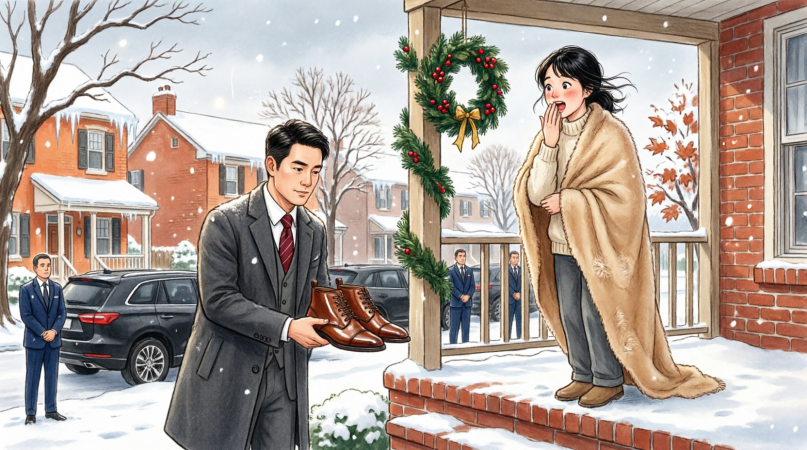
He reached beside the chair and lifted a polished paper bag I had not noticed. From it, he pulled my brown boots.
Cleaned, conditioned, waterproofed, looking better than the day I bought them.
“I wanted to return these.”
I took them from him slowly. The leather was warm from the house now, soft under my fingers. Seeing them again made the park feel real, not a fever dream born from heartbreak and snow.
“Thank you,” I said. “You didn’t have to.”
“I did.”
I looked toward the street again. “Did you need seventeen SUVs to return footwear?”
His mouth twitched. “No. That part was non-negotiable once my chief of security learned I was visiting a private residence after months of what he calls ‘reckless moral research.’”
This time I did laugh, and the sound surprised me.
Then his face grew serious.
“I didn’t come only to return the boots.”
“I assumed.”
“I came to offer you a job.”
The room seemed to tilt.
“A job.”
“Yes.”
“Mr. Wellington—”
“Marcus.”
“Marcus, I’m a retired nurse whose husband left two nights ago. I have no idea what world you think I belong in, but I can promise you it is not the one outside my house right now.”
“That may be exactly why I’m here.”
He reached into his coat pocket and removed a business card, thick white paper with raised black lettering.
“The Wellington Foundation gives away roughly two hundred million dollars a year. Medical grants, housing initiatives, education, disaster relief, community development. On paper, it is successful. In practice, it has become too bureaucratic, too insulated, too impressed with its own processes. Elizabeth warned me for years. I listened politely and changed too little.”
He placed the card on my coffee table.
“I want to rebuild it.”
“And you think I can help?”
“I know you can.”
“You don’t know me.”
“I know enough to begin. You spent thirty years as a nurse. You understand suffering at ground level. You know how systems fail people because you’ve watched it happen. You know the difference between what looks helpful in a report and what actually helps in a room. And you have the rarest quality I’ve found in any field.”
“What?”
“You act when compassion costs you something.”
I felt tears sting my eyes. After years of Trent calling me too emotional, too invested, too soft, this man was sitting in my living room describing the same traits as valuable.
“What would the job be?” I asked cautiously.
“Director of Community Outreach to start. If it becomes what I think it can become, possibly more. You would work with our grant teams, visit organizations directly, identify needs we are missing, help redesign how we choose and support programs.”
“I don’t have nonprofit management experience.”
“You’ll learn. I’ll provide training, staff, advisers, whatever you need.”
“I don’t have a business degree.”
“I have enough people with business degrees.”
“I’m fifty-five.”
“Good.”
That stopped me.
He smiled gently. “You say that as if experience were a liability.”
“Most people think it is.”
“Most people are fools about age. They mistake novelty for value.”
I looked away because I did not trust my face.
“The salary would be one hundred twenty thousand dollars a year,” he said. “Full benefits. Retirement. Housing assistance if you choose to move closer to downtown.”
I stared at him.
One hundred twenty thousand.
More than I had ever earned as a nurse. More than Trent made in sales. Enough to pay lawyers, fix the roof, travel, save, breathe. Enough to make the word abandoned feel less like a financial diagnosis.
“I don’t need an answer today,” Marcus said. “In fact, I’d prefer you take time. You’re in shock. But I wanted to make the offer before you convinced yourself your life had narrowed.”
I picked up the business card. The paper felt expensive, real.
“I have a question,” I said.
“Anything.”
“The coin. The one you gave me.”
His expression changed. The room grew quieter.
“It belonged to Elizabeth.”
I looked toward the stairs, toward my bedroom, where the coin sat on the nightstand.
“She carried it for years,” he said. “She had several made for a youth shelter program she helped start, but that one was hers. She kept it in her pocket during difficult meetings. She said it reminded her that kindness is not sentiment. It is strategy for a better world.”
“You gave me your wife’s coin?”
“Yes.”
“Why?”
His eyes shone. “Because she would have wanted you to have it.”
I could not speak.
Marcus stood after a moment. “Call me when you’re ready, yes or no. If no, I will still be grateful for what you did. If yes, we begin again.”
At the door, he paused.
“Claudia, that night in the park, when you thought your life had been reduced to loss, you still found a way to give. Please do not underestimate what that says about you.”
Then he stepped onto the porch.
The SUVs departed as precisely as they had arrived. Within minutes, my street looked ordinary again: snowbanks, parked cars, Christmas wreaths, a neighbor walking a terrier in a red sweater.
But my living room was not ordinary.
My boots sat beside the couch. Marcus Wellington’s business card lay on the coffee table. Upstairs, a dead woman’s silver coin carried a sentence that felt suddenly less like inspiration and more like instruction.
Kindness is the only investment that never fails.
I spent the next three days trying to talk myself out of believing in the offer.
I researched the Wellington Foundation until two in the morning, reading annual reports, grant summaries, news articles, criticism, praise. It was real. Marcus was real. The job, apparently, was real. I filled a notebook with questions: governance structure, reporting lines, program categories, evaluation metrics, staffing, training, legal compliance. My nursing brain liked protocols. If I was going to leap, I wanted to know whether there was a floor somewhere beneath the clouds.
Then doubt came, as it always does when a woman has spent too long being measured by someone else’s limited imagination.
Who was I to walk into a billionaire’s foundation and tell people how to help communities? What if the staff resented me? What if Marcus had romanticized one moment in the snow and would be disappointed by the ordinary human being who arrived in daylight? What if I failed publicly? What if Trent was right about me in all the ways he never said plainly?
On the third day, Trent came back.
I opened the door because I was expecting groceries and because grief had made me careless.
He stood on the porch holding red roses.
Not pink roses, which were my favorite. Red. Dramatic, obvious, impersonal red roses, already wilting at the edges in the cold. He wore the apologetic face I remembered from smaller failures: forgotten birthdays, late dinners, that time he missed my hospital retirement party because a client meeting “ran over.”
“Hi, Claudia.”
I did not move aside. “What are you doing here?”
“I wanted to talk.”
“We talked.”
“No, I talked. You were in shock.” He held out the roses. “These are for you.”
I looked at them. “My favorite flowers are pink roses.”
He blinked. “Right. I thought—”
“You thought wrong.”
His mouth tightened. “Can I come in?”
“No.”
He glanced past me into the living room, where books and printed articles about nonprofit leadership covered the coffee table. I had moved his recliner into the garage two days earlier because I could no longer stand looking at the depression in the cushion where his body had shaped my evenings.
“What’s all this?” he asked.
“None of your business.”
“Are you going back to school?”
“Maybe. Maybe not.”
His eyes sharpened, salesman instincts waking. “Claudia, you’re fifty-five. Don’t you think you’re a little old to start reinventing yourself?”
There it was.
A little old.
The phrase did not destroy me. That was the astonishing thing. Two days earlier, it might have. Now it rang against something Marcus had said and failed to penetrate.
Fifty-five. Good.
“I think,” I said slowly, “that fifty-five is exactly the right age to stop letting other people decide what I’m capable of.”
Trent sighed, as though I were being difficult. “I know you’re angry.”
“I am.”
“And you have a right to be.”
“How generous.”
“But Jessica and I…” He looked down at the roses. “It isn’t working out.”
I stared at him.
“She’s not who I thought she was,” he continued. “She’s demanding. She wants a lifestyle I can’t keep up with. She started seeing someone else, some guy in finance. I think she was using me.”
For a moment, I felt nothing. Then, unexpectedly, I felt pity. Not the tender kind. The bleak kind you feel when someone has burned down a house and comes back complaining about smoke inhalation.
“So you came here because your twenty-eight-year-old girlfriend found someone with more money.”
“That’s not fair.”
“No? Then why are you here?”
“Because I made a mistake. Because what we had was real.”
“What we had was convenient for you.”
“That’s not true.”
“Tell me something, Trent. In all the years we were married, did you ever tell anyone I was remarkable?”
He looked confused. “What?”
“Did you ever brag about me? Not that I was reliable. Not that I was a good nurse or a good wife. Did you ever say I was remarkable?”
He shifted. “I was proud of you.”
“That isn’t what I asked.”
“You were a good wife, Claudia.”
A good wife.
The phrase stood between us, plain and damning. Not extraordinary. Not brilliant. Not brave. Not even beloved. Good wife, like a dependable appliance. Like a car that started in winter. Like a coffee maker that never complained.
“I’ve been offered a job,” I said.
His eyebrows lifted. “What kind of job?”
“An important one.”
“Doing what?”
“Helping rebuild a charitable foundation.”
His face changed, first with disbelief, then suspicion. “Who offered you that?”
“Someone who thinks compassion has value.”
“Claudia, be realistic. High-level jobs don’t just appear because you gave someone soup at church.”
“It wasn’t soup.”
“What?”
“Never mind.”
He leaned closer. “This sounds like a scam. Who is going to hire a fifty-five-year-old retired nurse for some executive foundation job?”
There it was again. The ceiling he had placed over my life, so familiar I had once mistaken it for shelter.
I looked at him and finally saw the marriage clearly. Not only the affair. Not only Jessica. The long quiet diminishing that came before it. The way he smiled when I spoke passionately about patients, as if my investment were quaint. The way he called my empathy “taking things too personally.” The way he praised my cooking more often than my mind. The way he liked me best when I was useful, soft, forgiving, and slightly smaller than my own potential.
“You did me a favor,” I said.
He blinked. “What?”
“Leaving. You did me a favor.”
“Claudia—”
“No. We’re done. We were done before Christmas Eve. I just didn’t know it because I was still decorating the ruins.”
His face hardened. “You’ll regret this when whatever fantasy you’re chasing falls apart.”
“Maybe. But I will not regret refusing to crawl back into a life that required me to disappear.”
I closed the door while he was still saying my name.
My hands shook afterward, but not from weakness. From force. From blood returning to places long numb.
The red roses remained on the porch.
I walked to the kitchen, picked up Marcus’s card, and dialed before courage could become theory.
His assistant answered with crisp professionalism. When I said my name, I was transferred almost immediately.
“Claudia,” Marcus said, warmth entering his voice. “I was hoping you’d call.”
“I have questions.”
“I expected you would.”
“If I take this job and I’m terrible at it, will you fire me?”
“If you take this job and struggle, I will get you training and support. If you refuse to learn, I will challenge you. If you betray the mission, then yes, I would fire you. But I do not expect any of those outcomes except the learning.”
That made me smile. “Good answer.”
“I’ve had practice.”
“I don’t want charity.”
“I’m not offering charity.”
“I don’t want to be some inspirational story you tell at donor dinners.”
“Then we won’t tell it.”
“I don’t want people treating me like I got the job because I was kind to a billionaire in disguise.”
“They may. We’ll prove them wrong through your work.”
I sat down at the kitchen table.
“I’m scared,” I admitted.
“So am I,” he said.
That surprised me. “Of what?”
“Of wasting Elizabeth’s legacy by continuing what is comfortable instead of building what is needed. Of trusting the wrong people. Of becoming the kind of man who confuses giving money with doing good. Fear is not evidence you should stop, Claudia. Sometimes it is evidence you understand the stakes.”
I looked through the window at the dead roses on the porch, their red petals darkening in the cold.
“When would I start?”
“Monday, if you’re ready.”
I closed my eyes. I thought of Trent calling me old. I thought of Marcus calling my age experience. I thought of my mother’s coin, warm in my hand. I thought of a barefoot man turning blue under a streetlight and the strange, holy clarity of doing the next right thing.
“I’m ready,” I said. “Yes.”
On Monday morning, I stood in front of my closet and realized half my clothes belonged to a woman I no longer wished to impersonate.
The cardigans. The muted blouses. The dresses Trent called “appropriate.” The soft shapes designed not to draw attention. I pushed them aside and found a navy dress I had bought two years earlier and never worn because Trent said it was “a little bold” for a woman my age. It was not bold. It fit beautifully. It made me stand straighter.
I wore it with black boots—my boots, returned and restored—and my mother’s blue scarf beneath my winter coat. Before leaving, I placed Elizabeth Wellington’s silver coin in my pocket.
The Wellington Foundation occupied the top three floors of Wellington Tower downtown, a glass-and-steel building overlooking the Chicago River. I had passed it many times without imagining I might one day belong inside. The lobby was all marble, bronze, and quiet confidence. Security knew my name. That unnerved me more than if they had ignored me.
The elevator carried me to the thirty-second floor, where a young woman with kind eyes met me.
“Mrs. Hayes? I’m Sarah Chen, Mr. Wellington’s executive assistant. Welcome.”
Her smile was warm without being false. I appreciated that immediately.
“Please call me Claudia,” I said.
“Only if you call me Sarah.”
She led me through hallways lined with photographs: a rural clinic in Kentucky, a children’s literacy program in Detroit, solar panels on a community center in Arizona, a mobile medical unit in West Virginia, a scholarship cohort grinning in caps and gowns. The images were beautiful, but even on that first walk I noticed what Elizabeth must have noticed. They looked polished. Finished. Safe for donors.
I wondered what had happened before the photographs.
Marcus was waiting in a conference room with windows overlooking the city. He turned when I entered, and his smile made the room feel less intimidating.
“Welcome, Claudia.”
“I still reserve the right to panic.”
“Reasonable.”
The first week was overwhelming.
There were twelve core staff members, each smart, credentialed, overworked, and politely skeptical. Janet Morrison, interim director, had sharp silver glasses and a sharper understanding of grant compliance. Devon Price managed data evaluation and spoke in metrics until I asked him what a number meant for a person standing in line at a clinic. Priya Shah handled medical grants and had the exhausted competence of someone who had been trying to reform a system from inside spreadsheets. Luis Ortega managed housing initiatives and seemed relieved when I asked whether he had ever been to the shelters listed in our quarterly reports.
Some staff members warmed to me. Others watched.
I did not blame them. If I had spent years building expertise and a retired nurse appeared because the billionaire founder had a moving Christmas story, I would have watched too.
So I listened.
For days, I sat in meetings and asked questions. Why did certain organizations receive repeat funding? Who visited them? How were outcomes measured? Did anyone speak directly with participants? What happened to applicants who did not have professional grant writers? How much money was spent evaluating need versus evaluating paperwork quality?
By Wednesday, Janet leaned back in her chair after one of my questions and said, “You realize you’re describing a complete redesign of our intake model.”
“No,” I said honestly. “I’m describing what used to frustrate me in hospitals.”
Marcus smiled from the end of the table. “That may be the same thing.”
During lunch that day, he told me more about Elizabeth. How she grew up in Rockford, the daughter of a grocery clerk and a bus mechanic. How she worked through college cleaning offices at night. How she became a social worker because, as she put it, “Nobody should have to prove they are drowning before someone throws a rope.” How she married Marcus before Wellington Industries became a name people recognized. How she spent the rest of her life reminding him that wealth could either isolate a person or enlarge their obligations.
“She used to say charity without relationship is guilt management,” Marcus told me.
“She was right.”
“I know that now.”
“No,” I said gently. “You knew it then. You just had more people helping you ignore it.”
He looked at me for a moment, then laughed softly. “You are not as intimidated by me as people usually are.”
“I’ve cleaned wounds deeper than your ego.”
He laughed harder then, and something shifted between us. Not romance, not yet. Trust, maybe. The beginning of a friendship built not on admiration but on honesty.
By Friday, we had the outline of a new approach: field visits before major grants, direct interviews with community members, simplified applications for grassroots organizations, emergency micro-grants for urgent needs, partnerships with local leaders rather than only established institutions, and a review panel that included people who had actually used the services being funded.
“It will be messy,” Janet warned.
“People are messy,” I said.
Devon looked pained. “Metrics are cleaner.”
“Then we’ll build better metrics.”
He stared at me, then nodded slowly. “That’s… actually fair.”
That afternoon, while I was reviewing files in my temporary office, Sarah appeared in the doorway.
“Claudia, there’s a man in reception asking for you. He says he’s your husband.”
The word husband felt outdated already, like a label on a box from another house.
“Thank you,” I said. “I’ll handle it.”
Trent stood in the reception area wearing his best navy suit and the tie I had bought him for his last birthday. He looked around the foundation offices with badly concealed amazement and resentment. The glass walls, the river view, the quiet efficiency of staff moving between meetings—it all seemed to offend him by existing around me.
“Claudia,” he said. “This place is incredible.”
“What are you doing here?”
“I needed to see where you were working.”
“No, you wanted to see whether it was real.”
His mouth tightened. “Can we talk privately?”
“No.”
Several staff members pretended not to listen.
Trent lowered his voice. “You’re making a mistake. You don’t belong in this world.”
I looked at him, and for the first time his condescension seemed almost small.
“I work here.”
“For now. But these people don’t know you.”
“No. They’re learning.”
“I know you.”
“No, Trent. You knew how I served your life. That is not the same as knowing me.”
Before he could respond, Marcus stepped out of the hallway leading from the executive offices. He took in the scene quickly: Trent’s posture, my crossed arms, Sarah’s watchful concern at the desk.
“Is everything all right?” Marcus asked.
“Marcus,” I said, “this is Trent Hayes, my soon-to-be ex-husband. Trent, Marcus Wellington.”
Trent’s face changed as the name landed. He extended a hand too quickly.
“Mr. Wellington. An honor. I have to say, I’m impressed by all this.”
Marcus shook his hand briefly. “Thank you.”
“I was just telling Claudia this is quite an opportunity.”
“Indeed. She has already improved several conversations that needed improving.”
Trent gave a tight smile. “Claudia always did have a soft spot for lost causes.”
The reception area went silent.
Embarrassment flushed through me first, then anger. How many times had he said some version of that at dinner parties? How often had I laughed weakly to soften it? Claudia cares too much. Claudia brings home every sad story. Claudia would adopt the whole hospital if she could.
Marcus’s expression did not change, but his voice cooled.
“I’ve found that people who dismiss compassion as weakness often lack the courage to practice it.”
Trent blinked.
Marcus turned to me. “Claudia, our meeting.”
“We don’t have a meeting,” I said.
“We do now.”
He guided me toward the elevator with a hand near my elbow, not touching until I nodded slightly. Behind us, Trent called my name.
I turned.
“This won’t last,” he said, desperation sharpening his voice. “When they figure out who you really are, don’t expect me to pick up the pieces.”
The elevator doors opened.
I looked at him across the polished reception area. “They’re figuring out who I really am. That’s why I’m staying.”
The doors closed on his face.
In the elevator, my hands began to shake.
Marcus noticed but did not crowd me. “Do you want quiet or conversation?”
That question alone nearly made me cry. Trent would have told me what I felt. Marcus asked.
“Conversation,” I said.
“Your ex-husband is an idiot.”
I laughed despite everything. “That was direct.”
“I considered softer phrasing and rejected it.”
“He wasn’t always like that.”
“Maybe not. Or maybe he was, and you were busy translating.”
The elevator rose.
“My wife used to say there are two kinds of people when suffering appears,” Marcus said. “Those who turn away and those who step toward it. The first group often runs the world. The second saves it.”
I looked at him.
“What Trent calls a soft spot for lost causes,” he continued, “I would call the instinct that built every decent thing humanity has ever done.”
For years, my compassion had been treated like a leak in my professionalism, a feminine excess, a liability that made me vulnerable. That day, standing in a billionaire’s private elevator while my abandoned marriage waited thirty-two floors below, I began to believe it might be my strongest credential.
Six months later, I stood before the bathroom mirror in my new apartment downtown, fastening a silver necklace at my throat and trying to recognize the woman looking back at me.
Her hair was shorter now, cut into a soft, angled bob that framed her face instead of hiding it. Her eyes looked brighter, not because the grief had vanished, but because life had returned behind it. She wore a cream blazer over a deep blue dress, small pearl earrings, and the silver coin on a chain Marcus had commissioned after I admitted I carried it so often I feared losing it.
Kindness is the only investment that never fails.
I had sold the Oak Park house during the divorce proceedings. Trent fought harder over money once he realized I was not waiting for him to return, but infidelity had consequences, and so did underestimating a woman who had spent thirty years documenting everything in patient charts. My lawyer, Denise Alvarez, was brisk, brilliant, and expensive. I enjoyed paying her.
I moved into a two-bedroom apartment in River North with a view of the city and a small balcony where I kept herbs in mismatched pots. The second bedroom became an office, though I often worked too late at the foundation anyway. My life was not simple, but it was mine.
The Wellington Foundation had changed in ways none of us fully predicted.
Our first field visits were awkward. Some organizations distrusted us, assuming we had arrived to inspect and judge. Others performed poverty for funding because that was what donors had trained them to do. I learned to sit long enough for the performance to end. I learned to ask, “What do people need that no one wants to fund because it isn’t glamorous?” The answers changed everything.
Diapers. Bus passes. Dental care. Refrigerators for insulin. Child care during job interviews. Laundry vouchers. Translation services. Steel-toed boots for training programs. Storage lockers for people without homes. Repair money for a shelter van. A stipend for the woman everyone trusted but nobody paid because she was “just helping.”
We created micro-grants. Then rapid-response funds. Then community advisory boards. Janet learned to tolerate mess. Devon built metrics that tracked not only outputs but stability: days housed, appointments kept, jobs retained, school attendance improved, emergency room visits avoided. Priya redesigned medical equipment grants after visiting a rural clinic where a broken refrigerator had quietly destroyed thousands of dollars of vaccines. Luis found three grassroots housing groups that had never applied because their director thought foundations “only funded people who knew which fork to use at lunch.”
Marcus came on many visits. Not all. Enough.
At first, staff expected him to dominate rooms. He did not. He listened, sometimes with visible discomfort, especially when people spoke frankly about how wealthy donors made them feel like exhibits. After one meeting at a West Side youth center, he sat in the car for ten minutes without speaking.
Finally, he said, “Elizabeth told me this for twenty years.”
“What?”
“That I loved humanity at a distance.”
“And now?”
“Now distance feels like cowardice.”
The Second Chances Community Center grew from one of those visits.
We found Rosa Martinez operating a job-readiness program out of a church basement near Northview Park, not far from the bench where I met Marcus. Rosa was forty-two, fierce, funny, and so competent she made the rest of us look decorative. She had once been homeless herself after leaving an abusive marriage with two children and no savings. A local nonprofit helped her get stable. Years later, she returned to help others do the same.
Her basement program had a monthly budget smaller than what the Wellington Foundation spent on one donor luncheon centerpiece arrangement. Yet she had placed thirty-seven people in jobs that year, helped twelve women secure housing, arranged child care through a network of retired grandmothers, and kept a handwritten wall chart more accurate than many dashboards I had seen.
When I asked what she needed most, she did not say money first.
She said, “A place where people don’t feel like they’re being processed.”
That became the center’s guiding principle.
Now, six months after my life cracked open on Christmas Eve, we were launching it.
The Second Chances Community Center occupied a renovated brick building that had once been a discount furniture warehouse. We kept the old exterior because Rosa insisted the neighborhood deserved improvement, not erasure. Inside, we built classrooms, counseling rooms, a computer lab, a child care center, showers, lockers, a clinic room for visiting nurses, a legal aid office twice a week, and a community kitchen that smelled, on opening day, like coffee, fresh bread, and possibility.
I arrived early, but Marcus was already there, standing near the entrance in a dark suit with no tie, sleeves slightly rolled as he helped a volunteer move boxes of donated books. The sight of Marcus Wellington carrying children’s books while a local grandmother instructed him where to put them remained one of my favorite images from that day.
He saw me and smiled.
“There she is,” he said. “The woman who made this happen.”
“We made this happen.”
“Yes,” Rosa called from across the room. “But she made us stop talking long enough to do it right.”
I laughed and hugged her.
Local news crews arrived. Community members streamed in. Children ran immediately toward the play area. A man named Darren, who had gotten work through Rosa’s original program, stood in the computer lab with tears in his eyes because he had helped install the desks. A retired teacher volunteered to run literacy classes. Two nurses from my old hospital came to ask how they could help.
Then I saw Trent.
He stood near the back of the crowd, half-hidden beside a news van, wearing a tan overcoat I had always hated. Jessica was not with him. His face looked thinner, older, less certain. When our eyes met, he did not wave. He simply looked at me as if seeing a person he had assumed would remain where he left her.
For a second, old pain moved through me.
Then Rosa called my name, and I turned toward the podium.
Marcus spoke first. He talked about investment, not charity. About communities as partners, not recipients. About his late wife Elizabeth, whose belief in proximity had shaped the foundation’s new direction. His voice broke once when he said her name, and no one seemed uncomfortable. That was another thing I had learned: grief, when honest, invites respect rather than pity.
Rosa spoke next. She spoke without notes.
“People don’t need saving by strangers who feel sorry for them,” she said. “They need doors unlocked, barriers removed, and somebody willing to believe that their current situation is not their final identity.”
Then it was my turn.
I stepped to the microphone, looking out at the crowd: foundation staff, neighbors, reporters, volunteers, people who had slept in shelters, people who funded shelters, children with juice boxes, city officials trying to look essential, Marcus near the front, Trent near the back.
“My name is Claudia Hayes,” I began. “Six months ago, I thought my life was over.”
The crowd quieted.
“I was fifty-five years old. My marriage had ended. My future looked nothing like the one I had planned. And on the worst night of my life, I found myself sitting on a bench in the snow not far from here, feeling discarded and very, very sorry for myself.”
Marcus’s eyes held mine.
“Then someone crossed my path who needed help more urgently than I needed to stay comfortable. That moment did not solve my grief. It did not erase betrayal. It did not magically make me brave. But it reminded me that even when we are broken, we can still choose who we are.”
I touched the coin at my throat.
“Second chances do not always arrive looking like blessings. Sometimes they arrive as endings. Sometimes as loss. Sometimes as a person standing in front of you with a need you cannot ignore. The work of this center is not to rescue people from above. It is to stand close enough to see what is needed, humble enough to listen, and committed enough to act.”
I looked toward Rosa.
“This place exists because people who had been ignored knew exactly what their community needed. We just finally had the sense to ask them.”
Applause rose, warm and sustained. I saw Trent lower his gaze. I saw Janet wiping one eye behind her glasses. I saw Devon clapping like a man whose metrics had unexpectedly become personal.
After the ribbon cutting, the center filled with movement. Tours, interviews, coffee, children laughing, old neighbors greeting one another, volunteers directing people toward program sign-ups. For hours, I barely stopped moving.
Near sunset, I escaped to the courtyard garden.
Rosa had insisted on the garden too. “People need to see things grow,” she said. Raised beds lined the brick walls, newly planted with herbs, greens, tomatoes, and flowers. It was too early for much growth, but small green shoots had already begun pushing through soil.
I stood there breathing for the first time all day.
“Beautiful, isn’t it?”
Marcus appeared beside me holding two paper cups of coffee.
“Perfect,” I said, accepting one.
“Elizabeth would have loved it.”
“Yes,” I said. “She would have loved Rosa.”
“She would have loved you.”
I looked at him.
Something in his face was different. Not the public Marcus, not the grieving husband telling stories, not the focused partner in foundation reform. This was a man standing at the edge of a question.
“These past six months,” he said slowly, “have been the happiest I’ve been since Elizabeth died. I don’t say that lightly, and I don’t say it without guilt, though I’m working on that.”
“You don’t have to feel guilty for being alive.”
“I know. Some days.”
He set his coffee on the edge of a raised bed.
“Claudia, I respect you more than almost anyone I know. I admire your mind, your courage, your impatience with nonsense, your tenderness with people who need it, your refusal to perform for people who underestimate you. Somewhere along the way, admiration became something more.”
My heart began to pound.
“I know we work together,” he continued. “I know you are still healing. I know I carry my own grief. I do not want to complicate your life or presume anything. But I would regret not asking.”
He smiled, nervous in a way I found unexpectedly endearing.
“Would you have dinner with me tonight? Not as colleagues. Not as foundation partners. As two people who might like to discover whether the thing growing between them deserves light.”
For months, I had told myself I was imagining it. The lingering conversations. The way he looked for me in a room. The way his hand hovered near my back but never touched unless invited. The way my day brightened when he laughed. I had told myself women like me did not begin again with men like him, and then I heard Trent’s voice in that thought and hated it.
“Marcus,” I said, “I’m scared.”
“So am I.”
“I don’t want to be rescued.”
“I don’t want to rescue you.”
“I don’t want to be a replacement for Elizabeth.”
His eyes softened. “No one could replace Elizabeth. And no one could replace you. Love is not a position with one seat.”
I breathed in the cold garden air.
“I don’t know who I am in a relationship anymore.”
“Then we learn slowly.”
I looked through the courtyard doors at the center alive with people, at Rosa laughing near the kitchen, at children pressing handprints onto the glass, at the place that had grown from a night of ruin and a pair of boots.
“Yes,” I said.
Marcus went very still. “Yes to dinner?”
“Yes to dinner. Yes to slowly. Yes to finding out.”
His smile changed his whole face.
Then he reached behind the bench and lifted a familiar pair of brown boots.
I stared. “Why do you have those?”
“I brought them for the exhibit Rosa is planning about the center’s origins.”
“The exhibit?”
“She wants to display objects connected to turning points. A bus pass, a GED pencil, a house key, a stethoscope, your boots.”
“My boots are not museum artifacts.”
“Rosa disagrees. Strongly.”
I took them from him, laughing. “Absolutely not. These boots are coming home with me.”
“I suspected you might say that.”
“They are part of my story.”
“Yes,” Marcus said softly. “They are.”
That night, we had dinner at a small Italian restaurant where no one seemed to recognize him, or if they did, they were polite enough to pretend otherwise. We talked for three hours. Not about the foundation at first, but about ordinary things: my mother’s soup, his terrible first car, Elizabeth’s habit of adopting injured birds, my fear of karaoke, his inability to assemble furniture, the patients I still remembered, the buildings he regretted constructing, the fact that I liked my coffee strong enough to qualify as a medical intervention.
At the end of the night, he walked me to my car.
“May I kiss you?” he asked.
No one had asked me that in decades.
“Yes,” I said.
The kiss was gentle, careful, full of beginning rather than hunger. I drove home with my boots on the passenger seat and the silver coin warm against my chest.
Three years later, I stood in the same courtyard garden wearing an ivory dress I had chosen for myself, surrounded by tomatoes, marigolds, folding chairs, fairy lights, and two hundred people who had no business fitting into any traditional wedding category.
There were billionaires and former shelter residents. Nurses from St. Catherine’s and teenagers from the center’s mentorship program. Rosa officiated because she had gotten licensed online and dared anyone to question her authority. Janet cried openly. Devon created a data visualization of our relationship timeline as a joke and then cried while explaining it. Melanie flew in from California and told Marcus that if he hurt me, she knew several nurses who could make it look accidental. Marcus believed her.
Trent did not attend, though he sent a card. It was simple. Congratulations, Claudia. You deserved to be seen. I am sorry it took losing you to understand that.
I kept the card. Not because it healed everything, but because accountability, however late, deserves a witness.
Bethany—Rosa’s first program graduate to become staff, not my nonexistent sister, though people often joked she adopted me as one—walked down the aisle carrying the brown boots on a velvet pillow because the center had developed a flair for symbolism that I blamed entirely on Marcus.
When Marcus saw them, he laughed so hard he had to wipe his eyes.
In his vows, he said, “I first met Claudia when I was pretending to have nothing, and she saw me anyway. The second time I met her, I came with seventeen SUVs, which she has never let me forget.”
Everyone laughed.
He turned to me.
“I thought I was testing the world for kindness. In truth, I was the one being tested. I had lost faith. I had confused grief with wisdom and distance with safety. Then a woman sitting in her own heartbreak took off her boots in the snow because someone else needed them more. Claudia, you saved my feet that night, yes. But you also saved the part of me that still wanted to believe love could become action. I promise to spend the rest of my life honoring what you taught me before you even knew my name.”
When it was my turn, I did not unfold the paper in my hand.
“Marcus,” I said, “when Trent left, I thought I had been thrown away because I had grown too old to be chosen. But what actually happened was that I was released from a life too small for me. I did not know that then. I only knew I was cold, grieving, and still somehow capable of doing one good thing. You saw that one good thing and built a doorway around it. You never asked me to become smaller so you could feel larger. You never treated my kindness as weakness or my age as limitation. You gave me work, partnership, patience, and eventually love. Not the kind that completes me, because I was never incomplete. The kind that grows beside me.”
Rosa sobbed loudly enough to make the front row laugh.
“I promise,” I continued, “to keep choosing the work of love, not just the feeling. To step toward suffering with you. To tell you the truth when distance disguises itself as wisdom. To honor Elizabeth’s legacy, my mother’s lessons, and the strange miracle of a snowy park bench where two grieving people found the beginning of a life neither of them expected.”
We exchanged rings under strings of warm lights while the city glowed beyond the courtyard walls.
At the reception, Marcus did indeed joke that he had proposed twice: first as a barefoot stranger asking silently whether the world still cared, and later as himself, asking openly whether I might trust him with my heart. “Both times,” he said, “Claudia gave me exactly what I needed, though thankfully the second time she kept her shoes on.”
The boots were displayed near the guest book with Elizabeth’s coin, my mother’s blue scarf, and a handwritten sign Rosa made: Some doors open because someone gives what they can.
Late that night, after the music softened and guests drifted home, Marcus and I sat alone on the garden bench. The same bench where he had asked me to dinner. The center windows glowed behind us. Somewhere inside, volunteers were packing leftover cake for families to take home. Tomato vines climbed their supports. Basil scented the air. The courtyard had become lush over the years, proof that tended things grow.
“Do you ever think about what would have happened if you hadn’t been in the park?” Marcus asked.
“Yes.”
“What do you think?”
“I think you would have found your way to the diner because you are stubborn and dramatic.”
He laughed. “Probably.”
“And I think I would have gone home, cried for longer, maybe taken some smaller version of my life back eventually. But I don’t think I would have understood myself as quickly.”
He took my hand.
“I spent so many years thinking kindness was something I gave away,” I said. “Something that left me emptier. That night, I learned it could return, not always from the person you give it to, not always in the form you expect, but somehow. Not like a transaction. Like a seed.”
Marcus rubbed his thumb over my knuckles.
“My mother used to say gardens teach hope,” I continued. “You plant without certainty. You tend through storms. You wait through seasons when nothing seems to be happening. Then one day, something green breaks through the soil and proves life was working underground the whole time.”
“Is that what happened to us?”
I leaned against his shoulder.
“Yes,” I said. “I think we were both working underground.”
Now, when people ask me how my life changed, they expect the simple version. Husband left wife on Christmas Eve. Wife gave boots to disguised billionaire. Billionaire offered job. They fell in love. It sounds almost ridiculous when told that way, like a fairy tale written by someone with a flair for black SUVs.
But the truth is deeper and harder.
Trent did not destroy me. He revealed the places where I had already been disappearing. Marcus did not rescue me. He recognized me at a moment when I could barely recognize myself. The boots did not buy a new life. They simply proved that even stripped of certainty, I still knew how to choose compassion. And that choice became a path.
The Wellington Foundation is different now. We no longer measure success only in dollars granted, but in doors opened, burdens removed, dignity protected, relationships built. The Second Chances Community Center has helped thousands of people find jobs, housing, treatment, education, and community. Rosa runs it better than any executive could. Marcus still listens more than he speaks in neighborhood meetings. I still ask inconvenient questions. Janet still complains about messy processes while defending them fiercely to donors. Devon’s metrics now include stories because he finally admitted numbers without names can become hiding places.
Every Christmas Eve, Marcus and I go to Northview Memorial Park.
Not with cameras. Not with speeches. Not as performance.
We bring boots. Good ones. Coats, socks, gloves, hand warmers, and gift cards for the Grand Avenue Diner, which now has a quiet arrangement with the foundation to feed anyone who comes in cold and hungry during winter nights. Sometimes we meet people. Sometimes we leave supplies with outreach workers. Sometimes we simply sit on the bench for a few minutes and remember.
The bench has a small plaque now, though not with our names. I refused that, and Marcus agreed.
It reads: Step toward the cold.
That is all.
I still have the silver coin. I wear it often. The inscription has become more than a phrase to me. Kindness is the only investment that never fails. Not because kindness guarantees reward. It does not. I was kind to Trent for years, and he still betrayed me. I was kind to patients who died, families who yelled, systems that did not change fast enough. Kindness does not protect you from loss.
But true kindness changes the person who practices it. It keeps something alive that bitterness wants to kill. It teaches your hands what to do when your heart is broken. It points you toward the next right action when the future has gone dark.
On Christmas Eve of 2024, I thought my story had ended in a kitchen beside a cooling apple pie, with a man telling me I had become too predictable, too safe, too old. I thought I had been abandoned in the ruins of a life I built for someone who no longer wanted it.
But that was only the end of the life where I needed Trent to see me.
The life where I learned to see myself began in the snow, with numb feet, a silver coin, and a stranger named Marcus who was not really a stranger at all, but a doorway.
Sometimes the worst night of your life is not the night you lose everything.
Sometimes it is the night you finally stop carrying what was never yours to save.
Sometimes freedom arrives barefoot.
Sometimes love arrives disguised as need.
And sometimes, if you are brave enough to give away the thing keeping you warm, you discover that warmth was never only in the boots.
It was in you all along.
THE END