My name is Claire Bennett, and the day my husband came back from Europe, he stopped in my doorway like he’d been shot.
Not emotionally wounded. Not theatrically stunned. I mean his whole body actually stalled. One hand still on the doorknob, the other holding the handle of a hard-shell suitcase that slipped slowly from his fingers and hit the floor with a dull, helpless thud. His eyes moved over the room in short, disbelieving bursts—the vacuum lines in the rug, the lemon-clean shine on the coffee table, the neatly labeled boxes stacked against the far wall, the bassinet by the window where our daughter slept in a pale yellow swaddle.
Then his gaze found me.
I was leaning against the kitchen counter in gray leggings and an oversized sweatshirt, my hair braided over one shoulder, a mug of reheated coffee cooling in my hand. I was tired, but not wrecked. Quiet, but not broken. There was no mascara on my cheeks. No trembling lip. No frantic relief at seeing him home.
Just stillness.
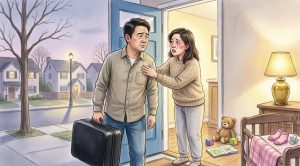
“No,” Derek whispered.
His voice cracked on the single word.
He took one step into the house, then another, like maybe if he moved slowly enough he could undo what he was seeing. “No. No, no, no.”
I set my coffee down.
“It already happened,” I said.
That was the first time I saw real fear in my husband’s face.
But to understand why that moment felt less like a reunion and more like a reckoning, you have to go back four weeks—to the night he told me he needed space while I was still bleeding from childbirth and learning how to keep our daughter alive.
Emma was twenty-eight days old when Derek announced he was leaving.
At that point, my world had narrowed to intervals measured in ounces, diapers, and minutes of sleep. I knew exactly how long it took to warm a bottle with one hand. I knew which floorboard in the nursery creaked when I rocked too far left. I knew the difference between Emma’s hungry cry and her overtired cry and the awful ragged cry she made when gas pains twisted through her tiny body at two in the morning.
I also knew what my own body sounded like when I stood up too fast.
A catch.
A pull.
A hot protest under the skin where I still hadn’t fully healed.
Nobody tells you how feral the first month can be. They tell you about love at first sight and newborn smell and sleepy smiles. They do not tell you what it feels like to sit on the edge of your bed at 4:17 a.m. wearing a stained nursing bra, trying not to cry because the baby won’t latch and your husband is snoring hard enough to shake the mattress.
Or maybe they do tell you, and you just don’t believe them until you live it.
That night I was pacing the dining room with Emma tucked against my shoulder, her cheek hot against my neck, while Derek sat at the table scrolling through his phone. The overhead light cast a yellow circle over the room. There were burp cloths draped over chairs, a bottle brush on the counter, and a laundry basket full of baby socks I hadn’t had time to sort. I remember that clearly because later, when I replayed the moment a hundred times, all those details stayed vivid while everything else blurred.
Emma finally quieted, and I stopped walking.
“That’s the longest she’s been awake all day,” I said. “I think she’s got her days and nights switched.”
Derek kept scrolling.
“Maybe.”
“I might call the pediatrician tomorrow if it keeps up.”
He put his phone down then, but not because he wanted to help.
He set it flat on the table and looked at me with that expression I came to know far too well in the years that followed—the expression of a man about to say something selfish and hoping calmness would disguise it as reason.
“I can’t breathe in this house anymore,” he said.
At first I thought he meant the crying. Or the clutter. Or the relentless feeling that nothing in our lives belonged to us anymore—not our schedule, not our bodies, not our time.
“What does that mean?” I asked.
He leaned back in his chair and rubbed both hands over his face.
“It means I’m losing myself, Claire.”
I stood there in old sweatpants with milk on my shirt and my stitches throbbing, staring at him.
“I don’t even know what that means,” I said.
“It means every conversation is about feedings and sleep schedules and whether she pooped. It means this house feels like a pressure cooker. It means you’re emotional all the time and I feel like I can’t do anything right.”
I laughed.
Not because it was funny. Because something in me rejected the sentence on impact.
“Emotional?”
“See?” He lifted one hand. “That tone. That’s exactly what I’m talking about.”
I moved Emma to my other shoulder and took a slow breath.
“Okay,” I said carefully. “Tell me what you’re actually trying to say.”
He looked relieved, like I had opened the door he wanted.
“The guys are doing a month in Europe,” he said. “Spain, Italy, maybe Greece. Colin’s cousin has a place in Barcelona. I think I should go.”
My first reaction wasn’t anger. It was incomprehension.
It felt like he had said something grammatically correct but spiritually impossible, like: I think I should become a cloud.
“You’re kidding.”
He shook his head.
“Derek.”
“I need a reset.”
I actually laughed again then, sharper this time.
“A reset.”
“Yes.”
“You have a newborn daughter.”
“I know that.”
I stared at him.
“I can barely walk without pain,” I said. “I haven’t slept more than ninety minutes at a time since she was born. I ate crackers for dinner. Twice. And you’re talking about a vacation.”
“It’s not a vacation,” he snapped. “It’s mental health.”
There’s a moment in certain arguments when the room changes. The conversation stops being about what is being said and becomes about the sickening realization that you are no longer participating in the same reality.
That was that moment.
“People do this all the time,” he said, like he was making a case study. “I need to clear my head before I start resenting everything.”
Everything.
The word hit me harder than the trip.
Not us. Not the stress. Not the change.
Everything.
I looked down at Emma’s head tucked beneath my chin and felt her tiny heartbeat against my chest.
“You mean me,” I said quietly.
He had the decency to look away.
“Don’t do that.”
“Do what?”
“Turn this into some attack.”
I almost admired the speed of it. The pivot. The way he could toss a grenade into the middle of my life and then act injured by the sound.
“Can you at least wait a little while?” I asked. “Two months. A month. A week, Derek. Your mom could come help. We could figure something out.”
“The flights are booked.”
There are sentences that divide your life into before and after.
That was one.
“What?”
He sighed like I was being difficult.
“I leave Friday.”
Friday was three days away.
I don’t remember the next few minutes in order. I remember the buzzing in my ears. I remember lowering myself into a chair because I suddenly didn’t trust my legs. I remember Emma starting to fuss again because she could feel my body change.
Mostly, I remember looking at my husband and realizing he had made plans to leave me while I was still learning how to sit down without pain.
He had discussed flights.
Coordinates.
Hotel dates.
A month.
A full month.
All while I was counting wet diapers and setting alarms to wake up and pump.
“When were you going to tell me?” I asked.
“I’m telling you now.”
“No. You’re announcing it now. That’s different.”
He pressed his lips together.
“I knew you’d react like this.”
Something inside me cracked then. Not outwardly. Outwardly I just sat there, holding our baby while my husband explained his abandonment like it was an issue of timing and not character.
He kissed Emma on the forehead Friday morning before he left.
That part mattered later, because it would have been easier to hate him cleanly if he had been cruel all the way through.
But Derek was not a cartoon villain. He was worse. He was ordinary in the way selfish men so often are. Capable of tenderness in flashes. Capable of sounding sincere. Capable of loving the version of family that made him feel good and fleeing the version that demanded something from him.
He kissed Emma’s head.
He kissed my cheek.
He told me he loved me.
He promised he’d call every day.
Then he climbed into a rideshare with a carry-on bag and a grin that belonged to a man leaving for spring break, not to a father walking away from a four-week-old daughter and a wife who still winced every time she laughed too hard.
I stood on the porch after the car was gone, Emma against my chest, and watched the empty street for far too long.
That was the night something inside me stopped waiting to be rescued.
The first week after Derek left was not one long cry. It was worse than that. It was a hundred tiny failures of the body and mind.
For four straight nights Emma screamed between one and five in the morning like her whole little life hurt. Not the delicate cry of hunger. Not the peevish cry of dampness. A desperate, animal sound that rose from somewhere too deep for such a small body. Gas, the pediatrician said. Newborns are unfinished systems. Be patient.
So I paced.
Through the living room.
Down the hall.
Back past the kitchen.
Barefoot. Bleeding. Whispering apologies into the dark.
My body didn’t feel like mine. My breasts ached. My lower back throbbed. My stomach still looked six months pregnant. My hair lived in a knot so tight it hurt my scalp, but taking it down meant it ended up in Emma’s fists. I would stand at the bathroom sink and catch sight of myself in the mirror—gray skin, split lip from dehydration, eyes so shadowed they looked bruised—and think, This can’t be me.
On the fifth day Derek texted me a photo of a beach.
Bright blue water. White umbrellas. A sweating glass in the foreground. His tanned foot stretched toward the frame like an insult.
Wish you were here, he wrote, followed by a winking emoji.
I stared at the message with Emma latched to my breast and milk soaking through the pad in my bra.
I typed: She barely slept. I’m exhausted.
The three dots appeared. Vanished. Appeared again.
Then his reply came.
Try to relax. Stress isn’t good for the baby.
I laughed so hard I started crying.
That became the rhythm of those days. Not grief exactly. A kind of cracked astonishment. He really does not understand. Or worse—he understands and thinks it doesn’t matter.
His mother came over unannounced on day six.
Linda Bennett entered my house the way certain women enter hotel lobbies—with an air of prior disappointment. She kissed the air beside my cheek, glanced at the sink full of dishes, and frowned so subtly most people wouldn’t catch it.
“Well,” she said, “I thought motherhood would suit you better.”
I was standing in leggings, no bra, a nursing pad shifting visibly under my shirt, and I was too tired to fake politeness.
“I’m doing it mostly alone.”
Linda made a little noise in the back of her throat.
“Men need room after a baby, Claire. You can’t smother Derek with all this intensity.”
She gestured vaguely toward the bassinet, the laundry basket, me.
All this.
The baby, presumably.
The wound where the woman she expected to marry her son had become inconveniently human.
She stayed eighteen minutes.
In that time she suggested formula because breastfeeding was “making me dramatic,” told me Derek had always been sensitive, and advised me not to make his return difficult if I wanted things to go back to normal.
Normal.
After she left I locked the door behind her, leaned my forehead against it, and laughed once into the wood.
The neighbor found me crying on my front steps that evening.
Mrs. Evelyn Carter lived next door and had the sort of practical kindness that feels almost aggressive when you are falling apart. She was seventy-two, retired from forty years as an emergency room nurse, and wore white sneakers with every outfit as a matter of principle. I knew her in the way suburban neighbors know each other—mail misdeliveries, tomato plants, package sign-offs, brief chats about weather. Not intimately. Not until that week.
She came through the side gate carrying a paper grocery bag and stopped dead when she saw me on the steps with Emma in my arms.
“Oh, honey,” she said softly. “You look like you’re about to tip over.”
That sentence nearly undid me.
Because it was the first sentence anyone had said in days that was about me.
Not the baby. Not Derek. Me.
Before I could protest, she took Emma from my arms with calm competence and handed me the grocery bag.
“Go shower,” she said. “Then eat something that isn’t beige.”
I obeyed her because I no longer had the energy not to.
When I came back twenty minutes later, smelling faintly of soap and disbelief, Emma was asleep against Evelyn’s shoulder and scrambled eggs sat waiting at my kitchen table.
I burst into tears again.
“Sit,” Evelyn said.
So I sat.
She didn’t ask if Derek was away for work. She didn’t pretend this was temporary or noble. She looked at the half-packed diaper bag by the door, the stack of paper plates on the counter, the unopened hospital bill on the table, and saw exactly what was happening.
“You are not meant to do this alone,” she said. “And you’re not weak for needing help. But you do need a plan.”
That word hit me strangely.
Plan.
Not endurance.
Not hope.
Plan.
She watched me eat while Emma slept.
“Start writing things down,” she said. “Dates. Messages. Expenses. Not because you want revenge. Because women in your position always think love is going to return before paperwork matters. Sometimes it doesn’t.”
I opened a spiral notebook that night and wrote the date Derek left.
Then I wrote the flight day.
The screenshot of the beach.
The amount of formula I bought because I wasn’t producing enough under stress.
The ride share receipt to the pediatrician.
Every text.
Every purchase.
Every call he didn’t answer.
I did not know yet what I was preparing for. I only knew that documenting it made me feel less like prey.
The next morning I reread our message thread from the beginning of his trip.
The rooftop bar selfie.
The sangria.
The beach.
The one where he stood in front of a cathedral in Italy wearing sunglasses and looking freer than I had ever seen him.
Then my replies.
Emma didn’t sleep.
I’m scared.
Can you call?
The doctor says she’s fine but I feel like I’m failing.
I miss you.
Please answer.
It was all there—my grief made small enough to fit on a phone screen, his indifference polished into vacation captions.
I stopped crying then.
Not because I felt better. Because humiliation can cauterize things sorrow cannot.
At the public library, while Evelyn rocked Emma in the stroller outside the printer room, I printed every page of that thread. Every bank alert. Every charge to coastal hotels and rooftop bars and guided excursions. His month of liberation was costing nearly eight thousand dollars, and the hospital’s postpartum balance notice sat unopened on my entry table.
When I walked out carrying a manila folder of our marriage in paper form, Evelyn glanced at it and nodded.
“That’s right,” she said. “Make it real.”
I scheduled a consultation with a family attorney that same afternoon.
Rachel Greene’s office was downtown on the seventh floor of a building with tinted windows and depressing carpeting. She wore navy, had a voice like dry paper, and did not waste time pretending my situation was unusual.
“You’re not filing today?” she asked.
“No.”
“You want information.”
“Yes.”
She nodded and began listing questions.
Whose name was on the deed?
Both.
Who paid the mortgage?
Mostly from his paycheck, but household maintenance and groceries often came from my account because I’d saved before marriage and Derek liked to tell himself that made him generous.
What liquid savings existed?
A joint emergency account and his personal checking.
Any prenuptial agreement?
No.
Any written acknowledgment from him that he left you postpartum?
I slid the printed texts across the desk.
Rachel read in silence for a full minute.
Then she looked up.
“He’s not careful,” she said.
“No.”
“That helps.”
She handed me a yellow legal pad.
“Start tracking every expense for the baby and household. Save proof that he knew your condition when he left. If this becomes divorce, abandonment during the immediate postpartum period and failure to provide practical support matter in custody and temporary support arguments, even if not in the dramatic way people think.”
I listened, nodding.
“This isn’t revenge,” she said, almost exactly as Evelyn had. “This is leverage and safety.”
Leverage.
Another word I had never imagined applying to my marriage.
That afternoon I logged into our bank account and stared at the numbers until my vision sharpened with anger.
Eight thousand dollars gone in less than two weeks. Beach clubs. Hotels. Flights between countries. A watch boutique charge that made me physically laugh.
He had not paid the hospital bill.
He had not sent money for diapers.
He had not once asked how much formula cost.
But he had absolutely found time to purchase himself a new pair of designer loafers in Barcelona.
I transferred a practical household amount into a new checking account in my name—rent buffer, groceries, utilities, infant necessities, emergency margin—and left a digital memo in the notes field:
Transferred for household continuity and child-care expenses during your voluntary absence.
It was not theft.
It was the first intelligent thing I had done in weeks.
Over the next several days, I began reorganizing the house in the same way I was reorganizing my mind.
I created a feeding chart that gave me two predictable windows to nap when Evelyn could stop by.
I joined an online postpartum group full of women whose husbands were deployed, incarcerated, indifferent, or just gone in all the quieter ways men vanish from family life while technically still existing. I learned hacks for swaddling, pumping, and how to eat one-handed without dropping soup onto a baby.
I took Emma on short walks in the late afternoon so we could both remember weather existed.
One afternoon I stood in our bedroom looking at the framed wedding photo on Derek’s nightstand. Me in ivory silk, him grinning like he’d won something. Behind it, a beach picture from Florida. Beside that, a photo strip from an arcade bar on our second anniversary.
I picked up all three and placed them in a box.
I didn’t throw them away.
I wasn’t trying to erase my life.
I was removing the fiction that I was still living inside it.
By the time Derek texted me—Booked my flight home. Can’t wait to reset us—I had already highlighted his bank statements and put them in chronological order.
Reset us.
Like he had stepped out for fresh air instead of abandoning me four weeks postpartum.
Like our marriage was a phone app that needed an update.
I didn’t answer.
Instead, I typed a letter.
Not emotional. Not long.
Three paragraphs. Clean and brutal.
You left me at my weakest. I learned how strong I had to become without you. When you come home, we are discussing practical terms, not pretending the past month didn’t happen.
Then I put the letter on the dining table with the folder from Rachel Greene’s office, the highlighted spending, the feeding log, the printed messages, and a list of baby expenses on lined paper in my own handwriting.
If he wanted a reset, I was going to give him one.
Just not the kind he imagined.
He arrived on a Tuesday afternoon under clear sunlight.
That detail mattered too. Nothing about his return was softened by dusk or fatigue or weather. It was bright enough to see everything exactly as it was.
When he stepped through the door and stopped breathing, part of me wanted to feel vindicated.
Instead I felt calm.
He picked up my letter with fingers that had held airport cocktails and camera phones and maybe someone else’s waist while I was still learning how to keep our daughter asleep through a diaper change.
“You left me at my weakest,” he read, voice unsteady. “I learned how strong I had to become without you.”
He looked up at me then.
“Claire,” he said, and the sound of my name in his mouth was so raw it almost startled me.
“I told you I needed space.”
“You told me after you booked flights.”
His eyes flicked to the lawyer’s letter.
“You talked to an attorney?”
“I talked to information.”
His mouth opened and shut.
“That’s insane.”
“No,” I said. “What was insane was leaving your wife four weeks postpartum with a newborn and texting her beach photos.”
He looked at Emma then, really looked at her.
“She’s bigger.”
There was something tragic in the stupidity of that observation.
“Yes,” I said. “Babies do that.”
He took one hesitant step toward the bassinet, then stopped like he needed permission to stand near his own child.
“I missed a lot,” he said.
I almost laughed.
He missed colic. Cluster feeding. The first time her umbilical stump fell off. The night I sat on the bathroom floor at 2:00 a.m. because she would only sleep if I held her upright and I was too dizzy to stand. He missed the first real smile that might have been gas but felt like salvation. He missed the pediatrician explaining her reflux. He missed me realizing I could open a bottle with one hand and cry without sound.
“Yes,” I said again. “You did.”
He sank into a dining chair and stared at the papers.
“What is all this?”
“Reality.”
He looked at the printed bank statements and I saw it hit him—his own spending, itemized, highlighted, stripped of whatever thrill it had held in the moment.
“I was going to replace that money.”
“With what?”
He looked up.
“The trip wasn’t like that,” he said weakly.
“No? Because from here it looked exactly like that.”
He scrubbed both hands over his face.
“I just needed to remember who I was.”
That sentence would have destroyed me a month earlier.
Instead I heard it for what it was: the philosophy of a man who thought fatherhood should happen around him, not to him.
“You had a daughter,” I said. “That was who you were.”
Emma stirred in the bassinet and made a soft, searching noise.
Instinct moved both of us.
We stepped forward at the same time and stopped inches from each other.
“Can I?” he asked.
I looked at him, really looked. Tan fading at the collar. Expensive travel jacket. Beard slightly overgrown. Eyes suddenly red around the edges.
He looked like a man standing at the edge of consequence for the first time.
I stepped back.
He lifted Emma awkwardly, like she was both precious and breakable, which she was.
The first tear slid down his face before he seemed to realize he was crying.
“I was a coward,” he whispered into her hair.
It should have satisfied me more than it did.
But apologies are strange. They can be entirely sincere and still completely insufficient.
That first night after he came home, he did not sleep.
I could hear him moving around the living room long after I lay down. Opening drawers. Shutting them softly. Walking to the kitchen. Walking back. Once I heard him stop outside the nursery and stand there long enough that I almost got up and told him to either come in or go away.
At three in the morning Emma woke crying.
For weeks that sound had meant my body moved before thought. My eyes opened, my muscles tensed, my breasts ached in anticipation.
This time I stayed still.
I listened.
Through the wall I heard Derek’s footsteps, then the creak of the bassinet.
His voice came next, low and uncertain.
“Hey, little girl. It’s okay. Daddy’s here.”
There was fumbling. The diaper bag zipper. Cabinet doors in the kitchen. The bottle warmer. Emma’s cries softened, then shifted into that wet, outraged hiccupping that came after real distress.
I lay in bed staring at the ceiling while tears slid sideways into my ears.
Not because I forgave him.
Because for the first time since she’d been born, I was not the only adult awake.
The next morning he looked terrible.
He had dark circles under his eyes and spit-up on his shirt.
Emma slept in her swing while we sat across from each other at the dining table, sunlight cutting hard lines across the wood between us.
“I know sorry isn’t enough,” he said.
“No,” I agreed.
His jaw tightened but he nodded.
“I don’t know where to start.”
“You don’t start with speeches.”
“Okay.”
“You start with facts.”
I had thought about this all night while he learned how long twenty minutes can feel when a baby will not settle.
“No more disappearing,” I said. “Not for weekends, not for space, not for a reset, not for anything we don’t agree on together.”
“Okay.”
“Individual therapy. For you. And couples counseling if I decide I want it.”
“Okay.”
“Full transparency with money.”
He hesitated just long enough to matter.
“Okay.”
“Shared night shifts. Shared appointments. Shared work. Your mother doesn’t get to comment on my parenting or our marriage anymore.”
That one landed hardest.
He looked down at his hands, then back at me.
“Okay.”
I waited.
He swallowed.
“I’m not asking you to forgive me,” he said.
“Good.”
“Because I don’t think I’d forgive me either.”
For the first time since he returned, I saw something that might have been humility.
Not remorse as performance. Not the panic of a man realizing his family might leave him. Something quieter. More humiliating. The beginning of self-recognition.
“Then maybe therapy will be useful,” I said.
The first two weeks after his return were harder than the month he was gone in a different way.
When he was absent, my life was painful but simple. Feed the baby. Survive the day. Protect the house. Document the facts.
When he came back, complexity returned with him.
Now I had to evaluate every gesture.
Was he helping because he was sorry or because he feared losing us?
Was he listening or waiting for things to feel normal enough to stop trying?
Was I allowing him in because I wanted our family or because exhaustion makes almost any help look like love?
Those questions shadowed everything.
But this much was true: he did the work.
Ugly, repetitive, unglamorous work.
He learned how to swaddle Emma without making her furious.
He got up at two in the morning and four and six.
The first time she screamed in his arms for forty straight minutes and he ended up shirtless, sweating, pacing the hallway whispering nonsense syllables while I sat in the bedroom pumping, I heard him say, “I know, I know, I know, I know,” in exactly the same rhythm I had used a hundred times alone.
That mattered more than flowers would have.
He started therapy with a man named Dr. Levin three blocks from his office. I knew because I called and verified the appointment myself before I agreed to believe him. He gave me the login to every account I asked for. He told Linda, in my presence, that her opinions about my “emotionality” had contributed to his selfishness and were no longer welcome in our house.
That call shocked me the most.
Linda was not loud when challenged. She went cold.
“After all I’ve done for you,” she said.
“No, Mom,” Derek replied quietly. “That’s the problem. You think control is help.”
I stood at the sink rinsing bottles, heart thudding, and understood that accountability can sound boring from a distance. Up close, it sounds like a man disappointing the people who taught him how not to grow up.
I did not melt because of any one moment.
Trust returned in fragments.
The first full night of sleep he insisted I take while he handled every waking.
The day he came home from work, saw dishes in the sink, and washed them without making himself a martyr.
The Sunday he canceled a golf outing because Emma had her first fever and never once hinted that he deserved credit for choosing his own child.
The evening I walked into the nursery and found him reading aloud from a parenting book, Emma asleep on his chest, a yellow highlighter in his hand.
He looked up sheepishly.
“Chapter four says babies can smell fear,” he said.
“They can.”
“Then she definitely knows I’m new here.”
I almost smiled.
Almost became often. Not always, but often enough to surprise me.
We started couples counseling six weeks after he came back.
The therapist, a woman in her sixties with silver hair and terrifying listening skills, made him say out loud what he had done.
Not “took a trip.”
Not “needed space.”
Left.
Abandoned.
Prioritized himself over his postpartum wife and newborn child.
She also made me say out loud that I had considered divorcing him before he even got home.
His face changed when he heard that.
Not because he hadn’t suspected it. Because hearing the truth from my mouth turned my calm into consequence.
“I thought I’d come back and we’d fight, maybe,” he admitted in one session. “I didn’t think she’d… adapt.”
I looked at him across the office.
“I had to.”
He nodded, eyes on the floor.
“I know.”
There were setbacks.
The first time he asked for a “guys’ night” three months later, I felt my whole body go rigid before he’d even finished the sentence. He saw it instantly.
“I’m home by ten,” he said. “Or I don’t go.”
I hated that he knew exactly where the trigger was. I hated even more that he spoke to it directly instead of pretending it didn’t exist.
“Go,” I said.
He came home at nine-forty-three with takeout for me and a look that was almost embarrassed by how grateful he was to be allowed back through the door.
There were moments I resented him all over again too.
When strangers called him such a hands-on father.
When his mother tried to tell people “they just had a rough patch.”
When I would watch him toss Emma in the air six months later and hear people coo about what a natural he was, as if fatherhood were a hobby he returned to impressively after a short break.
Nobody applauded me for not leaving.
Nobody ever does.
That is something women learn early and often.
But recovery has a strange logic. If both people keep telling the truth long enough, admiration changes shape.
I stopped needing him punished.
I started needing him consistent.
And he was.
When Emma was eight months old, I left her with him for an entire Saturday and drove three hours to a spa hotel Rachel Greene had recommended after joking that legal preparedness was not a substitute for magnesium. I turned off my phone for four hours, got a massage, slept in a quiet room with blackout curtains, and cried in the parking lot before driving home—not because I was upset, but because rest had become so foreign it felt almost illicit.
When I got back, the house was intact. Emma was fed, bathed, and asleep. Derek was on the couch with a parenting book face-down on his chest.
He woke when I walked in.
“How was it?”
I set down my bag and looked at him.
“Necessary.”
He nodded.
“Okay.”
No defensiveness. No scorekeeping. No need to make my absence harder so his sacrifice could shine brighter.
Necessary.
That was the new language of our marriage.
Not romance first.
Necessity.
Duty.
Repair.
Then, slowly, tenderness.
The first time I reached for his hand again without thinking, Emma was almost one.
We were standing side by side at her crib watching her sleep with one arm flung dramatically over her head, her curls damp from bathwater and her cheeks absurdly full. The room smelled like baby lotion and lavender and the kind of peace I had once thought I might never feel again in that house.
He let his fingers rest against mine for a second.
Then intertwined them carefully, like he was still asking.
I didn’t pull away.
That was not forgiveness.
It was permission.
There is a difference.
On Emma’s first birthday, we kept it small. Cupcakes, my parents, Clare from the postpartum group, Evelyn next door, Gregory and his wife, even Rachel Greene because by then she had become the kind of person who texted me articles about financial literacy for women between court dates. Linda was invited under strict behavioral conditions and, to my shock, actually followed them.
At one point Evelyn found me in the kitchen refilling drinks while Derek helped Emma smash frosting into her own eyebrows.
“You look different,” Evelyn said.
“I sleep now.”
“That’s not all.”
I looked through the doorway at Derek. He was kneeling on the floor in party-store paper hat ruins, laughing while Emma tried to feed him blue icing with her whole fist.
“What if he changes and I still never fully stop being angry?” I asked quietly.
Evelyn took a sip of lemonade.
“Then both things will be true.”
I laughed softly.
“That doesn’t feel fair.”
“Marriage rarely is,” she said. “But fairness isn’t the same as truth. Truth is you were abandoned. Truth is he came back and did the work. Truth is you don’t owe him amnesia to build a future. You only owe yourself honesty.”
That sentence stayed with me.
I think people misunderstand second chances because stories usually make them pretty. One apology. One grand gesture. One rainy kiss on a porch.
Real second chances are uglier than that.
They are calendars and therapy invoices and exhaustion and saying the same thing twenty times until your nervous system finally believes the change might be real.
They are choosing not to weaponize the other person’s worst moment every time you are hurt, while also refusing to pretend it didn’t happen.
They are profoundly uncinematic.
At two years old, Emma ran like her father and glared like me.
At three, she had a yellow raincoat and opinions about toast shape.
At four, she asked why Daddy cried when she was a baby.
We were in the backyard when she asked it. Just the three of us. Derek was trying to teach her how to water tomato plants without drowning them. She looked up at him and said it with blunt preschool curiosity.
“You cried when I was tiny?”
He froze.
I looked at him, waiting.
He crouched down to her height.
“Yeah,” he said. “I did.”
“Why?”
He glanced at me once, then back at her.
“Because I made a very big mistake. And I was sorry.”
Emma considered that.
“Did Mommy get mad?”
“Yes.”
“Did you say sorry?”
“Yes.”
She thought some more, then nodded as if the internal math had balanced.
“Okay. Don’t drown the tomatoes.”
I went inside and laughed until I cried.
Because there it was, distilled into a child’s worldview: mistake, apology, tomatoes. The whole unbearable complexity of adult harm reduced to something manageable and true.
It didn’t erase what happened.
Nothing would.
Some damage changes the grain of a life permanently. Even when you sand it down, even when you build over it, the lines remain underneath. I still kept separate savings. I still knew exactly how to survive without him. I still watched, sometimes, when life got hard, to see whether his eyes drifted toward an exit.
But over the years that followed, they didn’t.
That mattered.
When my father had a stroke and I spent a week driving between hospitals, Derek handled Emma, the house, and every meal without once asking for praise. When I went back to school online part-time for a certification I’d put off after Emma’s birth, he adjusted his work schedule without pretending he was being generous. When Linda started drifting back toward old habits, he held the line before I had to.
That mattered too.
The month he left became part of our marriage in the same way a scar becomes part of skin.
Not always visible.
Never gone.
And strangely, with enough time and truthful work, no longer the whole story.
Five years after he walked out, we took Emma to the beach.
Not Europe. Not some glamorous redemption tour.
Just three days on the Carolina coast with too much sunscreen, a rental cottage with terrible mattresses, and a plastic bucket set Emma insisted was “professional.”
The second afternoon, while Emma napped and gulls screamed over the dunes, Derek and I sat on the porch with sweating glasses of iced tea and watched the tide pull in.
He looked older than the man who had left.
Better, too.
Less smooth. More solid.
“I think about that month all the time,” he said suddenly.
I looked at him.
“I know.”
“No, I mean I think about how easily I could have lost everything because I was so busy making my own discomfort the center of the universe.”
I didn’t say anything.
He rested his forearms on his knees and stared at the sand.
“I thought adulthood was something I could take breaks from if it stopped feeling good. I thought fatherhood would wait for me. I thought you would wait for me.” He laughed once without humor. “I really did think you’d just still be there in exactly the same shape.”
“I wasn’t.”
“No.”
He turned to me then.
“That was the first time in my life I ever really saw you.”
The sentence landed so softly I almost missed how devastating it was.
Because that was the truth, wasn’t it? Not that he never loved me. He did, in the incomplete, self-centered way people love when they are still mainly in relationship with themselves. But seeing me—as a full person with limits and needs and the right to collapse and still be loved—that came later. That came after he left, after I survived, after the center of gravity shifted and I never gave it fully back.
“I don’t know if I’m glad it happened,” I said finally.
He nodded.
“You shouldn’t be.”
“But I am glad I learned I could live without you.”
He closed his eyes briefly, then nodded again.
“So am I,” he said.
That answer may be the reason we made it.
Not because it was noble.
Because it was true.
He did not need me dependent to feel loved anymore. And I did not need to pretend he had always been the man he became in order to stay.
When Emma was seven, she came home from school with a picture she’d drawn of our family.
Three figures holding hands. Her in the middle. Me on one side. Derek on the other. A yellow sun. A dog we did not own. A house that looked nothing like ours.
At the bottom she had written, in giant uneven letters, FAMILY STAYS.
I stared at that page for a very long time.
Then I pinned it to the fridge.
Because maybe that was the clearest ending there was.
Not that he left.
Not that he came back crying.
Not even that I let him stay.
The ending was that he learned staying is not a feeling. It is a discipline.
And I learned love is not proven by how much pain you can absorb without complaint. It is proven by what happens after the truth arrives—who grows, who hides, who rebuilds, who does the dishes at 3 a.m., who learns the feeding schedule, who stands in the wreckage and says, I made this, and I will stay long enough to fix what I can.
If you want a cleaner version than that, I can’t give it to you.
My husband left me with a newborn.
A month later he came home and begged at my door without using the word beg once.
He stood in the life I had rebuilt while he was gone and realized I no longer needed him in the old, dangerous way.
That terrified him.
It also saved us.
Not because fear is romantic.
Because reality finally got in.
The night he returned, after the first feeding and the first broken apology and the first terrible honest conversation, I stood alone in the kitchen rinsing bottles while the house settled around me in unfamiliar quiet.
I remember looking out the window over the dark yard and understanding something simple and permanent.
No matter what happened next—whether we healed, separated, rebuilt, or failed—I would never again confuse love with helplessness.
That was the real beginning.
Everything else came after.
THE END.