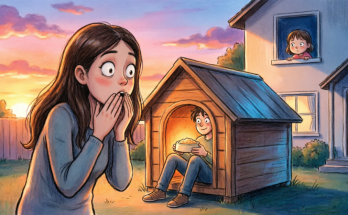
At dinner, my brother snapped, “Your son doesn’t belong here. He’s not one of us.” His wife said, “Then maybe you both should leave.” I stood up calmly and said, “We will. And my bank card too.” Her eyes went wide. “What do you mean?” I smiled and said…
The first time I realized how easy it was for someone to cut a child with words, it happened over dinner, in my brother’s house, under warm pendant lights that made everything look softer than it really was. The table was set the way Chelsea always set it—linen napkins folded into neat triangles, water glasses lined up like soldiers, a centerpiece that smelled faintly like rosemary and something expensive she couldn’t pronounce. Aaron had grilled steaks on the back patio, thick and red in the middle the way he liked them, and he’d served them like he was hosting a celebration instead of a family meal held together by obligation and habit.

Eli sat to my right, shoulders tucked in, hands in his lap the way I’d taught him when he was younger because he used to talk with his whole body—hands waving, legs bouncing, energy spilling over. At fourteen, he’d learned to pull it all back. Not because he wanted to, but because he’d learned that some rooms punished you for being too much.
He looked older than fourteen sometimes. Not in the tall, broad-shouldered way boys on the varsity team looked older, but in the careful way he listened, in the way he waited an extra beat before he answered a question, as if he was checking whether the answer would make someone else uncomfortable. He’d been top of his class for two years running, the kind of kid teachers wrote glowing notes about. Polite. Soft-spoken. Brilliant. The kind of kid people claimed to want… until wanting became the same thing as accepting.
The conversation had started pleasantly enough. Chelsea had talked about a new yoga studio she wanted to try—she said “hot vinyasa” like she was announcing a brand of champagne—and Aaron had complained about the neighbor’s dog barking, and my mother had texted earlier that she couldn’t make it because she had a headache. Nothing unusual. Nothing dramatic. Just the normal hum of a family that shared bloodlines but not always warmth.
Eli ate slowly. He always did in unfamiliar spaces, even spaces he’d been in many times. It was his way of making sure he didn’t take too much. Too much food, too much attention, too much air. He’d cut his steak into small pieces and kept his eyes on his plate, answering when spoken to, smiling when Chelsea’s laugh got sharp and performative.
Aaron was across from us, leaning back in his chair as if his own home was a throne room. He had the kind of confidence that came from never having to fear consequences. His hair was a mess in the way men tried to make look effortless. His forearm rested on the table, tan and muscled from the gym membership I’d paid for in January, February, March, and April, because he’d said he needed it for his mental health and I’d believed him, or wanted to believe him, because guilt makes you generous.
Halfway through the meal, Chelsea asked Eli about school. Her tone was sweet but thin, as if she was doing him a favor by remembering he existed.
“How’s honors biology?” she asked, lifting her wine glass.
Eli nodded. “Good. We’re doing genetics right now.”
“Genetics,” Aaron repeated, like he was tasting the word. He stabbed his fork into a piece of steak—my steak, in a way, because the money for it came from my account—and chewed slowly, looking at Eli the way someone looks at a stranger who has walked into the wrong house.
And then he said it.
“Your son doesn’t belong here. He’s not one of us.”
It was so casual. No buildup, no warning, no pause to soften it. The words hit the table like a dropped knife. For a few seconds, the whole room went still. Even the air felt like it paused, like it didn’t know what to do with that kind of cruelty sitting openly between plates and glasses.
Eli’s hands stayed folded in his lap. He didn’t look up. His jaw tightened, and I saw his throat move as he swallowed something that wasn’t food.
I looked at Aaron. I kept my voice steady because raising my voice would have been a gift to him, a way to make me the problem instead of him.
“Do you want to repeat that?” I asked.
He met my eyes, dead calm. “He’s adopted. He’s not blood. You can pretend all you want, but he’s not family.”
Chelsea nodded, smug, like she’d been waiting for someone to say it out loud. She held her glass of white wine like a prop, her lips curling in the kind of smile women practice in mirrors when they want to look sympathetic without being sincere.
“Then maybe you both should leave,” she added.
There are moments in life where you can feel the timeline splitting. One path is the one you’ve been walking, the one built out of habits and compromises and a long list of swallowed words. The other path is the one you could choose if you finally stopped trying to keep everyone comfortable. In that moment, I felt the split like a crack in glass.
I could have argued. I could have cried. I could have demanded they apologize. I could have made a scene, thrown my napkin, slammed my hands on the table the way movies tell you a righteous person should. But I’d spent years learning that scenes only feed people like Aaron and Chelsea. They thrive on drama because drama lets them claim victimhood when the smoke clears.
So I did something else.
I stood up quietly.
No yelling. No scene. I picked up my purse. I looked from Aaron to Chelsea, and I said, “We will.”
Chelsea’s eyebrows rose, like she’d expected me to beg or negotiate. Aaron smirked, already tasting the satisfaction of winning.
“And my bank card, too,” I added.
Chelsea blinked. “What do you mean?”
I smiled—small, controlled, a smile I used in boardrooms when someone underestimated me. “I mean the dinners,” I said, “the monthly transfers, your credit cards, your lease, your utilities, the god-forsaken Peloton you’ve used twice, the loan I cosigned because your credit was garbage, the money I gave Mom to secretly pass on to you when you were broke again and too proud to ask.”
Aaron’s smirk slipped.
Chelsea’s mouth opened, then closed.
I paused just long enough for the words to settle. I wanted them to feel it. Not as a threat. As reality.
“All gone,” I said. “As of now.”
I didn’t look at Eli when I said it because I didn’t want him to see anger on my face. I didn’t want him to think he’d caused something terrible. I reached for his shoulder instead, a quiet signal. He stood immediately, chair scraping lightly against the floor.
We walked out before either of them could say another word.
Not a word to Eli. Not an apology. Not even a goodbye.
The front door shut behind us, and the cold night air hit my skin like a slap. Eli stepped onto the porch, and for a second he just stood there, frozen.
In the car, he stared out the window.
I waited until we were on the road before I spoke.
“You don’t have to say anything,” I told him. “But I want you to hear me say this clearly. What they said is wrong. It’s cruel. It’s not true.”
His voice came out quiet. “They’ve always thought it.”
“I know,” I admitted. The truth tasted bitter. “But thinking something and saying it out loud are two different things. And now we know who they are when they’re not pretending.”
He nodded once, still looking away. “Do you… do you regret adopting me?”
The question hurt so much it almost stole my breath. I gripped the steering wheel, forcing myself to keep the car steady, forcing myself to speak like a mother instead of a wounded person.
“No,” I said. “Never. Not for a single second. You were mine the moment I met you.”
He swallowed, and the streetlights flickered over his face, catching the sheen of tears he refused to let fall.
When we got home, he went to his room without taking off his shoes. I heard his door click shut, and then the house went quiet in that hollow way it does when a child decides to protect you by hiding their pain.
I sat at the kitchen table for a long time, staring at my phone. Messages were already coming in. Chelsea, of course. She loved to control the narrative. Aaron too, texting as if he’d done nothing wrong.
Chelsea: “I can’t believe you’d walk out like that. This is family.”
Aaron: “You’re overreacting. You always do this. You think you’re better than us.”
I read the words and felt something strange: not anger, not heartbreak, but a calm, sharp clarity.
Because here was the truth I’d been avoiding for years: I had been funding their lives.
Not metaphorically. Literally.
And it wasn’t because I was rich and they were poor. It was because I felt guilty…………………….