The Versace dress had been missing for twenty-one days when I found it at my father’s funeral.
It was the first thing I saw when I stepped through the carved oak doors of St. Augustine’s Cathedral and into the cool, dim hush of incense and grief. Not the casket draped in white lilies. Not the priest standing near the altar with his hands folded. Not the stained-glass saints casting jeweled light across the marble floor.
The dress.
Midnight blue silk. Hand-sewn crystals stitched along the neckline in a crescent that caught the light and scattered it. A gown my father had given me for my fortieth birthday the year before, after pretending for weeks that he had no idea what to buy me.
“You already have everything,” he had said over dinner, rubbing his chin as though it were an unsolvable legal question.
“I do not,” I had told him.
“What could my impossible daughter possibly need?”
“A smaller mortgage. A bigger boat. Better taste in men.”
He had barked out a laugh loud enough to turn heads in the restaurant, then wagged a finger at Grant and said, “You hear that? She’s finally developing judgment.”
A week later the dress had arrived in tissue paper and a black garment bag from Milan, with a note in his square, impatient handwriting: For the next time you need a room to remember who you are before you speak.
It had fit like moonlight.
Three weeks ago, it vanished.
I had gone looking for it because grief has strange habits. While my father was in hospice, while morphine and silence hollowed out his last days, my mind kept clinging to small practical things because the big thing—losing him—was too massive to hold. I could not control cancer. I could not control time. But I could locate a dress. I could make order in my closet. I could accuse the dry cleaner in a voice so cold they sent a manager to reassure me they had never even received it.
I had pulled every hanger from the rail. Opened every drawer. Checked garment bags I hadn’t touched since winter. I had crouched on the floor in cashmere socks at midnight with mascara on my cheeks, staring at empty cedar shelves as if the dress might materialize out of pity.
Now here it was, not missing at all.
It was sitting in the front pew of my father’s funeral.
And the woman wearing it was holding my husband’s hand.
For a second my mind refused to make sense of the scene. It tried to rearrange the facts into something survivable. A misunderstanding. A cruel coincidence. A dress that only looked like mine. Grant sitting too close to a colleague out of shared professional obligation. My eyes blurred by sleeplessness and shock.
Then the woman turned.
Rebecca Thornton.
Becca.
Twenty-eight, bright smile, perfect teeth, executive sheen. A rising star in marketing at my husband’s firm. I had met her twice at company dinners. Once she had told me she loved my shoes. Once she had asked if Grant had always been “that funny,” and I had smiled and said, “Only when there’s an audience.”
She smiled at me now, and in that smile was the entire grotesque truth.
It was a polished, careful smile. The kind some women practiced in mirrors and others learned by instinct. Soft enough to seem innocent, confident enough to claim territory. It belonged on someone arriving at a gala, not someone seated in the front row at the funeral of a man she had never met.
The crystals at her throat flashed as she tilted her head.
Behind my ribs, something cold and hard clicked into place.
“Becca,” I said, and my voice came out thin with disbelief, “what the hell are you doing here?”
Several heads turned.
Beside her, my husband went still.
Grant Morrison had always prided himself on composure. He could walk into boardrooms full of hostile investors and emerge smiling. He could soothe angry clients, charm skeptical bankers, and flirt his way through donor dinners without loosening his tie. For fifteen years I had watched him move through the world like a man who believed all situations could be handled if one simply found the right tone.
But there are expressions no amount of grooming can hide. Fear, when it arrives suddenly enough, strips a person bare.
Grant looked at me, then at Becca, then at the altar, as though one of the saints in stained glass might take pity and intervene.
“Natalie,” he said quietly, rising halfway to his feet. “Darling—”
Don’t darling me, I almost said, but the words lodged behind my teeth because Becca had turned toward me fully now, as if she’d been waiting for this moment and found it faintly amusing.
“I’m here for support,” she said.
The nerve of that sentence almost made me laugh.
“Support,” I repeated.
She nodded, still smiling. “Family supports family during difficult times.”
Family.
The word rang in the cathedral like an obscene little bell.
I heard it too loudly because I was suddenly aware of everything—the sigh of someone shifting in a pew, the rustle of funeral programs, the waxy sweetness of lilies, the hollow thud of my heart. My father’s casket stood twenty feet away, and my husband’s mistress was wearing my birthday dress and calling herself family.
“Family?” I said.
This time I didn’t bother to lower my voice.
The murmuring in the cathedral changed tone. It sharpened. People were listening now.
Becca crossed one elegant leg over the other. “Well,” she said, “I’m practically family now.”
The sentence landed like a match in dry grass.
My husband inhaled sharply. “Becca—”
“No?” she said, with a little laugh that skated over the marble. “Grant and I have been together for almost a year. It seemed appropriate that I be here.”
Almost a year.
I remember that number more clearly than I remember my father’s coffin at that exact moment, and that is one of the cruelties of being human: grief will share a body with humiliation and rage, and none of them will make room for the other.
Almost a year.
The math rose up in perfect, merciless sequence.
Our anniversary trip to Paris, shortened because Grant had a “scheduling emergency.”
The sudden multiplication of conferences that somehow required weekends.
The nights he came home with hotel shampoo in his toiletry bag and said he’d forgotten to unpack.
The messages he answered while smiling down at his phone and then turned it face down when I walked into the room.
The fatigue in his voice when he spoke to me. The brightness in it when he spoke to everyone else.
I had explained all of it away because my father was dying.
When a person you love is disappearing by inches, you become dangerously willing to postpone other pain.
“That,” I said, hearing my own voice as if from a distance, “is my dress.”
It was absurd, of course. Not the biggest betrayal in front of me by miles. But trauma does not arrive in tidy order. The mind grabs what it can hold. At that moment I could not hold the affair, the deception, the indecency of this woman sitting in my place at my father’s funeral. But I could hold the dress. The stolen, tangible thing. Silk and crystals. Evidence.
Becca looked down at herself with theatrical surprise. Then she stood, smoothed the skirt over her hips, and did a small turn.
“Oh, this?” she said. “Grant gave it to me. He said you never wore it. Such a shame to let beautiful things go to waste.”
I looked at Grant.
Really looked at him.
My husband of fifteen years.
He could not meet my eyes.
His gaze had dropped to his hands, which were clenched so tightly the knuckles showed white. That, more than anything, told me the truth. Guilt has a posture. Shame does too. The man who had held my hand in oncology waiting rooms, the man who had stood beside me at my mother’s memorial, the man who had kissed my forehead two nights ago when I fell asleep in the chair beside my father’s hospice bed—he sat there like a boy caught stealing.
He didn’t deny it.
He didn’t say Becca was mistaken. Didn’t tell me I had misunderstood. Didn’t stand up and come to me.
He sat beside her.
“Natalie.”
My aunt Helen appeared at my elbow like a force of weather.
Helen Crawford was my father’s younger sister by four years and fiercer than most standing armies. At sixty-five she still wore black better than any widow in Newport and had a voice capable of reducing grown men to self-examination. She had loved me from the moment I was born, and she had despised Grant in small, disciplined doses for the entire duration of my marriage without ever once saying I told you so.
Now her hand closed around my forearm.
“The service is about to begin,” she said in a tone sharp enough to shave bark from a tree. “Sit down.”
My feet moved because Aunt Helen’s voice could still activate obedience from childhood.
She guided me into the pew directly behind Grant and Becca—because the seat that should have been mine, beside my husband in the front row for my father’s funeral, was occupied by the woman in my dress.
I sat.
My knees felt unreliable.
At the front of the cathedral, Father Martinez stepped to the lectern and began the opening prayer. His voice was deep and practiced, built to steady the grieving. The organ hummed softly behind him. Sunlight streamed through the stained glass and lit the crystals at Becca’s throat until tiny shards of color danced over the back of the pew in front of me.
It felt as though the universe had developed a particularly vicious sense of humor.
“My father believed,” Father Martinez said, “that character is what remains when comfort is stripped away.”
I almost choked.
Because if ever there was a morning when comfort had been stripped away, this was it.
I folded my hands so tightly in my lap that my nails left half moons in my palms and stared at the back of Becca’s head while Father Martinez spoke about my father’s generosity, his discipline, his faith, his devotion to family.
Devotion to family.
Another phrase sharpened into irony.
My father, James Crawford, had been a man of impossible standards in expensive loafers. He had built one of the most respected corporate law practices on the West Coast and then spent half his life giving money away with the impatience of a man who considered generosity a form of efficiency. He funded scholarship programs, sailing camps, and legal aid clinics. He served on boards he privately found tedious because, as he used to say, “If sensible people refuse to sit in boring rooms, then boring people make all the decisions.”
He liked order. He liked competence. He liked black coffee, old boats, and cross-examining waiters about the provenance of oysters.
And he loved me with a force so matter-of-fact I had almost mistaken it, as a child, for weather.
When I was six, he taught me how to tie a bowline in the dark.
“When would I ever need to do that in the dark?” I had complained, fumbling with the rope on the deck of his old sailboat.
“When things go wrong,” he had said. “Which they will.”
“When?”
“At sea? Constantly. In life? Also constantly.”
“That’s not comforting.”
“It’s not supposed to be comforting,” he replied. “It’s supposed to be useful.”
That was Dad. Not sentimental. Useful. If he loved you, he handed you tools.
Even when Grant first came into my life, it was my father’s opinion that mattered more than I admitted.
Grant was handsome in a polished, accessible way. He wasn’t old-money handsome like the men I had grown up around, all inherited confidence and indifferent tailoring. He was sharper than that. Hungrier. Self-made, or so I believed then. He knew how to ask questions that made people feel interesting. He remembered names. He studied rooms with the quick intelligence of a man who had spent his life learning how wealth behaved so he could stand close to it without seeming impressed.
We met at a charity auction. He teased me for bidding too much on a painting I didn’t even like, and I told him to mind his own bankruptcy risk. He laughed. We danced. He said things that suggested he saw me rather than the life around me. For a woman raised in rooms full of men who looked at my father first and me second, that mattered.
When he asked Dad for his blessing, my father invited him sailing.
Grant returned six hours later sunburned, damp at the cuffs, and sporting a purple bruise rising under one eye.
“Your father is… quite the sailor,” he said, in the careful tone of a man uncertain whether he had been interviewed or threatened.
“He likes you,” I said.
Grant gave me a look. “I’m not sure that’s what happened.”
Later that evening, Dad poured himself two fingers of bourbon and told me, “I made it clear what would happen if he ever hurt you.”
I rolled my eyes. “You cannot threaten every man I date.”
“I didn’t threaten him.”
“What did you do?”
He sipped his bourbon. “I educated him.”
On our wedding day he kissed my forehead and whispered, “If he ever turns out to be a fool, remember that fools are not fatal.”
At the time I laughed.
Now, in the cathedral, watching Grant’s arm resting along the back of the pew behind another woman, I understood that my father had always planned for storms.
My cousin Mark gave the first eulogy. He spoke about summers in Martha’s Vineyard, about learning to sail under my father’s barked instructions, about Dad’s talent for making children feel capable and grown men feel like they hadn’t done their homework. People smiled through tears. Aunt Helen dabbed at her eyes. Even I managed to steady my breathing for a while.
Then Dad’s law partner, Arthur Bell, spoke about integrity, about brilliant negotiations, about the time my father walked away from a seven-figure client because the man had lied to his wife in the lobby and Dad said, “If he’ll deceive someone who shares his bed, he’ll deceive us all.”
That nearly undid me.
Because two days earlier, while my father lay in hospice with yellowed skin stretched thin over the angles of his face, he had called me close and rasped, “I need you to hear me.”
His voice was so weak I had to lean down until my ear almost brushed his mouth.
“You rest,” I had told him. “You don’t need to talk.”
“Yes, I do.”
He had gripped my wrist with surprising strength. The effort of it made the tendons stand out in his hand.
“I hired Blackwood,” he said.
I had frowned. “For what?”
His eyes, still clear despite the pain, searched my face. “To look.”
“At what?”
“At your life.”
I almost laughed then because morphine can untether people from sequence and sense. “Dad, my life is sitting right here with you.”
But he shook his head a fraction. “No. Something’s wrong.”
His breathing had turned shallow. I reached for the call button, but he tightened his hand again.
“Don’t let him take anything else from you,” he whispered.
I thought he was talking about grief. About the way death steals time, appetite, sleep. I kissed his forehead and told him not to worry about me. He closed his eyes, and I believed the conversation was over.
It never occurred to me that my dying father was spending his final lucid strength making contingency plans for my marriage.
At the funeral, I sat with that memory moving through me like an underground current.
More speakers came and went. More stories. My father in court, on the water, at holiday dinners, at scholarship interviews. The man they described was every version of him I had ever known: exacting, funny, impossible, kind.
And all the while Becca sat in my dress with her shoulder nearly brushing my husband’s.
People noticed. Of course they did.
Scandal has a frequency. It moves through a room before a word is spoken, changing the angle of faces, the timing of silences. I could feel the awareness spreading in widening circles. Someone had likely heard the exchange at the door. Someone else had seen Grant stiffen when Becca made her announcement. Families like mine could identify impropriety at fifty yards and remember it for generations.
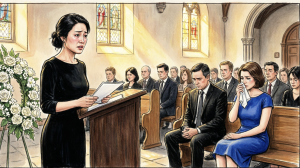
When Father Martinez nodded toward me, it took me a second to realize it was my turn to speak.
I stood.
The cathedral seemed to inhale.
I had written a eulogy at three in the morning, sitting at my father’s desk because I could not sleep in the bed Grant and I had shared. I wrote it with the investigator’s report in a sealed envelope three feet away, unopened since Blackwood had sent it over at dawn. I wrote it with my phone buzzing every twenty minutes from my husband, who had still not come home from wherever he spent the night before the funeral. I wrote it with mascara streaks on the sleeve of my robe and a crystal whiskey decanter glinting in the dark.
By sunrise, I had a speech about my father.
By the time I walked to the pulpit, I had something else too.
My heels struck the marble in measured clicks. I passed my husband without looking at him. Passed the woman in my dress. Stood beneath the cathedral lights and faced the congregation.
The room was full.
Clients and judges. Old sailing friends. Former scholarship recipients. Neighbors. Staff from the firm. A reporter from the city paper in the back row. The youth sailing team in navy blazers. The florist’s teenage daughter who had cried while arranging the lilies because Dad once paid her camp fees when her mother couldn’t.
My father had touched too many lives for any room to hold.
I unfolded my notes and looked down at them for a moment, if only to steady my hands.
“My father,” I said, and my voice echoed softly through the cathedral, “did not believe in half measures.”
A few people smiled.
“He liked things done properly. Boats properly moored. contracts properly drafted. Apologies properly given. Coffee properly hot. He could detect incompetence before most people had finished introducing themselves.”
That drew a ripple of laughter.
“He taught me that there are two kinds of storms in life. The ones you can see coming from a mile away, and the ones that break over your head while you are still telling yourself it’s only wind.”
The laughter faded.
I let my gaze move over the congregation, not lingering, not flinching.
“My father loved many things—sailing, justice, terrible puns, and winning arguments he had no practical need to win. But above all else, he loved his family. He protected us in ways large and small. Sometimes with money. Sometimes with advice. Sometimes with intervention so discreet you didn’t know it had happened until years later.”
I lifted my eyes.
“Two days ago, while he was in hospice, he asked me to come close because he had something important to tell me.”
That was when Grant finally looked up.
Our eyes met across the cathedral.
There are moments in a marriage when language becomes unnecessary. You can know an entire truth from the way someone braces. The way their mouth tightens. The way fear flares behind the eyes.
Grant knew then, or part of him knew. Maybe he didn’t yet understand how much my father had uncovered, but he understood enough to realize the floor beneath him had shifted.
I continued.
“He told me that he had hired a private investigator because he was worried about me. He said I seemed… diminished. Unhappy. He wanted to be sure I was all right.”
A murmur moved through the pews.
“He asked someone he trusted to look into certain things. To verify certain concerns. He didn’t tell me what those concerns were because by then he had very little strength left, and frankly, I was too busy trying to imagine a world without him to ask the right questions.”
I turned one page of my notes.
“Imagine his surprise,” I said softly, “when the report included photographs of my husband with another woman.”
The murmur became a shockwave.
Not loud, exactly. St. Augustine’s was not a loud place. But a hundred restrained reactions at once create their own kind of thunder. Shoulders straightened. Heads turned. A woman in the second pew actually covered her mouth.
From the front row, I heard Becca inhale sharply.
“Multiple hotels,” I went on. “Romantic dinners. Weekends that were apparently not business trips at all. An anniversary trip to Paris that ended early for reasons I now understand. Even a weekend in Cabo that was billed to everyone in my household as a conference.”
Grant stood so abruptly his funeral program fluttered to the floor.
“Natalie,” he said, low and urgent. “Please.”
That word—please—might have moved me once.
Instead I looked at him the way my father used to look at opposing counsel who had just made a foolish objection.
“My father’s last coherent instruction to me,” I said, “was, ‘Don’t let him take anything else from you. I’ve made sure of it.’”
Silence spread outward now, heavier than the earlier murmuring. Even Father Martinez looked stunned.
I reached into my notes and withdrew a folded document.
“This morning,” I said, “Mr. Blackwood explained what my father meant.”
Grant took a step into the aisle. “This is neither the time nor the place.”
“No?” I asked. “And when, exactly, would have been a better time? Before or after your mistress introduced herself as family at my father’s funeral while wearing my dress?”
The force of that sentence knocked him back half a pace more effectively than any shout could have.
I heard Aunt Helen make a small sound of approval.
I unfolded the paper.
“My father changed his will last week.”
Now Mr. Blackwood rose from the third row. Tall, silver-haired, with the kind of old-school legal gravitas that could make entire boards of directors reconsider themselves, he didn’t speak at first. He merely stood and adjusted his cuff links as if he had always known this would be the moment.
Grant looked at him in betrayal. Which would have been funny, under different circumstances.
“Would you like to know what it says?” I asked.
“Natalie—”
I read.
“To my daughter, Natalie Crawford Morrison, who should never again be made to feel unsafe in what is hers, I leave the bulk of my estate in a trust inaccessible to any current or future spouse. The beach house in Martha’s Vineyard, the investment portfolio, the sailing yacht Integrity, the primary residence’s underlying title interests, and all family-held assets already designated shall remain solely and irrevocably hers.”
By the time I reached the word irrevocably, the blood had drained from Grant’s face.
Because wealth, like infidelity, changes shape when spoken aloud.
For years he had enjoyed the look of our life. The house in Pacific Heights with the bay windows and original moldings. The memberships. The vacations. The quiet assumption, among those who knew him only socially, that he had built all of it by force of charisma and smart investing. He never explicitly lied to those people. He just never corrected them.
He rarely mentioned that the down payment on the house had come from my trust. That the “capital injection” which launched his first independent venture had been a loan from my father so generously structured it barely deserved the name. That the boat berthed in Sausalito had my family’s name on the original registration. That Crawford money sat under nearly every polished surface of our life like steel in a skyscraper.
Becca was staring at Grant now, all coy polish gone from her face.
I continued reading.
“To Grant Morrison, my son-in-law, I leave the sum of one dollar and one piece of advice: a man who betrays his wife while her father is dying deserves precisely what he has earned on his own.”
A pause.
“Nothing.”
The word dropped into the cathedral like a judge’s gavel.
Someone in the back actually let out a startled cough that sounded suspiciously like a laugh.
Grant’s face flushed dark red. “This is outrageous.”
“No,” I said. “What’s outrageous is bringing your mistress to my father’s funeral.”
“You are making a spectacle of yourself.”
“I’m making a record,” I said. “There’s a difference.”
Becca stood. “Grant,” she said, her voice suddenly thin, “what is she talking about?”
He didn’t answer.
That was answer enough.
Mr. Blackwood stepped fully into the aisle then, voice smooth as polished oak. “For the sake of accuracy,” he said, “Mr. Crawford had all amendments reviewed and executed under full legal supervision. The relevant trusts and title protections are secure.”
Grant turned to him. “You can’t—”
“I can,” Blackwood said mildly. “And did.”
I looked back at my paper, because there was one final paragraph and my father had, in classic James Crawford fashion, saved his sharpest blade for last.
“There is an additional statement,” I said, “that my father requested be read publicly in the presence of witnesses.”
Becca had gone completely still.
I found the paragraph and, despite the cathedral and the lilies and the rawness of grief under everything, I felt something almost like my father’s dry amusement move through me.
“To Rebecca Thornton,” I read, “who the investigator informs me is under the impression she is about to become the next Mrs. Morrison and inherit a fortune, I leave this reality check: the house, the cars, the memberships, the accounts, and the life you appear to admire were built on Crawford family resources, not on Mr. Morrison’s independent wealth. I hope this information proves useful in your future decision-making.”
The silence that followed was so complete I could hear the hum of the lights.
Then Becca turned to Grant with the kind of movement one usually sees in animals realizing the ground has changed beneath them.
“You told me,” she said, and the shine in her voice had gone sharp, “that the house was yours.”
Grant opened his mouth.
“You told me the investments were yours. You said she was keeping you in an unhappy marriage because of the money. You said once the divorce was done, we’d have—”
“Becca,” he hissed.
“No, answer me!”
Her voice cracked across the cathedral.
People were no longer pretending not to listen.
Classic scandal etiquette evaporates when deceit becomes this entertaining.
Grant ran a hand over his face. “It’s more complicated than that.”
“No,” Mr. Blackwood said pleasantly, “legally speaking, it is considerably less complicated than that.”
A flicker of appreciation passed through the crowd. There is nothing San Francisco old money loves more than impeccably timed legal humiliation.
Grant rounded on him. “Stay out of this.”
“Impossible,” Blackwood replied. “It is, in a very literal sense, my profession.”
Aunt Helen, from my pew, said loudly, “Oh, James would have adored this.”
Several people looked down to hide smiles.
Becca took a step away from Grant as if distance itself might preserve her dignity. The crystals at her throat flashed again, but now they looked less like glamour and more like evidence.
“You lied to me,” she said.
Grant reached for her elbow. She pulled back.
“It wasn’t a lie,” he said. “Not exactly.”
That sentence was the final absurdity.
I folded my father’s will and set it atop my notes.
“Father Martinez,” I said, turning slightly toward the altar, “I apologize. I know this is not how funerals are supposed to go.”
The priest looked as though he had aged three years in ten minutes. “Perhaps,” he said delicately, “we should take a brief recess.”
“No need,” I said.
I looked out over the congregation again, but this time I was no longer speaking to Grant or Becca. I was speaking to the people who had come to honor my father. The people who knew what he valued.
“My father believed in truth,” I said. “He believed in consequence. He believed that decency is not situational. That a person does not get to wear integrity like a tie and remove it when inconvenient.”
I swallowed once.
“He protected me to his last breath. That is what happened here today. The rest is simply exposure.”
Then I stepped away from the pulpit.
As I walked back down the aisle, Grant said my name.
Not loudly. Not theatrically. It was almost worse for being quiet. Pleading. Familiar. The voice that used to ask me if I wanted tea, or tell me traffic was terrible, or say my name in the dark like it belonged to him.
“Natalie.”
I didn’t turn.
Aunt Helen had moved to the end of the pew by then, one hand on her handbag, shoulders squared like a nightclub bouncer in pearls. Grant took one look at her and thought better of trying to pass.
Becca, however, was less cautious.
She grabbed her purse, shoved past him, and strode down the side aisle in my dress with her head high and her humiliation crackling around her like static. The cathedral doors boomed shut behind her a second later.
I kept walking.
Outside, the California sun hit me like a verdict.
The cathedral steps were warm beneath my shoes. Down on the street, black cars lined the curb. A gull wheeled overhead, shrieking at absolutely nothing. The city went on being itself—bright, expensive, indifferent—while my life stood there in pieces.
And then, to my own shock, I started laughing.
Not because anything was funny.
Because the pressure inside me had built beyond tears and needed somewhere to go.
I laughed with one hand over my mouth, shoulders shaking, while mascara burned at the corners of my eyes and two women from the sailing club pretended not to stare. It wasn’t graceful. It wasn’t ladylike. It was the sound of shock cracking.
A hand settled on my shoulder.
I looked up and found Mr. Blackwood beside me.
He glanced toward the cathedral doors, where muffled voices suggested the implosion inside was still underway. Then he looked down at me with an expression I had never expected to see on his usually grave face.
Amusement.
“Your father,” he said, “would be very proud.”
I wiped beneath one eye with the heel of my hand. “Did he really change the will last week?”
“The moment the investigator’s report was complete,” Blackwood said. “He had me at hospice before dawn. I have seldom seen a dying man so motivated.”
The image of Dad in that narrow bed, making legal revisions while pain threaded through him, nearly undid me again.
“He knew,” I said.
Blackwood nodded. “He suspected before he knew. He saw the way you were fading.”
I looked away. “I thought I was hiding it.”
“You were,” he said kindly. “From everyone except the people who loved you longest.”
That landed harder than anything else.
Because it was true.
I had not admitted the shape of my unhappiness even to myself. Not clearly. Not in language. But my father had seen it in missed laughter, in tired eyes, in the way I had started letting sentences trail off.
Blackwood reached into his inside pocket and withdrew an envelope.
“He left this for you.”