“He’s a loser,” my father snapped, vicious. “Nobody will believe him.”
The video showed them scrambling out of the wreckage. The camera angle shifted as doors opened. You could see flickering streetlights, hear distant barking dogs, hear my father’s heavy breathing.
“Run to your house through the woods,” he told her. “I’ll run home. I’ll call it in.”
Then the recording ended.
For a long moment, the porch was silent except for the distant hum of cruiser engines and the faint crackle of the radio.
Officer Miller stared at the phone.
Then he looked at me.
Then he reached into his pocket, pulled out the key, and unlocked my cuffs.
The metal fell away from my wrists with a click that sounded like justice.
“I’m sorry,” Officer Miller said, and he meant it.
Then he turned toward my father.
My father was trembling now, his lips moving but no sound coming out. He looked like a man who had been caught mid-performance and forgotten his lines.
“Mr. Reynolds,” Officer Miller said, voice hard, “turn around and place your hands behind your back.”
“Wait,” my father squeaked, voice suddenly small. “It—it was a deep fake. He edited it. That’s AI!”
“Save it,” Officer Miller said, grabbing his wrist and spinning him around with practiced force. He slapped cuffs on him tight.
“Robert Reynolds,” Officer Miller said, “you are under arrest for driving under the influence, reckless driving, leaving the scene of an accident with injury, and filing a false police report.”
“Injury?” my father repeated, voice shaking. The word seemed to hit him harder than the DUI.
Officer Miller’s eyes were cold. “We got a report of a pedestrian hit on Oak Street five minutes before the crash,” he said. “He’s in critical condition. That makes this felony hit-and-run. You’re looking at serious time.”
My father started crying.
Not the fake, controlled crying he’d done earlier when he wanted sympathy.
This was ugly crying—jaw loose, breath hitching, face collapsing.
“Jason!” he shouted as the officers walked him toward the cruiser. “Jason, tell them! Tell them you let me drive! Don’t let them take me—I’m your father!”
I stood on the porch with my arms crossed, wrists still red from the cuffs. My whole body felt like it was vibrating, not from fear now, but from the sheer adrenaline of watching the truth cut through his lies in real time.
I looked him dead in the eye.
“You said it yourself,” I said, loud enough for the neighbors to hear as they watched from windows and porches. “I’m just a loser. Nobody will believe me.”
His sob turned into a sound that was half rage, half despair.
They shoved him into the back of the cruiser. The door slammed shut.
And with that, a piece of metal and glass finally did what I couldn’t do for twenty-two years.
It exposed him.
Because the truth about my father was this: he didn’t love cars because he loved machines.
He loved cars because they made people look at him.
They made him feel like a king.
And the moment that car turned against him—capturing his drunken voice, his mistress’s panic, his plan to blame his own son—the king had no clothes.
The aftermath didn’t unfold like a movie where everything resolves in a neat montage. It was messier. Slower. More painful in the ways that matter.
My mother came home the next morning.
I was sitting at the kitchen table when I heard the front door open. She walked in with her overnight bag still on her shoulder, cheeks flushed from the cold. For a second, she smiled like she expected normal—like she’d left for two days and returned to the same careful routine.
Then she saw the police business card on the counter. She saw my face. She saw the way the house felt—too quiet, too heavy.
“Jason?” she whispered.
I stood up slowly. My wrists still ached. My throat felt raw from adrenaline.
“Mom,” I said, and my voice cracked.
She dropped her bag. “Where’s your father?” she asked, and the question itself sounded like dread.
I didn’t answer with words. I just picked up my phone, opened the dash cam file, and handed it to her.
She looked at me, confusion flickering. “What is this?”
“It’s… evidence,” I said quietly. “Just watch.”
She sat down at the table like her legs gave out, and she pressed play.
I watched her face while the video rolled, because I couldn’t watch the video again. I’d already heard my father call me a loser with a stranger’s laughter in the background. I’d already heard him say he’d blame me. I didn’t need to hear it again.
My mother’s expression changed in stages. Confusion first. Then disbelief. Then horror.
When Mrs. Henderson appeared in the passenger seat, my mother’s lips parted but no sound came out. When my father’s voice slurred “baby,” I saw something in her eyes shatter, like glass cracking.
And when he said, “I’ll blame Jason,” my mother made a sound that wasn’t a sob and wasn’t a scream—something raw, guttural, like her body was rejecting the reality.
She pressed a hand to her mouth, eyes wide and wet. The video ended.
The kitchen was silent.
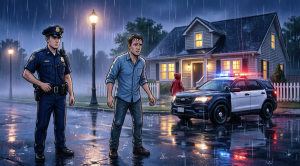
My mother stared at the phone for a long moment like she didn’t recognize the world anymore.
Then she looked up at me.
“I’m so sorry,” she whispered.
It wasn’t a dramatic apology. It was the kind of apology that comes from a person realizing they have been complicit in something by standing still.
I swallowed hard. “He called the cops on me,” I said, voice flat, because saying it out loud made it real again. “He tried to have me arrested.”
My mother’s eyes filled with tears. “I know,” she whispered. “I know. I—I didn’t… I didn’t know he could…”
But the truth was, she did know. Maybe not that specific act, but the shape of him. She’d lived in his orbit for decades. She’d just survived by telling herself it would never land on her son like that.
Now it had.
Something in her changed that day. I could see it. The fear in her eyes was still there, but there was something else too—anger, finally, and a hard kind of clarity.
She filed for divorce within a week.
People in our town were shocked, but only the people who’d believed the billboard version of my father. The people who knew him intimately—my mother, me—weren’t shocked. They were exhausted.
Because of the dash cam evidence—his infidelity, his criminal behavior, the false police report—my mother had leverage she’d never had before. My father couldn’t charm his way out of a felony hit-and-run with a clear 4K recording and audio of him plotting.
The pedestrian he hit survived, thank God, but he had a broken leg and a concussion. He was in the hospital for days. I visited him once with my mom—not because I was responsible, but because I couldn’t stop thinking about the sound of that thump and the woman’s scream.
He was older, mid-fifties, with a bruised face and a tired, pained smile. When I introduced myself, his eyes narrowed in confusion.
“Why are you here?” he asked.
“Because,” I said quietly, “I’m sorry you got hurt. And because my father tried to blame me.”
His mouth tightened. “I heard,” he said. “The cops told me. That dashcam saved a lot of people.”
I nodded. My throat was tight. “I’m glad you’re alive,” I said.
He looked at me for a long moment, then nodded once. “So am I,” he said.
My father faced a massive lawsuit on top of the criminal charges. And because he was the face of his real estate firm—because his image was his currency—the news destroyed him overnight.
Nobody wants to buy a house from a guy who hits pedestrians, flees the scene, and frames his own kid.
His partners kicked him out. Listings vanished. His face came down from the bus bench because the company didn’t want his smile attached to them anymore.
He tried to call my mother from jail. Tried to call me. Left voicemails that swung wildly between rage and pleading.
At first he tried to threaten.
“You think you’ve won?” he hissed. “You think you can ruin me and walk away?”
Then he tried to charm.
“Jason, buddy,” he said in another message, voice strained. “Listen. We’re family. We can work this out.”
Then he tried to guilt.
“Your mother is turning you against me,” he snapped, like my mother had ever had that power. “I’m your father. You owe me.”
I didn’t answer any of them.
The judge denied him bail. Flight risk, history of lying to authorities. The things he’d used for years—confidence, manipulation—were now listed as reasons he couldn’t be trusted.
He was sitting in a cell waiting for trial.
And for the first time in my life, my mother stopped tiptoeing around him.
With my father gone, my mom needed help managing the estate and finances. She’d spent her whole life letting my father handle “money stuff,” which meant he controlled it and she pretended it was fine because asking questions would start fights. Now she was staring at accounts she didn’t understand and paperwork that felt like a different language.
She turned to me.
To the grease monkey.
To the disappointment.
And she saw, maybe for the first time, that I wasn’t the problem.
I helped her navigate lawyers and banks. I sat at kitchen tables with folders spread out. I explained terms. I asked questions she didn’t know she was allowed to ask.
We sold the big house.
It had too many bad memories. Too many echoes of my father’s voice bouncing off expensive walls. Too many nights where my mother tried to smile while he made the air tense.
My mom bought a condo for herself—smaller, calmer, in a building where nobody cared what your husband drove. She chose it because it had light and because it didn’t feel like a stage.
Then she did something that stunned me.
She gave me a significant chunk of money from the settlement—money she received through the divorce proceedings and the shifting of assets.
“It’s not a gift,” she said, eyes wet. “It’s… it’s an apology. For not standing up for you sooner.”
I didn’t know what to do with that. Apologies were rare in our house. They weren’t part of the language. My father never apologized for anything. My mother’s apologies had always been quiet and indirect—extra food on my plate, a hand on my shoulder, a look that said I’m sorry but I can’t say it.
This time she said it.
I took the money, not because I wanted to profit from family destruction, but because I understood what she was offering: recognition. Acknowledgment. A tangible admission that she’d failed me.
I used that money to open my own performance auto shop.
Not a greasy little bay with one lift and a leaky roof. A real place. Clean. Professional. The kind of shop where people bring cars they love and trust you not to treat them like toys.
Business was slow at first, then it grew fast, because word gets around when someone is good at what they do. My waiting list filled. Customers came back. They told friends. People started trusting me with machines that cost more than my father’s Camaro ever did.
Sometimes I’d catch myself in my office late at night, hands clean, paperwork done, looking around at the place I built and thinking about how badly my father misjudged me.
He’d wanted a son he could brag about at the country club. He never realized he already had a son who could build something real with his hands.
I keep the dash cam on a shelf in my office now.
It’s a small thing—black plastic, a lens the size of a coin—but it feels heavier than it looks. A reminder. A trophy. A warning.
Customers sometimes ask about it.
“What’s that?” they’ll say, nodding toward it.
I usually just smile and say, “Something that taught me a lesson.”
If they press, if they seem like the type who wants a story, I’ll tell a version of it. Not the whole thing. Not the part where my father tried to throw me in prison. Not the part where he called me a loser while plotting with his mistress. Just enough to land the point.
“That camera saved me,” I’ll say. “And it proved something important.”
“What?” they’ll ask.
I’ll tap the dash cam lightly with one finger.
“That the truth always comes out,” I’ll tell them. “Especially in 4K.”
People ask me sometimes if I feel bad for my dad.
“He’s still your father,” they’ll say, like blood is a leash you’re supposed to keep wrapped around your wrist forever.
I think back to that night—the blue and red lights, the cold click of handcuffs, my father’s satisfaction when he thought he’d won. I think about how easily he tried to throw my life away to save his image.
I think about him slurring “baby” to another woman while going eighty-five in a thirty-five. I think about the pedestrian in critical condition. I think about the words that came out of his mouth without hesitation:
“I’ll blame Jason.”
I don’t feel bad.
He loved that Camaro more than anything in the world. More than his marriage. More than his reputation. More than his own kid.
It’s fitting that the Camaro is what took everything from him.
The car was totaled—crushed into a cube at a scrapyard like every other piece of metal that thinks it’s invincible.
But the truth it carried?
That survived.
And so did I.