The pounding on my bedroom door didn’t sound like knocking.
It sounded like an accusation.
Bam. Bam. Bam.
I lurched upright so fast my neck cracked, disoriented, the room still dark except for the faint blue glow of my phone on the nightstand. For a second I thought it was a dream—one of those half-awake moments where your brain tries to stitch the world together from scraps.
Then the pounding came again, harder, shaking the cheap hollow door in its frame.
“Jason!” my father’s voice bellowed. “Open this door. Open it right now!”
I blinked at my phone. 3:15 a.m.
My body was heavy with sleep and the long shift I’d worked at the shop, but adrenaline yanked me upright anyway. I threw the blanket off, stumbled across the carpet, and opened the door.
My father didn’t wait for it to swing all the way.
He shoved past me into my room like he owned the air.
He was in his bathrobe, but he looked like he’d run a mile. His face was slick with sweat, cheeks flushed red, eyes wild. The smell hit me a beat later—sharp alcohol and something sour underneath it, like he’d been drinking hard enough that his body was trying to reject it.
“You ungrateful little thief,” he snarled, spinning on me. “What did you do?”
I stood there, still half-asleep, trying to decode what he was saying. My heart started thudding anyway, because my father didn’t come into my room at three in the morning unless the world was about to become a problem.
“What are you talking about?” I asked, rubbing my eyes.
“The car,” he shouted, voice cracking with outrage. “My Camaro. It’s gone.”
For a second, my brain misfired. Gone meant stolen. Gone meant someone had broken into the house. Gone meant the security gate had failed. Gone meant—
My stomach dropped.
“Gone?” I repeated. “Did someone steal it?”
He stepped closer until he was in my space, breath hot with whiskey. “Don’t play dumb with me,” he hissed. “The keys are gone from the hook. You’re the only one here. You took it for a joy ride, didn’t you? Where is it? Did you scratch it?”
I stared at him, awake now in the worst way. “Dad, I’ve been asleep since ten. I didn’t touch your car.”
“Liar!” he screamed, and spit flew. “You’ve been jealous since the day I bought it.”
Jealous.
The word was almost funny, except nothing about his face was funny. His eyes weren’t just angry—they were hunting, like he’d decided on a story and he was going to force the world to match it.
“I don’t want to drive your car,” I said, voice steadier than I felt. “I work on cars all day. I don’t need—”
He cut me off with a harsh laugh. “Right. The grease monkey with the moral compass. Spare me.” He jabbed a finger toward my chest. “I’m calling the police. I’m not protecting you this time. You steal my car, you pay the price.”
He pulled his phone out and dialed 911 while I stood there in my own doorway feeling like the floor had tilted. I heard the operator answer. I heard my father’s voice shift—smooth, practiced, the voice he used when he wanted to be believed.
“This is Robert Reynolds,” he said. “My son stole my $80,000 vehicle. I want officers here now.”
Eighty thousand. He said it like the number made the crime more real. Like the price tag mattered more than the fact he was accusing his own kid.
“Dad,” I said, trying again, “hang up. Let’s check outside. Maybe you parked it somewhere else.”
He whirled on me. “I parked it in the garage,” he roared. “And now the garage door is open and the car is gone.”
He gave the operator our address, the gated community, the house with the trimmed hedges and the stone archway—everything that screamed respectability. Then he ended the call and looked at me with a kind of grim satisfaction, like he’d just made the winning move in a game I didn’t realize we were playing.
I could feel my pulse in my throat.
My father had always loved two things more than anything else: the way people looked at him, and the things that made people look at him.
Cars were his favorite kind of attention.
He didn’t just drive them. He wore them. He let them announce him long before he stepped out.
And for the last three months, he’d been wearing that Camaro like it was proof he was still powerful, still admired, still the man he wanted everyone to believe he was.
My name is Jason Reynolds. I was twenty-two then, a mechanic by trade, grease under my fingernails most days because engines don’t care about image. I still lived at home—not because I was mooching, but because I was saving up for a down payment on my own place. I paid rent. I bought my own food. I kept to myself as much as you can in a house where your father treats every hallway like his stage.
My father, Robert, was a successful real estate agent in our town, the kind whose face was on bus benches and billboards. Perfect suit, perfect teeth, perfect watch, perfect handshake. People loved him because he made them feel like they were part of something glossy and exclusive. They didn’t see what it cost the people who lived behind that smile.
My mother, Linda, saw it. She’d been seeing it for years.
She was quiet, soft-spoken, the kind of woman who learned to keep the peace by making herself smaller. She walked on eggshells around my father’s ego, smoothing things over before they could explode, apologizing for things that weren’t her fault because it was easier than watching him get louder.
I grew up watching that dynamic and learning one lesson early:
In our house, my father’s version of reality was the only version allowed.
That’s why the Camaro mattered so much.
Three months before that night, my father went through what I called his super midlife crisis.
He came home one Friday evening like he was carrying a secret. He didn’t even take off his shoes before he started talking.
“You’re not going to believe what I did today,” he said, voice bright with self-satisfaction.
My mom looked up from the kitchen sink. I was at the table with my laptop, checking invoices from the shop, half-listening. My father loved to announce purchases like they were achievements.
“What did you do?” my mom asked carefully.
He jingled keys in his hand. Not house keys. Not normal keys. Something heavier.
“I bought a ZL1,” he said, as if those letters were a magic spell.
I glanced up despite myself. “A Camaro ZL1?”
He smiled like he’d been waiting for me to speak the language. “Brand new. Black on black. Six hundred fifty horsepower.”
My mom’s face tightened. “Robert—”
“Don’t start,” he warned immediately, smile still on but eyes already sharpening. “I earned it.”
That was always his justification. Earned. As if anything he wanted automatically counted as deserved because he wanted it badly enough.
The next morning, he pulled into the driveway with a sound that didn’t belong in our quiet gated community—a low, aggressive rumble that made the windows vibrate. The car looked like a stealth bomber on wheels, black paint so glossy it swallowed light. The hood had vents like gills. The tires were thick and wide and expensive.
He parked it in the garage and immediately turned the garage into a shrine.
I’m not exaggerating. He literally bought velvet ropes—the kind you see in museums—and placed them around the Camaro so no one would “brush against the paint.” He wiped it down with a microfiber cloth every night like it was a ritual. He bought special soap. Special wax. Special gloves. He’d stand back afterward, arms crossed, admiring his reflection in it like the car was a mirror showing him who he wanted to be.
He made rules.
No eating in it. No drinking in it. No touching it with “dirty hands.”
And specifically, loudly, repeatedly:
“Jason is never allowed to touch it.”
He’d say it like it was a joke to anyone who visited. “I can’t let him near it,” he’d laugh. “He’d probably change the oil with a shovel.”
Then he’d look at me and smirk.
I didn’t care about driving it. I drove fast cars at the shop sometimes. I got my thrill from diagnosing a problem and fixing it, not from flexing horsepower on a suburban street. Honestly, the Camaro made me nervous—not because I wanted it, but because my father was a terrible driver.
Aggressive, impatient, the kind of man who believed the rules of the road didn’t apply to him because he was important. He cut people off. He tailgated. He treated yellow lights like personal dares.
And with six hundred fifty horsepower under his foot?
I was worried he was going to kill himself.
That worry—quiet, practical, the kind mechanics have because we see how fragile machines and bodies are—was why I did what I did next.
Two weeks after he bought the car, I bought him a dash cam.
Not a cheap one. A high-end 4K system that recorded front, rear, and interior cabin. GPS tracking. Speed overlay. Cloud backup. It was the kind of camera you buy when you’re serious about protecting yourself.
I told myself it was a peace offering. A way to show him I wasn’t against his joy, even if his joy made the whole house tense.
The truth is I also wanted proof.
Proof of what he did behind the wheel, because I had this sick feeling one day someone would get hurt and he would claim it wasn’t his fault.
I gave it to him at the kitchen counter like a normal gift.
“Dad,” I said, keeping my tone light, “with a car this expensive, you need protection. People drive crazy. This will prove it wasn’t your fault if someone hits you.”
He scoffed. “I don’t need a camera. I’m an excellent driver.”
My mom glanced at me, a flicker of gratitude in her eyes. She didn’t say anything. She never did when it came to my father’s ego. But I could see she wanted him protected too, even if she wouldn’t admit she feared him.
My father turned the box over like it was insulting his intelligence. Then he shoved it toward me.
“Fine,” he said. “Install it. Just don’t scratch the dashboard.”
I installed it perfectly.
I hid the wires so you couldn’t see them. I mounted the front camera clean, tucked the rear camera neatly, tested the interior lens. I linked it to the cloud. I made sure it would upload automatically. I showed him the app, how to pull footage, how to save clips.
He looked at it for five seconds, got bored, and walked away.
He forgot about it completely.
He assumed it was just a gadget that sat there.
He didn’t realize it was always watching.
That was the part that would save me.
And destroy him.
Fast forward to last Saturday.
It was humid for December, one of those weird nights where the air feels thick and wrong, like the weather is holding something back. My mom was out of town visiting her sister for the weekend—one of the few times she ever left the house without my father. I remember helping her load her overnight bag in the car earlier that day and seeing that small, guilty relief on her face. Like being away from him for two days felt like breathing.
“Call me if you need anything,” she’d whispered when my father wasn’t looking.
“I’m fine, Mom,” I’d said, but my voice had been tight. I always felt uneasy when she left me alone with him. Not because I thought he’d hit me. He didn’t need to. He had other ways of hurting.
That night I worked a long shift at the shop. I was exhausted—hands sore, back tight, brain fried from a stubborn transmission issue that had eaten half my day. I got home around nine, ate something quick, went to my room, put on headphones, played a little video game to shut my mind off, and fell asleep.
I didn’t hear my father come home.
I didn’t hear the garage door.
I didn’t hear anything until the pounding on my door at 3:15.
And after he called the cops, after he accused me with that wild certainty, everything moved fast.
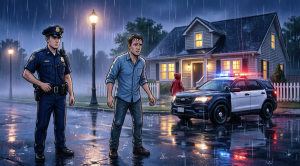
Twenty minutes later, the front yard was lit up with blue and red lights.
Two police cruisers pulled in. A third vehicle arrived a minute later—a tow truck, but not for us. It rolled slowly down the street like it already knew it was headed toward something dead.
My father opened the front door like he’d been waiting for an audience.
Officer Miller stepped onto the porch first. Big guy, serious face, posture that said he’d seen plenty of late-night family mess and had no patience for theatrics. Another officer followed, younger, hand near his belt. Their flashlights swept the porch, the foyer, my father’s face.
“Mr. Reynolds?” Officer Miller asked.
“Yes,” my father said, immediately putting on his victim mask. It was almost impressive how fast he could switch. His voice softened, eyes widened, shoulders slumped slightly like a grieving man.
“Officer, thank you for coming. I’m devastated.” He gestured toward me as if I were a stranger he’d found in his house. “My son—he has a problem. He took my new Camaro while I was sleeping. I just want my car back.”
Officer Miller’s gaze moved to me. “Is this your son?”
“Yes,” my father said quickly. “He’s a mechanic. He knows how to hotwire cars. Or he just stole the keys. He’s been jealous of that car since I bought it.”
Jealous again.
I stepped forward. “Officer, I didn’t take the car. I’ve been asleep.”………………………………………………………………………………………………………………