Part 1
The highway looked endless at night, like a black ribbon pulled tight under a sky with no mercy. Headlights carved a narrow tunnel through darkness, and everything beyond it might as well have been the edge of the world.
I sat in the back seat the way I always did—folded small, knees tucked in, bag hugged to my chest like it could protect me from words. The window beside me was cold enough to sting through my sleeve. Every few minutes my breath fogged the glass and vanished.
Chelsea stretched out like she owned the air.
Her legs sprawled across the seat, heels planted on the floor mat, painted nails tapping a bored rhythm against the leather. She sighed loudly, the kind of sigh meant for an audience.
“Dad,” she whined, nudging the back of his seat with her heel. “My knees are cramped. Why do I have to suffer while she hogs space?”
I blinked and stared down at my lap. I wasn’t hogging anything. I was practically pressed into the door. But defending myself never helped. In our family, defending myself was proof I was guilty of existing.
My father’s voice cut through the car like a blade.
“Move your legs, Allison. Don’t make your sister uncomfortable.”
“I already did,” I whispered, and shifted anyway, curling tighter. My shoulder pressed into the door. The latch dug into my arm.
Chelsea groaned louder, like my compliance was still offensive. “She’s still in my space,” she said. “She doesn’t belong here anyway.”
My stomach twisted. The words didn’t surprise me. They never did. Chelsea had been saying some version of that since we were kids. She was the sun. I was whatever stayed in shadow.
Then she said it, and my whole body went cold.
“Throw her out,” Chelsea said, sweet as poison. “Let her walk for once.”
For a second, I thought it was a joke, the kind that lands cruel and then gets waved off as teasing.
Then my mother laughed from the passenger seat, sharp as glass.
“Honestly,” she said, “that’s not a bad idea. It would teach her what real discomfort is. Better than whining like she always does.”
I opened my mouth, panic breaking through.
“Wait—”
Chelsea leaned forward slightly, eyes glittering with delight. “Yeah. Toss her out. She’ll figure out how to crawl in the dark.”
The car slowed.
My heart slammed against my ribs. The gravel shoulder appeared in the headlights like a mouth opening. The right-turn signal clicked, calm and steady, like this was an ordinary choice.
My father eased the car over. Tires crunched on gravel. Tail lights painted the interior red, like we were sitting inside a warning.
“Out,” he barked.
I clutched my bag tighter. “Dad, please,” I said, voice shaking. “It’s the middle of the night. It’s freezing. I’ll move. She can have all the space. Just don’t—don’t leave me here.”
Chelsea laughed so hard she wiped at her eyes. “All this for leg room,” she said. “Pathetic.”
The door yanked open. Cold air slapped my face so hard it stole my breath. My father’s hand clamped on my arm, fingers digging in deep enough that I knew bruises would bloom by morning.
He pulled me out like I weighed nothing.
My shoes hit gravel. I stumbled, scraping my palms as I caught myself on the ground. The pain was sharp and immediate, but it was nothing compared to the bigger one—the realization that this was really happening.
“Dad,” I cried, voice cracking. “Please don’t do this.”
He shoved me back, the smell of gasoline and rubber filling my nose.
“If you want to stay in this family,” he said, eyes hard, “you learn you don’t come before your sister.”
Then he slammed the door.
The engine roared.
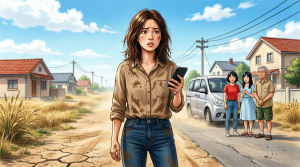
And just like that, the car sped off, tail lights shrinking into the endless black until they were just two distant sparks.
Then nothing.
I stood there on the side of the highway, breath shaking, the night swallowing me whole. Trucks thundered past, their wind gusts slamming into my body like invisible hands. Crickets chirped somewhere in the dark, indifferent.
I took one step, then another, unsure whether to run after them or curl into the gravel and disappear.
I sank to my knees instead, bag clutched tight, and listened to their laughter echo in my head long after it had vanished into the road.
They hadn’t just left me behind.
They had declared me disposable.
Hours crawled by. Cold seeped through my jacket and into my bones. My fingers numbed. Every time headlights appeared in the distance, hope flared for a cruel second—then died when the vehicle blew past, leaving exhaust and emptiness behind.
I whispered to myself, “Just hold on,” because it was the only voice in my world that wasn’t trying to break me.
When dawn finally lightened the edge of the sky, my body felt heavy, stiff, half-frozen. But something inside me had hardened into a different kind of heat.
They wanted me gone.
Fine.
But one day they would regret the choice they made on that highway.
The night they threw me out wasn’t the night I died.
It was the night I stopped being their victim.
Part 2
The sun hadn’t risen fully when I dragged myself off the gravel shoulder, legs stiff, palms burning from scrapes. The road stretched behind me like a threat and ahead like an empty promise.
A small town appeared eventually—just a cluster of lights, a gas station, a diner with a flickering sign that buzzed faintly as if it was tired too.
I stumbled into the gas station like a ghost.
The attendant looked up, eyebrows lifting. “Rough night?”
I tried to speak, but my throat was so dry only a rasp came out. I fumbled through my bag. A few crumpled dollars. Not enough for anything real.
The attendant glanced at my hands, the dirt in my nails, the way my shoulders hunched like I was bracing for a hit.
He slid a bottle of water across the counter without asking for money.
I froze, startled by kindness.
“Take it,” he muttered. “And sit for a minute.”
I clutched the bottle like it was gold. Every sip burned and healed at the same time. The warmth of that simple mercy cut deep, because it showed me what family was supposed to do.
I took a bus out of that town using the last of my cash. The seats smelled like old fabric and cheap disinfectant. I stared out the window as the countryside blurred into suburbs, then into the hard edges of a city skyline.
All the way there, I replayed the night in my head.
Out.
She doesn’t belong here.
Crawl home or die out there.
Even if my father hadn’t said those exact words, his shove had. My mother’s laugh had. Chelsea’s grin had.
By the time I got off the bus, I wasn’t thinking about home.
I was thinking about survival.
I spent two nights at a shelter. The bed was thin. The room smelled like bleach and fatigue. But the roof didn’t disappear. No one told me I deserved to freeze for someone else’s comfort.
A volunteer with silver hair and gentle eyes noticed how tightly I hugged my bag.
“Honey,” she said softly, “you’re safe here.”
The word safe felt foreign on my tongue.
But safety wasn’t enough.
I needed power.
I found work at a diner, starting the next day. The manager took one look at my exhausted face and said, “Can you wash dishes?”
“Yes,” I said.
I worked breakfast shift, then dinner shift, then weekend doubles. I learned the rhythm of greasy plates and hot water and aching feet. I learned how to smile at strangers and keep my pain tucked behind my ribs.
I rented a tiny apartment with a heater that worked only when it felt like it. In winter, I slept under three blankets and wore socks to bed.
I never called my parents.
Not when I got sick.
Not when my rent was due.
Not when I saw families laughing in booths at the diner and my chest ached like it was splitting open.
I refused to be the girl who begged again.
Meanwhile, Chelsea glittered online like a jewel my parents showed off to the world. Pageants. Vacations. Dresses worth more than my yearly rent. My parents posed beside her with proud smiles, captions like: Our shining star. Our future.
Once, I saw a photo of Chelsea blowing out candles on a massive cake, my parents grinning on either side of her, and the caption read: Family is everything.
I laughed out loud in my freezing apartment.
The sound came out jagged.
Family.
I thought about the highway again—the cold gravel, the shrinking tail lights, their laughter fading into distance.
They thought that moment erased me.
And in a way, it did.
It erased the version of me that still hoped, still waited, still believed love could be earned through endurance.
But it also did something else.
It gave me a gift I didn’t ask for:
Invisibility.
To them, I was gone. Forgotten. A problem solved.
And if they believed that, then I could move in shadows.
I started paying attention.
My parents’ lives weren’t as perfect as their posts suggested. Their house—big, polished, impressive—was paid for with debt. Their “connections” were favors. Their status was borrowed.
And Chelsea… Chelsea wasn’t flawless.
Backstage gossip floated online, in forums where pageant fans talked like detectives. People mentioned tantrums, threats, cheating, cruelty to other contestants. Nothing concrete enough to take down a star.
Not yet.
I didn’t rush.
Revenge, real revenge, wasn’t about screaming into the wind.
It was about timing.
I built my life like a quiet weapon.
I saved money. I learned. I took night classes in bookkeeping, then marketing. I learned how businesses really worked, how reputations could rise and collapse. I learned how to collect information without leaving fingerprints.
Two years passed.
And then, on a Tuesday night after a double shift, my phone rang.
A number I hadn’t seen in years.
My mother.
For a moment, my hand hovered over the screen like it might burn me.
Then I answered, because some part of me wanted to hear it—the first crack in their certainty.
“Allison,” my mother said, voice trembling. “Your father’s business deal went wrong. We’re… we’re drowning. Chelsea’s sponsors are pulling out. We need—”
Need.
Not how are you.
Not where have you been.
Need.
My lips curved into a slow smile.
I let her keep talking, her desperation spilling out like water from a broken pipe. Money. Contacts. Help. Anything.
“We’re your family,” she said, as if the word had power by itself.
Family.
That word again.
I didn’t yell. I didn’t cry.
I whispered into the phone, “You’ll get what you deserve.”
Then I hung up.
And I knew it was time to stop surviving in the shadows.
It was time to step into the light and let their lives collapse under the truth they’d tried to bury………………………………..