Run to the well!
The door gave way with a sharp crash. It didn’t open all the way because the wooden security beam was still holding, but the lock was completely destroyed. I saw the tip of a black shoe force its way through the gap. Then came Mr. Vance’s hand—the one with the gold ring and the black stone—pushing forward as if my home belonged to him too.
— Mrs. Miller — he said —, don’t do something that will get you hurt. I’m here to help you.
Liar.
I shoved Madison’s notebook under my cardigan, grabbed the ultrasound, and ran toward the back door. The receiver was clutched in my hand, the phone cord stretching so tight it was on the verge of ripping out of the wall. My daughter’s voice was still there—broken, urgent.
— The sheet metal, Mom. Pull off the sheet metal.
I burst out onto the back porch.
The midnight air bit my face. The moon barely lit the dry garden beds, the chicken coop, and the potted lilies Madison used to care for as a little girl. Beyond that, the dark silhouette of the woods loomed, and further off, the distant lights of the old highway toward Traverse City.
The well was at the back of the property. It was covered with a rusted piece of sheet metal and two large stones. For ten years, I hadn’t touched it. For ten years, I had walked right past it with a bucket, with feed for the chickens, with flowers for the altar, fully believing it had been sealed up for my safety.
Now I understood they had sealed it out of fear.
Behind me, Vance stormed into the kitchen.
— Elena!
He didn’t call me Mrs. Miller anymore. He didn’t even bother pretending to show respect.
I dropped to my knees beside the well and shoved the first stone. It felt as heavy as a decade of guilt. I scraped my fingers, a fingernail tore, but I moved it. Then I moved the other one. The sheet metal screeched as I lifted it, as if it were waking something up.
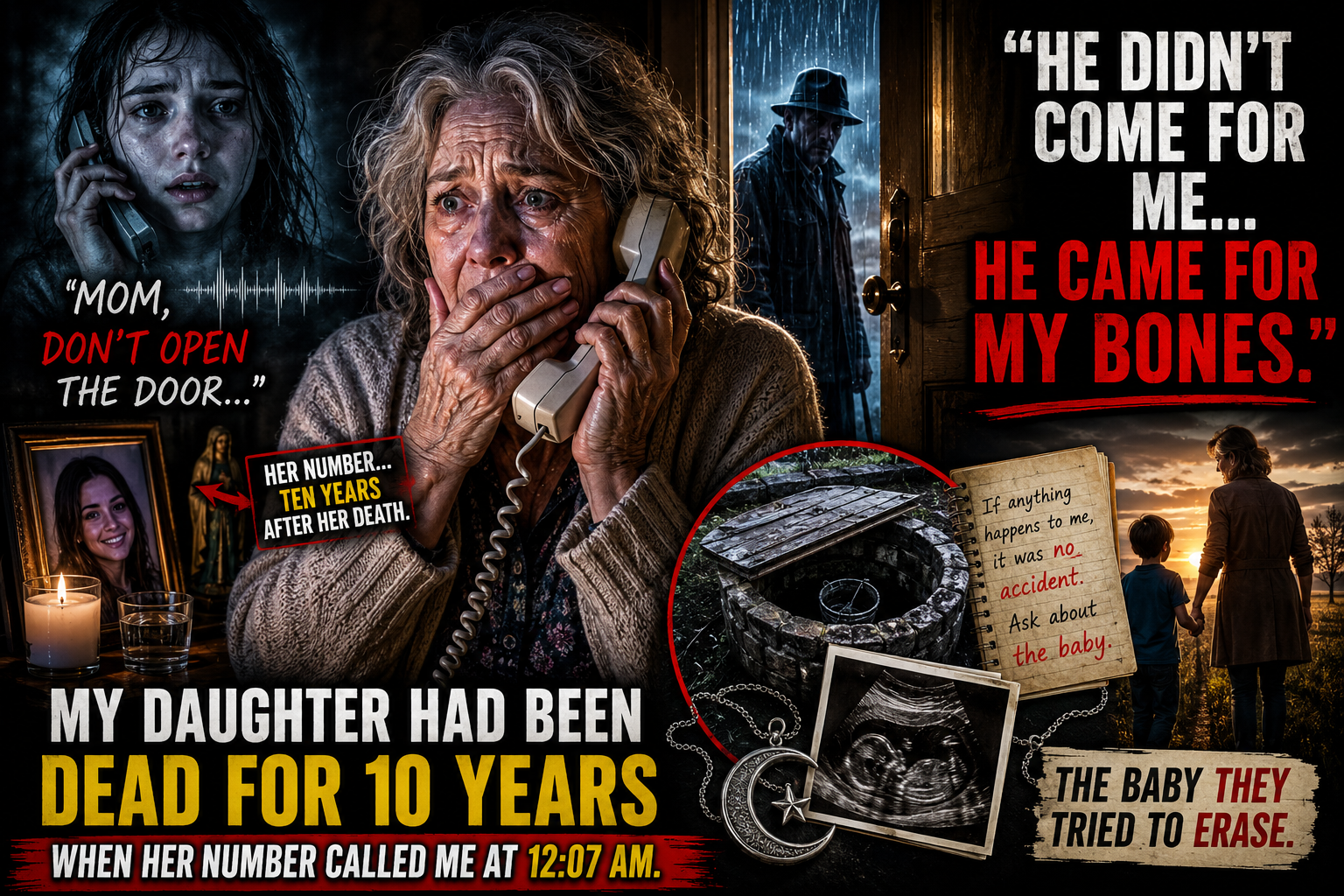
A cold odor drifted up from below. Damp earth. Mold. Stagnant water. And something else—something a mother doesn’t know how to name, but recognizes deep in her gut.
— Mom — Madison said —, don’t reach your hand in. Lower the bucket.
The old bucket was still there, rigged to the pulley system. My husband had left it there “just in case we ever needed it.” Now, everything he did after Madison’s death filled me with suspicion.
I lowered the bucket. The rope groaned.
Vance stepped out onto the back porch. He held a flashlight in his hand, and his smile was completely gone.
— You have no idea what you’re doing.
— No — I said, hauling on the rope —, I’m just finally learning.
The bucket hit something at the bottom. It didn’t sound like water. It sounded like metal.
Thud. Thud. Thud.
The exact same three knocks. My legs began to shake.
I pulled with every ounce of strength I had left. Vance lunged toward me, but my chickens, startled by the commotion, went flying wildly out of their coop. One flapped right into his face. Another scratched his trousers. Madison would have burst out laughing. I nearly did.
The bucket cleared the rim. Inside was a rusted old cookie tin, bound tight with wire.
Vance saw it, and the blood drained completely from his face.
— Hand it over.
I clutched it tight against my chest.
— You’ll have to kill me first.
He took a step forward.
Suddenly, lights flickered on across the fence line.
— Elena! — a woman’s voice yelled. — Are you okay?
It was Charlotte, my neighbor. Then her son’s voice echoed out:
— We already dialed 911!
Vance stopped dead in his tracks. In a small town, a lonely old woman might be easy prey. But an old woman screaming with awake neighbors nearby is a major problem. And cowards absolutely loathe problems that come with witnesses.
— This isn’t over — he whispered.
He turned toward the side gate. He didn’t run; he walked fast, carrying that false dignity typical of men who still believe the mud can’t touch them. Before passing through the gate, he glanced back at the well.
— Some dead people are meant to stay quiet.
I squeezed the tin tighter.
— And some living people ought to learn to shut their mouths before they get buried in their own lies.
I don’t know where those words came from. Maybe from Madison. Maybe from every mother who has ever wept over a closed casket.
Vance vanished into the brush.
My legs finally gave out. I collapsed into a sitting position right next to the well. The receiver was still clutched in my hand.
— Sweetheart — I said —, I have it.
On the other end, there was only static. Then the voice returned, much fainter now.
— I’m not in the grave, Mom.
— Where are you?
Silence. Then:
— In what they hid away.
The line went dead.
I pried open the tin with bleeding fingers. Inside was a thick plastic Ziploc bag, three photographs, a mini-cassette tape, a hospital wristband, and a sheet of paper folded multiple times. The paper was covered in Madison’s handwriting. My little girl—the handwriting that made the letter ‘M’ look like tiny mountains.
“If you find this, Mom, please forgive me for not telling you. I’m pregnant. It was no accident. Mayor Roger Vance says if I say a word, he’ll take the house from you and make my baby disappear. His brother, the lawyer, works for him. If I die, find my child. Don’t believe I’m dead until you see my face.”
I read the words “my child” and felt the entire world split wide open.
Roger Vance. The town mayor. The man with the ring. The very man who had hugged me tightly at the funeral and said:
— Your daughter is in a better place, Elena.
The same man who showed up at every town festival in a polished suit, smiling among the seasonal decorations, talking about how much our community honors family values. What filth. He honored family values in public while manufacturing tragedies in private.
Charlotte rushed into the backyard with a shawl draped over her shoulders.
— Oh my God, Elena, what happened?
I couldn’t speak. I simply handed her the paper. She read barely two lines and gasped, crossing herself.
— That absolute monster.
Her son arrived with a flashlight, followed closely by other neighbors. Within minutes, my backyard filled with whispers, thrown-on jackets, unbuckled shoes, fear, and pure rage. That’s how small towns are: they take a long time to wake up, but when they do, everyone wakes up together.
The police arrived half an hour later—two local cruisers. That filled me with more dread than relief. Because if Roger was the mayor, and his brother Vance was still entering homes in the middle of the night, who did those uniforms actually answer to?
Charlotte leaned in close to my ear.
— Don’t hand anything over to them here. Demand the State Police or the State Attorney’s office.
I looked at her.
— How do you know to do that?
— My niece went missing for three months. You learn the hard way.
I hid the tin beneath my cardigan. When the local officer tried to take it from me, I told him:
— This gets delivered directly to the State Crime Division. Not to you.
He grew annoyed.
— Ma’am, don’t make this complicated.
— They made it complicated for ten years.
Charlotte held up her cell phone.
— I’m recording this.
The officer’s demeanor shifted instantly.
By dawn, my house felt like a wake all over again. Coffee brewing on the stove. Neighbors speaking in hushed tones. Madison’s broken photo frame sitting on the table. The ultrasound resting right next to my rosary. The old landline phone sat completely mute, as if it had never rung at all.
At eight o’clock, my nephew Ethan arrived from Grand Rapids. He worked in a government administrative office and knew exactly how to navigate bureaucracy and closed doors. The moment he saw the tin, he didn’t ask me if I was sure. He just hugged me and said:
— Aunt Elena, we are leaving for Grand Rapids right now.
— What about the well?
— It’s being watched. Nobody touches it.
Charlotte crossed her arms.
— I’ll sit right here on this porch with my son and half the neighborhood if I have to.
She wasn’t blood family, but that day she was more family than most.
We drove out in an old pickup truck, the tin clamped tightly between my knees. We passed the highway toward Traverse City, driving along those sharp curves that had terrified me for so many years after Madison’s alleged accident. I saw the lake in the distance, gray, still, with a heavy mist hanging over it like a blanket. I thought about the winter vigils, the candles lit for the lost, and the families who spend nights praying for their dead.
I had spent ten years praying over an absence that wasn’t actually a grave.
At the State Attorney’s office, they made us wait. Of course. Grief always waits sitting on plastic chairs. Ethan spoke to the staff, and Charlotte forwarded the videos. I handed over photocopies, not the originals, because Ethan had made me photograph every single item beforehand. The investigator who received us changed her expression the moment she read the name Roger Vance. She didn’t say a word, but her jaw clenched tight.
— Mrs. Miller, are you prepared to give a formal statement?
— I’ve spent ten years giving statements to a photograph. Today, someone is finally going to listen to me.
They listened. It wasn’t fast, and it wasn’t easy, but they listened.
An official investigation was launched that very day. They secured the well on my property. They reviewed the tin, the notebook, the ultrasound, and the hospital band. The mini-cassette was sent out to be digitally processed. I didn’t want to let it out of my sight, but a young forensics specialist looked at me with kind eyes.
— We will take care of it for you.
— That’s exactly what they told me about my daughter.
The girl lowered her gaze.
— I am not them.
I chose to believe her a little.
The audio file was ready by nightfall. They let us listen to it in a small briefing room. First came static. Then, Madison’s voice. Younger. Alive. Terrified.
“Mom, if this ever gets to you, don’t cry too much. Well, cry, because you cry at absolutely everything. But then you get right back up. I’m pregnant. Roger says the baby is his, but I know he doesn’t want a child. He wants silence. His brother Vance brought me paperwork to sign, and I refused. They say they’re taking me to Detroit to ‘fix it.’ If anything happens to me, look in the neighboring county. The midwife’s name is Clara. She knows the truth.”
The recording ended with three sharp thuds.
Knock. Knock. Knock.
Her signal. The one she used to make as a little girl whenever she came into my bedroom.
That was when I finally understood the phone call. It hadn’t been a ghost—or at least, not just a ghost. Someone had found Madison’s old phone. Someone had active access to her old digital profile. Someone knew the signal. And that someone might still be alive.
— Clara’s old place — Ethan said. — It’s not far from here.
I stood right up.
— Let’s go.
The investigator stopped us.
— Not alone. If there is a midwife involved, we need to handle this by the book.
“By the book” took two days. Two days where Vance didn’t show his face. Two days where the well was thoroughly excavated.
They didn’t find Madison’s complete remains. They found bone fragments, charred clothing, a belt buckle I had gifted her, and the remains of a medical file hidden inside another bag. They also found something that drained every bit of strength from my body: a silver crescent moon pendant.
Madison’s pendant. It hadn’t been in the casket they gave me. I had bought it for her at a flea market one Sunday afternoon, back when we ate pastries and laughed about nonsense. She had said the crescent moon looked like God’s fingernail.
They handed it to me in a small evidence bag. I pressed it to my lips. It wasn’t my whole daughter, but it was enough to make the grand lie bleed out.
We drove out to the neighboring county alongside State investigators, Ethan, and a State Police escort. The town smelled of woodsmoke and crisp autumn air. From the local workshops, the clatter of machinery echoed—a sound that felt like a massive heart beating through the streets. In another life, Madison had wanted to buy a copper kettle from this area.
The midwife, Clara, lived in a small cottage with a wicker cross hanging over the front door. When she heard my name, she broke down in tears before even opening the screen door fully.
— I knew you would show up here someday.
I gripped the doorframe.
— Where is my grandchild?
Clara covered her face with her hands.
— He’s alive.
I felt my knees buckle underneath me. Alive. The greatest word I had heard in ten long years.
We sat down in her kitchen. It smelled of cinnamon and firewood. Clara recounted that Madison had arrived one night in active labor, accompanied by Vance. She kept saying she didn’t want to go with him. She kept begging to call her mother. The baby boy was born just before sunrise.
A boy. My grandson.
— And what about her? — I asked.
Clara wept.
— They took her away. They told me if I said a word, my own children would go missing. The baby was picked up by a woman from the next town over. I never found out her name. Only that she wore a blue wool scarf and carried a black rosary.
— Who sent her?
Clara didn’t answer verbally. But she looked directly at the photograph of Roger Vance that the investigator placed on the table. That was more than enough.
The search lasted for weeks. It wasn’t like it is in the movies, where a door swings open and blood instantly calls out to blood. It was slow. Painful. Navigating through vital statistics archives, falsified records, changed names, and people who claimed they couldn’t remember a thing. In this region, many truths learn to bury themselves beneath local politics, family names, and deep-seated fear.
I returned to my house, but I didn’t live the same way. The well remained cordoned off with yellow police tape. Madison’s photograph returned to the altar—this time without the glass, her moon pendant resting right beside the candle. Every night, I changed the glass of water and told her:
— I’m getting closer, sweetheart. Don’t let go of me.
One afternoon, nearly two months later, Ethan came running up the driveway. He held a legal document in his hand.
— Aunt Elena.
He couldn’t manage to say another word.
The boy’s name was Liam. He was ten years old. He lived in Traverse City with an older couple who had registered him as their own child. The woman with the blue scarf had passed away years prior. The husband, facing terminal illness, finally confessed that the baby had been handed to them “to protect him from powerful people.” They never knew about me. Or at least, they claimed they didn’t.
I saw him for the first time in a state social services office—not in a beautiful park, nor under a swell of music. He was sitting with his hands placed flat on his knees. Skinny. Dark-haired. With Madison’s eyes. The exact same eyes. I felt my daughter looking back at me from a completely different face.
— Hi — he said, guarded.
I didn’t lunge forward to hug him. I wanted to—God knows I wanted to. But that boy wasn’t a trophy life was handing back to console me. He was a person who had also been robbed of his own history.
I knelt down slowly, my joints popping.
— Hi, Liam. My name is Elena.
He looked at me with deep seriousness.
— They told me you’re my grandmother.
The word cut right through me.
— That’s what the paperwork says. But you can take all the time you need.
He looked at the silver moon pendant I held in my open hand.
— I’ve seen that before.
My heart stopped beating.
— Where?
He pulled an old, frayed red thread bracelet out of his pocket—worn down, nearly unravelling.
— The woman who raised me said it belonged to my mom. She said if anyone ever brought the matching moon, it meant they were family.
I cried. Not loudly; I didn’t want to frighten him. The tears simply spilled from my eyes like summer rain on parched soil.
— Your mother’s name was Madison — I told him. — She used to sing while she washed the dishes. She hated it when people treated her like a kid. She loved apple pastries, and she always said that one day she was going to go see the ocean.
Liam lowered his gaze.
— Is she dead?
The question shattered me.
— Yes, sweetheart. — I swallowed hard. — But not the way they told us.
He didn’t ask anything else that day. Children know when a truth carries far too much weight.
The downfall of Roger Vance was not immediate. Men like that don’t fall like chopped trees. They collapse like old abandoned houses: first, cracks appear in the foundation, then the vermin start to flee, and finally, everyone claims they knew all along that the structure was completely rotten.
His brother Vance tried to flee toward the state line. They apprehended him at a toll plaza. He had cash, passports, and the gold ring with the black stone on his finger. Roger denied everything. He claimed it was a political witch hunt. He said Madison was an unstable girl. He said I was an elderly, confused woman.
But the notebook spoke. The mini-cassette spoke. Clara spoke. The well spoke. And Liam existed. That was what terrified them the most—the living, breathing proof that Madison did not die where they said, nor when they said, nor alone.
Months later, on a quiet autumn evening, I didn’t go to the town square or the local vigils, even though the seasonal memorials were glowing with candles and remembrances just like every year. I stayed inside my home.
I set up a massive memorial altar. Larger than ever before. Flowers stretching from the front door all the way to the dining table. Incense. Traditional bread. A fresh glass of water. Madison’s photograph. Her moon pendant. And one small candle for the woman I used to be before I chose to believe their lies.
Liam came over with Ethan and Charlotte. He walked in silently, taking everything in. He wore a blue jacket, his hair combed neat. He stopped right in front of Madison’s photo. He stared at it for a long, quiet moment.
— I have her eyes — he said.
— Yes, you do.
— Did she know about me?
I stepped closer.
— She fought for you before you were even born.
Liam took a deep breath. Then, right next to the photograph, he placed the frayed red thread bracelet.
— Then let her know that I found her.
I couldn’t hold it in anymore. I wept. He allowed me to pull him into a brief embrace, rigid at first, but then his tiny arms loosened slightly around my neck. It wasn’t a movie hug. It was clumsy, new, and cautious. But it was entirely real.
That night, as the distant town bells chimed and the wind rattled the metal roof, the old landline phone in the living room began to ring. We all froze.
It rang once. Twice. Thrice.
Liam looked at me. Charlotte crossed herself. I walked over slowly and picked up the receiver.
— Hello?
There was no voice. Only static. Then, three soft, distinct thuds.
Knock. Knock. Knock.
I closed my eyes. I didn’t feel any fear. I felt pure peace.
— I found him, sweetheart — I whispered. — I found your boy.
The line disconnected. Outside, the neighborhood dogs began to bark again. The way they are supposed to. The way they do when the danger is finally gone.
I walked back to the altar and took Liam’s hand. I didn’t get Madison back. Nobody can recover a daughter from the earth, or from violence, or from ten years of a manufactured lie. But I recovered her truth. I recovered her name. I recovered the son they attempted to erase before he ever learned to speak.
And I understood that the dead don’t always return to haunt us. Sometimes they return because we, the living, were far too obedient. Because we kept boxes locked that we should have pried open. Because we believed men with gold rings and polished words.
That night, standing in front of my daughter’s photograph, with the scent of incense rising to the ceiling and the candles lit like a warm fire on the table, I made her a promise:
— As long as I draw breath, nobody will ever bury you in silence again.
Liam squeezed my hand. And for the first time in ten years, the house didn’t feel lonely. It felt watched over by a daughter who, even in death, found a way to knock three times on the door.