Partie 2 : But Tomás lifted his face, his voice breaking, and said: “Dad…” Tomás said, his voice shattered. “If you came for us, ask her permission first.”
Gabriel froze as if he had been shot all over again.
Rain ran down his face, mixed with mud and exhaustion. One arm was wrapped in old rags, and his left leg trembled under the weight of his body. But none of that seemed to hurt as much as seeing his eldest son standing in front of me, protecting me.
“Tomás,” he whispered.
“No,” the boy said. “You left. She stayed.”
No one spoke.
The twins stared at Gabriel as though he were a saint stepping down from a church altar—or a dead man escaping the graveyard. Clara pressed her lips tightly together. Mateo held Lupita, and Lupita clung to my skirt with her tiny fingers, as if afraid that man had come to tear me away from the house.
Gabriel looked at his hands.
“I didn’t come to take anything from you.”
His voice was rough, almost dust.
“Then come inside,” I said.
Not because I had forgiven him.
Not because I had been waiting for him.I said it because he was soaked, pale, and about to collapse into the mud.
Tomás didn’t move.
“Put the machete away,” I asked him.
“No.”
Gabriel barely raised a hand.
“Let him. He has the right.”
That disarmed him more than any order could have.
Tomás lowered the machete slowly, though he didn’t let go of it.
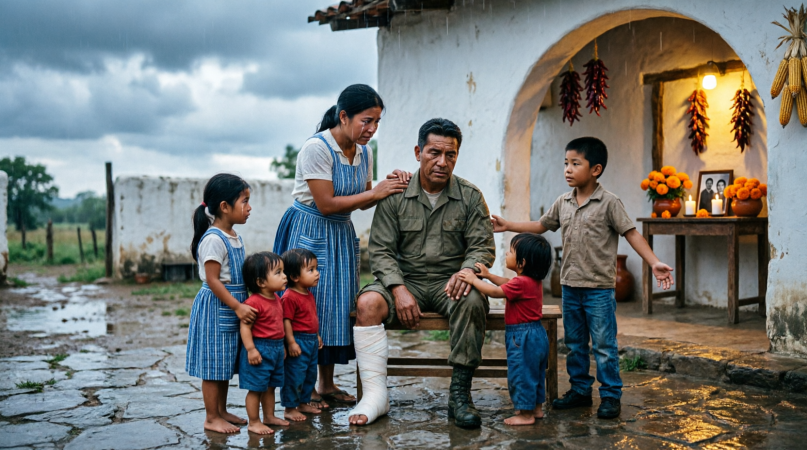
Gabriel crossed the doorway and, as he did, looked around the house as though he had stepped into another world. The walls had been whitewashed. The pots hung clean. On the table were tortillas wrapped in cloth, freshly cooked beans, fresh cheese, and a clay jug of piloncillo atole with cinnamon that Clara had made.
In one corner stood the altar.
It wasn’t large, but it was cared for.
There was a photograph of Gabriel’s first wife, a glass of water, a candle, dried marigolds we had kept since November, and a small piece of bread that Lupita insisted on placing there every week “in case her mama got hungry in heaven.”
Gabriel saw the photograph and broke apart.
He didn’t cry beautifully.
He cried the way men cry when they have no pride left to defend.
He fell to his knees before the altar and covered his face with both hands.
The children stood frozen.
So did I.
For months I had imagined his return. I thought he would come back giving orders, reclaiming his house, his children, his place. I thought I would have to step aside like a borrowed chair pushed against the wall.
But that man didn’t look like the owner of anything.
He looked like a castaway.
Lupita let go of my skirt and walked toward him.
“Are you my daddy?”
Gabriel lifted his face.
That question pierced straight through his soul.
“Yes, Lupita.”
She looked at him seriously.
“My mama Inés says that when someone comes back from far away, they have to wash their hands before eating.”
The twins let out nervous laughter.
I closed my eyes for a second.
Mama Inés.
Gabriel looked at me.
Not with anger.
With something harder to bear: gratitude.
“Then I’ll wash my hands,” he said.
That night he ate in silence.
He didn’t sit at the head of the table. He chose a stool beside the door, as though he didn’t want to take a place he was no longer sure he deserved. He drank the broth slowly. Between spoonfuls, he watched the children.
Clara served tortillas.
Tomás refilled the water jug without being asked.
Mateo passed him the salt.
The twins argued over a piece of cornbread.
Lupita fell asleep with her head in my lap.
Gabriel noticed everything.
Every gesture.
Every habit.
Every sign that the house already had a heart beating without him.
When the children went to bed, I stepped outside to wring out a rag beneath the awning. The rain had softened, but the air still smelled of wet earth, chicken coop, and dead firewood. In the distance, from the center of town, fireworks echoed. It was the novena of San Jacinto, and despite the rain, people still gathered beneath tarps with rosaries, hot cinnamon drinks, and banda music.
Gabriel appeared behind me.
“I don’t know how to thank you.”
“Don’t.”
“Inés…”
“I didn’t do it for you.”
The words came out hard.
He accepted them.
“I know.”
I wiped my hands on my apron.
“Your children had fevers. Hunger. Nightmares. Tomás fought half the town because they called them orphans. Clara stopped playing to carry babies. Lupita asked every week if you still knew the way home.”
Gabriel clenched his jaw.
“They declared me dead twice.”
“So did we here.”
He pulled a leather-wrapped bundle from inside his shirt. It was damp, stained with old blood. He placed it on the patio table.
“I wrote letters.”
I didn’t want to touch it.
“We didn’t receive any after January.”
“I know that now.”
I looked at him.
“What do you mean?”
“At the station, a sergeant handed me returned mail. Letters I sent. Letters from you. Letters from Tomás.”
A chill went through me.
“I never received anything from you after January.”
“And I stopped receiving yours too.”
We understood at the same moment.
Doña Eulalia.
Gabriel’s mother hadn’t only brought mourning dresses too early. She had buried us alive in silence.
At dawn, she arrived.
She wore black, a rosary hanging from her wrist, and two men followed behind her. One was Don Anselmo, the town lender, owner of half the street, the largest store, and a belly that seemed to grow on other people’s desperation. The other was the assistant judge, a dried-up little man who always smelled of ink and mezcal.
Doña Eulalia stopped at the entrance when she saw Gabriel.
She didn’t scream.
She didn’t run to embrace him.
She turned pale, like someone watching a business deal collapse.
“My son,” she finally said.
Gabriel sat in the courtyard, his leg bandaged, Lupita asleep against his shoulder. He didn’t stand.
“Mother.”
She looked at the children.
Then at me.
“What a miracle,” she said, though her voice held no joy.
Don Anselmo removed his hat.
“Captain Altamirano. We believed you dead.”
“Many people preferred it that way.”
Doña Eulalia pretended not to hear him.
“I came to fix the mess this woman created.”
Tomás stepped out of the room.
“No one here made a mess.”
“You be quiet, boy.”
Gabriel raised a hand.
“My son speaks in his own house.”
The old woman stiffened.
“Your house is in debt, Gabriel. While you were off playing hero, the debts kept growing. This girl bought corn, medicine, fabric on credit. Don Anselmo was generous.”
Heat rushed into my face.
“I paid every week with laundry, sewing, and eggs.”
Don Anselmo smiled.
“Interest, girl. Paying is one thing. Settling a debt is another.”
He pulled out papers.
“The property can cover it. Or we can make another arrangement. The older boys can work my fields. Clara would serve nicely in my sister’s house. The little one…”
“Don’t finish that sentence,” Gabriel said.
His voice was low, but everyone fell silent.
Don Anselmo raised an eyebrow.
“You’re not in a position to threaten anyone.”
“I’m not threatening you. I’m warning you that you will not touch my children.”
Doña Eulalia struck the ground with her cane.
“Your children were dying with her!”
Tomás let out a bitter laugh.
“We were dying before her.”
Clara stepped out with the twins behind her.
“Inés taught us how to nixtamalize corn so it would last longer. She took us to the mill when nobody wanted to lend us anything. She treated us with herbal tea when there was no doctor. She made shoes from old leather.”
Mateo raised a hand.
“And she killed a snake in the chicken coop.”
Lupita woke up.
“And she knows how to make cornbread.”
Doña Eulalia looked at them as though betrayal itself had entered their blood.
“She filled your heads with nonsense.”
Gabriel carefully set Lupita down and stood up.
It cost him.
I saw pain bite into his leg, but he asked for no help.
“Mother, where are my letters?”
She blinked.
“What letters?”
Gabriel held up the leather bundle.
“The ones I sent. The ones Inés never received. The ones my children never received.”
The assistant judge lowered his eyes.
Don Anselmo quietly gathered his papers.
Guilt has a smell, and that morning it filled the courtyard.
“I was only protecting your house,” Doña Eulalia said.
“No. You wanted it empty.”
The old woman trembled.
“That woman is nobody.”
Gabriel turned toward me.
For the first time since I had known him, I saw the captain beneath the broken man.
“She is my wife.”
My chest hurt.
“By arrangement,” I said.
“By law,” he answered. “And by life, if she wants.”
I didn’t know what to say.
Because for a year I had repeated to myself that I expected nothing.
But the heart never asks permission when it learns to wait.