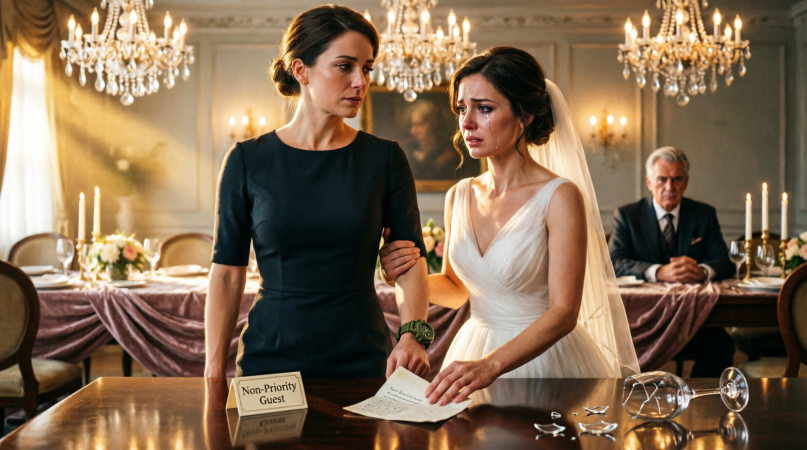
The place card had my name spelled correctly, which somehow made the insult worse. Evelyn Ulette. Under it, in smaller gray lettering, someone had printed two words that did not belong on any wedding seating card.Non-priority guest. For a moment, I only stared. The card was thick ivory stock, edged in gold, the kind of paper people use when they want money to look like taste. Around me, the lobby of Greenfield Country Club hummed with expensive joy. Champagne glasses chimed. Women in silk dresses kissed cheeks without smudging lipstick. Men in dark suits laughed too loudly beneath crystal chandeliers. Somewhere beyond the ballroom doors, a string quartet played something soft and European. I stood beside the seating table with my overnight bag still in my hand, looking at that phrase.
Non-priority guest. After fifteen years away from my family, I had expected coldness. I had expected stares, whispers, maybe my father pretending not to see me. I had not expected the insult to be laminated into the wedding plan. Margaret appeared at my shoulder before I could move. My father’s wife. My stepmother, though she had always preferred “Gerald’s wife” when speaking to people who mattered and “the woman who raised Clare properly” when speaking to me. She wore red silk, pearls, and the mild smile of someone who had planned this part carefully. “Oh, Evelyn,” she said. “You found your card. “I did.” She leaned in, perfume sharp and powdery. “That just means you’re not seated at the family table. Nothing personal.” Nothing personal.
The phrase people use when they want cruelty to seem administrative. My hand closed around the card. At the gift table, beneath a spray of white orchids, sat the envelope I had placed there ten minutes earlier. Inside was a cashier’s check for ten thousand dollars, made out to my sister Clare and her new husband David. It was not a performance. It was not guilt money. It was a gift from one sister to another, from the woman I had become to the girl I had left crying in a second-story window fifteen years ago. Margaret followed my gaze. Her smile thinned. “Of course,” she said, “gifts are appreciated from all guests, priority or not.” I looked at her. She had not aged as much as I wanted her to. That annoyed me irrationally. Her blond hair was still smooth, her posture perfect, her eyes bright with the satisfaction of a woman who knew how to wound without raising her voice.
My father had married her two years after my mother died. My real mother, Helen Ulette, had been gone since I was sixteen. Cancer took her slowly and with an elegance nobody deserved to witness. On her last clear afternoon, she held my hand and told me, “Promise me you won’t live small, Evelyn.” I promised. Six years later, when I was accepted into Air Force Officer Training School, my father called that promise a betrayal.
Gerald Ulette had built Ulette Insurance Group from a one-desk office in Bridgeport into a regional power. He believed in legacy, discipline, family image, and money as both reward and leash. He had expected me to join the company after college. I had expected him to understand that saving lives meant more to me than selling policies to rich people afraid of hail damage.
Neither of us got what we expected.
I was twenty-two when he put my suitcase on the porch.
Not threw it. Not in rage.
Placed it.
That was worse.
“You made your choice,” he said.
Behind him, Margaret stood in the doorway with her arms folded. My little sister Clare, fifteen and still in braces, watched from my old bedroom window, crying so hard her face pressed white against the glass.
The locks changed by the next morning. My health insurance vanished by Friday. My photos disappeared from the walls within a month.
Fifteen years later, I stood in that country club lobby with a card calling me non-priority.
A younger version of me would have folded. She would have swallowed it, smiled, found the farthest table, and spent the night pretending that being included badly was better than being excluded honestly.
But I was not twenty-two anymore.
I was thirty-seven years old, a major general in the United States Air Force, commander of a rescue wing, and the woman who had learned how to land helicopters in weather that made prayer sound practical.
Margaret did not know that.
Almost nobody in the room did.
My father had spent fifteen years telling people I had run away to play soldier. That I was unstable. Ungrateful. Too proud to admit I had failed. My absence had become a family myth, polished and repeated until people mistook it for truth.
Clare knew more.
Maybe not everything, but enough.
Her invitation had arrived three weeks earlier, handwritten on cream paper and tucked into an envelope with no return address.
Please come. I need you there.
That was it.
No explanation. No apology. No warning.
Just Clare’s small, careful handwriting, slanting left the way it always had.
I almost did not come.
I had flown combat rescue missions in Afghanistan, landed in dust storms, pulled men from wreckage, felt rotor wash slam heat and sand into my face while gunfire stitched the horizon. None of that had made me as uneasy as driving three hours through Connecticut autumn toward my sister’s wedding.
Outside, October smelled like wet leaves and wood smoke. I parked in the overflow lot, not the valet circle, because I did not come to perform success. My Ford was twelve years old and reliable. That was enough.
Now, inside, Margaret waited for me to react.
I smiled.
Not warmly.
Precisely.
“Thank you for explaining,” I said.
Then I walked to the gift table.
Her hand darted out. “Evelyn.”
I picked up my envelope.
Guests nearby turned. A woman in emerald satin paused with a champagne flute halfway to her mouth.
Margaret’s smile cracked. “What are you doing?”
I slid the envelope into my clutch.
“If I’m just a courtesy,” I said, “so is this.”
The woman in emerald inhaled sharply.
Margaret’s eyes went cold.
Before she could answer, I heard the rustle of tulle and the quick click of heels moving too fast for any bride in a cathedral train.
“You came.”
Clare hit me like a wave.
Arms around my neck. Jasmine perfume. Hairspray. Trembling. My little sister, grown and glittering in white, holding me like she was afraid I might disappear before the room could see us.
“Oh God,” she whispered against my shoulder. “You actually came.”
I held her carefully, because wedding dresses are engineered like aircraft and cost more than some motorcycles.
“I came because you asked.”
She pulled back. Her green eyes, our mother’s eyes, were wet and fierce.
“Dad doesn’t know I sent the invitation.”
“I figured.”
“Margaret tried to stop it.”
“I also figured.”
Clare gripped my hands.
“Listen to me. No matter what happens tonight, stay.”
My stomach tightened.
“Clare, what did you do?”
She looked over her shoulder toward the ballroom doors, then back at me.
“Something I should have done years ago.”
Before I could press her, the maid of honor appeared, breathless, calling for photos. Clare squeezed my hands once more.
“You’re the reason I’m standing here today,” she whispered. “Tonight everyone finds out.”
Then she was gone in a sweep of silk and light.
I stood there with my place card in one hand and ten thousand dollars in the other, watching my sister disappear into the crowd.
And for the first time all day, I realized this wedding was not only a reunion.
It was an ambush.
I just did not know who Clare had set the trap for.
Part 2
The ballroom looked like a place designed to make ordinary people feel temporary.
White roses spilled from silver vases. Candles floated in glass bowls. Crystal stemware caught the chandelier light and fractured it into small, expensive stars. The head table stretched along the far wall beneath an arch of orchids, where my father stood laughing with men in suits cut close enough to qualify as architecture.
I found my assigned table near the kitchen doors.
Table 22.
The last one.
The centerpiece was silk flowers, and not even convincing ones.
A waiter pushed through the swinging kitchen door behind me, carrying plates that smelled of butter, salmon, and rosemary. Warm air hit my back every time the door opened. At table one, white roses. At table 22, plastic petals and the steady thump of catering staff trying not to be seen.
I almost laughed.
Subtlety had never been Margaret’s strongest quality.
My place card sat beside a half-filled water glass. Beneath my name, the non-priority guest label had been repeated in tiny type on the seating chart by the entrance. A private insult with public paperwork. Efficient.
A bartender, barely old enough to rent a car, leaned over as he passed.
“Whoever put you here doesn’t know what they’re missing,” he murmured.
That did make me laugh once.
“Careful,” I said. “Kindness can get you demoted in this room.”
He grinned and moved on.
I had just taken my seat when my father found me.
Gerald Ulette had aged into the exact man he had always been practicing to become. Silver hair swept back. Brioni suit. Shoulders squared. A glass of dark red Bordeaux in one hand. He did not walk across rooms so much as occupy them in advance.
No hello.
No “it has been a long time.”
No father seeing a daughter after fifteen years.
His eyes dropped to my table number, then to my dress, then to my face.
“I didn’t realize Clare’s guest list included charity cases.”
The words were quiet, but the tables nearby heard them. That was the point.
I set my napkin across my lap.
“Hello, Dad.”
His jaw twitched at the word.
“You have nerve showing up here.”
“I was invited.”
“By a sentimental bride who doesn’t understand consequences.”
“She is thirty.”
“She is funded by me.”
There it was.
He had not changed. Money still came before love in every sentence. It was his favorite subject, his strongest weapon, his substitute for tenderness.
He leaned closer, lowering his voice just enough to make the intimacy uglier.
“If you embarrass this family tonight, Clare will regret it.”
I looked toward the head table. Clare stood beside David, smiling for a photograph, but her eyes kept searching the room.
“I’m here for her,” I said. “Not for you.”
He smiled then, but there was no pleasure in it.
“You always did think showing up late counted as loyalty.”
Margaret appeared at his elbow as if summoned by cruelty.
“Oh, Evelyn,” she said brightly. “There you are. Gerald was worried you might make a scene.”
“That makes one of us.”
Her eyes hardened. Her smile did not.
She turned to the guests seated near me. “Everyone, this is Gerald’s older daughter. She left the family years ago to do something with planes.”
“The Air Force,” I said.
“Right. Structure is good for some people.”
A woman at the table looked down at her salad. A man with a country club pin examined his fork like it had become fascinating.
Margaret continued. “No husband? No children? Still just you and the uniform?”
“Still just me and the uniform.”
I let her have the line because I had learned long ago that not every shot deserves return fire.
In the military, hostile territory is simpler. At least there, people admit they want you gone.
My father’s eyes moved to my wrist.
My watch was a Marathon GSAR, olive drab, scratched at the edge. Four hundred dollars, water-resistant, built to function in places no diamond watch would survive. Around the room, men wore Patek Philippe, Rolex, Audemars Piguet. Watches that measured status more than time.
“Still wearing field gear to formal events?” Gerald asked.
“It tells time.”
“So does a phone.”
“Not underwater.”
That landed somewhere I did not expect.
Across the table, Richard Hale’s wife—Patricia, I later learned—looked up sharply. Her gaze held on the watch, then my face. Something flickered there. Recognition? Curiosity? I filed it away.
Gerald caught my arm in the hallway before dinner was called.
Not hard enough to leave a mark. Just firm enough to remind me that in his mind, I was still twenty-two and standing on his porch.
The corridor was empty except for oil paintings, brass sconces, and carpet thick enough to swallow footsteps. A perfect place for ugly words dressed in quiet voices.
“Let me be clear,” he said. “You stay in your corner. You smile when spoken to. You do not approach Clare unless she approaches you.”
I looked at his hand on my arm.
He released me.
“Clare has a trust,” he continued. “An apartment. A car. This wedding. All of it runs through me. You want to test how far sentiment gets her?”
The old fear moved in me.
Not for myself.
For Clare.
That was his talent. He knew exactly which hostage to show you.
“You still think money is the same as family,” I said.
“You would know the difference if you had either.”
I stepped back.
Then he crossed the line I should have expected but still was not ready for.
“Your mother would be ashamed of what you became.”
The hallway went silent.
Not literally. The music still floated from the ballroom. Someone laughed behind a closed door. Silverware clinked faintly. But inside me, everything stopped.
My mother had spent her last clear afternoon telling me not to live small.
My father had taken that memory and sharpened it into a knife.
I breathed in for four seconds.
Held.
Out for four.
Combat breathing works in cockpits, in triage tents, in briefing rooms where the news is bad and everyone is looking at you to become the floor.
“You do not get to use Mom’s name to hurt me,” I said. “Not anymore.”
I turned and walked away.
His voice followed me.
“You were always the weak one, Evelyn. That’s why you ran.”
Dinner began at seven.
Guests found their seats beneath chandelier light. The band played something soft. Waiters moved between tables with practiced invisibility. My father stood at table one and tapped his glass with a fork.
The room fell silent.
He smiled out at 250 people.
“Clare has always been my pride,” he began.
His voice filled the ballroom, warm and polished.
“She understood that family means loyalty. She understood that when you’re given everything, you don’t throw it away to chase some fantasy.”
A few heads turned toward table 22.
Some looked away quickly.
Others did not bother hiding.
I held my wine glass steady.
“I raised my daughters to know their worth,” Gerald said. “And Clare always knew hers.”
There it was.
The toast that was also a funeral.
He had just buried me again in front of 250 guests and called it love for my sister.
Across the room, Clare’s hand tightened around David’s. Her knuckles went white. She caught my eyes and gave one tiny nod.
Wait.
That was what it said.
I did not know what she had planned.
But my father had just delivered his closing argument.
And from the look in Clare’s eyes, the defense was about to begin.
Part 3
Dinner tasted like nothing.
I know the salmon was good because the woman beside me said so three times, perhaps to fill the silence my father had dropped over table 22. The plate smelled of lemon, butter, and dill. The asparagus was arranged in a little green fence. The wine was expensive enough that several guests kept mentioning the vineyard as if they had personally watered the grapes.
I cut, lifted, chewed, swallowed.
Nothing.
Across the ballroom, my father glowed under admiration. Men leaned toward him. Women smiled sympathetically. Margaret rested one hand lightly on his shoulder, queen beside the king, both of them pleased with the order of the room.
Then she came for another pass.
She brought Richard Hale with her.
I had seen him during cocktail hour: thick neck, Tom Ford suit, Rolex Day-Date flashing beneath his cuff. He was my father’s business partner and Margaret’s older brother, which meant he had two reasons to believe I was beneath him.
“Richard,” Margaret said, “this is Evelyn. Gerald’s daughter who chose the military over the family business.”
Richard looked at me the way men like him look at service workers, weather delays, and minor lawsuits.
“Military, huh?” He lifted his scotch. “Good for you. Someone has to do it.”
I smiled politely.
He leaned back. “I just prefer people who build something instead of following orders.”
The other guests at the table discovered urgent interest in their food.
Margaret laughed softly.
“What do they pay you?” Richard asked. “Eighty? Ninety a year? I spend that on my boat.”
“The work is rewarding.”
“Rewarding.” Margaret repeated it like a word in a language she did not respect. “How noble.”
Richard nodded at my watch. “Practical little thing.”
“It survives water.”
“So does my boat.”
Margaret laughed again.
I took a sip of wine.
Some men mistake silence for defeat because they have never seen it used as restraint.
My father arrived as if on cue. The three of them formed a little tribunal around my chair: Gerald at my left, Margaret behind me, Richard across the table. They smelled of bourbon, perfume, and confidence.
“Richard,” my father said, “Evelyn here thinks flying helicopters is a career.”
“At least she’s not asking for money,” Richard said.
They laughed.
Not because it was funny. Because cruelty enjoys witnesses.
My father pulled out the chair beside me and sat. His cologne was heavy, expensive, suffocating.
“You see this room?” he asked quietly, though not quietly enough. “Every person here knows you abandoned your family. Showing up tonight doesn’t change that.”
I set my fork down.
“You’ve had fifteen years to tell the story your way.”
“And yet here you are,” he said. “Still looking for something you’ll never get.”
“What’s that?”
“My approval.”
The table went still.
He was not entirely wrong. That was the worst part. Somewhere inside me, a twenty-two-year-old woman still stood on his porch with one suitcase, waiting for her father to say he was proud. Waiting for him to choose her. Waiting for him to turn around before the lock clicked.
She had been waiting fifteen years.
She would have to keep waiting.
I gave him nothing.
No tears. No argument. No trembling voice.
Only silence.
Silence unsettled him more than anger ever could.
He stood, pushing the chair back just hard enough for it to scrape the floor. Conversations at nearby tables faltered.
“If it wasn’t for pity,” he said, louder now, “no one would have invited you.”
The bread basket stopped moving.
A waiter froze three steps from the kitchen door.
Margaret’s hand touched Gerald’s arm, but not to stop him. To make the performance look regrettable.
Richard looked into his scotch.
I picked up my wine glass, took a sip, and smiled.
Fifteen years earlier, those words would have broken me. I would have run to the bathroom, then the parking lot, then the highway, crying so hard I could not see.
But I had flown through dust storms with alarms screaming in my headset. I had made decisions with people bleeding behind me and mountains hidden in brown air. I had learned that panic is information, not command.
“Funny thing about pity,” I said softly. “The people who give it usually need it most.”
My father stared.
For the first time that evening, he had no immediate response.
That was when I stood.
Not fast. Not dramatically. I placed my napkin beside the plate and walked toward the ladies’ room because my hands were shaking and I would not let him watch.
The bathroom at Greenfield Country Club was nicer than several apartments I had lived in during my twenties. Marble counters. Brass fixtures. Tiny rolled hand towels. A basket of French skincare products arranged like museum pieces.
I locked myself in, leaned against the door, and looked at my reflection.
My eyes were red, but dry.
I hated that he could still do that. Hated that one sentence from him could reach past stars on my shoulders, past medals, past missions, past all the names of people alive because I had not flinched.
I looked down at my hands.
A scar crossed the knuckles of my right hand, pale against the skin. Afghanistan. Six years earlier. Pulling a crew chief from a torn fuselage while hydraulic metal sliced through my glove. I had not noticed I was bleeding until a medic said, “Ma’am, that’s your blood too.”
These hands had pulled people out of fire, water, twisted metal, and war.
Tonight they shook because my father had called me unwanted over salmon.
My phone buzzed.
Colonel Diane Webb.
My old commanding officer. Mentor. The woman who taught me to fly rescue missions through the Hindu Kush and later told a promotion board, “Ulette is the person you want when everyone else starts praying.”
Her text read:
Heard you’re at the wedding. Remember who you are, General. We’re proud of you.
I read it twice.
Then a third time.
Remember who you are.
I turned on the faucet, ran cold water over my wrists, and breathed.
Four in.
Hold.
Four out.
When I opened the bathroom door, music drifted down the hallway. Laughter. Silverware. The smooth machinery of celebration pretending nothing had happened.
I walked back into the ballroom.
My father noticed immediately. A small twitch at the corner of his mouth told me what he thought.
She went to cry.
Let him think it.
I sat at table 22, smoothed my napkin across my lap, and took a bite of salmon.
It was actually good.
At the next table, an older man with white hair and a trimmed mustache watched me. He sat upright, shoulders squared, the way military men sit even after retirement. His eyes moved to my watch, then my posture, then back to my face.
He leaned toward the woman beside him and said low enough that only nearby tables heard, “Dorothy, that’s officer bearing. Not junior either.”
I pretended not to hear.
A few minutes later, he approached.
“Thomas Brennan,” he said, extending a hand. “Retired colonel, Air Mobility Command. Twenty-eight years.”
“Evelyn Ulette.”
He looked at my watch. “Marathon GSAR. Rescue wing?”
I felt something loosen in my chest.
“Yes, sir.”
He smiled faintly. “A colonel who recognizes rescue gear has been called worse than sir.”
He did not ask my rank. That would have been rude. But halfway through our short conversation, his tone changed. He stopped speaking to me as a curious guest and began speaking to me as someone he suspected outranked him.
When he stood, he shook my hand again.
“I don’t know your rank, and you don’t have to tell me,” he said quietly. “But whoever seated you at table 22 made a serious miscalculation, ma’am.”
Ma’am.
From a retired colonel, it carried weight.
He returned to his table.
Across the ballroom, Clare rose from the head table.
The band lowered.
David touched her back once, steadying her.
She picked up the microphone, looked directly at me, and in that instant I understood the evening was about to break open.
Part 4
Clare’s hand trembled around the microphone.
Most people would not have noticed. Brides tremble. Weddings are emotional. Speeches are difficult under chandeliers while 250 people wait to laugh or cry on cue.
But I saw it.
I had watched hands tremble before combat flights, before casualty notifications, before medics cut into uniforms slick with blood. Clare was not nervous.
She was afraid.
And she was going to speak anyway.
“Before we cut the cake,” she said, “I need to do something I should have done years ago.”
At table one, my father leaned back slightly, satisfied. He assumed tribute was coming. Margaret smiled with the serene glow of a woman expecting public gratitude.
Clare looked across the ballroom until she found me.
“Most brides thank their parents,” she said. “And I will talk about family tonight. But not in the way some people expect.”
A murmur passed softly through the room.
Gerald’s smile held, but his eyes sharpened.
Clare took a breath.
“Seven years ago, I almost died.”
The room changed.
You could feel it. Laughter near the bar died. Forks paused. A waiter carrying coffee stopped beside a column.
“I drove off Millstone Bridge during a rainstorm,” Clare said. “My car went through the guardrail and into the Connecticut River.”
The air left my lungs.
Rain.
Black water.
A radio call at 2300 hours.
I had not let myself think about that night for years unless required by official inquiry or awards language someone else wrote in sterile terms. Civilian vehicle submerged. One survivor trapped. Extreme conditions.
“I was underwater for eleven minutes,” Clare continued. “My lungs filled. I stopped breathing.”
Margaret’s hand rose to her throat.
My father looked down at his plate.
He knew about the accident. Of course he did. But it had happened after he cut me out. In his version of the family, I no longer existed. The rescue had been a tragedy narrowly avoided, not a thread leading back to the daughter he erased.
“A military rescue helicopter came,” Clare said. “The pilot did not wait for the dive team.”
The old cold returned so vividly I felt it on my skin.
The Connecticut River had been black that night, swollen with rain and runoff, water at forty-one degrees, current pushing debris against the car. The dive team was twenty minutes out. Twenty minutes was death. My co-pilot, Lieutenant Graham, had looked at me when I unclipped.
“Ma’am?”
“Hold position.”
I jumped.
Training makes some decisions before fear can vote.
I hit the water hard. It knocked breath from my chest. Diesel coated my tongue. Visibility was zero. I found the car by feel, metal slick under my gloves, passenger window shattered, seat belt jammed across a trapped body.
I cut the strap.
Dragged the survivor out.
Kicked toward shore.
Laid her on mud beneath rotor wash and rain.
No pulse.
No breath.
Thirty compressions. Two breaths.
Thirty compressions. Two breaths.
My hands knew what to do.
Then the helicopter floodlight swept across her face.
Clare.
My sister.
The world cracked but did not stop.
Training would not let it.
I kept counting.
“She pulled me out herself,” Clare told the room. “She performed CPR on the riverbank in the rain until my heart started again.”
A woman near table eight began crying.
“For five years,” Clare said, “I did not know who that pilot was. The Air Force would not release the name. Operational security. Privacy. Redactions. But I needed to know. So I filed a Freedom of Information Act request.”
David stood from the head table and handed her a craft paper envelope.
The Department of the Air Force seal was visible even from table 22.
My father’s face went very still.
Clare opened the envelope with hands that shook harder now.
“When the response came, most of the report was blacked out. But one name was cleared.”
She looked directly at me.
“The pilot was Captain Evelyn Ulette.”
Silence.
Not the polite quiet of a speech.
A stunned, physical silence.
Then the gasp moved through the ballroom like wind through dry leaves.
“My sister,” Clare said.
The words landed everywhere at once.
I sat frozen, one hand around the stem of my wine glass, the other flat on the table. The kitchen door swung open behind me, then stopped. Even the catering staff had gone still.
Clare’s voice broke.
“My father kicked out the woman who saved my life. She knew it was me that night. She never told anyone. She never used it. She never asked for thanks. She just kept serving.”
She unfolded another page.
This one I recognized from across the room by its format.
Official biography.
Department letterhead.
No.
Clare, no.
But she continued.
“Major General Evelyn Ulette,” she read, each word clear. “Commander, 920th Rescue Wing, Patrick Space Force Base, Florida. Recipient of the Distinguished Flying Cross, the Air Medal with three Oak Leaf Clusters, and the Humanitarian Service Medal.”
Someone whispered, “Major general?”
Clare lowered the page.
“Two hundred thirty-seven confirmed rescues.”
The number spread through the room. I heard it repeated softly, table by table.
Two hundred thirty-seven.
Margaret’s mouth opened.
Richard Hale stared at me like he was seeing a person replace an object.
My father stood perfectly motionless.
Clare lifted her right hand to her forehead.
Her salute was terrible. Fingers too loose, angle too steep, elbow awkward.
It was the most beautiful salute I had ever received.
“To Major General Evelyn Ulette,” she said, voice shaking. “The bravest person I know. And the best sister I could ever have.”
I stood slowly.
The chair scraped the floor.
Every head turned toward table 22.
Then Thomas Brennan rose.
His salute was textbook. Crisp. Exact. Twenty-eight years of muscle memory in one motion.
Dorothy stood beside him.
Another man rose at table twelve. Then another. Veterans, retirees, people who recognized service even when it arrived in a navy dress from the clearance rack.
The applause began with one pair of hands.
Then another.
Then the entire ballroom stood.
Two hundred fifty people on their feet.
Not for Gerald.
Not for his money.
Not for his carefully managed story.
For me.
I had received medals from generals. I had been saluted on flight lines, in hangars, in heat, in rain, in places where people bled into dust.
Nothing had ever felt like my little sister saluting me in her wedding dress.
Gerald tried to speak.
“Clare, this is hardly—”
The applause swallowed him whole.
Margaret leaned toward a woman nearby and said shakily, “Gerald always supported Evelyn in his own way.”
Nobody even turned toward her.
Fiction does not survive long once proof enters the room.
My father found that out when David connected his laptop to the projector.
The screen behind the cake table lit up.
US Air Force Official Biography.
My photograph appeared twenty feet tall, full dress uniform, two stars on each shoulder, standing before an HH-60 Pave Hawk.
Gerald stared at my face on the screen, and for the first time in my life, I saw him look small.
Then Richard Hale dropped his scotch glass.
It shattered on the marble floor.
His hand went to his chest.
And before anyone screamed, I was already moving.
Part 5
Richard hit the floor hard.
The tablecloth came down with him, dragging white roses, silverware, and a half-full wine glass into the crash. Patricia screamed first. Margaret followed. The sound cut through the applause and turned celebration into chaos in a single breath.
I crossed the ballroom before thought caught up.
Male, sixties.
Sudden collapse.
Chest clutch.
Color draining from face.
Probable cardiac arrest.
Training saw it all faster than emotion could.
I dropped to my knees beside him, ignoring the wine soaking through my dress.
“Call 911,” I ordered. “Now.”
My voice was not loud. It did not need to be. It was command voice, the one that carries through rotor noise and fear.
Someone shouted for the manager.
Patricia crouched near me, sobbing. “Richard? Richard!”
“Ma’am, move back.”
She froze.
“Now.”
Dorothy Brennan put both hands on Patricia’s shoulders and pulled her gently away.
I tilted Richard’s head, checked his airway, put two fingers to his carotid.
No pulse.
No breath.
I interlaced my hands over his sternum and started compressions.
One, two, three, four.
The ballroom became a tunnel.
Not guests.
Not chandeliers.
Not my father standing motionless twenty feet away.
Only the body under my hands and the count in my mouth.
Twenty-eight, twenty-nine, thirty.
Two breaths.
Again.
“Where is the AED?” I called.
A staff member ran toward the lobby.
Richard’s ribs gave under my palms the way ribs sometimes do. Patricia made a broken sound. I kept going.
The man had called me a uniformed follower an hour earlier. He had laughed while Margaret reduced my life to a joke. None of that mattered now. People imagine moral clarity comes before rescue. It does not. Rescue comes first. Moral clarity can wait in the hallway.
The AED arrived in a red case.
Thomas Brennan was beside me instantly, opening it, hands steady.
“Need assistance, General?”
“Pads.”
“Yes, ma’am.”
We moved like we had trained together. He tore open the package. I cut Richard’s shirt with a steak knife someone handed me from a table. Patricia gasped when the blade flashed.
“Clear,” I said.
Everyone pulled back.
Shock.
Richard’s body jerked.
The AED analyzed again.
No pulse.
I resumed compressions.
My shoulders burned. My dress clung wet at the knees. The room stayed silent except for my counting, the AED’s mechanical instructions, and Patricia whispering prayers that kept breaking apart.
Again.
Clear.
Shock.
This time, Richard coughed.
Wet. Ragged. Beautiful.
A pulse fluttered under my fingers.
Weak, but there.
I rolled him into recovery position and kept one hand on his shoulder.
“Stay still, Richard. Paramedics are coming.”
His eyelids trembled open. He looked confused, gray, terrified.
“You arrested,” I said. “Don’t try to talk.”
He tried anyway.
“Boat,” he rasped.
I almost laughed from adrenaline.
“Your boat is not the priority.”
The paramedics arrived six minutes later. They took over with clean efficiency: oxygen, leads, stretcher, vitals, questions. I gave them the timeline and shocks administered. The medic looked at me halfway through and said, “You medical?”
“Combat rescue.”
“That’ll do.”
As they wheeled Richard out, Patricia broke from Dorothy and came to me.
Her makeup had run. Her earrings shook. She took my hands, the ones that had just compressed her husband’s chest, and held them like relics.
“Thank you,” she said. “I heard what he said earlier. I’m sorry. I should have said something.”
I looked at her.
She was crying for Richard, yes. But there was shame there too.
“Take care of him,” I said.
She nodded and followed the stretcher.
The ballroom remained frozen.
Then people began to breathe again.
Someone picked up a chair. A waiter righted a vase. The band members stood awkwardly near their instruments, not sure whether weddings resumed after death briefly entered the room and was escorted out.
My father stood near table one, face pale, glass still in hand.
He had watched me save his business partner’s life.
After watching Clare reveal I had once saved hers.
Two lives tied to his table.
Both rescued by the daughter he had spent fifteen years calling a disgrace.
I walked to the gift table.
Not fast. Not angry in the messy sense. Calm. Exact.
The envelope with my ten-thousand-dollar check was in my clutch, because I had already taken it back. But there was another card there now, one Margaret must have had placed after I retrieved mine.
Evelyn Ulette — courtesy guest.
Inside was a printed thank-you note template, unsigned.
No.
I picked it up and walked to table one.
Margaret saw it first. “Evelyn—”
I held up the card.
“Courtesy guest,” I said.
My father’s eyes narrowed. “Not now.”
“Yes,” I said. “Now.”
Clare was still on the stage, white dress pooling around her feet, tears shining on her face. David stood beside her, one arm around her waist. The guests watched with the exhausted attention of people who knew the night had become history.
I took the cashier’s check from my clutch and held it where my father and Margaret could see it.
“This was for Clare,” I said. “But I put it on your gift table because I thought this was a family event.”
Gerald said nothing.
“Since I’m just a courtesy,” I continued, “this will not go through your hands.”
Margaret’s face flushed. “That is completely unnecessary.”
“No. What was unnecessary was labeling a human being non-priority at her sister’s wedding.”
Clare descended from the stage then, gathering her dress in one hand.
“Ev.”
I turned toward her.
Her eyes went to the check.
“It’s still yours,” I said quietly. “But not like this. Not through them. Not under a roof where money is used as a collar.”
She pressed one hand to her mouth.
My father found his voice.
“You think you can walk in here and humiliate me?”
“No,” I said. “You did that by telling the truth about yourself loudly enough for everyone to hear.”
A few people turned away, pretending not to listen while listening with every cell in their bodies.
Gerald stepped closer.
“You owe this family respect.”
I looked at him for a long moment.
Then I laughed once.
Not because it was funny.
Because it was finally absurd.
“I pulled your daughter from a river. I brought your friend back from cardiac arrest. I stood here while you called me pity, charity, weak, and a disgrace.” I folded the check and slid it back into my clutch. “I owe this family nothing.”
Clare reached me then.
“Please don’t leave,” she whispered.
The room blurred at the edges.
I touched her cheek. “Not because of you.”
“Then why?”
I looked at my father, at Margaret, at the place cards, the silk flowers, the wedding board that had erased me from the Ulette family while using my dead mother’s name for decoration.
“Because if I stay one more minute,” I said, “I might start believing I still have to prove I belong.”
Clare began crying.
Behind us, Gerald said, “Evelyn, come back here.”
I walked toward the exit.
For the first time in fifteen years, when my father called after me, I did not turn around.
But Clare ran after me into the night.
And what she handed me in the parking lot changed the shape of everything I thought I knew about our silence.
Part 6
The parking lot smelled like wet leaves, exhaust, and rain waiting to happen.
My Ford sat in the overflow section between a catering van and a landscaper’s truck, exactly where I had left it hours earlier when I still believed the night might only hurt privately. Behind me, Greenfield Country Club glowed through tall windows, all chandelier light and expensive disaster.
“Ev, wait!”
Clare ran across the pavement in her wedding dress, one hand lifting the skirt, the other clutching something white against her chest. David followed several paces behind, carrying her train because apparently he had good instincts.
I stopped beside my car.
“You should go back inside.”
“No.”
“Clare, it’s your wedding.”
“That’s why I get to decide what matters.”
She was breathless when she reached me. Her cheeks were wet. The beading on her dress caught the parking lot light like tiny cold stars.
“I didn’t do all this so you would leave alone again.”
That sentence hit harder than I wanted it to.
“I’m not alone,” I said.
She looked at the empty lot around us.
“You know what I mean.”
David stopped a respectful distance away.
Clare handed me the folded paper.
It was old. Creased at the edges. My name was written across the front in handwriting I recognized so sharply that my throat closed.
Evelyn.
My mother’s handwriting.
I could not move.
“Where did you get this?”
Clare swallowed. “Mom wrote it before she died. Margaret kept it.”
The world narrowed to the paper in my hands.
“She what?”
“I found it two years ago, after the FOIA letter. I was going through old boxes in the attic because I wanted pictures of Mom for the wedding. There was a locked cedar chest. I broke it open with David’s tire iron.”
Despite everything, a laugh almost escaped me.
“In the chest were letters,” Clare continued. “Yours. Mine. Some from Mom. Some you sent after Dad kicked you out.”
I looked up.
“I wrote to you.”
“I know.”
Her face crumpled.
“Margaret took them. Dad let her. I never saw them.”
For years, I had believed Clare stopped reaching out because survival inside that house required loyalty to him. I had understood. It hurt, but I understood. Now the silence widened into something uglier.
Manufactured.
Curated.
Enforced.
Clare wiped her face.
“I tried calling when I turned eighteen. The number didn’t work. I sent messages through an old email address. Nothing. Margaret told me you wanted distance. Dad said you were ashamed of us.”
I closed my eyes.
There are betrayals that confirm what you suspected, and betrayals that make you grieve the years differently.
This was the second kind.
“What’s in the letter?” I asked.
“I didn’t read yours. I read mine. Mom told me to find you if I ever felt alone.”
My hand shook around the paper.
“I was alone,” Clare whispered. “After the accident. I kept dreaming about the river. Dad wanted everything normal. Margaret said trauma made bridesmaids difficult, which didn’t even make sense because I wasn’t engaged yet.”
She laughed through tears.
“Then I found the rescue report. Your name. Your rank. Everything. And I realized you had been there all along in the one way you could.”
I leaned against the car because my knees felt untrustworthy.
“Why tonight?”
Clare looked back at the country club.
“Because Dad was going to use my wedding as his final proof that he won. He controlled the guest list. The tables. The speeches. The money. He wanted everyone to see the perfect daughter and the failed one.”
She turned back to me.
“I wanted them to see the truth.”
“And the place card?”
Her face went hard.
“I didn’t know. David didn’t know. Margaret handled seating after I threatened to cancel if she blocked you. She promised she would include you.”
David approached now, his voice low. “We saw it during cocktail hour, but by then you were already inside. Clare nearly lost her mind.”
“I did lose my mind,” Clare said.
“Elegantly,” he added.
She almost smiled.
I looked down at my mother’s letter.
“Dad used her name tonight,” I said. “Said she’d be ashamed of me.”
Clare’s expression changed.
“She would not.”
“I know.”
“No,” Clare said, fiercer now. “You don’t know enough.”
She reached into the small white clutch hanging from her wrist and pulled out another paper.
A photocopy.
At the top: Last Will and Testament of Helen Ulette.
I felt the blood leave my face.
“What is this?”
“Mom left you money.”
The parking lot seemed to tilt.
“She left both of us money,” Clare said. “Separate education and life-start trusts. Mine was held properly. Yours was never transferred.”
“Dad told me there was nothing.”
“There was.”
David’s jaw tightened. “We found account references in the attic chest. Clare hired an estate attorney three months ago.”
My fingers went cold.
“How much?”
Clare looked like she hated the number before saying it.
“With growth? A little over four hundred thousand.”
For several seconds, all I heard was the distant muffled music from inside the country club.
Four hundred thousand dollars.
Not because I needed it now. I had built my life without it. But at twenty-two, that money would have meant health insurance, rent, tuition, a car that started reliably, food that was not ramen eaten standing over a dorm sink. It would have meant my mother kept her promise even after death, and my father stole that from me too.
“Did he know?”
Clare nodded.
“Margaret too?”
“Yes.”
The anger that moved through me then was not hot. It was clean and cold and nearly silent.
“What are you going to do?” Clare asked.
I opened my car door, placed the papers carefully on the passenger seat, and looked back at the glowing country club.
“I’m going to finish the mission.”
Clare’s eyes widened.
“You’re going back in?”
“Yes.”
David smiled faintly.
“Should I warn anyone?”
“No,” I said. “Let them enjoy the surprise.”
When I walked back into the ballroom, conversations died in waves.
Gerald saw me from table one. His face tightened with annoyance, then uncertainty. Margaret leaned toward him, whispering fast.
I crossed the room holding my mother’s letter and the photocopy of her will.
Clare followed.
So did David.
Behind us, Thomas Brennan stood.
Then Dorothy.
Then half the room seemed to turn in their chairs.
I stopped before my father.
“You used Mom’s name tonight,” I said.
His eyes flicked to the papers.
For the first time, fear showed.
Not much.
Enough.
“So now,” I said, “let’s talk about what you did with her last wishes.”
Margaret whispered, “Gerald.”
The single word carried panic.
And every guest close enough to hear went silent.
Part 7
My father reached for the papers.
I moved them out of his reach.
That small motion changed his face more than any insult could have. Gerald Ulette was used to documents being handed to him. Contracts. Checks. Deeds. Life insurance policies. My mother’s will, apparently.
He was not used to evidence staying in someone else’s hands.
“Evelyn,” he said, voice low, “this is not the time.”
“You said that earlier about Clare saving my life. You were wrong then too.”
Margaret stepped forward. “Whatever Clare told you, she misunderstood. Helen was very ill when—”
“Do not speak for my mother.”
The sentence cut through the air.
Margaret stopped.
The nearest tables had gone still. The band had not resumed. Staff stood along the wall holding trays they had forgotten to deliver. Richard was gone in an ambulance, but his broken glass had left a dark stain near table one, a mark nobody had cleaned yet.
Clare stood beside me in her wedding dress, pale but steady.
David’s hand rested lightly at her back.
My father tried to recover.
“Family matters should remain private.”
I looked around the ballroom.
“You made my humiliation public. You do not get privacy for your crimes.”
A few guests gasped at the word.
Crime.
Lawyers are careful with words. I knew that one had force. I also knew I had not chosen it lightly.
Gerald’s eyes sharpened. “Be very careful.”
“No,” I said. “You be careful.”
Then I turned to the room, because my father had always counted on controlling the audience.
“My mother died when I was sixteen,” I said. “Before she died, she apparently created separate trusts for both her daughters. Clare received hers. I did not.”
Margaret’s face had gone bloodless beneath her makeup.
“My father told me there was nothing. He changed the locks when I was twenty-two, removed me from health insurance, and let me leave with one suitcase. Tonight I learned there was money my mother left specifically for me.”
A murmur moved through the ballroom.
Gerald’s business friends were suddenly very interested. Insurance men understand fiduciary duty. They understand misappropriation. They understand that stories can become subpoenas.
My father said, “You have no idea how complicated estates can be.”
“I have commanded multi-national rescue operations in active combat environments. I can learn probate.”
Thomas Brennan made a sound that might have been a laugh.
Clare lifted the photocopy.
“I found Mom’s will,” she said. “And the account references. I also found Evelyn’s letters. The ones she sent me. The ones Margaret hid.”
Margaret’s head snapped toward her.
“You went through my things?”
Clare laughed once, broken and sharp.
“No, Margaret. I went through my mother’s things.”
That landed too.
My father’s face changed again. Anger returning because fear could not serve him long.
“You ungrateful girls,” he said.
Girls.
Clare was thirty. I was thirty-seven. He still saw daughters as property with better manners.
“You stood in a room paid for by me,” he continued, “and you decided to destroy your family.”
“No,” Clare said. “You destroyed it. We’re just no longer decorating the wreckage.”
I had never been prouder of her.
Then Patricia Hale reentered the ballroom.
Her face was pale, her dress wrinkled, hair partly fallen from its updo. Everyone turned. She had followed the ambulance but must have returned from the lobby before leaving for the hospital.
“Richard is alive,” she said, voice shaking. “They’re taking him in. The medic said CPR saved him.”
A murmur of relief moved through the guests.
Her eyes found me.
“Thank you.”
I nodded once.
Then Patricia looked at Gerald.
Whatever friendship, business loyalty, or social caution had held her silent earlier was gone.
“I heard enough before I left,” she said. “Richard and I invested with Gerald because he told us family was his foundation.”
Gerald stiffened. “Patricia, not now.”
“Yes, now.”
Her voice shook, but she did not stop.
“Richard had concerns about the trust accounts years ago. He mentioned it once after Helen died. You told him everything was clean.”
My father’s mouth hardened.
“Richard was mistaken.”
“Maybe.” Patricia swallowed. “Or maybe he wasn’t. But after tonight, I think our attorney should review every shared account involving Ulette Insurance and the estate.”
The room went silent again.
This silence was different.
Colder.
Business silence.
The kind that costs money.
Margaret grabbed Gerald’s arm. “We’re leaving.”
He did not move. He looked from Patricia to Clare to me, and I saw him doing the math. His daughter, a major general. His younger daughter with documents. His partner’s wife talking about attorneys. Two hundred fifty witnesses. A projector still showing my official biography above the cake table.
His empire had been built on image.
Tonight, image was bleeding out on marble.
He tried one last time.
“Evelyn, let’s discuss this calmly.”
I looked at him.
Fifteen years earlier, I would have followed him into a side room for the chance at a softer voice.
Now I knew better.
“No private rooms,” I said.
His jaw clenched.
“No more edited stories.”
Margaret whispered, “Gerald, please.”
My father turned on her for half a second, and in that look I saw their marriage stripped of wealth and choreography. No partnership. Only complicity under pressure.
Clare stepped closer to me.
“I don’t want his money anymore,” she said, loud enough for the head tables. “The apartment, the car, the account. None of it. If it comes with silence, he can keep it.”
Gerald stared at her.
“Clare.”
She lifted her chin.
“You left my sister outside the family for fifteen years. You used Mom’s money and Mom’s memory. You sat here tonight while Margaret marked Evelyn as non-priority.”
Her voice broke, but she continued.
“I know what non-priority feels like now. I should have noticed sooner.”
I turned toward her.
“Clare—”
“No,” she said. “I should have. I was scared of losing them. But you lost us first, and you still saved me.”
The room blurred.
I did not care who saw.
I reached for my sister, and she stepped into my arms in the middle of the ballroom.
This time, she was not a child behind glass.
This time, no one stood between us.
My father said my name once.
“Evelyn.”
I looked at him over Clare’s shoulder.
He seemed older suddenly. Not softened. Reduced.
“I am not asking for your approval anymore,” I said.
Then I turned to the guests.
“Enjoy the cake.”
And walked out with my sister before my father could decide whether to rage or beg.
But the night was not finished with him.
By morning, the first client had called Patricia.
By Monday, Ulette Insurance had a problem.
By Friday, my father had lost control of the company he loved more than his daughters.
Part 8
The scandal did not explode.
It leaked.
That was worse for my father.
Explosions end quickly. Leaks soak foundations. By Sunday morning, half the wedding guests had told the other half of Fairfield County exactly what happened at Greenfield Country Club. By Monday, three major clients had requested account reviews. By Tuesday, Richard Hale was awake in the cardiac unit and demanding that his attorney examine his partnership agreements with Ulette Insurance.
I heard this from Patricia, who called me from a hospital hallway.
Her voice was tired but clear.
“Richard wants you to know he remembers enough to be embarrassed.”
“That’s low on the priority list.”
“He said you’d say that.”
I heard a monitor beep faintly behind her.
“He also wants to apologize in person when he’s medically cleared.”
“He should focus on staying alive.”
“He is. Annoyingly.”
That made me smile despite myself.
Then her voice changed.
“Evelyn, our attorney found irregularities.”
I stood at the window of my hotel room, watching rain stripe the glass.
“With my mother’s estate?”
“With that, and potentially more. Gerald moved money between family-related accounts and corporate holding accounts. Richard signed off on things he did not understand because Gerald framed them as internal family matters.”
Internal family matters.
The phrase had protected more damage than any locked door I had ever seen.
“Send everything to my attorney,” I said.
“You have one?”
“I have three by noon.”
She laughed weakly. “Of course you do.”
In truth, I had called Colonel Webb first. Not because she was an attorney, but because she knew people who knew people, and senior officers are basically switchboards in human form. By noon, I had a probate attorney, a civil litigator, and an accountant who spoke in numbers the way some people speak in scripture.
Clare and David stayed in a hotel under a name Margaret did not know.
Their wedding night had become depositions, tears, room-service fries, and three hours of Clare reading letters I had sent as a young officer from bases around the country.
I sat beside her on the hotel floor while she opened them.
Evelyn, age 23, writing from Alabama.
Evelyn, age 25, from New Mexico.
Evelyn, age 29, from Afghanistan.
I had written about weather, training, bad coffee, how proud Mom would be of Clare’s scholarship, how I hoped she still loved thunderstorms, how I missed her.
Clare cried harder with each one.
“I thought you stopped wanting me,” she whispered.
I closed my eyes.
“I thought you chose them.”
We sat in that mutual wound for a long time.
Then she said, “I want to give back everything Dad gave me.”
“No.”
She blinked.
“No?”
“No. Do not make yourself homeless to prove moral purity. That is a young person’s mistake.”
David, sitting on the bed with a laptop full of spreadsheets, looked relieved.
I continued, “You separate what is legally yours from what is his leash. That takes paperwork, not drama.”
Clare wiped her face. “You sound like a general.”
“I am one.”
That got a watery laugh.
By Thursday, the trust documents confirmed it.
My mother had left two accounts. Clare’s had been preserved. Mine had been redirected into “family stabilization expenses” after my father claimed I had voluntarily severed ties and forfeited practical need.
That phrase made my attorney pause.
“Practical need is not a legal standard,” she said.
“No,” I said. “It’s a Gerald standard.”
The numbers were exact.
Principal, growth, missing distributions, potential damages.
Four hundred thirty-two thousand dollars, before penalties.
I felt no joy looking at it.
At twenty-two, that money would have changed my survival. At thirty-seven, it was evidence.
My father called every day.
I did not answer.
His messages shifted in stages.
Anger.
You have no idea what you’re doing.
Authority.
Call me before this becomes worse for everyone.
Sentiment.
Your mother would not have wanted this.
Then finally, fear.
Evelyn, please. We should talk as family.
Family.
He reached for the word only after documents reached for him.
Margaret sent one message.
This is unnecessary cruelty.
I forwarded it to my attorney and blocked her.
Clare’s calls from Anthony? Wait no, wrong family. Clare’s calls from Dad were worse. He alternated between crying and threatening. David handled most of the logistics because Clare could barely sleep.
On Friday, the Ulette Insurance board requested Gerald step aside temporarily pending review.
He refused.
Richard, from his hospital bed, voted by proxy.
Gerald was removed from operational control by evening.
That night, he came to my hotel.
I knew it was him before I opened the door because power has a rhythm. Three sharp knocks. A pause. Two more.
I left the chain on.
He stood in the hallway wearing a navy coat and no tie. That alone told me he was unraveling.
“Evelyn.”
“What do you want?”
His eyes moved to the chain.
That offended him.
Good.
“We need to discuss this.”
“No.”
“You cannot destroy the company.”
“You used Mom’s money. You hid my letters. You humiliated me publicly. You erased me from the family story. The company is not being destroyed by me. It is being examined because of you.”
His face tightened.
“You think you’re so righteous because you wear a uniform?”
“No. I think I am right because the documents agree with me.”
For a second, I saw the old father. Not gentle. But powerful. The man who could make a house hold its breath.
Then he said, “I was trying to protect Clare.”
That stunned me.
“From what?”
“From you. From your instability. From the example you set.”
I laughed once, cold and short.
“You mean independence.”
“I mean rebellion.”
“No. You mean a daughter outside your control.”
He looked away first.
That was new.
Then he did something I had not expected.
He lowered his voice.
“I made mistakes.”
The words hung there.
Small.
Late.
Calculated.
“Say what they were,” I said.
He looked back.
“What?”
“If you want to stand in this hallway and use the word mistakes, name them.”
He swallowed.
“I was too harsh when you left.”
“No.”
“I should have handled your mother’s estate more transparently.”
“No.”
His eyes hardened again. “You want humiliation.”
“I want truth.”
He stared at me.
The silence stretched.
Then he said, “I should not have put your suitcase on the porch.”
That one hit.
Not enough to soften me.
Enough to remind me that language can still find scars.
“And?”
He looked exhausted.
“I should not have kept Clare from your letters.”
“And?”
His jaw clenched.
“I should not have said Helen would be ashamed.”
My throat tightened, but my voice stayed steady.
“No. You shouldn’t have.”
He took one small step closer.
“Then we can begin again.”
There it was.
The shortcut.
Confession as key.
I looked at my father through the narrow opening of a hotel door.
“No,” I said.
His face changed.
“I named them.”
“You named what was useful. You did not repair what you broke.”
“What do you want from me?”
“Nothing.”
That was the truth.
And it frightened him more than anger.
“I am pursuing the estate matter legally. Clare will decide her own boundaries. I will not speak to Margaret. I will not attend family events designed around your comfort. And I will not forgive you because you finally ran out of ways to deny what happened.”
He stared.
“You would abandon your father?”
I looked at him for a long moment.
Then I unhooked the chain, opened the door just wide enough for him to see my face clearly, and said, “You taught me how.”
Then I closed it.
For the first time in fifteen years, my father was the one left standing outside a locked door.
Part 9
The settlement came eight months later.
By then, my life had returned to its normal shape from the outside. Command briefings. Readiness reviews. Personnel issues. Budget fights. Rescue training. Aircraft maintenance delays. The constant, unglamorous machinery behind every mission that looks heroic for thirty seconds on the news.
Inside, things had changed.
Clare called every Sunday.
At first our calls were heavy, full of legal updates, old letters, and the strange grief of sisters discovering they had been kept apart by design. Then, gradually, ordinary life crept in.
She told me David snored when he had allergies.
I told her one of my captains had accidentally sent a squadron-wide email meant for his fantasy football league.
She told me she burned rice.
I told her rice was arrogant and deserved it.
We learned each other again, not as the child behind the window and the exiled daughter, but as women with scars, jokes, jobs, bad habits, and separate lives choosing to overlap.
The ten-thousand-dollar check never went through the gift table.
I tore it up.
Then I set up a new account in Clare’s name only, with no connection to Gerald, and transferred the money there with a note:
For the life you choose without permission.
She called me crying when she saw it.
I told her to use it for something unwise and joyful.
She used part of it for therapy and part for a honeymoon in Iceland. That felt appropriate. Healing and glaciers.
Gerald fought the estate claim until discovery became too dangerous. My attorneys obtained enough records to establish misuse, concealment, and deliberate interference with correspondence. Margaret’s handwriting appeared on notes attached to old letters. Gerald’s signatures appeared on transfers. The cedar chest became evidence.
He settled before trial.
Four hundred thirty-two thousand dollars restored, plus penalties and fees.
I donated half to a scholarship fund for children of rescue personnel and kept half. Not because I needed it, but because my mother had meant me to have it. Refusing it would have been another way of letting Gerald decide what her love was worth.
Ulette Insurance survived.
Gerald did not remain CEO.
Richard Hale recovered slowly, then returned to the board with a pacemaker, a new diet he complained about constantly, and a moral clarity that Patricia described as “annoying but welcome.” He pushed for Gerald’s permanent removal. Other partners followed.
My father retained shares but lost control.
Control had always been his real religion.
Losing it aged him faster than time.
Margaret vanished from social life for a while, then reappeared at smaller events wearing fewer pearls and more grievance. She sent Clare letters. Clare returned them unopened. She sent me one handwritten note that began, I hope one day you understand what pressure your father put me under.
I shredded it.
Some women choose proximity to power, then call themselves victims when that power finally turns public.
I did not owe her a hearing.
A year after the wedding, Clare and David invited me to dinner at their new apartment.
Not the Chapel Street one my father controlled. A smaller place above a bakery, with uneven floors, old windows, and the smell of sugar rising through the vents. Clare loved it. David loved that she loved it.
She cooked badly.
We ate anyway.
After dinner, she brought out a small velvet box.
My body immediately tensed.
“No,” I said.
“You don’t know what it is.”
“I know it’s sentimental. I’m against being ambushed by objects.”
She rolled her eyes and opened the box.
Inside was her wedding band.
Not the real one. A replica. Thin gold, engraved inside with one word.
Phoenix.
“I had this made for you,” she said. “Not to wear if you don’t want. Just to keep.”
I looked at the engraving.
Phoenix.
The call sign the rescue crew had given that mission afterward, because Clare had no pulse and came back. I had not known she knew.
“I don’t need jewelry,” I said, because that was easier than crying.
“I know. You need proof.”
She placed it in my palm.
It was warm from her hand.
“You came back for me in the river,” she said. “And I came back for you at the wedding.”
I closed my fingers around the ring.
For years, I had believed family was a room I had been locked out of.
Now I understood something else.
Sometimes family is one person finding the key late and still using it.
I kept the ring.
Not on my finger.
In my flight bag.
Two years after the wedding, Gerald asked to meet.
Not through me. Through Clare.
She called first.
“You can say no.”
“No.”
She exhaled. “That was fast.”
“I’ve had fifteen years to prepare.”
“He says he’s changed.”
“Maybe he has.”
“You still won’t see him?”
“No.”
“Can I ask why?”
I looked out my office window at the flight line. A Pave Hawk sat in the Florida sun, crew moving around it with practiced purpose.
“Because his regret is no longer my assignment.”
Clare was quiet.
Then she said, “I think I needed to hear that.”
She still saw him twice after that. Both times in public. Both times with David. Both times leaving with headaches. Eventually, she stopped.
When her daughter was born three years later, Clare named her Helen.
My father found out through someone else.
He sent flowers.
Clare donated them to a nursing home.
That might sound cruel to some people.
It sounded healthy to me.
I met baby Helen in a hospital room filled with sunlight and the soft mechanical beeps of new life. Clare handed her to me carefully, as if I had not held bodies in worse conditions than anyone in that room could imagine.
“She’s tiny,” I said.
“She’s a baby,” David replied.
“I have limited experience with fresh civilians.”
Clare laughed, exhausted and happy.
Baby Helen opened one eye and frowned at me like a senior officer reviewing disappointing paperwork.
I loved her immediately.
Holding her, I thought of my mother. Of the letter I still had not opened fully because some grief waits until you have enough joy beside it. Of my father using her name like a weapon and my sister giving it back like a blessing.
Clare touched the baby’s blanket.
“I’m never letting her think love is something she has to earn.”
“No,” I said. “You won’t.”
She looked at me.
“Neither did you, you know.”
“What?”
“Earn love. You shouldn’t have had to.”
I could not answer.
So I held my niece and let silence be kind for once.
Part 10
Five years after the wedding, Greenfield Country Club invited me to speak at a veterans’ benefit.
I almost declined.
The idea of standing in that ballroom again felt less like closure and more like walking into a room where I had once been stabbed and being asked to admire the wallpaper.
Then Thomas Brennan called.
“You’ll come,” he said.
“Is that a request or an order, Colonel?”
“Retired colonels cannot order major generals.”
“They can try.”
He chuckled. “It’s for the rescue scholarship. Your mother’s fund.”
That was unfair and effective.
The Helen Ulette Rescue Scholarship had begun with half the settlement money and grown through donations after Clare wrote an essay about the river, the wedding, and the sister she had been taught to misunderstand. It paid tuition for children of pararescue, medical evacuation, and search-and-rescue personnel.
I agreed.
The ballroom looked different without the wedding flowers.
Still polished. Still expensive. Still full of people who measured worth in quiet ways before loudly denying it. But I was different too. That mattered more.
This time, my name appeared on the welcome board.
Major General Evelyn Ulette.
Keynote Speaker.
No table 22.
No non-priority guest.
Clare sat near the front with David and little Helen, who wore a blue dress and kept trying to feed crackers to a napkin. Patricia Hale was there with Richard, thinner but alive, one hand resting over the pacemaker beneath his jacket. Thomas and Dorothy sat beside them.
My father did not attend.
I knew because event staff asked if I wanted him removed if he appeared.
I said no.
Not because I wanted him there.
Because I did not want the night built around his absence anymore.
When I stepped to the podium, I could see the corner where table 22 had been. The kitchen door still swung in the same place. I remembered silk flowers, salmon, Richard’s glass shattering, Clare’s hand raised in a bad salute.
I took a breath.
“Rescue,” I began, “is not always dramatic from the outside.”
The room quieted.
“Sometimes it is a helicopter in a storm. Sometimes it is CPR on a ballroom floor. Sometimes it is a sister filing a FOIA request because she knows the story she was handed has missing pages.”
Clare smiled through tears.
“Sometimes rescue is not forgiving the people who harmed you, but refusing to become the kind of person who lets harm continue because silence is easier.”
That line made several people shift.
Good.
Comfort rarely saves anyone.
After the speech, a young lieutenant approached me with his mother. He wanted to join combat rescue. His mother looked terrified and proud, which is the proper expression for parents of anyone who wants to run toward disaster professionally.
Clare found me later near the terrace doors.
“Mom would have loved that speech,” she said.
“I hope so.”
“She would have hated the salmon.”
“She had standards.”
We stood side by side, looking out at the dark golf course beyond the glass.
Then Clare said, “Dad wrote again.”
I did not turn.
“What did he want?”
“To meet Helen.”
“No.”
Clare laughed softly. “I already said that.”
“Good.”
“He said he deserves a chance as a grandfather.”
I looked at her then.
My sister’s face was calm. Not untouched. Not unhurt. But steady.
“What did you say?”
“That children are not second chances for adults who failed the first time.”
I smiled.
“Excellent.”
She leaned her head on my shoulder for one second, then straightened before her daughter saw and demanded to be included.
“Do you ever wish it had gone differently?” she asked.
“All of it?”
“Yes.”
I looked at Richard across the room, laughing weakly at something Thomas said. At Patricia holding his elbow. At David lifting little Helen so she could touch the chandelier light with one finger. At Clare, alive, here, no longer behind a window.
“Yes,” I said. “But not if differently means I become smaller.”
She nodded.
That was the clearest truth I had.
I did not forgive my father.
People ask that sometimes, usually in softer language. Did you reconcile? Did he ever apologize? Did you find peace?
Peace, yes.
Forgiveness, no.
Not because I spent my life burning with hatred. Hatred is heavy, and I fly better light. But forgiveness, the kind people like Gerald want, would have required me to hand him a version of the story where consequences had an expiration date.
They did not.
He used my mother’s death as leverage. He stole what she left me. He let Margaret cut the wires between sisters. He humiliated me in a room full of witnesses because he believed I would still beg for a seat at his table.
I did not.
That was my peace.
Not making him understand.
Not watching him suffer.
Not being applauded in the same ballroom where he once called me pity.
Peace was simpler.
Clare texting me pictures of Helen with cereal in her hair.
David calling me when he needed advice about whether toddlers could survive on blueberries alone.
Richard sending annual donations to the scholarship with notes that said, Still alive, thanks to you.
Thomas Brennan saluting me every time we met, even though I told him it was unnecessary and he told me to take it up with Congress.
Peace was my mother’s letter, finally opened one quiet Sunday.
My dearest Evelyn,
If you are reading this, then I am not there to remind you in person: you were never difficult to love. Some people simply lack the courage to love what they cannot control.
Live large. Save who you can. Leave where you must.
Mom
I framed that letter.
Not in my office.
In my bedroom, where I see it in the morning before rank, duty, history, and other people’s expectations find me.
At the end of the benefit, Clare and I walked past the old gift table area. No orchids now. No envelopes. No silent judgments.
She nudged me.
“Do you still have the check?”
“I tore it up years ago.”
“Rude.”
“I gave you better money.”
“You did.”
“And a much better story.”
She laughed.
Outside, the October air smelled like wood smoke and dying leaves, the same scent that had once pulled me back to the porch where my father left my suitcase.
This time, Clare walked beside me.
David carried Helen ahead of us. The little girl had fallen asleep against his shoulder, one fist tangled in his collar.
My Ford was parked in the front circle now because Clare had insisted I stop “parking like a fugitive.” It was still old. Still reliable. Still mine.
Before getting in, I looked back once at the country club.
Fifteen years earlier, my father erased me from his house.
At my sister’s wedding, he tried to finish the job in front of 250 guests.
Instead, the room learned who I was.
The daughter he called a disgrace had saved his child from a river, his partner from death, and herself from spending one more minute at a table where love had to be purchased with obedience.
Clare hugged me before leaving.
“Thank you for staying that night,” she said.
“I almost didn’t.”
“I know.”
She pulled back.
“But you did.”
I looked at my sister, at the life she had built without his leash, at the child in David’s arms who would grow up knowing family photos had room for everyone who belonged.
“Yes,” I said. “I did.”
Then I got into my car and drove into the dark, not away from my family this time, but toward the one that had finally learned how to choose me back.