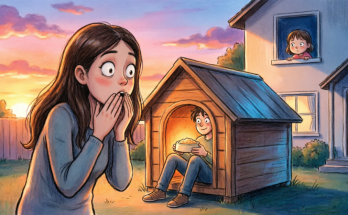
At My Daughter’s 9th Birthday Dinner, My Parents Served Everyone Steak— Except Her. She Got Dog Food On A Paper Plate. “Eat It Or Starve,” My Father Said. Eight People Saw It. I Didn’t Scream, Beg, Or Let Them See Me Break. I Picked Up That Plate, Took My Daughter’s Hand, And…
Part 1
My father looked my nine-year-old daughter straight in the eyes and said, “Eat it or starve,” while pointing at a paper plate of dog food.
For a moment, the dining room became so quiet that I could hear the faint scrape of my uncle’s knife against his steak plate. Eight family members sat around my parents’ long mahogany table, dressed in expensive clothes, drinking wine from crystal glasses, and pretending they had not just watched a little girl’s birthday turn into something cruel enough to stain the air.
My daughter Mia sat beside me in the pale blue dress she had chosen herself, the one with tiny embroidered flowers around the collar. She had practiced her table manners for two weeks because she wanted to make her grandparents proud, and now she was staring at a paper plate in front of her with chunks of canned dog food sliding slowly toward the edge.
“Mommy,” she whispered, her voice trembling so softly that it nearly broke me. “What did I do?”
That was the moment something inside me went completely still.
My name is Rachel Winters, and I am the daughter of George and Patricia Winters, two people who built their lives around wealth, reputation, and the belief that money made them morally superior to everyone else. My father made his fortune in commercial real estate, buying properties when people were desperate and selling them when the city became interested. My mother spent her afternoons at the country club, writing large checks at charity galas where photographers were always conveniently present.
To the world, my parents were generous, polished, and respectable. To me, they were the people who decided I became a disappointment the day I married a mechanic.
My husband Paul had been gone for three years by the time of Mia’s ninth birthday. He died when a driver ran a red light and hit his truck on the way home from the auto shop, and one ordinary evening became the night I learned what grief sounds like when police knock on your door.
Mia was six then. For weeks, she kept asking when Daddy was coming home, and every answer I gave felt too small for the size of what she had lost. Paul had been the kind of father who taught her to ride a bike, check the oil in a car, and believe that honest work was something to be proud of, not something to apologize for.
After he passed, I did what mothers do when the world collapses. I kept going.
I worked as a manager at Target, forty-five hours a week, sometimes more during the holidays. It was not glamorous, and my parents made sure I knew that, but it paid our rent and kept food in the fridge. Mia and I lived in a two-bedroom apartment in Riverside Heights, with thin walls, old carpet, and a refrigerator covered in her drawings.
We had movie nights every Friday on our secondhand couch. We made popcorn in a dented pot Paul had bought before we were married. We laughed when we could, cried when we had to, and built a home that did not look impressive from the outside but held more love than my parents’ mansion ever had.
My parents never forgave me for refusing to move back home after Paul died. At his funeral, while I was still barely standing, my mother leaned close in her black designer dress and said, “You threw your life away, Rachel. Now look where it got you.”
My father was more practical, because cruelty always sounded cleaner when he delivered it like a business offer.
“We’ll pay for Mia’s education,” he said, “but only if you move back and do things our way.”
I said no.
From then on, we saw them only a few times a year. Christmas meant expensive gifts wrapped in judgment. Easter meant brunch at the country club, where my mother commented that Mia’s dress from Target was “sweet, but not appropriate for this venue.” They never came to her school plays, never sat through soccer games, never called just to ask how she was.
But Mia still hoped.
Children have a heartbreaking way of loving people who have not earned it. She made them cards for holidays, practiced her handwriting carefully, and asked whether Grandpa might put her picture on his refrigerator this time. He never did, but she kept trying because she was nine and still believed love could be won by being good enough.
Two weeks before her birthday, a cream-colored envelope arrived in our mailbox. It was addressed to Miss Mia Winters in gold script, and when she saw it, her whole face lit up.
“Grandma and Grandpa invited me to dinner,” she said, running her fingers over the raised letters like they were magic. “At their house. For my birthday.”
I read the invitation twice, searching for the insult I assumed was hidden somewhere between the polite lines. It simply said they wanted to host a proper birthday dinner for their granddaughter, Saturday at six, formal attire requested.
Mia was thrilled. She chose her blue dress three days early and hung it on her closet door. She practiced saying thank you. She asked if steak was hard to eat politely, and I told her she would do just fine.
The night of the dinner, my parents’ mansion looked like something built to remind ordinary people of their place. The long driveway curved past trimmed hedges and stone fountains, and warm light spilled from every window. Mia squeezed my hand when we stepped out of the car.
“Do I look okay?” she asked.
“You look beautiful,” I said.
Inside, the house smelled like roses, polished wood, and expensive food. Uncle Dennis was there with his wife Lorraine and their two children. Great-Aunt Dorothy had come from Phoenix, wearing pearls and a dark green dress. My parents stood near the dining room entrance like hosts at a fundraiser rather than grandparents at a child’s birthday dinner.
Mia walked straight to them with a careful smile. “Thank you for inviting me.”
My mother looked her over. “You’re welcome, dear. That dress is very simple.”
Mia’s smile flickered, but she nodded anyway.
The dining room table was set with fine china, silverware that probably cost more than my monthly rent, crystal water glasses, and fresh roses in silver vases. Mia whispered that it looked like a castle dinner, and I wanted so badly for the night to become what she hoped it would be.
For the first fifteen minutes, it almost did.
Then the servers came in with dinner.
Everyone received filet mignon on white china plates, with roasted vegetables, potatoes, and glossy sauce arranged like art. The children at the table received smaller portions, still elegant, still carefully plated.
Then the server placed a paper plate in front of Mia.
At first, my brain refused to understand what I was seeing. The smell reached me before the thought did, sour and meaty and unmistakably wrong. Mia stared down at the wet brown chunks on the plate, her face turning pale.
I looked at my father.
“Is this a joke?” I asked, my voice low and shaking.
He leaned back in his leather chair as if he had been waiting for the question. “The only joke is you thinking you can raise a child properly on a retail worker’s salary.”
My mother lifted her wine glass, her pearl necklace catching the chandelier light. “We are doing this out of love, Rachel. Sometimes children need harsh lessons before life gives them worse ones.”
“She is nine years old,” I said.
“And old enough to understand where poor choices lead,” my father replied. He pointed at the plate. “Eat it or starve.”
Mia’s eyes filled with tears. She did not reach for the fork. She did not move at all.
Around the table, nobody spoke. Uncle Dennis looked at his steak. Lorraine pressed her lips together. Great-Aunt Dorothy blinked rapidly but did not intervene. The other children sat frozen, sensing that something terrible had happened even if they did not understand the full shape of it.
I looked at my daughter, and I saw the exact second she started wondering whether she deserved this.
That was the line.
Not the insult to me. Not the money. Not the years of being treated like I had lowered myself by choosing love over status. The line was my child sitting at that table on her birthday, trying to understand why the grandparents she wanted to love had served her humiliation on a paper plate.
I stood slowly.
My father’s mouth tightened. “Rachel, don’t start a scene.”
“I’m not.”
My mother gave a small, cold laugh. “For once, think before you overreact.”
“I am thinking,” I said.
Then I picked up the paper plate.
Part 2….
The room seemed to hold its breath as I lifted that plate from the table. I did not throw it, though every part of me wanted to. I did not scream at my parents, because Mia had already seen enough ugliness for one night, and I would not let them turn my rage into another lesson about why we were supposedly beneath them.
I took Mia’s hand instead.
She slid out of her chair without a word, her small fingers curling around mine so tightly that I felt her fear through my skin. Her birthday dress brushed against the edge of the table, and for one horrible second, she looked back at the untouched steak on everyone else’s plates like she was still trying to solve the puzzle of what made her different.
My father stood. “If you walk out now, do not expect an apology later.”
I looked at him over the plate in my hand. “I don’t.”
My mother’s face hardened. “You are embarrassing yourself.”
“No,” I said, keeping my voice calm because calm frightened them more than tears. “You did that.”
No one followed us to the door. No one stopped us. Eight adults stayed seated while I walked my daughter through the marble foyer, past framed family portraits where my parents smiled like generous people, and out into the cold night with the plate still balanced in my hand.
Mia did not cry until we reached the car.
“Mommy,” she whispered once I buckled her in, “am I bad?”
I knelt beside the open door, holding her face gently between my hands. “No, baby. You are not bad. What they did was wrong, and I am so sorry they made you feel that way.”
She nodded, but I could see the damage sitting behind her eyes.
I placed the paper plate carefully on the passenger floorboard, untouched and sealed later in a plastic container from the gas station down the road. I did not fully know what I was going to do with it yet.
I only knew I was done letting their money decide whose pain mattered.
Type OK if you’re still with me.⬇️💬
My father looked my 9-year-old daughter straight in the eyes and said, “Eat it or starve.” while pointing at a paper plate of dog food. Eight family members sat frozen at that birthday dinner table. Nobody said a word. Nobody moved. They just kept cutting their steaks and sipping their wine like nothing was happening.
I’m Rachel Winters and I’m about to tell you how my wealthy parents tried to break my daughter’s spirit on her ninth birthday. They thought their money made them untouchable. They thought I’d just take it like I always had. But what happened when the jury saw that same plate of dog food 6 months later >> [music] >> made my parents lose everything they thought money could protect.
My daughter Mia was the victim here. A sweet brilliant little girl who just wanted her grandparents to love her. She’d spent weeks telling her friends about the fancy birthday dinner at grandma’s and grandpa’s mansion. She practiced her table manners every night at our kitchen table holding her fork just [music] right sitting up straight because she wanted to make them proud.
My parents George and Patricia Winters lived in a world where your bank account determined your worth as a human being. Dad built his fortune in commercial real estate buying up properties and flipping them for millions. Mom spent her days at the country club organizing charity galas where she’d write big checks in front of cameras.
To everyone else they were pillars of the community. To me they were the people who told me I was worthless for marrying a mechanic. To Mia they were the grandparents who barely acknowledged her existence. That night started like any other family gathering at their estate. Uncle Dennis was there with his wife Lorraine and their two kids.
Great Aunt Dorothy had driven up from Phoenix. The dining room looked like something from a magazine with crystal glasses catching the light from the chandelier and fresh roses in silver vases. But while everyone else got served filet mignon on fine China my baby girl got chunks of wet dog food dumped on a paper plate.
Is this a joke? >> [music] >> I asked my voice shaking as I stared at the grotesque meal in front of my daughter. The only joke my father said leaning back in his leather chair is you thinking you can raise a child on a retail worker’s salary. This is what she’s headed for if you don’t get your life together. My mother nodded her pearl necklace catching the light.
We’re doing this out of love Rachel. Sometimes children need harsh lessons. She’s 9 years old. I wanted to scream but I kept my voice level. I had to. Mia was watching me with those huge brown eyes trying to understand why grandpa was being so mean. Mommy what did I do? She whispered her bottom lip trembling.
That’s when I knew this wasn’t about teaching anyone a lesson. This was about power. This was about cruelty and this was the last time they’d ever make my daughter feel like she was nothing. I didn’t throw the plate. I didn’t cause a scene. I picked up that paper plate of dog food took my daughter’s hand and walked out of that mansion with evidence that would destroy them.
They thought they’d won when we left quietly. They had no idea that their arrogance had just handed me everything I needed to protect Mia forever. See wealthy people like my parents think consequences don’t apply to them. They think they can do anything to anybody and their money will make it disappear. But they forgot one crucial thing that night.
They forgot that a mother’s love is more powerful than all their millions. They forgot that when you hurt a child in front of witnesses when you serve dog food to a little girl on her birthday while eight adults watch you create evidence that no amount of money can make disappear. What they did that night wasn’t just cruel.
According to my lawyer Harold Quinton it was legally actionable emotional abuse. And that paper plate of dog food that became exhibit A in a case that would strip them of everything they valued most. Their reputation their social standing and their belief that they were untouchable. This is the story of how my parents learned that money can’t buy you the right to destroy a child’s innocence.
This is the story of how eight witnesses who stayed silent that night eventually found their voices in a courtroom. And this is the story of how a 9-year-old girl named Mia taught an entire jury that dignity isn’t determined by your bank account but by how you treat the most vulnerable among us. The dinner was supposed to be a celebration.
Instead it became the night my parents signed their own social death warrant with a can of dog food and a paper plate. 3 years ago my husband Paul died when a drunk driver ran a red light and hit his truck on his way home from the auto shop. One moment I was setting the table for dinner. The next I was identifying his body at the morgue.
Mia was only six. She kept asking when daddy was coming home and I had to find ways to explain that he never would. That’s when I learned what it really means to be alone. To be a single mother trying to hold everything together while your heart is shattered into a thousand pieces. I work as a manager at Target.
45 hours a week sometimes more during the holidays. It’s not glamorous but it pays the bills and keeps a roof over our heads. We live in a two-bedroom apartment in Riverside Heights. A decent neighborhood with good schools and a park where Mia plays soccer on weekends. The walls are thin and the carpet is old but we’ve made it home.
Mia’s artwork covers the refrigerator and we have movie nights every Friday on our second-hand couch sharing a bowl of popcorn and laughing at Disney movies. My parents never approved of Paul. He was a mechanic who came from a working-class family in Ohio. He didn’t have a college degree or a trust fund or any of the things they thought their daughter should marry into.
But Paul had something more valuable than money. He had kindness. He had integrity. He’d wake up at dawn to help a neighbor fix their car for free. He taught Mia how to ride a bike and check the oil in a car and that getting your hands dirty from honest work was nothing to be ashamed of. You threw your life away.
My mother said at Paul’s funeral standing there in her black designer dress while I was barely holding myself upright. Now look where it’s gotten you. My father pulled me aside that same day while guests were still arriving. We’ll pay for Mia’s education but only if you move back home and do things our way. I refused.
Paul had life insurance enough to cover the funeral and a few months of expenses. I’d figure out the rest. I always did. After that we saw my parents maybe four times a year. Christmas was always awkward with them giving Mia expensive gifts that came with lectures about how she could have so much more if I wasn’t so stubborn. Easter meant sitting through brunch at the country club while they pointed out how Mia’s dress from Target wasn’t appropriate for such a nice venue.
They never came to her school plays or soccer games. They never called just to ask how she was doing. But Mia still hoped. Kids have this amazing ability to love people who don’t deserve it. To keep believing that maybe this time will be different. She’d make them cards for Father’s Day and Mother’s Day spending hours drawing pictures and writing messages in her careful handwriting.
Maybe grandpa will put this one on his refrigerator. She’d say hopefully. >> [music] >> He never did. 2 weeks before her ninth birthday the invitation arrived. Thick cream-colored paper with gold embossed letters addressed to Miss Mia Winters. Mia ran her fingers over it like it was made of magic. Dear Mia she read aloud.
Grandma and grandpa request the pleasure of your company for a special birthday dinner in your honor. She looked up at me with such joy that it broke my heart. >> [music] >> They remembered Mommy. They actually remembered. I wanted to throw that invitation in the trash. Every instinct told me this was a bad idea.
But how could I look at my daughter’s face glowing with happiness and take that away from her. She’d already lost so much. Can I wear my purple dress? Mia asked [music] already planning. The one with the flowers? And can we curl my hair? I want to look really nice for them. Of course baby. I said pushing down my dread.
>> [music] >> You’ll look beautiful. The morning of the dinner Mia was up at 6:00 too excited to sleep. She helped me make breakfast chattering about how maybe grandma would have a cake with nine candles and maybe grandpa would finally tell her he was proud of her good grades. She’d been getting straight A’s all year working so hard on her homework every night at our kitchen table.
Do you think they’ll take pictures? She asked while I braided her hair weaving purple ribbons through each braid. My friend Sophie’s grandparents have pictures of her all over their house. Maybe they will. I said. Though I knew my parents house had no pictures of us anywhere. Their walls were covered with abstract art and photos from charity galas. Not family memories.
As I helped her into her purple dress the one she’d picked out herself at Target with her birthday money from last year. She looked at herself in the mirror and smiled. I look pretty don’t I Mommy? You’re the most beautiful girl in the world. I told her meaning every word. [music] Then maybe tonight grandpa will finally love me. She said quietly.
Those words hit me like a physical blow. No child should have to earn love especially from family. But I forced myself to smile to keep hope alive for just a few more hours. I had no idea I was driving my innocent daughter straight into an ambush that would shatter her heart and change our lives forever. We pulled up to my parents estate at exactly 6:00.
The circular driveway was full of cars. Uncle Dennis’s BMW. Great Aunt Dorothy’s Cadillac and a few others I didn’t recognize. The house stood like a monument to their success. Three stories of limestone and glass with perfectly manicured hedges and a fountain spurting water into the evening air. “It’s like a castle.” Mia whispered, clutching the small gift bag she’d insisted on bringing for her grandparents.
Inside was a handmade card and a painted rock she’d decorated with the words “World’s Best Grandparents” in glittery letters. Patricia opened the door wearing a cream-colored suit that probably cost more than I made in a month. She looked at Mia, then at me, her expression unreadable. “You’re here.
Everyone else is already in the dining room.” No hello, no happy birthday, no hug for the granddaughter she hadn’t seen in 3 months. The dining room had been transformed. Crystal glasses sparkled under the chandelier and the long mahogany table was set with the China they only used for special occasions. But something felt wrong immediately.
Place cards sat at each setting and Mia’s name was at the far end of the table, separated from everyone else by empty chairs. “Why am I sitting so far away?” Mia asked, looking at the seating arrangement. “That’s your special birthday seat.” George said from the head of the table, not getting up to greet us.
He was already nursing a scotch, his gray eyes cold as winter. Uncle Dennis stood up, at least having the decency to look uncomfortable. “Hey there, birthday girl. 9 years old, that’s a big deal.” “Hi Uncle Dennis.” Mia brightened, running over to give him a hug. Lorraine, his wife, shifted nervously in her seat, managing a weak smile.
Their kids, Bryce and Tammy, were focused on their phones, barely acknowledging our arrival. Great-aunt Dorothy, sitting rigid in her chair, patted Mia’s hand. “Don’t you look pretty, dear?” I took my seat next to Mia, already feeling the tension thick as smoke in the air. Patricia rang a small silver bell and servers appeared with the first course, shrimp cocktail for everyone.
“I’m allergic to shellfish.” I reminded my mother quietly. “Oh, I forgot.” she said, though we both knew she hadn’t. A server quickly brought me a small salad instead. George started one of his typical monologues about the real estate market, how he’d just closed another million-dollar deal, how success was all about making the right choices.
“Of course.” he said, looking directly at me. “Some people choose to work retail and live paycheck to paycheck, but that’s what separates winners from losers.” “Rachel works very hard.” Dennis said quietly. [music] “Hard work without ambition is just spinning your wheels.” George shot back. Mia was trying to follow the conversation, her eyes darting between the adults.
“Mommy got promoted to manager last month.” she said proudly. “She’s the best manager in the whole store.” George laughed, ugly and harsh. “Manager of a Target, what an achievement.” “George.” Dorothy said warningly, but he ignored her. Patricia rang her bell again. “Time for the main course.” The servers returned, placing plates in front of each guest with theatrical precision.
Filet mignon, perfectly seared with garlic mashed potatoes and grilled asparagus. The smell was incredible. >> [music] >> Wine was poured, even special grape juice for the kids. Then I saw it. A server approaching with something different, a paper plate, the cheap kind you’d buy for a backyard barbecue, and on it, glistening under the chandelier’s light, were chunks of brown, wet dog food.
Actual dog food straight from the can, the smell unmistakable as it landed with a dull thud in front of my daughter. The room went silent. Even Bryce looked up from his phone. “What is this?” I stood so fast my chair scraped against the floor. George leaned back, savoring the moment. “It’s dinner. It’s what she deserves.” “This is dog food.
” I said, my voice deadly calm though my hands were shaking. “Yes, it is.” Patricia said matter-of-factly. “You can’t afford to feed her properly on your salary, so we’re showing you both what your lifestyle really provides. Dogs in this neighborhood eat better than you live.” Mia stared at the plate, then looked up at me with confused, hurt eyes.
“Mommy, why did they give me dog food?” “Because.” George said, speaking directly to my daughter now. “Your mother is a failure who can’t provide for you. This is where you’re headed if she doesn’t get her act together. Eat it or starve. Your choice.” Tears rolled down Mia’s cheeks. “But it’s my birthday.” “I’ve been good.
I got straight A’s.” “Public school grades mean nothing.” Patricia said, cutting into her steak. “This is a lesson in reality.” I looked around the table. Dennis had his head down, jaw clenched. Lorraine was gripping her fork so tight her knuckles were white. Dorothy looked horrified but stayed silent.
Even the teenagers looked uncomfortable, but nobody said a word. They all just sat there letting it happen. “Dennis.” I said, my voice sharp. “Are you really going to let them do this to her?” He looked up, conflict clear in his eyes, then looked at George. “Dad, this is going too far.” “Shut up, Dennis, or you’re out of the will, too.
I’ve already written Rachel out. Don’t make me add another name.” The threat hung in the air. Dennis looked away. The coward chose money over his 9-year-old niece. “Please.” Mia whispered, pushing the plate away. “I don’t understand. What did I do wrong?” “You were born to a loser.” George said simply.
“But maybe this will motivate your mother to do better.” I stood there for a moment that felt like an eternity, looking at my daughter’s tear-stained face, at the grotesque plate of dog food, at the eight adults who continued eating their expensive steaks as if nothing was wrong. My father had a smirk playing at the corners of his mouth, waiting to see if I’d explode, give him the reaction he wanted, prove I was the trashy failure he’d always said I was.
But something crystallized in that moment. This wasn’t about me anymore. This was about Mia, and I was going to handle this with the dignity they thought we didn’t deserve. I walked calmly around the table to Mia’s chair and knelt down beside her, wiping her tears with my thumb. “Baby, look at me.
You did absolutely nothing wrong. You are perfect exactly as you are.” “But Grandpa said.” “Grandpa is wrong.” I said, loud enough for everyone to hear. “Sometimes adults are cruel because they’re broken inside, not because of anything you did. We’re going to leave now and we’re going to get McDonald’s, your favorite. Would you like that?” She nodded, hiccuping through her tears.
“Can I get a Happy Meal?” “You can get anything you want, sweetheart.” I stood and picked up the paper plate of dog food. George’s smirk widened. “Going to throw it at me? Show your daughter what trash you really are?” “No.” I said quietly, maintaining eye contact. “I’m taking this with me.” Patricia laughed, sharp and cold.
“What are you going to do? Frame it?” “A monument to your failures.” “Something like that.” I replied, [music] carefully holding the plate level so nothing spilled. I helped Mia into her coat, her small hands shaking as I buttoned it up. >> [music] >> The room remained silent except for the clink of silverware on China.
Eight adults and not one of them stood up for a child. >> [music] >> “You walk out that door.” George said, “and you’re done. No inheritance, no help, nothing. You [music] and that kid are on your own.” “We’ve been on our own since Paul died.” I said, taking Mia’s hand. “The only difference is now we know it.” As we reached the dining room entrance, Patricia called out, “Don’t bother coming back. You’re both dead to us.
” I turned to face them one last time. My mother, sitting there in her pearls, my father with his scotch, my brother who wouldn’t meet my eyes, and all the rest who chose silence over protecting a child. “After tonight, that’s mutual.” I said. >> [music] >> “But you should know something. You didn’t just alienate your daughter and granddaughter tonight.
You committed witnessed emotional abuse of a minor. And this plate, it’s evidence.” George laughed. >> [music] >> “You going to call the cops because we served dog food? They’ll laugh you out of the station.” “No.” I said. “I’m going to call a lawyer.” The smirk finally left his face. In the car, Mia broke down completely, sobbing so hard she could barely breathe.
I pulled over in a parking lot and held her while she cried, her little body shaking against mine. “Why do they hate me so much, Mommy?” “I tried so hard to be good.” “Baby, listen to me.” I said, holding her face in my hands. “This has nothing to do with you. Grandma and Grandpa are sick in their hearts.
They think money makes them better than everyone else, but what they did tonight proves they’re not good people at all.” “But they’re family.” “She whispered. Real family doesn’t hurt you on purpose. Real family protects you and loves you no matter what. We’re going to be okay without them.” I drove us to McDonald’s as promised, and Mia got her Happy Meal, though she barely touched it.
>> [music] >> Then I made a decision. I called my friend Janine, an emergency room nurse who’d helped us through Paul’s death. “I need your help.” >> [music] >> I said when she answered. “Something happened tonight and I need documentation.” We drove to Janine’s house, where she took photos of Mia’s emotional state, documented everything while it was fresh.
She measured Mia’s elevated pulse, noted her trembling hands, the classic signs of acute emotional distress in a child. “This is abuse, Rachel.” Janine said quietly while Mia was in the bathroom. “This needs to be reported.” “I know, but first I need to preserve this.” I said, indicating the plate I’d carefully transported. Janine helped me transfer the dog food into a sealed container, photographing every step, creating a chain of custody that would hold up in court.
We labeled it with the date, time, and circumstances. She even kept a sample in her medical freezer as backup. >> [music] >> That night, after I’d gotten Mia to sleep, holding her until her breathing finally steadied, I sat at my kitchen table and made a list of everyone who’d been there.
Eight witnesses to child abuse. Eight adults who chose silence. The next morning, while Mia was at school, I walked into the law offices of Harold Quinton. I’d researched him extensively the night before. 25 years specializing in family law, particularly cases involving emotional abuse and toxic family dynamics. I placed the sealed container on his desk. “Mr.
Quinton, I need your help. My parents fed my 9-year-old daughter dog food at her birthday dinner while eight people watched. They told her to eat it or starve.” Harold opened the container, examined the contents, then looked at me with steel in his eyes. “This is going to be exhibit A,” he said, “and we’re going to make them pay for what they did to that little girl.
” Six months later, I sat in a packed courtroom wearing my best dress, the only one I owned that could pass for professional. Mia was safe at school, protected by a restraining order Harold had secured within days of that birthday dinner. My parents sat across the aisle with their team of three lawyers.
Patricia, wearing her diamonds, and George in his thousand-dollar suit, still believing their money would make this disappear. They’d made a critical mistake. When I filed for the restraining order and sued for intentional infliction of emotional distress, they’d countersued for grandparents’ rights, claiming I was alienating them from Mia.
That opened the door for everything to become public record. Harold stood before the jury, his presence commanding the room. “Ladies and gentlemen, what you’re going to hear today isn’t just about a family dispute. It’s about eight adults who watched a 9-year-old girl be served dog food at her birthday dinner and did nothing.
” The defense attorney, a slick man named Richardson, immediately objected. “Your honor, that’s inflammatory.” “It’s also true,” Judge Martinez replied. “Overruled.” Harold called Dennis to the stand first. My brother looked older, worn down by guilt. Under oath, he couldn’t hide behind his fear anymore. “Tell us what happened on March 15th,” Harold said.
Dennis’s voice was barely audible. “My father served my niece dog food while we all ate steak.” “Did anyone try to stop him?” “No,” Dennis admitted, his voice cracking. “I should have, but he threatened to cut me from the will. I was a coward. I chose money over my niece and I’ll regret it for the rest of my life.” Lorraine was next, tears streaming down her face before she even took the oath.
“I’ve never seen anything so cruel done to a child,” she testified. “Mia just sat there crying, asking what she did wrong. It haunts me. I should have stood up, taken that plate away, but I was terrified of George.” Even Great-aunt Dorothy took the stand, her elderly voice shaking but clear. “I’ve known George for 70 years.
I’ve seen him be ruthless in business, but what he did to that baby was evil, pure evil.” But the moment that changed everything came when Harold presented exhibit A. “Your honor,” he said, “I’d like to present the actual plate of dog food that was served to Mia Winters.” He brought out the preserved evidence, exactly as it had been that night.
The courtroom gasped collectively. One juror, a grandmother herself, covered her mouth in horror. Another man shook his head in disgust. “This is what George and Patricia Winters thought was appropriate to serve their granddaughter,” Harold said, holding it up. Chunks of dog food on a paper plate while everyone else ate $50 steaks on fine china.
Richardson tried to minimize it. “Your honor, this was merely an unfortunate attempt at teaching a lesson about financial responsibility.” “By feeding a child dog food?” >> [music] >> Harold shot back. “Let’s ask Mr. Winters about that lesson.” George took the stand with his usual arrogance intact.
He straightened his tie and looked at the jury like he was closing a business deal. “It was meant to motivate my daughter to provide better for her child,” he said smoothly. “Tell me, Mr. Winters,” Harold said, approaching slowly, “what brand of dog food was it?” George faltered. “I don’t recall.” Harold held up the can, which I’d retrieved from their garbage that night when I returned with a police escort.
“Beef chunks in gravy, generic brand, the cheapest available. You fed your granddaughter the cheapest dog food while you ate premium filet mignon. Was that part of the lesson?” “She needs to understand consequences,” George said, his composure cracking. “Consequences for what? Being born to a widowed mother, getting straight A’s in public school, being 9 years old?” “Her mother chose poverty,” George snapped, his real self finally showing.
“She married beneath her station.” “So you punished the child for the mother’s choice of husband?” Patricia took the stand next, still wearing her pearls, still believing she was untouchable. Harold was ready for her. “Mrs. Winters, do you have pets?” “Two poodles,” she answered carefully. “What do you feed them?” Patricia hesitated, realizing the trap.
“Premium organic food.” “More expensive than what you served your granddaughter?” “That’s not the same thing.” “You’re right,” Harold agreed. “Your dogs are treated with more dignity than you showed your 9-year-old granddaughter on her birthday.” Harold then presented Janine’s medical documentation, showing Mia’s acute emotional distress that night.
He read from the therapy reports that detailed her nightmares, her new fear of eating at other people’s houses, her constant anxiety that she’d done something wrong to deserve such treatment. In his closing argument, Harold stood before the jury with tears in his eyes. “Eight adults sat at that table. Eight adults watched a little girl be served dog food on her birthday.
Eight adults heard her ask what she did wrong, and not one of them stood up for her. Not one of them said, ‘This is wrong.’ They chose their comfort, their inheritance, their fear of confrontation over protecting an innocent child. Today, you have the chance to be the adults Mia needed that night. You have the chance to say, definitively, that no amount of wealth gives you the right to emotionally torture >> [music] >> a child.
” The jury deliberated for only two hours. When they returned, the foreman stood with conviction in his voice. “We find in favor of the plaintiffs. We award Rachel and Mia Winters $500,000 in damages for intentional infliction of emotional distress.” George shot to his feet. “This is outrageous! You can’t” “Mr.
Winters,” Judge Martinez said coldly, “in 30 years on the bench, I’ve never seen such calculated cruelty toward a child by family members. The jury’s decision stands. And if you come within 500 feet of your granddaughter again, you’ll be held in contempt.” [music] The verdict was just the beginning. Within 48 hours, the story hit local news.
>> [music] >> “Millionaire couple serves granddaughter dog food at birthday dinner” became the headline nobody could ignore. George’s business partners started calling, not to congratulate him on his latest deal, but to terminate their contracts. One of them, a man named Robert, who had grandchildren of his own, told him directly, “I can’t do business with someone capable of that kind of cruelty.
” Patricia’s carefully constructed social world crumbled like tissue paper in rain. The country club board held an emergency meeting and voted unanimously to revoke their membership. Her charity organization sent politely worded letters asking her to step down from their boards. The woman who had spent decades building her reputation as a philanthropist became persona non grata overnight.
Even her beloved salon called to inform her that they were unfortunately fully booked indefinitely. Three weeks after the verdict, Uncle Dennis showed up at our apartment. He looked broken, aged 10 years in 6 months. Mia was at soccer practice, and I almost didn’t let him in. “I know I don’t deserve your forgiveness,” he said, standing in my small living room that was worth less than his watch, “but I need to do something to make this right.
I’m setting up a college fund for Mia, full ride to any school she wants. It’s already done, irrevocable trust, completely in your control.” I studied my brother, the man who had chosen money over my daughter’s dignity. “Why now?” “Because I can’t sleep,” he admitted, tears falling freely. “Every night I see her face, hear her asking what she did wrong.
My own kids won’t talk to me. Tammy asked me why I didn’t protect Mia, and I had no answer. Bryce called me a coward, and he was right.” “You were a coward,” I said simply. “But you can change that. You can be in Mia’s life, Dennis, but only if you promise to always stand up for her, no matter what, no matter who’s threatening you or what it costs.” He nodded, wiping his eyes.
“I promise. I’ll never be that person again.” And he kept that promise. Dennis became the uncle Mia deserved, showing up to every soccer game, every school play, every achievement. He stood up to anyone who had anything negative to say about us, including his own father when George tried to reconcile a year later.
The reconciliation attempt came through a lawyer, a formal letter requesting mediation. They wanted to see Mia, claimed they’d changed, that they understood now what they’d done wrong. I looked at that letter for a long time, then showed it to Mia, who was now 10 and in therapy to process what had happened. “Do you want to see them?” I asked her.
She thought about it seriously, then shook her head. “They’re not sorry they did it, Mom. They’re sorry everyone found out. There’s a difference.” My 10-year-old daughter understood something my parents never would. True remorse requires acknowledging the harm you caused, not just the consequences you faced.
I dropped the letter in the trash without responding. The $500,000 went into a trust for Mia’s future, carefully managed and growing. But money was never the real victory. The real victory came a year later, on Mia’s 10th birthday. We had a small party in our apartment, just Janine, Dennis, and his family, and a few of Mia’s school friends.
No mansion, no crystal glasses, no expensive catering, just a homemade cake that Mia and I decorated together, pizza from her favorite place, and people who actually loved her. As she was blowing out her candles, Mia suddenly stopped and looked at me. “Mom, can I say something?” “Of course, baby.” She stood up, addressing everyone in our small living room.
“Last year, my grandparents tried to make me eat dog food on my birthday because they thought we were poor and worthless. But look around this room. Everyone here loves me for who I am. We might not have a big house or fancy cars, but we have something my grandparents will never have. We have real family. We have love that doesn’t come with conditions or price tags, >> [music] >> and that makes us the richest people in the world.
” There wasn’t a dry eye in the room. Dennis hugged her so tight I thought he might never let go. Janine started the happy birthday song, and everyone joined in, voices filling our small apartment with more warmth than my parents’ mansion ever held. Later that night, as I tucked Mia into bed, she said something that stays with me every single day.
“Mom, I feel sorry for Grandma and Grandpa. They have all that money, all those fancy things, but nobody who really loves them. They’re going to die alone in that big house, and nobody will miss [music] them. But when we die, people will remember how we loved them. That’s what really matters, isn’t it?” “Yes, baby,” I said, kissing her forehead. “That’s exactly what matters.
” Some bridges are meant to stay burned. Some plates of dog food become evidence that sets you free. And sometimes, the family that rejects you for not being wealthy enough only clears the path for you to find the people who love you for who you truly are. My parents thought they were teaching Mia a lesson about consequences that night.
They were right, just not in the way they intended. They taught her that cruelty has consequences, that standing up to abuse is always the right choice, and that dignity isn’t something money can buy or take away. They taught her that real wealth isn’t measured in dollars, but in the courage to protect the ones you love, even when it means standing alone against people who think their money makes them untouchable.
Most importantly, they taught both of us that family isn’t about blood or inheritance or last names. It’s about who shows up, who stands up, and who refuses to let a child believe she deserves anything less than love. If you’ve made it this far in our story, thank you for listening. If this resonated with you, if you’ve ever had to stand up to toxic family members or protect someone you love from those who should have loved them, please share this video.
Leave a comment about your own experience because you’re not alone in this fight. And don’t forget to subscribe to this channel for more stories about real people standing up to injustice, finding their strength, and learning that sometimes the best family is the one you choose, not the one you’re born into.
Remember, you deserve to be treated with dignity and respect, no matter what your bank account says. And anyone who tries to convince you otherwise, even if they’re family, especially if they’re family, doesn’t deserve a place at your table.