My parents skipped my wedding, but when Mom saw my $2.5 million lake house online, she ordered a family meeting and said, “You owe us, Blair,” so I walked back into the house where I’d been invisible for thirty years carrying the one legal folder that could finally make them understand what they had lost long before they ever noticed my bank account.
My parents skipped my wedding, but when they saw my $2.5 million mansion on Facebook, my mother called and demanded, “Where did that money come from? Family meeting at 6:00 p.m.” By the time I pulled into their driveway, I already had a plan waiting.
There is a very specific kind of quiet you only get when you live by a lake. Not the flat, heavy silence of an empty city apartment, but a living, breathing quiet, the sound of water brushing against a private dock and wind moving through old pine trees.
That is the sound I wake up to now. I was standing in the center of my living room, holding a mug of coffee my husband Dylan had just handed me, staring through the floor-to-ceiling glass walls of our new house.
We had closed on the property a week earlier. It was a sprawling, ultra-modern architectural masterpiece in Lake Geneva, Wisconsin, with a price tag of $2.5 million, paid in cash, clear and free.
I was thirty-four years old, standing in that magnificent room, watching the morning fog roll off the water, and I felt an overwhelming sense of peace. I had won. I had literally built my dream life from the ground up with my own two hands, my own sleepless nights, and absolutely no help from the people who were supposed to love me unconditionally.
I set my coffee down on the marble island and pulled out my phone. I am a digital content creator and a media agency founder, so my life has always been tied to screens.
I decided to post a picture to my personal Facebook page. It was not meant to be a flex, at least not a cruel one. It was just a beautiful photo of morning light hitting the glass facade of the house, with a simple caption about new beginnings and being grateful for the journey.
I hit post, put my phone on silent, and went about my day unpacking boxes and organizing my new home office. It was not until late that afternoon that I checked my phone again.
When the screen lit up, my stomach made a strange, involuntary turn. I had dozens of notifications, likes, and comments from industry friends, college buddies, and clients.
But there, sitting right at the top of my lock screen, was a text message from a number I had not saved in my contacts for a very long time. Still, I knew the number. You never really forget your childhood home phone number or your mother’s cell.
It was Brenda Kensington, my mother.
We had not spoken in years. She had not been at my wedding. She had not called on my birthdays. She had essentially treated me like a ghost for most of my adult life.
I opened the message expecting, maybe, a stiff and formal congratulations.
Instead, the text read exactly like this.
“Whose house is that? Where did you get that kind of money? Family meeting at our house. Tomorrow at 6:00 p.m.”
I just stared at the screen. I did not cry. I did not shake. I actually let out a short, hollow laugh that echoed through the empty living room.
The sheer audacity of this woman stunned me. After years of silence, after ignoring the most important milestones of my life, one picture of a multi-million-dollar piece of real estate was all it took to magically bring my mother back into my life.
She did not ask how I was doing. She did not ask about Dylan. She demanded to know where the money came from and summoned me like a disobedient teenager.
I am Blair. Blair Kensington. Pierce now, technically, but for the sake of this story, let us stay with the girl who grew up invisible.
Looking at that text message, feeling the cold glass of my phone in my hand, I realized something important. They had not changed. They were never going to change. But I had.
I was no longer the desperate, neglected little girl begging for a scrap of their attention. I was a self-made millionaire with a titanium backbone.
And as I looked at her demand for a family meeting, a cold, calculated plan started forming in my mind. If they wanted a meeting about money, I was going to give them exactly what they asked for.
But to understand why I did what I did, and why I do not regret a single second of it, I need to take you back. I need to show you the house where I learned how to be invisible.
I grew up in Madison, Wisconsin, in a very neat, very traditional two-story brick house in a solidly upper-middle-class neighborhood. The lawns were manicured, the driveways were power-washed, and the neighbors all knew one another’s business.
On paper, we were the perfect American family. My father, Craig Kensington, was a regional bank manager. He was a man utterly obsessed with optics.
To Craig, perception was reality. If things looked good from the street, it did not matter if the foundation was rotting on the inside.
My mother, Brenda, was a real estate agent, which mostly served as a socially acceptable way for her to network with wealthy suburban moms and collect gossip. She was the architect of our family’s public image, and she managed us like a public relations crisis team.
And then there was Carter.
Carter is my older brother by three years. In the Kensington household, Carter was not just a son. He was an investment.
He was the golden boy, the sun around which my parents’ entire universe violently orbited. He was handsome. He played football. He got decent grades. And he knew exactly how to play the game to get whatever he wanted from our parents.
And me? I was the shadow. I was the leftover space.
From a very young age, I understood my role. I was the low-maintenance kid, the one who was not supposed to ask for anything, need anything, or cause any disruption to the Carter show.
The favoritism was not subtle. It was not something you had to squint to see. It was loud, heavy, and crushing.
Let me give you an example.
When I was eight years old, Carter’s middle school football team won their regional championship. It was not the Super Bowl. It was a bunch of preteens playing in the mud.
But my parents threw a massive backyard barbecue to celebrate. They invited fifty people. There were catered ribs, a huge custom cake with his jersey number on it, and streamers in the team colors everywhere.
I remember watching my dad walk around with a beer, slapping other dads on the back, pointing at Carter and saying, “That’s my boy right there. Going places.”
I spent that entire afternoon sitting by the edge of the patio, holding a warm soda and wearing a new dress I had picked out specifically because I hoped someone would notice me.
No one did. I was practically camouflaged.
A year later, when I was nine, I entered a statewide creative writing contest. I spent weeks working on my essay, writing and rewriting it at the kitchen table while my mom talked on the phone and ignored me.
I ended up winning first place for my age group. They handed me this beautiful, heavy wooden plaque with my name engraved on it.
I practically ran all the way home from the bus stop. I burst through the front door, found my mom in the kitchen, and held the plaque up like it was an Olympic gold medal.
I was beaming. I thought, finally, this is it. This is the thing that makes them look at me the way they look at him.
My mom paused her chopping, glanced at the plaque for a fraction of a second, and said, “Oh, that’s nice, Blair. Can you get the plates out? Carter is going to be starving after practice.”
She did not read it. She did not touch it.
I put the plaque down on the kitchen counter. A few days later, it got moved to the top of the refrigerator to make room for groceries. A month later, I found it in a box in the garage.
Meanwhile, Carter’s participation trophies were polished weekly and lined up on the living room mantel like holy relics. This was my normal.
My art projects, my straight-A report cards, my little achievements, all of them were treated as minor annoyances, background noise to the grand symphony of Carter’s life.
If I asked my dad to look at a drawing, he would mutter that he was busy checking Carter’s college fund. If I asked my mom to come to a parent-teacher conference, she would sigh and complain that it conflicted with Carter’s tutoring schedule.
I learned to swallow my words. I learned to stop sharing my joys because having them ignored hurt a thousand times worse than keeping them to myself.
But a child can only shrink herself down so much before she starts to suffocate. The real breaking point, the day I stopped trying to exist in their world entirely, happened when I turned sixteen.
If there is one birthday American culture tells you is supposed to be magical, it is your sixteenth. You watch the movies, you see the shows, you see your friends at school getting cars with giant red bows or surprise parties, or at the very least, a nice dinner with a cake.
I did not expect a car. I was not delusional. But I had dropped hints for months.
I had circled things in catalogs. I had casually mentioned restaurants I wanted to try. I just wanted one day, twenty-four hours, where the focus was on me.
The morning of my birthday, I woke up an hour before my alarm. I lay in bed, my heart actually fluttering with this stupid, stubborn hope.
I put on my favorite outfit, fixed my hair, and walked downstairs to the kitchen. I expected a balloon, maybe a card on the counter, maybe just my mom turning around from the stove and saying, “Happy birthday, sweetie.”
I walked in.
My dad, Craig, was sitting at the island, fiercely typing on his laptop, completely absorbed in some bank report. My mom, Brenda, was standing in front of Carter.
Carter was nineteen at the time, home from his freshman year of college, and he was getting ready for an interview for a highly competitive, prestigious pre-law summer internship.
Brenda was frantically adjusting his tie and smoothing his shoulders, her voice a high-pitched buzz of nervous energy.
“You remember what we practiced?” she was saying to him. “Firm handshake. Look them right in the eye. Mention your dad’s connections if you have to.”
I stood in the doorway for a full minute. Neither of them looked up.
Finally, I walked over to the fridge to get a glass of orange juice. My mom stepped back, admired Carter, and clapped her hands.
“Perfect,” she said. “Craig, get the keys. We can’t be late.”
My dad snapped his laptop shut. “Right. Let’s go, son. Big day.”
They bustled toward the garage door. I stood there holding my glass of juice.
“Have a good interview,” I said quietly.
Carter threw a thumbs-up over his shoulder. My parents did not even acknowledge I had spoken.
The door slammed shut, and the house fell into that heavy, oppressive silence. They were gone. They had completely, entirely forgotten my birthday.
I went to school. I did not tell anyone it was my birthday because the thought of someone pitying me was worse than the neglect.
When I got home that afternoon, the house was empty. They were still out, probably taking Carter to a celebratory late lunch. I went up to my room and sat on the edge of my bed.
I did not turn on the lights. I just sat there as the sun went down, watching the shadows stretch across my floor.
Around 8:00 p.m., I heard the garage door open, laughter echoing up the stairs, and the clinking of glasses. They were in a great mood.
I went downstairs. They were in the kitchen eating leftover pizza they had picked up on the way home.
My mom looked at me, completely unbothered.
“There’s cold pizza in the box if you’re hungry, Blair,” she said.
That was it. That was the entirety of my sixteenth birthday. Eating a cold slice of pepperoni pizza in the glow of the open refrigerator door while my family celebrated my brother’s internship in the next room.
I did not scream. I did not throw a tantrum.
I realized, with a chilling clarity no one should have at sixteen, that I was profoundly and entirely alone. I was a tenant in their house, not a daughter.
That night, lying in the dark, something inside me snapped. The desperate need for their validation, the endless, exhausting cycle of trying to impress them, just died.
It burned out completely. I decided right then and there that I was going to build a life so big, so undeniably successful, that their opinion of me would not matter.
I just needed a way out.
My escape route presented itself at the beginning of my junior year of high school. I needed an elective credit, and the easiest one to fit into my schedule was a multimedia and video production class.
I walked into that room expecting an easy A, just a place to sit quietly in the back and zone out. But then I met Mrs. Diane Higgins.
Mrs. Higgins was a tornado of a woman. She had wild curly hair, paint on her jeans, and an intensity that made you sit up straight.
On the first day of class, she did not hand out a syllabus. She held up an old, bulky digital camera like it was a weapon.
“This,” she told us, “is how you control the narrative. The world is a messy, chaotic, unfair place. But through this lens, you get to decide what matters.”
“You get to frame the story. You get to cut out the garbage and highlight the beauty.”
For a kid whose entire existence felt out of control, whose own family had written her out of their narrative, those words hit me like a physical blow.
I checked out a camera that afternoon and did not put it down for two years.
I started filming everything. Not people at first. People disappointed you.
I filmed the way rain hit the pavement outside my bedroom window. I filmed the abandoned train tracks on the edge of town. I filmed the harsh flickering neon sign of the diner down the street.
I would take hours of useless footage and bring it back to the school’s clunky desktop computers. That was where the real magic happened: the editing room.
The first time I opened the editing software, it looked like an airplane dashboard. It was terrifying and complex, but I was obsessed.
I spent every lunch period, every free hour, and every day after school sitting in that dark, air-conditioned lab. While Carter was out partying with fraternity friends and my parents were agonizing over his law school prospects, I was learning how to color grade.
I was learning how to cut a scene perfectly to the beat of an instrumental track. I was learning how to shape emotion through sound and light.
When you edit a video, you command time. You can make a painful moment disappear with a single keystroke. You can stretch a beautiful second into an eternity.
It was the ultimate antidote to my real life. In my videos, I was never ignored. I was the invisible hand guiding the viewer exactly where I wanted them to go.
Mrs. Higgins noticed my obsession. She did not treat me like a weird loner. She treated me like a professional.
She gave me advanced tutorials, introduced me to complex framing techniques, and pushed me harder than anyone ever had. She looked at my work, really looked at it, and told me I had a gift.
Not a hobby. A gift.
By the time I was a senior, I was not just slapping clips together. I was telling stories.
I was making short, atmospheric documentaries about the loneliness of our suburban town. I poured every ounce of my isolation, my anger, and my hidden hope into those digital files.
My family thought I was just wasting time playing on the computer. They never asked to see a single video. They never asked what I was working on.
But for the first time in my life, I did not care. I did not want their eyes on my work. My art was mine.
It was the only thing in the world that belonged entirely to me, untainted by their neglect, and I was getting incredibly good at it.
Toward the end of my senior year, Mrs. Higgins pulled me aside and handed me a crumpled flyer. It was for a regional student film festival hosted in downtown Madison.
The prize was a $500 grant and a trophy, but more importantly, it was public recognition.
“You’re entering this, Blair,” she said.
It was not a suggestion.
“Your work is too good to rot on a hard drive. It’s time to show people.”
I spent three weeks practically living in the editing lab. I crafted a four-minute short film about the passage of time using thousands of still photos I had taken around the city, stitched together into a hyperlapse.
It was frantic, emotional, and technically flawless. I was so proud of it that it actually scared me.
It was the first time I felt a flicker of the old, dangerous desire. I wanted my parents to see it.
I wanted them to sit in a dark room, look at a massive screen, and realize that their invisible daughter had created something beautiful.
Two days before the festival, I cornered my mom in the kitchen. I handed her a printed invitation I had made myself. My hands were actually shaking a little.
“Hey,” I said, trying to sound casual. “There’s this film festival on Friday night. My video got selected to be screened. It would be really cool if you and Dad could come.”
My mom took the paper, her eyes skimming it for barely a second. She sighed a deep, put-upon sigh that she reserved specifically for me.
“Oh, Blair. Friday? Really? You know Carter has a mock trial prep session that night. Your father and I promised we’d sit in and play the jury for him.”
“He needs the practice before he heads back to college.”
I felt the blood drain from my face.
“It’s only an hour,” I pleaded, hating how small my voice sounded. “My video is only four minutes long. You could come for my part and leave.”
“We can’t be in two places at once, sweetie,” she said, handing the flyer back to me. “I’m sure it’ll be very nice. You’ll have to tell us how it goes.”
Then she turned her back to me and started washing dishes.
I did not argue. I took the flyer, walked up to my room, and tore it into tiny pieces.
Friday night came. I took the bus downtown by myself.
The community center auditorium was packed with students, parents holding bouquets of flowers, teachers, and local judges. The air buzzed with excitement and pride.
I sat in the very back row, the only person sitting entirely alone in my section.
The lights went down. The screen lit up.
For the next hour, I watched other kids’ projects. Whenever a video ended, cheering and applause erupted from specific pockets of the audience where that kid’s family was sitting.
Then my title card flashed on the screen. The room went silent.
As my hyperlapse played, driven by a heavy, pulsing instrumental track I had painstakingly mixed, I did not look at the screen. I watched the backs of the audience’s heads.
I watched them lean forward. I watched them get pulled in.
When the screen cut to black, there was one beat of pure silence. Then the room erupted.
It was not polite family applause. It was genuine, thunderous clapping from a room full of strangers.
At the end of the night, the head judge walked onto the stage.
“First place,” he announced into the microphone, “goes to Blair Kensington.”
I stood up. My legs felt like lead.
I walked down the long aisle, climbed the stairs to the stage, and accepted a heavy glass trophy. They handed me a microphone to say a few words.
I looked out into the crowd. I saw Mrs. Higgins beaming in the front row, but behind her, in the sea of smiling faces, I looked for my mother’s hair. I looked for my father’s shoulders.
Nothing. Just an ocean of strangers.
“Thank you,” I whispered into the mic, and handed it back.
I took the bus back to the suburbs. I walked the four blocks from the bus stop to my house in the pitch black.
The house was completely dark when I got there. Everyone was already asleep.
I stood on the front porch holding my first-place trophy. The cold glass fit into my hands.
In that moment, staring at the locked front door of my own home, the last tiny, fragile piece of my childhood innocence died.
I realized the brutal truth. Nobody was coming to save me. Nobody was going to clap for me.
If I wanted a life, I had to build it myself, brick by painful brick. And I was going to make sure I built a fortress so high they could never reach me.
If you have ever known what it feels like to be the invisible child, then you understand that moment. The moment you stop waiting for the people who should have loved you to finally turn around and see you.
Now let me tell you how I built the empire that made them come crawling back.
The day after I graduated high school, I packed everything I owned into two suitcases and left. I got into a state university a few hours away.
My parents did not offer a dime for tuition, claiming they had drained their savings putting Carter through his expensive out-of-state private college. I did not even ask.
I took out student loans that made my stomach churn, got a job as a barista working the opening shift, and threw myself into survival mode.
College for me was not about fraternity parties, study-abroad trips, or finding myself. It was a brutal, nonstop grind.
My schedule was sickening. I would wake up at 4:00 in the morning, walk in the freezing dark to the coffee shop, smell like burnt espresso until noon, run to my classes, and then sit in the university library from 6:00 p.m. until 2:00 in the morning working on my laptop.
I had started a YouTube channel. I did not show my face at first.
I posted video essays, highly edited short films, and eventually deep-dive tutorials on video editing and digital marketing. I was making content for other creators, teaching them the high-end techniques I had taught myself.
At first, nobody watched. I was speaking into the void.
But I kept pushing. I survived on cheap ramen noodles, bulk oatmeal, and the sheer, burning fear of failing and having to move back into that brick house in Madison.
While I was drowning in assignments and utility bills, my parents were financing Carter’s life. He would post pictures from spring break in Cabo or his new apartment in the city, fully furnished by Craig and Brenda.
When we did speak, which was maybe twice a year on major holidays, my mom would spend twenty minutes raving about Carter’s new law firm job, then give me a breathless, “So glad you’re doing okay, Blair. Got to run,” before hanging up.
But a funny thing started happening during those lonely nights in the library. My channel started to gain traction, slowly at first, then rapidly.
By my senior year of college, I had crossed 100,000 subscribers. More importantly, I was getting flooded with emails from small businesses asking me to edit their commercials, manage their social media, and shoot their campaigns.
I was making thousands of dollars a month freelancing from my dorm room. I realized I did not just have a hobby. I had a highly monetizable skill set.
The audience I had built online became a strange, beautiful surrogate family. I had strangers in the comment section telling me my videos inspired them, asking for my advice, thanking me for my work.
I was receiving more validation and warmth from anonymous usernames than I had ever received from my own flesh and blood.
That online community gave me the confidence to take the biggest, most terrifying risk of my life. The day after I got my degree, instead of applying for a safe corporate job, I officially registered my own media agency.
I called it Kensington Digital. I was twenty-two years old, exhausted, terrified, and completely on my own.
Starting an agency sounds glamorous. You picture sleek offices, brainstorming sessions with cool tech people, and giant checks.
The reality is crushing rejection, late-night panic, and watching your bank account slowly bleed dry.
I moved to a cheap apartment in Chicago to be closer to bigger corporate clients. For the first two years, it was just me in a windowless room, sending out hundreds of cold emails a week.
I was the CEO, the lead editor, the accountant, and the janitor. I pitched to local restaurants, startup tech companies, and anyone who would listen.
Ninety-nine percent of the time, I got the door slammed in my face. They looked at a young woman in her twenties and did not take me seriously.
I hit rock bottom the winter I turned twenty-four. A client had defaulted on a massive payment. I was two months behind on rent, and I had exactly $42 left in my checking account.
I remember sitting on the floor of my apartment, wrapped in a blanket because I could not afford to turn the heat up, staring at my laptop screen.
I was crying so hard I could barely breathe. I was so close to losing everything.
I had my phone in my hand, my thumb hovering over my dad’s contact name. I just needed a small loan, just enough to keep the lights on for another month.
I stared at his name, and then I remembered the cold pizza. I remembered the empty auditorium.
I realized that if I called him, if I begged for help, I would owe him for the rest of my life. He would use it as proof that I could not survive without him, proof that I was a failure compared to Carter.
I put the phone down. I wiped my face. I drank a glass of tap water, opened my email, and sent out fifty more pitches.
One of those pitches landed.
It was a midsized cosmetics brand looking to completely overhaul its digital presence for a younger demographic. I did not just send them a quote.
I stayed up for forty-eight hours straight and built them a complete, hyper-targeted video campaign prototype. I walked into their corporate office running on fumes and caffeine, and I delivered the pitch of my life.
They signed a contract worth $100,000.
That was the turning point.
I hired a small team. We executed the campaign, and it went viral, doubling the brand’s online sales in a quarter.
Suddenly, Kensington Digital was not begging for work. Companies were lining up to hire us.
We moved out of my apartment and into a real office space. By the time I was twenty-seven, we were pulling in seven figures in revenue.
I was managing a staff of twenty people. I was flying to conferences, winning industry awards, and building serious generational wealth.
And my family knew absolutely none of it.
They did not know about the agency. They did not know I lived in Chicago. Whenever my mom texted, usually just a generic holiday greeting, I replied with short, polite answers.
Doing fine. Keeping busy.
I guarded my success like a dragon guarding gold. It was mine. They had not watered the soil, so they were not going to enjoy the harvest.
I was rich. I was successful. I was fiercely independent.
But I was also incredibly lonely. My past had made me an excellent CEO, but it had turned my heart into an absolute fortress.
I trusted no one until I met Dylan.
I met Dylan Pierce at a coffee shop in downtown Chicago. It is a cliché, I know.
I was twenty-eight, exhausted from a massive client launch, frantically typing emails on my laptop while waiting for an outrageously expensive oat milk latte.
Dylan was standing behind me in line.
He was an architect, tall and easygoing, with incredibly kind eyes and a laugh that actually forced you to relax your shoulders.
He made a joke about the chaos of the café. I actually looked up from my screen, and we ended up talking for twenty minutes until our coffees went cold.
Dylan was the exact opposite of everything I had ever known. He was not frantic. He was not status-obsessed. He did not view relationships as transactional.
When we started dating, it was terrifying for me. I was so used to having to prove my worth, to constantly perform for basic human decency, that his unconditional affection felt like a trap.
I kept waiting for the other shoe to drop. I kept waiting for him to get bored of me or demand something in return.
But the shoe never dropped.
Instead, he slowly, patiently dismantled the fortress I had spent a decade building.
He was the first person I ever told about my family. I told him about the barbecue, the sixteenth birthday, the film festival.
We were sitting on the couch in his apartment, and as I told him, expecting him to maybe offer a polite “that’s awful,” he actually pulled me into his chest, wrapped his arms around me, and let me cry until my shirt was soaked.
“You didn’t deserve that, Blair,” he told me. “You were just a kid.”
It was the first time anyone had ever validated my pain out loud.
But the real culture shock came when Dylan introduced me to his family. His parents lived in a chaotic, lived-in house in the suburbs.
The first time we went over for Sunday dinner, I was a nervous wreck. I wore a stiff dress, brought an expensive bottle of wine, and prepared to be judged.
I walked through the door and was immediately engulfed in a hug by his mother, a woman who smelled like cinnamon and genuinely smiled when she saw me.
His father shook my hand warmly and immediately started asking me about my agency, not to judge my income, but because he was actually interested in digital media.
His siblings teased Dylan, passed giant bowls of pasta around the table, and talked over each other in this loud, joyful mess of a conversation.
I sat at that table watching them, and I felt a physical ache in my chest. It was grief. Pure, concentrated grief for the childhood I never had.
This was what it was supposed to look like.
If someone had a bad day, the table stopped to listen. If someone had a victory, everyone raised a glass.
They asked me questions. They remembered my answers.
When Dylan’s mom found out I liked a specific kind of dark chocolate, she started mailing care packages of it to my office. It was utterly foreign to me.
I had spent my entire life starving for affection, convinced I was inherently unlovable, only to realize I had simply been sitting at the wrong table my whole life.
The Pierce family did not care about optics. They did not care who was the most successful. They just loved one another, period.
Marrying into that warmth healed parts of me I did not even know were broken. It made me realize I was not defective.
But it also threw the toxic nature of my biological family into sharp relief. Seeing what real love looked like made my parents’ neglect look even colder.
And as my career hit its absolute peak and I prepared to walk down the aisle to marry Dylan, that realization set the stage for the final catastrophic collision with my past.
By the time I was thirty-two, Kensington Digital was not just a successful agency. It was a juggernaut in the short-form content space.
We were the ones brands called when they wanted to go viral on YouTube or TikTok. My life was a whirlwind of high-level board meetings, creative retreats, and managing a team that had grown far beyond anything I had imagined.
Then the offer came.
A massive global streaming platform, the kind everyone has an icon for on their smart TV, approached me for a full buyout. They did not just want my clients. They wanted our proprietary editing workflows and our creative soul.
The negotiations took six months. It was the most stressful half year of my life.
I remember sitting in a glass conference room in New York, surrounded by lawyers in suits that cost more than my first car, realizing my life was about to change forever.
When the ink finally dried on the contract, the buyout figure was $18 million.
After taxes and paying bonuses to my loyal staff, I saw that number hit my personal bank account. $18 million.
I sat at my desk in my home office, staring at the screen until the pixels blurred. I was thirty-three years old, and I was retired if I wanted to be.
I paid off my student loans, that lingering heavy weight from my college years, with a single click. I paid off the mortgage on Dylan’s and my current place.
I bought him the vintage Porsche he had been eyeing since he was a teenager.
But here is the thing. I told no one in my biological family. Not a word.
By this point, my relationship with Brenda, Craig, and Carter was a hollow shell of politeness. I would get a Merry Christmas text or a happy birthday, usually two days late, and I would reply with a thumbs-up emoji.
They still thought I was doing okay with some internet video business in Chicago. They had no idea I had just built and sold an empire.
That money was my ultimate armor. It was the physical manifestation of every no I had ever heard, every missed birthday, every empty seat at my school events.
I did not want their congratulations because I knew with cynical certainty that their pride would be tied directly to my net worth.
I wanted to see if they could love me for being Blair, not for being a walking ATM. I decided to keep my wealth a secret, a private shield between me and the people who had spent twenty years making me feel like I was worth nothing.
I was ready to start my real life with Dylan, untainted by the Kensington name.
Despite the fortress I had built around my heart, there is a part of the human soul that never quite stops wanting its parents to be proud. It is a glitch in our programming.
As Dylan and I began planning our wedding, that tiny, neglected eight-year-old girl inside me started whispering again.
Maybe this time will be different. It is a wedding. Nobody skips their daughter’s wedding.
Dylan wanted a big celebration, but I pushed for something more intimate. A beautiful garden venue in Lake Geneva, surrounded by the people who actually showed up for us.
I spent months obsessing over every detail. I found an ivory gown that made me feel like I was finally stepping out of the shadows.
And then I did the hardest thing I had ever done.
I mailed the invitations to Madison. One for Craig and Brenda, one for Carter and his wife.
I waited. Two weeks passed. Three.
My phone stayed silent.
Finally, I could not take the suspense anymore. I called my mother.
“Hi, Mom,” I said, my voice tight and professional. “I’m calling about the wedding. Did you get the invitation?”
“Oh, Blair. Yes, we got it,” Brenda said. Her voice was distracted, with the sound of papers rustling in the background. “It sounds lovely.”
“Really.”
“But listen, honey, that’s a very busy weekend for the family. Carter has a massive case he’s closing at the firm, and he really needs us to help out with Ava and Colin. You know how stressful his job is.”
My grip on the phone tightened until my knuckles turned white.
“Mom, it’s my wedding. It’s one day. It’s only an hour’s drive from Madison.”
“We’ll try, Blair. We really will,” she said, using that dismissive tone she had used a thousand times before. “But Carter’s career is at such a critical junction right now. We have to prioritize the family’s future.”
“I’m sure you understand. You’ve always been so independent.”
I hung up without saying goodbye. I sat in my car in the driveway and cried until I could barely breathe.
Independent was just their code word for we do not care about you.
I realized then that I was not an invitation to them. I was an inconvenience. I was a footnote in the epic saga of Carter Kensington.
I told Dylan I did not think they were coming. He held me while I shook with rage and grief, promising me that his family would be there to fill every empty seat.
I went ahead with the final payments, the final dress fitting, and the final walkthrough. I prepared for the worst, but a small, stubborn part of me still hoped that on that Saturday in June, I would see their car pull into the lot.
The morning of my wedding was a blur of hairspray, champagne, and nerves. My bridesmaids, women I had met in the trenches of my startup years, were buzzing around me, but I was in a trance.
I kept glancing at my phone, half expecting a text saying my family was running late.
Nothing.
The ceremony was held outdoors under a canopy of ancient oak trees draped in white silk and string lights. It was breathtaking.
As the music started, a slow acoustic version of a song Dylan and I loved, I took a deep breath and began the walk down the aisle alone.
I did not want anyone else to walk me if my father would not.
As I moved toward the altar, my eyes scanned the crowd. I saw Dylan’s parents crying and smiling in the second row. I saw my mentors, my friends, my team.
Then my eyes landed on the very front row on the left side.
Three chairs. Three beautiful white-painted wooden chairs with small reserved-for-family signs tucked into the bouquets of lilies on the armrests.
They were empty.
No Brenda. No Craig. No Carter.
Not even a card or a cheap bouquet of grocery-store flowers sent in their place.
I felt a sharp physical pain in my chest, as if someone had reached in and squeezed my heart with a cold hand.
I nearly stumbled. Then I looked up and saw Dylan.
His eyes were locked on mine, filled with such fierce, protective love that it acted like a physical anchor.
Behind him, his father, a man I had known for only a few years, gave me a small, encouraging nod.
I made it to the altar. I said my vows through a throat that felt full of glass.
We exchanged rings. We kissed. The crowd erupted in joy.
But as we walked back up the aisle as husband and wife, I did not look at the empty chairs again.
I looked at the people who were there.
The reception was a masterpiece of warmth. Dylan’s family took over.
His mother pulled me into a hug that lasted a full minute and whispered, “You are our daughter now, Blair. You are exactly where you belong.”
His sister danced with me until our feet hurt. His father gave a toast that brought the entire room to tears, talking about my strength, my brilliance, and how lucky the Pierce family was to have me.
I smiled. I laughed. I danced.
But inside, something had hardened into diamond.
The last bridge had burned. My biological family had not just missed a party. They had declared that I was not worth one hour of their time, even on the most important day of my life.
I realized I did not have a family in Madison anymore. I had a set of biological strangers who happened to share my last name.
And as the sun set over the lake and the music played into the night, I made a silent vow. I was done.
No more invitations. No more phone calls. No more hoping.
They were gone from my life. And they would have stayed that way forever if I had not posted that one picture of my new house.
The drive from Lake Geneva to Madison takes about an hour if traffic is light. It is a drive I have done a thousand times, but this time felt different.
I was driving my new electric-blue Tesla, the one I had posted on Facebook that had apparently triggered my mother’s miraculous memory of my existence.
Dylan had offered to come with me, but I told him I needed to do this alone. I needed them to see me, truly see me, without anyone else there to soften the blow.
As I pulled into the familiar brick driveway of my childhood home, I felt like a stranger visiting a museum of my own pain.
The basketball hoop was still there. The lawn was still perfect. Everything looked good from the street, just like Craig always wanted.
I walked up to the front door and knocked.
My father opened it. He did not hug me. He did not apologize for missing the wedding.
He just nodded and said, “Good to see you, Blair. Come in. Your mother has coffee.”
I walked into the living room. It was like stepping into a time capsule.
My brother Carter was already there, sitting on the sofa, scrolling through his phone. He looked older, tired, and restless in a way he had never looked when we were young.
We sat at the dining table, the same table where I had eaten my cold sixteenth-birthday pizza.
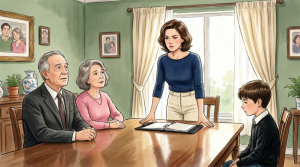
My mother started, her voice unnervingly sweet.
“Blair, honey, you look wonderful. And that house you posted, and the car. You’ve clearly done very well for yourself. We’re so proud.”
“Cut the act, Mom,” I said, my voice flat and cold. “You haven’t spoken to me in years. You skipped my wedding because you were busy. Why am I here?”
The room went silent.
Carter cleared his throat and leaned forward.
“Look, Blair, we’re all family here, and family helps each other when things get tough. I’ve had a string of bad luck with some investments and the firm. Things are tight.”
“I’m underwater on my mortgage, and the bank is threatening foreclosure.”
My father chimed in, his tone matter-of-fact, as if we were discussing a bank loan.
“And the kids, Ava and Colin, they have college coming up. Tuition is skyrocketing. Since you’ve clearly come into some significant money, it’s only right that you step up.”
“We need about $2 million to stabilize Carter’s situation and set up trusts for the grandchildren.”
I stared at them. I actually leaned back in my chair and looked at each of them in turn.
“Two million dollars?” I repeated slowly. “You want two million dollars from the daughter whose wedding you didn’t even bother to attend because you were helping Carter with his stressful job.”
“Don’t be dramatic, Blair,” Carter snapped, his old entitlement flaring up. “You have $18 million from that company sale. What’s two million to you? It’s for your own niece and nephew.”
“You knew?” I asked, my voice rising. “You knew I sold my company for $18 million, and you still didn’t call to congratulate me?”
“You only called when you realized you could use a piece of it.”
“We meant to call,” Brenda said weakly, her hands trembling. “We were just waiting for the right time.”
“The right time was my wedding day,” I snapped, standing up so abruptly that my chair scraped harshly against the floor.
“The right time was my sixteenth birthday. The right time was every single day for twenty years when I was invisible to you.”
“You don’t want a daughter. You want a benefactor, and you are about twenty years too late.”
The silence in the dining room was heavy and suffocating.
My father’s face was turning a deep, furious red. Carter looked like he wanted to lunge across the table, but I was not finished.
I pulled a thick legal folder out of my bag and slid it across the mahogany table.
“You think I’m sitting on that money just waiting for you to ask for it?” I said, my voice echoing in the quiet house. “I spent the last two weeks finalizing this. Go ahead. Read it.”
My mother picked up the top document with shaking fingers. Her eyes scanned the pages, and slowly the color drained from her face.
“Fifteen million,” she whispered. “Blair, what is this?”
“It’s an irrevocable donation to the Higgins Foundation for Children’s Media Education,” I said, my heart pounding with a fierce, cold joy. “I named it after the only teacher who ever actually saw me.”
“It’s a trust that will fund full-ride scholarships and equipment for kids in underfunded districts. Kids like I was, kids with talent and no one to believe in them.”
“It’s fully funded. It’s legally untouchable. And it’s gone.”
“You gave away $15 million?” my father said, slamming his hand on the table. “That’s family money. That could have set Carter’s children up for life. You’ve turned your back on your own blood.”
“Family money?” I laughed, and it was the most honest sound I had ever made in that house. “You didn’t earn a cent of it.”
“You didn’t support a minute of it. You were too busy polishing Carter’s trophies while I was building a future out of nothing.”
“This money is going to children who actually need a champion. I’m not throwing it away. I’m finally putting it somewhere it matters.”
“You’re selfish,” Carter spat, his face twisted in a sneer. “You’d rather give to strangers than help your own brother keep a roof over his head. That’s pathetic.”
I walked around the table until I was standing right in front of him. I was taller than him in my heels, and I did not flinch.
“I offered you my love for thirty years, Carter. You ignored it. I offered you a place in my life. You skipped it.”
“You chose to be the golden boy in a house built on neglect. Well, guess what? The gold is gone.”
“You’re underwater because you’re entitled and careless. And I am done being the ghost who pays for your mistakes.”
I turned to my mother, who was crying now. Real tears of frustration and loss.
“Blair, please,” she sobbed. “We’re sorry. We didn’t know we hurt you this much. We can fix this.”
“You knew, Mom,” I said, my voice dropping to a whisper. “You just didn’t think I’d ever be successful enough for it to matter.”
“You only care about the hurt now because the hurt has a price tag you can’t afford.”
I picked up my bag. I did not say goodbye.
I walked through the living room, past the mantel full of Carter’s dusty trophies, and out the front door.
I stepped into my Tesla, the engine silent, and drove away.
As I reached the highway, I pulled over for a second. My hands were shaking, and my heart was racing at a hundred miles an hour.
I took my phone and did what I should have done a decade ago.
I blocked them.
I blocked their numbers, their emails, and their social media accounts. I deleted the photos of that house from places where they could reach me.
I removed them from my digital life just as I had removed them from my heart.
I drove back to Lake Geneva, back to Dylan, and back to a house that was finally, truly a home.
I had lost a biological family, but for the first time in my life, I felt like I had found my soul.
It has been six months since that meeting in Madison. The fallout was exactly what I expected.
Through mutual friends, I heard that Carter could not find the money. He lost the house he had been trying to flip, and his family had to move into a rental apartment.
My parents had to push back their retirement plans and take on part-time work to help cover his debts. They tell anyone who will listen that I am a heartless millionaire who abandoned her family in their time of need.
But here in my glass house, the noise does not reach me.
I spend my days working with the Higgins Foundation. I spend my weekends with Dylan’s parents, who still treat me like the daughter they always wanted.
I have started mentoring a girl named Mia, a brilliant fifteen-year-old from a rough neighborhood who has an eye for cinematography that reminds me so much of myself.
Seeing her face light up when she sees her work on a screen is my real return on investment.
Cutting them off was not about being petty. It was about protecting the peace I worked so hard to build.
It was about finally deciding that my value is not determined by people who only see me when I am holding a check.
I blocked all their numbers before I even pulled out of the driveway. Sometimes mutual friends reach out telling me my parents are devastated and just want their daughter back.
But I know what they really miss. They miss the daughter they ignored only after she became useful.
So no, I do not regret giving millions to strangers instead of rescuing the family that left me alone at every moment that mattered.
I gave that money to children who still have a chance to be seen before the world teaches them to disappear.
And every morning, when the fog lifts over Lake Geneva and the light hits the glass walls of the home I built without them, I drink my coffee in the quiet and remember one simple truth.
I was never the forgotten child because I was worthless.
I was the forgotten child because they never knew how to recognize something valuable until it had already walked out the door